warning MERCEDES-BENZ M-CLASS SUV 2011 Manual PDF
[x] Cancel search | Manufacturer: MERCEDES-BENZ, Model Year: 2011, Model line: M-CLASS SUV, Model: MERCEDES-BENZ M-CLASS SUV 2011Pages: 389, PDF Size: 9.22 MB
Page 143 of 389
X
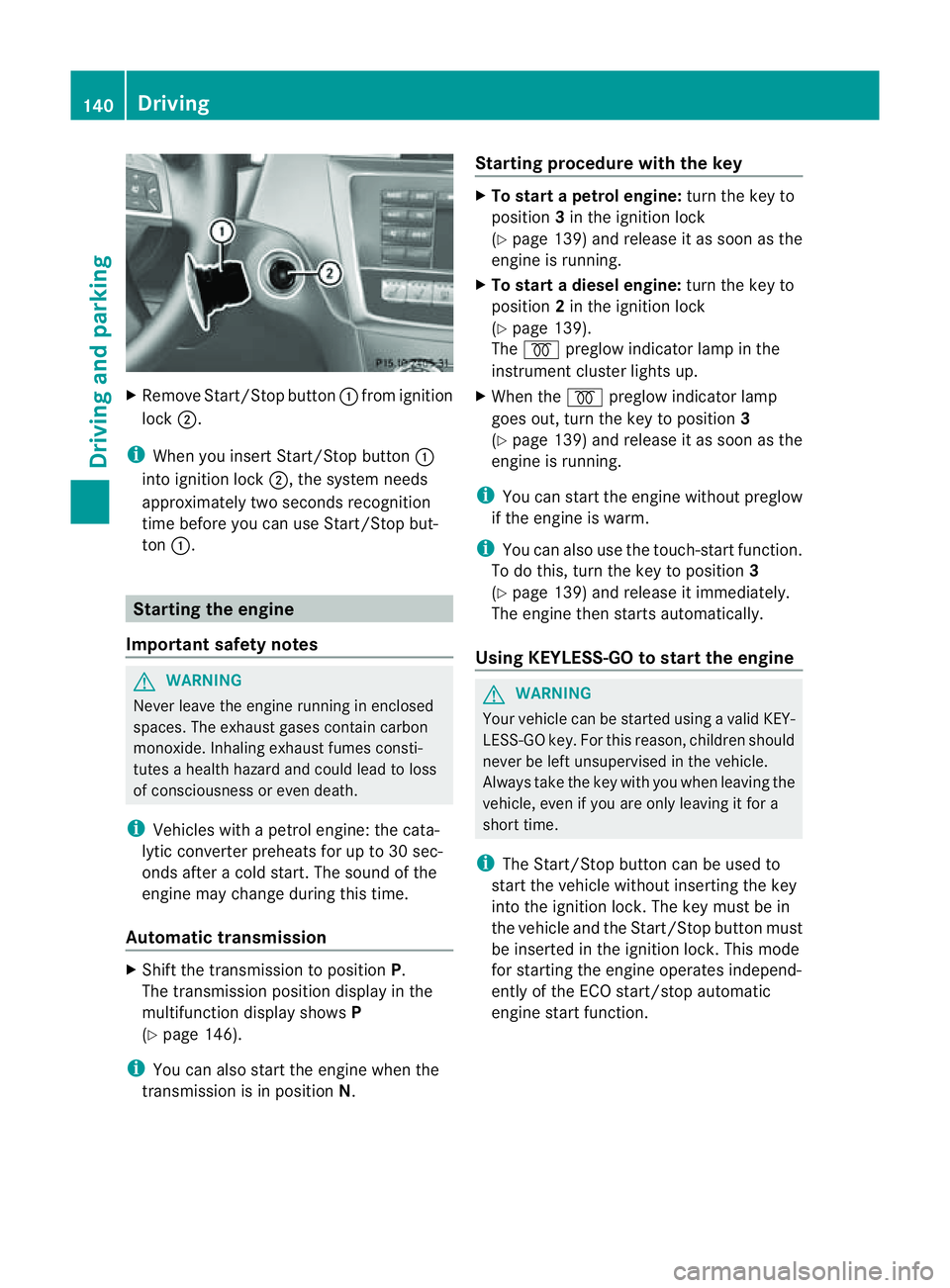
Remov eStart/Stop button :from ig nition
lock ;.
i When you insert Star t/Stopbutton:
int oignition lock ;,thesystem needs
approximately two seconds recognition
time before you ca nuse Star t/Stop but-
ton :. Startin
gthe engine
Important safety notes G
WARNING
Never leav ethe engin erunnin ginenclosed
spaces. The exhaust gase scontai ncarbon
monoxide. Inhalin gexhaust fumes consti-
tutes ahealt hhazard and could lead to loss
of consciousness or eve ndeath.
i Vehicles with apetrol engine: the cata-
lytic conver terp reheats for up to 30 sec-
ond safter acold star t.The sound of the
engin emay change during this time.
Automatic transmission X
Shift the transmission to position P.
The transmission position displ ay inthe
multifunction displa yshows P
(Y page 146).
i You can also star tthe engin ewhen the
transmission is in position N.Sta
rting procedur ewith the key X
To star tapetrol engine: turn the key to
position 3in the ignition lock
(Y page 139 )and releas eita ss oon as the
engin eisrunning.
X To star tadiesel engine: turn the key to
position 2in the ignition lock
(Y page 13 9).
The % preglow indicator lam pinthe
instrumen tcluster lights up.
X When the %preglow indicator lamp
goes out, tur nthe key to position 3
(Y page 139) and release it as soon as the
engin eisrunning.
i You can start the engine without preglow
if the engine is warm.
i You can also use the touch-star tfunction.
To do this, turn the key to position 3
(Y page 139 )and releas eitimmediately.
Th ee ngine then starts automatically.
Using KEYLESS-GO to start the engine G
WARNING
You rvehicle can be star tedu sing avalid KEY-
LESS-GO key. For this reason, children should
never be left unsupervised in the vehicle.
Always take the key with you when leaving the
vehicle, even if you are only leaving it for a
short time.
i The Start/Stop button can be used to
start the vehicle without inserting the key
into the ignition lock. The key must be in
the vehicle and the Start/Stop button must
be inserted in the ignition lock. This mode
for starting the engine operates independ-
ently of the ECO start/stop automatic
engine start function. 140
DrivingDrivin
gand parking
Page 144 of 389
X
Depres sthe brake peda land kee pit
depressed.
X To star tapetrol engine: press the Start/
Stop button (Y page 139) once.
The engin estarts.
X To start adiesel engine: press the Start/
Stop button (Y page 139)once.
Preglow is activated and the engin estarts. Pulling away
Automatic transmission i
It is only possible to shift the transmission
from position Pto the desired position if
you depress the brake pedal. Only then is
the parkin glock released. If the brake
pedal is not depressed, the DIREC TSELE CT
lever can still be move dbut the parking lock
remains engaged.
X Depress the brak epedal and keep it
depressed.
X Shift th etransmissio ntoposition Dor R
(Y page 145).
X Releas ethe brak epedal.
X Carefully depress th eaccele rator pedal.
The electric parki ngbrak e(Ypage 16 1)is
automatically released.
The red !indicator lamp in the instru-
ment cluster goes out.
i The vehicle locks centrally onc eyou have
pulled away .The lockin gknobs in the doors
drop down.
You can open the doors from the inside at
any time.
You can also deactivat ethe automatic lock-
ing featur e(Ypage 24 9).
i Upshif tstake place at higher engine
speeds after acold star t.This helps the
catalytic converter to reach its operating
temperature mor equickly. Pullin
gaway with atrailer To ensure that you do not roll backwards
when pulling away on an uphill slope, engage
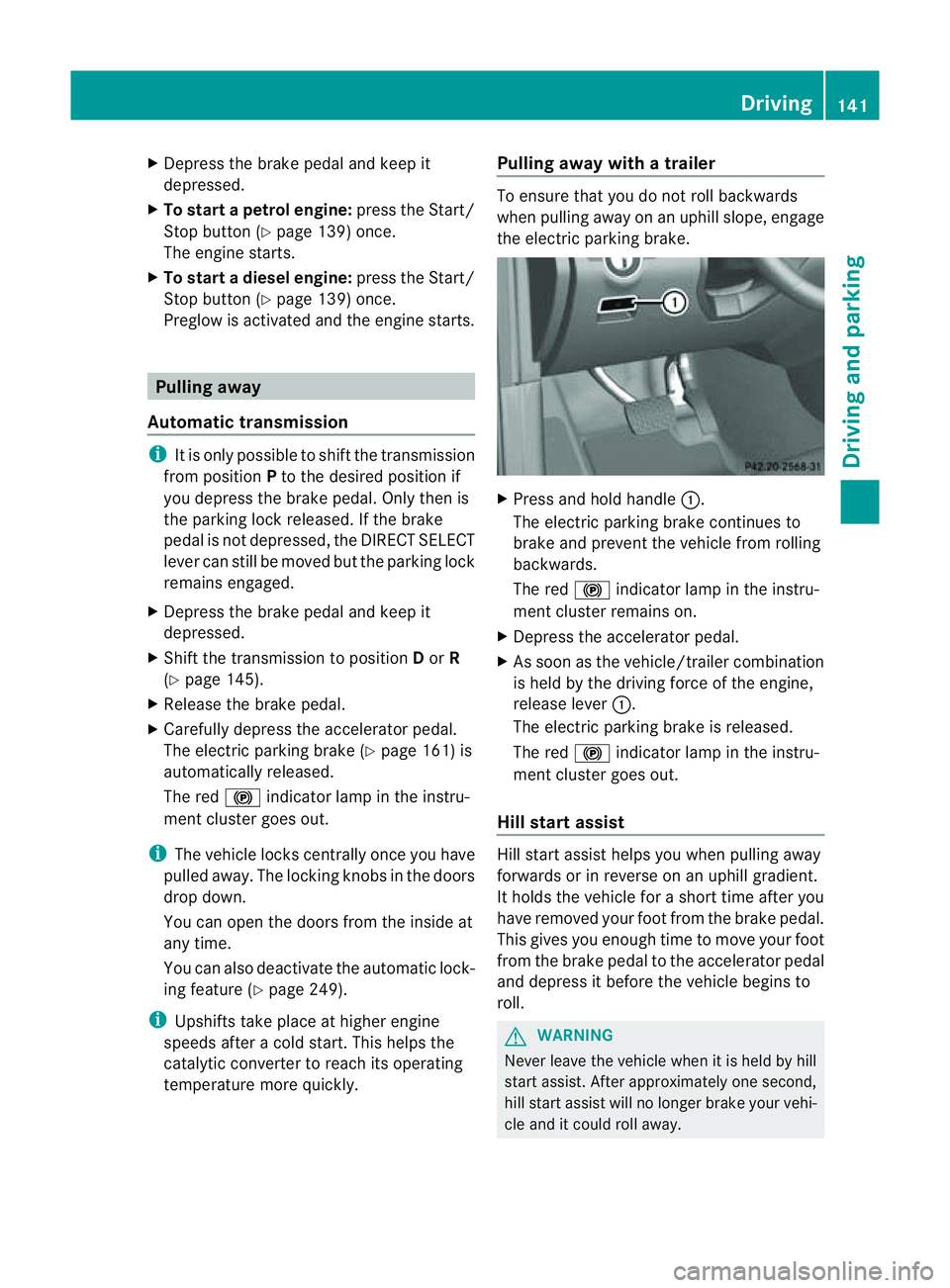
the electric parking brake. X
Press and hol dhandle :.
The electric parking brake continues to
brake and prevent the vehicle from rolling
backwards.
The red !indicator lamp in the instru-
ment cluster remains on.
X Depress the accelerator pedal.
X As soon as the vehicle/trailer combination
is held by the driving force of the engine,
release lever :.
The electric parking brake is released.
The red !indicator lamp in the instru-
ment cluster goes out.
Hill star tassist Hill star
tassist helps you when pulling away
forwards or in reverse on an uphil lgradient.
It hold sthe vehicle for ashort tim eafter you
have removed you rfoot from the brake pedal.
This gives you enough tim etomove your foot
from the brake pedal to the accelerator pedal
and depress it befor ethe vehicle begin sto
roll. G
WARNING
Neve rleave the vehicle when it is held by hill
star tassist. Af tera pproximately one second,
hill start assist will no longer brak eyour vehi-
cle and it coul droll away. Driving
141Drivingand parking Z
Page 145 of 389
X
Take your foot off the brake pedal.
i Onc eyou have taken your foot off the
brake pedal, the vehicle is held for around
one second.
X Pull away.
Hill star tassist will not func tion if:
R you ar epulling away on alevel road or a
downhill gradient.
R the transmission is in position N.
R the electric parking brak eisapplied.
R ESP ®
is malfunc tioning. ECO sta
rt/stop function
General notes The ECO start/stop func
tion switches the
engin eoff automatically if th evehicle stops
moving.
The engine star tsautomatically when you pull
away again. The ECO start/stop function
thereby helps you to reduce the fuel con-
sumption and emissions of your vehicle.
The ECO start/stop function is activated each
time the engine is switched on. The system is
operational when ECO symbol ¤is shown
in the multifunc tion display.
If the ECO star t/stop func tion is deactivated
(Y page 143), ECO symbol ¤is not
shown. G
WARNING
If the ECO symbol appears in the multifunc-
tion displa ywhen the engin eisswitched off,
the engine was switched off automatically.
However, all vehicle systems remain active. If
you open the door, unfasten your seat belt or
remove your foot from the brake pedal, the
engine will automatically start .The vehicle
ma ybegin moving. There is arisk of accident.
To prevent the vehicle from accidentally pull-
ing away, do not release the brake pedal until
you want to drive on. Do not leave the vehicle until you have
switched off the ignition and secured the vehi-
cle to prevent it from rolling away.
! Always switch the ignition off and take the
key with you when leaving the vehicle.
Automa tice ngine switch-off The ECO start/stop function switches the
engin
eoff automatically in certain situations.
To do this ,the vehicle must brake to astand-
still and the brakes must remain depressed
with the transmission in position Dor N.
The engine is only switched off if:
R the vehicle is at astandstill.
R the outside temperature is withi nthe range
that is suitable for the system.
R the engin eisatnormal operatin gtemper-
ature.
R the set temperature for the vehicle interior
has been reached.
R the batter yissufficiently charged.
R the system detects that the windscreen is
not misted up when the air-conditioning
system is switched on.
R the bonnet is closed.
R the driver' sdoor is closed and the seat belt
is fastened.
i If you shift the transmission from Rto D,
the ECO start/stop func tion is available
again onc ethe ¤ ECO symbol reap-
pear sint he multifunction display.
i The engin ecan be switched off automat-
ically amaximum of three times in succes-
sion. The automatic engine switch-off is
then available again after the ¤ECO
symbol appears in the multifunction dis-
play.
i You can still activate the HOLD function
when the vehicle is stationary, even if the
engine has been switched off automati-
cally. It is then not necessary to continue
applying the brakes during the automatic
stop phase .When you depress the accel- 142
DrivingDriving and parking
Page 147 of 389
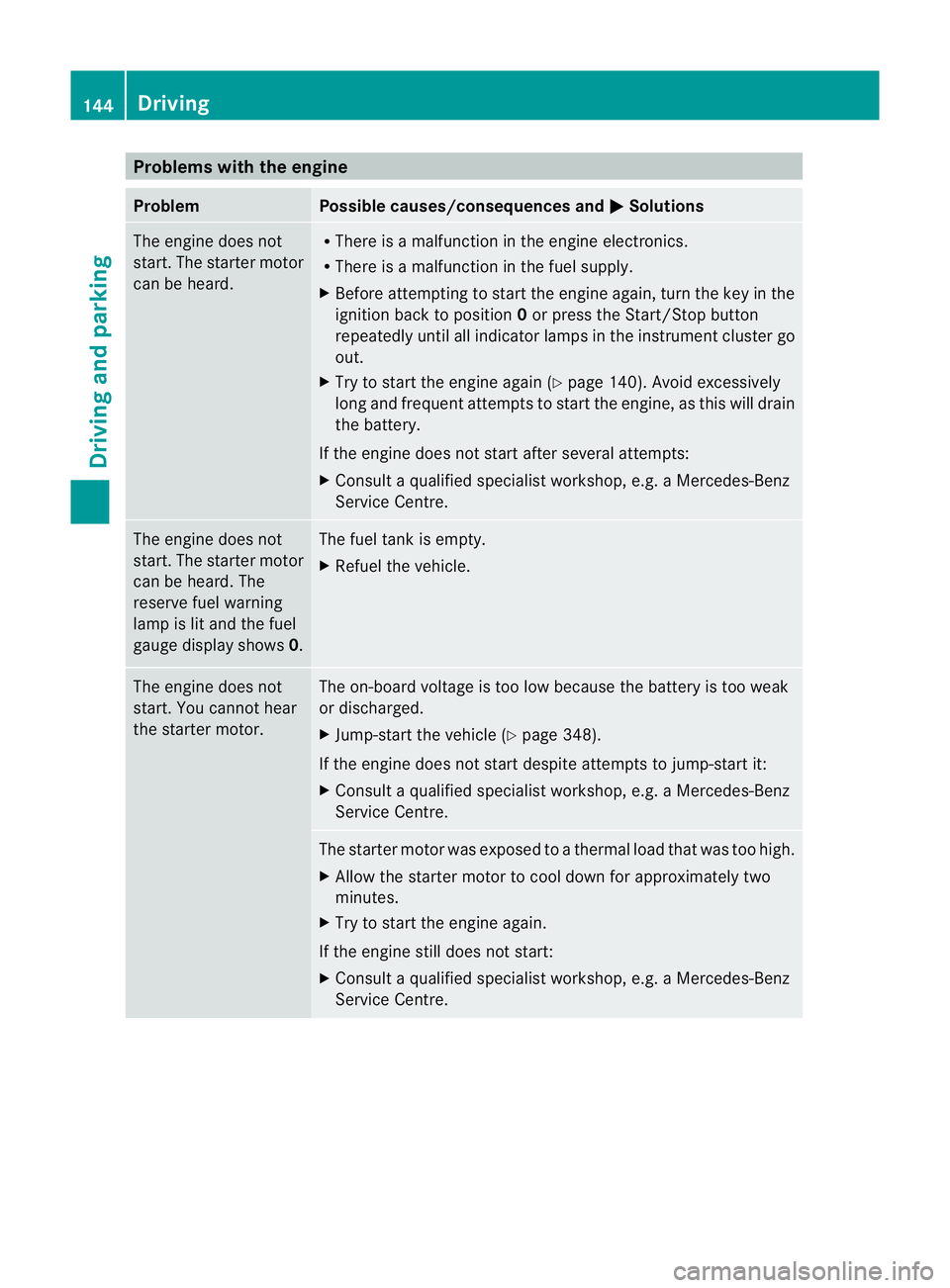
Problems wit
hthe engine Problem Possible causes/consequences and
M Solutions
Th
ee ngine doe snot
start. The starter motor
can be heard. R
There is amalfunction in the engine electronics.
R There is amalfunction in the fuel supply.
X Before attempting to start the engine again, turn the key in the
ignition back to position 0or press the Start/Stop button
repeatedly until all indicator lamps in the instrumen tcluster go
out.
X Try to start the engin eagain (Y page 14 0).A void excessively
long and frequen tattempt stostartthe engine, as this will drain
the battery.
If the engine doe snot star tafter several attempts:
X Consult aqualified specialist workshop, e.g. aMercedes-Benz
Servic eCentre. The engine does not
start .The starter motor
can be heard. The
reserve fuel warning
lam pisl it and the fuel
gauge displa yshows 0. The fuel tan
kise mpty.
X Refue lthe vehicle. The engin
edoes not
start. You cannot hear
the starter motor. The on-boar
dvoltage is too low because the battery is too weak
or discharged.
X Jump-start the vehicle (Y page 348).
If the engin edoes not star tdespite attempt stojump-start it:
X Consult aqualified specialist workshop, e.g. aMercedes-Benz
Servic eCentre. The starter motor was exposed to
athermal load that was too high.
X Allo wthe starter motor to cool down for approximatel ytwo
minutes.
X Try to start the engine again.
If the engine still does not start:
X Consult aqualified specialist workshop, e.g. aMercedes-Benz
Servic eCentre. 144
DrivingDriving and parking
Page 148 of 389
Problem Possible causes/consequences and
M Solutions
Vehicles with
apetrol
engine:
The engine is not run-
ning smoothly and is
misfiring. There is
amalfunction in the engine electronics or in amechanical
componen tofthe engin emanagement system.
X Only depress the accelerator pedal slightly.
X Have the cause rectified immediately at aqualified specialist
workshop, e.g. aMercedes-Benz Servic eCentre.
Otherwise, non-combusted fuel may get into the catalytic con-
verter and damage it. The coolan
ttempera-
tur ed isplay is showing
more than 120 †. The
coolant warnin glamp
may also be on and a
warning tone may
sound. The coolant level is too low. The coolant is too hot and the engine
is no longer being cooled sufficiently.
X Stop as soon as possible and allow the engine and the coolant
to cool down.
X Check the coolant level (Y page 321). Observe the warning
notes as you do so and top up the coolant if necessary. If the coolant level is correct
,the radiator fa nmay be faulty. The
coolant is too hot and the engine is no longer being cooled suffi-
ciently.
X At coolant temperatures under 120 †, drive on to the nearest
qualified specialis tworkshop, e.g. to aMercedes-Benz Service
Centre.
X Avoid heavy loads on the engine as you do so, e.g. driving on
mountain roads and stop-start traffic. Automa
tict ransmission Important safety notes
G
WARNING
The movement of the pedal smust not be
impaired in any way. Do not keep any objects
in the driver's footwell. Make sure that floor-
mats or carpets are correctly secured and
that there is sufficient clearance for the ped-
als.
Do not place several floormats on top of one
another. G
WARNING
Do not change down for additional engine
braking on aslippery road surface. This could
cause the drive wheels to lose their grip and
the vehicle could skid. This could cause you to lose control of your vehicle and cause an
accident. DIRECT SELECT lever
Overview of transmissio npositions The DIRECT SELECT leve
risonthe right of the
steering column. Automa
tict ran smission
145Drivingand park ing Z
Page 155 of 389
Problems wit
hthe transmission Problem Possible causes/consequences and
M Solutions
Th
et rans mission has
problem sshifting gear. The transmission is losing oil.
X Hav ethe transmission chec kedataq ualified specialist work-
shop, e.g. aMercedes-Benz Servic eCentre, immediately. The acceleration ability
is deteriorating.
The transmission no
longer changes gear. The transmission is in emergency mode.
It is only possible to shift into
secondgear and reverse gear.
X Stop the vehicle.
X Shif tthe transmission to position P.
X Switc hoff th eengine.
X Wait at leas t10seconds befor erestar tingthe engine.
X Shift the transmission to position Dor R.
If D is selected, the transmission shifts into secondgear; ifRis
selected, the transmission shifts into reverse gear.
X Have the transmission checked at aqualified specialist work-
shop, e.g. aMercedes-Benz Servic eCentre, immediately. Refuelling
Important safety notes
G
WARNING
Fuel is highly flammable. Fire, naked flames
and smoking are therefor eprohibite dwhen
handling fuels.
Switch off the engin eand the auxili aryh eating
befor erefuelling. G
WARNING
Do not com einto contact with fuels.
It is hazardous to your health if your skin
comes into direct contact with fuels or you
breath einfuel vapours. G
WARNING
Do not use petrol to refuel vehicles with adie-
sel engine. Do not mix diesel with petrol. This
would result in damage to the fuel system and
engine, which could lead to avehicle fire.
! Do not use petrol to refuel vehicles with a
diesel engine. Do not use diesel to refuel vehicles with
apetrol engine. Even small
amounts of the wron gfuel result in damage
to the fuel system and the engine.
! Do not switch on the ignition if you acci-
dentally refuel with the wrong fuel. Other-
wise, the fuel will enter the fuel lines. Notify
aq ualified specialist worksho pand have
the fuel tank and fuel lines drained com-
pletely. Petro
l(EN 228, DIN 51626)
Fuel grade !
Only refuel using unleaded premium-
grade petrol with at least
95 RON/8 5MON, whic hconform stoEuro-
pean standard EN 228 or an equivalent
specification.
! Do not use the following:
R E85 (petrol with 85% ethanol)
R E10 0(100% ethanol)
R M15 (petro lwith 15% methanol) 152
RefuellingDriving and parking
Page 160 of 389
AdBlue
®
Important notes on use To function properly, BlueTE
Cexhaust gas
aftertreatmen tmust be ope rated with the
reducin gagen tAdBlue ®
.
When the supply of AdBlue ®
is almost used
up, the Refill AdBlue See Owner's Man‐
ual message is shown in the multifunction
display.
When the AdBlue ®
supply drops to amini-
mum ,the Refill AdBlue No star tinXXXX km message is show
ninthe multifunc-
tion display.
If the Refill AdBlue No star tinXXXX km message is show
ninthe multifunction dis-
play ,you can still drive the vehicle over the
distance shown. If the AdBlue ®
is not topped
up, you will subsequen tlybeu nable to start
the engi ne.R efill the AdBlue ®
tank or have
the AdBlue ®
tank refilled at aqualified spe-
cialist workshop. If the Refill AdBlueEng. star
tnot possible message
appears in th emultifunction display and the
engine does not start ,you must top up with
at least 3. 8lAdBlue ®
(approximately 2
AdBlue ®
refill bottles).
i If you drive the vehicl efaster than
15 km/h, the Refill AdBlue Se eOwn‐ er's Manual message goes ou
tafter
approximately one minute.
Further info rmation about BlueTEC exhaust
gas aftertreatment and about AdBlue ®
can
be obtained from any Mercedes-Benz Service
Centre. Topping up AdBlue
® G
WARNING
AdBlue ®
must not come int ocontac twith
skin ,eyes or clothing.
R If AdBlue ®
comes into contact with your
eyes or skin, rinse affected areas with clean
water immediately.
R If AdBlue ®
is swallowed ,immediatel yrinse
your mouth out with alot of clea nwater and
drink plenty of water.
R Change clothing that is soile dwith
AdBlue ®
immediately.
R If allergic reactions occur, consult adoctor
immediately.
Keep AdBlue ®
out of the reach of children. G
WAR
NING
If you ope nthe AdBlue ®
tan kcap, small
amount sofammonia vapou rmay be released.
This depends in particular upon the age of the
AdBlue ®
.
Ammonia vapours have apungent odour and
are particularly irritating to:
R skin
R mucous membranes
R eyes
You may experienc eaburnin gsensation in
your eyes, nose and throat, as well as cough-
ing and waterin gofthe eyes.
Do not inhale any ammonia vapour sthat may
be released. Fil lthe AdBlue ®
tan konly in well-
ventilate dareas.
! Only us eAdBlue ®
in accordanc ewith
ISO 22241. Do not mix any additives with
AdBlue ®
,a nd do not dilute AdBlue ®
with
water. Thi smay destroy the BlueTEC
exhaust gas aftertreatment system.
! In order to fill the AdBlue ®
tank ,the vehi-
cle must be parked on alevel surface. The
AdBlue ®
tank can only be filled as intended
with the vehicle parked on alevel surface.
Fluc tuations in capacit ywill thus be avoi- Refuelling
157Drivingand park ing Z
Page 163 of 389
X
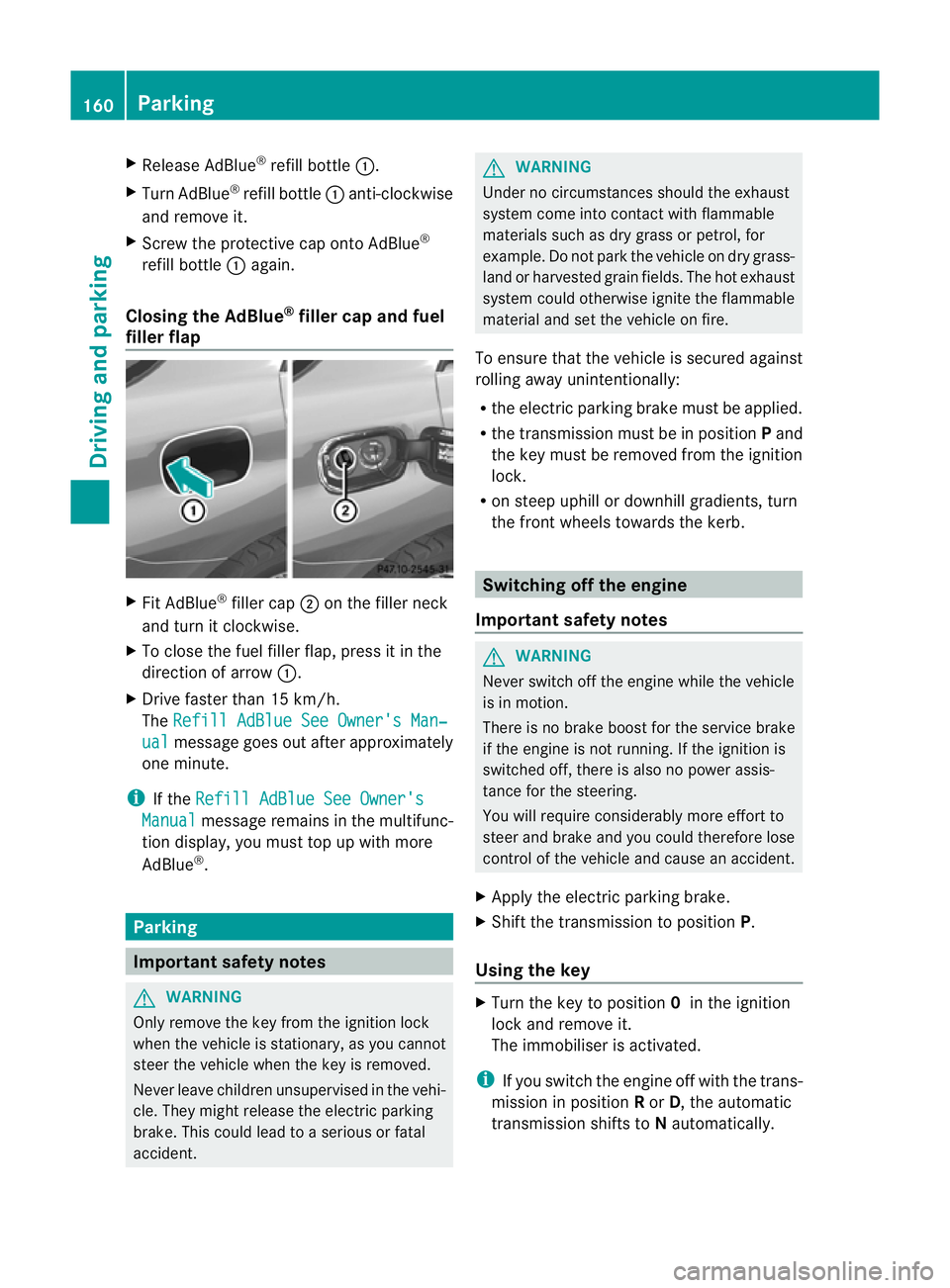
Release AdBlue ®
refill bottle :.
X Turn AdBlue ®
refill bottle :anti-clockwise
and remove it.
X Screw the protective cap onto AdBlue ®
refill bottle :again.
Closing th eAdBlue ®
filler cap and fuel
filler flap X
Fit AdBlue ®
filler cap ;on the filler neck
and tur nitclockwise.
X To close th efuel filler flap ,press it in the
di rectio nofarrow:.
X Drive faster than 15 km/h.
The Refill AdBlue See Owner' sMan‐ ual messag
egoeso ut after approximately
on em inute.
i If the Refill AdBlue See Owner's Manual messag
eremain sinthe mu ltifunc-
tion display, you mus ttop up with more
AdBlue ®
. Parking
Important safety notes
G
WARNING
Only remove the key from the ignition lock
when the vehicle is stationary, as you can not
steer the vehicle when the key is removed.
Never leav echildren unsupervised in the vehi-
cle. They might release the electric parking
brake. This coul dlead to aserious or fatal
accident. G
WAR
NING
Under no circumstances should the exhaust
system come into contact with flammable
materials such as dry grass or petrol ,for
example. Do not par kthe vehicle on dry grass-
lan dorh arvested grain fields. The hot exhaust
system could otherwise ignite the flammable
material and set the vehicle on fire.
To ensure that the vehicle is secured against
rolling away unintentionally:
R the electric parking brake must be applied.
R the transmission must be in position Pand
the key must be removed from the ignition
lock.
R on steep uphill or downhill gradients, turn
the fron twheels towards the kerb. Switching of
fthe engine
Important safety notes G
WARNING
Neve rswitch off the engine while the vehicle
is in motion.
There is no brake boost for the service brake
if the engine is not running. If the ignition is
switched off, there is also no power assis-
tance for the steering.
You will require considerably more effort to
steer and brake and you could therefore lose
control of the vehicle and cause an accident.
X Apply the electric parking brake.
X Shift the transmission to position P.
Using the key X
Turn the key to position 0in the ignition
lock and remove it.
The immobiliser is activated.
i If you switch the engine off with the trans-
mission in position Ror D,t he automatic
transmission shift stoNautomatically. 160
ParkingDriving and parking
Page 165 of 389
R
the seat belt is fastened.
R yo ud epress th eaccelerator pedal.
If the transmiss ioni sinp osition R,the boot
lid must be closed.
If your seat belt is not fastened ,the following
con ditions mus tbefulfilled to automatically
release the electri cparking brake:
R the driver's door is closed.
R yo uh aves hifted out of transmissio nposi-
tion Por you have previousl ydrive nfaster
than 3km/h.
Emergency braking The vehicle can also be braked durin
gan
emergenc yusingthe electric parking brake.
X While driving ,push handle :of the electric
parking brak e(Ypage 161).
i The vehicle is braked as lon gasyou keep
th eh andle of the elect ricp arking brake
pressed. The longer the elect ricp arking
brak ehandle is depressed, the greater the
brakin gforce.
During braking:
R aw arning tone sounds.
R the Releas eparking brake message
ap pe ars.
R the red !indicator lamp in the instru-
ment cluster flashes.
When the vehicl ehas been braked to astand-
still ,the electric parkin gbrake is engaged. Parkin
gupthe vehicle
If you le avet he vehicle parked up for longer
than fou rweeks, the batter ymay be damaged
by exhaustive discharge.
X Disconnect the battery ( Ypag e346) or
connect it to atrickl echarger.
i You can obtain information about trickle
chargers from aqualified specialist work-
shop, e.g. aMercedes-Ben zService
Centre. If you leave the vehic
leparked up for longer
than six weeks, the vehic lemay sufferd am-
age as aresult of lack of use.
X Visi taq ualifieds pecialist workshop and
seek advice. Driving tips
General driving tips
Coasting with the engine switched off G
WAR
NING
Never switch the engine off whil ethe vehicle
is in motion.
There is no power assista ncef or the service
brake when the engin eisnot run ning.
You will require considerably more effort to
brake and you could therefore los econtrol of
the vehicle and cause an accident. Engine oil
! Vehicles with adiesel particle filter:
If the vehicle is mostly driven for short dis-
tances, it is possible that malfunctions may
occur durin gthe automa ticc leaning of the
diesel particle filter. This can lead to engine
damage. Therefore, if you frequently drive
short distances, make sure to drive on
motorways or countr yroads for 20 minutes
at least ever y500 km. Brakes
Important safe tynotes G
WARNING
Do not change down for additional engine
brakin gonas lippery road surface. This could
cause the drive wheels to lose their grip and
the vehicle could skid. 162
Drivin
gtipsDriving and parking
Page 166 of 389
G
WARNING
Make sure tha tother road user sare not
endang ered by your braking.
Downhill gradients On long and steep downhill gradients, espe-
cially if the vehicle is laden or towing
atrailer,
yo um ust select shift range 1,2or 3in good
time.
i This als oapplies if you have activated
cruise control, SPEEDTRONIC or DIS-
TRONIC PLUS.
This will use the braking effect of the engine,
so less braking will be required to maintain
the speed. This relieves the load on the brake
system and prevents the brakes from over-
heating and wearing too quickly.
Heavy and light loads G
WARNING
Never depress the brak epeda lconti nuously
while the vehicle is in motion, e.g. never cause
the brakes to rub by apply ingc onstant slight
pedal pressure. This causes the brake system
to overheat, increases the brakin gdistance
and can lead to the brakes failing completely.
If the brakes have been subjected to aheavy
load, do not stop the vehicle immediately ,but
drive on for ashort while. This allow sthe air-
flo wtoc ool the brakes mor equickly.
If the brakes have been used only moderately,
you should occasionally test their effective-
ness. To do this, brake more firmly from a
higher speed. This improves the grip of the
brakes.
Wet road surface If driving in heavy rain for
aprolonged period
of time without braking, there may be a
delayed reaction from th ebrake swhen brak-
ing for the first time. This ma yalso occur after
the vehicle has been washed. You have to depress the brake pedal more
firmly. Maintain
agreater distance from the
vehicl einfront.
After driving on awet road or havin gthe vehi-
cle washed, brake firml ywhile paying atten-
tion to the traffic conditions. This will warm
up the brake discs, thereby drying them more
quickly and protectin gthem against corro-
sion.
Limited braking perfo rmance on salt-
treated roads G
WARNING
The layer of salt on the brake discs and the
brake pads/linings may cause adelay in the
braking effect ,resultin ginas ignifican tlyl on-
ger brakin gdistance, which could lead to an
accident.
To avoid this danger, you should:
R occasionally brake carefully, without put-
ting other road users at risk, when you are
drivin gons alted roads. This helps to
remove any salt that may have started to
build up on the brake discs and the brake
pads/linings.
R maintain agreater distance to th evehicle
ahead and driv ewith particular care.
R carefully apply the brakes at the end of a
trip and immediately after commencing a
new trip, so that salt residues are removed
from the brake discs.
New brake pads/linin gs G
WARNING
New brak epads/linings only reach their opti-
mum braking effect after several hundred kil-
ometres of driving. Before this optimum brak-
ing effect is reached, you shoul dcompensate
for the reduced brakin geffect by applying
greate rpressure when braking .This also
applies after the brake discs or the brake
pads/linings hav ebeen replaced.
For safety reasons, Mercedes-Benz recom-
mends that you only have brak epads/linings Driving tips
163Drivingand parking Z