instrument cluster MERCEDES-BENZ M-CLASS SUV 2011 Owners Manual
[x] Cancel search | Manufacturer: MERCEDES-BENZ, Model Year: 2011, Model line: M-CLASS SUV, Model: MERCEDES-BENZ M-CLASS SUV 2011Pages: 389, PDF Size: 9.22 MB
Page 15 of 389
Headlamps
Misting up ...................................... 111
Topping up the cle aning system ....321
se eA utomati cheadlamp mode
Hea drestraints
Adjusting ......................................... 94
Adjusting (e lectrically )..................... 95
Adjusting (manually )........................ 94
Adjusting (re ar)................................ 95
Fitting/removing (re ar).................... 96
Heati ng
se eC limate control
High-pressure clean ers.................... 325
Hill star tassist .................................. 141
HOLD function Display message ............................ 272
Function/notes ............................. 187I
Immobili ser.......................................... 68
Ind icator and warn ingl amps
Co olan t.......................................... 291
DISTRONI CPLUS ........................... 293
Engine di agnostics ......................... 290
Fue ltank ........................................ 291
Indicator lamps
Display message ............................ 263
se eW arning and indicator lamps
Indicators
see Turn signals
Insec tprotection on the radiator ....320
Instrument cluster Overview .......................................... 30
Setting s......................................... 246
Warn inga nd indicator lamps ...........32
Instrument cluste rlighting ................ 30
Instrument li ghting
see Instrument cluster lighting
Intelligen tLight System
Activating/deactivatin g................. 247
Display message ............................ 264
Setting the di pped-beam head-
lamps for driving on the right/left .247
Int erior lighting ................................. 112
Automatic control sy stem .............. 112
Del ayed swit ch-off (on-bo ard
computer) ...................................... 249Emergency lighting
........................112
Manual control ............................... 112
Overview ........................................ 112
Reading lamp ................................. 112
Setting the ambient lighting
bri ghtness (on-bo ardc omputer ).... 248
Setting the ambient lighting col-
ou r(on-board computer) ...... .......... 248
Interior motio nsensor ........................ 69
IS OFIX child seat securing system ....53 J
Jack Storage locatio n............................ 333
Using ............................................. 339
Jump startin g(engine) ...................... 348 K
Key Changing the battery ....................... 75
Ch ecking the battery ....................... 74
Convenience closing feat ure. ........... 84
Convenience opening feat ure. ......... 84
Display message ............................ 282
Doo rcentral locking/unlocking .......72
Emergency key el ement ...... ............. 74
Loss ................................................. 76
Modifying the programming .............73
Positions (i gnition lock) ................. 139
Pro blem (malfunction) ..................... 76
Starting the engine ........................140
KEYLES S-GO
Convenience closing ........................85
Display message ............................ 282
Locking ............................................ 73
Start/Sto pbutton ...... .................... 139
Starting the engine ........................140
Unlockin g......................................... 73
Ke yp ositions
Key ................................................ 139
KEYLESS GO .................................. 139
Kickdown
Driving tip s.................................... 148
Manual drive program ....................151
Kneebag ............................................... 4412
Index
Page 30 of 389
Dashboard
........................................... 28
Instrument cluster ..............................30
Multifunction steering wheel .............33
Centr econsole .................................... 34
Overhe adcontrol panel ...................... 36
Door control panel .............................. 37 27At
ag lance
Page 32 of 389
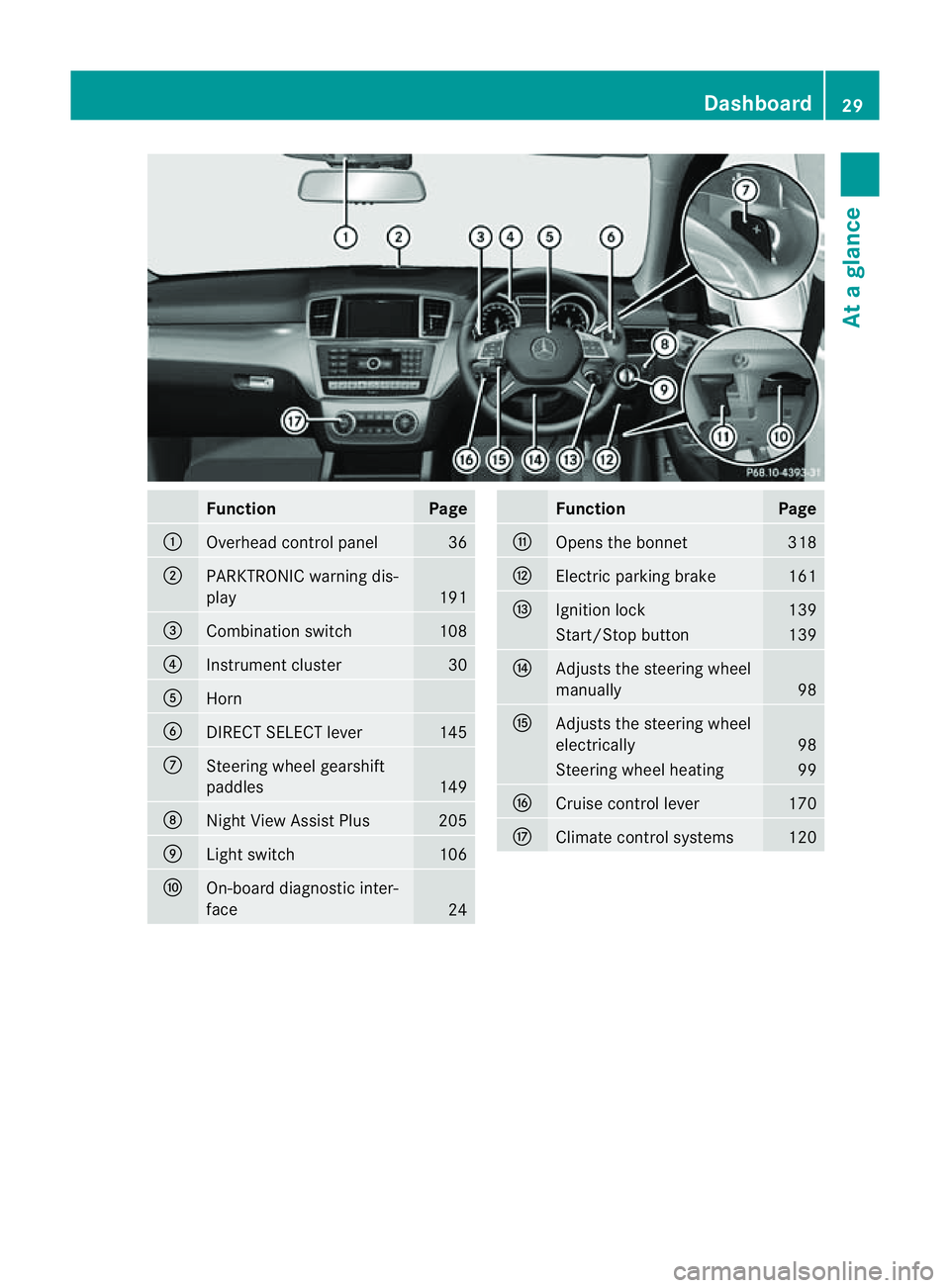
Function Page
:
Overhead con
trol panel 36
;
PARKTRONI
Cwarning dis-
play 191
=
Combination switch 108
?
Instrument cluster 30
A
Horn
B
DIRECT SELECT lever 145
C
Steerin
gwheel gearshift
paddles 149
D
Nigh
tView Assist Plus 205
E
Light switch 106
F
On-board diagnostic inter-
face 24 Function Page
G
Opens the bonnet 318
H
Electric parking brake 161
I
Ignition lock 139
Start/Stop button 139
J
Adjusts the steerin
gwheel
manually 98
K
Adjusts the steeri
ngwheel
electrically 98
Steerin
gwheel heati ng 99
L
Cruise control lever 170
M
Climate control systems 120Dashbo
ard
29Atag lance
Page 33 of 389
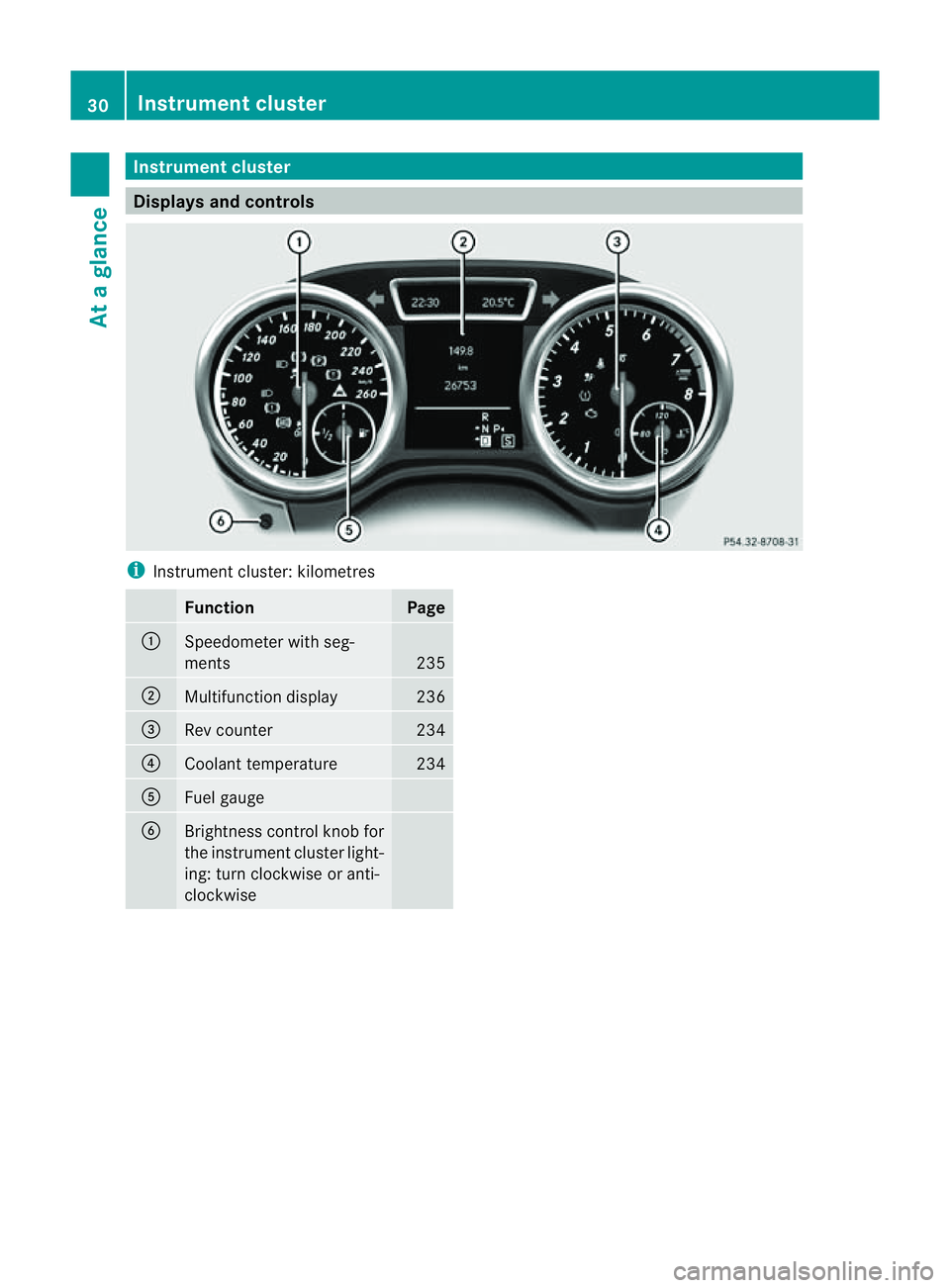
Instr
umentc luster Displa
ysand controls i
Inst rument cluster: kilometres Function Page
:
Speedometer with seg-
ments
235
;
Multi
function display 236
=
Rev counter 234
?
Coolant temperature 234
A
Fuel gauge
B
Brightness control knob for
the instrument cluster light-
ing: tur nclockwise or anti-
clockwise 30
Instrument clusterAt
ag lance
Page 34 of 389
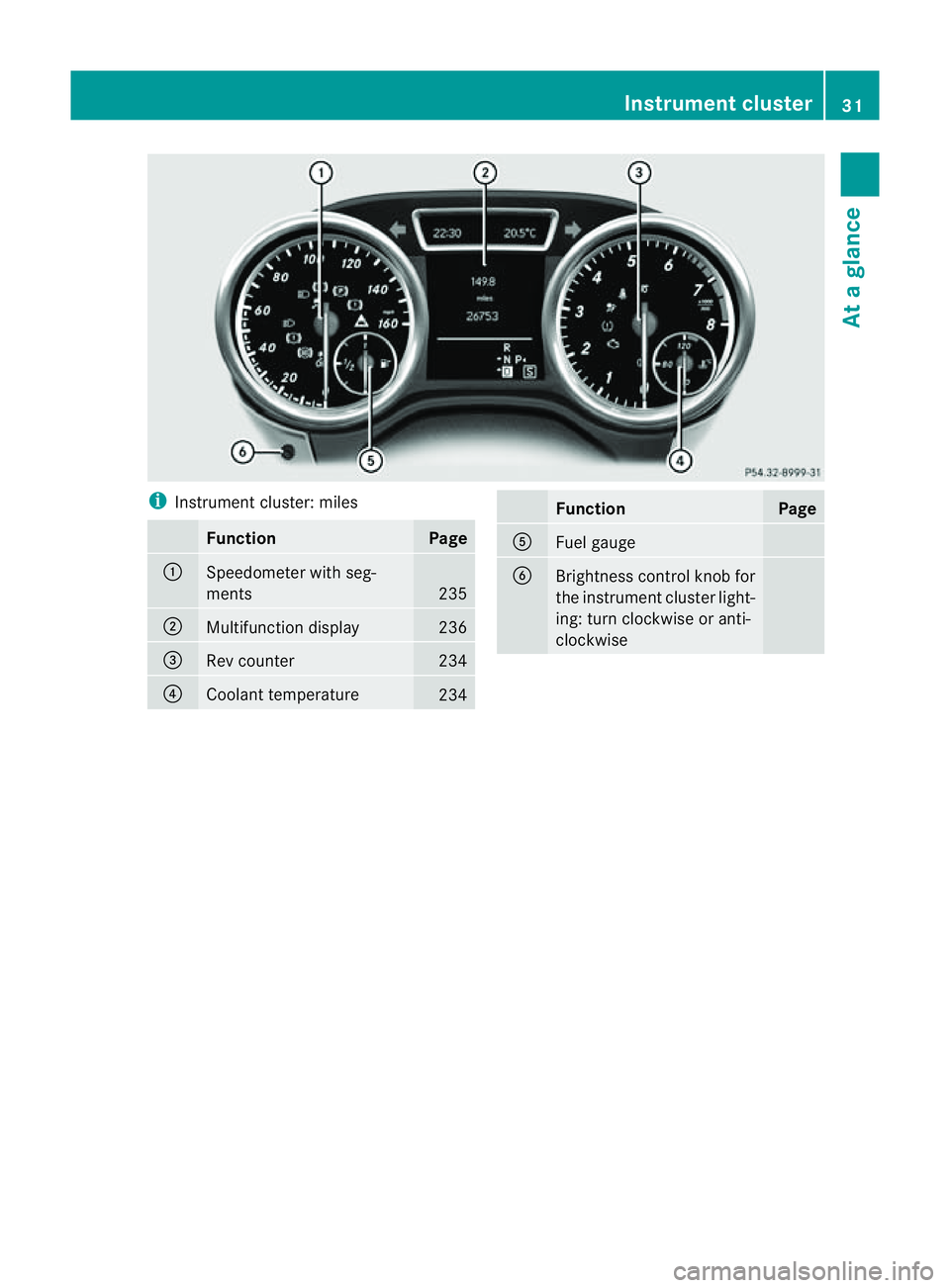
i
Instrument cluster: miles Fun
ction Page
:
Speedometer with seg-
ments
235
;
Multifunctio
ndisplay 236
=
Rev counter 234
?
Coolant temperature
234 Function Page
A
Fuel gauge
B
Brightness control knob for
the instrument cluster light-
ing: turn clockwise or anti-
clockwise Instrument cluster
31Atag lance
Page 35 of 389
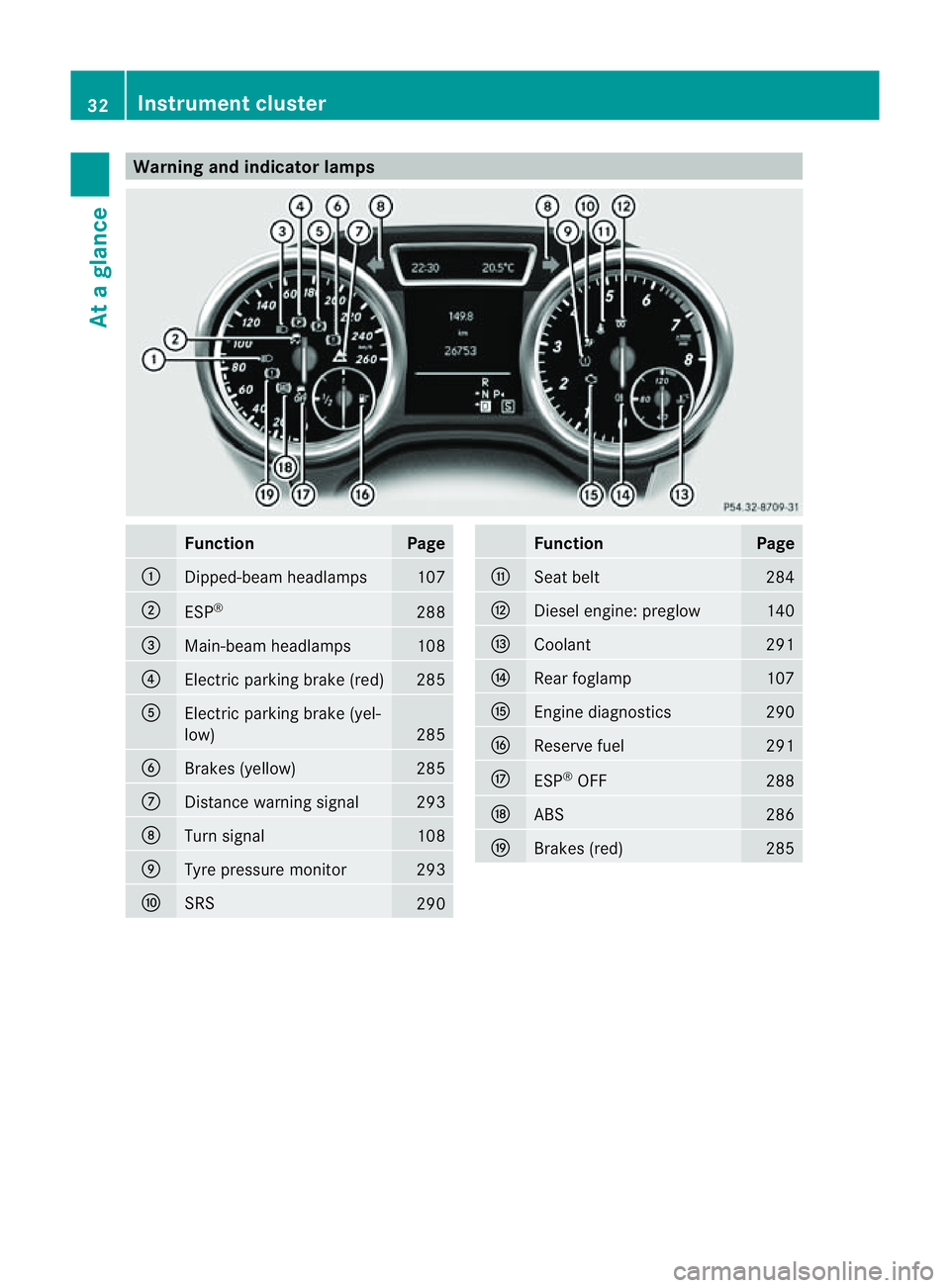
Warnin
gand indicator lamps Fun
ction Page
:
Dipped-bea
mheadlamps 107
;
ESP
® 288
=
Main-beam headlamps 108
?
Electric parkin
gbrake (red) 285
A
Electric parking brake (yel-
low)
285
B
Brakes (yellow) 285
C
Distance warning signal 293
D
Turn signal 108
E
Tyre pressure moni
tor 293
F
SRS
290 Function Page
G
Sea
tbelt 284
H
Diesel engine: preglow 140
I
Coolant 291
J
Rear foglamp 107
K
Engine diagnostics 290
L
Reserv
efuel 291
M
ESP
®
OFF 288
N
ABS 286
O
Brakes (red) 28532
Instrument clusterAt
ag lance
Page 44 of 389
G
WARNING
Modifications to or work performe dincor-
rectly on the following parts can result in the
restraint systems not functioning as intended:
R the restraint system, consisting of seat
belts and thei ranchorage points, bel tten-
sioners, belt for celimiter sand airbags
R the wiring
R networked electronic systems
Airbags and belt tensioners could fail to
deploy or be trigge redinana ccident despite
the deceleration force being sufficient to trig-
ger the systems, or could be triggered unin-
tentionally. For this reason, never make any
modifications to the restrain tsystems.
Therefore, you must not tamper with elec-
tronic components or their software. SRS (Supplemen
talRestraint System)
Introduction SRS consists of:
R
the 6 SRS warning lamp
R airbags
R airba gcontrol unit (with crash sensors)
R belt tensioner sfor the front seat belts and
the outer seat belts in the rear
R belt force limiters
SRS reduces the risk of occupan ts coming
into contact with the vehicle's interio rinthe
even tofana ccident. It can als oreduce the
effect of the forces to which occupant sare
subjected during an accident.
SRS warnin glamp SRS functions are checked regularly when
you switch on the ignition and when the
engine is running. Therefore ,malfunctions
can be detected in good time.
The 6 SRS warning lamp in the instrument
cluster lights up when the ignition is switched
on. It goes out no later than afew seconds
after the engine is star ted. G
WARNING
If SRS is malfunctioning, individual systems
may be activated unintentionally or may not
be triggered in the even tofanaccident with
ah igh rate of vehicle deceleration.
Am alfunction has occurred if:
R the 6 SRS warning lamp does not light
up when the ignition is switched on.
R the engine is runnin gand the 6SRS
warning lamp doe snot go out after afew
seconds.
R the engine is runnin gand the 6SRS
warning lamp lights up again.
In this case, have SRS checked immediately
at aq ualified specialist workshop .Mercedes-
Benz recommends that you use aMercedes-
Benz Servic eCentr efor this purpose.
In particular ,work relevant to safet yoron
safety-related systems must be carried out at
aq ualified specialist workshop.
Triggering of belt tensioners, belt force
limiters and airbags During the first stage of
acollision ,the airbag
con trol unit evaluates important physical
data relatin gtovehicle deceleration or accel-
eration, such as:
R duration
R direction
R magnitude
Based on the evaluation of this data, the air-
bag control unit pre-emptively triggers the
belt tensioner sinthe first stage.
i The front belt tensioner scan only be trig-
gered if the seat belt tongues on the front
seats are correctly engaged in the seat belt
buckles.
If there is an even higher rate of vehicle decel-
eration or acceleration in alongitudinal direc-
tion ,the front airbags ar ealso deployed.
Your vehicle has adaptive, two-stage front air-
bags. The airbag control unit evaluates vehi-
cle deceleration or acceleration in the event Occupant safety
41Safety Z
Page 52 of 389
cator lamps in the instrument cluster, se
at
belt" (Y page284).
Rear seat belt status indicator Th
er ear-com partment se at belt status indi-
cator tells you if the rear passengers have
their seat belts fastened.
The rear-compartment seat belt status indi-
cator indicates the rear seat on which the belt
is fastened. The üsymbol in the display
indicates afastened seat belt. If aseat belt is
not fastened or if aseat is not occupied, the
ý symbol is displayed.
The rear-compartment seat belt status indi-
cator appear sint he multifunction displa yfor
around 30 seconds if:
R you drive off and reach aspeed of approx-
imately 10 km/h.
R the rear passengers fasten or unfasten
their seat belts while the vehicle is in
motion.
R someon egets in or out of the vehicle and
the vehicle drives off again.
You can also can celthe rea rseat belt status
indicator immediately (Y page 253).
i The status indicator for the rear- compart-
ment seat belts is onl yavailable for certain
countries.
Bel ttensioners, belt force limiters The fron
tseat belts and the outer seat belts
in the rear are equipped with belt tensioners.
The belt tensioners tighten the seat belts in
an accident, pullin gthem close against the
body.
Belt tensioner sdonot correct incorrect seat
positions or incorrectly faste neds eat belts.
Belt tensioners do not pull vehicle occupants
back towards the back rest.
If the seat belt is also fitted wit habelt for ce
limiter and this is triggered, the forc eexerted
by the sea tbelt on the vehicle occupan tis
red uced. Th
eb elt force limiters on the front seats are
synchroni sedw ith the front airbags .They
tak eonap art of the deceleratio nforce,
resultin ginthe force exerted on the occupant
being distributed over agreater are a.
The belt tensioners can only be activated
when:
R the ignition is switched on.
R the restraint systems are operational; see
"SRS warning lamp" (Y page 41).
R the front-passenger seat is occupied and
the belt tongue is engaged in the buckle on
the front-passenger side.
The belt tensioners on the outside seats in the
rear compartment are triggered independ-
ently of the lock status of the seat belts.
The belt tensioners are triggered depending
on the type and severit yofanaccident:
R if, in the event of ahead-on or rear-en dcol-
lision, the vehicle decelerates or acceler-
ates rapidly in alongitudinal direction dur-
ing the initial stages of the impact
R if, in the even tofaside impact, on the side
opposit ethe impac tthe vehicle deceler-
ates or accelerates rapidly in alateral direc-
tion
R if in certain situations where the vehicle
overturns and the system determines that
it can provide additional protection
If the airbags are deployed, you will hear a
bang, and asmall amount of powder may also
be released. Only in rare cases will th ebang
affect your hearing. The powde rthat is
released generally does not constitute a
healt hhazard. The 6SRS warning lamp
lights up. G
WARNING
If the seat belt tensioners have been trig-
gered, they provide no additional protection
in the event of another accident. Therefore,
have belt tensioners which have been trig-
gered replaced at aqualified specialist work-
shop. Occupant safety
49Safety
Z
Page 67 of 389
course withi
nphysical limits. ESP ®
assists
the driver when pulling away on wet or slip-
pery roads. ESP ®
can als ostabilise the vehi-
cle durin gbraking.
If ESP ®
intervenes, the ÷ESP®
warning
lamp flashe sinthe instrumen tcluster. G
WAR
NING
If the ÷ warnin glamp in the instrument
cluster flashes, proceed as follows:
R do not deactivat eESP®
under any circum-
stances.
R only depress the accelerator pedal as far as
necessar ywhen pulling away.
R adapt your drivin gstyle to suit the prevail-
ing road and weather conditions.
Otherwise, the vehicle could go into askid.
ESP ®
cannot reduce the risk of an accident if
you drive too fast. ESP ®
cannot override the
laws of physics.
! Only operate the vehicl efor am aximum
of ten seconds on abrake dynamometer.
Switch off th eignition.
Application of the brakes by ESP ®
ma yoth-
erwise destroy the brake system.
! Function or performanc etest sm ay only
be performed on a2-axle dynamometer. If
you wis htooperatethe vehicle on such a
dynamometer, please consult aMercedes-
Benz Servic eCentr ebeforehand. You could
otherwise damage the driv etrain or the
brake system.
i Only us ewheels with the recommended
tyr es izes. Only then will ESP ®
func tion
properly.
4ETS (Electronic Traction System) i
Observ ethe "Importan tsafety notes" sec-
tion (Y page 61).
Traction control is part of ESP ®
.
Traction control brakes the drive wheels indi-
viduall yifthey spin. This enables you to pull
away and accelerate on slipper ysurfaces, for example if the road surface is slippery on one
side .Ina ddition, mor edrive torqu eistrans-
ferre dtot he wheel or wheels with traction.
Traction con trol remains active if you deacti-
vate ESP ®
.
X In appropriate drivin gsituations, activate
the off- road program (Y page 222). G
WARNING
Traction control cannot reduce the risk of an
accident if you drive too fast. Traction control
cannot override the laws of physics.
Off-road 4ETS (Electronic Traction Sys-
tem)
A4 ETS syste mspecifically suited to off -road
ter rain is activated automatically onc ethe off-
roa ddrive progra m(Ypage 22 2)is activated.
Deactivating/activating ESP ® i
Observe the "Important safety notes" sec-
tion (Y page 61).
ESP ®
is activate dautomaticall ywhen the
engin eisstarted.
i Vehicle swith ECO start/stop func tion:
the ECO start/stop func tion switches the
engin eoff automatically when th evehicle
comes to astop. The engine starts auto-
matically when the driver wants to pull
away again. ESP ®
remains in its previously
selected status .Example: if ESP ®
was
deactivated before the engine was
switched off, ESP ®
remains deactivated
whe nthe engin eisswitched on again.
It may be best to deactivate ESP ®
in the fol-
lowing situations:
R when using snow chains
R in deep snow
R on sand or gravel G
WARNING
Activate ESP ®
as soon as the situations
described above no longer apply .ESP ®
will
oth erwise not be able to stabilise the vehicle 64
Drivin
gsafety systemsSafety
Page 68 of 389
if the vehicle starts to skid or
awheel starts
to spin.
When you deactivate ESP ®
:
R ESP ®
no longer improves drivin gstabili ty.
R the engine's torque is no longer limited and
the drive wheels can spin. The spinning of
the wheels results in acuttin gaction, which
provides bet terg rip.
R tractio ncontrol is still activated.
R ESP ®
still provides suppor twhen you
bra ke.
If ESP ®
is deactivate dand one or more wheels
start to spin, the ÷ESP®
warning lamp in
the instrument cluster flashes. In such situa-
tions, ESP ®
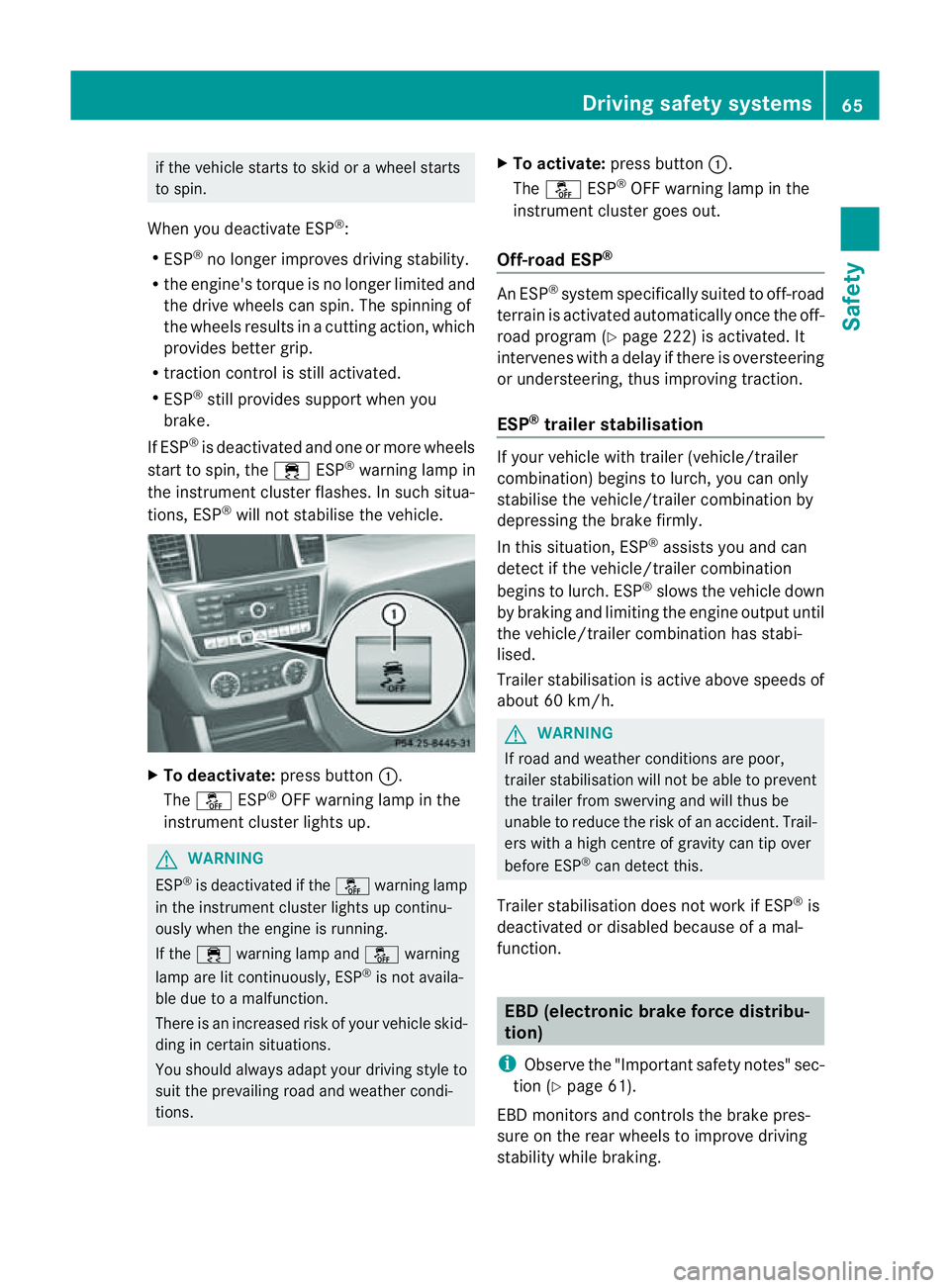
will not stabilis ethe vehicle. X
To deactivate: press button:.
The å ESP®
OFF warnin glamp in the
instrument cluster lights up. G
WARNING
ESP ®
is deactivated if the åwarning lamp
in the instrument cluster lights up continu-
ously when the engine is running.
If the ÷ warning lamp and åwarning
lamp are lit continuously, ESP ®
is not availa-
ble due to amalfunction.
There is an increased risk of your vehicle skid-
ding in certain situations.
You shoul dalway sadapt your driving style to
suit the prevailing road and weather condi-
tions. X
To activate: press button :.
The å ESP®
OFF warning lamp in the
instrumen tcluster goes out.
Off- road ESP® An ESP
®
system specifically suited to off-road
terrain is activated automatically once the off-
road program (Y page 222)isa ctivated. It
intervene swithadelay if there is oversteering
or understeering, thus improvin gtraction.
ESP ®
traile rstabilisation If your vehicle with trailer (vehicle/trailer
combination) begins to lurch, you can only
stabilis ethe vehicle/ trailer combination by
depressing the brake firmly.
In this situation, ESP ®
assists you and can
detect if the vehicle/trailer combination
begins to lurch. ESP ®
slows the vehicle down
by brakin gand limiting the engine output until
the vehicle/traile rcombination has stabi-
lised.
Trailer stabilisation is active abov espeeds of
about 60 km/h. G
WARNING
If road and weather condi tions are poor,
trailer stabilisation will not be able to prevent
the trailer from swerving and will thus be
unable to reduce the risk of an accident .Trail-
ers wit hahigh centr eofgravity can tip over
before ESP ®
can detec tthis.
Trailer stabilisation does not work if ESP ®
is
deactivated or disable dbecause of amal-
function. EBD (electronic brake force distribu-
tion)
i Observe the "Important safety notes" sec-
tion (Y page61).
EBD monitors and control sthe brake pres-
sur eonthe rea rwheels to improv edriving
stab ility while braking. Driving safety systems
65Safety Z