ESP MERCEDES-BENZ METRIS 2016 MY16 Operator’s Manual
[x] Cancel search | Manufacturer: MERCEDES-BENZ, Model Year: 2016, Model line: METRIS, Model: MERCEDES-BENZ METRIS 2016Pages: 310, PDF Size: 7.28 MB
Page 33 of 310
Please observe the information concerning
Mercedes-Benz Genuine Parts (Ypage 31).
You can obtain further information from any
Mercedes-Benz Commercial Van Center.
GWARNING
The function of systems or components can
be affected by conversions or modifications
to the vehicle. They might not function prop-
erly anymore and/or jeopardize the opera-
tional safety of the vehicle. There is an
increased risk of an accident and injury.
Conversion sormodification sshould always
be carried out at qualified specialist work-
shop.
If you inten dtomake modification stoyour vehi-
cle, we strongly recommend that you contact
the distributor named on the inside of the front
cover. There you will receive all the necessary
information and acharge may be levied.
You alone accept the responsibility if body man-
ufacturers or dealers make modification sthat
affect the final certification of the engine, the
vehicle or the equipment. This also applies to
the identification and documentation of modifi-
cation stothe affected vehicle components.
You are responsible for certification and confir-
mation that:
Rall the applicable standards and regulations
that are affected by the vehicle modification
are met
Rthe modified vehicle fulfills the vehicle safety standards and emissions laws and regula-
tions
Rthe modification sorinstallation of accesso-
ries does not affect the safety of the vehicle
We are not responsible for the final certification,
product liability or warranty claims which result
from the modifications. This applies to:
Rthe modified components ,assemblies or sys-
tems
Rany resulting noncompliance with any of the
emissions laws and regulations or the motor
vehicle safety standards
Rany consequences arising from the changes
that make the vehicle less safe or even render it defective
We do not assume responsibility as the final-
stage manufacturer or for the consequential
product liability.
Notes on the radiator
Even seemingly small changes to the vehicle,
such as attaching aradiator trim for winter driv-
ing, is not permitted. Do not cover up the radi-
ator. Do not use thermal mats, insect protection
covers or anything similar.
Otherwise, the values of the diagnostic system
may be affected. Some of these values are
legally prescribed and must alwaysbec orrect.
Genuine Mercedes-Benz parts
!
Air bags and Emergency TensioningD evi-
ces, as well as control units and sensors for
these restraint systems, may be installed in
the following areas of your vehicle:
Rdoors
Rdoor pillars
Rdoor sills
Rseats
Rcockpit
Rinstrument cluster
Rcenter console
Do not install accessories such as audio sys-
tems in these areas. Do not carry out repairs or welding. You could impair the operating
efficiency of the restraint systems.
Have aftermarket accessories installed at a
qualified specialist workshop.
HEnvironmenta lnote
We supply reconditioned assemblies and
parts which are of the same quality as new
parts. The same New Vehicle Limited War-
rantya pplies as for new parts.
The operating safety of the vehicle could be
jeopardized if you use parts, tires and wheels as
well as accessories relevant to safety which
have not been approved by Mercedes-Benz.T his
could lead to malfunctions in safety-relevant
systems, e.g. the brake system. Only use genu-
ine Mercedes-Benz parts or parts of equal qual-
ity. Only use tires, wheels and accessories that
have been specifically approved for your vehi-
cle.
Introduction31
Z
Page 34 of 310
Mercedes-Benztests genuine Mercedes-Benz
parts, conversion parts and accessories that
have been specifically approved for the type of
vehicle for:
Rreliability
Rsafety
Rsuitability
Despite ongoing market research, Mercedes-
Benz is unable to assess other parts. Even if an
independent or official approval has been pro-
vided in exceptional cases, Mercedes-Benz
accepts no responsibility for the use of such
parts in Mercedes-Benzv ehicles.
In some countries, certain parts are only offi-
cially approved for installation or modification if
they comply with legal requirements. All genu-
ine Mercedes-Benzp arts satisfy these require-
ments .Make sure that all parts are suitable for
your vehicle.
Always specify the vehicle identification number
(VIN) (
Ypage 294) and engine number when
ordering genuine Mercedes-Benzp arts
(
Ypage 295).
QR code for rescue card
The QR Code stickers are affixed to the B-pillar
on the driver's and front-passenger side.
In the event of an accident the rescue services
use the QR Code to quickly find the rescue card
for your vehicle. The current rescue card con-
tains the most important information on your
vehicle, e.g. the electric cable routes, in acom-
pact form.
Further information can be found under http://
portal.aftersales.i.daimler.com.
Data stored in the vehicle
Data Recording
Aw ide range of electronic components in your
vehicle contain data memories.
These data memories temporarily or perma-
nently store technical information about:
Rthe vehicle's operating state
Revents
Rfaults In general, this technical information docu-
ments the state of
acomponent, amodule, a
system or the surroundings.
These include, for example:
Roperating conditionsofs ystem components,
e.g. fluid levels
Rthe vehicle's status messages and those of its
individual components, e.g. number of wheel
revolutions/speed, deceleration in move-
ment, lateral acceleration, accelerator pedal
position
Rmalfunctions and defects in important system
components, e.g. lights, brakes
Rvehicle reactions and operating conditionsi n
special driving situations, e.g. airbag deploy-
ment, intervention of stability control sys-
tems
Rambient conditions, e.g. outside temperature
This data is of an exclusively technical nature
and can be used to:
Rassist in detectin gand rectifying faults and
defects
Ranalyze vehicle functions, e.g. after an acci-
dent
Roptimize vehicle functions
The data cannot be used to trace the vehicle's
movements.
When your vehicle is serviced, technical infor-
mation can be read from the event data memory
and fault data memory.
Services include, for example:
Rrepair services
Rservice processes
Rwarranty events
Rquality assurance
The vehicle is read out by employees of the ser- vice network (including the manufacturer) using
special diagnostic testers .You can obtain more
information there, if required.
After afault has been rectified, the information
is deleted from the fault memory or is continu-
ally overwritten.
When operating the vehicle, situations are con-
ceivable in which this technical data, in connec-
tion with other information (if necessary, after
consultation with an authorized expert), could
be traced to aperson.
32Introduction
Page 35 of 310
Examples include:
Raccident reports
Rdamage to the vehicle
Rwitnessstatements
Furthera dditional functions thath aveb eenc on-
tractuall yagree du ponw itht he custome rallow
certain vehicl edatatobec onveyedbythe vehi-
cle as well .The additional functions include, for
example, vehicl eloc ation in cas eofanemer-
gency.
Even tDataR ecorders
Thisvehicl eise quippe dwithane vent data
recorde r(EDR). The main purpose of an EDR is
to record, in certain crash or nea rcrash-like sit-
uations, such as an ai rbag deployment or hitting
ar oado bstacle ,datat hatw illa ssis tinu nder-
standing how avehicle’ ssystem sperformed.
The EDR is designe dtorecord data relate dto
vehicl edynamics and safety system sfor as hort
perio doft ime,typicall y30second sorless.
The EDR in thisv ehicleisd esignedtor ecord
such data as:
RHow various system sinyourv ehicl ewere
operating;
RWhether or not the driver and passenger
safety belts were buckled/fastened;
RHow far( ifat all) the driver wa sdepressing the
accelerator and/or brake pedal; and,
RHow fast the vehicl ewastraveling.
These data can help provid eabetter under-
standing of the circumstances in which crashes
and injurie soccur. NOTE: EDR data ar erecorded
by your vehicl eonlyifan on-trivia lcrash situa-
tio no ccurs; no data ar erecorde dbythe EDR
under normal drivin gconditions and no personal
data (e.g., name, gender, age, and crash loca-
tion) ar erecorded. However, othe rparties, such
as la wenforcement cou ld co
mbine the EDR data
w
ith the typ eofpersonally identifying data rou-
tinely acquired durin gacrash investigation.
Acces stothe vehicl eand/or the EDR is needed
to rea ddatat hati srecorde dbyanE DR, and
special equipment is required .Inadditiontot he
vehicl emanufacturer ,othe rpartie sthath ave
the special equipment, such as la wenforce-
ment, can rea dthe informatio nbyaccessing the
vehicl eorthe EDR.
EDR data maybeu sedinc ivil and criminal mat-
ters as atool in accident reconstruction, acci- dent claims
,and vehicl esafety .Since the Crash
Data RetrievalC DR tool thatisusedtoe xtract
data fromt he EDR is commercially available,
Mercedes-Benz USA, LLC ("MBUSA") expressly
disclaims any and al lliabili ty arising fromt he
extractio nofthisinformatio nbyunauthorized
Mercedes-Benz personnel.
MBUSA will not share EDR data with others
withou tthe consent of the vehicl eowners or, if
the vehicl eisleased, withoutthe consent of the
lessee. Exceptions to thisr epresentation
includ eresponsestos ubpoenas by lawenforce-
ment; by federal, state or local government; in
connectio nwithora rising ou toflitigation involv-
ing MBUSA or its subsidiarie sand affiliates; or,
as re quired by law.
W
arning: The EDR is acomponent of the
Restraint System Module. Tamperin gwith, alter-
ing ,m odifying or removing the EDR component
mayr esultina malfunctio nofthe Restraint Sys-
tem Modul eand othe rsystems.
State laws or regulations regarding EDRs that
conflict with federa lregulation ar epre-empted.
Thi sm eans thatint he event of such conflict, the
federa lregulation governs. As of Februar y2013,
13 states have enacted laws relating to EDRs.
Introduction33
Z
Page 38 of 310
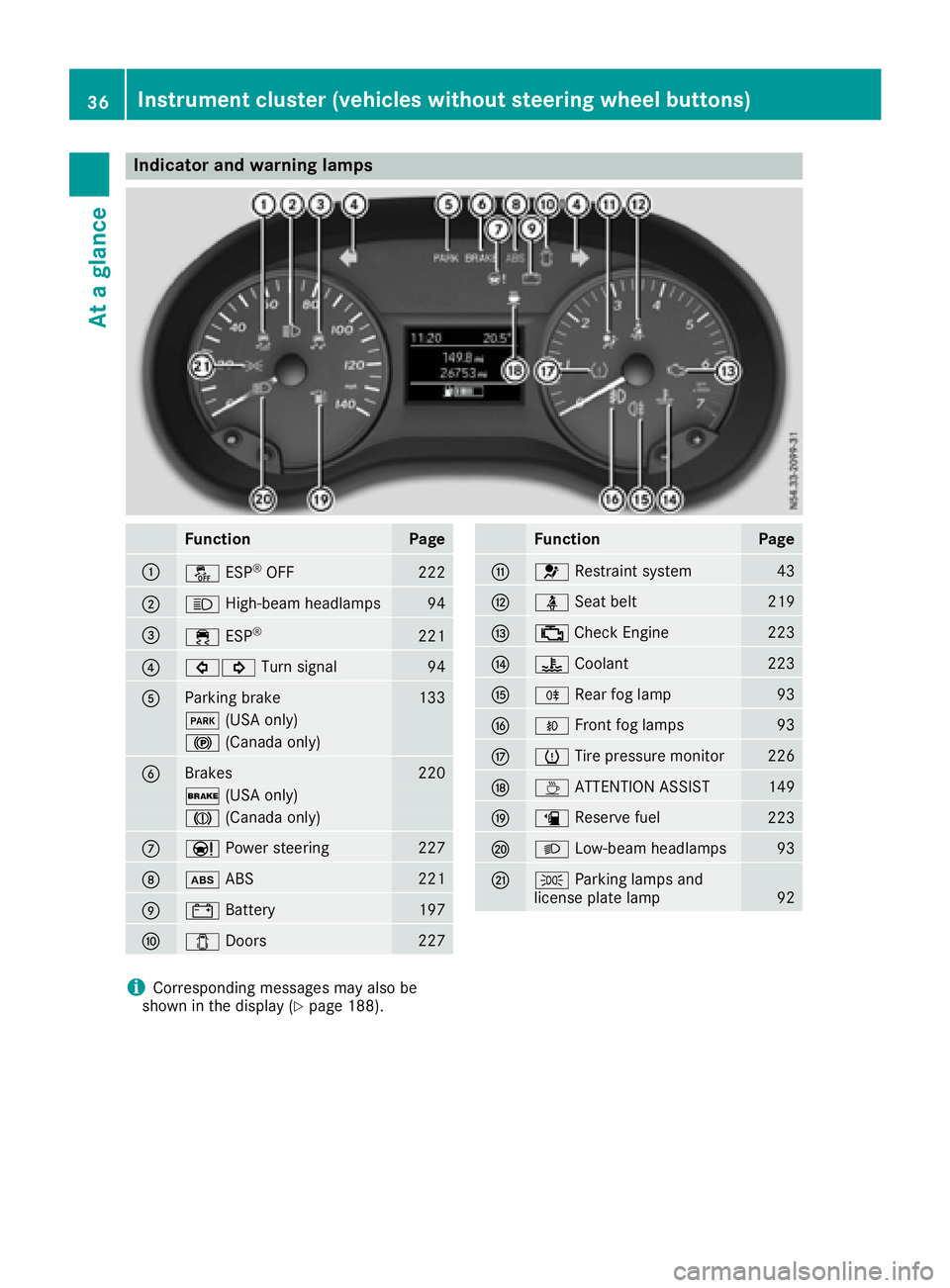
Indicator and warning lamps
FunctionPage
:å ESP®OF F222
;K High-beam headlamps94
=÷ESP®22 1
?#! Turn signal94
AParking brak e133
F (USAonly)
! (Canada only)
BBrakes220
$ (USAonly)
J (Canada only)
CÐPowersteering22 7
Dò ABS221
E# Battery197
F1 Doors227
FunctionPag e
G6 Restrain tsystem43
Hü Seat belt219
I; CheckEngine22 3
J? Coolan t223
KR Rear fog lamp93
LOFrontfog lamp s93
MhTirep ressur emonitor226
NÀ ATTENTION ASSIST149
Oæ Reserve fuel223
PL Low-beam headlamps93
QTParking lamp sand
license plat elamp92
iCorresponding message smay also be
shown in th edisplay (Ypage 188).
36Instrumen tcluster (vehicles without steering wheel buttons)
At ag lance
Page 40 of 310
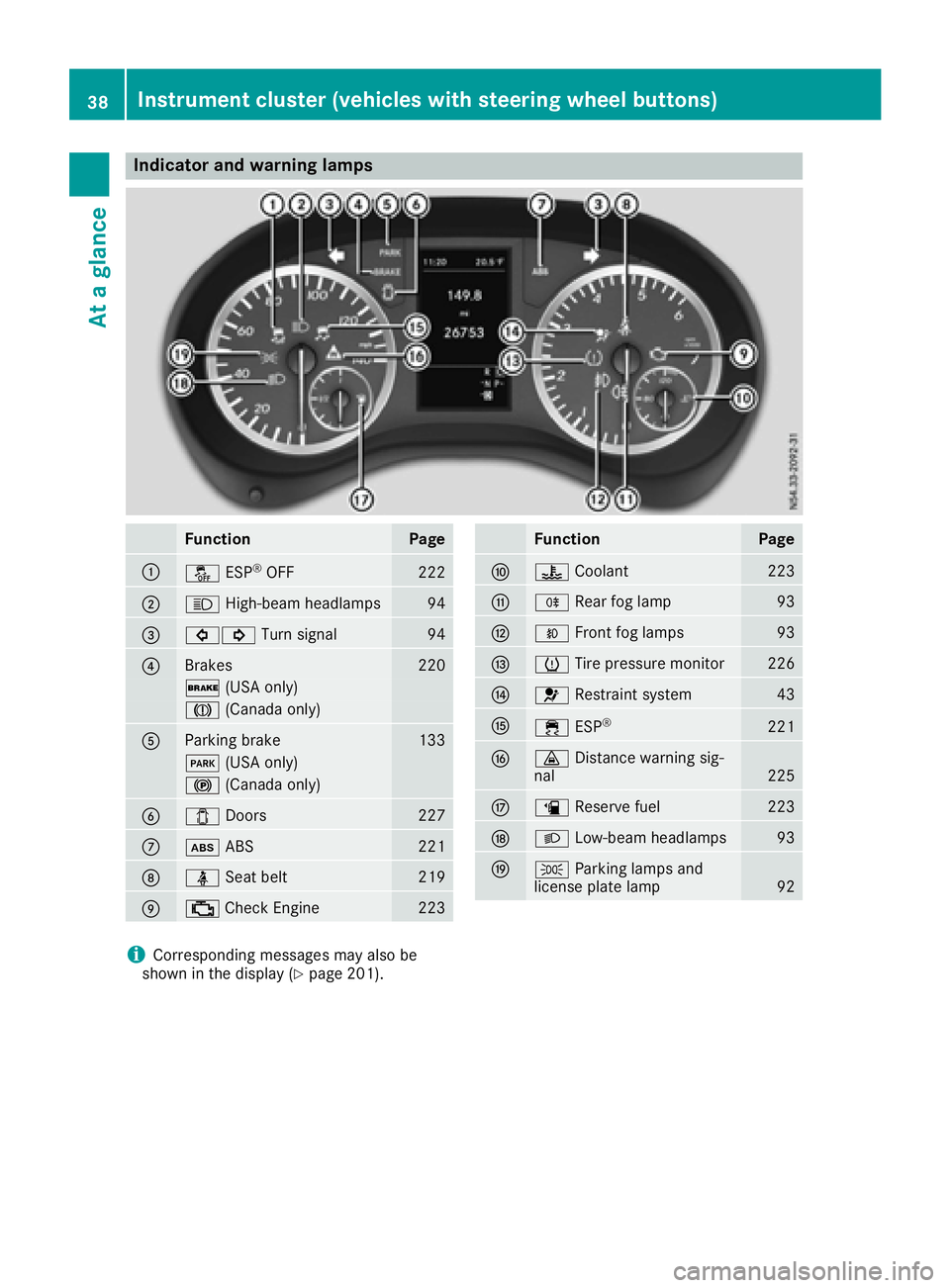
Indicator and warning lamps
FunctionPage
:å ESP®OF F222
;K High-beam headlamps94
=#! Turn signal94
?Brakes220
$ (USAonly)
J (Canada only)
AParking brak e133
F (USAonly)
! (Canada only)
B1Doors227
Cò ABS221
Dü Seat belt219
E; CheckEngine22 3
FunctionPag e
F? Coolan t223
GR Rear fog lamp93
HOFrontfog lamp s93
IhTirep ressur emonitor226
J6 Restrain tsystem43
K÷ ESP®22 1
L· Distanc ewarning sig-
nal22 5
Mæ Reserve fuel223
NL Low-beam headlamps93
OTParking lamp sand
license plat elamp92
iCorresponding message smay also be
shown in th edisplay (Ypage 201).
38Instrumen tcluster (vehicles with steering wheel buttons)
At ag lance
Page 42 of 310
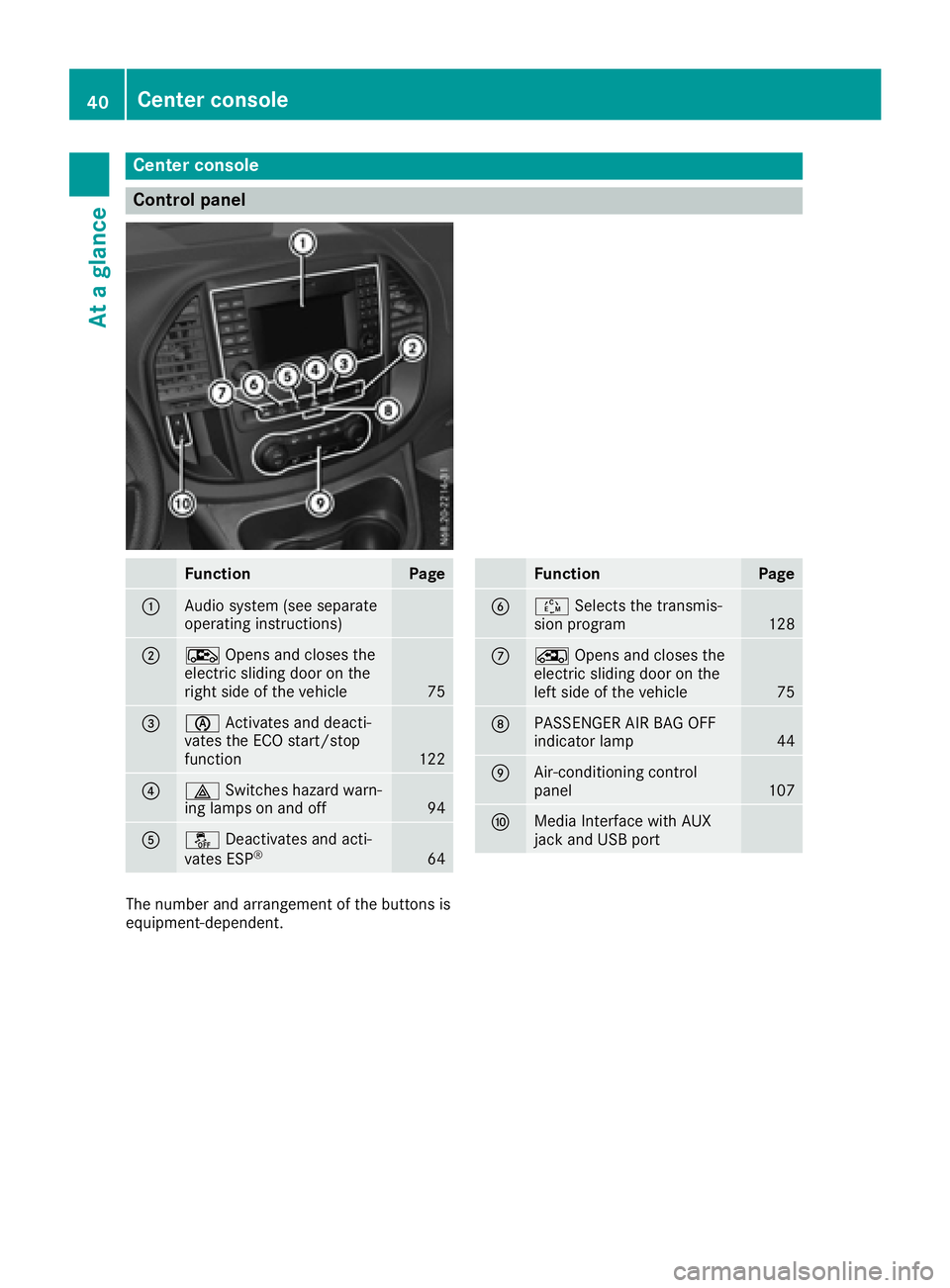
Center console
Control panel
FunctionPage
:Audiosystem (see separate
operatin ginstructions)
;Æ Opensa nd closes the
electric slidingd oor on the
righ tside of th evehicle
75
=è Activate sand deacti-
vates th eECO start/stop
function
122
?£ Switches hazard warn-
ing lamps on and off94
Aå Deactivates and acti-
vates ESP®64
FunctionPage
BÉ Select sthe transmis-
sion program128
CÅ Opensa nd closes the
electric slidingd oor on the
left side of th evehicle
75
DPASSENGER AI RBAG OFF
indicator lamp44
EAir-conditioning control
panel107
FMedia Interface withA UX
jac ka nd USBp ort
The number and arrangement of th ebuttons is
equipment-dependent.
40Center console
At ag lance
Page 45 of 310
Useful information
This Operator's Manual describes all models as
well as standard and optional equipment of your
vehicle that were available at the time of going
to print.Country-specific variation sare possi-
ble. Note that your vehicle may not be equipped
with all of the described functions. This also
applies to system sand function srelevantt o
safety.
Read the information on qualified specialist
workshops (
Ypage 29).
Occupant safety
Restraint system introduction
The restraint system can reduce the risk of vehi- cle occupants comingi ntoc ontact with parts of
the vehicle' sinterior in the eventofana ccident.
Furthermore, the restraint system may also
reduce the forces exerted on the vehicle occu-
pant swhen an acciden toccurs.
The restraint system includes:
RSeat belt system
RAir bags
RChild restraint system
RChild seat securings ystem
The components of the restraint system work in
conjunction with each other .They can only offer
the intended level of protection if all vehicle
occupants:
Rare correctly wearing their seat belts.
(Ypage 45)
Radjust their seat and head restraint properly
(Ypage 83).
The driver is also responsible for ensurin gthat
the steering wheel has been correctly posi-
tioned. Observet he information relatin gtothe
correct driver'ss eat position (
Ypage 83).
Always ensure the air bag can inflat eproperly if
deployed (
Ypage 48).
An air bag supplement sacorrectly fastened
seat belt. As an additional safetyd evice, the air
bag increases the level of protection for vehicle
occupants in the eventofana ccident. For exam-
ple, if the protection already provided by acor-
rectly fastened seat belt will suffice, the air bags
are not deployed. Furthermore, only the air bags
that would increase the degree of protection
afforded to the vehicle occupants in the evento fan acciden
tare deployed. Seat belts and air
bags generally do not protect against objects
penetratin gthe vehicle from the outside.
Information on restraint system operatio ncan
be found under "TriggeringofE mergencyTen-
sionin gDevices and air bags" (
Ypage 54).
See “Children in the vehicle” for information on children traveling with you as well as vehicle
restraint system s(
Ypage 56).
Important safetyn otes
GWARNING
If the restraint system is modified, it may no
longer work as intended. The restraint system
may then not performi ts intended protective
function by failing in an acciden tortriggering
unexpectedly, for example. There is an
increased risk of injury, possibly even fatal.
Never modify parts of the restraint system .Do
not attempt to modify the wiring as well as
electronic components or their software.
If it is necessary to modify an air bag system to
accommodate aperson with disabilities, con-
tact aMercedes-Benz Commercial Van Cen-
ter for details. USA only: contact our
Mercedes-Benz Customer Assistance Center
at 1-877-762-8267 for details.
Restraint system warning lamp
The restraint system sfunction sare checked
after the ignition is switched on and at regular
intervals when the engin eisrunning. This allows
malfunction stobedetected in good time.
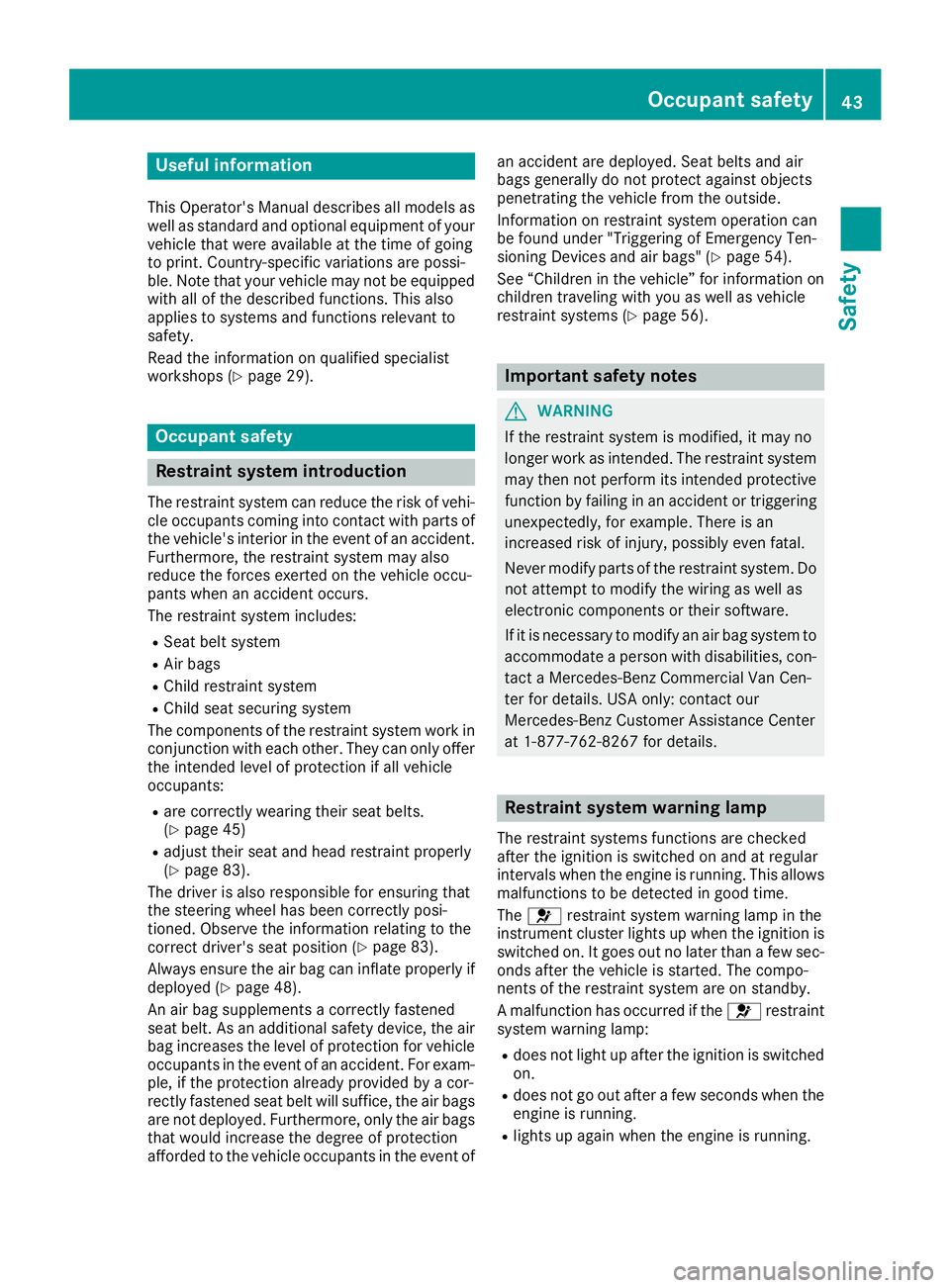
The 6 restraint system warnin glamp in the
instrumentc luster lights up when the ignition is
switched on. It goes out no later than afew sec-
onds after the vehicle is started. The compo-
nents of the restraint system are on standby.
Am alfunction has occurred if the 6restraint
system warnin glamp:
Rdoes not light up after the ignition is switched
on.
Rdoes not go out after afew seconds when the
engin eisrunning.
Rlights up again when the engin eisrunning.
Occupant safety43
Safety
Z
Page 46 of 310
GWARNING
If restraint system is malfunctioning, restraint
system components may be triggere dunin-
tentionall yormight not be triggere datall in
the event of an accident with ahigh rate of
vehicled eceleration. This can affect the Emer-
gency Tensioning Device or air bag ,for exam-
ple.T his poses an increased risk of injury or
even fatal injury.
Have the restraint system checked and
repaired in aqualified specialist worksho pas
soon as possible.
PASSENGER AI RBAG OFF indicator
lamp
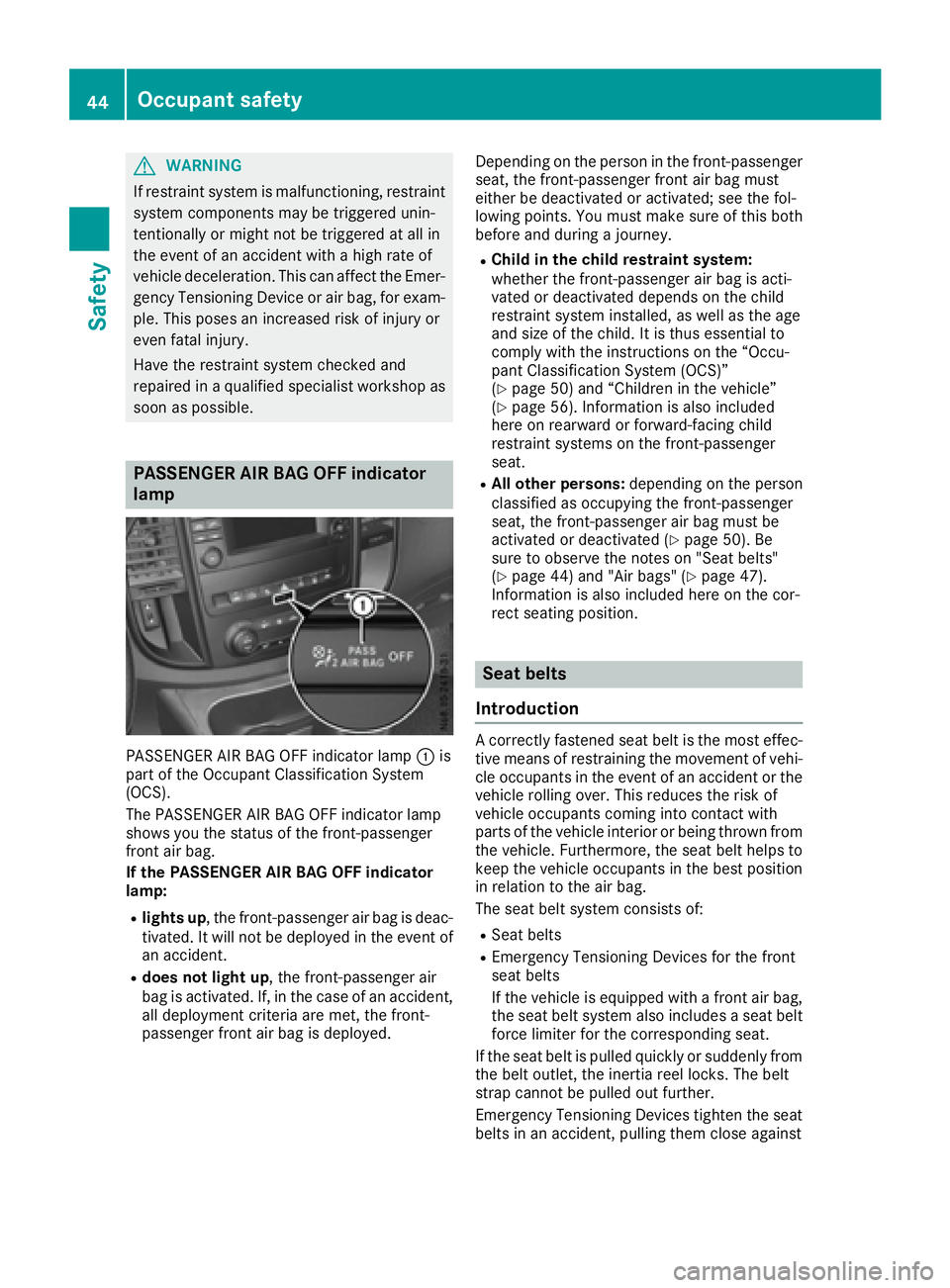
PASSENGER AIR BAG OFF indicator lamp :is
part of the Occupant Classification System
(OCS).
The PASSENGER AIR BAG OFF indicator lamp
showsy ou the status of the front-passenger
front air bag.
If the PASSENGER AI RBAG OFF indicator
lamp:
Rlights up,t he front-passenge rair bag is deac-
tivated. It wil lnot be deploye dinthe event of
an accident.
Rdoes not light up,t he front-passengerair
bag is activated. If, in the case of an accident,
all deployment criteria are met, the front-
passenger front air bag is deployed. Depending on the personint
he front-passenger
seat, the front-passenge rfront air bag must
either be deactivated or activated; see the fol-
lowing points. You must make sure of this both
before and during ajourney.
RChil dint he chil drestraint system:
whethe rthe front-passenge rair bag is acti-
vated or deactivated depends on the child
restraint system installed, as wel lasthe age
and size of the child .Itisthus essentialt o
comply with the instructions on the “Occu-
pant Classification System (OCS)”
(
Ypag e50) and “Childre ninthe vehicle”
(Ypag e56). Information is als oincluded
here on rearward or forward-facing child
restraint systems on the front-passenger
seat.
RAll other persons: depending on the person
classifie dasoccupying the front-passenger
seat, the front-passenge rair bag must be
activated or deactivated (
Ypag e50). Be
sure to observe the notes on "Sea tbelts"
(
Ypag e44) and "Air bags" (Ypag e47).
Information is als oincluded here on the cor-
rect seating position.
Seat belts
Introduction
Ac orrectly fastened seat beltist he most effec-
tive means of restraining the movement of vehi- cle occupants in the event of an accident or the
vehicler olling over. This reduces the risk of
vehicleo ccupants coming into contact with
parts of the vehiclei nterior or being thrown from
the vehicle. Furthermore ,the seat belth elpsto
keep the vehicleo ccupants in the best position
in relation to the air bag.
The seat belts ystem consists of:
RSeat belts
REmergency Tensioning Devices for the front
seat belts
If the vehicleise quipped withafront air bag,
the seat belts ystem alsoincludes aseat belt
force limiter for the corresponding seat.
If the seat beltisp ulled quickly or suddenly from
the belto utlet, the inertia reel locks. The belt
strap cannot be pulled out further.
Emergency Tensioning Devices tighten the seat belts in an accident, pulling them close against
44Occupant safety
Safety
Page 51 of 310
formed correctly to the doors or door panel-
ing, as wellasdamaged doors,c an leadtothe
function of the sensors being impaired .The air
bag smight therefore not function properly
anymore. Consequently, the air bag scannot
protect vehicl eoccupants as they are
designed to do. There is an increased risk of
injury.
Never modify the doors or parts of the doors. Always have work on the doors or door pan-
eling carrie dout at aqualified specialist work-
shop.
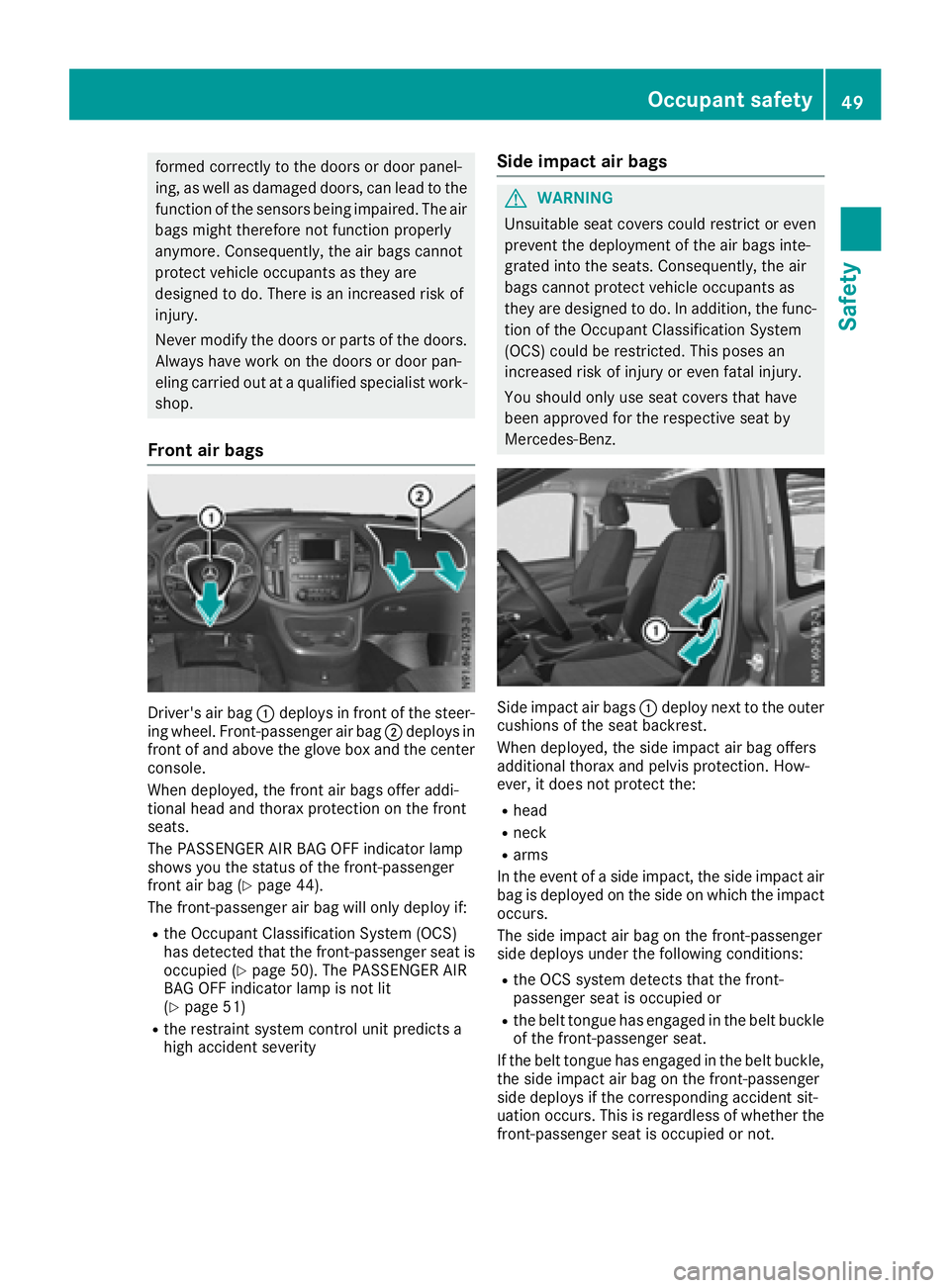
Fron tair bags
Driver's air bag :deploys in front of the steer-
ing wheel. Front-passenger air bag ;deploys in
front of and above the glove box and the center
console.
When deployed, the front air bag soffer addi-
tional heada nd thorax protection on the front
seats.
The PASSENGER AIR BAG OFF indicator lamp
showsy ou the status of the front-passenger
front air bag (
Ypag e44).
The front-passenger air bag wil lonly deploy if:
Rthe Occupant Classification System (OCS)
has detected that the front-passenger seati s
occupied (
Ypag e50). The PASSENGER AIR
BAG OFF indicator lam pisnot lit
(
Ypag e51)
Rthe restraint system control unit predicts a
high accident severity
Side impact air bags
GWARNING
Unsuitabl eseatc overs coul drestrict or even
prevent the deployment of the air bag sinte-
grated into the seats. Consequently, the air
bag scannot protect vehicl eoccupants as
they are designed to do. In addition, the func- tion of the Occupant Classification System
(OCS) coul dberestricted. This posesa n
increased risk of injury or even fatal injury.
You should only use seatc overs that have
been approved for the respective seatb y
Mercedes-Benz.
Side impact air bags :deploy next to the outer
cushions of the seatb ackrest.
When deployed, the side impact air bag offers
additiona lthorax and pelvis protection. How-
ever, it does not protect the:
Rhead
Rneck
Rarms
In the event of aside impact, the side impact air
bag is deploye donthe side on which the impact
occurs.
The side impact air bag on the front-passenger
side deploys under the following conditions:
Rthe OCS system detects that the front-
passenger seatiso ccupied or
Rthe belttongue has engaged in the beltb uckle
of the front-passenger seat.
If the beltt ongue has engaged in the beltb uckle,
the side impact air bag on the front-passenger
side deploys if the corresponding accident sit-
uation occurs. This is regardless of whethe rthe
front-passenger seatiso ccupied or not.
Occupant safety49
Safety
Z
Page 53 of 310
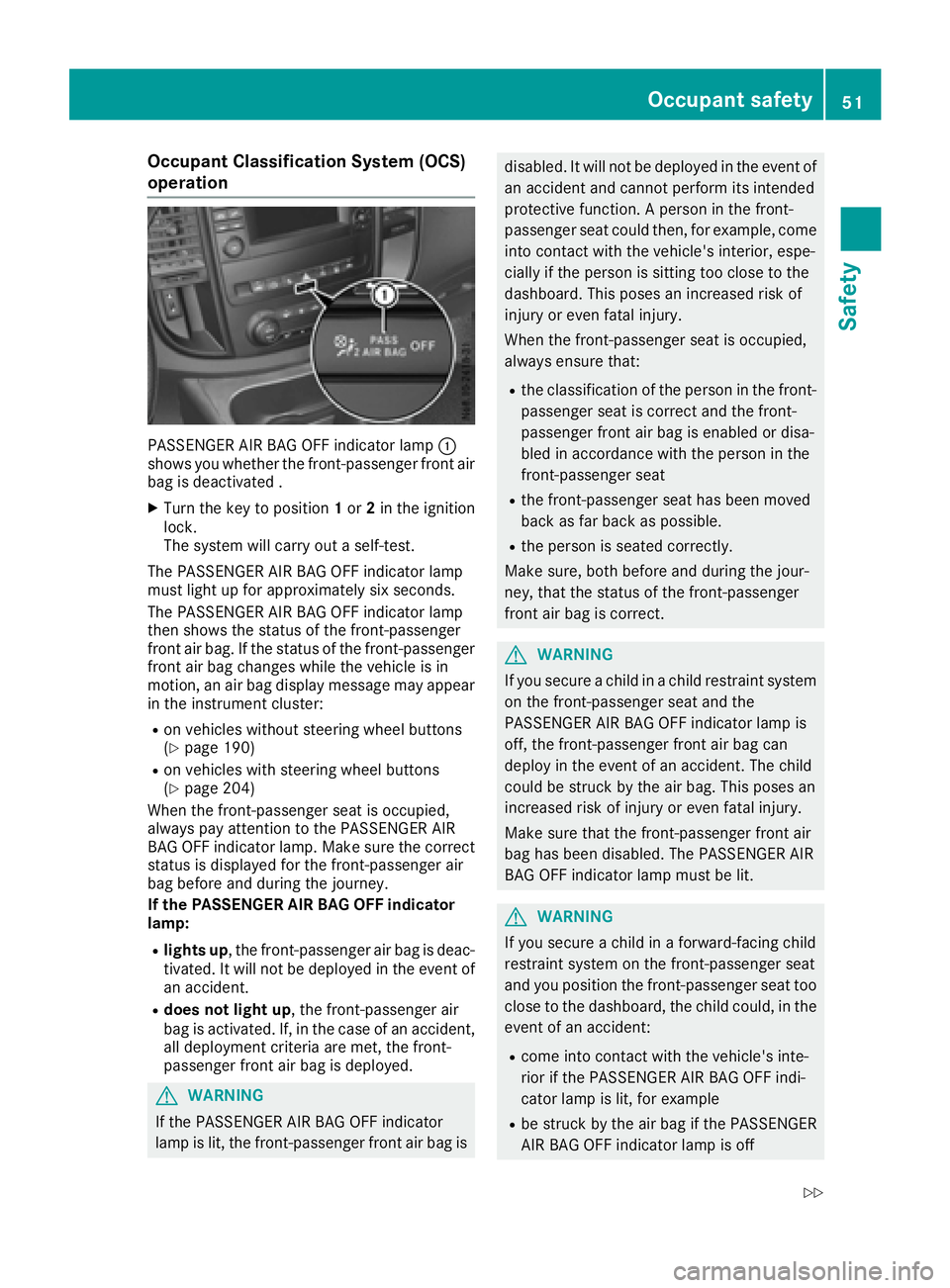
Occupant Classification System (OCS)
operation
PASSENGER AIR BAG OFF indicator lamp:
shows you whether the front-passenger fronta ir
bag is deactivated .
XTurn the key to position 1or 2in the ignition
lock.
The system will carry out aself-test.
The PASSENGER AIR BAG OFF indicator lamp
must light up for approximately six seconds.
The PASSENGER AIR BAG OFF indicator lamp
then shows the status of the front-passenger
fronta ir bag. If the status of the front-passenger
fronta ir bag changes while the vehicle is in
motion ,anair bag display message may appear
in the instrument cluster:
Ron vehicles without steering wheel buttons
(Ypage 190)
Ron vehicles with steering wheel buttons
(Ypage 204)
When the front-passenger seat is occupied,
alwaysp ay attention to the PASSENGER AIR
BAG OFF indicator lamp. Make sure the correct
status is displayed for the front-passenger air
bag before and during the journey.
If the PASSENGER AIR BAG OFF indicator
lamp:
Rlights up ,the front-passenger air bag is deac-
tivated. It will not be deployed in the event of
an accident.
Rdoes not light up,t he front-passenger air
bag is activated. If, in the case of an accident,
all deployment criteria are met, the front-
passenger fronta ir bag is deployed.
GWARNING
If the PASSENGER AIR BAG OFF indicator
lamp is lit, the front-passenger fronta ir bag is
disabled. It will not be deployed in the event of
an accidenta nd cannot perform its intended
protective function .Aperson in the front-
passenger seat could then ,for example, come
into contact with the vehicle's interior, espe-
cially if the person is sitting too close to the
dashboard. This poses an increased risk of
injur yore ven fatal injury.
When the front-passenger seat is occupied,
alwayse nsure that:
Rthe classification of the person in the front-
passenger seat is correct and the front-
passenger fronta ir bag is enabled or disa-
bled in accordance with the person in the
front-passenger seat
Rthe front-passenger seat has been moved
back as far back as possible.
Rthe person is seated correctly.
Make sure, both before and during the jour-
ney, that the status of the front-passenger
fronta ir bag is correct.
GWARNING
If you secure achild in achild restraint system
on the front-passenger seat and the
PASSENGER AIR BAG OFF indicator lamp is
off, the front-passenger fronta ir bag can
deploy in the event of an accident. The child
could be struc kbythe air bag. This poses an
increased risk of injur yoreven fatal injury.
Make sure that the front-passenger fronta ir
bag has been disabled. The PASSENGER AIR
BAG OFF indicator lamp must be lit.
GWARNING
If you secure achild in aforward-facing child
restraint system on the front-passenger seat
and you position the front-passenger seat too close to the dashboard, the child could, in the
event of an accident:
Rcome into contact with the vehicle's inte-
rior if the PASSENGER AIR BAG OFF indi-
cator lamp is lit, for example
Rbe struck by the air bag if the PASSENGER
AIR BAG OFF indicator lamp is off
Occupant safety51
Safety
Z