tire type MERCEDES-BENZ METRIS 2016 MY16 Operator’s Manual
[x] Cancel search | Manufacturer: MERCEDES-BENZ, Model Year: 2016, Model line: METRIS, Model: MERCEDES-BENZ METRIS 2016Pages: 310, PDF Size: 7.28 MB
Page 272 of 310
Snow chains
GWARNING
If snow chains are installed to the front
wheels, they may drag against the vehicle
body or chassis components. This could
cause damage to the vehicle or the tires.
There is arisk of an accident.
To avoid hazardous situations:
Rnever install snow chains to the front
wheels
Ralways install snow chains in pairs to the
rear wheels.
GWARNING
If you drive too fast with snow chains moun-
ted, they may snap. As aresult, you could
injure others and damage the vehicle. There is
ar isk of an accident.
Observe the maximum permissible speed for
operation with snow chains.
Observe the country-specific laws and regula-
tions for operation with snow chains.
!Check the snow chains for damage before
mounting them. Damaged or worn snow
chains may snap and damage the following
components:
Rwheel
Rwheel housing
Rwheel suspension
For this reason, you must use only snow
chains that are free of defects. Observe the
manufacturer's mounting instructions.
!Vehicles with steel wheels: if you mount
snow chains on steel wheels, you may dam-
age the hub caps. Remove the hub caps from
the relevant wheels before mounting the
snow chains.
Snow chains increase traction on roads in wintry conditions.
For safety reasons, Mercedes-Benz recom-
mends that you only use snow chains or traction
aids which have been approved for Mercedes-
Benz vehicles. The snow chains or traction aids
must be of class Uormeet the SAE type U
specification. Information about snow chains can be obtained
from any Mercedes-Benz Commercial Van Cen-
ter.
When mounting snow chains, please bear the
following points in mind:
RSnow chains cannot be mounted on all
wheel/tire combinations
.When mounting the
snow chains, note the permissible tire and
snow chain dimensions. Observe the restric-
tions on the use of snow chains under
"Wheel/tire combinations "(
Ypage 291).
RMount snow chains only in pairs and only to
the rear wheels. Observe the manufacturer's
mounting instructions.
ROnly use snow chains when the road is cov-
ered byalaye rofs now. Remove the snow
chains as soon as possible when you come to
ar oad that is not snow-covered.
RThe use of snow chains may be restricted by
local regulations. Observe the appropriate
regulations before mounting snow chains.
RWhen driving with snow chains installed, do
not exceed the maximum permissible speed
of 30 mph (50 km/h).
RCheck the tension of the chains after adis-
tance of approximately 0.5 miles (1.0 km).
You may wish to deactivate ESP
®when pulling
away with snow chains installed (Ypage 64).
This allowst he wheels to spin in acontrolled
manner, achieving an increased driving force
(cut tinga ction).
Tire pressure
Tire pressures pecifications
Important safety notes
GWARNING
Underinflated or overinflated tires pose the
following risks:
Rthe tires may burst, especially as the load
and vehicle speed increase.
Rthe tires may wear excessively and/or
unevenly, which may greatly impair tire
traction.
Rthe driving characteristics, as well as steer-
ing and braking, may be greatly impaired.
There is arisk of an accident.
270Tire pressure
Wheels and tires
Page 276 of 310
Maximum tire pressures
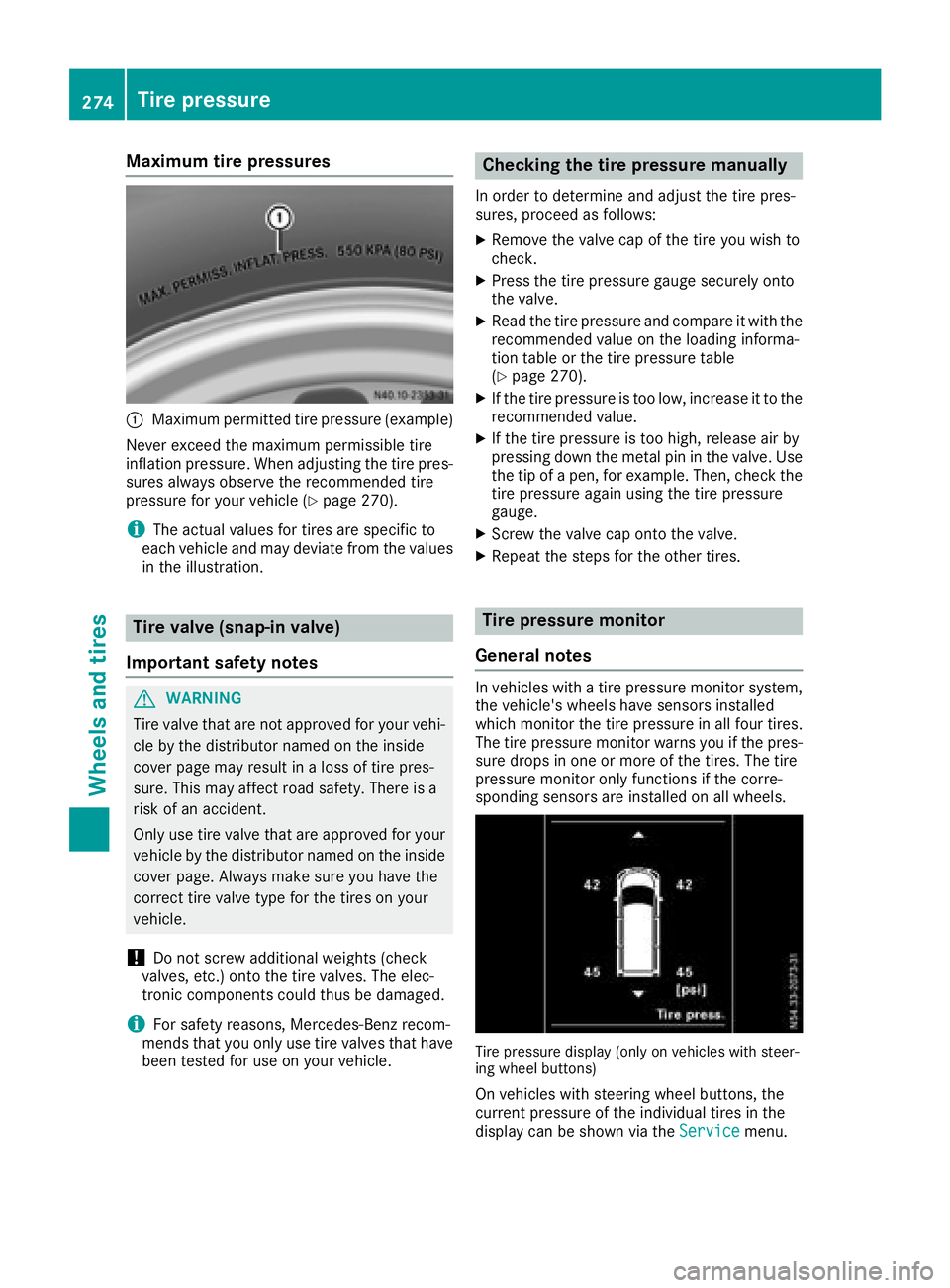
:Maximumpermitted tire pressure (example)
Never exceed the maximu mpermissible tire
inflation pressure. When adjusting the tire pres-
sure salway sobserve the recommendedt ire
pressure for you rvehicl e(
Ypage270).
iThe actua lvalues for tires are specific to
each vehiclea nd may deviate from the values
in the illustration.
Tire valve (snap-in valve)
Important safety notes
GWARNING
Tire valve that are not approved for you rvehi-
cle by the distributor named on the inside
cover pag emay result in aloss of tire pres-
sure .This may affect road safety .There is a
risk of an accident.
Only use tire valve that are approved for your
vehiclebyt he distributor named on the inside
cover page. Always make sure you have the
correct tire valve type for the tires on your
vehicle.
!Do not screw additiona lweights (check
valves, etc.) onto the tire valves. The elec-
tronic components coul dthus be damaged.
iFor safety reasons, Mercedes-Benz recom-
mends that you only use tire valve sthat have
been tested for use on you rvehicle.
Checking the tire pressure manually
In order to determine and adjust the tire pres-
sures, proceedasf ollows:
XRemove the valve cap of the tire you wis hto
check.
XPress the tire pressure gauge securely onto
the valve.
XRea dthe tire pressure and compare it with the
recommendedv alueont he loading informa-
tion table or the tire pressure table
(
Ypag e270).
XIf the tire pressure is too low ,increas eittothe
recommendedv alue.
XIf the tire pressure is too high ,release air by
pressing downt he metal pin in the valve .Use
the tip of apen, for example. Then, check the
tire pressure again using the tire pressure
gauge.
XScrew the valve cap onto the valve.
XRepeat the steps for the other tires.
Tire pressure monitor
General notes
In vehicles with atire pressure monitor system,
the vehicle's wheels have sensors installed
which monitor the tire pressure in all four tires.
The tire pressure monitor warns you if the pres- sure drops in one or more of the tires. The tire
pressure monitor only functions if the corre-
sponding sensors are installed on all wheels.
Tire pressure display (only on vehicles with steer-
ing whee lbuttons)
On vehicles with steering whee lbuttons, the
current pressure of the individua ltires in the
display can be shownv ia theService
menu.
274Tire pressure
Wheels and tires
Page 283 of 310
Vehicleidentificatio nplate
Even if yo uhavec alculate dthe totall oadc are-
fully ,you shoul dstillm ake sure thatt he permis-
sibl egross weight and the gross axl eweigh trat-
ing of your vehicl eare not exceeded .Thisd ata
can be found on the vehicl eide ntificatio nplate
on the B-pillar of your vehicl e(
Ypage 294).
Permissibl egross vehicle weight: the gross
weight of the vehicle, al loccupants, load and
traile rload/n oseweight (i fappli cable) must not
exceed the permissibl egross vehicl eweigh t.
Gros saxlew eightrating: the maximu mper-
missibl eloa dt hatc an be carrie dbyone axle
(front or rea raxle).
To ensure thaty ourvehicl edoesn ot exceed the
maximu mpermissibl evalue s(gros sv ehicle
weight and maximu mgross axl eweigh trating),
have your loaded vehicl e(including driver, occu-
pants, load ,and ful ltraile rloa difa pplicable)
weighed on asuitabl evehicl eweigh bridge.
Trailer load/noseweight
The traile rload/n oseweight affects the gross
weight of the vehicle. If atraile risa ttached, the
traile rload/n oseweight is included in the load
along with occupants and luggage. The trailer
load/noseweight is usuall yapproximately1 0%
of the gross weight of the traile rand its load.
What yous hould knowabout wheels
and tires
Tire labeling
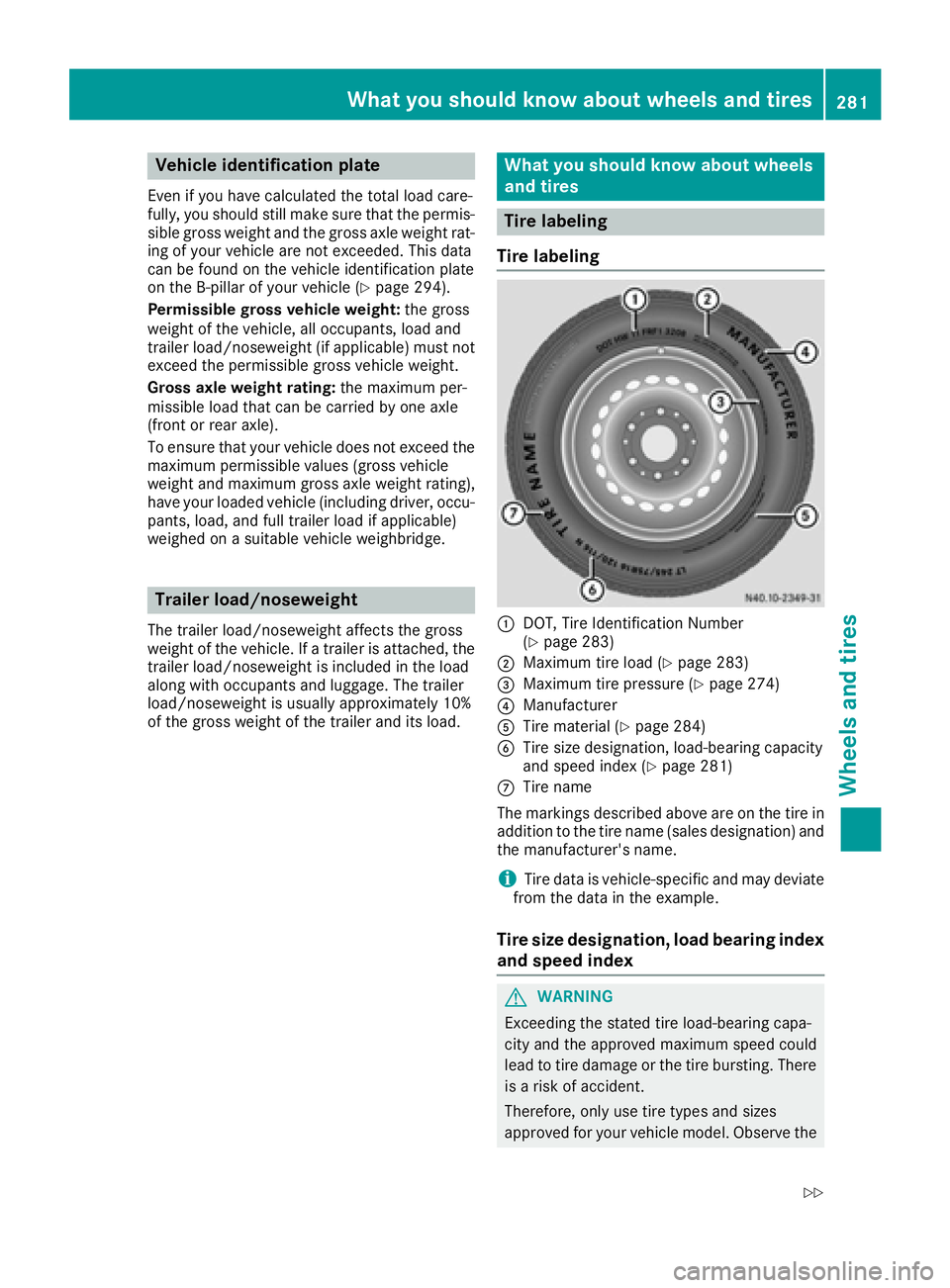
Tire labeling
:DOT, Tire Identification Number
(Ypage 283)
;Maximu mtire load (Ypage 283)
=Maximu mtire pressure (Ypage 274)
?Manufacturer
ATire material (Ypage 284)
BTire size designation, load-bearing capacity
and speed index (Ypage 281)
CTire name
The marking sdescribe dabove are on the tire in
additio ntothe tire nam e(sale sdesig nation) and
the manufacturer' sname.
iTire data is vehicle-specific and mayd eviate
from the data in the example.
Tire size designation ,loa db earin gind ex
and speed index
GWARNING
Exceeding the stated tire load-bearing capa-
city and the approved maximu mspeed could
lead to tire damage or the tire bursting. There is ar iskofa ccident.
Therefore, onlyu setire types and sizes
approved for your vehicl emodel .Observe the
What yous hould knowa bout wheels and tires281
Wheelsand tires
Z
Page 284 of 310
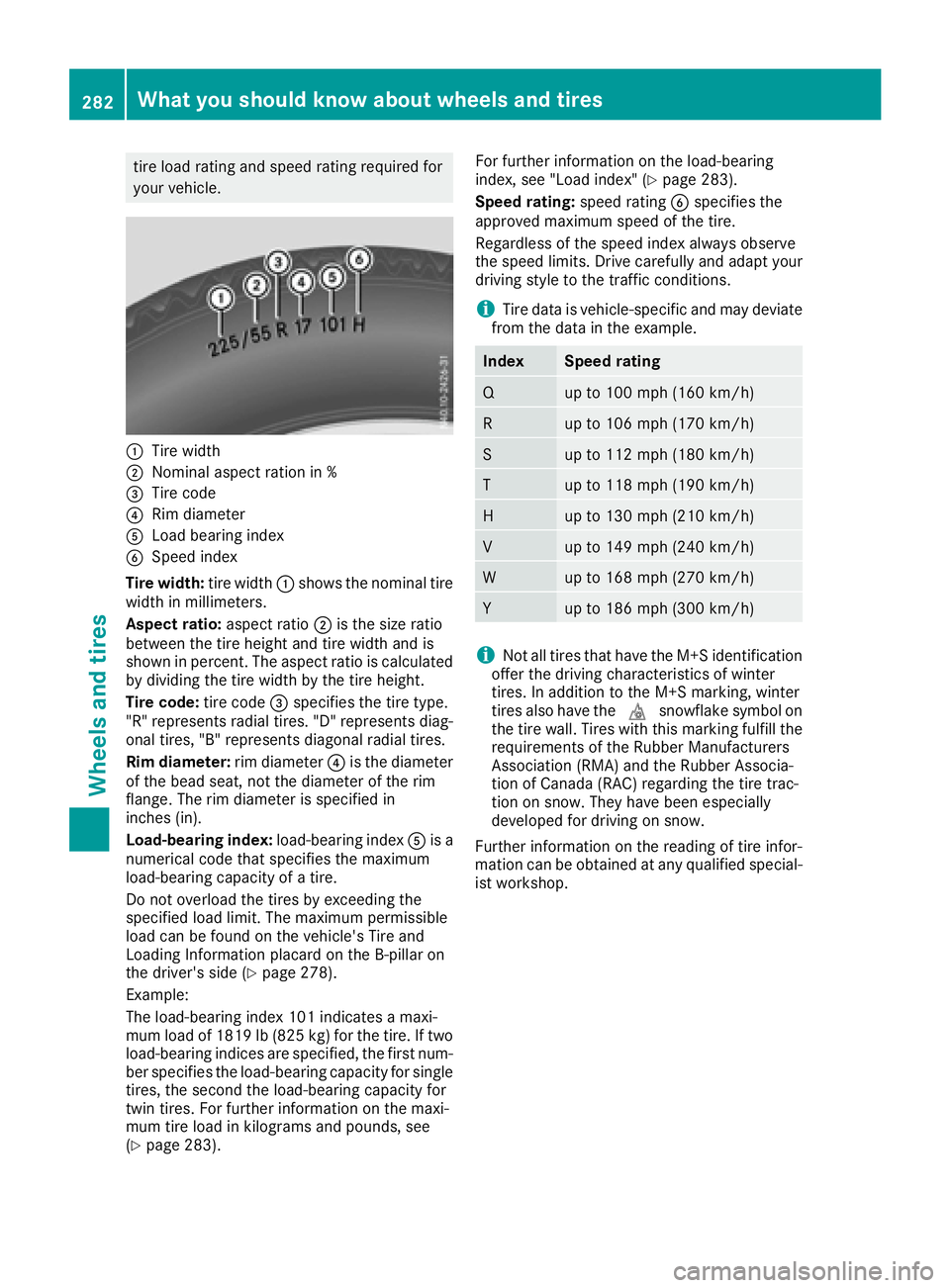
tire load rating and speedrating required for
your vehicle.
:Tire width
;Nomina laspec trationin%
=Tire code
?Ri md iame ter
ALoadbeari ng index
BSpeed index
Tire width: tire width:shows the nominal tire
width in millimeters.
Aspec tratio: aspect ratio ;is the size ratio
between the tire height and tire width and is
shown in percent. The aspect ratio is calculated
by dividing the tire width by the tire height.
Tire code: tire code=specifie sthe tire type.
"R "r epresents radial tires. "D" represents diag-
ona ltires, "B" represents diagona lradial tires.
Rim diameter: rim diameter?is the diameter
of the bead seat, not the diamete rofthe rim
flange .The rim diamete risspecifie din
inches (in).
Load-bearing index: load-bearing indexAis a
numerical cod ethats pecifie sthe maximum
load-bearing capacity of atire.
Do not overload the tire sbyexceeding the
specifie dloa dlimit .The maximum permissible
load can be found on the vehicle' sTirea nd
Loading Informatio nplacard on the B-pillar on
the driver's side (
Ypage 278).
Example:
The load-bearing index 101 indicates amaxi-
muml oado f1819 lb (825 kg )for the tire .Iftwo
load-bearing indice sarespecified, the first num-
be rspe cifie sthe lo ad-b
earing capacity for single
ti
res, the second the load-bearing capacity for
twi ntires. For furthe rinformation on the maxi-
mumt ire load in kilograms and pounds, see
(
Ypage 283). For furthe
rinformation on the load-bearing
index, see" Loadindex" (
Ypage 283).
Speed rating: speedrating Bspecifie sthe
approved maximum spee dofthe tire.
Regardles softhe spee dindex always observe
the spee dlimit s. Drive carefull yand adap tyou r
drivin gstyle to the trafficc onditions.
iTire data is vehicle-specific and mayd eviate
fromt he data in the example.
IndexSpeed rating
Qup to 100 mph (16 0km/h)
Rup to 106 mph (17 0km/h)
Sup to 112 mph (18 0km/h)
Tup to 118 mph (19 0km/h)
Hup to 130 mph (21 0km/h)
Vup to 149 mph (24 0km/h)
Wup to 168 mph (27 0km/h)
Yup to 186 mph (30 0km/h)
iNot al ltire sthath avet he M+S identification
offer the drivin gcharacteristics of winter
tires. In additio ntothe M+S marking, winter
tire salsoh avet he i snowflake symbo lon
the tire wall .Tires with thism arking fulfill the
requirements of the Rubber Manufacturers
Associatio n(RM A) and the Rubber Associa-
tio nofC anad a( RA C) regarding the tire trac-
tio nons now. They have been especially
developed for drivin gonsnow.
Furtheri nformation on the reading of tire infor-
matio ncan be obtained at any qualified special-
is tw orkshop.
282What yous hould knowabout wheels an dtires
Wheel sand tires
Page 292 of 310
When usingawheel/spare wheel with anew or
newly painted wheel rim, have the wheel bolts/
nuts retightened again after approximately 600
to 3,000 miles (1,000 to 5,000 km). Observe the
specified tightening torque.
Wheel and tirec ombination
General notes
!
Retreaded tires are neither tested nor rec-
ommended by Mercedes-Benz,s ince previ-
ous damage cannot alwaysbed etected on
retreaded tires. As aresult, Mercedes-Benz
cannot guarantee vehicle safety if retreaded
tires are mounted. Do not mount used tires if you have no information about their previous
usage.
!For safety reasons, Mercedes-Benz recom-
mends that you only use tires, wheels and
accessories which have been specially
approved by Mercedes-Benz for your vehicle.
These tires have been specially adapted for
use with the driving safety systems, such as
ABS or ESP
®.
Only use tires, wheels or accessories tested
and approved by Mercedes-Benz .Certain
characteristics, e.g. handling, vehicle noise
emissions or fuel consumption, may other-
wise be adversely affected. In addition, when
driving with aload, tire dimension variations
could cause the tires to come into contact
with the bodywork and axle components. This
could result in damage to the tires or the vehi-
cle.
Mercedes-Benz acceptsnol iability for dam-
age resulting from the use of tires, wheels or
accessories other than those tested and
approved.
Further information on wheels, tires and
approved combinations can be obtained from
any qualified specialist workshop.
!Large wheels: the lower the section width
for acertain wheel size, the lower the ride
comfort is on poor road surfaces. Roll comfort and suspension comfort are reduced and the
risk of damage to the wheels and tires as a
result of driving over obstacles increases.
You will find atable with the recommended tire
pressures for various vehicle loads on the inside
of your vehicle's fuel filler flap or under "Tire
pressure tables" (
Ypage 278). You can find fur- ther information under "Tire pressure"
(
Ypage 270).
Check tire pressures regularly and only when
the tires are cold.
Notes on the vehicle equipment –alwayse quip
the vehicle:
Rwith tires of the same size across an axle
(left/right)
Rwith the same type of tires on all wheels at a
given time (summer tires, winter tires)
iNot all wheel/tire combinations can be
installed at the factory in all coun tries.
290Wheel and tirecombination
Wheels and tires
Page 293 of 310
Tires
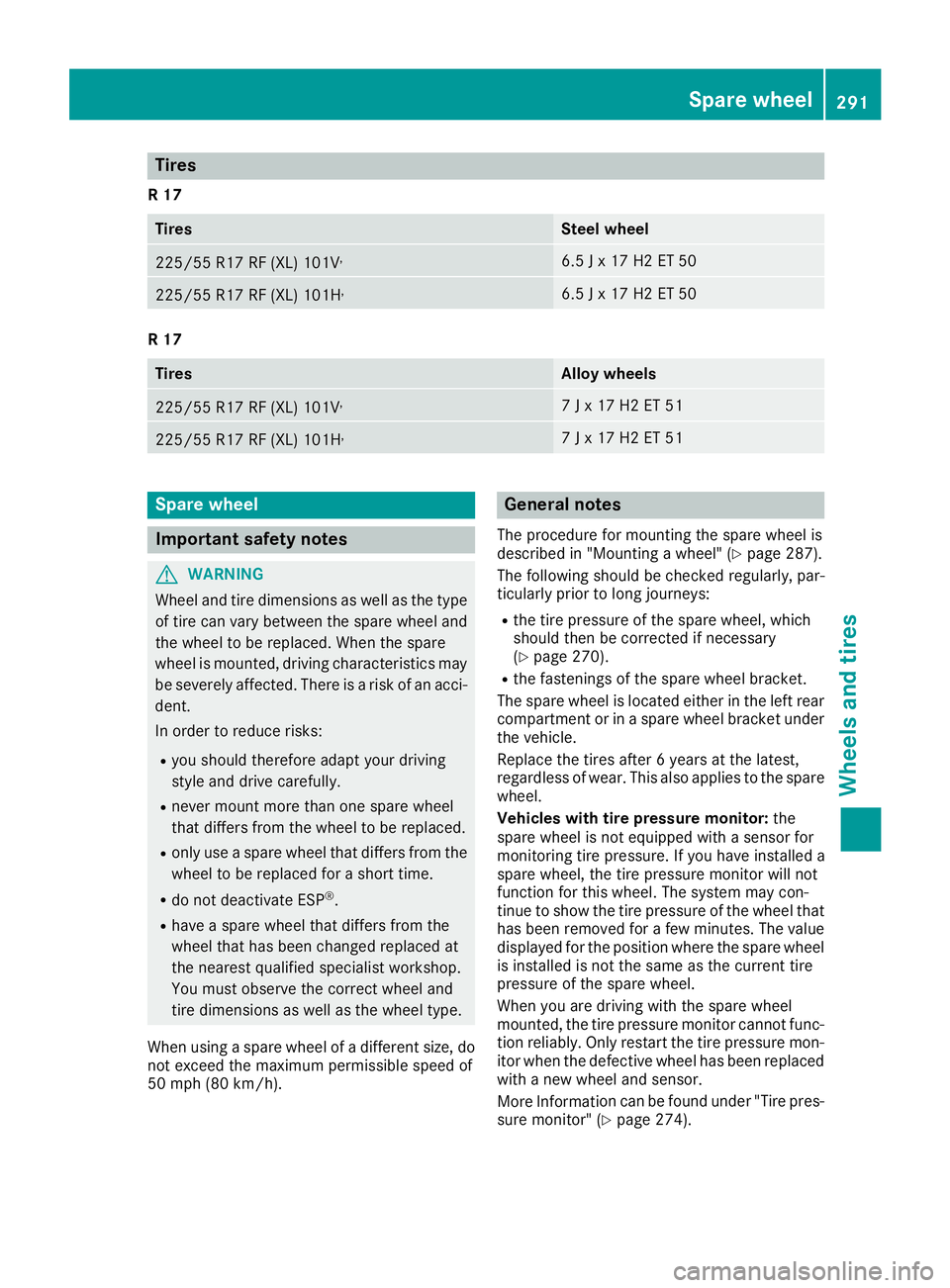
R17
TiresSteel wheel
225/55R 17RF (XL) 101V,6.5Jx17H2ET5 0
225/55 R17 RF (XL )101H,6.5 Jx17H2ET5 0
R17
TiresAllo ywheels
225/55 R17 RF (XL )101V,7Jx17H2ET5 1
225/55 R17 RF (XL )101H,7Jx17H2ET5 1
Spare wheel
Important safety notes
GWARNING
Wheel and tire dimensions as well as the type of tire can var ybetween the spare whee land
the whee ltobereplaced .Whent he spare
whee lismounted, driving characteristic smay
be severely affected. There is ariskofana cci-
dent.
In order to reduce risks:
Ryo us houl dtherefore adap tyou rd riving
style and drive carefully.
Rneve rmount more thano ne spare wheel
thatd iffer sfrom the whee ltobereplaced.
Ronlyuseaspare whee lthatd iffer sfrom the
whee ltober eplaced for ashort time.
Rdo not deactivate ESP®.
Rhave aspare whee lthatd iffer sfrom the
whee lthath asbeen changed replaced at
the neares tquali fied specialist workshop.
Yo um usto bserve the correct whee land
tire dimensions as well as the whee ltype.
Whe nusing aspare whee lofadifferent size, do
not exceed the maximump ermissibl espeed of
50 mph (80 km/h).
General notes
The procedure for mounting the spare whee lis
describe din"Mounting awheel "(Ypage 287).
The following shoul dbechecked regularly, par-
ticularly prior to long journeys:
Rthe tire pressure of the spare wheel, which
shoul dthen be corrected if necessary
(
Ypage 270).
Rthe fastenings of the spare whee lbracket.
The spare whee lislocate deither in the left rear
compartment or in aspare whee lbracket under
the vehicle.
Replace the tire safter6y ears at the latest,
regardless of wear. Thi salsoa pplies to the spare
wheel.
Vehicles with tire pressure monitor: the
spare whee lisnot equipped with asensor for
monitoring tire pressure. If yo uhavei nstalle da
spare wheel, the tire pressure monitor will not
functio nfor this wheel. The system may con-
tinu etos howt he tire pressure of the whee lthat
hasb eenr emoved for afew minutes. The value
displayed for the position where the spare wheel
is installe disnot the same as the current tire
pressure of the spare wheel.
Whe nyou are driving with the spare wheel
mounted, the tire pressure monitor canno tfunc-
tio nr eliably. Only restart the tire pressure mon-
ito rw henthe defective whee lhas been replaced
with anew whee land sensor.
Mor eInformati on can be found under "Tire pres-
sure
monitor" (Ypage 274).
Spare wheel291
Wheel sand tires
Z