display MERCEDES-BENZ METRIS 2016 MY16 Operator’s Manual
[x] Cancel search | Manufacturer: MERCEDES-BENZ, Model Year: 2016, Model line: METRIS, Model: MERCEDES-BENZ METRIS 2016Pages: 310, PDF Size: 7.28 MB
Page 26 of 310
Mountingawheel .......................... 287
Removing awheel .......................... 288
Removing and mounting the spare
wheel ............................................. 292
Snow chains ..................................2 70
Storing ...........................................2 86
Tightening torque. .......................... 289
Wheels ize/tire size ....................... 290
Windo wcurtain air bag
Display message (vehicle with
steering wheel buttons) ................. 208
Display message (vehicle without
steering wheel buttons) ................. 194
Operation ......................................... 50
Windows
see Side windows
Windshield
Cleaning ......................................... 256
Defrosting ...................................... 114
Windshiel dwashe rfluid
Adding ...........................................2 46
Windshiel dwiper
Setting the sensitivity of the rain
sensor (vehicle with steering
wheel buttons) ............................... 187
Setting the sensitivity of the rain
sensor (vehicle without steering
wheel buttons) ............................... 174
Windshiel dwiper
see Windshield
Windshiel dwipers
Problem (malfunction) ................... 106
Rea rwindow wiper ........................ 102
Replacing the wiper blades ............ 103
Switching on/off ........................... 101
Winte rdriving
Slippery road surfaces ................... 138
Snow chains .................................. 270
Winte roperation
General notes ................................ 269
Radiator cover ................................. 31
Winte rtires
M+S tires ....................................... 269
Setting alimit speed. .....................1 35
Wiper blades
Cleaning ......................................... 256
Important safety notes .................. 103
Replacing (rearw indow) ................ 104 Replacing (windshield).
.................. 103
Service indica tor ............................ 103
Wo rk
shop
see Qualifie dspecialist workshop
24Index
Page 37 of 310
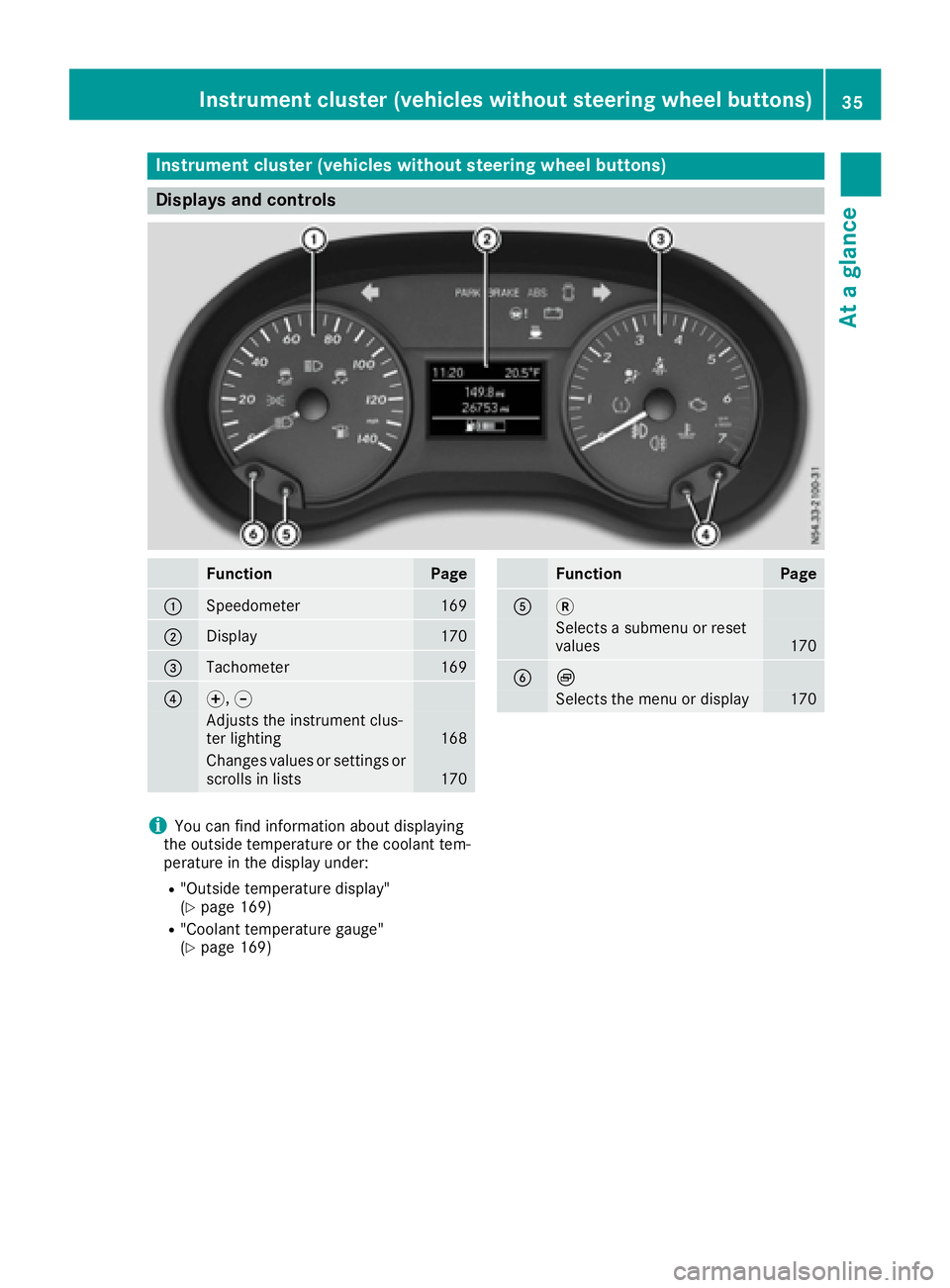
Instrumentcluster (vehicles without steering wheel buttons)
Display sand controls
FunctionPag e
:Speedometer169
;Display170
=Tachometer169
?f, g
Adjusts th einstrumen tclus -
te rlighting16 8
Changes value sorsetting sor
scrolls in list s170
FunctionPag e
A3
Selects asubmen uorreset
value s170
BÈ
Selects th emenuord isplay170
iYou can fin dinformation about displayin g
th eo utside temperature or th ecoolan ttem -
peratur einthedisplay under:
R"Outside temperature display"
(Ypage 169)
R"Coolan ttem perature gauge "
(Ypage 169)
Instrumen tcluster (vehicles without steering wheel buttons)35
At ag lance
Page 38 of 310
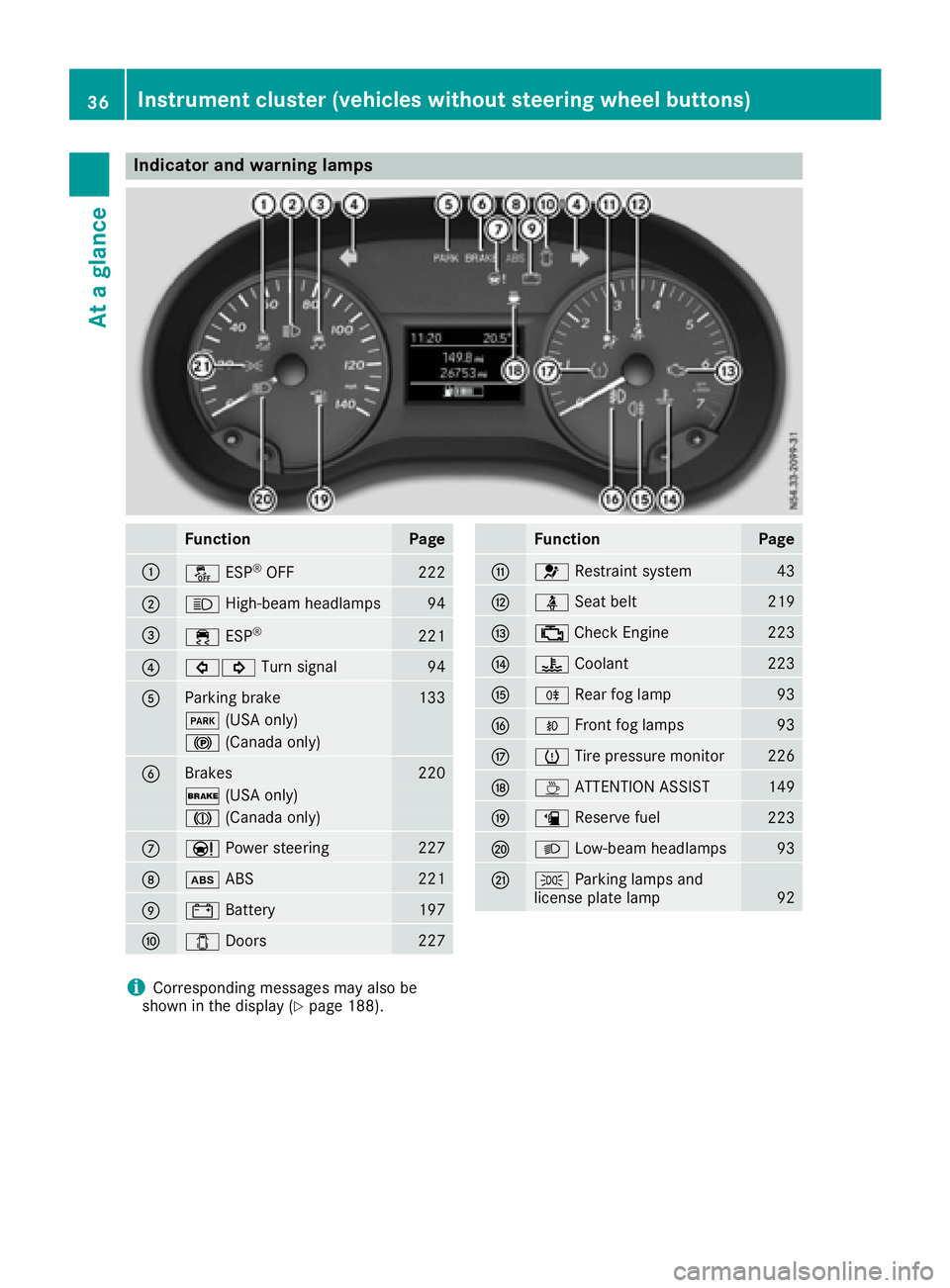
Indicator and warning lamps
FunctionPage
:å ESP®OF F222
;K High-beam headlamps94
=÷ESP®22 1
?#! Turn signal94
AParking brak e133
F (USAonly)
! (Canada only)
BBrakes220
$ (USAonly)
J (Canada only)
CÐPowersteering22 7
Dò ABS221
E# Battery197
F1 Doors227
FunctionPag e
G6 Restrain tsystem43
Hü Seat belt219
I; CheckEngine22 3
J? Coolan t223
KR Rear fog lamp93
LOFrontfog lamp s93
MhTirep ressur emonitor226
NÀ ATTENTION ASSIST149
Oæ Reserve fuel223
PL Low-beam headlamps93
QTParking lamp sand
license plat elamp92
iCorresponding message smay also be
shown in th edisplay (Ypage 188).
36Instrumen tcluster (vehicles without steering wheel buttons)
At ag lance
Page 39 of 310
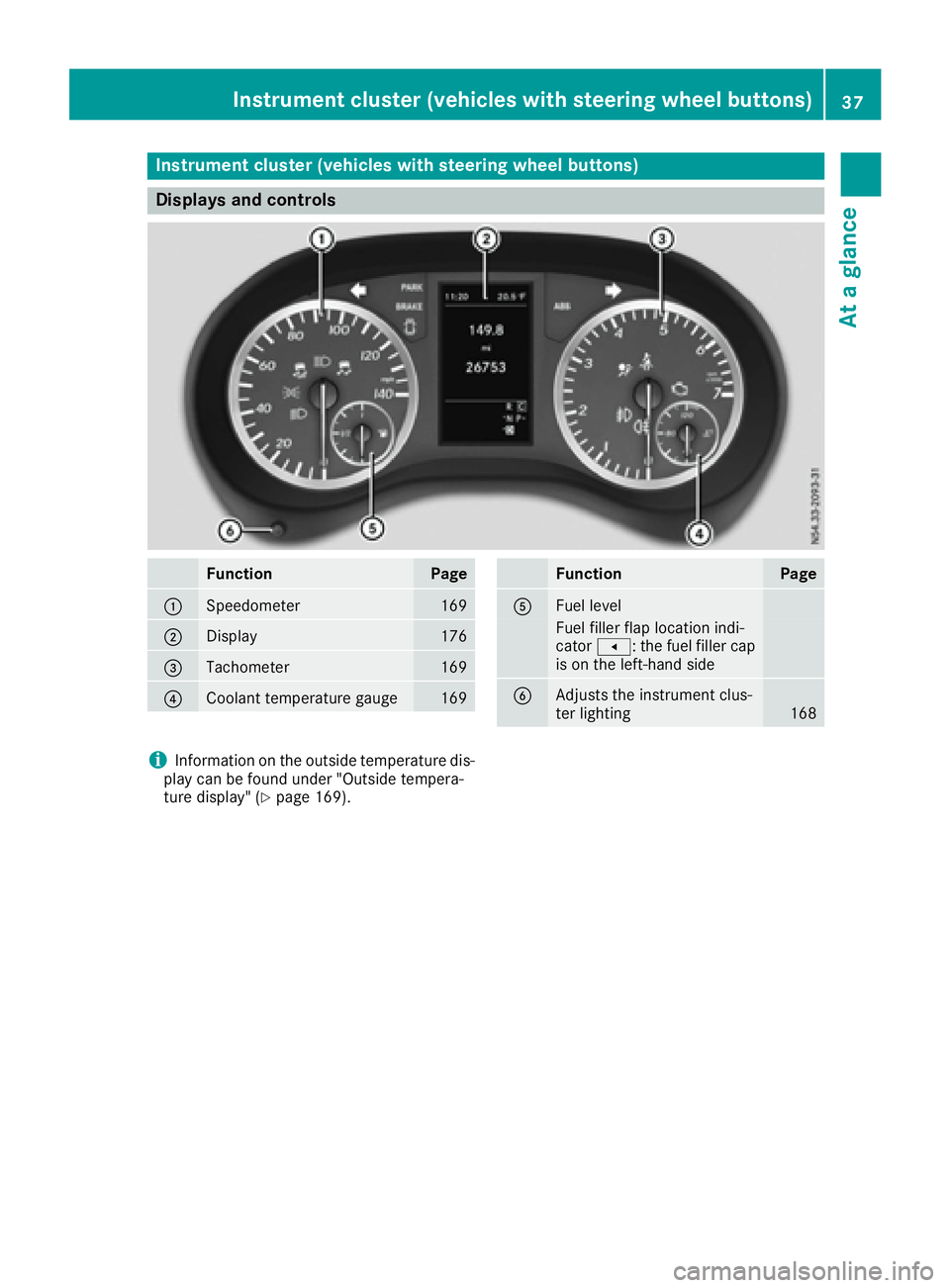
Instrumentcluster (vehicles with steering wheel buttons)
Display sand controls
FunctionPag e
:Speedometer169
;Display176
=Tachometer169
?Coolan ttem perature gauge169
FunctionPag e
AFuellevel
Fue lfiller flap location indi-
cator t:t hefuel filler cap
is on th eleft-han dside
BAdjusts th einstrumen tclus -
te rlighting16 8
iInformation on th eoutside temperature dis-
play can be foun dunder "Outside tempera-
tur ed isplay" (
Ypage 169).
Instrumen tcluster (vehicles with steering wheel buttons)37
At ag lance
Page 40 of 310
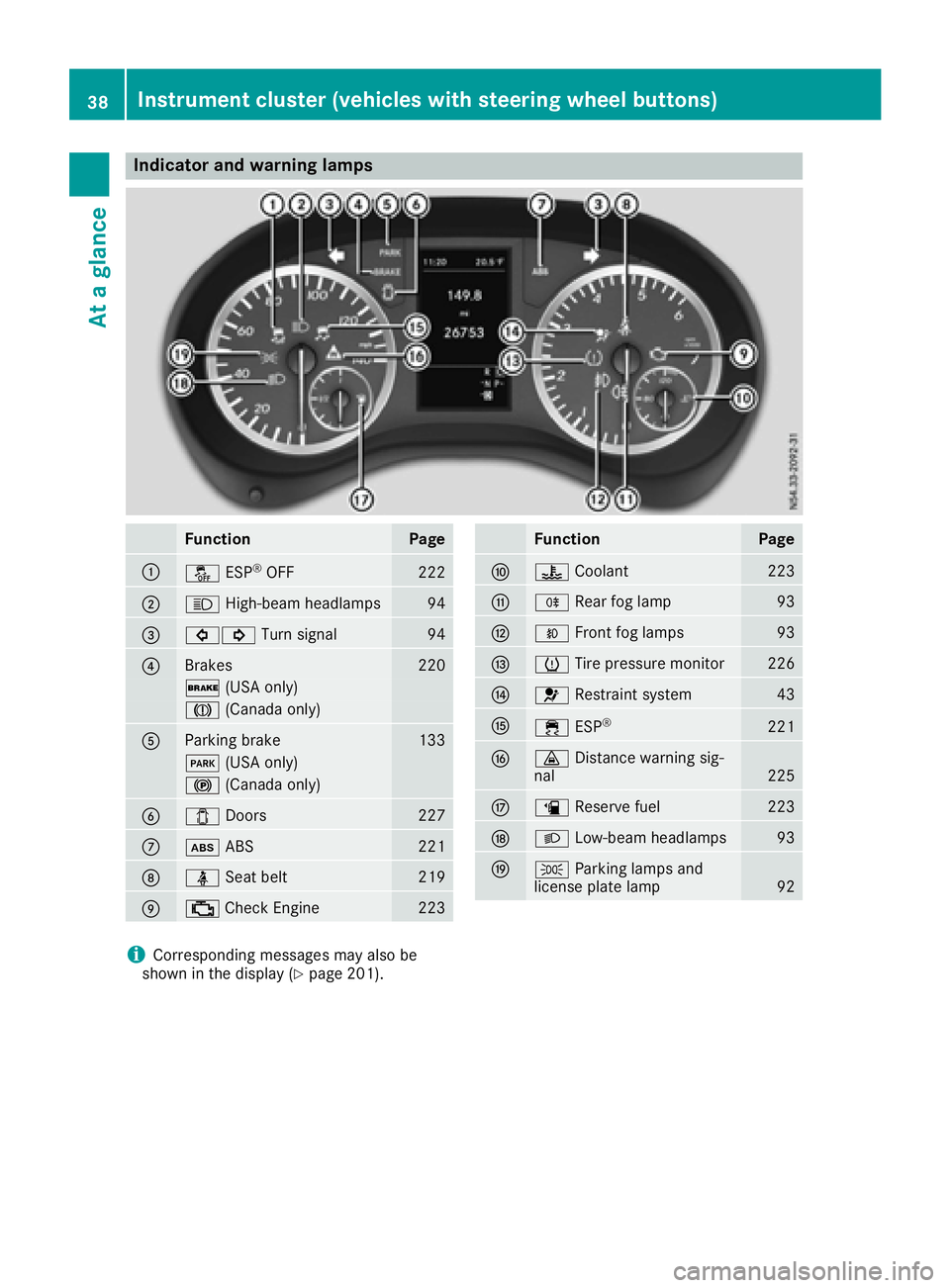
Indicator and warning lamps
FunctionPage
:å ESP®OF F222
;K High-beam headlamps94
=#! Turn signal94
?Brakes220
$ (USAonly)
J (Canada only)
AParking brak e133
F (USAonly)
! (Canada only)
B1Doors227
Cò ABS221
Dü Seat belt219
E; CheckEngine22 3
FunctionPag e
F? Coolan t223
GR Rear fog lamp93
HOFrontfog lamp s93
IhTirep ressur emonitor226
J6 Restrain tsystem43
K÷ ESP®22 1
L· Distanc ewarning sig-
nal22 5
Mæ Reserve fuel223
NL Low-beam headlamps93
OTParking lamp sand
license plat elamp92
iCorresponding message smay also be
shown in th edisplay (Ypage 201).
38Instrumen tcluster (vehicles with steering wheel buttons)
At ag lance
Page 41 of 310
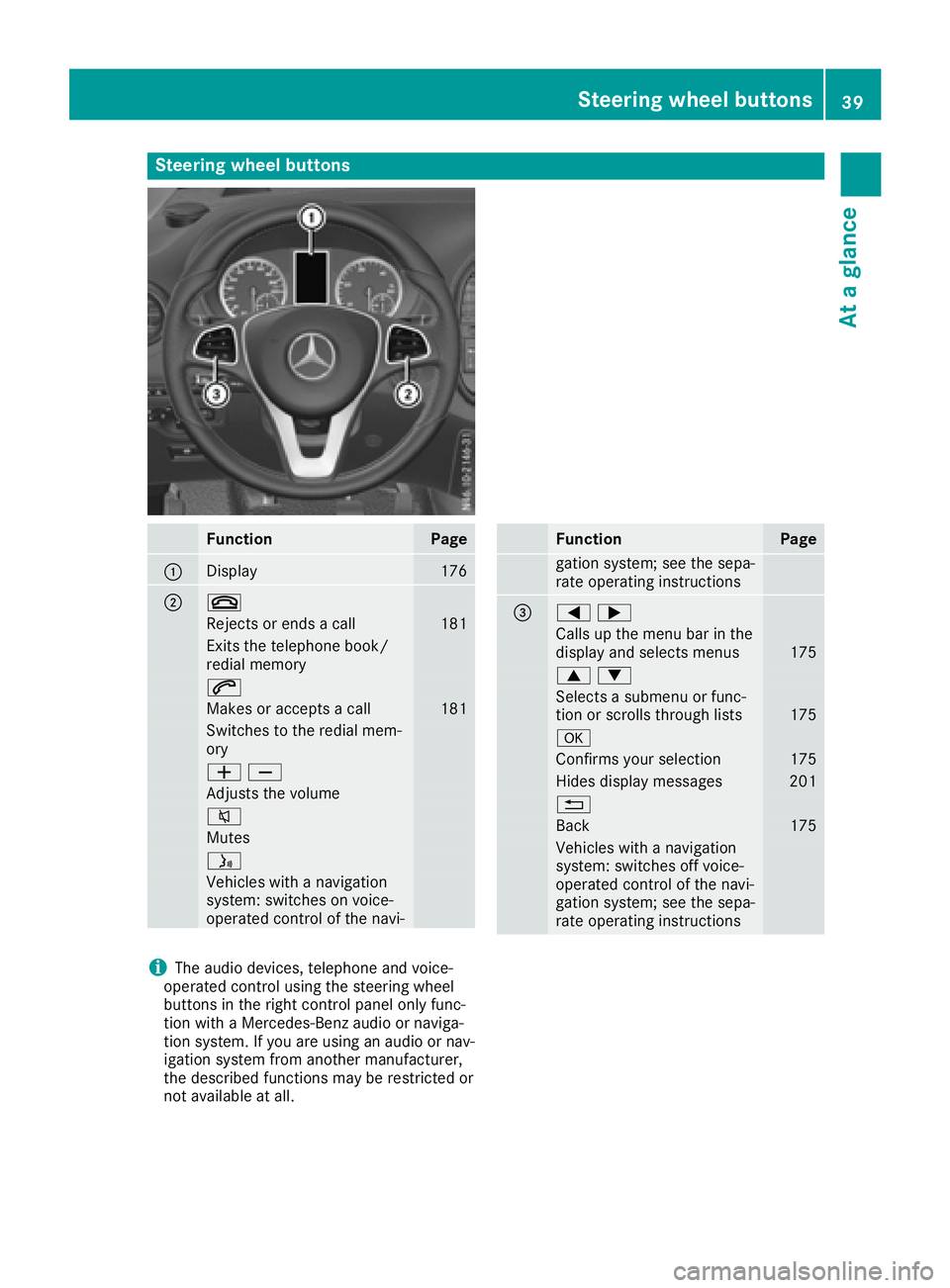
Steering wheel buttons
FunctionPage
:Display176
;~
Rejects or endsacall181
Exitst he telephone book/
redial memory
6
Makes or accepts acall181
Switches to the redial mem-
ory
WX
Adjusts the volume
8
Mutes
ó
Vehicles with anavigation
system :switches on voice-
operated contro lofthe navi-
FunctionPage
gatio nsystem ;see the sepa-
rate operating instructions
==;
Calls up th emenub arinthe
display and select smenus175
9:
Selects asubmenu or func-
tion or scrolls through lists175
a
Confirm syours election175
Hides display messages201
%
Back175
Vehicles with anavigation
system: switches off voice-
operate dcontrol of the navi-
gation system; see the sepa-
rate operating instructions
iThe audi odevices, telephone and voice-
operate dcontrol using the steering wheel
buttons in the right control panel only func-
tion with aMercedes-Benz audi oornaviga-
tion system. If yo uare using an audi oornav-
igation system from another manufacturer,
the described functions may be restricted or
not available at all.
Steering whee lbuttons39
At ag lance
Page 53 of 310
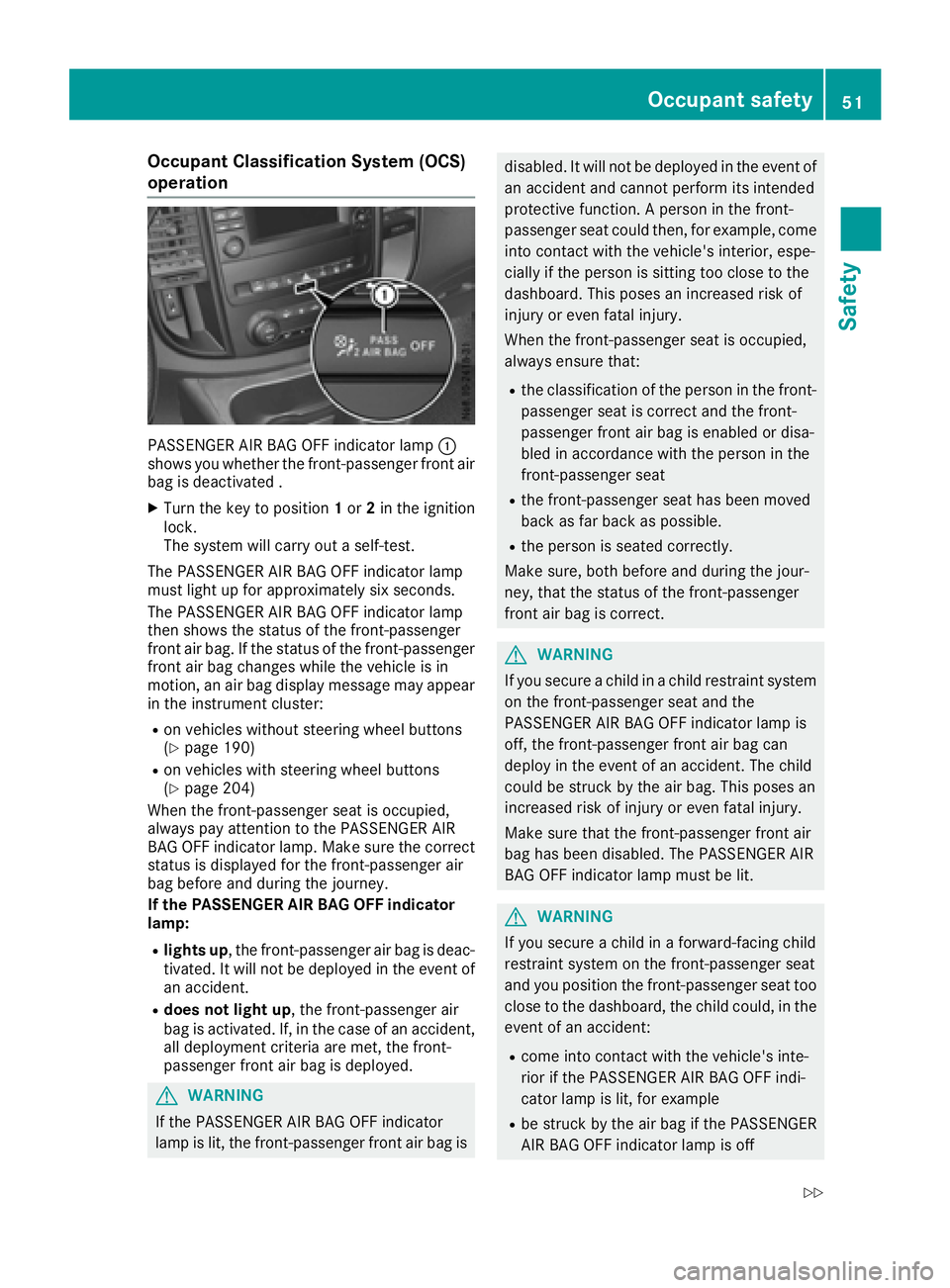
Occupant Classification System (OCS)
operation
PASSENGER AIR BAG OFF indicator lamp:
shows you whether the front-passenger fronta ir
bag is deactivated .
XTurn the key to position 1or 2in the ignition
lock.
The system will carry out aself-test.
The PASSENGER AIR BAG OFF indicator lamp
must light up for approximately six seconds.
The PASSENGER AIR BAG OFF indicator lamp
then shows the status of the front-passenger
fronta ir bag. If the status of the front-passenger
fronta ir bag changes while the vehicle is in
motion ,anair bag display message may appear
in the instrument cluster:
Ron vehicles without steering wheel buttons
(Ypage 190)
Ron vehicles with steering wheel buttons
(Ypage 204)
When the front-passenger seat is occupied,
alwaysp ay attention to the PASSENGER AIR
BAG OFF indicator lamp. Make sure the correct
status is displayed for the front-passenger air
bag before and during the journey.
If the PASSENGER AIR BAG OFF indicator
lamp:
Rlights up ,the front-passenger air bag is deac-
tivated. It will not be deployed in the event of
an accident.
Rdoes not light up,t he front-passenger air
bag is activated. If, in the case of an accident,
all deployment criteria are met, the front-
passenger fronta ir bag is deployed.
GWARNING
If the PASSENGER AIR BAG OFF indicator
lamp is lit, the front-passenger fronta ir bag is
disabled. It will not be deployed in the event of
an accidenta nd cannot perform its intended
protective function .Aperson in the front-
passenger seat could then ,for example, come
into contact with the vehicle's interior, espe-
cially if the person is sitting too close to the
dashboard. This poses an increased risk of
injur yore ven fatal injury.
When the front-passenger seat is occupied,
alwayse nsure that:
Rthe classification of the person in the front-
passenger seat is correct and the front-
passenger fronta ir bag is enabled or disa-
bled in accordance with the person in the
front-passenger seat
Rthe front-passenger seat has been moved
back as far back as possible.
Rthe person is seated correctly.
Make sure, both before and during the jour-
ney, that the status of the front-passenger
fronta ir bag is correct.
GWARNING
If you secure achild in achild restraint system
on the front-passenger seat and the
PASSENGER AIR BAG OFF indicator lamp is
off, the front-passenger fronta ir bag can
deploy in the event of an accident. The child
could be struc kbythe air bag. This poses an
increased risk of injur yoreven fatal injury.
Make sure that the front-passenger fronta ir
bag has been disabled. The PASSENGER AIR
BAG OFF indicator lamp must be lit.
GWARNING
If you secure achild in aforward-facing child
restraint system on the front-passenger seat
and you position the front-passenger seat too close to the dashboard, the child could, in the
event of an accident:
Rcome into contact with the vehicle's inte-
rior if the PASSENGER AIR BAG OFF indi-
cator lamp is lit, for example
Rbe struck by the air bag if the PASSENGER
AIR BAG OFF indicator lamp is off
Occupant safety51
Safety
Z
Page 64 of 310
the electricslidin gdoorusing the corresponding
Å orÆ sliding door button in the center
consol e(
Ypage 75).
Pets in the vehicle
GWARNING
If yo uleave animals unattended or unsecured
in the vehicle, theyc ould press buttons or
switches ,for example.
As aresult, theyc ould:
Ractivate vehicl eequipment and become
trapped ,for example
Ractivate or deactivate systems, thereby
endangering othe rroa du sers
Unsecured animals could also be flung around
the vehicl einthe event of an accident or sud-
de ns teering or braking ,thereb yinjurin gvehi-
cle occupants. There is ariskofana ccident
and injury.
Never leav eanimals unattended in the vehi-
cle .Alway ssecurea nimals properly during
the journey ,e.g.u se asuitabl eanimalt rans-
port box.
Driving safety systems
Overview
In thiss ection, yo uwillf indi nformation about
the following drivin gsafety systems:
REBD ( Ele ctronic Brake Force Distribution)
RABS ( Anti-lock Braking Sys tem)
RBAS ( Brake Assist System)
RESP®(E le ctronic Stability Program)
Important safety notes
If yo ufailtoa dapt your drivin gstyle or if yo uare
inattentive, the drivin gsafety systems can nei-
therr educe the ris kofaccident nor override the
laws of physics .Drivin gsafety systems are
merel yaidsd esig nedtoa ssistdriving. Yo uare
responsibl efor the distance to the vehicl ein
front, for vehicl espeed, braking in good time
and for staying in your lane. Alway sadapt your drivin
gstyle to the prevailing roa dand weather
conditions and maintain asufficient, safe dis-
tance fromo therroa du sers.D rive carefully.
Please note thatt he drivingsafety systems
describe donlyw orko ptimally when:
Rthere is adequate contact between the tires
and the roa dsurface
Ryo uu sewinter tire s(M+ Stires),w iths now
chains if necessary,w hent he roa dconditions
ar ew intry
Rthe spee dinformation determine dbythe
vehicl eiswithint he legall yprescribe ddisplay
accuracy
Pa yp articular attentio ntothe information
regarding tires, coding of the whee lsizeg roups,
tire trea dand winter operatio nunder "Wheels
and tires" (
Ypage 267).
ABS (Anti-lock Braking System)
General notes
ABS regulate sbrake pressure in such awaythat
the wheels do not lock when yo ubrake. This
allows yo utocontinue steering the vehicl ewhen
braking.
The ò warning lamp in the instrument cluster
lights up when the ignition is switched on. The
lamp goes ou twhent he engine starts running.
Important safety notes
Observe the important safety guideline sfor the
drivin gsafety system(Ypage 62).
ABS works fromas peedof abou t5mph
(8 km/h), regardles sofroad-surface conditions.
ABS works on slippery surfaces ,evenw heny ou
onl ybrake gently.
GWARNING
If ABS is faulty, the wheels could lock when
braking .The steerability an dbraking charac-
teristics maybes everel yimpaired. Addition-
ally ,fur the rdrivin gsafety systems ar edeac-
tivated .Ther eisani ncreasedd angerofs kid-
ding and accidents.
Drive on carefully. Hav eABS checked imme-
diately at aquali fied specialis tworkshop.
62Driving safet ysystems
Safety
Page 65 of 310
If ABS is malfunctioning, theòwarning lamp
(Ypage 221) lights up whil ethe engine is run-
ning and the display shows amessage:
Ron vehiclesw ithoutsteering wheel buttons
(Ypage 189)
Ron vehiclesw ith steering wheel buttons
(Ypage 203)
BAS, Hill Start Assist and ESP®and its driving
safety systems and other driving systems also
fail .Observe the notes on the òwarning
lamp and the display messages.
Braking
If ABS intervenes when braking, you wil lfeel a
pulsating in the brake pedal.
The pulsating brake pedalc an be an indication
of hazardous road conditions and functions as a
reminder to take extra care whiled riving.
XIf ABS intervenes:continue to depresst he
brake pedalw ith force until the braking sit-
uatio niso ver.
XTo make afull brake application: depress
the brake pedalw ith full force.
BAS (Brake Assist System)
General notes
BAS operates in emergency braking situations.
If you depresst he brake pedalq uickly, BAS
automatically boosts the braking force, thus
shortening the stopping distance.
Important safety notes
Observe the important safety guidelines for the
driving safety system (Ypage 62).
GWARNING
If BAS is malfunctioning, the braking distance
in an emergency braking situation is
increased .There is arisk of an accident.
In an emergency braking situation, depress
the brake pedalw ith full force. ABS prevents
the wheel sfrom locking.
If BAS is malfunctioning, the ÷warning lamp
lights up whil ethe engine is running
(
Ypage 221) and the display shows amessage:
Ron vehiclesw ithoutsteering wheel buttons
(Ypage 193)
Ron vehiclesw ith steering wheel buttons
(Ypage 207)
Braking
XKeep the brake pedalf irmly depressed until
the emergency braking situation is over.
ABS prevents the wheel sfrom locking.
The brakes willf unction as usual once you
release the brake pedal. BAS is deactivated.
EBD (electroni cbrake force distribu-
tion)
General notes
EBD monitors and controls the brake pressure
to the rear wheels. This enables EBD to improve handling during braking.
Important safety notes
Observe the important safety guidelines for the
driving safety system (Ypage 62).
GWARNING
If EBD is malfunctioning, the rear wheelsc an
lock, e.g. under full braking. This increases the
risk of skidding and an accident.
You shoul dtherefore adapt you rdriving style
to the different handling characteristics. Have
the brake system checked at aqualifieds pe-
cialist workshop.
If EBD is malfunctioning, the $warning lamp
(
Ypage 220) lights up whil ethe engine is run-
ning and the display shows amessage.
Ron vehiclesw ithoutsteering wheel buttons
(Ypage 192)
Ron vehiclesw ith steering wheel buttons
(Ypage 206)
Other driving systems and driving safety sys-
tems then also fail.
Driving safety systems63
Safety
Z
Page 66 of 310
ESP®(Electronic Stability Program)
General notes
ESP®monitors driving stabilitya nd detectsa
tendenc yofthevehicle to understeer or over-
steer (skidding) in good time. If ESP
®detects
that th evehicle is deviatin gfromt hedirection
desired by th edriver, oneorm orew heels are
braked to stabilizet hevehicle .The engine out-
put is also modified to keep th evehicle on the
desired course within physical limits. ESP
®can
also stabilizet hevehicle durin gbraking.
ESP
®also monitors traction,i .e.p ower trans-
mission between th etires and th eroad surface.
The integrate dtraction control support syou
when pullinga way or acceleratin gonwet,slip-
pery or slickr oads. Should th edrivew heels spin,
traction control brakes them individually. In
addition,g reaterdrivet orque is transmitte dto
th ew heel or wheels with traction.Ift raction on
th er oad surface is no tsufficient ,even ESP
®will
no tallow you to pull away without difficulty. The
type of tires and total weightoft hevehicle as
well as th egradientoft heroad also play acru-
cial role .Tractio ncontrol remains active if you
deactivate ESP
®.
If the h warning lamp in th einstrumen tclus-
te rg oes out before beginnin gthe journey, ESP
®
is automaticall yactive.
The h warning lamp in th einstrumen tcluster
flashes when ESP
®intervenes:
XDo no tdeactivate ESP®unde rany circum-
stances.
Xwhen driving off ,apply as little throttle as
possible.
Xadapt your speeda nd driving style to th epre-
vailin groad conditions.
Important safety notes
Observ ethe important safety guidelines for the
driving safety system (Ypage 62).
GWARNING
If ESP
®is malfunctionin gitwill notprovide
any vehicle stabilization. Thereisani ncreased
risk of skiddingorofana ccident.
Exercise caution when continuing to drive.
Hav eESP
®checked at aqualified specialist
workshop.
!Do no trun th evehicle on aroller dynamom-
eter (e.g. for performanc etests) .Ifyou must
operate th evehicle on aroller dynamometer,
please consult aqualified specialist workshop
in advance. You coul dotherwise damag ethe
driv etrain or th ebrak esystem.
If ESP
®is malfunctioning, the hwarning
lamp (Ypage 221) lightsupc ontinuously while
th ee ngine is runnin gand th edisplay showsa
message.
Ron vehicle swithout steering wheel buttons
(Ypage 193)
Ron vehicle swith steering wheel buttons
(Ypage 207)
ESP®is deactivate diftheå warning lamp in
th ei nstrumentc lusterislit when th eengine is
running.
Only use wheels with th erecommended tire
sizes. Only then will ESP
®function properly.
Deactivating/activatin gESP®
GWARNING
If you deactivate ESP
®,E SP®no longer sta-
bilizes th evehicle .Thereisani ncreased risk
of skiddinga nd an accident.
Only deactivate ESP
®in th esituations descri-
bed in th efollowing.
It may be best to deactivate ESP
®in th efollow-
ing situations:
Rwhen usings nowc hains
Rin deep snow
Ron sandorg ravel
Activate ESP®as soon as th esituations descri-
bed abovenol onger apply. Otherwise, ESP®
assistance for stabilizing th evehicle will remain
significantly reduced, even if th evehicle starts
to skid.
If you deactivate ESP
®:
Rthe å warning lamp in th einstrumen tclus-
te rlightsu p.
Rthe÷ warning lamp in th einstrumen tclus-
te rf lashes if th ewheels are spinning.
RESP®assistance for stabilizing th evehicle in
th el ower speedr ange up to approximately
37 mph (60 km/h) is significantly reduced.
Rengine torque is no longer limited and the
driv ewheels are able to spin
64Driving safety systems
Safety