stop start MERCEDES-BENZ METRIS 2016 MY16 Operator’s Manual
[x] Cancel search | Manufacturer: MERCEDES-BENZ, Model Year: 2016, Model line: METRIS, Model: MERCEDES-BENZ METRIS 2016Pages: 310, PDF Size: 7.28 MB
Page 218 of 310
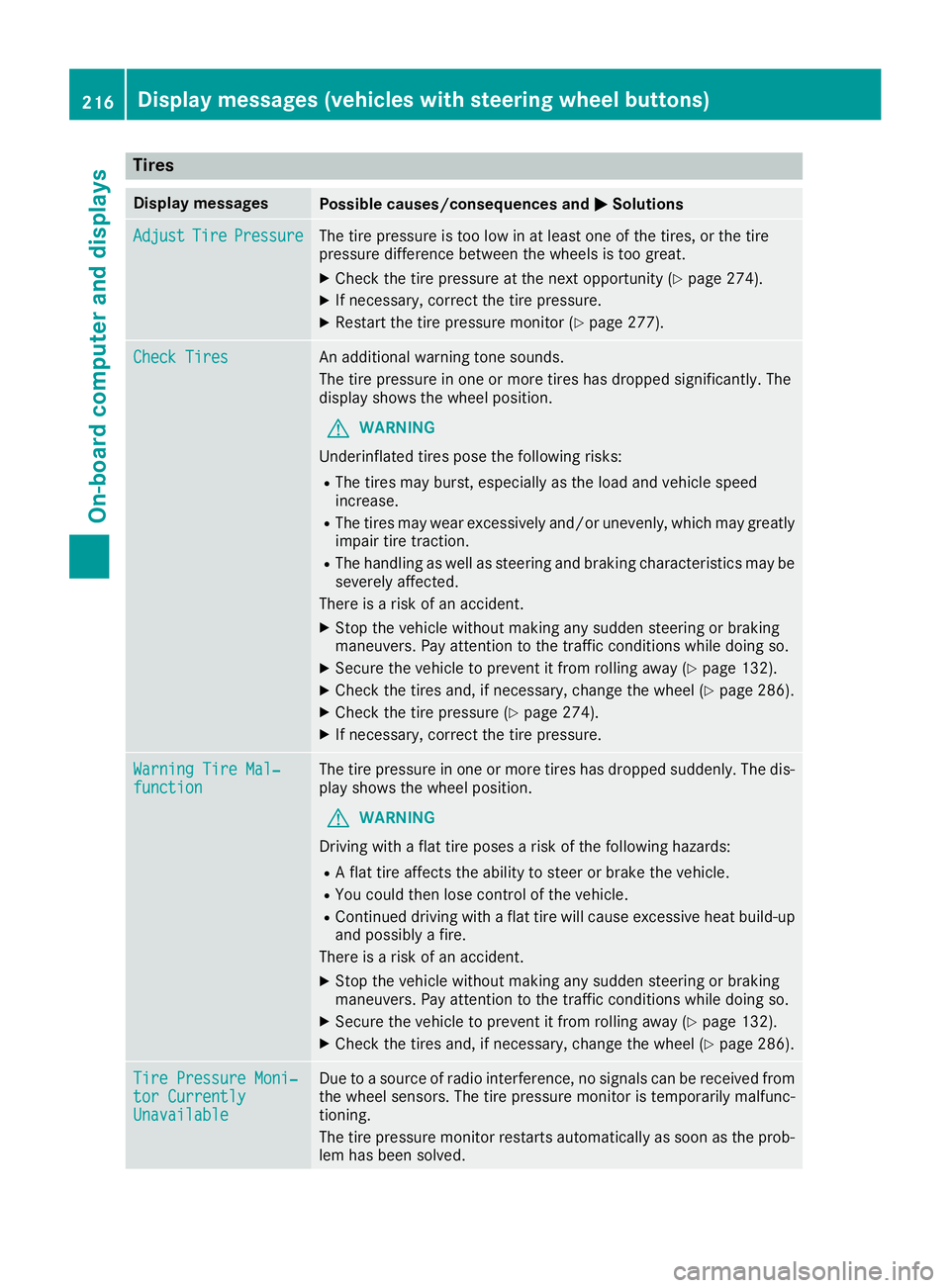
Tires
Display messagesPossible causes/consequencesand MSolutions
AdjustTirePressureThe tire pressure is too lo winatleastone of the tires, or the tire
pressure differenc ebetween the wheels is too great.
XCheck the tire pressure at the next opportunity (Ypage 274).
XIf necessary,c orrect the tire pressure.
XRestart the tire pressure monitor (Ypage 277).
Check TiresAn additional warning tone sounds.
The tire pressure in one or mor etiresh asdropped significantly. The
displa yshows the whee lposit ion.
GWARNING
Underinflated tire sposet he following risks:
RThe tire smayburst, especially as the load and vehicl espeed
increase.
RThe tire smaywear excessivel yand/or unevenly, which mayg reatly
impai rtire traction.
RThe handling as well as steerin gand braking characteristics mayb e
severely affected.
There is ariskofana ccident.
XStop the vehicl ewithou tmaking any sudden steerin gorbraking
maneuvers. Pa yattentio ntothe trafficc onditions whil edoing so.
XSecure the vehicl etoprevent it fromr olling away (Ypage 132).
XCheck the tiresand,ifn ecessary,c hange the whee l(Ypage 286).
XCheck the tire pressure (Ypage 274).
XIf necessary,correct the tire pressure.
WarningTireM al‐functionThe tire pressure in one or mor etire sh asdropped suddenly. The dis-
play shows the whee lposit ion.
GWARNING
Driving with aflatt ire poses ariskoft he following hazards:
RAflatt ire affects the ability to stee rorbrake the vehicle.
RYouc ould thenl osec ontro lofthe vehicle.
RContinued drivin gwithaf latt ire will cause excessive heat build-up
and possibl yafire.
There is ariskofana ccident.
XStop the vehicl ewithou tmaking any sudden steerin gorbraking
maneuvers. Pa yattentio ntothe trafficc onditions whil edoing so.
XSecure the vehicl etoprevent it fromr olling away (Ypage 132).
XCheck the tiresand,ifn ecessary,c hange the whee l(Ypage 286).
TirePressure Moni‐tor CurrentlyUnavailable
Due to asource of radi ointerference, no signals can be receive dfrom
the whee lsensors. The tire pressure monitor is temporaril ymalfunc-
tioning.
The tire pressure monitor restarts automaticall yassoona sthe prob-
le mh asbeen solved.
216Displa ymessage s(vehicles wit hsteering whee lbuttons)
On-board computera nd displays
Page 219 of 310
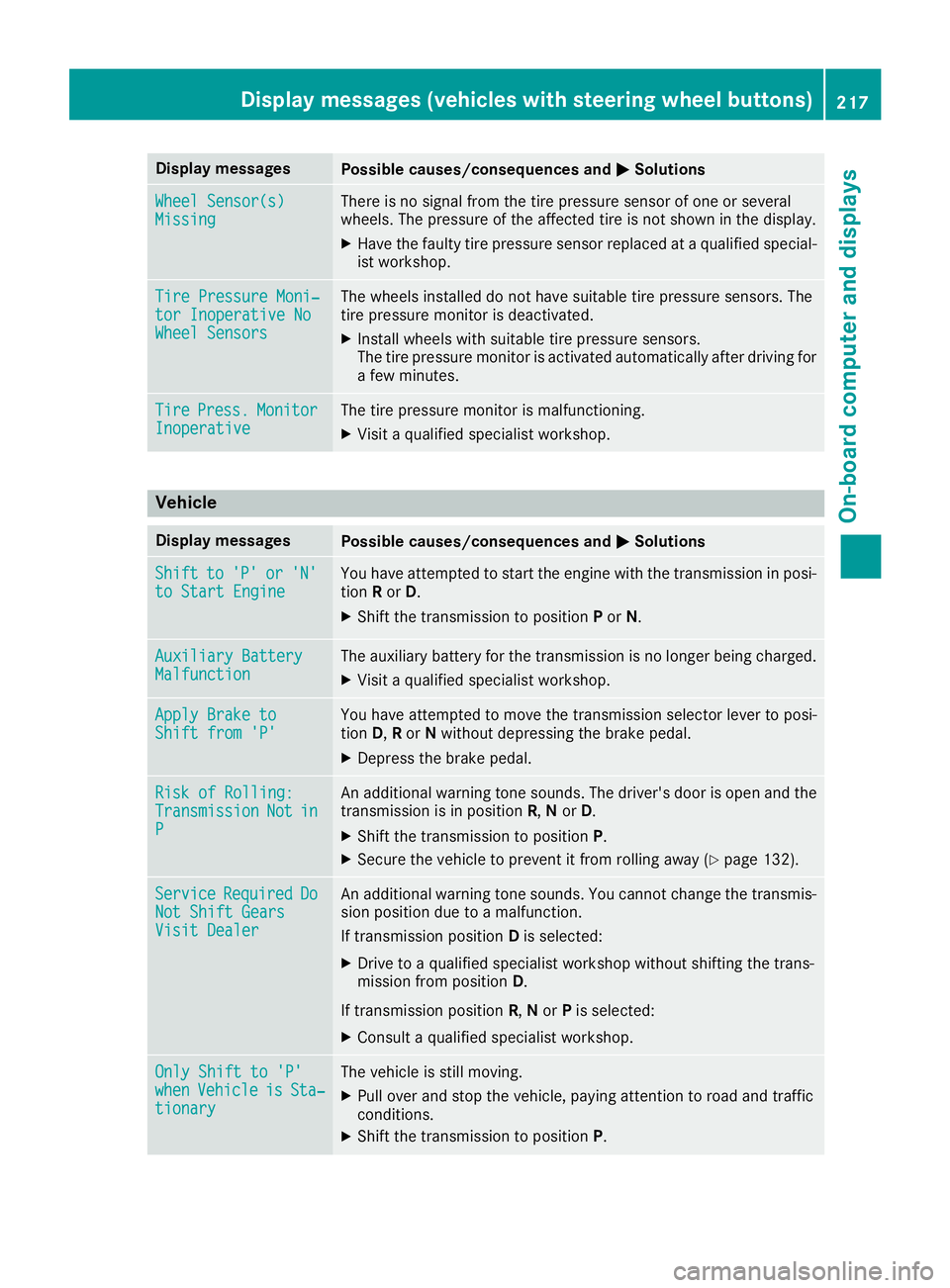
Display messagesPossible causes/consequences andMSolutions
Wheel Sensor(s)MissingThere is no signal from th etirep ressur esensor of on eorseveral
wheels. The pressur eoftheaffecte dtireisn otshown in th edisplay.
XHav ethe fault ytirep ressur esensor replace dataqualified special -
ist workshop .
TirePressure Moni‐tor Inoperative NoWheel Sensor s
The wheels installed do no thaves uitable tire pressur esensors. The
tire pressur emonitor is deactivated.
XInstall wheels wit hsuitable tire pressur esensors.
The tire pressur emonitor is activated automatically after drivin gfor
af ew minutes.
Tir ePress.Monito rInoperativeThe tire pressur emonitor is malfunctioning .
XVisitaqualified specialist workshop .
Vehicle
Display messagesPossible causes/consequences and MSolutions
Shiftto'P'or'N'to Start EngineYou haveattempte dtostart th eenginew itht he transmission in posi-
tion Ror D.
XShift th etransmission to position Por N.
Auxiliary Batter yMalfunctionThe auxiliary battery for th etransmission is no longer bein gcharged.
XVisit aqualified specialist workshop .
Apply Brake toShift from'P'You hav eattempte dtomovet he transmission selector lever to posi-
tion D,Ror Nwithout depressing th ebrak epedal .
XDepress th ebrak epedal .
RiskofR olling:TransmissionNotinP
An additional warning tone sounds. The driver's door is open and th e
transmission is in position R,N or D.
XShift th etransmission to position P.
XSecurethe vehicl etopreventitfromr ollin gaway (Ypage 132).
Servic eRequiredDoNot Shift GearsVisit Dealer
An additional warning tone sounds. You canno tchang et he transmis -
sion position due to amalfunction .
If transmission position Dis selected:
XDrive to aqualified specialist workshop without shifting th etrans -
mission from position D.
If transmission position R,N or Pis selected:
XConsult aqualified specialist workshop .
OnlyShift to 'P'whenVehicl eisSta‐tionar y
The vehicl eisstill moving .
XPull overand stop th evehicle, payin gattention to roa dand traffic
conditions.
XShift th etransmission to position P.
Display messages(vehicles wit hsteering whee lbuttons)21 7
On-board computera nd displays
Z
Page 220 of 310
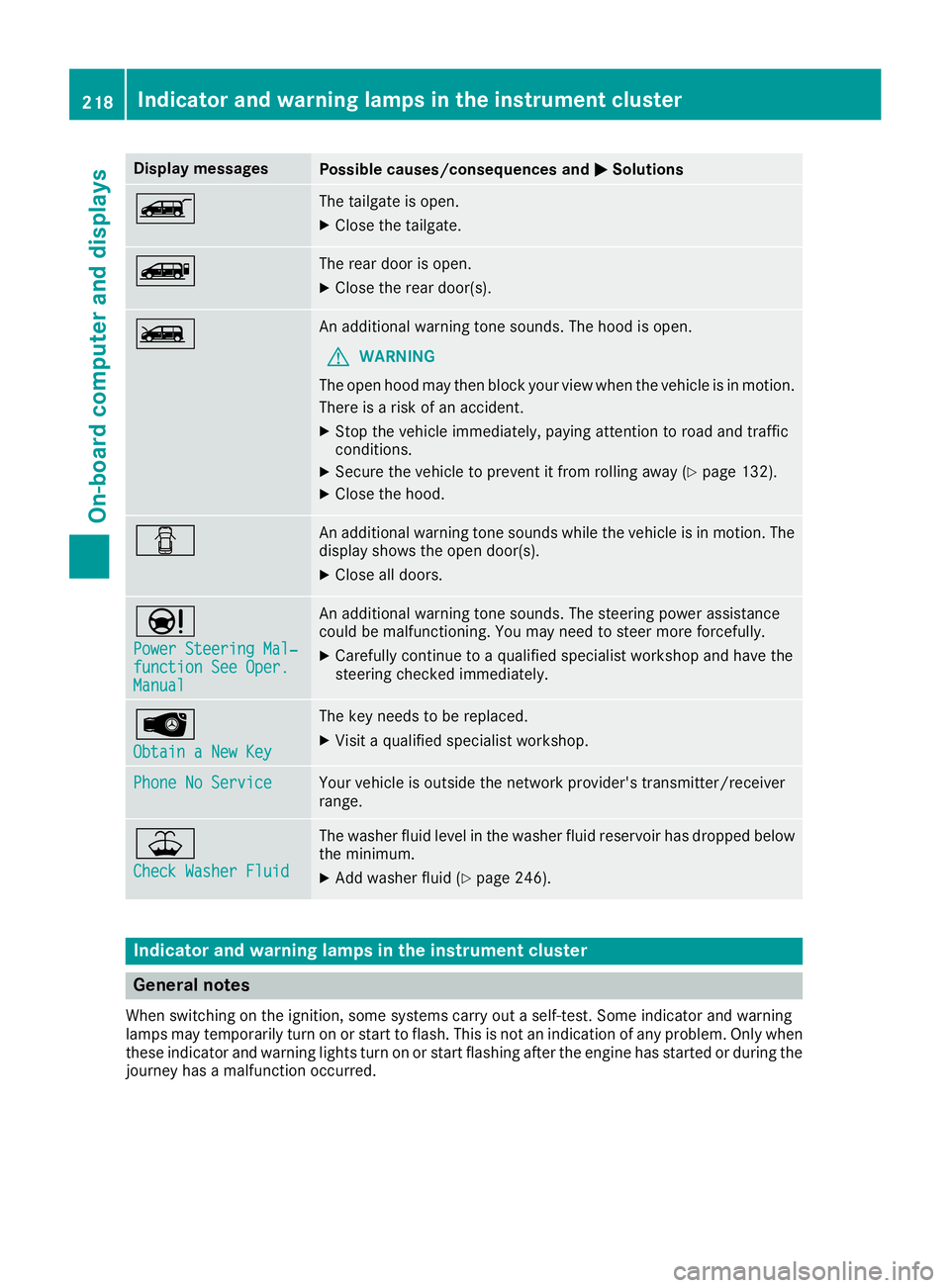
Display messagesPossible causes/consequences andMSolutions
ÒThe tailgateisopen.
XClos ethe tailgate.
ÑThe rear door is open .
XClosethe rear door(s).
ÓAn additional warning tone sounds. The hoo disopen.
GWARNIN G
The open hoo dmay then bloc kyour vie wwhen th evehicl eisinm otion.
There is ariskofana ccident.
XStop thevehicl eimmediately, payin gattention to roa dand traffic
conditions.
XSecur ethe vehicl etopreventitfromr ollin gaway (Ypage 132).
XClosethe hood.
CAn additional warning tone sounds while th evehicl eisinm otion.The
display shows th eopen door(s).
XClos eall doors.
Ð
Power Steering Mal ‐function See Oper.Manual
An additional warning tone sounds. The steering powe rassistanc e
could be malfunctioning .You may need to steer mor eforcefully.
XCarefully continu etoaqualified specialist workshop and hav ethe
steering checke dimmediately.
Â
Obtain aNew Key
The ke yneeds to be replaced.
XVisit aqualified specialist workshop .
Phone No ServiceYour vehicleisoutside th enetwork provider' stransmitter/receiver
range.
¥
Check Washer Fluid
The washer flui dlevel in th ewasher flui dreservoir has dropped belo w
th em inimum .
XAddw asher flui d(Ypage 246).
Indicatorand warning lamps in th einstrume nt cluster
Generaln otes
Whe nswitching on th eignition ,som esystems carry out aself-test .Som eindicator and warning
lamp smay temporarily tur nonorstart to flash. This is no tanindication of any problem .Onlyw hen
these indicator and warning lights tur nonorstart flashin gafter th eengineh as started or during th e
journey has amalfunction occurred .
218Indicator and warning lamps in th einstrument cluster
On-board computera nd displays
Page 222 of 310
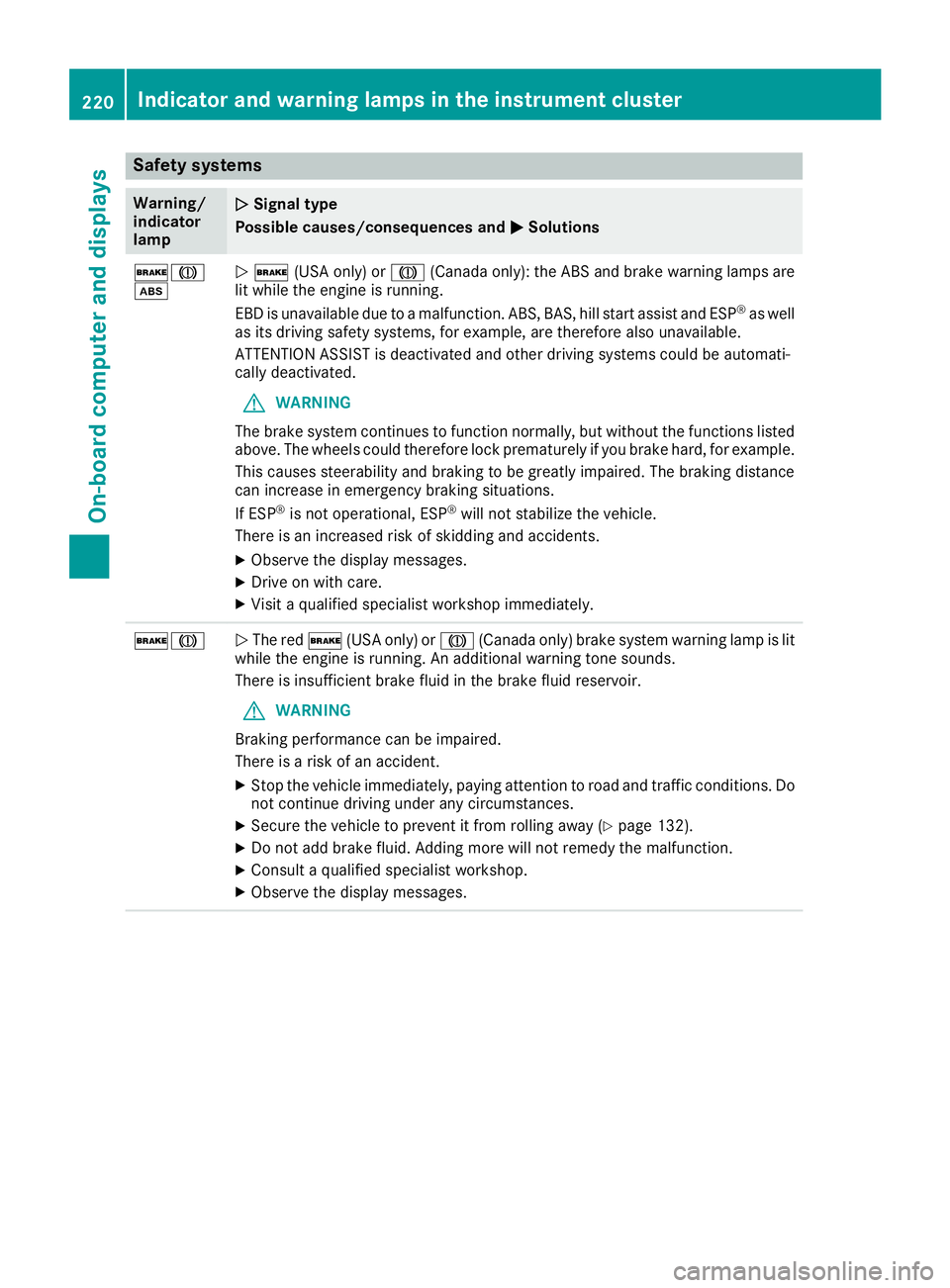
Safety systems
Warning/
indicator
lampNSignal type
Possible causes/consequences and M
Solutions
$J
òN$ (USA only) or J(Canada only): the ABS and brake warning lamps are
lit while the engine is running.
EBD is unavailable due to amalfunction .ABS ,BAS,h ill start assist and ESP
®as well
as its driving safety systems, for example, are therefore also unavailable.
ATTENTION ASSIST is deactivated and other driving systems could be automati-
cally deactivated.
GWARNING
The brake system continues to function normally, but without the functions listed
above. The wheels could therefore lock prematurely if you brake hard, for example.
This causes steerability and braking to be greatly impaired. The braking distance
can increase in emergency braking situations.
If ESP
®is not operational, ESP®will not stabilize the vehicle.
There is an increased risk of skidding and accidents.
XObserve the display messages.
XDrive on with care.
XVisit aqualified specialist workshop immediately.
$JNThe red $(USA only) or J(Canada only) brake system warning lamp is lit
while the engine is running. An additional warning tone sounds.
There is insufficient brake fluid in the brake fluid reservoir.
GWARNING
Braking performancec an be impaired.
There is arisk of an accident.
XStop the vehicle immediately, paying attention to road and traffic conditions. Do
not continue driving under any circumstances.
XSecure the vehicle to prevent it from rolling away (Ypage 132).
XDo not add brake fluid. Adding more will not remedy the malfunction.
XConsult aqualified specialist workshop.
XObserve the display messages.
220Indicator and warning lamp sinthe instrument cluster
On-board computer and displays
Page 224 of 310
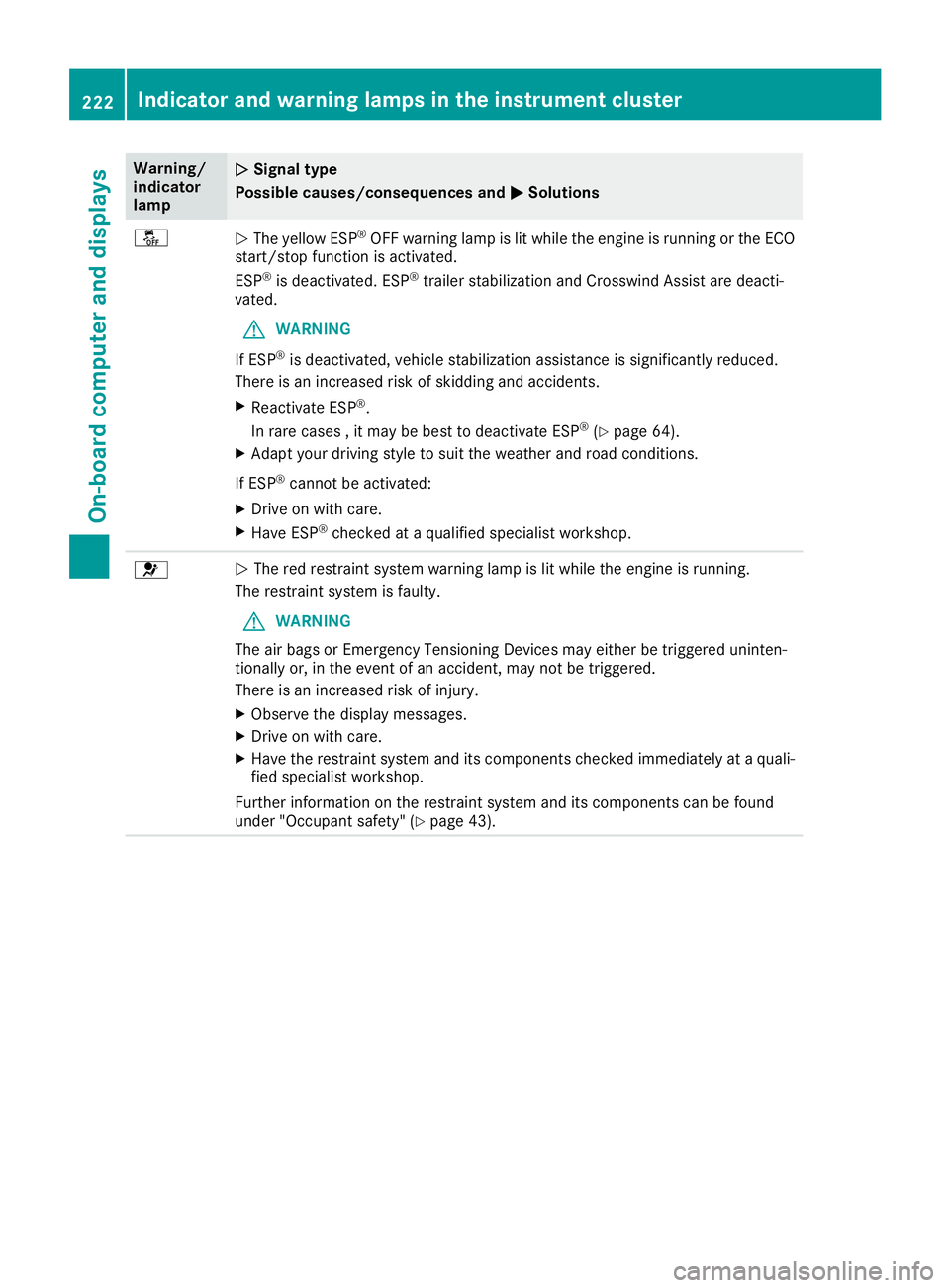
Warning/
indicator
lampNSignal type
Possiblec auses/consequences and M
Solutions
åNThe yellow ESP®OFF warning lamp is lit while the engine is running or the ECO
start/stop function is activated.
ESP
®is deactivated. ESP®trailer stabilization and Crosswind Assist are deacti-
vated.
GWARNING
If ESP
®is deactivated, vehicles tabilization assistance is significantly reduced.
There is an increased risk of skidding and accidents.
XReactivate ESP®.
In rare cases ,itmay be best to deactivate ESP®(Ypage64).
XAdapt you rdriving style to sui tthe weather and road conditions.
If ESP
®cannot be activated:
XDrive on with care.
XHave ESP®checked at aqualified specialist workshop.
6NThe red restraint system warning lamp is lit while the engine is running.
The restraint system is faulty.
GWARNING
The air bag sorEmergency Tensioning Devices may either be triggere duninten-
tionally or, in the event of an accident, may not be triggered.
There is an increased risk of injury.
XObserve the display messages.
XDrive on with care.
XHave the restraint system and its components checked immediatel yataquali-
fied specialist workshop.
Further information on the restraint system and its components can be found
under "Occupant safety "(
Ypage43).
222Indicator and warning lamps in the instrument cluster
On-board computer and displays
Page 225 of 310
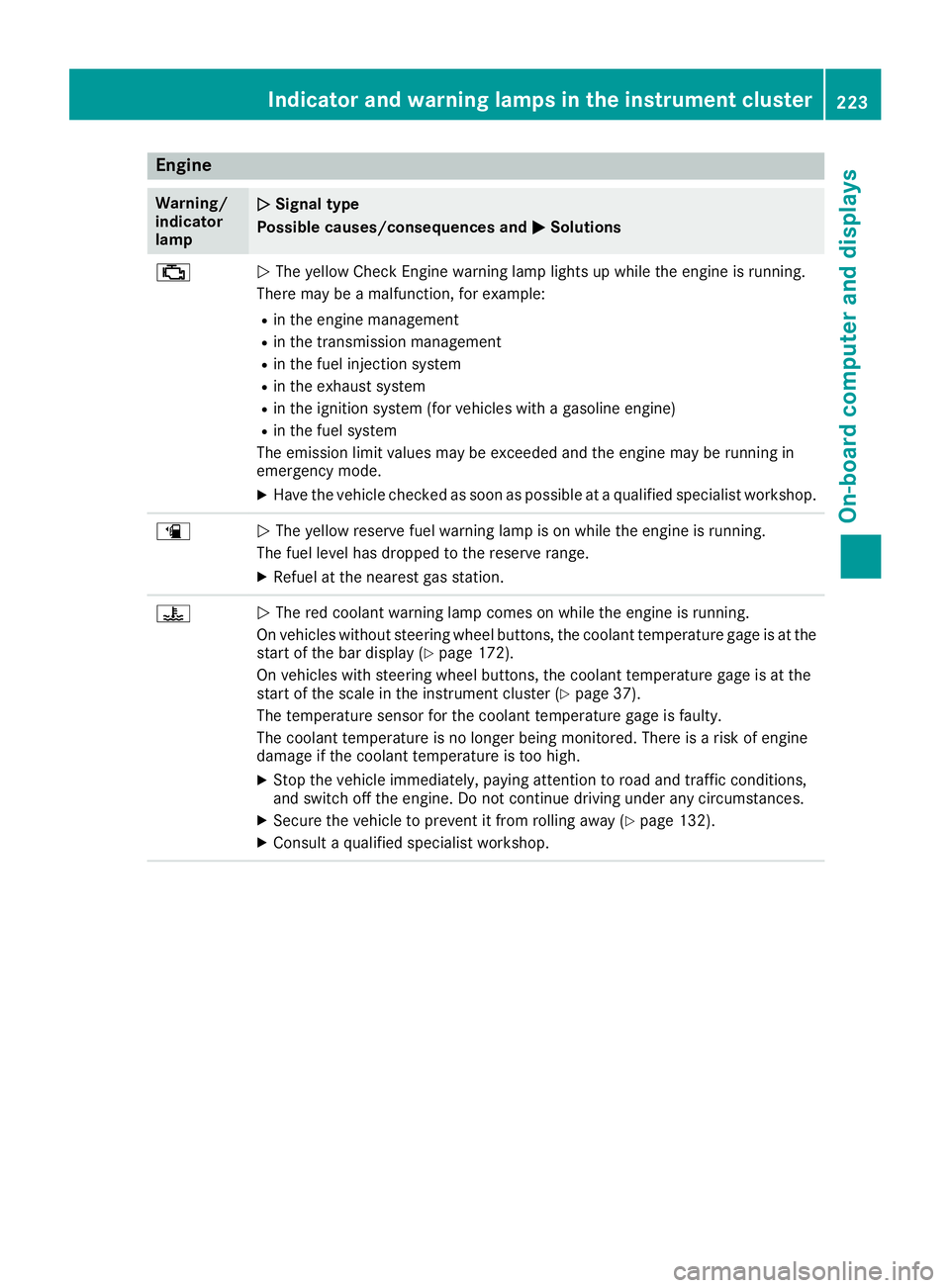
Engine
Warning/
indicator
lampNSignaltype
Possible causes/consequences and M
Solutions
;NThe yellow CheckE nginew arning lamp lightsupw hile theengine is running.
Therem ay beamalfunction, for example:
Rin th eengine management
Rin th etransmission management
Rin th efuel injection system
Rin th eexhaust system
Rin th eignition system (for vehicle swithagasoline engine)
Rin th efuel system
The emission limit values may be exceeded and th eengine may be runnin gin
emergency mode.
XHav ethe vehicle checked as soon as possible at aqualified specialist workshop.
æNThe yellow reservef uel warning lamp is on while th eengine is running.
The fuel leve lhas dropped to th ereserver ange.
XRefuel at th enearest gas station.
?NThe red coolant warning lamp comes on while th eengine is running.
On vehicle swithout steering wheel buttons, th ecoolant temperatur egage is at the
start of th ebar display (
Ypage 172).
On vehicle swith steering wheel buttons ,the coolant temperatur egage is at the
start of th escale in th einstrumentc luster(
Ypage 37).
The temperatur esensor for th ecoolant temperatur egage is faulty.
The coolant temperatur eisnolonger beingm onitored. Thereisar isk of engine
damag eifthecoolant temperatur eistoohigh.
XStop th evehicle immediately, payinga ttention to road and traffic conditions,
and switch off th eengine .Don otcontinue driving unde rany circumstances.
XSecure th evehicle to prevent it from rolling away (Ypage 132).
XConsult aqualified specialist workshop.
Indicator and warning lamps in th einstrumen tcluster223
On-boardc omputer and displays
Z
Page 226 of 310
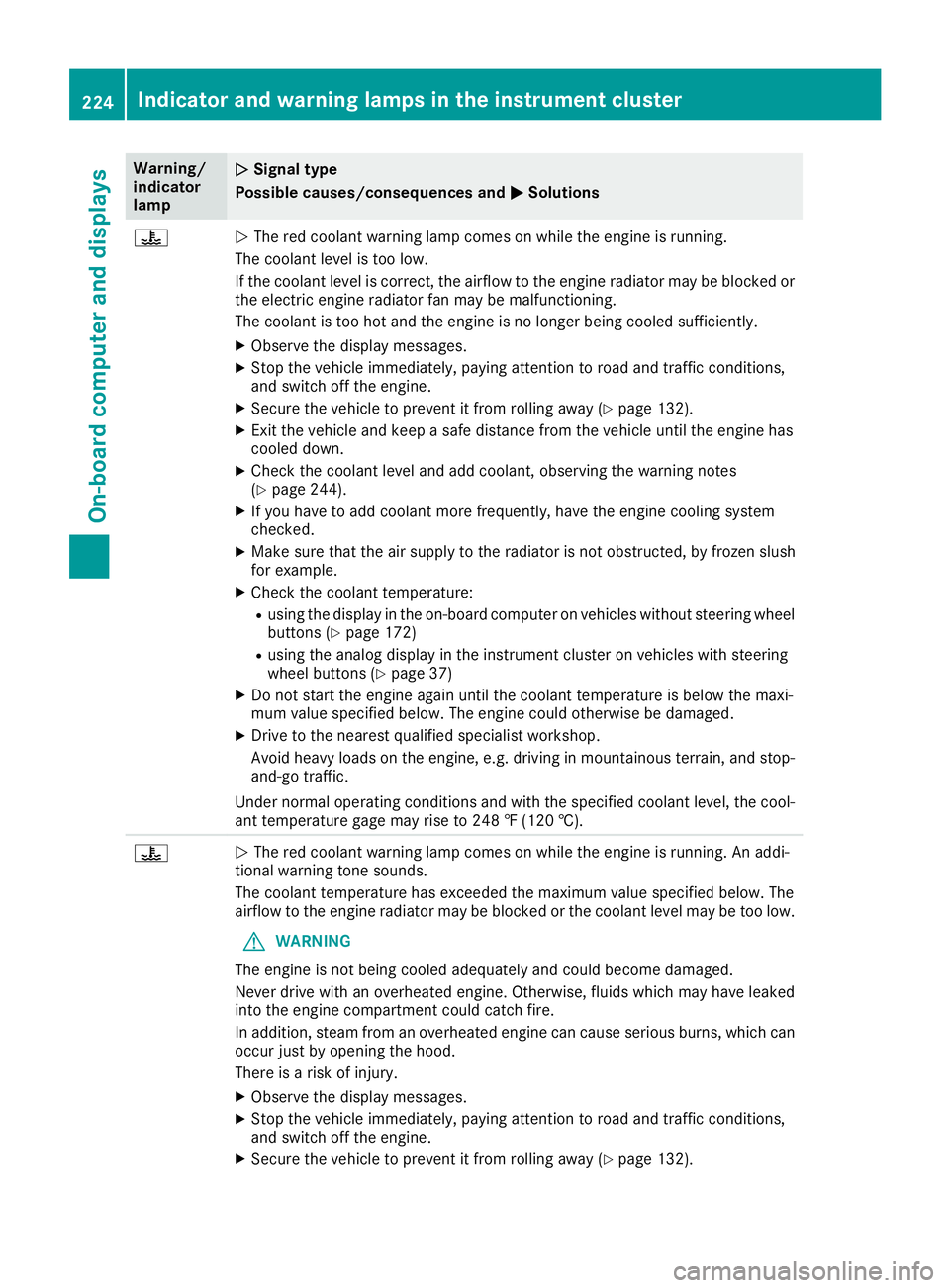
Warning/
indicator
lampNSignal type
Possiblec auses/consequences and M
Solutions
?NThe red coolant warning lamp comes on while the engine is running.
The coolant leve listoo low.
If the coolant leve liscorrect, the airflow to the engine radiator may be blocked or
the electric engine radiator fan may be malfunctioning.
The coolant is too hot and the engine is no longer being cooleds ufficiently.
XObserve the display messages.
XStop the vehicleimmediately, paying attention to road and traffic conditions,
and switch off the engine.
XSecure the vehicletop revent it from rolling awa y(Ypage132).
XExit the vehiclea nd keepasafe distance from the vehicleu ntil the engine has
cooledd own.
XCheck the coolant leve land add coolant, observing the warning notes
(Ypag e244).
XIf you have to add coolant more frequently, have the engine cooling system
checked.
XMake sure that the air supply to the radiator is not obstructed ,byfrozen slush
for example.
XCheck the coolant temperature:
Rusing the display in the on-board computer on vehicles without steering wheel
buttons (Ypag e172)
Rusing the analog display in the instrument cluster on vehicles with steering
whee lbuttons (Ypag e37)
XDo not start the engine again until the coolant temperature is below the maxi-
mum valu especified below. The engine coul dotherwise be damaged.
XDrive to the neares tqualified specialist workshop.
Avoid heavy loads on the engine, e.g. driving in mountainous terrain, and stop-
and-go traffic.
Under normal operating conditions and with the specified coolant level, the cool-
ant temperature gage may rise to 248 ‡(120 †).
?NThe red coolant warning lamp comes on while the engine is running. An addi-
tional warning tone sounds.
The coolant temperature has exceededt he maximumvaluespecified below. The
airflow to the engine radiator may be blocked or the coolant leve lmay be too low.
GWARNING
The engine is not being cooleda dequately and couldbecome damaged.
Never drive with an overheated engine. Otherwise, fluids which may have leaked
into the engine compartment coul dcatch fire.
In addition, steam from an overheated engine can caus eserious burns, which can
occur just by opening the hood.
There is arisk of injury.
XObserve the display messages.
XStop the vehiclei mmediately, paying attention to road and traffic conditions,
and switch off the engine.
XSecure the vehicletop revent it from rolling awa y(Ypage 132).
224Indicator and warning lamps in the instrument cluster
On-board computer and displays
Page 245 of 310
engine compartment,keep the hood closed
and contact the fire department.
GWARNING
Certain component sinthe engine compart-
ment ,such as the engine, radiator and parts
of the exhaust system, can become very hot.
Workin ginthe engine compartment poses a
risk of injury.
Where possible, let the engine cool down and touch only the component sdescribed in the
following.
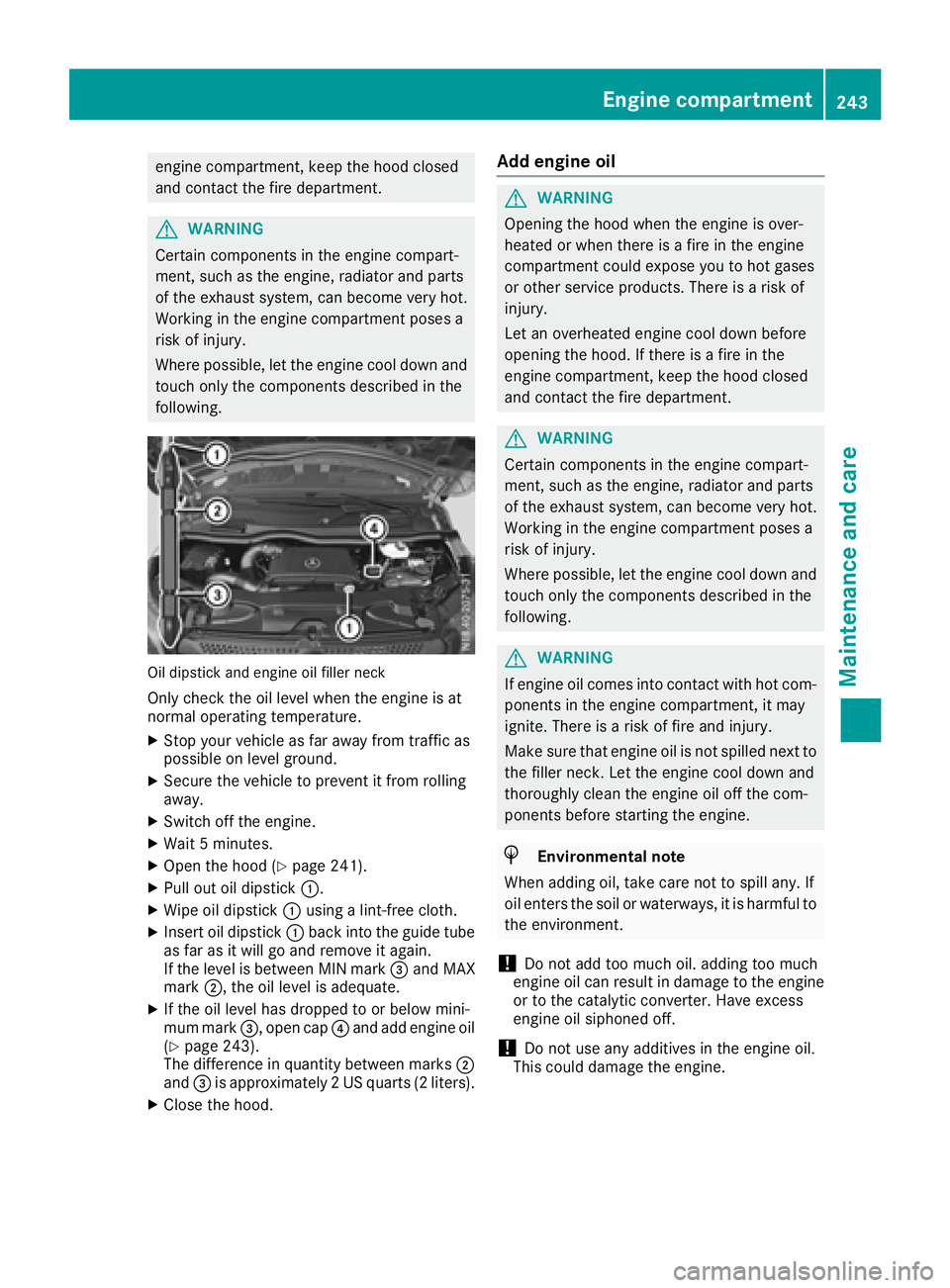
Oil dipstick and engine oil filler neck
Only check the oil level when the engine is at
normal operatin gtemperature.
XStop your vehicle as far away from traffic as
possible on level ground.
XSecure the vehicle to preventitf rom rolling
away.
XSwitc hoff the engine.
XWait 5minutes.
XOpen the hood (Ypage 241).
XPull out oil dipstick :.
XWipe oil dipstick:using alint-free cloth.
XInserto il dipstick :back into the guide tube
as far as it will go and remove it again.
If the level is between MIN mark =and MAX
mark ;,the oil level is adequate.
XIf the oil level has dropped to or below mini-
mum mark =,open cap ?and add engine oil
(
Ypage 243).
The difference in quantit ybetween marks ;
and =is approximately 2USquarts (2 liters).
XClose the hood.
Add engine oil
GWARNING
Openingt he hood when the engine is over-
heated or when there is afire in the engine
compartment could expose you to hot gases
or other servicep roducts. There isarisk of
injury.
Let an overheated engine cool down before
opening the hood. If there is afire in the
engine compartment ,keep the hood closed
and contact the fire department.
GWARNING
Certain component sinthe engine compart-
ment ,such as the engine, radiator and parts
of the exhaust system, can become very hot.
Workin ginthe engine compartment poses a
risk of injury.
Where possible, let the engine cool down and touch only the component sdescribed in the
following.
GWARNING
If engine oil comes into contact with hot com- ponents in the engine compartment ,itmay
ignite. There is arisk of fire and injury.
Make sure that engine oil is not spilled nex tto
the filler neck .Let the engine cool down and
thoroughly clean the engine oil off the com-
ponents before starting the engine.
HEnvironmental note
When adding oil, take care not to spill any. If
oil enters the soil or waterways, it is harmful to
the environment.
!Do not add too much oil. adding too much
engine oil can result in damage to the engine
or to the catalytic converter. Have excess
engine oil siphoned off.
!Do not use any additives in the engine oil.
This could damage the engine.
Engine compartment243
Maintenance and care
Z
Page 247 of 310
!Take care not to spill any coolant on painted
surfaces. You could otherwise damage the
paintwork.
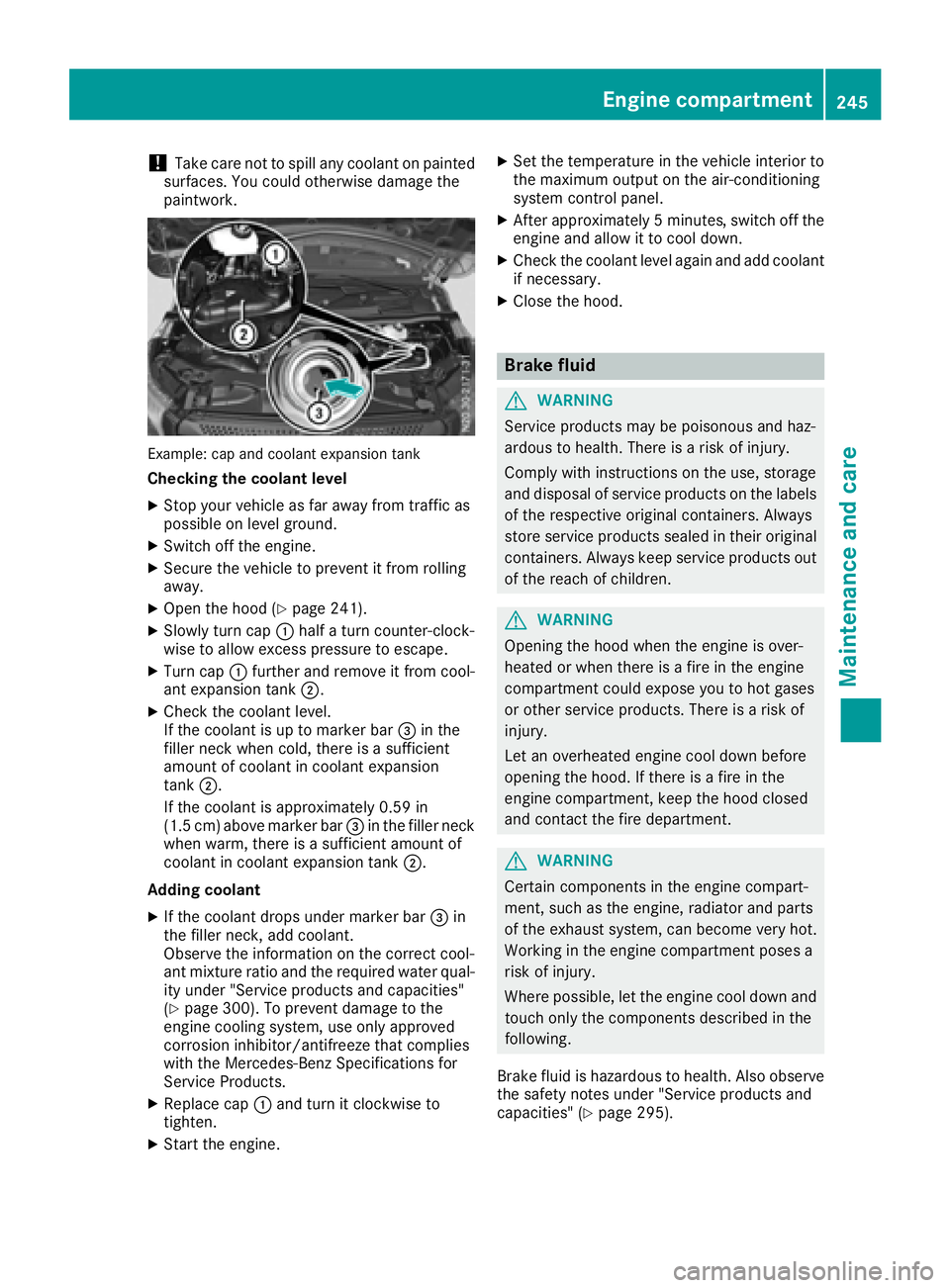
Example: cap and coolant expansion tank
Checkingt he coolant level
XStop your vehicle as far awayf rom traffic as
possible on level ground.
XSwitch off the engine.
XSecure the vehicle to prevent it from rolling
away.
XOpen the hood (Ypage 241).
XSlowly turn cap :half aturn counter-clock-
wise to allow excess pressure to escape.
XTurn cap :further and remove it from cool-
ant expansion tank ;.
XCheck the coolant level.
If the coolant is up to marker bar =in the
filler neck when cold, there is asufficient
amount of coolant in coolant expansion
tank ;.
If the coolant is approximately 0.59 in
(1.5 cm) above marker bar =in the filler neck
when warm, there is asufficient amount of
coolant in coolant expansion tank ;.
Adding coolant
XIf the coolant drops under marker bar =in
the filler neck, add coolant.
Observe the information on the correct cool-
ant mixture ratio and the required water qual-
ity under "Service products and capacities"
(
Ypage 300). To prevent damage to the
engine cooling system, use only approved
corrosion inhibitor/antifreeze that complies
with the Mercedes-Benz Specifications for
Service Products.
XReplace cap :and turn it clockwise to
tighten.
XStart the engine.
XSet the temperature in the vehicle interior to
the maximum output on the air-conditioning
system control panel.
XAfter approximately 5minutes ,switch off the
engine and allow it to cool down.
XCheck the coolant level againa nd add coolant
if necessary.
XClose the hood.
Brake fluid
GWARNING
Service products may be poisonous and haz-
ardous to health. There is arisk of injury.
Comply with instructionsont he use, storage
and disposalofs ervice products on the labels
of the respective original containers. Always
store service products sealed in their original
containers. Alwaysk eep service products out
of the reach of children.
GWARNING
Opening the hood when the engine is over-
heated or when there is afire in the engine
compartment could expose you to hot gases
or other service products. There is arisk of
injury.
Let an overheated engine cool down before
opening the hood. If there is afire in the
engine compartment,k eep the hood closed
and contact the fire department.
GWARNING
Certain componentsint he engine compart-
ment, such as the engine, radiator and parts
of the exhaust system, can become very hot.
Working in the engine compartment poses a
risk of injury.
Where possible,l et the engine cool down and
touch only the componentsd escribed in the
following.
Brake fluid is hazardous to health. Also observe the safety notes under "Service products and
capacities" (
Ypage 295).
Engine compartment245
Maintenance and care
Z
Page 267 of 310
Have the vehicle transported onatransporter or
trailer if it has transmission damage.
Whent owing, the automati ctransmission must
be in position N.Ifthe automati ctransmission
cannot be shifted to position N,havet he vehicle
transported on atransporter or trailer.
The battery mus tbeconnected and charged.
Otherwise ,you :
Rcannot turn the key to position 2in the igni-
tion lock
Rcannot shift the transmission to position N
Before the vehicle is towed, switch off the auto-
mati clocking feature (
Ypage 72). You could
otherwise lock yourself out of the vehicle when
pushing or towing away the vehicle.
Installing/removin gthe towing eye
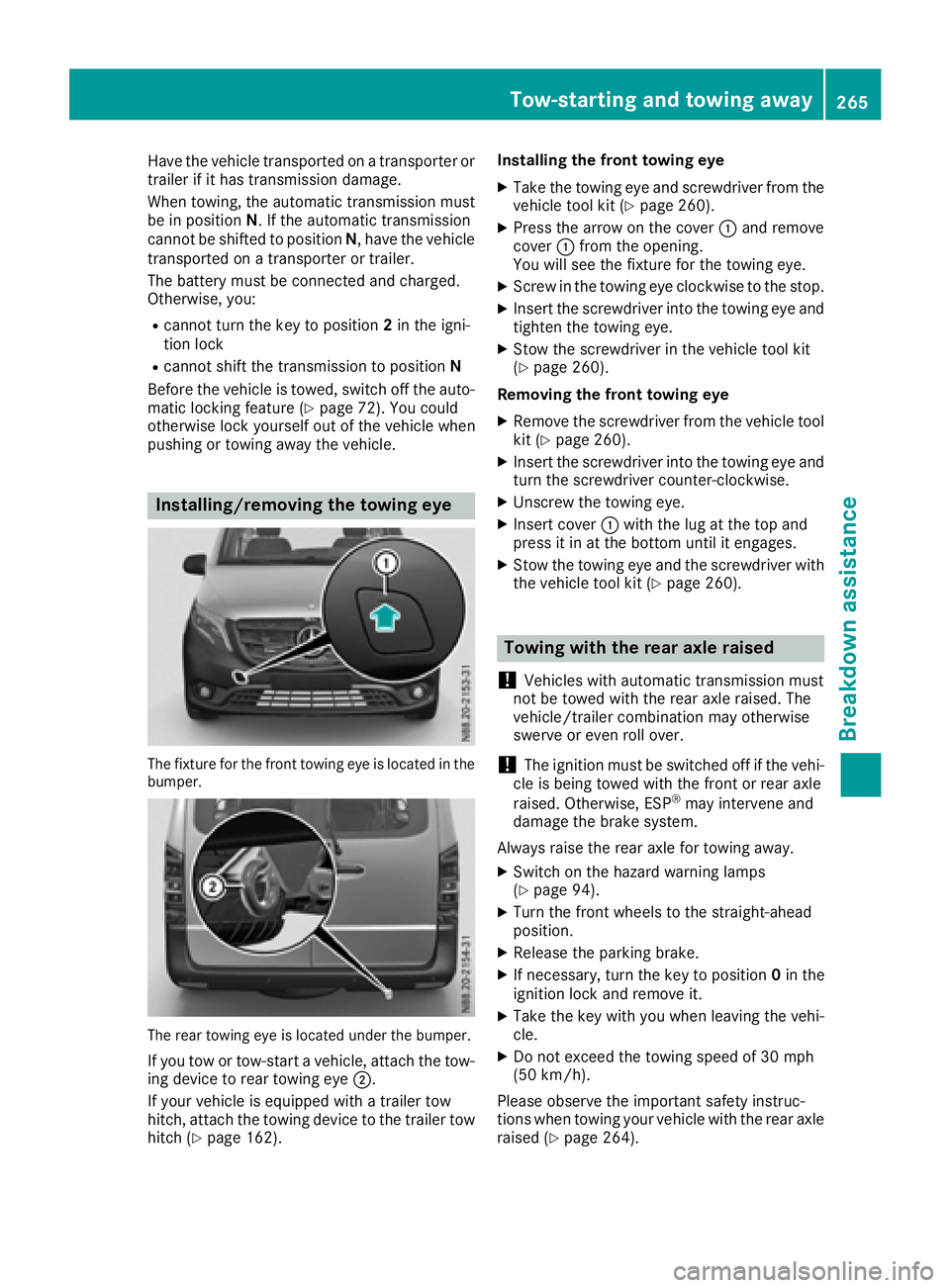
The fixtur efor the front towing eyeisl ocated in the
bumper.
The rea rtowing eyeisl ocated underthe bumper.
If yo utow or tow-start avehicle, attach the tow-
ing device to rea rtowing eye ;.
If your vehicle is equipped with atrailer tow
hitch, attach the towing device to the trailer tow
hitch (
Ypage 162). Installing the front towing eye
XTake the towing eyea
nd screwdriver from the
vehicle tool kit (Ypage 260).
XPres sthe arro wonthe cover :and remove
cover :from the opening.
You will see the fixtur efor the towing eye.
XScrew in the towing eyec lockwise to the stop.
XInsert the screwdriver into the towing eyea nd
tighte nthe towing eye.
XStow the screwdriver in the vehicle tool kit
(Ypage 260).
Removing the front towing eye
XRemove the screwdriver from the vehicle tool
kit (Ypage 260).
XInsert the screwdriver into the towing eyea nd
turn the screwdriver counter-clockwise.
XUnscrew the towing eye.
XInsert cover :with the lu gatthe top and
pres sitinatt he bottom until it engages.
XStow the towing eyea nd the screwdriver with
the vehicle tool kit (Ypage 260).
Towing with the rear axle raised
!
Vehicles with automati ctransmission must
not be towe dwitht he rea raxler aised.T he
vehicle/trailer combinatio nmay otherwise
swerve or even roll over.
!The ignition mus tbeswitched off if the vehi-
cle is being towe dwitht he front or rea raxle
raised.O therwise,ESP
®may intervene and
damag ethe brake system.
Always raise the rea raxlef or towing away.
XSwitch on the hazard warning lamps
(Ypage 94).
XTur nthe front wheels to the straight-ahead
position.
XRelease the parking brake.
XIf necessary ,turn the key to position 0in the
ignition lock and remov eit.
XTake the key with yo uwhenleaving the vehi-
cle.
XDo not excee dthe towing speed of 30 mph
(50 km/h).
Please observe the important safety instruc-
tions whe ntowing your vehicle with the rea raxle
raised (
Ypage 264).
Tow-starting and towing away265
Breakdow nassistance
Z