stop start MERCEDES-BENZ METRIS 2016 MY16 Operator’s Manual
[x] Cancel search | Manufacturer: MERCEDES-BENZ, Model Year: 2016, Model line: METRIS, Model: MERCEDES-BENZ METRIS 2016Pages: 310, PDF Size: 7.28 MB
Page 277 of 310
For further information on displaying the current
tire pressures, referto"Checking the tire pres-
sur eelectronically" (
Ypage 276).
Important safety notes
GWARNING
Each tire, including the spare (ifp rovided),
should be checked at least once amonth
whe ncold and inflated to the pressure rec-
ommended by the vehicle manufacturer on
the Tir eand Loading Information placard on
the driver's doo rB-pilla rort he tire pressure
label on the inside of the fue lfiller flap. If your
vehicle has tires of adifferent size than the
size indicated on the Tir eand Loading Infor-
mation placard or the tire pressure label ,you
should determine the proper tire pressure for
those tires.
As an added safety feature ,you rv ehicle has
bee nequipped with atire pressure monitoring
system (TPMS) that illuminates alow tire pres-
sur etelltal ewheno ne or more of your tires
are significantly underinflated. Accordingly,
whe nthe low tire pressure telltal eillumi nates,
yo us hould stop and check your tires as soon
as possible, and inflate them to the proper
pressure. Driving on asignificantly underin-
flated tire causes the tire to overheata nd can
lea dtot ire failure. Underinflation also
reduce sfue lefficiency and tire treadl ife, and
may affect the vehicle' shandling and stop-
ping ability.
Please note that the TPMSisn otas ubstitute
for proper tire maintenance, and it is the driv-
er's responsibility to maintain correct tire
pressure, even if underinflation has not
reached the level to trigger illumination of the
TPMSl ow tire pressure telltale.
USA only:
You rvehicle has also bee
nequipped with a
TPM
Sm alfunction indicator to indicate if the
system is not operating properly. The TPMS
malfunction indicator is combined with the
low tire pressure telltale. Whe nthe system
detects amalfunction, the warning lamp will
flash for approximately aminute and then
remain continuously illuminated. This
sequence will be repeated ever ytime the vehi-
cle is starte daslong as the malfunction
exists.
Whe nthe malfunction indicator is illuminated,
the system may not be able to detect or signal
low tire pressure as intended. TPMSm alfunc-
tions may occur for avariety of reasons,
including the mounting of incompatible
replacement or alternate tires or wheels on
the vehicle that prevent the TPMSf rom func-
tioning properly. Alway scheck the TPMSm al-
function telltal eafterreplacing one or more
tires or wheels on your vehicle to ensure that the replacement or alternate tires and wheels
allow the TPMStoc ontinuetofunction prop-
erly.
It is the driver's responsibility to set the tire
pressure to the recommende dcold tire pressure
suitabl efor the operating conditions
(
Ypage 270).
Note that the correct tire pressure for the cur-
rent operating conditions mus tfirs tb ep ro-
gramed into the tire pressure monitor. If there is
as ubstantial los sofpressure, the warning
threshol dfor the warning messag eisaligne dto
the reference value sprograme din. Restart the
tire pressure monito rafte radjusting the cold
tire pressure (
Ypage 277). The current pres-
sures are saved as new reference values. This
will ensure that awarning messag ewillo nly
appea rifthe tire pressure drop ssignificantly.
The tire pressure monito rdoesn ot warn yo uifa
tire pressure is incorrect. Observe the notes on
the
recommende dtire pressure (Ypage 270).
The tire pressure monito risnot able to warn you
of as udden los sofpressure, e.g. following pen-
etration by aforeign object. In this event, brake
the vehicle until it comes to astandstill. Avoid
sudden steering movements.
The tire pressure monito rhas ayello wh
warning lamp in the instrument cluster for indi-
cating pressure loss/malfunctions (USA) or
pressure los s(Ca nada). Depending on how the
warning lamp flashesorl ights up ,anunderin-
flated tire or amalfunction in the tire pressure
monito risdisplayed:
Rif the h warning lamp is li tcontinuously,
the tire pressure on one or more tires is sig-
Tire pressure275
Wheels and tires
Z
Page 290 of 310
rectly, it could tip over while the vehicleis
raised.
RThe vehicle's jack is intended only to rais ethe
vehicl efor as hort time when changing a
wheel. It is not suited for performing mainte-
nance work under the vehicle.
RAvoid changing the whee lonuphill and down-
hill slopes.
RBefore raising the vehicle, secure it from roll-
ing awa ybyapplying the parking brake and
inserting whee lchocks. Never disengage the
parking brake while the vehicl eisraised.
RThe jack must be placed on afirm, flat and
non-slip surface. On aloose surface, alarge,
load-bearing underlay must be used .Ona
slippery surface, anon-slip underlay must be
used ,e.g. rubber mats.
RMake sure that the distance between the
underside of the tires and the ground does not
exceed 1.2 in(3 cm).
RNever place you rhands or feet under the
raised vehicle.
RNever lie under the raised vehicle.
RNever start the engine when the vehicl eis
raised.
RNever open or close adoor or the tailgate/
rear door when the vehicl eisraised.
RMake sure that no persons are present in the
vehicl ewhen the vehicl eisraised.
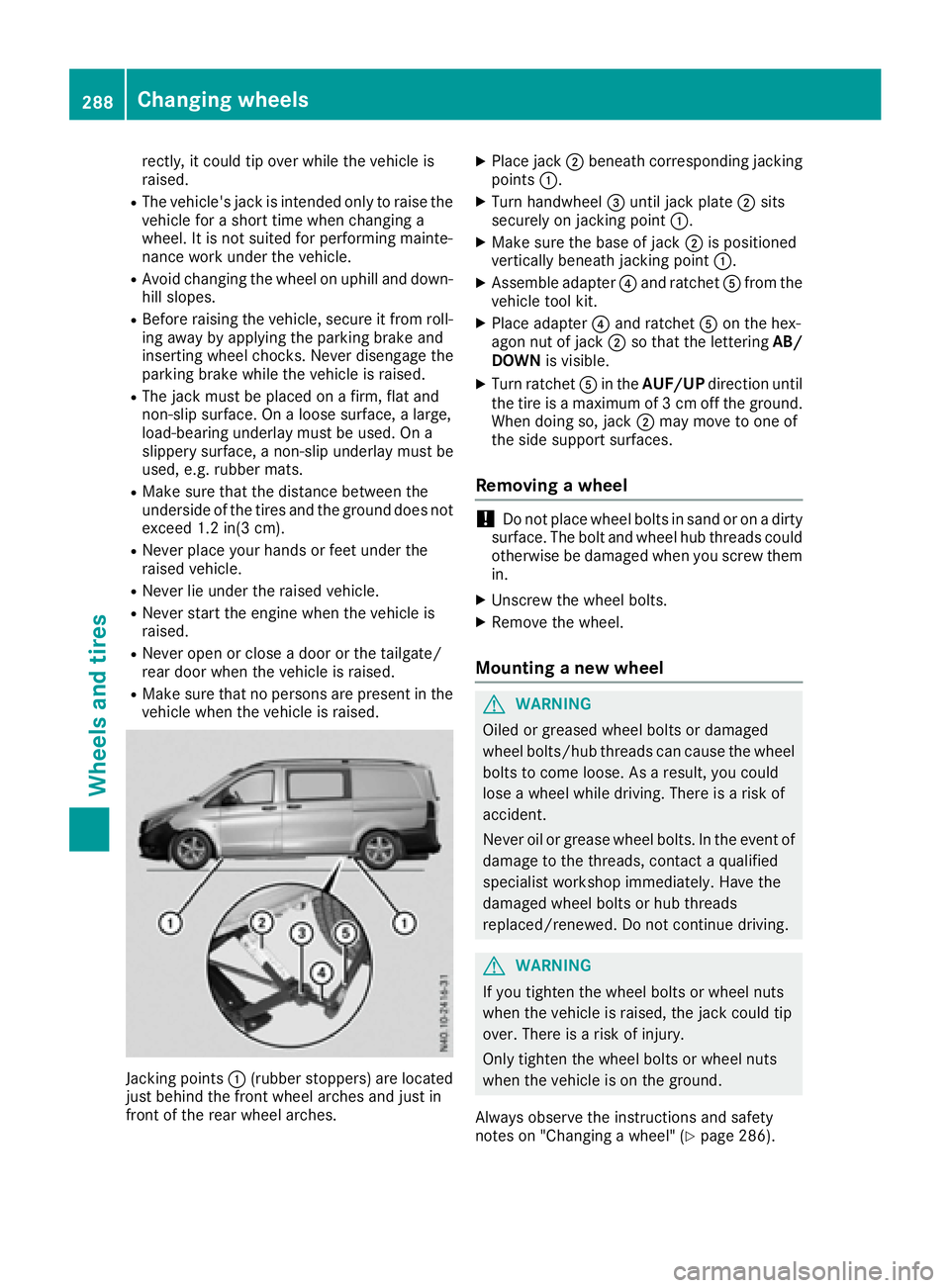
Jacking points :(rubber stoppers)a re located
just behind the front whee larches and just in
front of the rear whee larches.
XPlace jack ;beneath corresponding jacking
points :.
XTurn handwheel =until jack plate ;sits
securely on jacking point :.
XMake sure the base of jack ;is positioned
vertically beneath jacking point :.
XAssembleadapter?and ratchet Afrom the
vehicl etool kit.
XPlace adapter ?and ratchet Aon the hex-
agon nut of jack ;so that the lettering AB/
DOWN is visible.
XTurn ratchet Ain the AUF/UP directionuntil
the tire is amaximu mof3cm off the ground.
When doing so, jack ;may move to one of
the side support surfaces.
Removin gawheel
!Do not place whee lbolts in sand or on adirty
surface. The bolt and whee lhub threads could
otherwise be damaged when you screw them
in.
XUnscrew the whee lbolts.
XRemove the wheel.
Mountin ganew wheel
GWARNING
Oile dorg reased whee lbolts or damaged
whee lbolts/hu bthreads can caus ethe wheel
bolts to come loose .Asaresult, you could
lose awhee lwhile driving. There is arisk of
accident.
Never oil or greas ewhee lbolts. In the event of
damage to the threads ,contact aqualified
specialist workshop immediately. Have the
damaged whee lbolts or hub threads
replaced/renewed. Do not continue driving.
GWARNING
If you tighten the whee lbolts or whee lnuts
when the vehicl eisraised, the jack could tip
over. There is arisk of injury.
Only tighten the whee lbolts or whee lnuts
when the vehicl eisonthe ground.
Always observe the instructions and safety
notes on "Changing awheel" (
Ypag e286).
288Changing wheels
Wheels and tires