display MERCEDES-BENZ METRIS 2017 MY17 Operator’s Manual
[x] Cancel search | Manufacturer: MERCEDES-BENZ, Model Year: 2017, Model line: METRIS, Model: MERCEDES-BENZ METRIS 2017Pages: 318, PDF Size: 5.01 MB
Page 289 of 318
positions for a short time. This is rectified after a
few minutes of driving; the tire pressures are
then displayed for the correct positions.
Restarting the tire pressure monitor
General notes
When you restart the tire pressure monitor, all
existing warning messages are deleted and the
warning lamp goes out. The monitor uses the
currently set tire pressures as the reference val-
ues for monitoring. In most cases, the tire pres-
sure monitor will automatically detect the new
reference values after you have changed the tire
pressures. However, you can also define refer-
ence values manually as described here. The tire
pressure monitor then monitors the new tire
pressure values.
Vehicles without steering wheel buttons
The vehicle must be stationary. Use the buttons
in the instrument cluster.
XTurn the key to position 2in the ignition lock.
XPress Èto select the TirePressuremenu.
XPress3to confirm.
The display shows the Monitoring Active
message.
XPress3to confirm.
The display shows the Tire Pressure OK?
message.
If you wish to confirm the restart:
XPress the fbutton.
The display shows the distance menu.
After you have driven for a few minutes, the
system checks whether the current tire pres-
sures are within the specified range. The new
tire pressures are then accepted as reference
values and are monitored.
If you wish to cancel the restart:
XPress g.
The display shows the tire pressure menu.
The tire pressure values stored at the last
restart will continue to be monitored.
Vehicles with steering wheel buttons
Using the steering wheel buttons
XMake sure that the tire pressure of all four
wheels is set correctly for the current oper-
ating conditions. When doing so, observe the
notes under "Tire pressure" (
Ypage 280).
XTurn the key to position 2in the ignition lock.
XPress =or; to select the Servicemenu.
XPress9or: to select the TirePres‐suresubmenu.
XPressato confirm.
The display shows either the current tire pres-
sure for the individual tires, or the Tire
pressure will be displayed afterdriving a few minutesmessage.
XPress the:button.
The display shows the Use Current Pres‐
sures as New Reference Values:mes-
sage.
If you wish to confirm the restart:
XPress the abutton.
The display shows the Tire Press. Moni‐
tor Restartedmessage.
After you have driven for a few minutes, the
system checks whether the current tire pres- sures are within the specified range. The new
tire pressures are then accepted as reference
values and are monitored.
If you wish to cancel the restart:
XPress the %button.
The tire pressure values stored at the last
restart will continue to be monitored.
Tire pressure287
Wheels and tires
Z
Page 303 of 318
Spare wheel
Important safety notes
GWARNING
Wheel and tire dimensions as well as the type of tire can vary between the spare wheel and
the wheel to be replaced. When the spare
wheel is mounted, driving characteristics may be severely affected. There is a risk of an acci-
dent.
In order to reduce risks:
Ryou should therefore adapt your driving
style and drive carefully.
Rnever mount more than one spare wheel
that differs from the wheel to be replaced.
Ronly use a spare wheel that differs from the
wheel to be replaced for a short time.
Rdo not deactivate ESP®.
Rhave a spare wheel that differs from the
wheel that has been changed replaced at
the nearest qualified specialist workshop.
You must observe the correct wheel and
tire dimensions as well as the wheel type.
When using a spare wheel of a different size, do
not exceed the maximum permissible speed of
50 mph (80 km/h).
General notes
The procedure for mounting the spare wheel is
described in "Mounting a wheel" (Ypage 297).
The following should be checked regularly, par-
ticularly prior to long journeys:
Rthe tire pressure of the spare wheel, which
should then be corrected if necessary
(
Ypage 280)
Rthe fastenings of the spare wheel bracket
The spare wheel is located either in the left rear
compartment or in a spare wheel bracket under
the vehicle.
Replace the tires after six years at the latest,
regardless of wear. This also applies to the spare
wheel.
Vehicles with tire pressure monitor: the
spare wheel is not equipped with a sensor for
monitoring tire pressure. If you have installed a spare wheel, the tire pressure monitor will not
function for this wheel. The system may con-
tinue to show the tire pressure of the wheel that
has been removed for a few minutes. The value
displayed for the position where the spare wheel
is installed is not the same as the current tire
pressure of the spare wheel.
When you are driving with the spare wheel
mounted, the tire pressure monitor cannot func-
tion reliably. Only restart the tire pressure mon- itor when the defective wheel has been replaced
with a new wheel and sensor.
More Information can be found under "Tire pres-
sure monitor" (
Ypage 284).
Removing and installing the spare
wheel
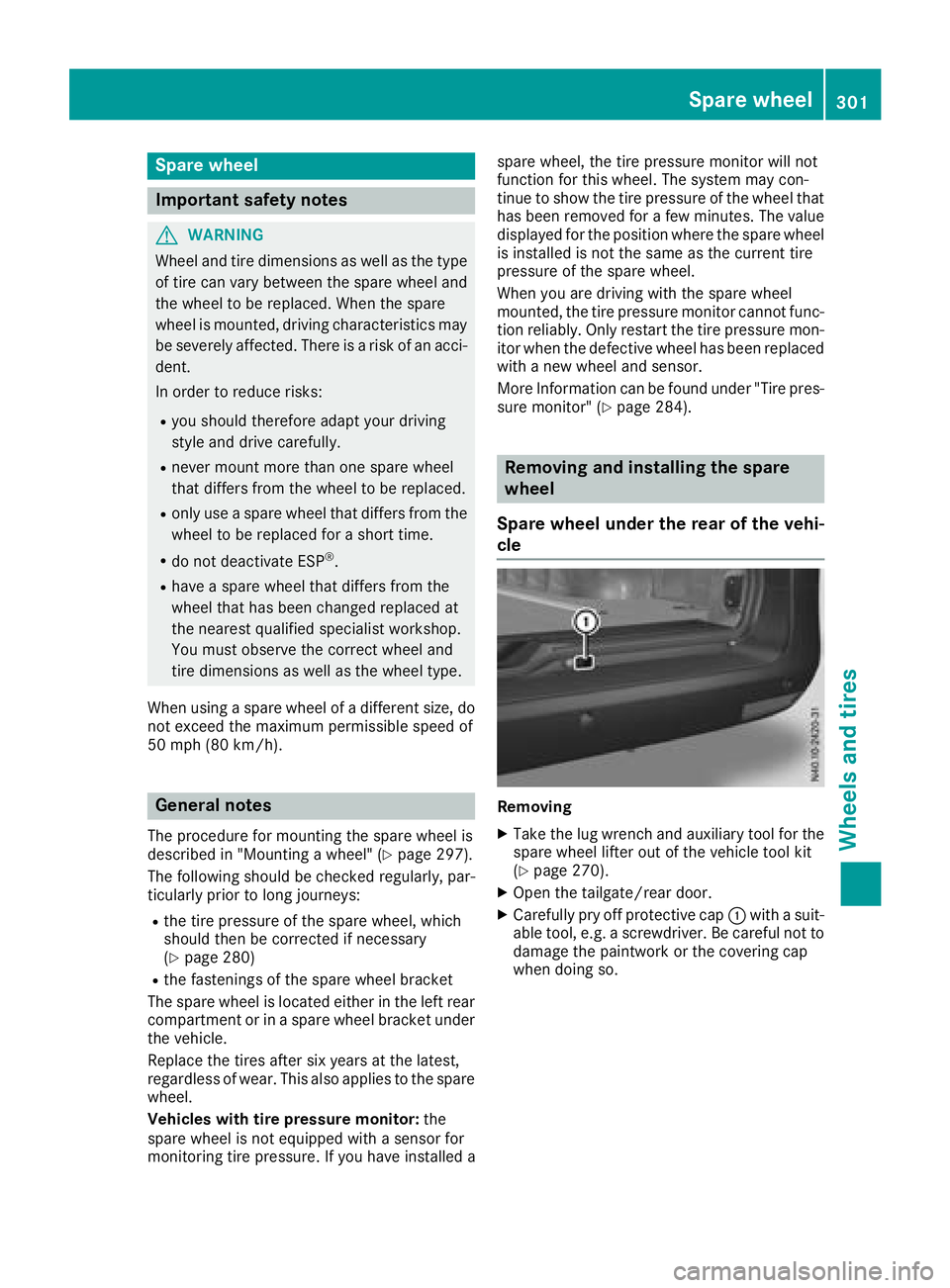
Spare wheel under the rear of the vehi-
cle
Removing
XTake the lug wrench and auxiliary tool for the
spare wheel lifter out of the vehicle tool kit
(
Ypage 270).
XOpen the tailgate/rear door.
XCarefully pry off protective cap :with a suit-
able tool, e.g. a screwdriver. Be careful not to
damage the paintwork or the covering cap
when doing so.
Spare wheel301
Wheels and tires
Z
Page 310 of 318
Additives
!Do notuse any additive sin th eengin eoil.
This could damag eth eengine.
Engine oil viscosity
!If th eSA Eviscosit yclas sof th eengin eoil
used does no tcover th eoutside temperature
range in whic hyou are operating th evehicle,
it mus tbe changed in goo dtime, in particular
before th ecold season commences. Using an
engin eoil that does no thav eadequate tem-
peratur echaracteristics can lead to engin e
damage.
The temperature range information of th eSA E
classification always refers to that of fresh oil.
The temperature characteristics of th eengin e
oil may deteriorat esignificantly due to agin g
in use, especially at low outside tempera-
tures.
We recommen dthat you chang eth eengin e
oil before th ecold season commences. Use
an approve dengin eoil of th especifie dSA E
class.
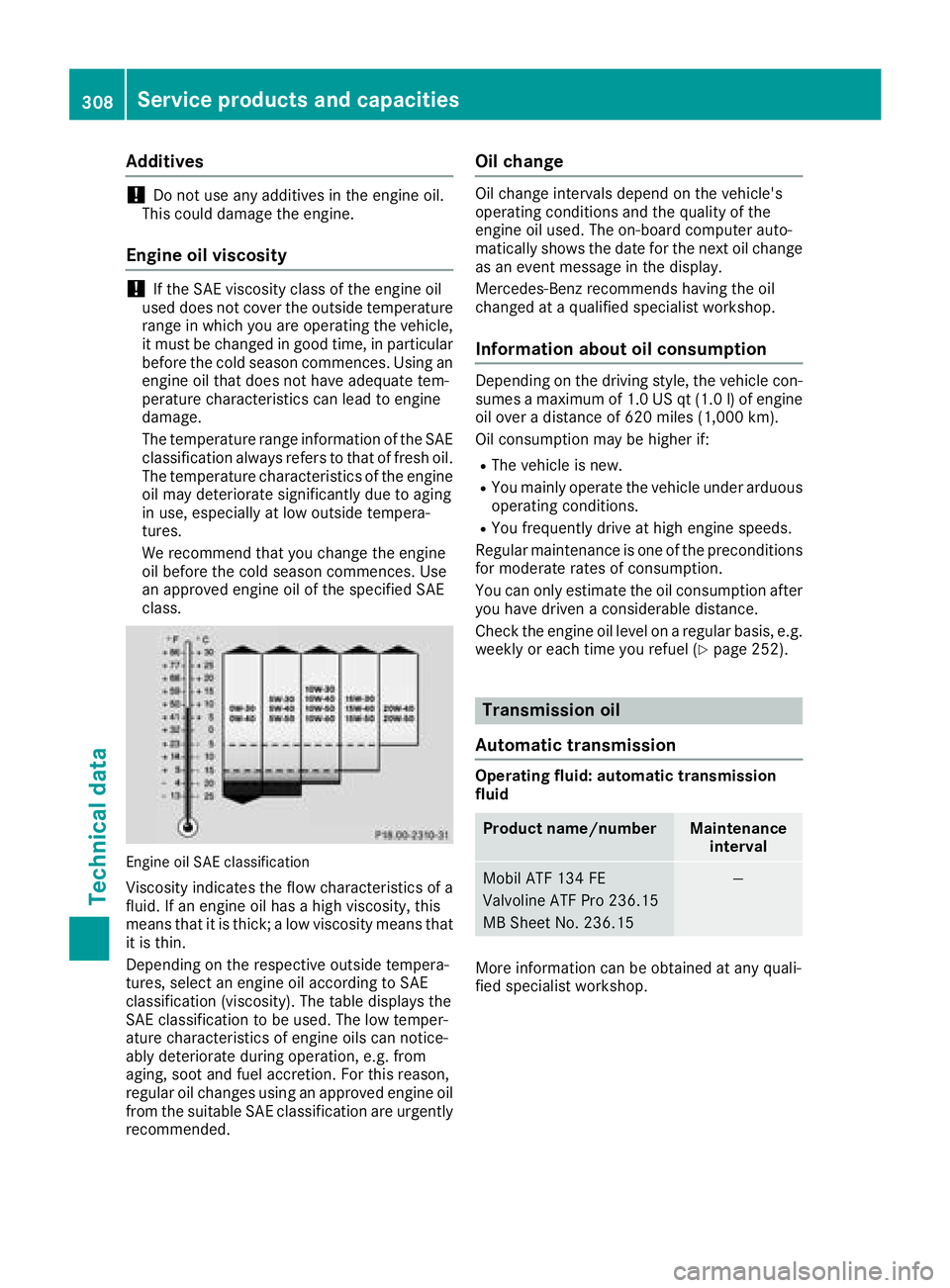
Engin eoil SA Eclassification
Viscosit yindicates th eflo wcharacteristics of a
fluid .If an engin eoil has ahigh viscosity, this
mean sthat it is thick ; alow viscosit ymean sthat
it is thin.
Dependin gon th erespective outside tempera-
tures, select an engin eoil according to SA E
classification (viscosity). The table displays th e
SA Eclassification to be used .The low temper-
atur echaracteristics of engin eoils can notice -
ably deteriorat eduring operation ,e.g. from
aging, soo tand fuel accretion .Fo rthis reason ,
regular oil changes usin gan approve dengin eoil
from th esuitable SA Eclassification are urgently
recommended.
Oil change
Oil chang eintervals depend on th evehicle's
operating condition sand th equalit yof th e
engin eoil used .The on-board computer auto -
matically shows th edat efor th enext oil chang e
as an event message in th edisplay.
Mercedes-Benz recommends having th eoil
changed at aqualified specialist workshop .
Information about oil consump tion
Dependin gon th edrivin gstyle, th evehicl econ-
sumes amaximum of 1. 0US qt (1. 0l)of engine
oil over a distance of 620 miles (1,000 km).
Oil consumption may be higher if:
RThe vehicle is new.
RYou mainly operate the vehicle under arduous
operating conditions.
RYou frequently drive at high engine speeds.
Regular maintenance is one of the preconditions
for moderate rates of consumption.
You can only estimate the oil consumption after
you have driven a considerable distance.
Check the engine oil level on a regular basis, e.g.
weekly or each time you refuel (
Ypage 252).
Transmission oil
Automatic transmission
Operating fluid: automatic transmission
fluid
Product name/numberMaintenance interval
Mobil ATF 134 FE
Valvoline ATF Pro 236.15
MB Sheet No. 236.15—
More information can be obtained at any quali-
fied specialist workshop.
308Service products and capacities
Technical data