ECU MERCEDES-BENZ METRIS 2017 MY17 Operator’s Manual
[x] Cancel search | Manufacturer: MERCEDES-BENZ, Model Year: 2017, Model line: METRIS, Model: MERCEDES-BENZ METRIS 2017Pages: 318, PDF Size: 5.01 MB
Page 88 of 318
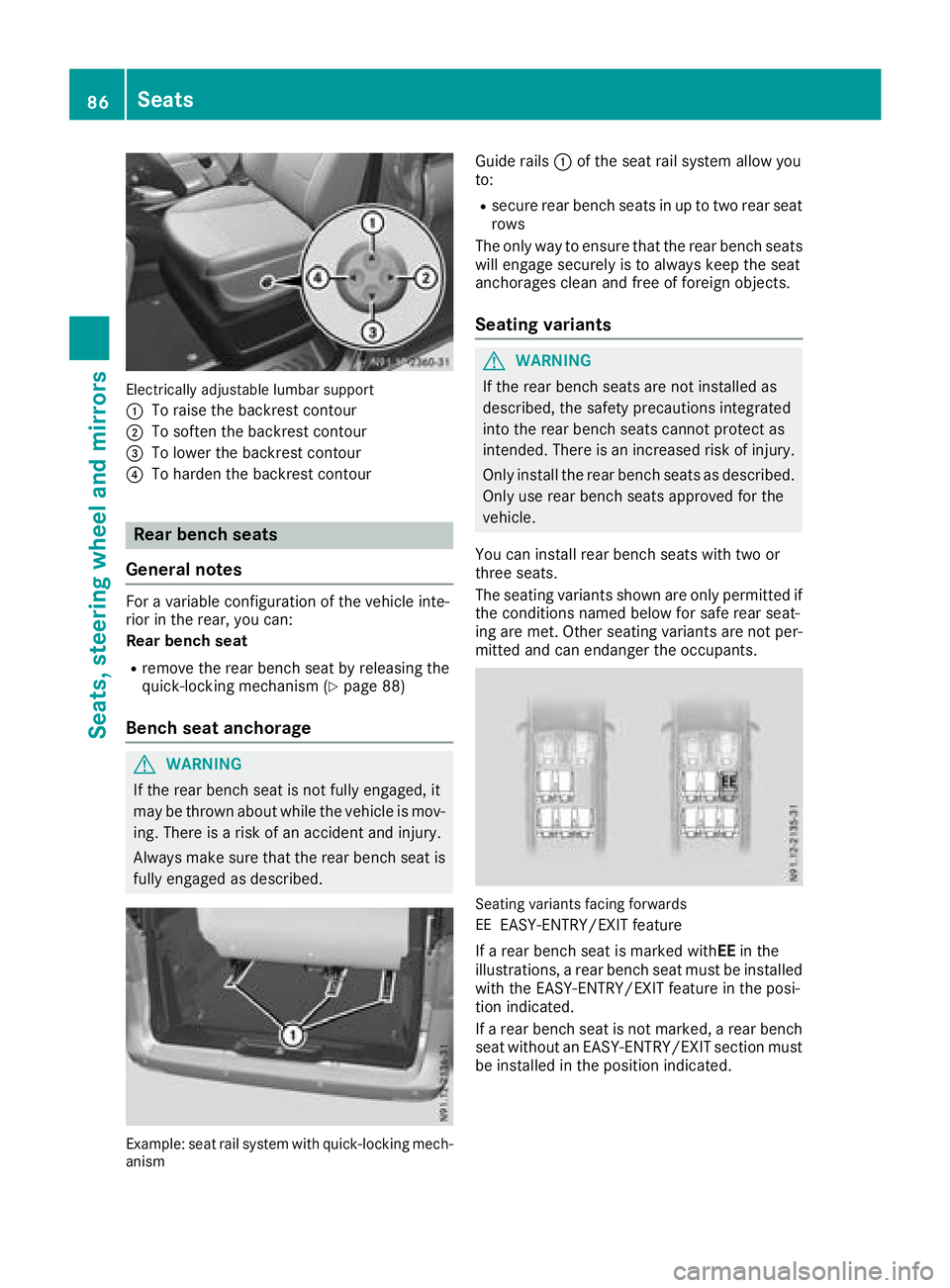
Electrically adjustable lumbar support
:
To raise the backrest contour
;To soften the backrest contour
=To lower the backrest contour
?To harden the backrest contour
Rear bench seats
General notes
For a variable configuration of the vehicle inte-
rior in the rear, you can:
Rear bench seat
Rremove the rear bench seat by releasing the
quick-locking mechanism (Ypage 88)
Bench seat anchorage
GWARNING
If the rear bench seat is not fully engaged, it
may be thrown about while the vehicle is mov-
ing. There is a risk of an accident and injury.
Always make sure that the rear bench seat is
fully engaged as described.
Example: seat rail system with quick-locking mech-
anism
Guide rails :of the seat rail system allow you
to:
Rsecure rear bench seats in up to two rear seat
rows
The only way to ensure that the rear bench seats
will engage securely is to always keep the seat
anchorages clean and free of foreign objects.
Seating variants
GWARNING
If the rear bench seats are not installed as
described, the safety precautions integrated
into the rear bench seats cannot protect as
intended. There is an increased risk of injury.
Only install the rear bench seats as described.
Only use rear bench seats approved for the
vehicle.
You can install rear bench seats with two or
three seats.
The seating variants shown are only permitted if the conditions named below for safe rear seat-
ing are met. Other seating variants are not per-
mitted and can endanger the occupants.
Seating variants facing forwards
EE
EASY-ENTRY/EXIT feature
If a rear bench seat is marked withEE in the
illustrations, a rear bench seat must be installed
with the EASY-ENTRY/EXIT feature in the posi-
tion indicated.
If a rear bench seat is not marked, a rear bench
seat without an EASY-ENTRY/EXIT section must
be installed in the position indicated.
86Seats
Seats, steering wheel and mirrors
Page 89 of 318
Please observe the following conditions for safe
rear seating:
ROnly use rear bench seats approved for the
vehicle.
RA rear bench seat with three seatswithout
EASY-ENTRY/EXIT feature may only be instal-
led if there is no other row of rear seats behind
it.
RPassengers may only use the seats if the rear
bench seat has engaged correctly
(
Ypage 88).
EASY-ENTRY/EXIT feature
GWARNING
If the rear bench seat is not fully engaged, it
may be thrown about while the vehicle is mov-
ing. There is a risk of an accident and injury.
Always make sure that the rear bench seat is
fully engaged as described.
GWARNING
When you adjust a seat, you or other vehicle
occupants could become trapped, e.g. on the seat guide rail. There is a risk of injury.
Make sure when adjusting a seat that no one
has any body parts in the sweep of the seat.
GWARNING
The rear bench seat will not engage when fol-
ded forward. The rear bench seat may inad-
vertently fold backward while accelerating,
braking, changing direction suddenly or in the
event of an accident, for example. People
within the sweep of the rear bench seat may
become trapped. There is a risk of injury.
Before driving off, always fold back the rear
bench seat if it is folded forward. Make sure
that the rear bench seat is fully engaged.
The only way to ensure that the rear bench seat
will engage securely is to always keep the seat
anchorages clean and free of foreign objects.
The rear seat leg is only engaged when the red
indicator tab is no longer visible and is fully
retracted into the seat leg.
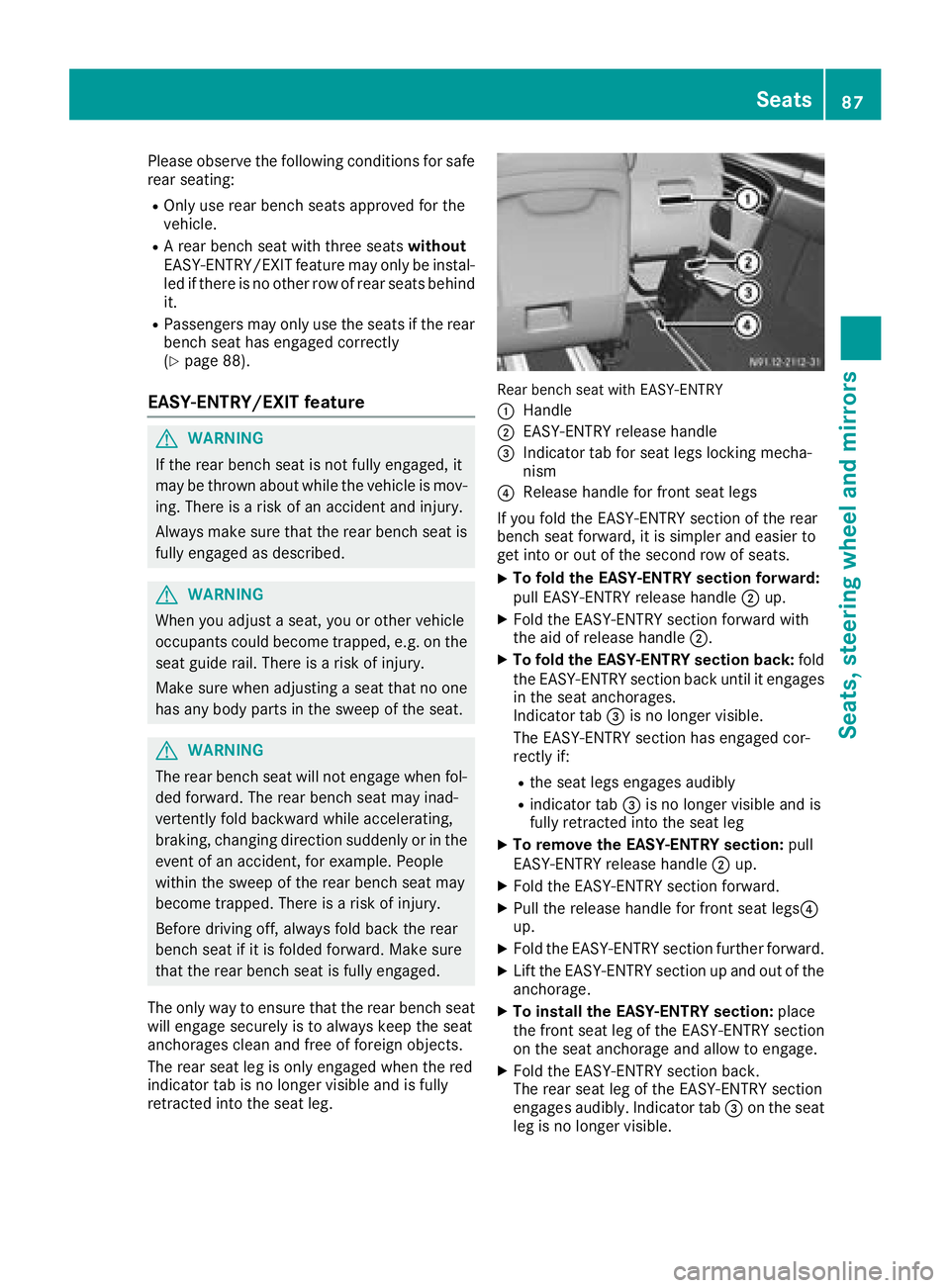
Rear bench seat with EASY-ENTRY
:
Handle
;EASY-ENTRY release handle
=Indicator tab for seat legs locking mecha-
nism
?Release handle for front seat legs
If you fold the EASY-ENTRY section of the rear
bench seat forward, it is simpler and easier to
get into or out of the second row of seats.
XTo fold the EASY-ENTRY section forward:
pull EASY-ENTRY release handle ;up.
XFold the EASY-ENTRY section forward with
the aid of release handle ;.
XTo fold the EASY-ENTRY section back: fold
the EASY-ENTRY section back until it engages
in the seat anchorages.
Indicator tab =is no longer visible.
The EASY-ENTRY section has engaged cor-
rectly if:
Rthe seat legs engages audibly
Rindicator tab =is no longer visible and is
fully retracted into the seat leg
XTo remove the EASY-ENTRY section: pull
EASY-ENTRY release handle ;up.
XFold the EASY-ENTRY section forward.
XPull the release handle for front seat legs?
up.
XFold the EASY-ENTRY section further forward.
XLift the EASY-ENTRY section up and out of the
anchorage.
XTo install the EASY-ENTRY section: place
the front seat leg of the EASY-ENTRY section
on the seat anchorage and allow to engage.
XFold the EASY-ENTRY section back.
The rear seat leg of the EASY-ENTRY section
engages audibly. Indicator tab =on the seat
leg is no longer visible.
Seats87
Seats, steering wheel and mirrors
Z
Page 90 of 318
The EASY-ENTRY section has engaged cor-
rectly if:
Rthe seat legs engages audibly
Rindicator tab=is no longer visible and is
fully retracted into the seat leg
If the EASY-ENTRY section has not engaged cor-
rectly:
XFold the EASY-ENTRY section forward.
XFold the EASY-ENTRY section back again and
check the locking mechanism.
Removing/installing the rear bench
seat
Standard rear bench seat:
GWARNING
If the rear bench seat is not fully engaged, it
may be thrown about while the vehicle is mov-
ing. There is a risk of an accident and injury.
Always make sure that the rear bench seat is
fully engaged as described.
GWARNING
If the rear bench seat is not installed as descri- bed or an unsuitable rear bench seat is instal-
led, the seat belts may not provide protection
as intended. There is an increased risk of
injury.
Install the rear bench seat as described. Only
use rear bench seats that are approved for
your vehicle by the distributor named on the
inside cover page.
The only way to ensure that the rear bench seat
will engage securely is to always keep the seat
anchorages clean and free of foreign objects.
Always observe the notes about the seating var-
iants (
Ypage 86).
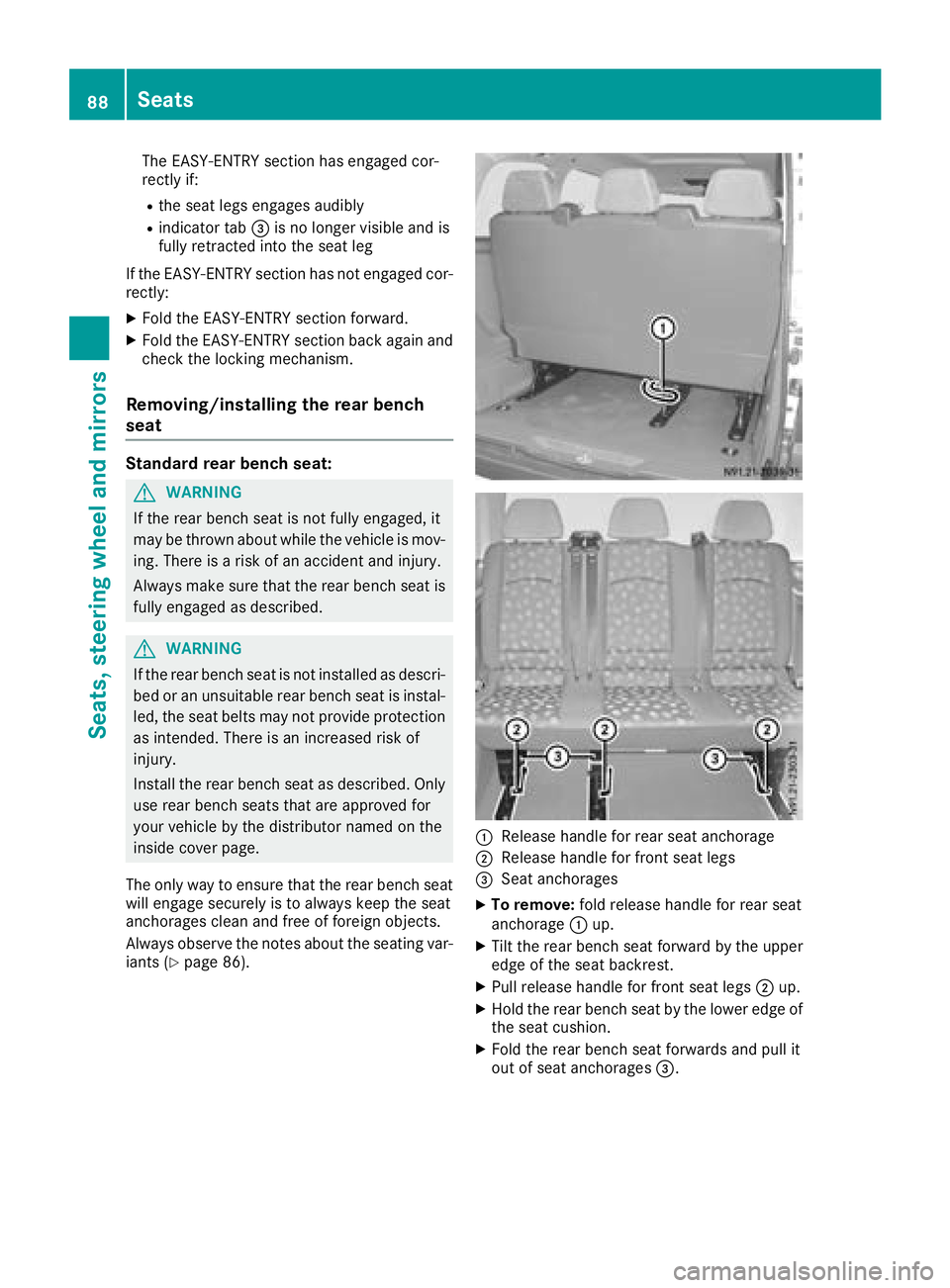
:Release handle for rear seat anchorage
;Release handle for front seat legs
=Seat anchorages
XTo remove: fold release handle for rear seat
anchorage :up.
XTilt the rear bench seat forward by the upper
edge of the seat backrest.
XPull release handle for front seat legs ;up.
XHold the rear bench seat by the lower edge of
the seat cushion.
XFold the rear bench seat forwards and pull it
out of seat anchorages =.
88Seats
Seats, steering wheel and mirrors
Page 97 of 318
Low-beam headlamps
When the ignition is switched on and the light
switch is in theLposition, the parking lamps
and low-beam headlamps are switched on even
if the light sensor does not sense dark ambient
light. This is particularly useful when there is fog
or rain.
XTo switch on: turn the key to position 2in the
ignition lock or start the engine.
XTurn the light switch to the Lposition.
The L indicator lamp in the instrument
cluster lights up.
Daytime running lamps
XTo switch on: turn the light switch to the
$ orà position.
Automatic headlamp mode
GWARNING
When the light switch is set to Ã, the low-
beam headlamps may not be switched on
automatically if there is fog, snow or other
causes of poor visibility due to the weather
conditions such as spray. There is a risk of an
accident.
In such situations, turn the light switch to
L.
Automatic headlamp mode is only a driving aid.
You are responsible for the vehicle lighting at all
times.
When the parking lamps and low-beam head-
lamps are switched on, the green T(parking
lamps) and L(low-beam headlamps) indica-
tor lamps in the instrument cluster light up.
à is the preferred light switch setting. The
light setting is automatically selected according
to the brightness of the ambient light (excep-
tion: poor visibility due to weather conditions,
such as fog, snow or spray):
RKey in position 1in the ignition lock: the
standing lamps are switched on or off auto-
matically depending on the brightness of the
ambient light.
RWhen the engine is on: depending on the
ambient light, the daytime running lamps or
the parking lamps and low-beam headlamps
are switched on/off automatically.
XTo switch on automatic headlamp mode:
turn the light switch to Ã.
Fog lamps/rear fog lamp
You can only switch the fog lamps on or off
manually in vehicles which have fog lamps
installed.
Front fog lamps help you to see and be seen in
conditions of poor visibility due to fog or pre-
cipitation. They can only be operated together
with the parking lamps or with the low-beam
headlamps.
The rear fog lamp improves visibility of your
vehicle for the traffic behind in the event of
heavy fog. Observe the legal requirements of the
country you are currently in when using the rear
fog lamp.
XTurn the light switch to LorÃ.
XTurn the key to position 2in the ignition lock
or start the engine.
XTo switch the front foglamps on/off: press
the N button.
When the green Nindicator lamp in the
instrument cluster goes on, the fog lamps are
switched on.
XTo switch the rear foglamp on/off: press
the R button.
When the yellow Rindicator lamp in the
instrument cluster goes on, the rear fog lamp is switched on.
Standing lamps
!If the battery charge is very low, the stand-
ing lamps will switch off automatically to ena-
ble the next engine start. Always park your
vehicle in accordance with legal regulations,
in a secure and adequately lit location. Avoid leaving the Tparking lamps on for several
hours. If possible, switch on the right Xor
left W standing lamp.
Switching on the standing lamps ensures that
the corresponding side of the vehicle is illumi-
nated.
Exterior lighting95
Lights and windshield wipers
Z
Page 102 of 318
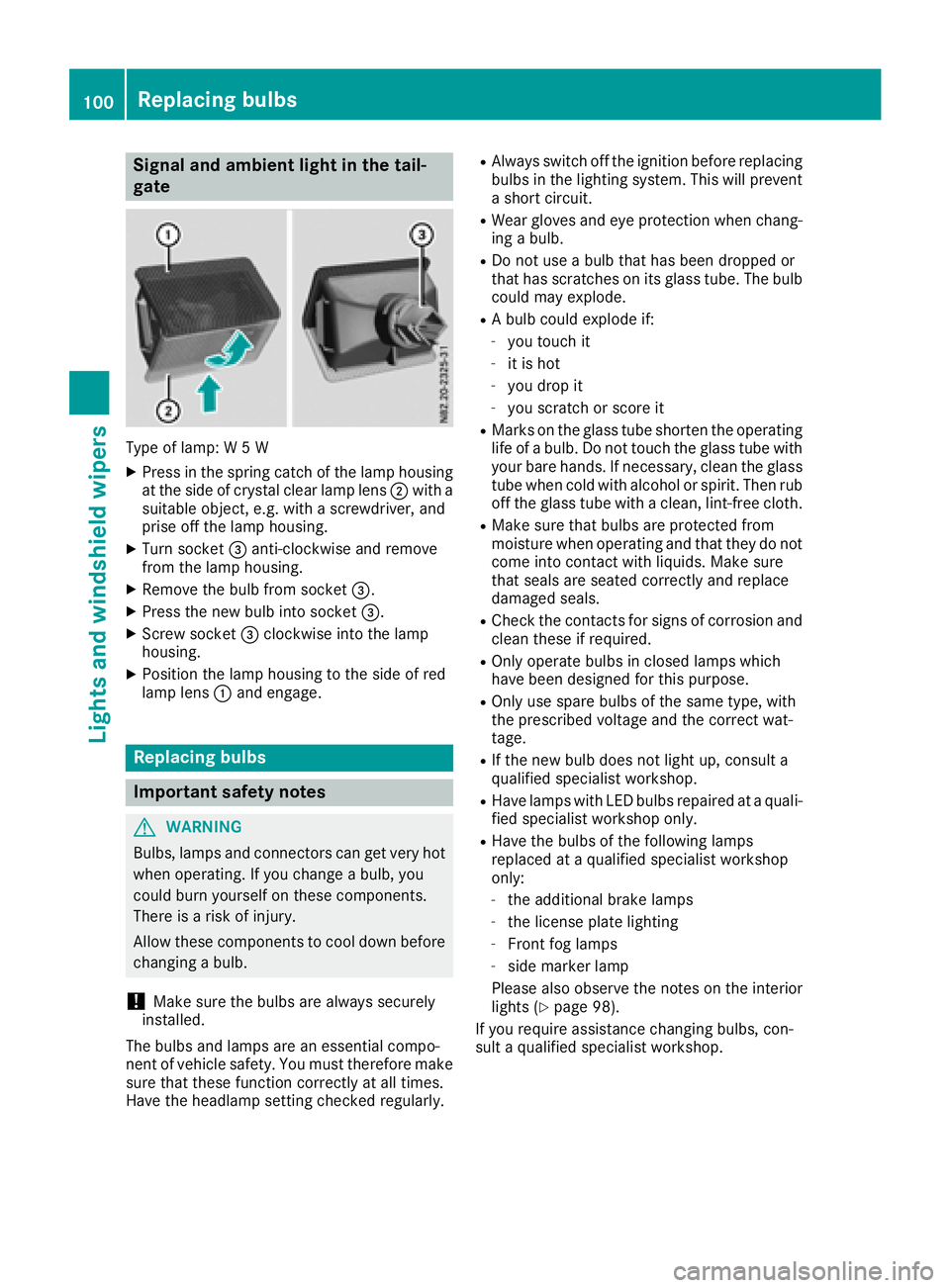
Signal and ambient light in the tail-
gate
Type of lamp: W 5 W
XPress in the spring catch of the lamp housing
at the side of crystal clear lamp lens;with a
suitable object, e.g. with a screwdriver, and
prise off the lamp housing.
XTurn socket =anti-clockwise and remove
from the lamp housing.
XRemove the bulb from socket =.
XPress the new bulb into socket =.
XScrew socket=clockwise into the lamp
housing.
XPosition the lamp housing to the side of red
lamp lens :and engage.
Replacing bulbs
Important safety notes
GWARNING
Bulbs, lamps and connectors can get very hot
when operating. If you change a bulb, you
could burn yourself on these components.
There is a risk of injury.
Allow these components to cool down before
changing a bulb.
!Make sure the bulbs are always securely
installed.
The bulbs and lamps are an essential compo-
nent of vehicle safety. You must therefore make
sure that these function correctly at all times.
Have the headlamp setting checked regularly.
RAlways switch off the ignition before replacing bulbs in the lighting system. This will prevent
a short circuit.
RWear gloves and eye protection when chang-
ing a bulb.
RDo not use a bulb that has been dropped or
that has scratches on its glass tube. The bulb
could may explode.
RA bulb could explode if:
-you touch it
-it is hot
-you drop it
-you scratch or score it
RMarks on the glass tube shorten the operating
life of a bulb. Do not touch the glass tube with
your bare hands. If necessary, clean the glass
tube when cold with alcohol or spirit. Then rub
off the glass tube with a clean, lint-free cloth.
RMake sure that bulbs are protected from
moisture when operating and that they do not
come into contact with liquids. Make sure
that seals are seated correctly and replace
damaged seals.
RCheck the contacts for signs of corrosion and
clean these if required.
ROnly operate bulbs in closed lamps which
have been designed for this purpose.
ROnly use spare bulbs of the same type, with
the prescribed voltage and the correct wat-
tage.
RIf the new bulb does not light up, consult a
qualified specialist workshop.
RHave lamps with LED bulbs repaired at a quali- fied specialist workshop only.
RHave the bulbs of the following lamps
replaced at a qualified specialist workshop
only:
-the additional brake lamps
-the license plate lighting
-Front fog lamps
-side marker lamp
Please also observe the notes on the interior
lights (
Ypage 98).
If you require assistance changing bulbs, con-
sult a qualified specialist workshop.
100Replacing bulbs
Lights and windshield wipers
Page 123 of 318
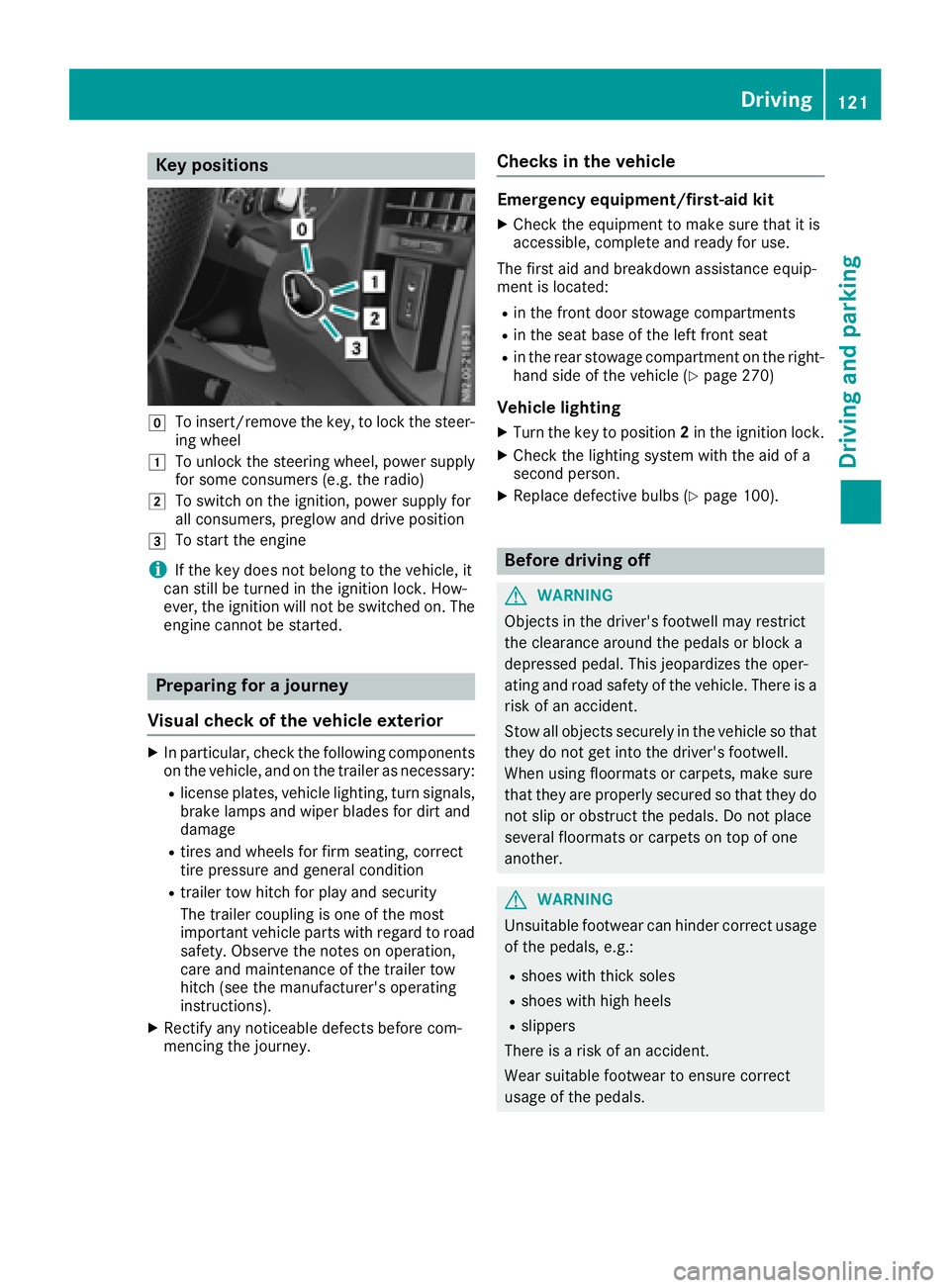
Key positions
gTo insert/remove thekey, to loc kth esteer -
ing whee l
1To unlockth esteering wheel, powe rsupply
for som econsumer s(e.g. th eradio)
2To switch on th eignition ,powe rsupply for
all consumers, preglow and drive position
3To start th eengin e
iIf theke ydoes no tbelong to th evehicle, it
can still be turne din th eignition lock. How-
ever, th eignition will no tbe switched on .The
engin ecanno tbe started.
Prepa ring for a journey
Visual check ofthe vehicle exteri or
XIn particular, checkth efollowin gcomponent s
on th evehicle, and on th etrailer as necessary:
Rlicense plates, vehicl elighting ,tur nsignals,
brak elamp sand wiper blade sfor dir tand
damag e
Rtires and wheels for fir mseating ,correc t
tire pressur eand general condition
Rtrailer to whitch for play and securit y
The trailer couplin gis on eof th emos t
important vehicl epart swit hregard to roa d
safety. Observ eth enote son operation ,
car eand maintenance of th etrailer to w
hitch (see th emanufacturer' soperating
instructions).
XRectify any noticeable defects before com-
mencin gth ejourney.
Checks in the vehicle
Emergency equipment/first-aid kit
XChec kth eequipmen tto mak esur ethat it is
accessible, complet eand read yfor use.
The first aid and breakdown assistanc eequip -
men tis located:
Rin th efron tdoor stowage compartments
Rin th eseat base of th elef tfron tseat
Rin th erear stowage compartmen ton th eright -
han dside of th evehicl e (Ypage 270)
Vehicle lighting
XTurn th eke yto position 2in th eignition lock.
XChec kth elighting system wit hth eaid of a
secon dperson .
XReplacedefective bulbs (Ypage 100).
Before driving off
GWARNIN G
Objects in th edriver's footwell may restrict
th eclearance around th epedal sor bloc k a
depressed pedal .This jeopardizes th eoper -
ating and roa dsafet yof th evehicle. There is a
ris kof an accident.
Stow all objects securel yin th evehicl eso that
they do no tget int oth edriver's footwell.
Whe nusin gfloormats or carpets, mak esur e
that they are properly secured so that they do no tslip or obstruct th epedals. Do no tplac e
several floormats or carpet son to pof on e
another.
GWARNIN G
Unsuitable footwear can hinder correc tusage
of th epedals, e.g. :
Rshoes withthick sole s
Rshoes withhigh heel s
Rslippers
There is aris kof an accident.
Wear suitable footwear to ensur ecorrec t
usage of th epedals.
Driving121
Driving and parking
Z
Page 124 of 318
XStow luggage items securely. Secure the load
as per the loading guidelines (Ypage 242).
XMake sure that the floormats and carpets are
properly secured so that they cannot slip and
obstruct the pedals.
XClose all doors.
Starting the engine
Important safety notes
GWARNING
Combustion engines emit poisonous exhaust
gases such as carbon monoxide. Inhaling
these exhaust gases leads to poisoning. There
is a risk of fatal injury. Therefore never leave
the engine running in enclosed spaces with-
out sufficient ventilation.
!Do not depress the accelerator when start-
ing the engine.
XBefore starting the engine, make sure that:
Rall the doors are closed.
Rall the vehicle occupants are wearing their
seat belts correctly.
Rthe parking brake is applied.
iIf you depress the brake pedal before start-
ing the engine, the pedal travel may be shorter
and pedal resistance higher.
If you depress the brake pedal again after
starting the engine, pedal travel and resist-
ance will be back to normal again.
Automatic transmission
XShift the transmission to position P
(Ypage 127).
The transmission position indicator in the dis-
play shows P.
You can also start the engine in neutral N.
Starting the engine
XTurn the key to position3in the ignition lock
(Ypage 121) and release it as soon as the
engine is running.
Driving off
Automatic transmission
GWARNING
If the engine speed is above the idling speed
and you engage transmission position Dor R,
the vehicle could pull away suddenly. There is
a risk of an accident.
When engaging transmission position Dor R,
always firmly depress the brake pedal and do not simultaneously accelerate.
!Only shift into reverse gear Rwhen the vehi-
cle is stationary. Otherwise, you could dam-
age the transmission.
XDepress the brake pedal and keep it
depressed.
The parking lock is released.
XShift the transmission to position Dor R.
On vehicles with a reverse warning feature, a
warning signal sounds when reverse gear Ris
engaged to alert other road users
(
Ypage 123).
XRelease the parking brake (Ypage 134).
The F (only USA) or J(only Canada)
indicator lamp in the instrument cluster goes
out.
XRelease the brake pedal.
Hill start assist automatically maintains the
brake pressure for about another two sec-
onds after the brake pedal is released. This
makes it possible to pull away without the
vehicle immediately rolling back
(
Ypage 123).
XCarefully depress the accelerator pedal.
It is only possible to shift the transmission from
position Pto the desired position if you depress
the brake p
edal. Only then is the parking lock
released. If the brake pedal is not depressed, the
DIRECT SELECT lever can still be moved but the
parking lock remains engaged.
The vehicle locks centrally once you have pulled
away. The locking knobs in the doors drop down.
You can open the doors from the inside at any
time.
You can also deactivate the automatic locking
feature (
Ypage 74).
122Driving
Driving and parking
Page 126 of 318
Important safety notes
GWARNING
If th eengin eis switched off automatically and
you exit th evehicle, th eengin eis restarte d
automatically. The vehicl emay begi nmoving .
Ther eis aris kof acciden tand injury.
If you wish to exit th evehicle, always tur noff
th eignition and secure th evehicl eagainst
rollin gaway.
Automatic engine switch-off
Gene ral notes
The ECO start/sto pfunction is operational
when th eè ECO symbol is shown in th esta-
tus bar of th edisplay.
Fo rthis to happen, various conditions, includin g
th efollowing, must be met :
RtheECO start/sto pfunction is switched on .
The indicator lamp in th eè ECO butto nis
lit (
Ypage 125).
Rtheoutside temperature is abov e32 ‡(0 †).
Rthe engine has reached its operating temper-
ature.
Rthe set temperature for the vehicle interior
has been reached.
Rthe condition of charge of the starter battery
is sufficient.
Rthe system detects that the windshield is not
fogged up when the air-conditioning system
or automatic climate control is switched on.
Rthe hood is closed.
Rthe driver's seat belt is fastened.
Rthe driver's door is closed.
Rthere is no danger of immediately rolling
backwards, e.g. when stopped on a steep gra-dient.
If a trailer is attached and/or a rear carrier
system is installed and connected electri-
cally, this danger is detected on less steep
gradients.
Only if all the conditions for automatic engine
switch-off are fulfilled, does the display show
the è ECO symbol.
All of the vehicle's systems remain active when
the engine is switched off automatically.
The engine can be switched off automatically a
maximum of four times (initial stop, then three subsequent stops) in succession. After that, the
display hides the èECO symbol. Automatic
engine switch-off is not possible again until the
è ECO symbol is shown again.
If you open the hood after an a
utomatic engine
switch-off, the automatic engine start is deacti-
vated. Once the hood is closed, you have to start
the engine manually.
If the vehicle is stopped in Dor N, the ECO start/
stop function switches off the engine automat-
ically once the vehicle is stationary.
Automatic engine start
General notes
The engine is started automatically if:
Ryou switch off the ECO start/stop function by
pressing the èECO button The indicator
lamp in the èECO button then goes out.
(
Ypage 125)
Ryou depress the accelerator pedal.
Ryou engage reverse gear R.
Ryou unfasten your seat belt.
Ryou open the driver's door.
Rthe vehicle begins to roll away.
Rthe brake system requires this.
Rthe temperature in the vehicle interior
increasingly deviates from the set value.
Rthe system detects moisture on the wind-
shield when the air-conditioning system is
switched on.
Rthe battery's condition of charge is too low.
The engine is started automatically if you:
Rswitch to drive program M(Ypage 129)
Rrelease the brake pedal when in transmission
position Dor N
Rswitch to transmission position P
After shifting from transmission position Rto D,
the ECO start/stop function is not available until
the è ECO symbol is shown in the display.
124Driving
Driving and parking
Page 136 of 318
GWARNING
If you leave children unsupervised in the vehi-
cle, they could set it in motion by, for example:
Rrelease the parking brake.
Rshift the automatic transmission out of the
parking position P.
Rstart the engine.
In addition, they may operate vehicle equip-
ment and become trapped. There is a risk of
an accident and injury.
When leaving the vehicle, always take the
SmartKey with you and lock the vehicle. Never
leave children unsupervised in the vehicle.
!Always secure the vehicle correctly against
rolling away. Otherwise, the vehicle or its driv-
etrain could be damaged.
!When the vehicle is parked, always remove
the key to prevent the battery from becoming
discharged.
Always park your vehicle safely and secure it
against rolling away. When parking, observe the
legal requirements of the country in which you
are currently driving.
To ensure that the vehicle is properly secured
against rolling away unintentionally:
Rthe parking brake must be firmly applied
Rthe transmission must be in position Pand the
key must be removed from the ignition lock
Ron steep uphill or downhill gradients, the front
wheels must be turned towards the curb
Parking brake
GWARNING
If you leave children unsupervised in the vehi-
cle, they could set it in motion by, for example:
Rrelease the parking brake.
Rshift the automatic transmission out of the
parking position P.
Rstart the engine.
In addition, they may operate vehicle equip-
ment and become trapped. There is a risk of
an accident and injury.
When leaving the vehicle, always take the
SmartKey with you and lock the vehicle. Never
leave children unsupervised in the vehicle.
GWARNING
If you must brake the vehicle with the parking brake, the braking distance is considerably
longer and the wheels could lock. There is an
increased danger of skidding and accidents.
Only use the parking brake to brake the vehi-
cle when the service brake is faulty. Do not
apply the parking brake too firmly. If the
wheels lock, release the parking brake until
the wheels begin turning again.
The brake lamps are not illuminated when you
brake the vehicle using the parking brake.
As a rule, you may only apply the parking brake
when the vehicle is stationary.
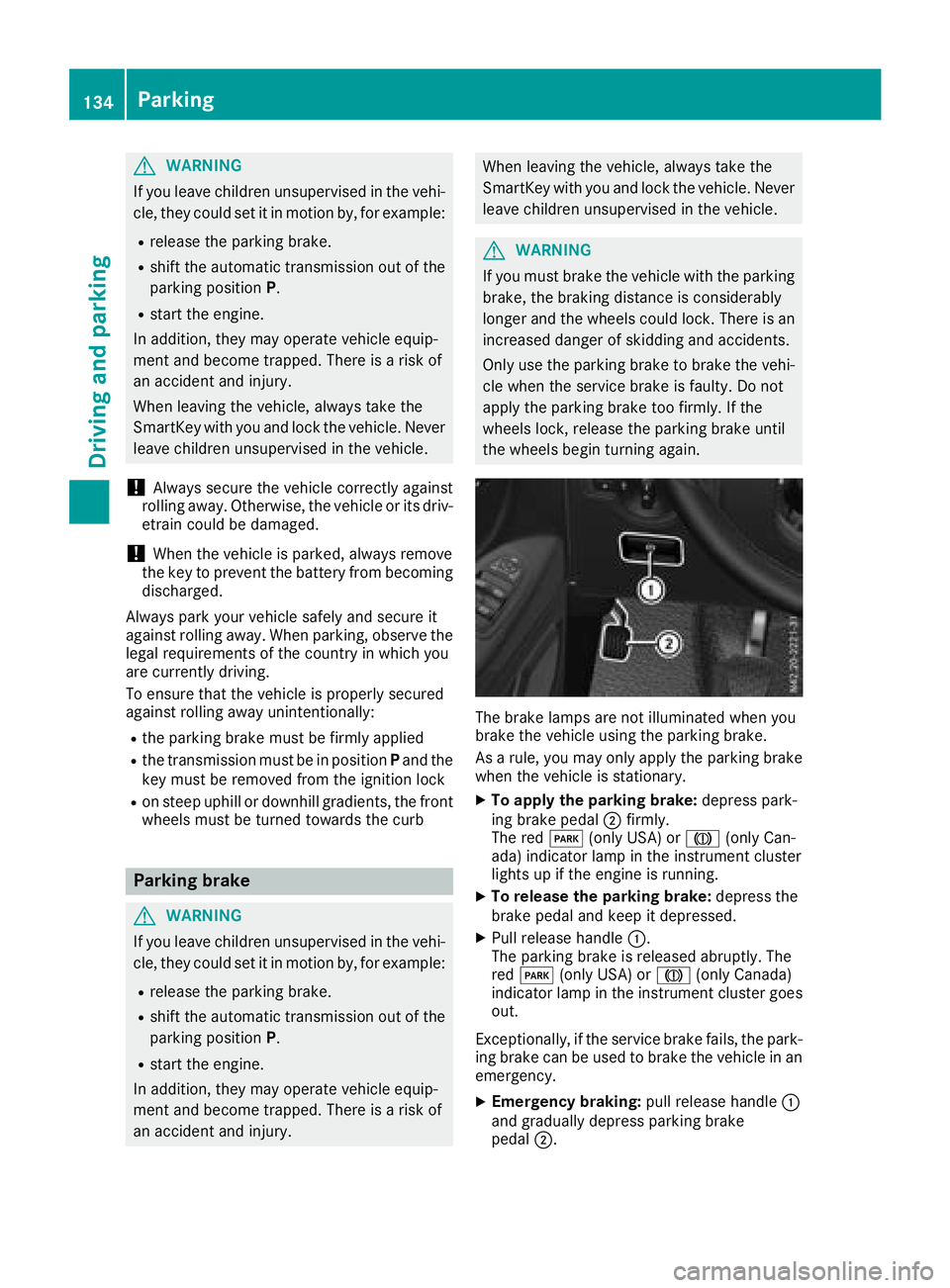
XTo apply the parking brake: depress park-
ing brake pedal ;firmly.
The red F(only USA) or J(only Can-
ada) indicator lamp in the instrument cluster
lights up if the engine is running.
XTo release the parking brake: depress the
brake pedal and keep it depressed.
XPull release handle :.
The parking brake is released abruptly. The
red F (only USA) or J(only Canada)
indicator lamp in the instrument cluster goes
out.
Exceptionally, if the service brake fails, the park-
ing brake can be used to brake the vehicle in an
emergency.
XEmergency braking: pull release handle:
and gradually depress parking brake
pedal ;.
134Parking
Driving and parking
Page 137 of 318
Switching off the engine
Important safety notes
GWARNING
The automatic transmission switches to neu-
tral position Nwhen you switch off the engine.
The vehicle may roll away. There is a risk of an
accident.
After switching off the engine, always switch
to parking position P. Prevent the parked vehi-
cle from rolling away by applying the parking
brake.
!If the coolant temperature is very high, e.g.
after driving on hilly roads, leave the engine
running at idle speed for about two minutes
before turning it off.
This allows the coolant temperature to return
to normal.
Vehicles with automatic transmission
XStop the vehicle.
XShift the transmission to position P.
XApply the parking brake.
XTurn the key to position0in the ignition lock
and remove it.
The immobilizer is activated.
If you switch the engine off with the trans-
mission in position Ror D, the automatic
transmission shifts to Nautomatically.
If you then open one of the front doors or
remove the key from the ignition, the auto-
matic transmission automatically shifts to P.
If you shift the automatic transmission to N
before switching off the engine, the automatic
transmission remains in Neven if a front door
is opened.
XSecure the vehicle to prevent it from rolling
away (Ypage 133).
Parking the vehicle for a long period
If you leave the vehicle parked for longer than
four weeks, the battery may be damaged by
exhaustive discharging.
XDisconnect the battery (Ypage 259).
or
XConnect the battery to a trickle charger.
Be sure to observe the notes on charging the batteries (
Ypage 262).
You can obtain information about trickle
chargers from a qualified specialist work-
shop.
If you leave the vehicle parked for longer than 6
weeks, the vehicle may suffer damage as a
result of lack of use.
XVisit a qualified specialist workshop and seek
advice.
Driving tips
General notes
Important safety notes
GWARNING
If you switch off the ignition while driving,
safety-relevant functions are only available
with limitations, or not at all. This could affect, for example, the power steering and the brake
boosting effect. You will require considerably
more effort to steer and brake. There is a risk
of an accident.
Do not switch off the ignition while driving.
GWARNING
If you operate mobile communication equip-
ment while driving, you will be distracted from traffic conditions. You could also lose control
of the vehicle. There is a risk of an accident.
Only operate this equipment when the vehicle
is stationary.
Observe the legal requirements of the country in
which you are driving. Some jurisdictions pro-
hibit the driver from using a mobile phone while driving a vehicle.
Driving tips135
Driving and parking
Z