fuel MERCEDES-BENZ METRIS 2017 MY17 Operator’s Manual
[x] Cancel search | Manufacturer: MERCEDES-BENZ, Model Year: 2017, Model line: METRIS, Model: MERCEDES-BENZ METRIS 2017Pages: 318, PDF Size: 5.01 MB
Page 308 of 318
iE10 fuel contains an admixture of up to 10%
bioethanol. Your vehicle is E10 compatible.
You can refuel your vehicle with E10 fuel.
iYou will generally find information about the
fuel grade on the filling pump. If there is no
identification on the filling pump, consult a
gas station attendant.
As a temporary measure, if the recommended
fuel is not available, you may also use regular
unleaded gasoline with an octane rating of
87 AKI/91 RON. This may reduce the engine's
performance and increase fuel consumption.
Avoid driving at full throttle and sudden accel-
eration. Never refuel using gasoline with a lower
AKI/RON rating.
iIn some countries, the available gasoline
may not be sufficiently low in sulfur. This fuel can temporarily produce unpleasant odors,
especially on short journeys. The odors are
reduced as soon as sulfur-free fuel (sulfur
content < 10 pp m) is used again fo rrefueling.
For more information about refueling
(
Ypage 132).
Fuel additives
!Operating the engine with subsequently
added fuel additives can cause engine dam-
age. Do not mix fuel additives with fuel. This
does not include additives for the remo val a
nd
prevention of deposits. Gasoline can only be
mixed with additives recommended by
Mercedes-Benz. Follow the instructions in the
product description. You can find further
information on recommended additives in any
Mercedes-Benz Commercial Van Center.
Mercedes-Benz recommends using brand-name
fuels with additives.
If you use fuels without these additives for a long
period of time, deposits can form. This primarily
forms on the inlet valve and in the combustion
chamber.
In some countries, the available fuel grade may
be inadequate. Residue could build up in the fuel
injection system as a result. In this case, in con-
sultation with a Mercedes-Benz Commercial
Van Center, the fuel should be mixed with the
cleaning additive recommended by Mercedes-
Benz. You must observe the notes and mixing
ratios indicated on the container.
Do not add other fuel additives to the fuel. This
results in unnecessary costs and can damage
the engine.
Information on fuel consumption
HEnvironmental note
CO
2(carbon dioxide) is the gas which scien-
tists believe to be principally responsible for
global warming (the greenhouse effect). Your
vehicle's CO
2emissions are directly related to
fuel consumption and therefore depend on:
Refficient use of the fuel by the engine
Rdriving style
Rother non-technical factors, such as envi-
ronmental influences, road conditions or
traffic flow
You can minimize your vehicle's CO
2emis-
sions by driving carefully and having it serv-
iced regularly.
Only for certain countries: the respective cur-
rent consumption and emission values of your
vehicle can be found in the COC papers (EC
CERTIFICATE OF CONFORMITY). These docu-
ments are supplied when the vehicle is deliv-
ered.
Consumption figures were found in the currently
valid respective version:
Rfor vehicles up to and including the Euro 4
standard according to EU Directive
80/1268/EEC
Rfor vehicles from the Euro 5standard accord-
ing to regulation (EC) no. 715/2007
Rfor vehicles from the Euro 6 standard accord- ing to regulation (EC) no. 595/2009
Fuel consumption depends on:
Rthe vehicle version
Rthe style of driving
Rthe operating conditions
Rthe type or quality of the fuel used
The vehicle will use more fuel than usual in the
following situations:
Rat very low outside temperatures
Rin city traffic
Rduring short journeys
Ron mountainous terrain
Rwhen towing a trailer
Observe the advice in the "Protection of the
environment" section to keep fuel consumption
low (
Ypage 29).
306Service products and capacities
Technical data
Page 309 of 318
The following components of the different vehi-
cle versions influence fuel consumption:
Rtire sizes, tire tread, tire pressure, tire condi-
tion
Rtransmission ratios for the drive assemblies
Radditional equipment (e.g. air-conditioning
system, auxiliary heating system)
For these reasons, the actual consumption fig-
ures for your vehicle may deviate from the con-
sumption figures determined according to EU
Directive 80/1268/EE C.
Details on fuel consumption can be called up in
the on-board computer:
Ron vehicles without steering wheel buttons
(Ypage 172)
Ron vehicles with steering wheel buttons
(Ypage 179)
Engine oil
General notes
When handling engine oil, observe the important
safety notes on operating fluids (Ypage 304).
The quality of the engine oil used is of decisive
importance for the engine's functionality and
operating life. Mercedes-Benz continually
approves engine oils based on complex experi-
ments according to the current state of the art. Therefore, only Mercedes-Benz approved
engine oils may be used in Mercedes-Benz
engines. Mercedes-Benz recommends having
the oil changed at a qualified specialist work-
shop. Information about engine oils approved by
Mercedes-Benz can be obtained:
Rfrom any Mercedes-Benz Commercial Van
Center
Ron the Internet at
http://bevo.mercedes-benz.co
mbyenterin g
th edesignation ,e.g. 229.5.
Mercedes-Ben zapprova lis indicate don th eoil
container by th einscription „MB-Freigabe “or
„MB Approval“ and th ecorrespondin gdesigna-
tion ,e.g. MB-Freigabe or MB Approval 229.5.
Designation sof th eapprove dengin eoils for
your vehicl e
MB-Freigabe or MB
Approval229.5
Mercedes-Ben zrecommends that you only use
approve dmultigrade engin eoils of th eSA E
classe sSA E0W-30 and SA E0W-40 or
SA E5W-30 and SA E5W-40. These engin eoils
ensur eoptimum lubrication eve nat ver ylow
outside temperatures (
Ypage 308).
Whe ntoppin gup, we recommen dthat you only
use engin eoil of th esam egrade (MB-Freigabe
or MB Approvaldesignation )and SA Eclass as
th eoil filled at th elast oil change.
iIf th eengin eoils listed in th etable are no t
available, you may add th efollowin gengin e
oils until th enext oil change:
RMB-Freigabe or MB Approval 229.1, or
ACE AA3
This mus tonly be added once and th eamount
mus tno tbe greate rthan 1qt (1. 0l).
Subsequentl yhav eth eengin eoil changed at
th eearliest possibl eopportunity.
!Using engin eoils of another grade qualit yis
no tpermitted.
Capacities
!Do no tadd to omuc hoil. addin gto omuc h
engin eoil can result in damage to th eengin e
or to th ecatalytic converter. Hav eexcess
engin eoil siphoned off .
Oil change includin goil filter
Engin eoilApprox. 2US gal
(7.75 l)
Service products and capacities307
Technical data
Z
Page 310 of 318
Additives
!Do notuse any additive sin th eengin eoil.
This could damag eth eengine.
Engine oil viscosity
!If th eSA Eviscosit yclas sof th eengin eoil
used does no tcover th eoutside temperature
range in whic hyou are operating th evehicle,
it mus tbe changed in goo dtime, in particular
before th ecold season commences. Using an
engin eoil that does no thav eadequate tem-
peratur echaracteristics can lead to engin e
damage.
The temperature range information of th eSA E
classification always refers to that of fresh oil.
The temperature characteristics of th eengin e
oil may deteriorat esignificantly due to agin g
in use, especially at low outside tempera-
tures.
We recommen dthat you chang eth eengin e
oil before th ecold season commences. Use
an approve dengin eoil of th especifie dSA E
class.
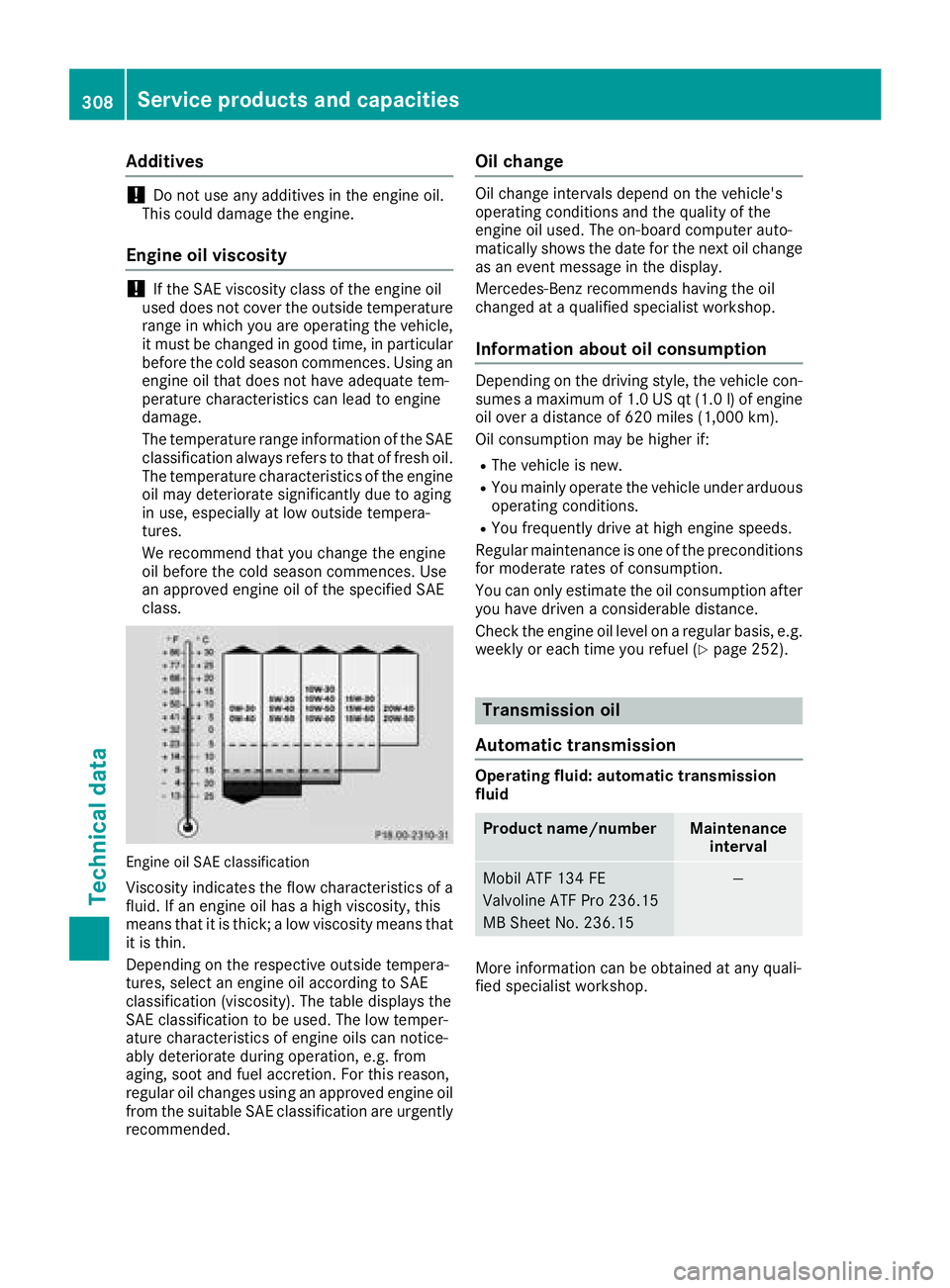
Engin eoil SA Eclassification
Viscosit yindicates th eflo wcharacteristics of a
fluid .If an engin eoil has ahigh viscosity, this
mean sthat it is thick ; alow viscosit ymean sthat
it is thin.
Dependin gon th erespective outside tempera-
tures, select an engin eoil according to SA E
classification (viscosity). The table displays th e
SA Eclassification to be used .The low temper-
atur echaracteristics of engin eoils can notice -
ably deteriorat eduring operation ,e.g. from
aging, soo tand fuel accretion .Fo rthis reason ,
regular oil changes usin gan approve dengin eoil
from th esuitable SA Eclassification are urgently
recommended.
Oil change
Oil chang eintervals depend on th evehicle's
operating condition sand th equalit yof th e
engin eoil used .The on-board computer auto -
matically shows th edat efor th enext oil chang e
as an event message in th edisplay.
Mercedes-Benz recommends having th eoil
changed at aqualified specialist workshop .
Information about oil consump tion
Dependin gon th edrivin gstyle, th evehicl econ-
sumes amaximum of 1. 0US qt (1. 0l)of engine
oil over a distance of 620 miles (1,000 km).
Oil consumption may be higher if:
RThe vehicle is new.
RYou mainly operate the vehicle under arduous
operating conditions.
RYou frequently drive at high engine speeds.
Regular maintenance is one of the preconditions
for moderate rates of consumption.
You can only estimate the oil consumption after
you have driven a considerable distance.
Check the engine oil level on a regular basis, e.g.
weekly or each time you refuel (
Ypage 252).
Transmission oil
Automatic transmission
Operating fluid: automatic transmission
fluid
Product name/numberMaintenance interval
Mobil ATF 134 FE
Valvoline ATF Pro 236.15
MB Sheet No. 236.15—
More information can be obtained at any quali-
fied specialist workshop.
308Service products and capacities
Technical data