fuel MERCEDES-BENZ METRIS 2017 MY17 Operator’s Manual
[x] Cancel search | Manufacturer: MERCEDES-BENZ, Model Year: 2017, Model line: METRIS, Model: MERCEDES-BENZ METRIS 2017Pages: 318, PDF Size: 5.01 MB
Page 283 of 318
Follow recommended tire inflation pressures
and check the pressure of all the tires includ-
ing the spare wheel:
Rmonthly, at least
Rif the load changes
Rbefore beginning a long journey
Runder different operating conditions, e.g.
off-road driving
If necessary, correct the tire pressure.
GWARNING
If you fit unsuitable accessories onto tire
valves, the tire valves may be overloaded and
malfunction, which can cause tire pressure
loss. Due to their design, retrofitted tire pres- sure monitors keep the tire valve open. This
can also result in tire pressure loss. There is a
risk of an accident.
Only screw the standard valve cap or other
valve caps approved by Mercedes-Benz for
your vehicle onto the tire valve.
!The pressure difference between tires on
any one axle must be no greater than 10 kPa
(0.1 bar/1.5 psi).
iThe specifications shown on the sample Tire
and Loading Information placard and tire
pressure table are examples. Tire pressure
data are vehicle-specific and may deviate
from the data illustrated here. The tire pres-
sure specifications that are valid for your vehi-
cle can be found on the Tire and Loading
Information placard and the tire pressure
table on the vehicle.
HEnvironmental note
Check the tire pressure regularly, at least
every 14 days.
General notes
You will find information on tire pressure for the vehicle's factory-mounted tires on the plates
described here.
The recommended tire pressure for various
operating conditions can be found on the Tire
and Loading Information placard on the B-pillar
on the driver's side of the vehicle or on the tire
pressure table inside the fuel filler flap. Further information on tire pressure can be
obtained at a qualified specialist workshop.
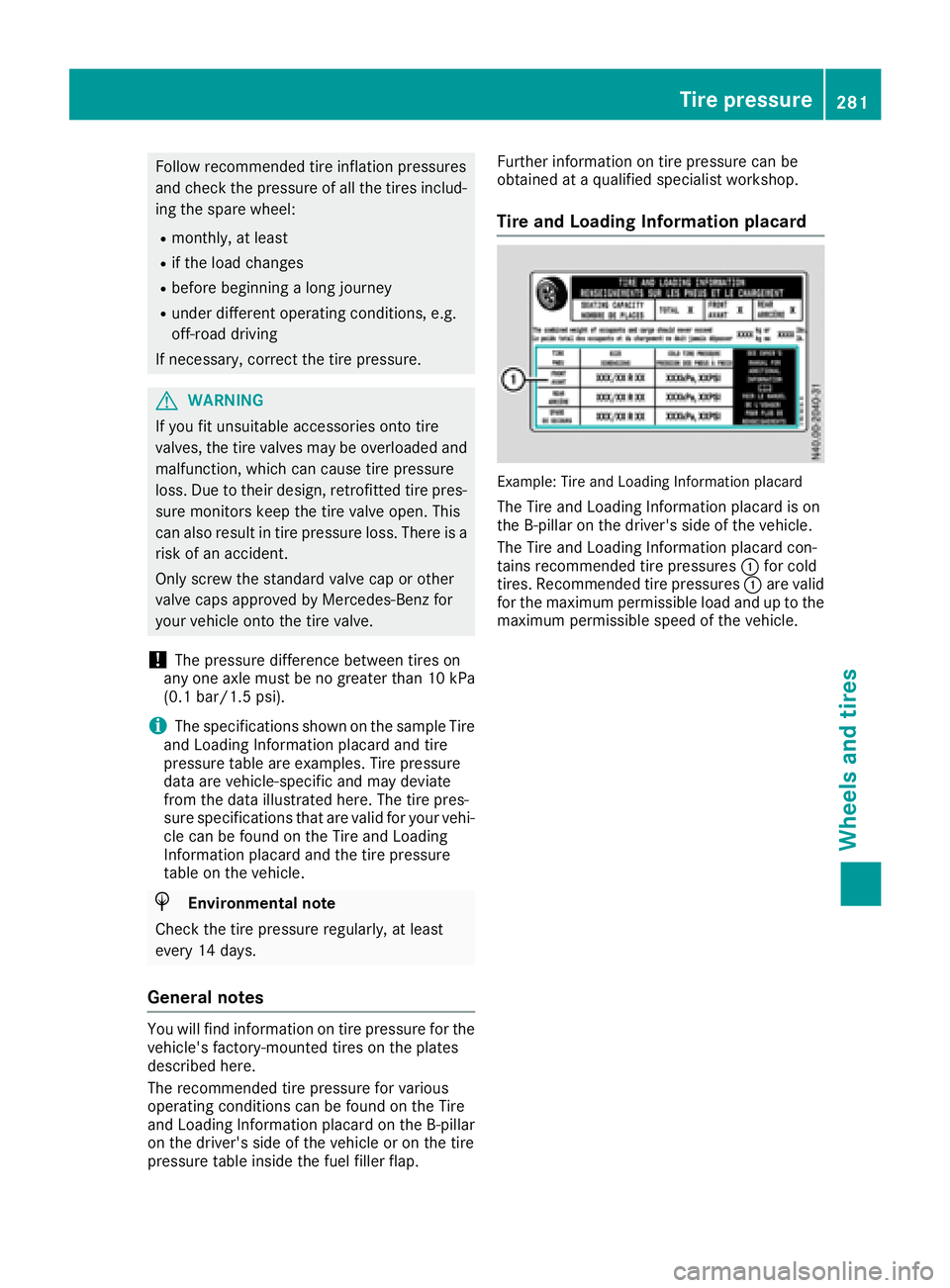
Tire and Loading Information placard
Example: Tire and Loading Information placard
The Tire and Loading Information placard is on
the B-pillar on the driver's side of the vehicle.
The Tire and Loading Information placard con-
tains recommended tire pressures
:for cold
tires. Recommended tire pressures :are valid
for the maximum permissible load and up to the
maximum permissible speed of the vehicle.
Tire pressure281
Wheels and tires
Z
Page 284 of 318
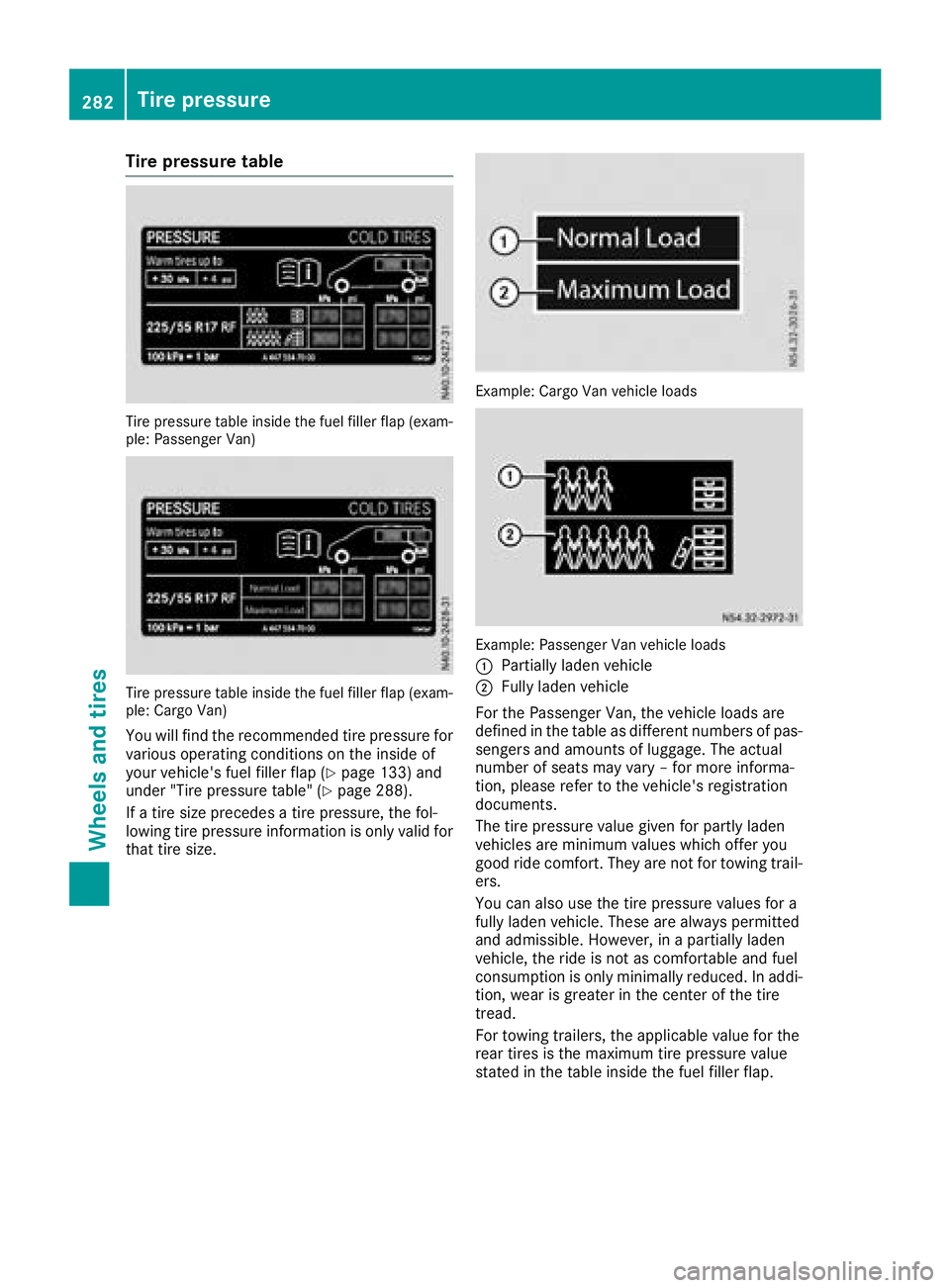
Tire pressure table
Tire pressure table inside the fuel filler flap (exam-
ple: Passenger Van)
Tire pressure table inside the fuel filler flap (exam-
ple: Cargo Van)
You will find the recommended tire pressure for
various operating conditions on the inside of
your vehicle's fuel filler flap (
Ypage 133) and
under "Tire pressure table" (Ypage 288).
If a tire size precedes a tire pressure, the fol-
lowing tire pressure information is only valid for
that tire size.
Example: Cargo Van vehicle loads
Example: Passenger Van vehicle loads
:
Partially laden vehicle
;Fully laden vehicle
For the Passenger Van, the vehicle loads are
defined in the table as different numbers of pas-
sengers and amounts of luggage. The actual
number of seats may vary – for more informa-
tion, please refer to the vehicle's registration
documents.
The tire pressure value given for partly laden
vehicles are minimum values which offer you
good ride comfort. They are not for towing trail-
ers.
You can also use the tire pressure values for a
fully laden vehicle. These are always permitted
and admissible. However, in a partially laden
vehicle, the ride is not as comfortable and fuel
consumption is only minimally reduced. In addi- tion, wear is greater in the center of the tire
tread.
For towing trailers, the applicable value for the
rear tires is the maximum tire pressure value
stated in the table inside the fuel filler flap.
282Tire pressure
Wheels and tires
Page 285 of 318
Important notes on tire pressure
GWARNING
If th etire pressur edrops repeatedly, th e
wheel, valv eor tire may be damaged. Tir e
pressur ethat is to olow may result in atire
blow-out .Ther eis aris kof an accident.
RChec kth etire for foreign objects .
RCheckwhether th ewhee lis losing air or th e
valv eis leaking .
If you are unable to rectify th edamage, con-
tac t a qualified specialist workshop.
Use asuitable pressur egage to chec kth etire
pressure. The outer appearanc eof atire does
no tpermit any reliable conclusio nabout th etire
pressure. On vehicles equipped wit hth eelec -
tronic tire pressur emonitor, th etire pressur e
can be checke dusin gth eon-board computer.
The tire temperature and pressur eincreas e
when th evehicl eis in motion .This is dependen t
on th edriving spee dand th eload.
Therefore, you should only correc ttire pressur e
when th etires are cold.
The tires are cold:
Rif th evehicl ehas been parked for at least
three hour swithout direct sunligh ton th e
tires ,and
Rif th evehicl ehas no tbeen driven further than
1 mile (1.6 km )
Tire temper ature changes depending on the
ambient temperature, driving speed and tire
load. If the tire temperature changes by 18 ‡
(10 †), the tire pressure ch anges by approx
-
imately 10 kPa (0.1 bar/1.5 psi). Take this into
account when checking the pressure of warm
tires. Only correct the tire pressure if it is too low
for the current operating conditions. If you
check the tire pressure when the tires are warm,
it results in a higher value than when the tires
are cold. This is normal. Do not under any cir-
cumstances release the air in order to adjust the
pressure to the prescribed value for cold tires.
The tire pressure would otherwise be too low.
Observe the recommended tire pressure for
cold tires on the tire pressure table in the fuel
filler flap. Driving with tire pressure that is too high or too
low can:
Rshorten the service life of the tires
Rcause increased tire damage
Rhave a negative effect on handling character-
istics and thus the driving safety (e.g. hydro-
planing)
Underinflated or overinflated tires
Underinflated tires:
GWARNING
Tires with pressure that is too low can over-
heat and burst as a consequence. In addition, they also suffer from excessive and/or irreg-
ular wear, which can severely impair the brak-
ing properties and the driving characteristics.
There is a risk of an accident.
Avoid tire pressures that are too low in all the
tires, including the spare wheel.
Underinflated tires can:
Rfail from being overheated
Radversely affect handling
Rwear excessively and/or unevenly
Rhave an adverse effect on fuel consumption
Overinflated tires
GWARNING
Tires with excessively high pressure can burst
because they are damaged more easily by
road debris, potholes etc. In addition, they
also suffer from irregular wear, which can
severely impair the braking properties and the driving characteristics. There is a risk of an
accident.
Avoid tire pressures that are too high in all the
tires, including the spare wheel.
Overinflated tires can:
Rincrease the braking distance
Radversely affect handling
Rwear excessively and/or unevenly
Radversely affect ride comfort
Rbe more susceptible to damage
Tire pressure283
Wheels and tires
Z
Page 287 of 318
For further information on displaying the current
tire pressures, refer to "Checking the tire pres-
sure electronically" (
Ypage 286).
Important safety notes
GWARNING
Each tire, including the spare (if provided),
should be checked at least once a month
when cold and inflated to the pressure rec-
ommended by the vehicle manufacturer on
the Tire and Loading Information placard on
the driver's door B-pillar or the tire pressure
label on the inside of the fuel filler flap. If your
vehicle has tires of a different size than the
size indicated on the Tire and Loading Infor-
mation placard or the tire pressure label, you
should determine the proper tire pressure for
those tires.
As an added safety feature, your vehicle has
been equipped with a tire pressure monitoring
system (TPMS) that illuminates a low tire pres-
sure telltale when one or more of your tires
are significantly underinflated. Accordingly,
when the low tire pressure telltale illuminates,
you should stop and check your tires as soon
as possible, and inflate them to the proper
pressure. Driving on a significantly underin-
flated tire causes the tire to overheat and can lead to tire failure. Underinflation also
reduces fuel efficiency and tire tread life, and
may affect the vehicle's handling and stop-
ping ability.
Please note that the TPMS is not a substitute
for proper tire maintenance, and it is the driv-
er's responsibility to maintain correct tire
pressure, even if underinflation has not
reached the level to trigger illumination of the
TPMS low tire pressure telltale.
USA only:
Your vehicle has al so b
een equipped with a
TPMS malfunction indicator to indicate if the
system is not operating properly. The TPMS
malfunction indicator is combined with the
low tire pressure telltale. When the system
detects a malfunction, the warning lamp will
flash for approximately a minute and then
remain continuously illuminated. This
sequence will be repeated every time the vehi-
cle is started as long as the malfunction
exists.
When the malfunction indicator is illuminated,
the system may not be able to detect or signal
low tire pressure as intended. TPMS malfunc-
tions may occur for a variety of reasons,
including the mounting of incompatible
replacement or alternate tires or wheels on
the vehicle that prevent the TPMS from func-
tioning properly. Always check the TPMS mal-
function telltale after replacing one or more
tires or wheels on your vehicle to ensure that the replacement or alternate tires and wheels
allow the TPMS to continue to function prop-
erly.
It is the driver's responsibility to set the tire
pressure to the recommended cold tire pressure
suitable for the operating conditions
(
Ypage 280).
Note that the correct tire pressure for the cur-
rent operating conditions must first be pro-
gramed into the tire pressure monitor. If there is
a substantial loss of pressure, the warning
threshold for the warning message is aligned to
the reference values programed in. Restart the
tire pressure monitor after adjusting the cold
tire pressure (
Ypage 287). The current pres-
sures are saved as new reference values. This
will ensure that a warning message will only
appear if the tire pressure drops significantly.
The tire pressure monitor does not warn you if a
tire pressure is incorrect. Obs erve the note
s on
the recommended tire pressure (Ypage 280).
The tire pressure monitor is not able to warn you
of a sudden loss of pressure, e.g. following pen- etration by a foreign object. In this event, brake
the vehicle until it comes to a standstill. Avoid
sudden steering movements.
The tire pressure monitor has a yellow h
warning lamp in the instrument cluster for indi-
cating pressure loss/malfunctions (USA) or
pressure loss (Canada). Depending on how the
warning lamp flashes or lights up, an underin-
flated tire or a malfunction in the tire pressure
monitor is displayed:
Rif the h warning lamp is lit continuously,
the tire pressure on one or more tires is sig-
Tire pressure285
Wheels and tires
Z
Page 290 of 318
Tire pressure tables
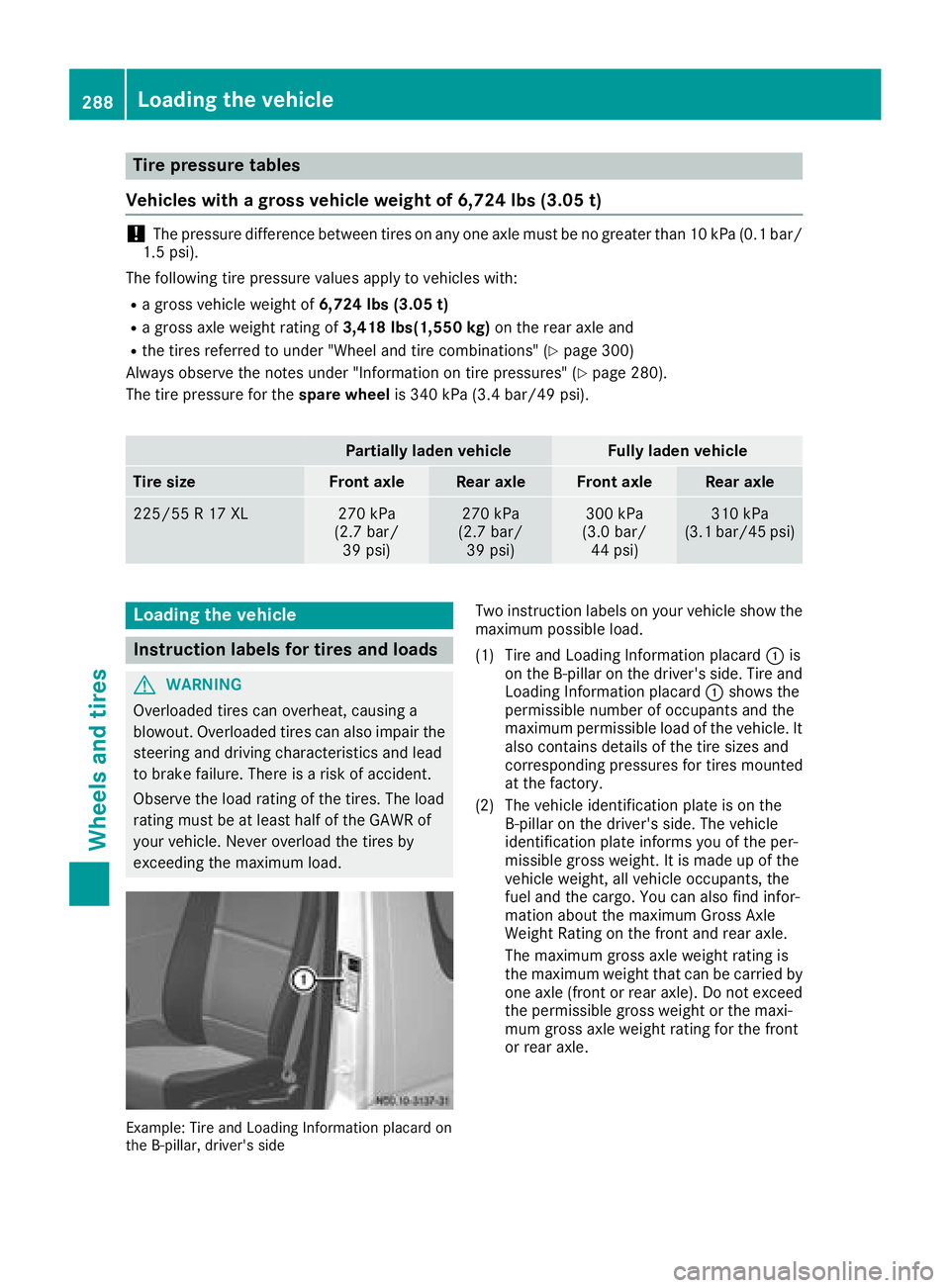
Vehicles with a gross vehicle weight of 6,724 lbs (3.05 t)
!The pressure difference between tires on any one axle must be no greater than 10 kPa (0.1 ba r/
1.5 psi).
The following tire pressure values apply to vehicles with:
Ra gross vehicle weight of 6,724 lbs (3.05 t)
Ra gross axle weight rating of 3,418 lbs(1,550 kg)on the rear axle and
Rthe tires referred to under "Wheel and tire combinations" (Ypage 300)
Always observe the notes under "Information on tire pressures" (
Ypage 280).
The tire pressure for the spare wheelis 340 kPa (3.4 bar/49 psi).
Partially laden vehicleFully laden vehicle
Tire sizeFront axleRear axleFront axleRear axle
225/55 R 17 XL270 kPa
(2.7 bar/ 39 psi)270 kPa
(2.7 bar/ 39 psi)300 kPa
(3.0 bar/ 44 psi)310 kPa
(3.1 bar/45 psi)
Loading the vehicle
Instruction labels for tires and loads
GWARNING
Overloaded tires can overheat, causing a
blowout. Overloaded tires can also impair the steering and driving characteristics and lead
to brake failure. There is a risk of accident.
Observe the load rating of the tires. The load
rating must be at least half of the GAWR of
your vehicle. Never overload the tires by
exceeding the maximum load.
Example: Tire and Loading Information placard on
the B-pillar, driver's side
Two instruction labels on your vehicle show themaximum possible load.
(1) Tire and Loading Information placard :is
on the B-pillar on the driver's side. Tire and
Loading Information placard :shows the
permissible number of occupants and the
maximum permissible load of the vehicle. It also contains details of the tire sizes and
corresponding pressures for tires mounted
at the factory.
(2) The vehicle identification plate is on the B-pillar on the driver's side. The vehicle
identification plate informs you of the per-
missible gross weight. It is made up of the
vehicle weight, all vehicle occupants, the
fuel and the cargo. You can also find infor-
mation about the maximum Gross Axle
Weight Rating on the front and rear axle.
The maximum gross axle weight rating is
the maximum weight that can be carried by
one axle (front or rear axle). Do not exceed the permissible gross weight or the maxi-
mum gross axle weight rating for the front
or rear axle.
288Loading the vehicle
Wheels and tires
Page 297 of 318
GVW (Gross Vehicle Weight)
The gross vehicle weight includes the weight of
the vehicle including fuel, tools, spare wheel,
accessories installed, occupants, luggage and
the drawbar noseweight if applicable. The gross
vehicle weight must never exceed the permissi-
ble gross weight (GVWR) specified on the
B-pillar on the driver's side (
Ypage 303).
GVWR (Gross Vehicle Weight Rating)
The GVWR is the maximum permitted gross
weight of the fully laden vehicle (weight of the
vehicle including all accessories, occupants,
fuel, luggage and the drawbar noseweight if
applicable). The permissible gross weight is
specified on the vehicle identification plate on
the B-pillar on the driver's side (
Ypage 303).
Maximum weight of the laden vehicle
The maximum weight is the sum of:
Rthe curb weight of the vehicle
Rthe weight of the accessories
Rthe load limit
Rthe weight of the factory installed optional
equipment
Kilopascal (kPa)
Metric unit for tire pressure. 6.9 kPa are the
equivalent of 1 psi. Another tire pressure unit is
bar. 100 kilopascals (kPa) are the equivalent of
1 bar.
Load index
In addition to the load bearing index, a load
index can be stamped onto the sidewall of the
tire. It specifies the load-bearing capacity of the
tire more precisely.
Curb weight
The weight of a vehicle with standard equipment
including the maximum filling capacity of fuel,
oil, and coolant. It also includes the air-condi-
tioning system and optional equipment if these
are installed on the vehicle, but does not include
passengers or luggage.
Maximum tire load
The maximum tire load in kilograms or pounds is
the maximum weight for which a tire is
approved.
Maximum permissible tire pressure
Maximum permissible tire pressure for one tire.
Maximum load on one tire
Maximum load on one tire. This is calculated by
dividing the maximum axle load of one axle by
two.
PSI (Pounds per square inch)
Standard unit of measurement for tire pressure.
Aspect ratio
Relationship between tire height and width in
percent.
Tire pressure
Pressure inside the tire applying an outward
force to every square inch of the tire's surface.
Tire pressure is specified in pounds per square
inch (psi), in kilopascal (kPa) or in bar. Tire pres-
sure should only be corrected when the tires are
cold.
Cold tire pressure
The tires are cold:
Rif the vehicle has been parked for at least
three hours without direct sunlight on the
tires, and
Rif the vehicle has not been driven further than
1 mile (1.6 km)
Tire tread
The part of the tire that comes into contact with
the road.
Tire bead
The tire bead ensures that the tire sits securely
on the wheel. There are several steel wires in the bead to prevent the tire from coming loose from
the wheel rim.
Sidewall
The part of the tire between the tread and the
tire bead.
Weight of optional extras
The combined weight of those optional extras
that weigh more than the replaced standard
parts and more than 2.3 kg (5 lbs). These
optional extras, such as high-performance
brakes, a roof rack or a high-performance bat-
tery, are not included in the curb weight and theweight of the accessories.
What you should know about wheels and tires295
Wheels and tires
Z
Page 298 of 318
TIN (Tire Identification Number)
A unique identification number which can be
used by a tire manufacturer to identify tires, for
example for a product recall, and thus identify
the purchasers. The TIN is composed of the
manufacturer identification code, tire size, tire
model code and manufacturing date.
Load bearing index
The load bearing index (also load index) is a code
that contains the maximum load bearing capa-
city of a tire.
Traction
Traction is the result of friction between the tires
and the road surface.
TWR (permissible trailer drawbar load)
The TWR is the maximum permissible weight
that may act on the ball coupling of the trailer
tow hitch.
Wear indicator
Narrow bars (tread wear bars) that are distrib-
uted over the tire tread. If the tire tread is level
with the bars, the wear limit of áin (1.6 mm)
has been reached.
Distribution of the vehicle occupants
The distribution of vehicle occupants over des-
ignated seat positions in a vehicle.
Maximum permissible payload weight
Nominal load and goods/luggage load plus
68 kg (150 lb s)multiplied by the number of
seats in the vehicle.
Changing wheels
Rotating the wheels
GWARNING
Interchanging the front and rear wheels may
severely impair the driving characteristics if
the wheels or tires have different dimensions. The wheel brakes or suspension components
may also be damaged. There is a risk of acci-
dent.
Rotate front and rear wheels only if the wheels and tires are of the same dimensions.
!On vehicles equipped with a tire pressure
monitor, electronic components are located
in the wheel.
Tire-mounting tools should not be used near
the valve. This could damage the electronic
components.
Only have tires changed at a qualified spe-
cialist workshop.
Always observe the instructions and safety
notes under "Mounting a wheel" (
Ypage 297).
The wear patterns on the front and rear tires
differ, depending on the operating conditions.
Rotate the wheels before a clear wear pattern
has formed on the tires. Front tires typically
wear more on the shoulders and the rear tires in the center.
If your vehicle's tire configuration allows, you
can rotate the tires according to the intervals in
the tire manufacturer's warranty book in your
vehicle documents. If no warranty book is avail-
able, the tires should be rotated every 3,000 to
6,000 miles (5,000 to 10,000 km) or earlier if
tire wear requires. Do not change the direction
of rotation.
Clean the contact surfaces of the wheel and the
brake disc thoroughly every time a wheel is rota-
ted. Avoid oily or greasy cleaning agents.
Check the tire pressure and reactivate the tire
pressure monitor if necessary.
Direction of rotation
Tires with a specified direction of rotation have
additional benefits, e.g. if there is a risk of hydro-
planing. You will only gain these benefits if the
correct direction of rotation is observed.
An arrow on the sidewall of the tire indicates its
correct direction of rotation.
You may mount a spare wheel against the direc-tion of rotation. Observe the time restriction on
use as well as the speed limitation specified on
the spare wheel.
Storing wheels
Store wheels that are not being used in a cool,
dry and preferably dark place. Protect the tires
from contact with oil, grease and fuel.
296Changing wheels
Wheels and tires
Page 302 of 318
When using a wheel/spare wheel with a new or
newly painted wheel rim, have the wheel bolts/
nuts retightened again after approximately 600
to 3,000 miles (1,000 to 5,000 km). Observe the
specified tightening torque.
Wheel and tire combination
General notes
!
Retreaded tires are neither tested nor rec-
ommended by Mercedes-Benz, since previ-
ous damage cannot always be detected on
retreaded tires. As a result, Mercedes-Benz
cannot guarantee vehicle safety if retreaded
tires are mounted. Do not mount used tires if you have no information about their previous
usage.
!For safety reasons, Mercedes-Benz recom-
mends that you only use tires, wheels and
accessories which have been specially
approved by Mercedes-Benz for your vehicle.
These tires have been specially adapted for
use with the driving safety systems, such as
ABS or ESP
®.
Only use tires, wheels or accessories tested
and approved by Mercedes-Benz. Certain
characteristics, e.g. handling, vehicle noise
emissions or fuel consumption, may other-
wise be adversely affected. In addition, when
driving with a load, tire dimension variations
could cause the tires to come into contact
with the bodywork and axle components. This could result in damage to the tires or the vehi-
cle.
Mercedes-Benz accepts no liability for dam-
age resulting from the use of tires, wheels or
accessories other than those tested and
approved.
Further information on wheels, tires and
approved combinations can be obtained from
any qualified specialist workshop.
!Large wheels: the lower the section width
for a certain wheel size, the lower the ride
comfort is on poor road surfaces. Roll comfort and suspension comfort are reduced and the
risk of damage to the wheels and tires as a
result of driving over obstacles increases.
You will find a table with the recommended tire
pressures for various vehicle loads on the inside
of your vehicle's fuel filler flap or under "Tire
pressure tables" (
Ypage 288). You can find fur-
ther information under "Tire pressure"
(
Ypage 280).
Check tire pressures regularly and only when
the tires are cold.
Notes on the vehicle equipment – always equip
the vehicle:
Rwith tires of the same size across an axle
(left/right)
Rwith the same type of tires on all wheels at a
given time (summer tires, winter tires)
iNot all wheel/tire combinations can be
installed at the factory in all countries.
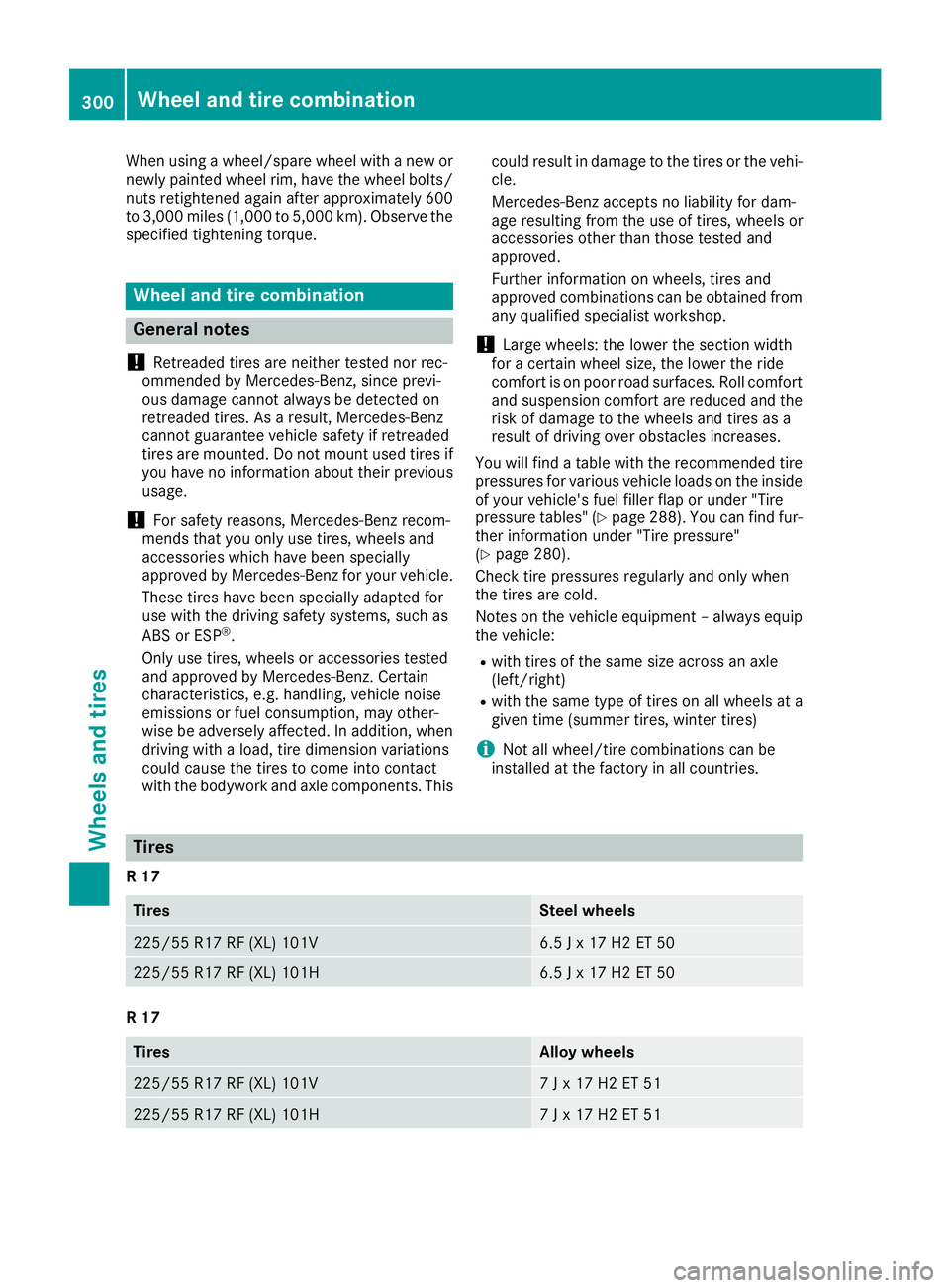
Tires
R 17
TiresSteel wheels
225/55 R17 RF (XL) 101V6.5 J x 17 H2 ET 50
225/55 R17 RF (XL) 101H6.5 J x 17 H2 ET 50
R 17
TiresAlloy wheels
225/55 R17 RF (XL) 101V7 J x 17 H2 ET 51
225/55 R17 RF (XL) 101H7 J x 17 H2 ET 51
300Wheel and tire combination
Wheels and tires
Page 306 of 318
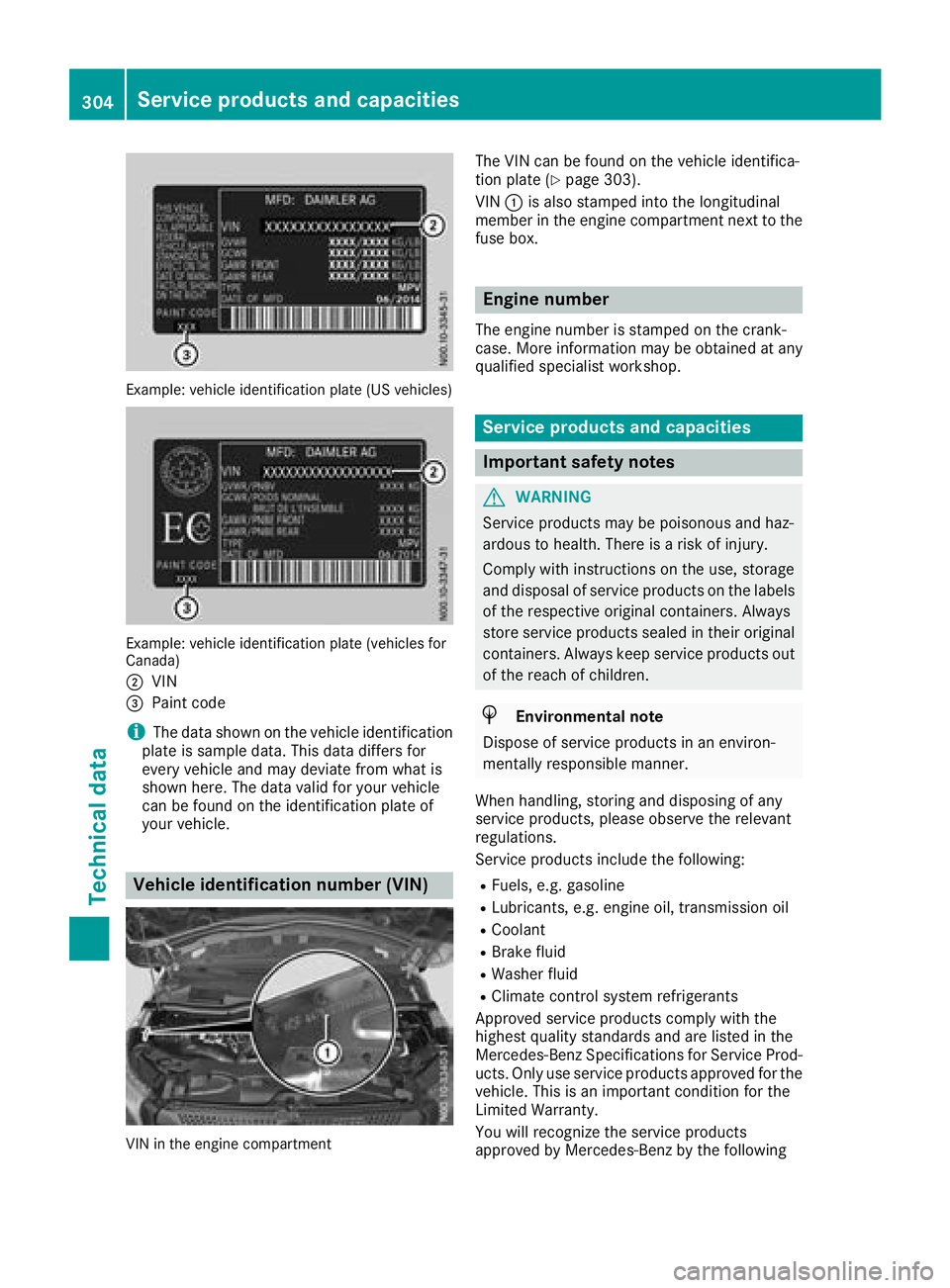
Example: vehicle identification plate (US vehicles)
Example: vehicle identification plate (vehicles for
Canada)
;
VIN
=Paint code
iThe data shown on the vehicle identification
plate is sample data. This data differs for
every vehicle and may deviate from what is
shown here. The data valid for your vehicle
can be found on the identification plate of
your vehicle.
Vehicle identification number (VIN)
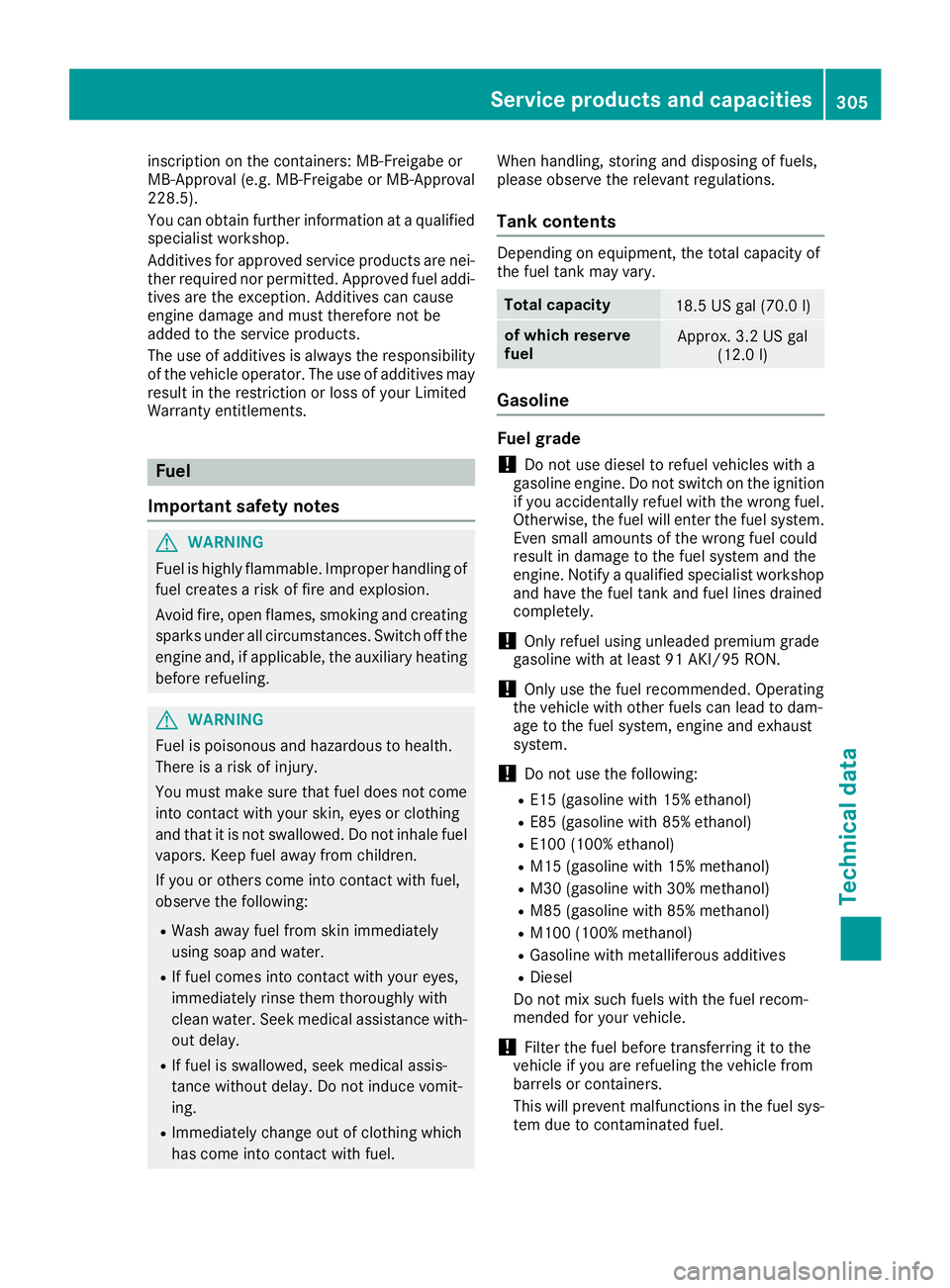
VIN in the engine compartment
The VIN can be found on the vehicle identifica-
tion plate (Ypage 303).
VIN :is also stamped into the longitudinal
member in the engine compartment next to the
fuse box.
Engine number
The engine number is stamped on the crank-
case. More information may be obtained at any
qualified specialist workshop.
Service products and capacities
Important safety notes
GWARNING
Service products may be poisonous and haz-
ardous to health. There is a risk of injury.
Comply with instructions on the use, storage
and disposal of service products on the labels
of the respective original containers. Always
store service products sealed in their original
containers. Always keep service products out
of the reach of children.
HEnvironmental note
Dispose of service products in an environ-
mentally responsible manner.
When handling, storing and disposing of any
service products, please observe the relevant
regulations.
Service products include the following:
RFuels, e.g. gasoline
RLubricants, e.g. engine oil, transmission oil
RCoolant
RBrake fluid
RWasher fluid
RClimate control system refrigerants
Approved service products comply with the
highest quality standards and are listed in the
Mercedes-Benz Specifications for Service Prod-
ucts. Only use service products approved for the
vehicle. This is an important condition for the
Limited Warranty.
You will recognize the service products
approved by Mercedes-Benz by the following
304Service products and capacities
Technical data
Page 307 of 318
inscription on the containers: MB-Freigabe or
MB-Approval (e.g. MB-Freigabe or MB-Approval
228.5).
You can obtain further information at a qualified
specialist workshop.
Additives for approved service products are nei-
ther required nor permitted. Approved fuel addi-
tives are the exception. Additives can cause
engine damage and must therefore not be
added to the service products.
The use of additives is always the responsibility
of the vehicle operator. The use of additives may
result in the restriction or loss of your Limited
Warranty entitlements.
Fuel
Important safety notes
GWARNING
Fuel is highly flammable. Improper handling of
fuel creates a risk of fire and explosion.
Avoid fire, open flames, smoking and creating
sparks under all circumstances. Switch off the
engine and, if applicable, the auxiliary heating
before refueling.
GWARNING
Fuel is poisonous and hazardous to health.
There is a risk of injury.
You must make sure that fuel does not come into contact with your skin, eyes or clothing
and that it is not swallowed. Do not inhale fuel
vapors. Keep fuel away from children.
If you or others come into contact with fuel,
observe the following:
RWash away fuel from skin immediately
using soap and water.
RIf fuel comes into contact with your eyes,
immediately rinse them thoroughly with
clean water. Seek medical assistance with-
out delay.
RIf fuel is swallowed, seek medical assis-
tance without delay. Do not induce vomit-
ing.
RImmediately change out of clothing which
has come into contact with fuel. When handling, storing and disposing of fuels,
please observe the relevant regulations.
Tank contents
Depending on equipment, the total capacity of
the fuel tank may vary.
Total capacity18.5 US gal (70.0 l)
of which reserve
fuelApprox. 3.2 US gal
(12.0 l)
Gasoline
Fuel grade
!Do not use diesel to refuel vehicles with a
gasoline engine. Do not switch on the ignition
if you accidentally refuel with the wrong fuel.
Otherwise, the fuel will enter the fuel system.
Even small amounts of the wrong fuel could
result in damage to the fuel system and the
engine. Notify a qualified specialist workshop
and have the fuel tank and fuel lines drained
completely.
!Only refuel using unleaded premium grade
gasoline with at least 91 AK I/95 RON.
!Only use the fuel recommended. Operating
the vehicle with other fuels can lead to dam-
age to the fuel system, engine and exhaust
system.
!Do not use the following:
RE15 (gasoline with 15% ethanol)
RE85 (gasoline with 85% ethanol)
RE100 (100% ethanol)
RM15 (gasoline with 15% methanol)
RM30 (gasoline with 30% methanol)
RM85 (gasoline with 85% methanol)
RM100 (100% methanol)
RGasoline with metalliferous additives
RDiesel
Do not mix such fuels with the fuel recom-
mended for your vehicle.
!Filter the fuel before transferring it to the
vehicle if you are refueling the vehicle from
barrels or containers.
This will prevent malfunctions in the fuel sys-
tem due to contaminated fuel.
Service products and capacities305
Technical data
Z