service MERCEDES-BENZ METRIS 2018 MY18 Operator’s Manual
[x] Cancel search | Manufacturer: MERCEDES-BENZ, Model Year: 2018, Model line: METRIS, Model: MERCEDES-BENZ METRIS 2018Pages: 318, PDF Size: 5.07 MB
Page 24 of 318
Setting (climate control) ................ 115
Theft deterrent systems
ATA (Anti-Theft Alarm system) ......... 68
Immobilizer ...................................... 67
Time
Setting (vehicle with steering
wheel buttons) ............................... 189
Setting the time (vehicle with
steering wheel buttons) ................. 189
Setting the time (vehicle without
steering wheel buttons) ................. 178
Tire pressure
Calling up (on-board computer) ..... 286
Checking manually ........................ 286
Display messages (vehicle with
steering wheel buttons) ................. 219
Display messages (vehicle with-
out steering wheel buttons) ........... 203
Important safety notes .................. 286
Maximum ....................................... 286
Notes ............................................. 285
Recommended ............................... 282
Tables ............................................ 290
Tire label ........................................ 283
Tire pressure monitor
Checking the tire pressure elec-
tronically ........................................ 288
Function/notes ............................. 286
General notes ................................ 286
Important safety notes .................. 287
Restarting ...................................... 289
Warning lamp ................................. 230
Warning message .......................... 288
Tire pressure table ............................ 290
Tires
Aspect ratio (definition) ................. 297
Average weight of the vehicle
occupants (definition) .................... 296
Bar (definition) ............................... 296
Changing a wheel .......................... 298
Characteristics .............................. 296
Checking ........................................ 280
Curb weight (definition) ................. 297
Definition of terms ......................... 296
Direction of rotation ...................... 298
Display messages (vehicle with
steering wheel buttons) ................. 219 Display messages (vehicle with-
out steering wheel buttons) ........... 203
Distribution of the vehicle occu-
pants (definition) ............................ 298
DOT (Department of Transporta-
tion)
(de
finition) ............................. 296
DOT, Tire Identification Number
(TIN) ............................................... 295
GAWR (Gross Axle Weight Rating)
(definition) ..................................... 296
GTW (Gross Trailer Weight) (defi-
nition) ............................................ 296
GVW (Gross Vehicle Weight) (def-
inition) ........................................... 297
GVWR (Gross Vehicle Weight Rat-
ing) (definition) .............................. 297
Important safety notes .................. 279
Increased vehicle weight due to
optional equipment (definition) ...... 296
Information on driving .................... 279
Kilopascal (kPa) (definition) ........... 297
Labeling (overview) ........................ 293
Load bearing index (definition) ...... 298
Load index ..................................... 295
Load index (definition) ................... 297
M+S tires ....................................... 281
Maximum load on a tire (defini-
tion) ............................................... 297
Maximum loaded vehicle weight
(definition) ..................................... 297
Maximum permissible tire pres-
sure (definition) ............................. 297
Maximum tire load ......................... 295
Maximum tire load (definition) ....... 297
Optional equipment weight (defi-
nition) ............................................ 297
PSI (pounds per square inch) (def-
inition) ........................................... 297
Replacing ....................................... 298
Service life ..................................... 280
Sidewall (definition) ....................... 297
Snow chains .................................. 282
Speed rating (definition) ................ 296
Storing ........................................... 298
Structure and characteristics
(definition) ..................................... 296
Summer tires ................................. 281
22Index
Page 28 of 318
Snow chains .................................. 282
Winter operation
General notes ................................ 281
Radiator cover ................................. 33
Winter tires
M+S tires ....................................... 281
Setting a limit speed ...................... 138
Wiper blades
Cleaning ......................................... 268
Important safety notes .................. 107
Replacing (rear window) ................ 108
Replacing (windshield) ................... 107
Service indicator ............................ 107
Workshop
see Qualified specialist workshop
26Index
Page 29 of 318
Operating Instructions
Before the first journey
These instructions, the Maintenance or Service
Booklet and the additional equipment-specific
instructions are integral parts of the vehicle.
Keep these documents in the vehicle at all
times. If you sell the vehicle, always pass on all
documents to the new owner.
Before you first drive off, read these documents
carefully and familiarize yourself with your vehi- cle.
For your own safety and a longer vehicle life,
follow the instructions and warning notices in
these operating instructions. Failure to observe
the instructions may lead to damage to the vehi-
cle or personal injury.
Vehicle damage caused by a failure to observe
the instructions is not covered by the New Vehi- cle Limited Warranty.
Limited warranty
!
Observe the notes in this Operator's Manual
regarding the correct operation of your vehi-
cle and possible damage to the vehicle. Dam-
age to the vehicle which is caused by violation
of these notes is not covered by the
Mercedes-Benz implied warranty or the new
or used-vehicle warranty.
Vehicle equipment
These operating instructions describe all mod-
els and standard and optional equipment of your
vehicle that were available at the time of going
to print. Country-specific variations are possi-
ble. Note that your vehicle may not be equipped with all of the described functions. This also
applies to systems and functions relevant to
safety. The equipment in your vehicle may there-
fore differ from that shown in the descriptions
and illustrations.
The original purchase contract documentation
for your vehicle contains a list of all of the sys-
tems in your vehicle.
Questions concerning equipment or operation
can be directed to any Mercedes-Benz Com-
mercial Van Center.
Service and vehicle operation
Warranty
The Limited Warranty for your vehicle is in
accordance with the warranty terms in the Ser-
vice and Warranty Information booklet.
Your Mercedes-Benz Commercial Van Center
will replace and repair all factory-installed parts
in accordance with the terms of the following
warranties:
RNew Vehicle Limited Warranty
RExhaust System Warranty
REmission Systems Warranty
RCalifornia, Connecticut, Maine, Massachu-
setts, New York, Pennsylvania, Rhode Island
and Vermont Emission Control System War-
ranty
RState Warranty Enforcement Laws ("Lemon
Laws")
Replacement parts and accessories are covered
by the Mercedes-Benz Parts and Accessories
Warranties. You can obtain these from any
Mercedes-Benz Commercial Van Center.
iShould you lose your Service and Warranty
Information booklet, contact a Mercedes-
Benz Commercial Van Center for a replace-
ment. The new Service and Warranty Infor-
mation booklet will be posted to you.
Customer information for California
In California you are entitled to demand that
your vehicle be exchanged or that the purchase
or leasing price be refunded if Mercedes-Benz
USA, LLC and/or authorized workshops or ser-
vice centers are not able, after several justifiable
repairs, to rectify major damage to or malfunc-
tions of the vehicle as covered by the contrac-
tual warranty provisions. Customers who pur-
chase or lease a vehicle can have the vehicle
repaired within a period of 18 months after
delivery or after a mileage of up to 29,000 km
(equals approx. 18,000 miles), whichever
comes first, if:
(1) the same serious defect or damage which could lead to fatal or serious injuries to the
occupants of the vehicle during driving has
been repaired at least twice and Mercedes-
Introduction27
Page 30 of 318
Benz, LLC has been informed in writing of
the necessity of such a repair.
(2) the same defect or damage, although less serious than described in (1), has been
repaired at least four times and Mercedes-
Benz has been informed of the necessity of
such a repair in writing.
(3) the vehicle cannot be operated for more than 30 calendar days due to repairs result-
ing from the same or other major defects ordamage.
Please send written notification to:
Mercedes-Benz USA, LLC
Customer Assistance Center
One Mercedes Drive
Montvale, NJ 07645-0350
Maintenance
USA only:
Always bring the Maintenance Booklet with you
when taking the vehicle to a Mercedes-Benz
Commercial Van Center. Your customer service
advisor enters each service into the Mainte-
nance Booklet.
Canada only:
Have every service carried out by a qualified
specialist workshop recorded in your service
report.
Roadside Assistance
The Mercedes-Benz Roadside Assistance Pro-
gram provides you with technical assistance in
the case of a breakdown. Your toll-free calls to
the Roadside Assistance Hotline are answered
by our staff around the clock. 365 days a year.
1-800-FOR-MERCedes (1-800-367-6372)
(USA)
1-800-387-0100 (Canada)
Further information can be found in the
Mercedes-Benz Roadside Assistance-Program
brochure (USA) or the "Roadside Assistance"
section of the Service and Warranty Information booklet (Canada). Both are located in your vehi-
cle document wallet.
Change of address or owner
Please use the "Notice of Change of Address"
form in the Service and Warranty Information
booklet to inform us of a change of address, or
simply phone the Mercedes-Benz Customer
Assistance Center (USA) on hotline number
1-800-FOR-MERCedes (1-800-367-6372) or
Customer Service (Canada) on
1-800-387-0100. This enables us, if necessary,
to contact you at any time.
If you sell your Mercedes, please leave all the
literature in the vehicle so that it is available for
the next owner.
If your vehicle was purchased as a used vehicle,
please send us the "Notice of Purchase of Used
Car" from the Service and Warranty Information
booklet or phone the Mercedes-Benz Customer
Assistance Center (USA) on hotline number
1-800-FOR-MERCedes (1-800-367-6372) or
Customer Service (Canada) on
1-800-387-0100.
Operating the vehicle outside of the
USA and Canada
When traveling abroad with your vehicle,
observe the following points:
RService facilities or replacement parts may
not be available immediately.
RUnleaded fuel for vehicles with a catalytic
converter may not be available. Leaded fuel
can cause damage to the catalytic converter.
RThe fuel may have a considerably lower
octane rating. Unsuitable fuel can cause
engine damage.
Certain Mercedes-Benz models are available in
Europe through our European Delivery Program.
Please consult a Mercedes-Benz Commercial
Van Center for further information, or write to
one of the following addresses:
In the USA
Mercedes-Benz USA, LLC
European Delivery Department
One Mercedes Drive
Montvale, NJ 07645-0350
In Canada
Mercedes-Benz Canada, Inc.
European Delivery Department
98 Vanderhoof Avenue
Toronto, Ontario M4G 4C9
28Introduction
Page 32 of 318
Operating conditions:
Ravoid short trips as these increase fuel con-
sumption.
Ralways make sure that the tire pressures
are correct.
Rdo not carry any unnecessary weight.
Rremove roof racks once you no longer need
them.
Ra regularly serviced vehicle will contribute
to environmental protection. You should
therefore adhere to the service intervals.
Ralways have service work carried out at a
qualified specialist workshop.
Personal driving style:
Rdo not depress the accelerator pedal when
starting the engine.
Rdo not warm up the engine when the vehicle
is stationary.
Rdrive carefully and maintain a safe distance
from the vehicle in front.
Ravoid frequent, sudden acceleration and
braking.
Rchange gear in good time and use each gear
only up to Ôof its maximum engine speed.
Rswitch off the engine in stationary traffic.
Rkeep an eye on the vehicle's fuel consump-
tion.
Environmental issues and recommen-
dations
When prompted by this Operator's Manual to
dispose of materials, please try to regenerate
and recycle these materials. Observe all rele-
vant environmental guidelines and regulations
when disposing of materials. This helps to pro-
tect the environment.
Operating safety and vehicle approval
Important safety notes
GWARNING
If you do not have the prescribed service/
maintenance work or any required repairs
carried out, this can result in malfunctions or system failures. There is a risk of an accident.
Always have the prescribed service/mainte-
nance work as well as any required repairs
carried out at a qualified specialist workshop.
Air bags and pyrotechnic Emergency Tensioning
Devices (ETDs) contain perchlorate material
which may require special handling and regard
for the environment. Check with your local gov- ernment’s disposal guidelines.
In California, you can find more information on
the Internet at www.dtsc.ca.gov.
Notes on operating the vehicle
There is a risk of damage to the vehicle if:
Rthe vehicle makes contact with the ground,
e.g. on a high curb or a loose road surface
Ryou drive too fast over an obstacle, e.g. a
curb, a speed bump or a pothole
Ra heavy object hits the underbody or chassis
component
In such situations, the body/frame, the under-
body, suspension parts, wheels or tires could be
damaged without the damage being visible.
Components that have been damaged in this
way can unexpectedly fail or no longer be able to assimilate the loads occurring in the event of an
accident. If the underbody paneling is damaged,
flammable material, such as leaves, grass or
twigs, could collect between the underbody and
underbody paneling. These materials could
ignite if they remain in contact with hot compo-
nents of the exhaust system for an extended
period.
GWARNING
Flammable material such as leaves, grass or
twigs may ignite if they come into contact with
hot parts of the exhaust system. There is a risk of fire.
30Introduction
Page 33 of 318
When driving off road or on unpaved roads,
check the vehicle's underside regularly. In
particular, remove parts of plants or other
flammable materials which have become
trapped. In the case of damage, contact a
qualified specialist workshop.
Have the vehicle checked and repaired immedi-
ately at a qualified specialist workshop. If you
become aware when continuing the journey that
driving safety has been effected, stop as soon as
possible in accordance with the traffic condi-
tions. In such cases, consult a qualified special- ist workshop.
Declaration of conformity
Radio-based vehicle components
USA: "The wireless devices of this vehicle com-
ply with Part 15 of the FCC Rules. Operation is
subject to the following two conditions: 1) These
devices may not cause harmful interference. 2.
This device must accept any interference
received, including interference that may cause
undesired operation. Changes or modifications
not expressly approved by the party responsible
for compliance could void the user’s authority to
operate the equipment."
Canada: "The wireless devices of this vehicle
comply with Industry Canada license-exempt
RSS standard(s). Operation is subject to the fol-
lowing two conditions: 1) These devices may not
cause interference, and 2) these devices must
accept any interference received, including
interference that may cause undesired opera-
tion of the device".
Diagnostics connection
The diagnostics connection is only intended for the connection of diagnostic equipment at a
qualified specialist workshop.
GWARNING
If you connect equipment to a diagnostics
connection in the vehicle, it may affect the
operation of vehicle systems. As a result, the
operating safety of the vehicle could be affec-
ted. There is a risk of an accident.
Only connect equipment to a diagnostics con-
nection in the vehicle, which is approved for
your vehicle by Mercedes-Benz.
Changing the engine power output
!
Increases in engine power can:
Rchange the emission values
Rcause malfunctions
Rcause consequential damage
The operating reliability of the engine is not
guaranteed in all cases.
Any tampering with the engine management
system in order to increase the engine power
output will lead to the loss of the New Vehicle
Limited Warranty and other warranty entitle-
ments.
If you sell the vehicle, inform the purchaser
about the changes to the engine power output of
the vehicle. If you do not inform the buyer, this
may constitute a punishable offense under
national legislation.
Qualified specialist workshops
A Mercedes-Benz Commercial Van Center is a
qualified specialist workshop.
A qualified specialist workshop has the neces-
sary specialist knowledge, tools and qualifica-
tions to correctly carry out the work required on
the vehicle.
This is especially the case for work relevant to
safety. Observe the notes in the Maintenance or
Service Booklet.
The following work should always be carried out at qualified specialist workshop:
Rwork relevant to safety
Rservice and maintenance work
Rrepair work
Rmodifications as well as installations and
alterations
Rwork on electronic components
Mercedes-Benz recommends that you use a
Mercedes-Benz Commercial Van Center.
!Only have work carried out on the engine
electronics and its associated parts, such as
control units, sensors, actuating components
and connector leads, at a qualified specialist
Introduction31
Z
Page 36 of 318
Mercedes-Benz tests genuine Mercedes-Benz
parts, conversion parts and accessories that
have been specifically approved for the type of
vehicle for:
RReliability
RSafety
RSuitability
Despite ongoing market research, Mercedes-
Benz is unable to assess other parts. Even if an
independent or official approval has been pro-
vided in exceptional cases, Mercedes-Benz
accepts no responsibility for the use of such
parts in Mercedes-Benz vehicles.
In some countries, certain parts are only offi-
cially approved for installation or modification if
they comply with legal requirements. All genu-
ine Mercedes-Benz parts satisfy these require-
ments. Make sure that all parts are suitable for
your vehicle.
Always specify the vehicle identification number
(VIN) (
Ypage 305) and engine number when
ordering genuine Mercedes-Benz parts
(
Ypage 306).
QR code for rescue card
The QR Code stickers are affixed to the B-pillar
on the driver's and front-passenger side.
In the event of an accident the rescue services
use the QR Code to quickly find the rescue card for your vehicle. The current rescue card con-
tains the most important information on your
vehicle, e.g. the electric cable routes, in a com-
pact form.
Further information can be found at http://
www.mercedes-benz.de/qr-code.
Data stored in the vehicle
Information from electronic control
units
There are electronic control units installed in
your vehicle. Some of these are necessary for
your vehicle to operate safely, while some offer
support during driving (driver assistance sys-
tems). In addition, your vehicle offers comfort
and entertainment functions that are also made
possible by electronic control units.
Electronic control units contain data storage
systems that can temporarily or permanently save technical information concerning the vehi-
cle's condition, component stress and mainte-
nance requirements as well as technical events
and malfunctions.
This information generally documents the con-
dition of a component, a module, a system or the surroundings, for example:
Roperating states of system components (e.g.
fill levels, battery status, tire pressure)
Rstatus messages concerning the vehicle or its
individual components (e.g. number of wheel
revolutions/speed, deceleration in move-
ment, lateral acceleration, display of fastened
seat belts)
Rmalfunctions and defects in important system
components (e.g. lights, brakes)
Rinformation about events leading to vehicle
damage
Rsystem responses in special driving situations
(e.g. air bag deployment, intervention of sta-
bility control systems)
Rambient conditions (e.g. temperature, rain
sensor)
In addition to performing the actual control unit function, this data is used by manufacturers to
detect and rectify malfunctions and to optimize
vehicle functions. Most of this data is volatile
and processed only in the vehicle itself. Only a
small part of the data is stored in event or mal-
function memories.
When you use services, the technical data from
the vehicle can be read out by service network
employees or third parties. Services can include
repair services, maintenance processes, war-
ranty cases and quality assurance measures.
The data is read out via the connection for OBD
(European on-board diagnostics) in the vehicle,
which is required by law. The relevant offices in
the service network or third parties collect,
process and use the data. This data documents
the vehicle's technical states, is used to help in
finding malfunctions and improving quality and
is sent to the manufacturer where necessary. Inaddition, the manufacturer is subject to product
liability. The manufacturer needs technical data
from vehicles for this purpose.
Malfunction memories in the vehicle can be
reset by a service center during repair or service
work.
You can incorporate data into the vehicle's com-
fort and infotainment functions y
ourself as part
of the selected equipment.
34Introduction
Page 37 of 318
These include, for example:
Rmultimedia data such as music, films or pho-
tos for playback in an integrated multimedia
system
Raddress book data for use in conjunction withan integrated hands-free system or an inte-
grated navigation system
Rnavigation destinations that have been
entered
Rdata about using Internet services
This data can be saved locally in the vehicle or is
located on a device that you have connected to
the vehicle. If this data is saved in the vehicle,
you can delete it at any time. This data is sent to third parties only at your request, particularly
when you use online services in accordance with
the settings that you have selected.
You can save and change comfort settings/
customizations in the vehicle at any time.
Depending on the piece of equipment in ques-
tion, these can include, for example:
Rsettings for the seat and steering wheel posi- tions
Rsuspension and climate control settings
Rcustomizations such as interior lighting
If your vehicle is equipped appropriately, you
can connect your smartphone or another mobile
terminal to the vehicle. You can control this by
means of the control elements integrated in the vehicle. The smartphone's picture and sound
can be output via the multimedia system. Spe-
cific items of information are also sent to your
smartphone.
Depending on the type of integration, this can
include, for example:
Rgeneral vehicle status
Rposition data
This allows the use of selected smartphone
apps, such as navigation or music player apps.
There is no additional interaction between the
smartphone and the vehicle, particularly active
access to vehicle data. The type of additional
data processing is determined by the provider of
the app being used. Whether you can configure settings for it and, if so, which ones, depends on
the app and your smartphone's operating sys-
tem.
Service provider
Wireless network connection
If your vehicle has a wireless network connec-
tion, it enables data to be exchanged between
your vehicle and other systems. The wireless
network connection is made possible by the
vehicle's own transmitter and receiver or by
mobile end devices that you have brought into
the vehicle (e.g. smartphones). Online functions
can be used via this wireless network connec-
tion. These include online services and applica-
tions/apps provided by the manufacturer or
other providers.
Services provided by the manufacturer
In the case of the manufacturer's online serv-
ices, the manufacturer describes the functions
in a suitable place and the associated informa-
tion subject to data protection legislation. Per-
sonal data can be used in order to provide online
services. The data exchange for this takes place
via a secure connection, e.g. with the manufac- turer's IT systems intended for the purpose. Col-
lecting, processing and using personal data
beyond the provision of services is permitted
only on the basis of a statutory permit or decla-
ration of consent.
You can usually activate and deactivate the serv-
ices and functions (sometimes subject to a fee).
In many cases, this also applies to the vehicle's
entire data connection. This does not include
legally prescribed functions and services such
as the "E-Call" emergency call system.
Services from third parties
If it is possible to use online services from other
providers, these services are the responsibility
of the provider in question and subject to that
provider's data protection conditions and terms
of use. The manufacturer has no influence over
the content exchanged here.
For this reason, please ask the service providerfor information about the type, extent and pur-
pose of the collection and use of personal data
when services are provided by third parties.
Introduction35
Z
Page 81 of 318
Problems with the sliding door
ProblemPossible causes/consequences andMSolutions
The electric sliding door
is locked in place.Unfavorable operating conditions, e.g. frost, ice or heavy soiling, may
obstruct the sliding door.
XPress and hold the sliding door button until the sliding door has
opened or closed.
The sliding door moves with increased force. Observe that, in such
circumstances, the obstacle detection is less sensitive. To stop the
movement, release the sliding door button.
XRemove the cause of the blockage at the earliest opportunity.
Tailgate
Important safety notes
GWARNING
Combustion engines emit poisonous exhaust
gases such as carbon monoxide. If the tailgate
is open when the engine is running, particu-
larly if the vehicle is moving, exhaust fumes
could enter the passenger compartment.
There is a risk of poisoning.
Turn off the engine before opening the tail-
gate. Never drive with the tailgate open.
!The tailgate swings upwards and to the rear
when opened. Therefore, make sure that
there is sufficient clearance above and behind
the tailgate.
You will find details of the tailgate opening
dimensions under "Technical data"
(
Ypage 313).
Opening and closing
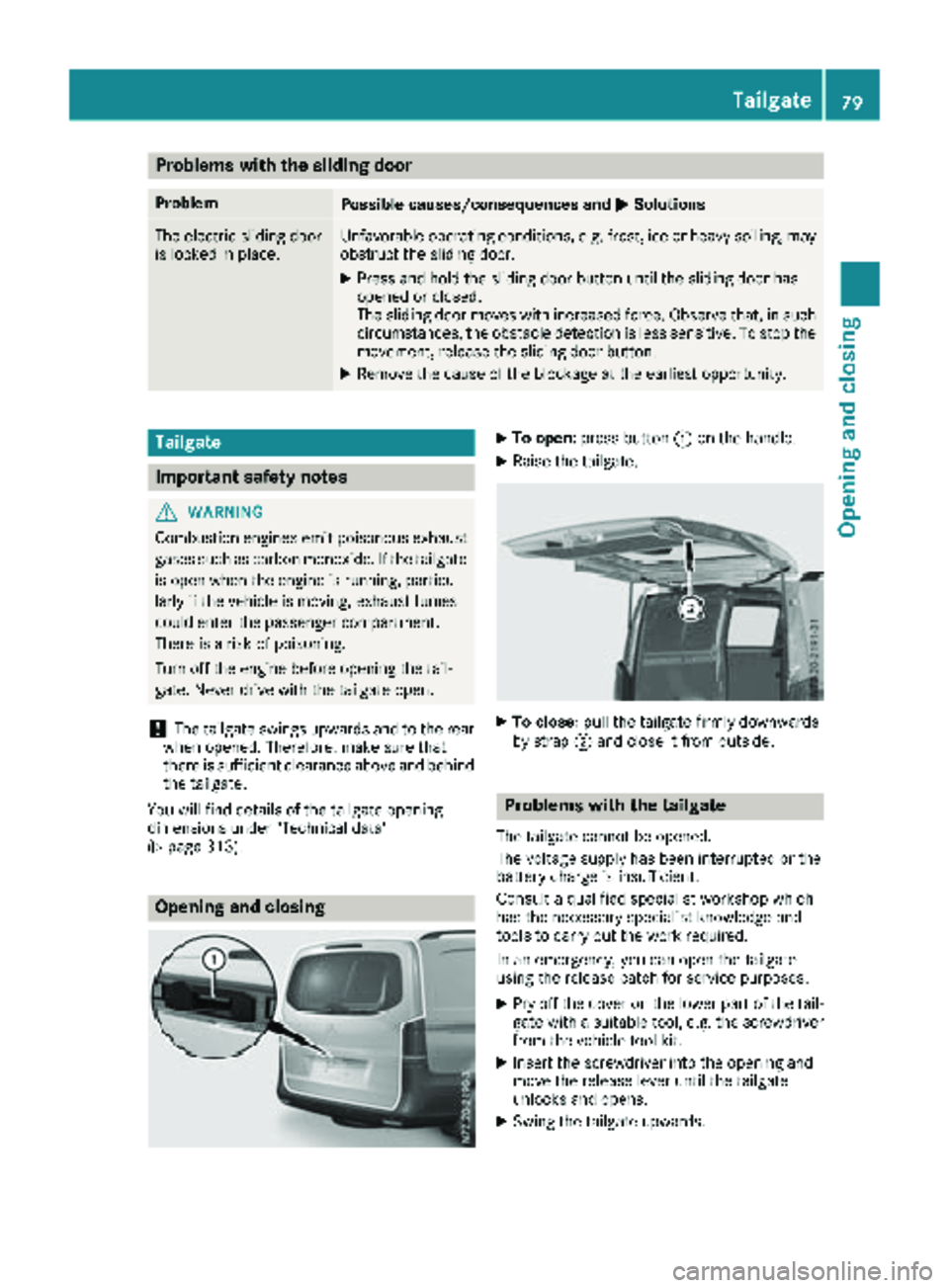
XTo open: press button :on the handle.
XRaise the tailgate.
XTo close: pull the tailgate firmly downwards
by strap ;and close it from outside.
Problems with the tailgate
The tailgate cannot be opened.
The voltage supply has been interrupted or the
battery charge is insufficient.
Consult a qualified specialist workshop which
has the necessary specialist knowledge and
tools to carry out the work required.
In an emergency, you can open the tailgate
using the release catch for service purposes.
XPry off the cover on the lower part of the tail-
gate with a suitable tool, e.g. the screwdriver from the vehicle tool kit.
XInsert the screwdriver into the opening and
move the release lever until the tailgate
unlocks and opens.
XSwing the tailgate upwards.
Tailgate79
Opening and closing
Z
Page 109 of 318
TheStatus Overviewin the Assist.menu
then also shows the èsymbol for vehicles
with steering wheel buttons (
Ypage 186).
XTo wipe with washer fluid: press theè
switch beyond the current position as far as it
will go to 1or press and hold 4.
When you release the èswitch, the rear
window wiper continues to wipe for about
another five seconds. The rear window wiper
then wipes according to the original position
2 or3.
The rear window wiper switches on automati-
cally if you engage reverse gear and the wind-
shield wipers are on.
If the vehicle is stationary and you open the tail-
gate or rear door, the rear window wiper will
stop automatically. The rear window wiper will
only resume wiping again when the tailgate and
rear door are closed and you pull away again.
The rear window will no longer be wiped properly if the wiper blade is worn. This may prevent you
from observing the traffic conditions. Informa-
tion on replacing the wiper blade can be found
under "Replacing wiper blades" (
Ypage 107).
Replacing the wiper blades
Important safety notes
GWARNING
If the windshield wipers begin to move while
you are changing the wiper blades, you could be trapped by the wiper arm. There is a risk of
injury.
Always switch off the windshield wipers and
ignition before changing the wiper blades.
!Never open the hood/tailgate or rear doors
if a windshield wiper arm has been folded
away from the windshield/rear window.
Never fold a windshield wiper arm without a
wiper blade back onto the windshield/rear
window.
Hold the windshield wiper arm firmly when
you change the wiper blade. If you release the
windshield wiper arm without a wiper blade
and it falls onto the windshield/rear window,
the windshield/rear window may be damaged
by the force of the impact. Mercedes-Benz recommends that you have
the wiper blades changed at a qualified spe-
cialist workshop.
!Only hold the wiper blade by the wiper arm.
You could otherwise damage the wiper rub-
ber.
Wiper blades are wear parts. The windshield will
no longer be wiped properly if the wiper blades
are worn. This may prevent you from observing
the traffic conditions.
Please observe the service indicator after
changing the wiper blades of the windshield
wiper.
Service indicator
Replacement wiper blades for the windshield
wiper have a service indicator on the tip of the
wiper blade.
Depending on the amount of use, the service
indicator will change color from black to yellow.
Change the wiper blade if:
Rthe wiper blade is damaged
Rthe service indicator has turned yellow
In order to activate the service indicator, you
have to remove the protective film
(
Ypage 107).
Windshield wipers
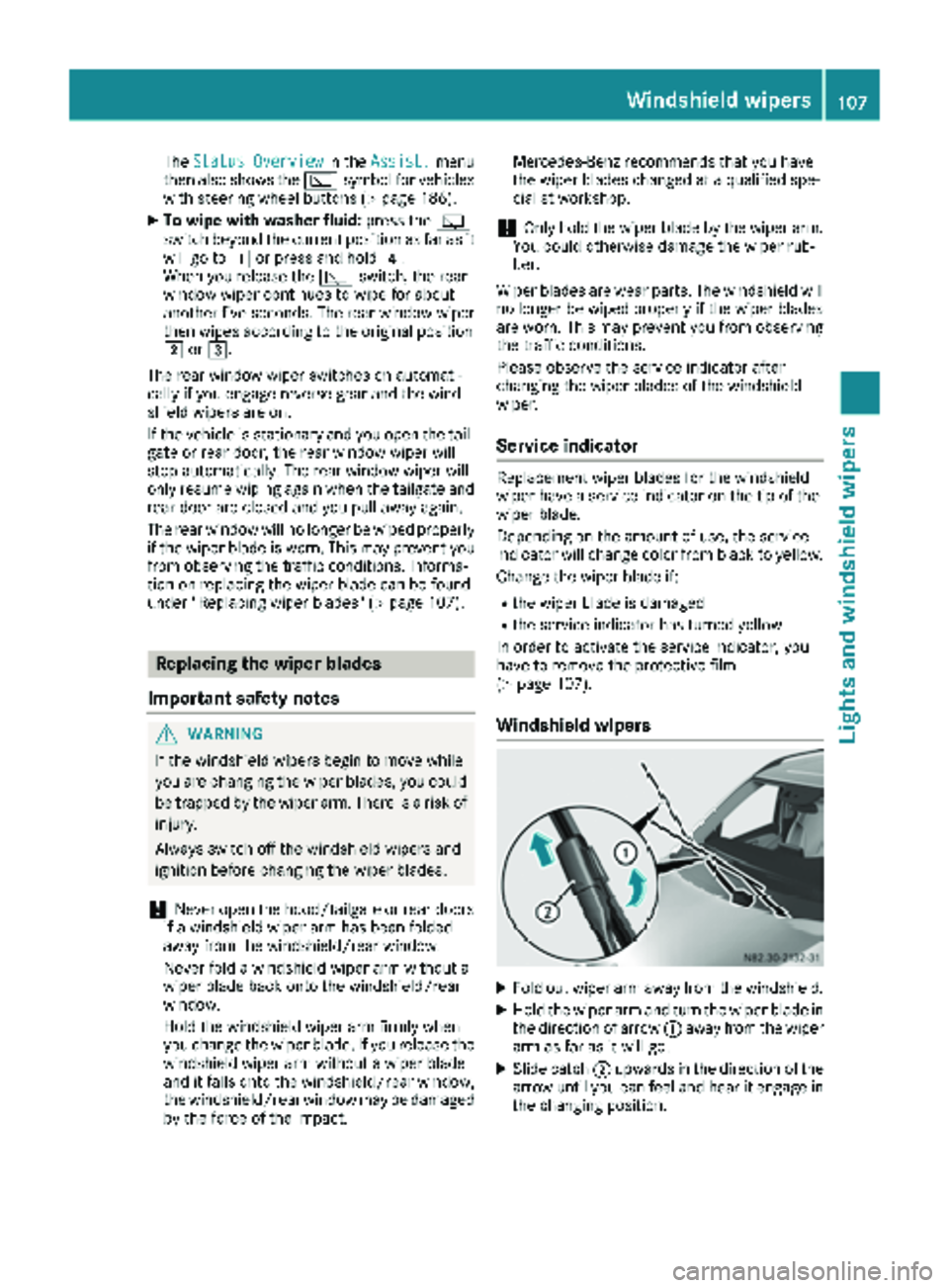
XFold out wiper arm away from the windshield.
XHold the wiper arm and turn the wiper blade in
the direction of arrow :away from the wiper
arm as far as it will go.
XSlide catch ;upwards in the direction of the
arrow until you can feel and hear it engage in
the changing position.
Windshield wipers107
Lights and windshield wipers
Z