towing MERCEDES-BENZ METRIS 2018 MY18 Operator’s Manual
[x] Cancel search | Manufacturer: MERCEDES-BENZ, Model Year: 2018, Model line: METRIS, Model: MERCEDES-BENZ METRIS 2018Pages: 318, PDF Size: 5.07 MB
Page 280 of 318
Towing the vehicle with both axles on
the ground
Important safety notes
GWARNING
You can no longer steer the vehicle if the
steering wheel lock has been engaged. There
is a risk of an accident.
Always switch off the ignition when towing the
vehicle with a tow cable or a tow bar.
!Do not exceed the towing speed of 30 mph
(50 km/h). You could otherwise damage the
transmission.
Please observe the important safety notes
before towing your vehicle (
Ypage 276).
Towing vehicles with automatic trans-
mission
XTurn the key to position 2in the ignition lock.
XDepress the brake pedal and keep it
depressed.
XShift the automatic transmission to position
N.
XLeave the key in position 2in the ignition lock.
XSwitch on the hazard warning lamps
(Ypage 98).
XRelease the parking brake.
XRelease the brake pedal.
XDo not exceed the towing speed of 30 mph
(50 km/h).
Recovering a vehicle that is stuck
!
When recovering a vehicle that has become
stuck, pull it as smoothly and evenly as pos-
sible. Excessive tractive power could damage
the vehicles.
If the drive wheels get trapped on loose or
muddy ground, recover the vehicle with the
utmost care. This is especially the case if the
vehicle is laden.
Never attempt to recover a vehicle with a trailer
attached.
Pull out the vehicle backwards, if possible, using
the tracks it made when it became stuck.
Transporting the vehicle
!
You may only secure the vehicle by the
wheels, not by parts of the vehicle such as
axle or steering components. Otherwise, the
vehicle could be damaged.
The towing eye or trailer tow hitch can be used
to pull the vehicle onto a trailer or transporter if
you wish to transport it.
XTurn the key to position 2in the ignition lock.
XShift the transmission to position N.
XRelease the parking brake.
If the vehicle is loaded:
XShift the transmission to position P.
XTurn the key to position 0in the ignition lock
and remove it.
XMake sure the parking brake is applied.
XLash down the vehicle.
Tow-starting (emergency engine
starting)
General notes
!Vehicles with automatic transmission must
not be tow-started. You could otherwise dam-
age the automatic transmission.
You can find information on jump-starting under
"Jump-starting“ (
Ypage 274).
Electrical fuses
The fuse allocation chart and important safety
information on the fuses can be found in the
"Fuse allocation chart" supplement.
278Electrical fuses
Breakdown assistance
Page 286 of 318
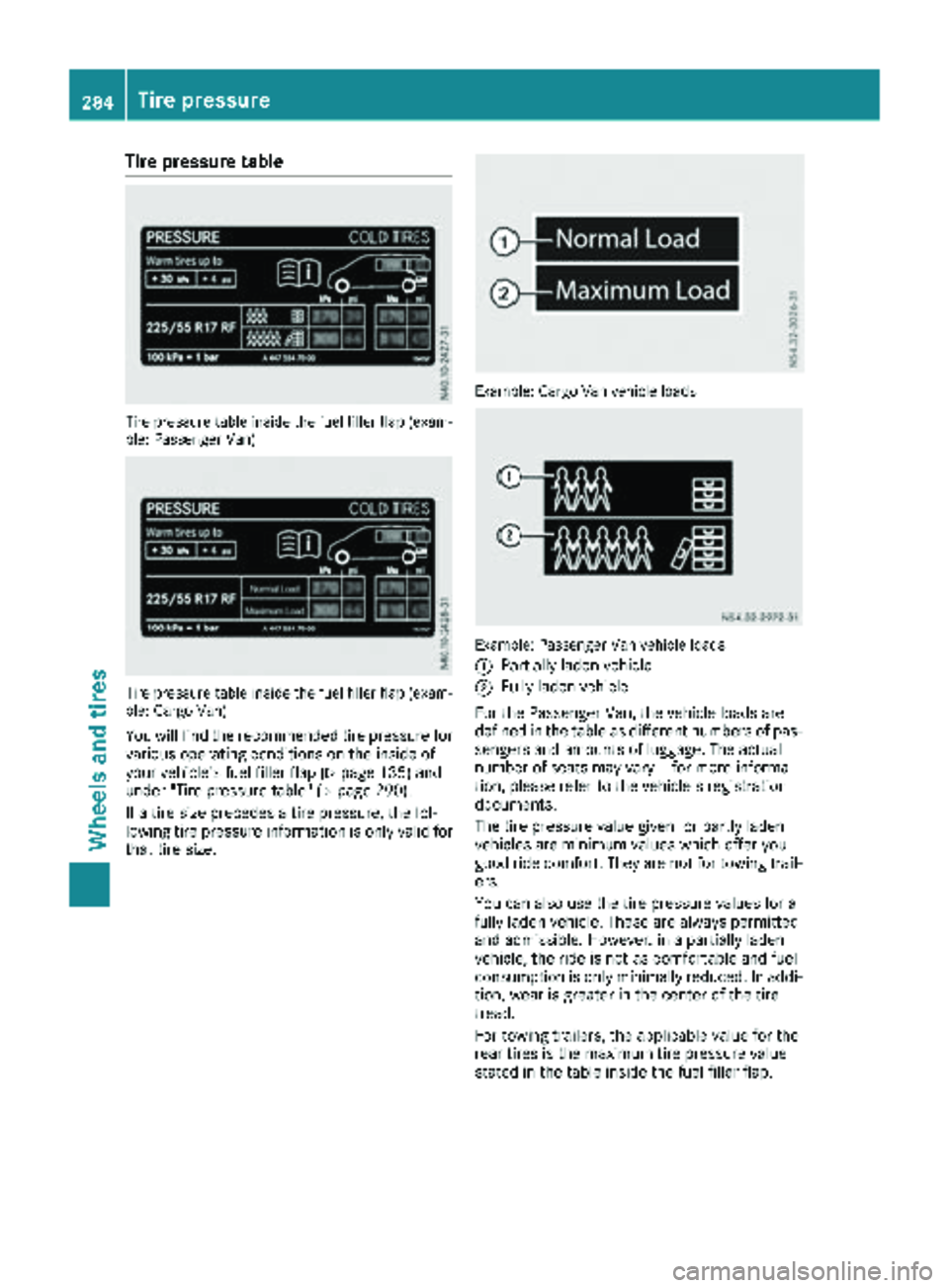
Tire pressure table
Tire pressure table inside the fuel filler flap (exam-
ple: Passenger Van)
Tire pressure table inside the fuel filler flap (exam-
ple: Cargo Van)
You will find the recommended tire pressure for
various operating conditions on the inside of
your vehicle's fuel filler flap (
Ypage 135) and
under "Tire pressure table" (Ypage 290).
If a tire size precedes a tire pressure, the fol-
lowing tire pressure information is only valid for
that tire size.
Example: Cargo Van vehicle loads
Example: Passenger Van vehicle loads
:
Partially laden vehicle
;Fully laden vehicle
For the Passenger Van, the vehicle loads are
defined in the table as different numbers of pas-
sengers and amounts of luggage. The actual
number of seats may vary – for more informa-
tion, please refer to the vehicle's registration
documents.
The tire pressure value given for partly laden
vehicles are minimum values which offer you
good ride comfort. They are not for towing trail-
ers.
You can also use the tire pressure values for a
fully laden vehicle. These are always permitted
and admissible. However, in a partially laden
vehicle, the ride is not as comfortable and fuel
consumption is only minimally reduced. In addi- tion, wear is greater in the center of the tire
tread.
For towing trailers, the applicable value for the
rear tires is the maximum tire pressure value
stated in the table inside the fuel filler flap.
284Tire pressure
Wheels and tires
Page 310 of 318
iE10 fuel contains an admixture of up to 10%
bioethanol. Your vehicle is E10 compatible.
You can refuel your vehicle with E10 fuel.
iUsually you will find information about the
fuel grade on the filling pump. If there is no
identification on the filling pump, consult a
gas station attendant.
If the recommended fuel is not available, you
may as a one-off measure use regular unleaded
gasoline with an octane rating of 87 AKI/
91 RON. Be aware that your vehicle is not cer-
tified with regular unleaded gasoline with an
octane rating of 87 AKI/91 RON and that usage
of this fuel may reduce the engine's output and
increase fuel consumption. Avoid driving at full
throttle and sudden acceleration. Never refuel
using gasoline with a lower AKI/RON rating.
iIn some countries, the available gasoline
may not be sufficiently low in sulfur. This fuel can temporarily produce unpleasant odors,
especially on short journeys. The odors are
reduced as soon as sulfur-free fuel (sulfur
content < 10 ppm) is used again for refueling.
For more information about refueling
(
Ypage 134).
Fuel additives
!Operating the engine with subsequently
added fuel additives can cause engine dam-
age. Do not mix fuel additives with fuel. This
does not include additives for the removal and
prevention of deposits. Gasoline can only be
mixed with additives recommended by
Mercedes-Benz. Follow the instructions in the
product description. You can find further
information on recommended additives in any
Mercedes-Benz Commercial Van Center.
Mercedes-Benz recommends using brand-name
fuels with additives.
If you use fuels without these additives for a long
period of time, deposits can form. This primarily
forms on the inlet valve and in the combustion
chamber.
In some countries, the available fuel grade may
be inadequate. Residue could build up in the fuel
injection system as a result. In this case, in con-
sultation with a Mercedes-Benz Commercial
Van Center, the fuel should be mixed with the
cleaning additive recommended by Mercedes-
Benz. You must observe the notes and mixing
ratios indicated on the container. Do not add other fuel additives to the fuel. This
results in unnecessary costs and can damage
the engine.
Information on fuel consumption
HEnvironmental note
CO
2(carbon dioxide) is the gas which scien-
tists believe to be principally responsible for
global warming (the greenhouse effect). Your
vehicle's CO
2emissions are directly related to
fuel consumption and therefore depend on:
Refficient use of the fuel by the engine
Rdriving style
Rother non-technical factors, such as envi-
ronmental influences, road conditions or
traffic flow
You can minimize your vehicle's CO
2emis-
sions by driving carefully and having it serv-
iced regularly.
Only for certain countries: the respective cur-
rent consumption and emission values of your
vehicle can be found in the COC papers (EC
CERTIFICATE OF CONFORMITY). These docu-
ments are supplied when the vehicle is deliv-
ered.
Consumption figures were found in the currently
valid respective version:
Rfor vehicles with exhaust gas standard Euro 6
as per directive (EC) no. 715/2007
Rfor vehicles with exhaust gas standard EURO
VI as per directive (EC) no. 595/2009
Fuel consumption depends on:
Rthe vehicle version
Rthe style of driving
Rthe operating conditions
Rthe type or quality of the fuel used
The vehicle will use mor e fu
el than usual in the
following situations:
Rat very low outside temperatures
Rin city traffic
Rduring short journeys
Ron mountainous terrain
Rwhen towing a trailer
Observe the advice in the "Protection of the
environment" section to keep fuel consumption low (
Ypage 29).
308Service products and capacities
Technical data