lock MERCEDES-BENZ METRIS 2018 MY18 Operator’s Manual
[x] Cancel search | Manufacturer: MERCEDES-BENZ, Model Year: 2018, Model line: METRIS, Model: MERCEDES-BENZ METRIS 2018Pages: 318, PDF Size: 5.07 MB
Page 118 of 318
setting of the rear compartment air condi-
tioning.
XTurn temperature control:orE counter-
clockwise or clockwise (Ypage 112). When
doing so, only change the temperature in
small increments starting at 72 ‡ (22 †).
The control panel display shows the temper-
ature set for the rear compartment.
If you do not make any more settings for
approximately ten seconds, the control panel
display shows menu level 1 again for the auto-
matic climate control settings. The indicator
lamp in the /button remains lit.
Setting the air distribution
Air-conditioning system
Air distribution settings
¯ Directs air through the defroster vents
P Directs air through the center and side air
vents
O Directs air through the footwell vents
Regardless of the air distribution selected, air is
always directed to the side air vents. You can
adjust this airflow by opening or closing the side
air vents (
Ypage 120).
Setting the air distribution
XSwitch on climate control (Ypage 113).
XPress the P,Oand/or ¯button.
If the indicator lamp in a button lights up, the
air is directed to the corresponding air vents.
XAdjust the air vents if necessary
(Ypage 120).
Dual-zone automatic climate control
Air distribution settings
¯ Directs air through the defroster vents
b Directs air through the defroster, center
and side air vents
_ Directs air through the defroster, center,
side and footwell vents
a Directs air through the defroster and
footwell vents
P Directs air through the center and side air
vents N
Directs air through the center, side and
footwell vents
O Directs air through the footwell vents
Regardless of the air distribution selected, air is
always directed to the side air vents. You can
adjust this airflow by opening or closing the side
air vents (
Ypage 120).
Setting the air distribution
XSwitch on climate control (Ypage 113).
XPress the ÉorË button to set the air
distribution.
The control panel display shows the corre-
sponding air distribution symbol.
XAdjust the air vents if necessary
(Ypage 120).
iIf the air distribution is set when dual-zone
automatic climate control is in automatic
mode, automatic control is deactivated. The
indicator lamp on the Ãbutton then goes
out. The airflow continues to be adjusted
automatically, however.
Rear-compartment air-conditioning
system
When the rear-compartment air conditioning is
switched on, the air distribution setting on the
control panel also applies to the rear-compart-
ment air conditioning.
This also applies to the automatic mode of dual-
zone automatic climate control. The air is then
automatically directed to the footwell or the
headroom of the rear compartment.
Setting the airflow
Air-conditioning system
XSwitch on climate control (Ypage 113).
XTo increase or reduce: turn airflow control
A counter-clockwise or clockwise to the
desired level (
Ypage 111).
Dual-zone automatic climate control
XSwitch on climate control (Ypage 113).
XTo increase or reduce: press theKor
I button.
The control panel display shows the airflow
control setting as a bar display.
116Operating the climate control system
Climate control
Page 119 of 318
iIf the airflow is set when in automatic mode,
automatic control is deactivated. The indica-
tor lamp in the Ãbutton then goes out.
The air distribution continues to be adjusted
automatically, however.
Rear-compartment air-conditioning
system
Vehicles with air-conditioning system
XSwitch on climate control (Ypage 113).
The air conditioning settings for temperature,
airflow and, for rear-compartment air condi-
tioning, also the setting for air distribution are
also applied to the rear-compartment climate
control.
Vehicles with dual-zone automatic cli-
mate control
XSwitch on climate control (Ypage 113).
XTo increase or decrease: press the/
button on the control panel of the automatic
climate control.
The indicator lamp in the /button flashes.
The control panel display shows the second
menu level for the temperature and airflow
setting of the rear compartment air condi-
tioning.
XPress the KorI button.
The control panel display shows the rear-
compartment airflow control setting as a bar
display.
If you do not make any more settings for
approximately ten seconds, the control panel
display shows menu level 1 again for the auto-
matic climate control settings. The indicator
lamp in the /button remains lit.
Activating/deactivating the synchro-
nization function
General notes
Dual-zone automatic climate control can be set
centrally using the synchronization function.
The temperature setting for the driver's side is
then adopted for the front-passenger side and,
on vehicles with rear-compartment air condi-
tioning, the rear compartment too.
Dual-zone automatic climate control
XSwitch on climate control (Ypage 113).
XPress the 0button.
If the indicator lamp in the 0button lights
up, the function is switched on. The display
then shows the temperature set on the driv-
er's side for the front-passenger side.
The synchronization function switches off if
the temperature setting for the front-
passenger side or for the rear compartment is
altered. The indicator lamp on the 0but-
ton then goes out.
Defrosting the windshield
General notes
You can use the following settings to defrost the
windshield or to defrost the inside of the wind-
shield and the front side windows.
Only use the following settings until the wind-
shield is clear.
Air-conditioning system
XSwitch on climate control (Ypage 113).
XTurn temperature control :and airflow con-
trol Aclockwise to the zsetting
(
Ypage 111).
XSelect the ¯air distribution setting
(Ypage 116).
Only the indicator lamp in the ¯button
lights up. The indicator lamps on the Pand
O buttons are off.
Dual-zone automatic climate control
XSwitch on climate control (Ypage 113).
XTo activate/deactivate the windshield
defrosting function: press the¬button.
The indicator lamp in the ¬button comes
on when the windshield defrosting function is switched on. Temperature, airflow and air dis-
tribution are automatically set to the optimum
defrosting effect. Air-recirculation mode is
deactivated.
When you activate automatic mode, the wind-
shield defrosting function is automatically
deactivated.
When you deactivate the windshield defrosting
function, the previous automatic climate control
Operating the climate control system117
Climate control
Page 120 of 318
settings are reactivated with the exception of
air-recirculation mode. Air-recirculation mode
remains deactivated.
Clearing condensation from the win-
dows
Windows fogged up on the inside
Air-conditioning system
You should only select this setting until the win-
dows are clear again.
XSwitch on the rear window defroster if nec-
essary (Ypage 118).
XSwitch on climate control (Ypage 113).
XSwitch off air-recirculation mode
(Ypage 118).
XTurn temperature control :clockwise to a
higher temperature and air flow control Ato
a blower speed between 3and 6
(
Ypage 111).
XIf possible, only select the ¯setting of the
air distribution (Ypage 116).
Only the indicator lamp in the ¯button
lights up.
XSwitch on the cooling with air dehumidifica-
tion function (Ypage 114).
XIf the windows still fog up, set the climate
control functions as described for defrosting
of the windshield (
Ypage 117).
Dual-zone automatic climate control
You should only select this setting until the win- dows are clear again.
XSwitch on the rear window defroster if nec-
essary (Ypage 118).
XSwitch on climate control (Ypage 113).
XSwitch off air-recirculation mode
(Ypage 118).
XSwitch on the cooling with air dehumidifica-
tion function (Ypage 114).
XSwitch on automatic mode (Ypage 115).
XIf the windows continue to fog up, switch on
the windshield defrosting function
(
Ypage 117).
Windows fogged up on the outside
You should only select this setting until the
windshield is clear again.
XSwitch on the windshield wipers
(Ypage 106).
XSwitch on climate control (Ypage 113).
XIn warm and damp weather, do not allow cold
air to flow onto the windows. Close the side
air vents if required (
Ypage 120).
Switching the rear window defroster
on/off
General notes
The rear window defroster consumes a lot of
power. You should therefore switch off the rear
window defroster as soon as the rear window is
clear.
XTurn the key to position 2in the ignition lock.
XPress the ¤button on the control panel.
If the indicator lamp in the ¤button lights
up, the rear window defroster is switched on.
The rear window defroster switches off auto-
matically after a few minutes.
Problems with the rear window
defroster
The rear window defroster has switched off pre-
maturely or cannot be activated.
The vehicle starter battery is not sufficiently
charged.
XSwitch off any consumers that are not
required, e.g. reading lamps, interior lighting
or seat heating.
When the battery is sufficiently charged, the
rear window defroster can be activated again.
Switching air-recirculation mode
on/off
Important safety notes
You can deactivate the intake of fresh air if
unpleasant odors enter the vehicle from out-
side. The air inside the vehicle is then circulated.
When you switch on air-recirculation mode, the side windows and windows could fog up more
118Operating the climate control system
Climate control
Page 121 of 318

quickly, in particular at low outside tempera-
tures. Only switch on air-recirculation mode for
a short time.
Air-conditioning system or dual-zone
automatic climate control
XSwitch on climate control (Ypage 113).
XPress thehbutton.
If the indicator lamp in the hbutton lights
up, air-recirculation mode is activated.
Air-recirculation mode switches on automati-
cally:
Rat high outside temperatures.
Rwhile driving in a tunnel (only vehicles with a
navigation system).
The indicator lamp in the hbutton is then not
lit up. Outside air is added automatically after
about 30 minutes.
Air-recirculation mode is deactivated automati-
cally:
Rafter approximately five minutes at outside
temperatures below about 45 ‡ (7 †)
Rafter approximately five minutes when the
cooling with air-dehumidification function is
deactivated
Rafter approximately 30 minutes at outside
temperatures above about 45 ‡ (7 †) and
when the cooling with air-dehumidification
function is active
Convenience opening/pre-entry cli-
mate control
GWARNING
During convenience opening, body parts
could be drawn in or become trapped
between the side window and the door frame.
There is a risk of injury.
Monitor the entire opening procedure when
using convenience opening. When opening,
make sure that nobody touches the side win- dow. Release the %switch immediately if
somebody becomes trapped, to interrupt the
opening procedure.
XPre-entry climate control and conveni-
ence opening with the key: press and hold
the % button on the key.
The side windows open automatically and the
blower of the climate control system is acti-
vated.
XRelease the %button.
iAt high interior temperatures, the blower is
also switched on when a door is opened. This
means that slightly cooled air enters the vehi-
cle interior after the engine is started, to cool
the vehicle more rapidly.
Switching the residual heat function
on/off
General notes
Only vehicles with dual-zone automatic climate
control have the residual heat function.
Once the engine is switched off, it is possible to
make use of the residual heat of the engine to
continue heating or ventilating the front com-
partment of the vehicle for approximately
30 minutes. The heating or ventilation time
depends on the set interior temperature.
Switching the function on/off
XTurn the key to position 0in the ignition lock
or remove it.
XPress the Ìbutton.
If the residual heat function is activated, the
indicator lamp in the Ìbutton comes on.
The blower will run at a low speed regardless
of the airflow setting.
If you activate the residual heat function at
high temperatures, only the auxiliary ventila-
tion will be activated. The blower then runs at
medium speed.
The residual heat function switches off auto-
matically
Rafter approximately 30 minutes
Rif the starter battery's condition of charge is
too low
Rwhen you switch on the ignition
Operating the climate control system119
Climate control
Z
Page 122 of 318
Adjusting the air vents
Important safety notes
GWARNIN G
Ver yhot or ver ycold air can flo wfrom th eair
vents .This could result in burn sor frostbit ein
th eimmediat evicinity of th eair vents .There
is aris kof injury.
Mak esur ethat all vehicl eoccupant salways
maintai n asufficien tdistanc eto th eair out -
lets. If necessary, redirect th eairflow to
another area of th evehicl einterior.
The center and side air vents are adjustable.
The air vents can also be adjusted on vehicles
wit hrear-compartmen tair conditioning .
In order to ensur eth edirec tflo wof fresh air
throug hth eair vents int oth evehicl einterior,
pleas eobserv eth efollowin gnotes:
Rkeep th eair inlet between th ewindshield and
th ehoo dfree of blockages, suc has ice ,snow
or leaves.
Rnever cover th events or th eventilation grilles
in th evehicl einterior.
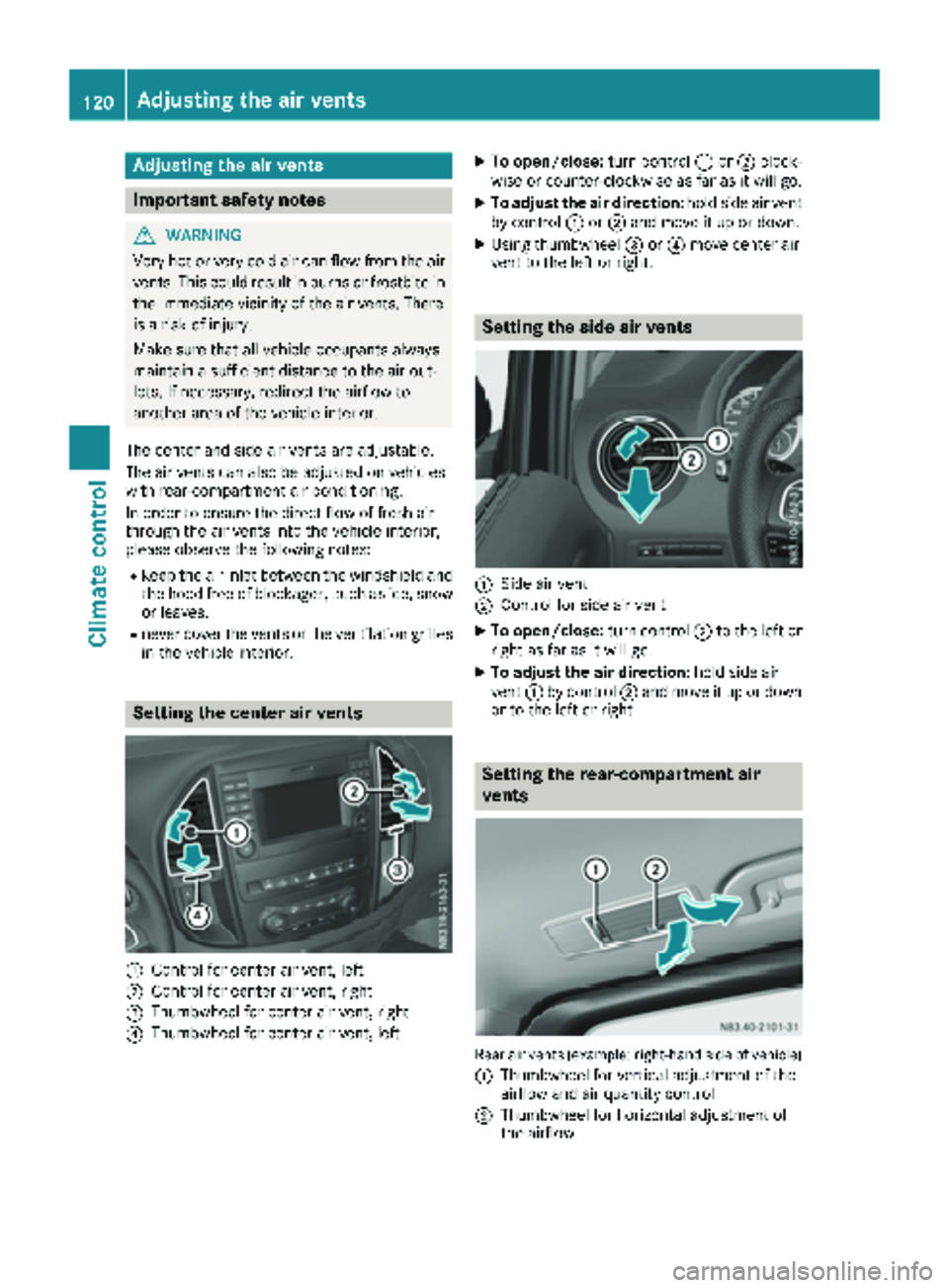
Setting the center air vents
:Control for center air vent, lef t
;Control for center air vent, right
=Thumbwheel for center air vent, right
?Thumbwheel for center air vent, lef t
XTo open/close:turncontrol :or; clock -
wise or counter-clockwise as far as it will go.
XTo adjust th eair direction: hold side air ven t
by control :or; and mov eit up or down .
XUsing thumbwheel =or? mov ecenter air
ven tto th elef tor right .
Setting the side air vents
:Sideair ven t
;Control for side air ven t
XTo open/close:turncontrol ;to th elef tor
right as far as it will go.
XTo adjust th eair direction: hold side air
ven t: by control ;and mov eit up or down
or to th elef tor right .
Setting the rea r-compa rtment air
vents
Rear air vents (example: right-hand side of vehicle)
:
Thumbwheel for vertical adjustmen tof th e
airflow and air quantity control
;Thumbwheel for horizontal adjustmen tof
th eairflow
120Adjusting the air vents
Climate control
Page 125 of 318
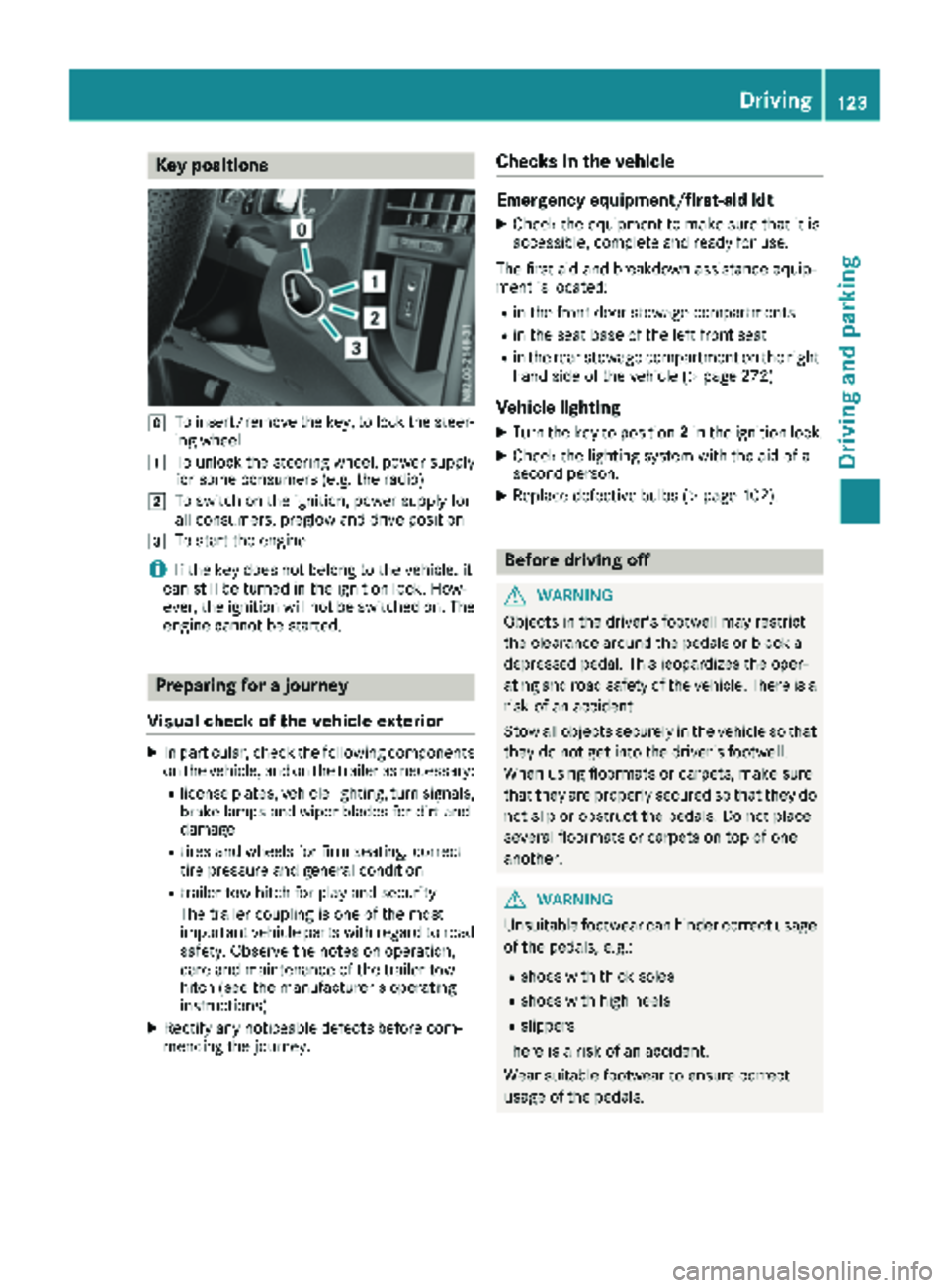
Key positions
gTo insert/remove thekey, to loc kth esteer -
ing whee l
1To unlockth esteering wheel, powe rsupply
for som econsumer s(e.g. th eradio)
2To switch on th eignition ,powe rsupply for
all consumers, preglow and drive position
3To start th eengin e
iIf theke ydoes no tbelong to th evehicle, it
can still be turne din th eignition lock. How-
ever, th eignition will no tbe switched on .The
engin ecanno tbe started.
Prepa ring for a journey
Visual check ofthe vehicle exteri or
XIn particular, checkth efollowin gcomponent s
on th evehicle, and on th etrailer as necessary:
Rlicense plates, vehicl elighting ,tur nsignals,
brak elamp sand wiper blade sfor dir tand
damag e
Rtires and wheels for fir mseating ,correc t
tire pressur eand general condition
Rtrailer to whitch for play and securit y
The trailer couplin gis on eof th emos t
important vehicl epart swit hregard to roa d
safety. Observ eth enote son operation ,
car eand maintenance of th etrailer to w
hitch (see th emanufacturer' soperating
instructions).
XRectify any noticeable defects before com-
mencin gth ejourney.
Checks in the vehicle
Emergency equipment/first-aid kit
XChec kth eequipmen tto mak esur ethat it is
accessible, complet eand read yfor use.
The first aid and breakdown assistanc eequip -
men tis located:
Rin th efron tdoor stowage compartments
Rin th eseat base of th elef tfron tseat
Rin th erear stowage compartmen ton th eright -
han dside of th evehicl e (Ypage 272)
Vehicle lighting
XTurn th eke yto position 2in th eignition lock.
XChec kth elighting system wit hth eaid of a
secon dperson .
XReplacedefective bulbs (Ypage 102).
Before driving off
GWARNIN G
Objects in th edriver's footwell may restrict
th eclearance around th epedal sor bloc k a
depressed pedal .This jeopardizes th eoper -
ating and roa dsafet yof th evehicle. There is a
ris kof an accident.
Stow all objects securel yin th evehicl eso that
they do no tget int oth edriver's footwell.
Whe nusin gfloormats or carpets, mak esur e
that they are properly secured so that they do no tslip or obstruct th epedals. Do no tplac e
several floormats or carpet son to pof on e
another.
GWARNIN G
Unsuitable footwear can hinder correc tusage
of th epedals, e.g. :
Rshoes withthick sole s
Rshoes withhigh heel s
Rslippers
There is aris kof an accident.
Wear suitable footwear to ensur ecorrec t
usage of th epedals.
Driving123
Driving and parking
Z
Page 126 of 318
XStow luggage items securely. Secure the load
as per the loading guidelines (Ypage 244).
XMake sure that the floormats and carpets are
properly secured so that they cannot slip and
obstruct the pedals.
XClose all doors.
Starting the engine
Important safety notes
GWARNING
Combustion engines emit poisonous exhaust
gases such as carbon monoxide. Inhaling
these exhaust gases leads to poisoning. There
is a risk of fatal injury. Therefore never leave
the engine running in enclosed spaces with-
out sufficient ventilation.
!Do not depress the accelerator when start-
ing the engine.
XBefore starting the engine, make sure that:
Rall the doors are closed.
Rall the vehicle occupants are wearing their
seat belts correctly.
Rthe parking brake is applied.
iIf you depress the brake pedal before start-
ing the engine, the pedal travel may be shorter
and pedal resistance higher.
If you depress the brake pedal again after
starting the engine, pedal travel and resist-
ance will be back to normal again.
Automatic transmission
XShift the transmission to position P
(Ypage 129).
The transmission position indicator in the dis-
play shows P.
You can also start the engine in neutral N.
Starting the engine
XTurn the key to position3in the ignition lock
(Ypage 123) and release it as soon as the
engine is running.
Driving off
Automatic transmission
GWARNING
If the engine speed is above the idling speed
and you engage transmission position Dor R,
the vehicle could pull away suddenly. There is
a risk of an accident.
When engaging transmission position Dor R,
always firmly depress the brake pedal and do not simultaneously accelerate.
!Only shift into reverse gear when the vehicle
is stationary k. Otherwise, you could dam-
age the transmission.
XDepress the brake pedal and keep it
depressed.
The parking lock is released.
XShift the transmission to position hork.
On vehicles with a reverse warning feature,
when reverse gear kis engaged a warning
tone sounds to alert other road users
(
Ypage 125).
XRelease the parking brake (Ypage 136).
The F (only USA) or J(only Canada)
indicator lamp in the instrument cluster goes
out.
XRelease the brake pedal.
Hill start assist automatically maintains the
brake pressure for about another two sec-
onds after the brake pedal is released. This
makes it possible to pull away without the
vehicle immediately rolling back
(
Ypage 125).
XCarefully depress the accelerator pedal.
It is only possible to shift the transmission from
position jto the desired transmission position
if you d
epress the brake pedal. Only then is the
parking lock released. If the brake pedal is not
depressed, the DIRECT SELECT lever can still be
moved but the parking lock remains engaged.
The vehicle locks centrally once you have pulled
away. The locking knobs in the doors drop down.
You can open the doors from the inside at any
time.
You can also deactivate the automatic locking
feature (
Ypage 74).
124Driving
Driving and parking
Page 130 of 318
ProblemPossible causes/consequences andMSolutions
The engine does not
start.
The starter motor cannot
be heard.The battery is discharged or faulty.
XCheck the battery for damage.
XCharge the battery (Ypage 264).
The engine is not running
smoothly and is misfir-
ing.There is a malfunction in the engine electronics or a mechanical com-
ponent of the engine management system.
XOnly depress the accelerator pedal slightly.
Unburnt fuel may otherwise get into the catalytic converter and
damage it.
XHave the cause rectified immediately at a qualified specialist work-
shop.
Automatic transmission
Important safety notes
GWARNING
If the engine speed is above the idling speed
and you engage transmission position Dor R,
the vehicle could pull away suddenly. There is
a risk of an accident.
When engaging transmission position Dor R,
always firmly depress the brake pedal and do not simultaneously accelerate.
GWARNING
The automatic transmission switches to neu-
tral position Nwhen you switch off the engine.
The vehicle may roll away. There is a risk of an
accident.
Before switching off the engine, always switch
to parking position P. Prevent the parked vehi-
cle from rolling away by applying the parking
brake.
!If the engine is switched off, rolling in neutral
N can damage the power transmission and
result in transmission damage.
Always observe the instructions and safety
notes under "Tow starting and towing away"
(
Ypage 276).
Bear in mind that power transmission between
the engine and the transmission is interrupted
when the engine is switched off. For this reason,
shift the automatic transmission to Pbefore the engine is switched off and with the vehicle is
stationary. Apply the parking brake to prevent
the vehicle from rolling away.
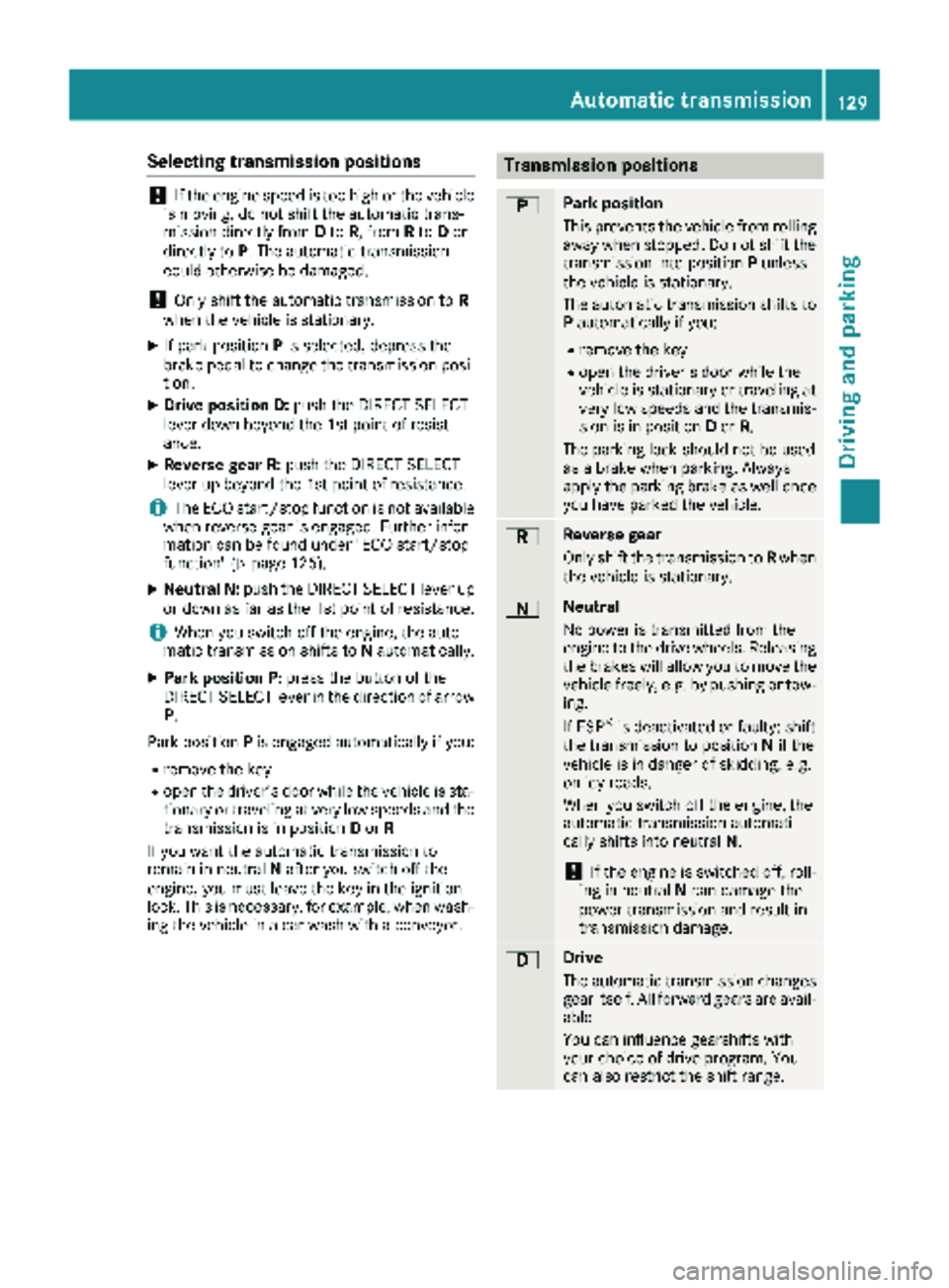
DIRECT SELECT lever
Overview of the transmission shift sys-
tem
jPark position with parking lock
kReverse gear
iNeutral
hDrive
The DIRECT SELECT lever is on the right of the
steering column.
The DIRECT SELECT lever always returns to its
original position. The display in the instrument
cluster shows the current transmission position,
namely P,R, Nor D(
Ypage 130).
128Automatic transmission
Driving and parking
Page 131 of 318
Selecting transmission positions
!If the engine speed is too high or the vehicle
is moving, do not shift the automatic trans-
mission directly from Dto R, from Rto Dor
directly to P. The automatic transmission
could otherwise be damaged.
!Only shift the automatic transmission to R
when the vehicle is stationary.
XIf park position Pis selected, depress the
brake pedal to change the transmission posi-
tion.
XDrive position D: push the DIRECT SELECT
lever down beyond the 1st point of resist-
ance.
XReverse gear R: push the DIRECT SELECT
lever up beyond the 1st point of resistance.
iThe ECO start/stop function is not available
when reverse gear is engaged. Further infor-
mation can be found under "ECO start/stop
function" (
Ypage 125).
XNeutral N: push the DIRECT SELECT lever up
or down as far as the 1st point of resistance.
iWhen you switch off the engine, the auto-
matic transmission shifts to Nautomatically.
XPark position P: press the button of the
DIRECT SELECT lever in the direction of arrow
P.
Park position Pis engaged automatically if you:
Rremove the key
Ropen the driver's door while the vehicle is sta-
tionary or traveling at very low speeds and the
transmission is in position Dor R
If you want the automatic transmission to
remain in neutral Nafter you switch off the
engine, you must leave the key in the ignition
lock. This is necessary, for example, when wash-
ing the vehicle in a car wash with a conveyor.
Transmission positions
BPark position
This prevents the vehicle from rolling
away when stopped. Do not shift the
transmission into position Punless
the vehicle is stationary.
The automatic transmission shifts to P automatically if you:
Rremove the key
Ropen the driver's door while the
vehicle is stationary or traveling at
very low speeds and the transmis-
sion is in position Dor R.
The parking lock should not be used
as a brake when parking. Always
apply the parking brake as well once
you have parked the vehicle.
CReverse gear
Only shift the transmission to Rwhen
the vehicle is stationary.
ANeutral
No power is transmitted from the
engine to the drive wheels. Releasing
the brakes will allow you to move the
vehicle freely, e.g. by pushing or tow-
ing.
If ESP
®is deactivated or faulty: shift
the transmission to position Nif the
vehicle is in danger of skidding, e.g.
on icy roads.
When you switch off the engine, the
automatic transmission automati-
cally shifts into neutral N.
!If the engine is switched off, roll-
ing in neutral Ncan damage the
power transmission and result in
transmission damage.
7Drive
The automatic transmission changes
gear itself. All forward gears are avail-
able.
You can influence gearshifts with
your choice of drive program. You
can also restrict the shift range.
Automatic transmission129
Driving and parking
Z
Page 136 of 318
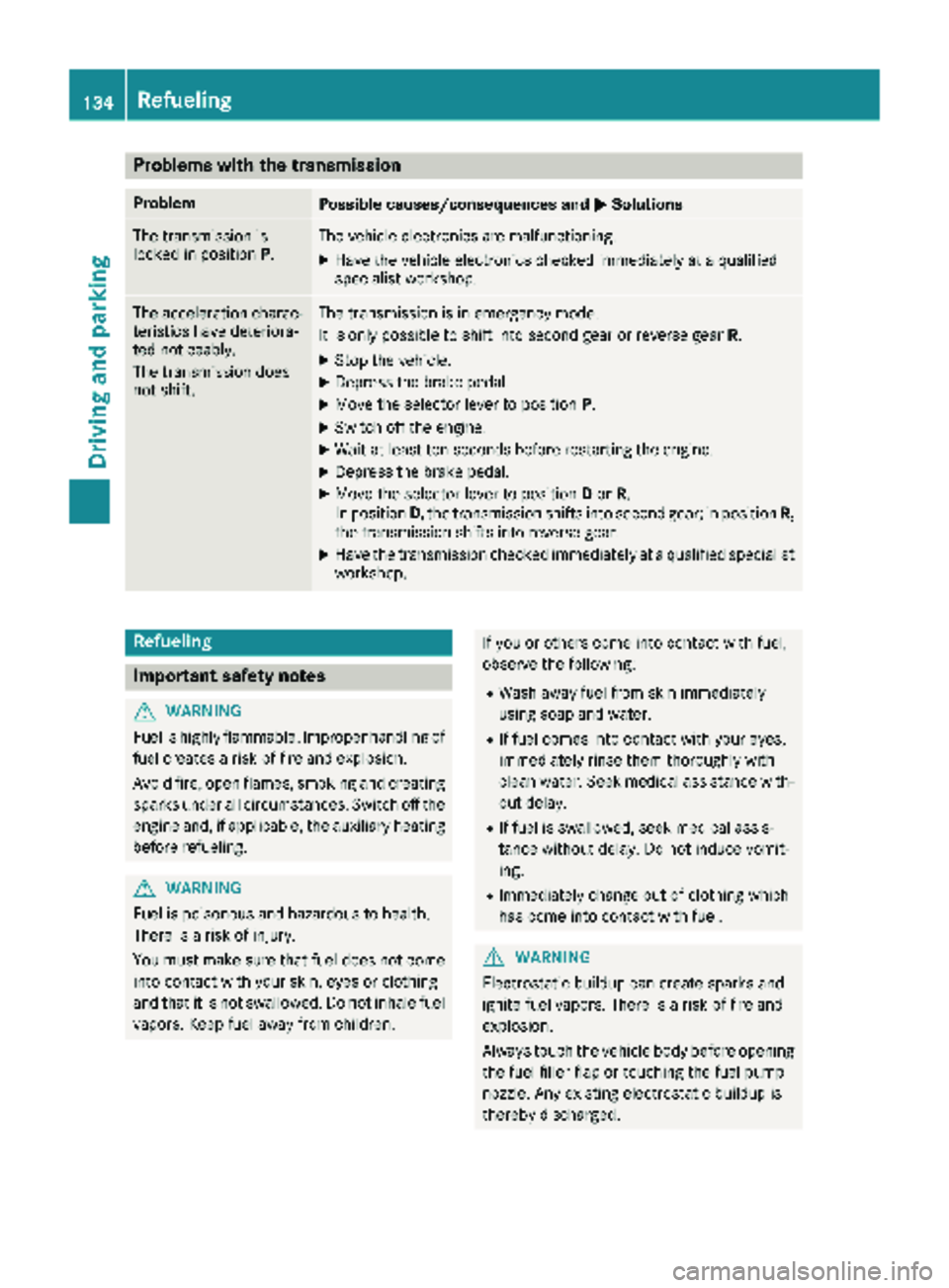
Problems with the transmission
ProblemPossible causes/consequences andMSolutions
The transmission is
locked in positionP.The vehicle electronics are malfunctioning.
XHave the vehicle electronics checked immediately at a qualified
specialist workshop.
The acceleration charac-
teristics have deteriora-
ted noticeably.
The transmission does
not shift.The transmission is in emergency mode.
It is only possible to shift into second gear or reverse gear R.
XStop the vehicle.
XDepress the brake pedal.
XMove the selector lever to positionP.
XSwitch off the engine.
XWait at least ten seconds before restarting the engine.
XDepress the brake pedal.
XMove the selector lever to positionDor R.
In position D, the transmission shifts into second gear; in position R,
the transmission shifts into reverse gear.
XHave the transmission checked immediately at a qualified specialist
workshop.
Refueling
Important safety notes
GWARNING
Fuel is highly flammable. Improper handling of
fuel creates a risk of fire and explosion.
Avoid fire, open flames, smoking and creating
sparks under all circumstances. Switch off the
engine and, if applicable, the auxiliary heating
before refueling.
GWARNING
Fuel is poisonous and hazardous to health.
There is a risk of injury.
You must make sure that fuel does not come into contact with your skin, eyes or clothing
and that it is not swallowed. Do not inhale fuel
vapors. Keep fuel away from children.
If you or others come into contact with fuel,
observe the following:
RWash away fuel from skin immediately
using soap and water.
RIf fuel comes into contact with your eyes,
immediately rinse them thoroughly with
clean water. Seek medical assistance with-
out delay.
RIf fuel is swallowed, seek medical assis-
tance without delay. Do not induce vomit-
ing.
RImmediately change out of clothing which
has come into contact with fuel.
GWARNING
Electrostatic buildup can create sparks and
ignite fuel vapors. There is a risk of fire and
explosion.
Always touch the vehicle body before opening
the fuel filler flap or touching the fuel pump
nozzle. Any existing electrostatic buildup is
thereby discharged.
134Refueling
Driving and parking