steering MERCEDES-BENZ METRIS 2020 MY20 Operator’s Manual
[x] Cancel search | Manufacturer: MERCEDES-BENZ, Model Year: 2020, Model line: METRIS, Model: MERCEDES-BENZ METRIS 2020Pages: 320, PDF Size: 26.38 MB
Page 229 of 320
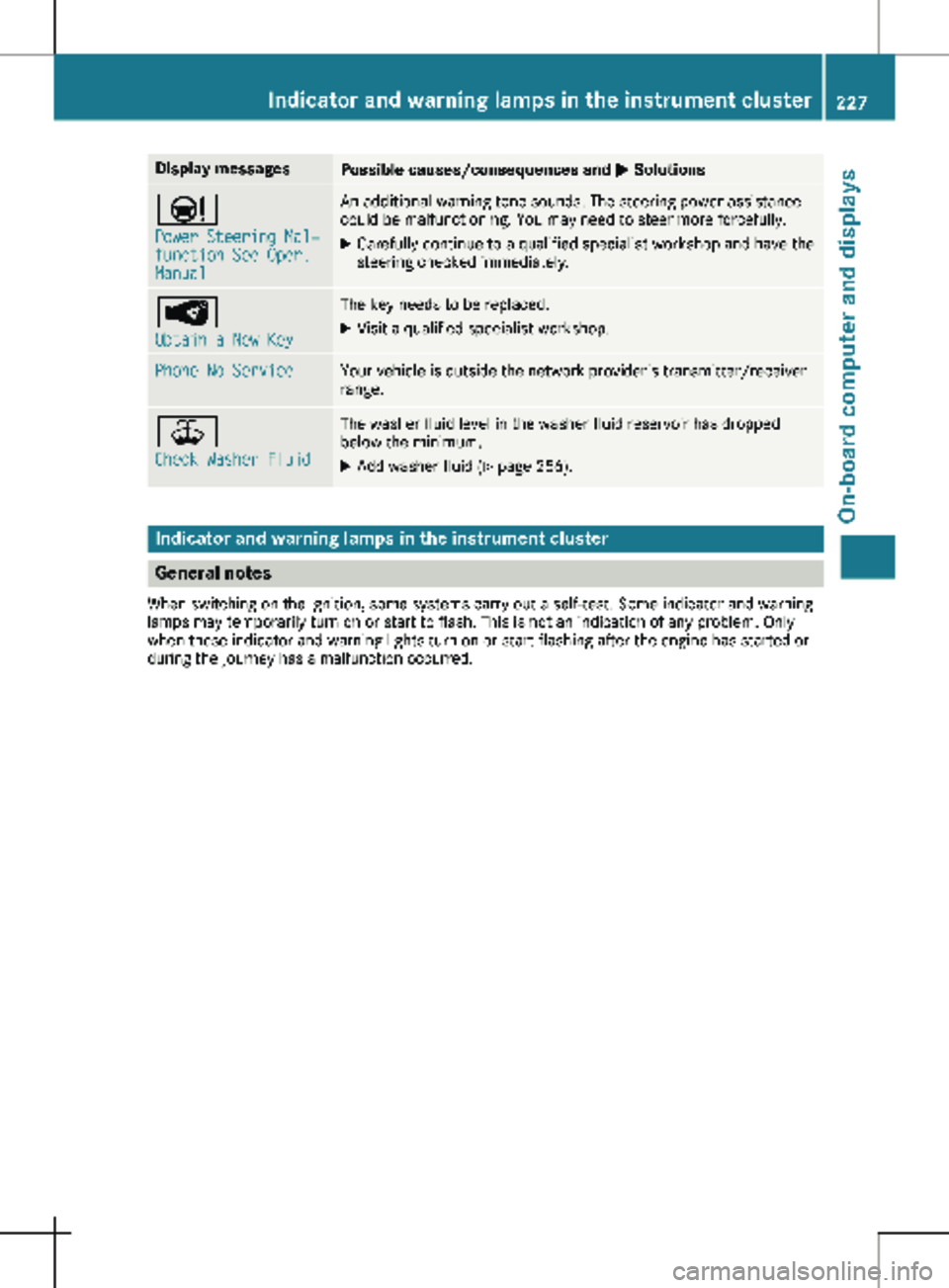
Display messages
Possible causes/consequences and
M SolutionsÐ
Power Steering Mal‐
function See Oper.
Manual An additional warning tone sounds. The steering power assistance
could be malfunctioning. You may need to steer more forcefully.
X Carefully continue to a qualified specialist workshop and have the
steering checked immediately. Â
Obtain a New Key The key needs to be replaced.
X Visit a qualified specialist workshop. Phone No Service Your vehicle is outside the network provider's transmitter/receiver
range. ¥
Check Washer Fluid The washer fluid level in the washer fluid reservoir has dropped
below the minimum.
X Add washer fluid (Y page 256).Indicator and warning lamps in the instrument cluster
General notes
When switching on the ignition, some systems carry out a self-test. Some indicator and warning
lamps may temporarily turn on or start to flash. This is not an indication of any problem. Only
when these indicator and warning lights turn on or start flashing after the engine has started or
during the journey has a malfunction occurred. Indicator and warning lamps in the instrument cluster
227
On-board computer and displays Z
Page 235 of 320

Engine
Warning/
indicator
lamp
N Signal type
Possible causes/consequences and
M Solutions;
N The yellow Check Engine warning lamp lights up while the engine is running.
There may be a malfunction in the following vehicle systems:
R in the engine management
R in the transmission management
R in the fuel injection system
R in the exhaust system
R in the ignition system (for vehicles with a gasoline engine)
R in the fuel system
The emission limit values may be exceeded and the engine may be running in
emergency mode.
X Have the vehicle checked as soon as possible at a qualified specialist work-
shop. 6
N The yellow reserve fuel warning lamp is on while the engine is running.
The fuel level has dropped to the reserve range.
X Refuel at the nearest gas station. ?
N The red coolant warning lamp comes on while the engine is running.
On vehicles without steering wheel buttons, the coolant temperature gauge is at
the start of the bar display
(Y page 178).
On vehicles with steering wheel buttons, the coolant temperature gauge is at
the start of the scale in the instrument cluster ( Y page 40).
The temperature sensor for the coolant temperature gauge is faulty.
The coolant temperature is no longer being monitored. There is a risk of engine
damage if the coolant temperature is too high.
X Stop the vehicle immediately, paying attention to road and traffic conditions,
and switch off the engine. Do not continue driving under any circumstances.
X Secure the vehicle to prevent it from rolling away (Y page
138).
X Consult a qualified specialist workshop. Indicator and warning lamps in the instrument cluster
233
On-board computer and displays Z
Page 236 of 320
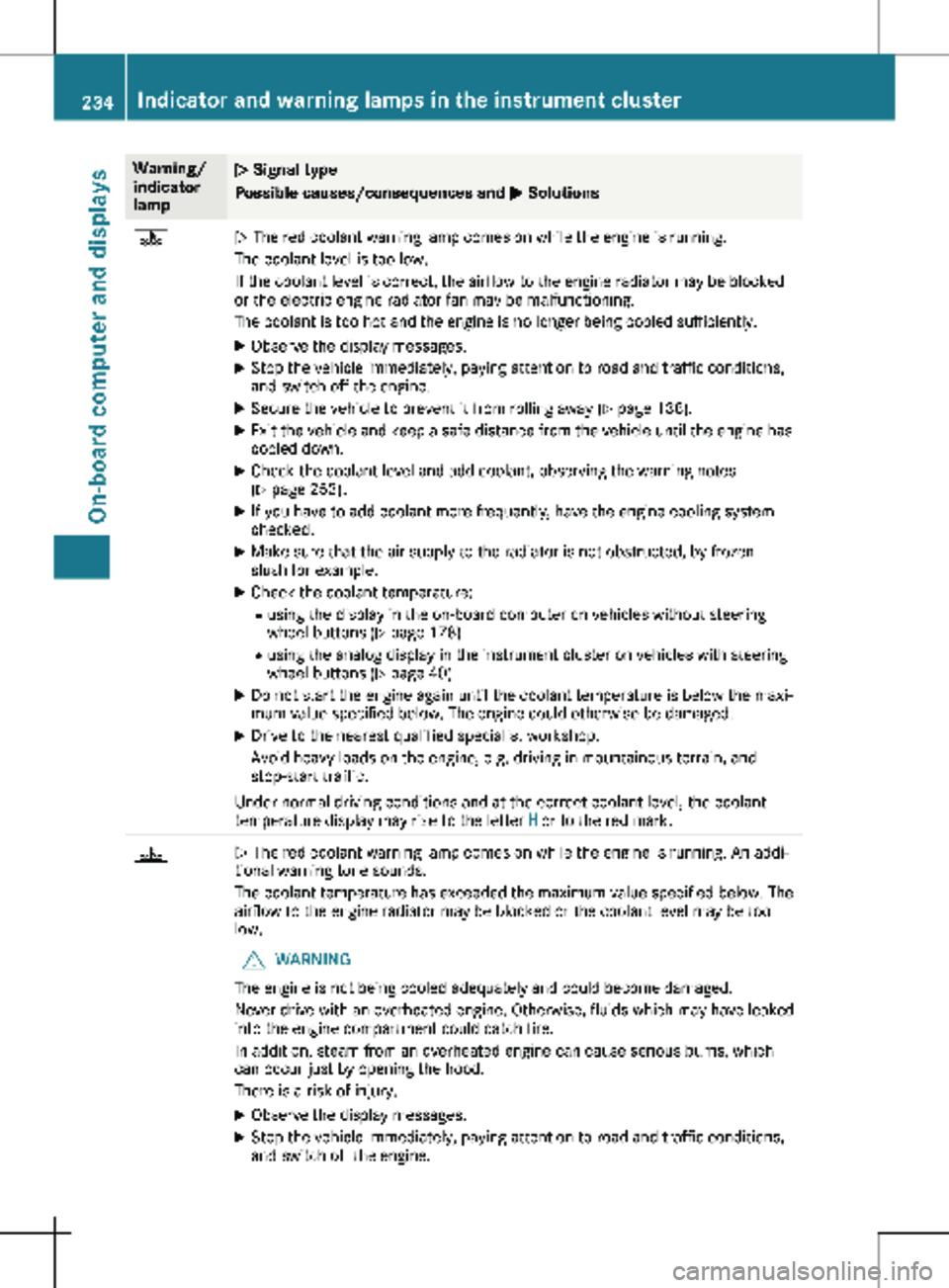
Warning/
indicator
lamp
N Signal type
Possible causes/consequences and
M Solutions?
N The red coolant warning lamp comes on while the engine is running.
The coolant level is too low.
If the coolant level is correct, the airflow to the engine radiator may be blocked
or the electric engine radiator fan may be malfunctioning.
The coolant is too hot and the engine is no longer being cooled sufficiently.
X Observe the display messages.
X Stop the vehicle immediately, paying attention to road and traffic conditions,
and switch off the engine.
X Secure the vehicle to prevent it from rolling away (Y page 138).
X Exit the vehicle and keep a safe distance from the vehicle until the engine has
cooled down.
X Check the coolant level and add coolant, observing the warning notes
(Y page
253).
X If you have to add coolant more frequently, have the engine cooling system
checked.
X Make sure that the air supply to the radiator is not obstructed, by frozen
slush for example.
X Check the coolant temperature:
R using the display in the on-board computer on vehicles without steering
wheel buttons ( Y page
178)
R using the analog display in the instrument cluster on vehicles with steering
wheel buttons ( Y page 40)
X Do not start the engine again until the coolant temperature is below the maxi-
mum value specified below. The engine could otherwise be damaged.
X Drive to the nearest qualified specialist workshop.
Avoid heavy loads on the engine, e.g. driving in mountainous terrain, and
stop-start traffic.
Under normal driving conditions and at the correct coolant level, the coolant
temperature display may rise to the letter H or to the red mark.?
N The red coolant warning lamp comes on while the engine is running. An addi-
tional warning tone sounds.
The coolant temperature has exceeded the maximum value specified below. The
airflow to the engine radiator may be blocked or the coolant level may be too
low.
G WARNING
The engine is not being cooled adequately and could become damaged.
Never drive with an overheated engine. Otherwise, fluids which may have leaked
into the engine compartment could catch fire.
In addition, steam from an overheated engine can cause serious burns, which
can occur just by opening the hood.
There is a risk of injury.
X Observe the display messages.
X Stop the vehicle immediately, paying attention to road and traffic conditions,
and switch off the engine. 234
Indicator and warning lamps in the instrument cluster
On-board computer and displays
Page 237 of 320
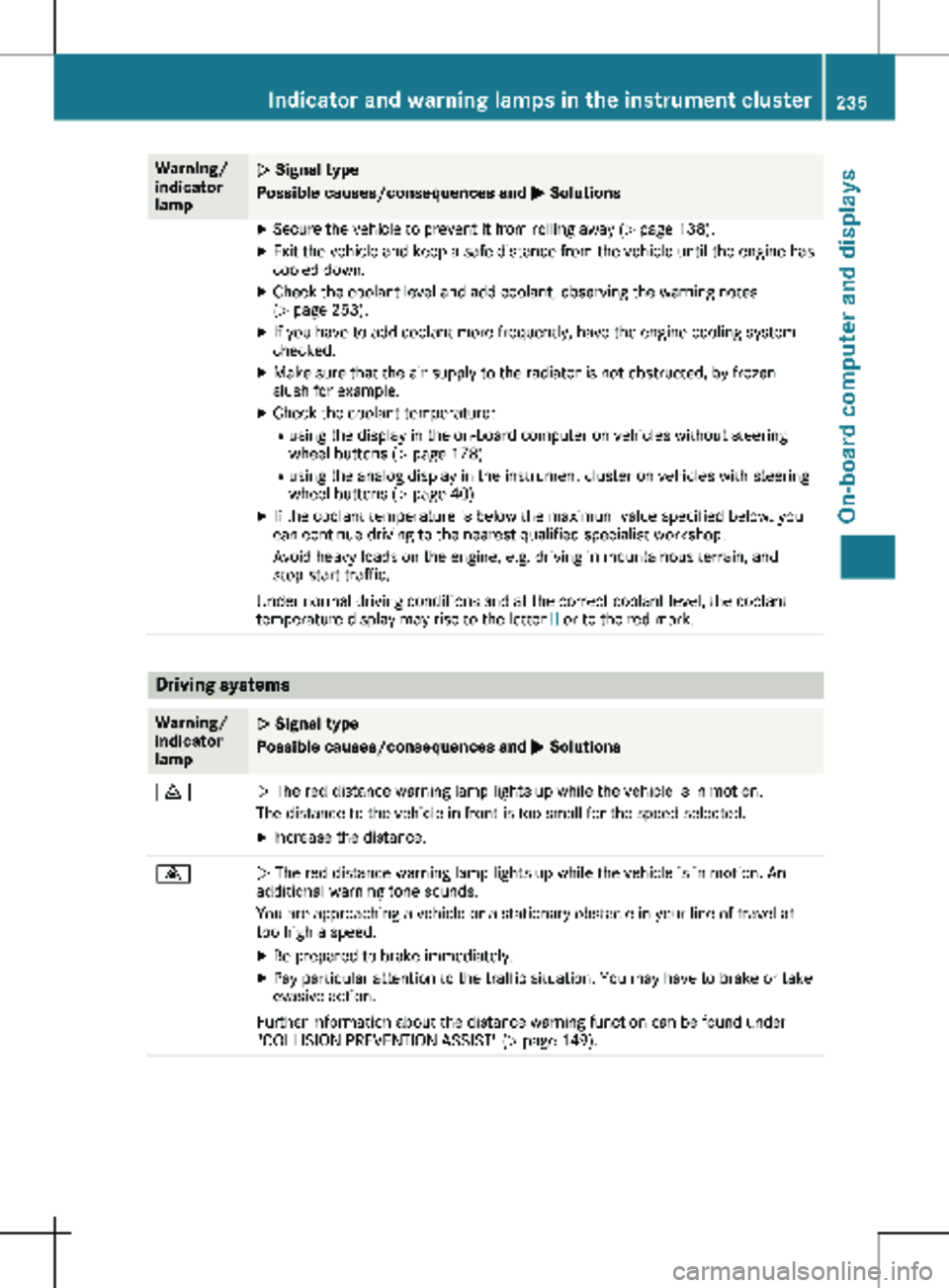
Warning/
indicator
lamp
N Signal type
Possible causes/consequences and
M SolutionsX
Secure the vehicle to prevent it from rolling away ( Y page 138).
X Exit the vehicle and keep a safe distance from the vehicle until the engine has
cooled down.
X Check the coolant level and add coolant, observing the warning notes
(Y page
253).
X If you have to add coolant more frequently, have the engine cooling system
checked.
X Make sure that the air supply to the radiator is not obstructed, by frozen
slush for example.
X Check the coolant temperature:
R using the display in the on-board computer on vehicles without steering
wheel buttons ( Y page
178)
R using the analog display in the instrument cluster on vehicles with steering
wheel buttons ( Y page 40)
X If the coolant temperature is below the maximum value specified below, you
can continue driving to the nearest qualified specialist workshop.
Avoid heavy loads on the engine, e.g. driving in mountainous terrain, and
stop-start traffic.
Under normal driving conditions and at the correct coolant level, the coolant
temperature display may rise to the letter H or to the red mark.Driving systems
Warning/
indicator
lamp
N Signal type
Possible causes/consequences and
M Solutions·
N The red distance warning lamp lights up while the vehicle is in motion.
The distance to the vehicle in front is too small for the speed selected.
X Increase the distance. ·
N The red distance warning lamp lights up while the vehicle is in motion. An
additional warning tone sounds.
You are approaching a vehicle or a stationary obstacle in your line of travel at
too high a speed.
X Be prepared to brake immediately.
X Pay particular attention to the traffic situation. You may have to brake or take
evasive action.
Further information about the distance warning function can be found under
"COLLISION PREVENTION ASSIST"
(Y page 149). Indicator and warning lamps in the instrument cluster
235
On-board computer and displays Z
Page 238 of 320
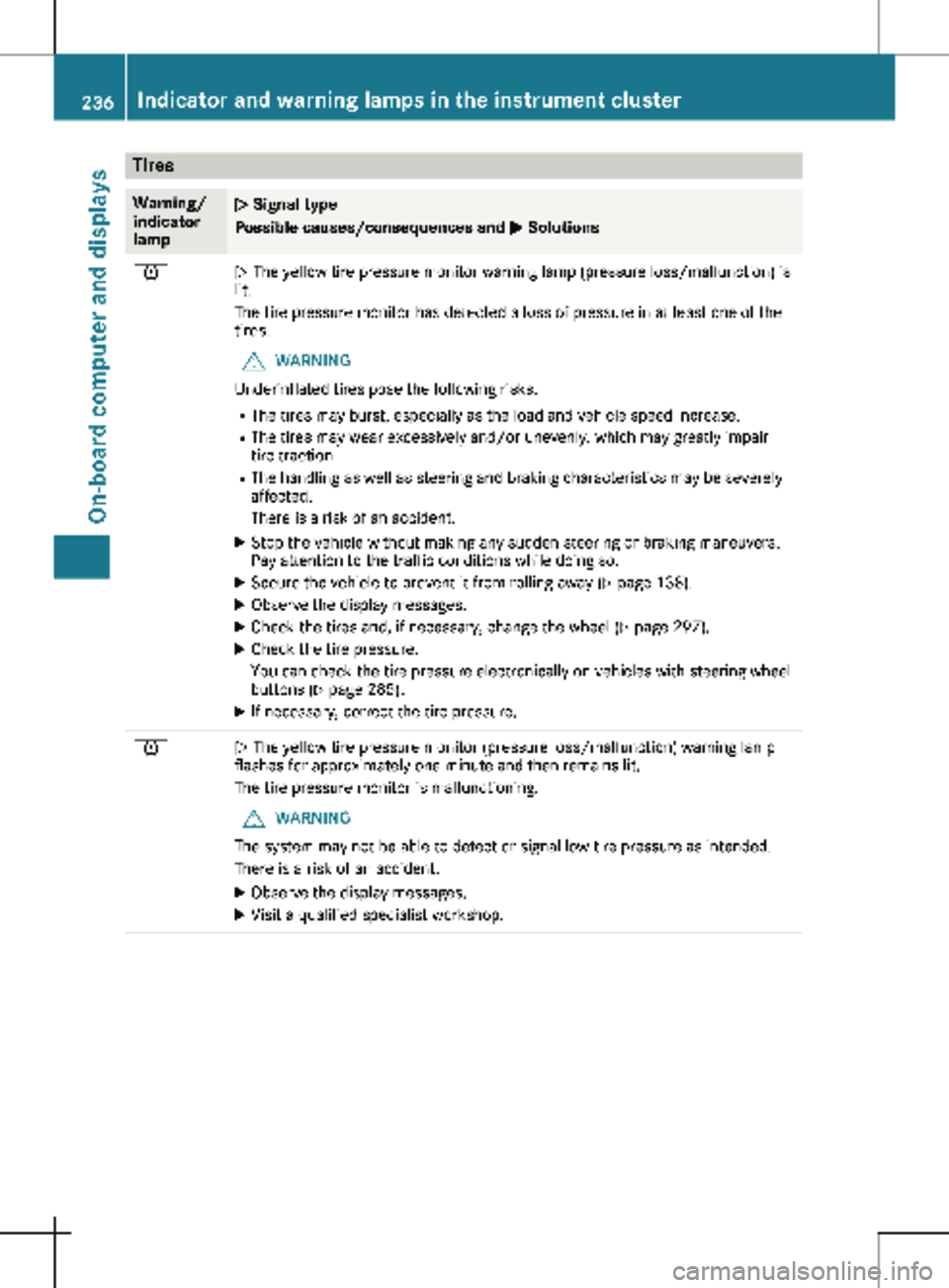
Tires
Warning/
indicator
lamp
N Signal type
Possible causes/consequences and
M Solutionsh
N The yellow tire pressure monitor warning lamp (pressure loss/malfunction) is
lit.
The tire pressure monitor has detected a loss of pressure in at least one of the
tires.
G WARNING
Underinflated tires pose the following risks:
R The tires may burst, especially as the load and vehicle speed increase.
R The tires may wear excessively and/or unevenly, which may greatly impair
tire traction.
R The handling as well as steering and braking characteristics may be severely
affected.
There is a risk of an accident.
X Stop the vehicle without making any sudden steering or braking maneuvers.
Pay attention to the traffic conditions while doing so.
X Secure the vehicle to prevent it from rolling away (Y page 138).
X Observe the display messages.
X Check the tires and, if necessary, change the wheel (Y page
297).
X Check the tire pressure.
You can check the tire pressure electronically on vehicles with steering wheel
buttons
(Y page 285).
X If necessary, correct the tire pressure. h
N The yellow tire pressure monitor (pressure loss/malfunction) warning lamp
flashes for approximately one minute and then remains lit.
The tire pressure monitor is malfunctioning.
G WARNING
The system may not be able to detect or signal low tire pressure as intended.
There is a risk of an accident.
X Observe the display messages.
X Visit a qualified specialist workshop.236
Indicator and warning lamps in the instrument cluster
On-board computer and displays
Page 239 of 320
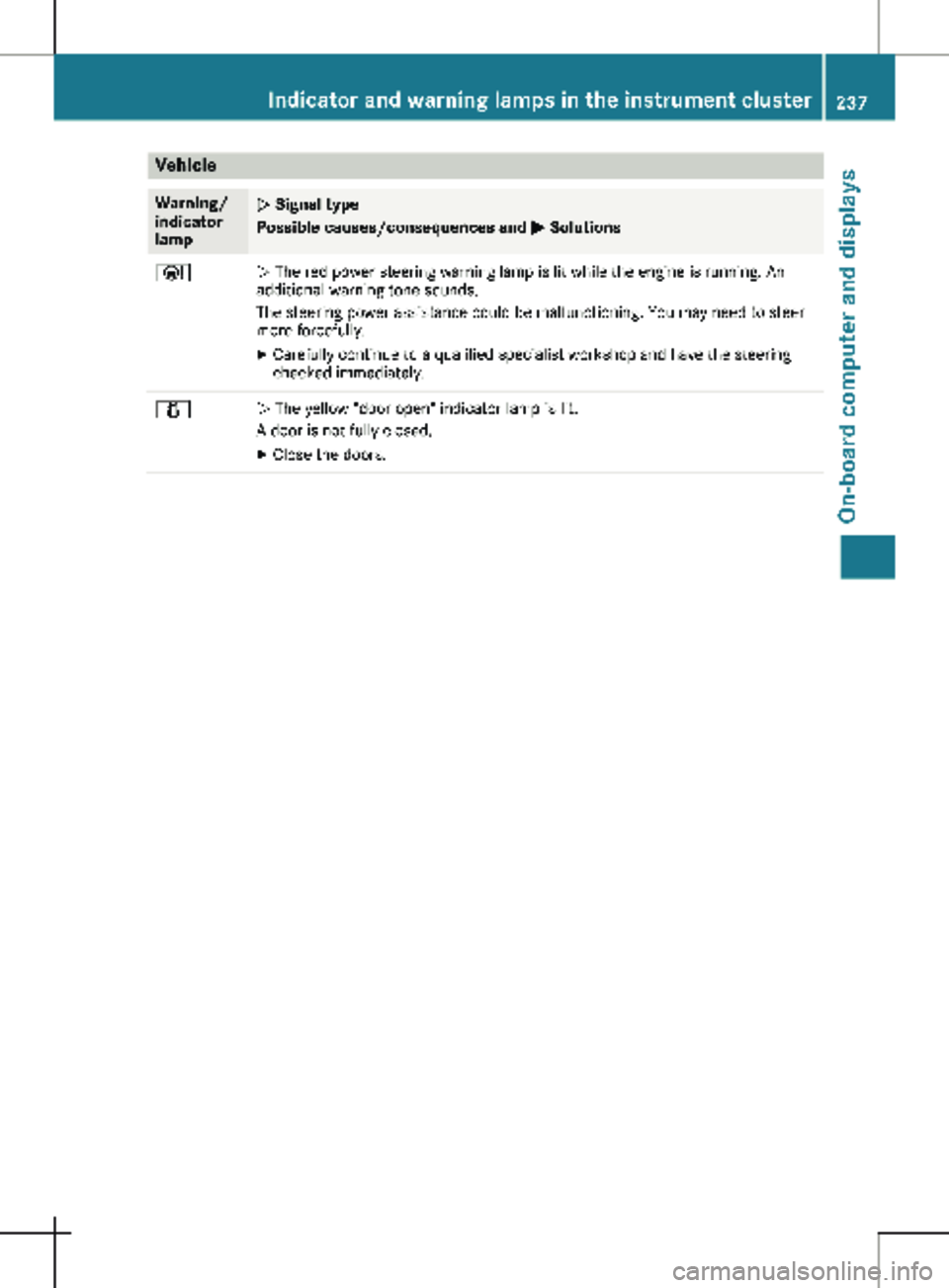
Vehicle
Warning/
indicator
lamp
N Signal type
Possible causes/consequences and
M SolutionsÐ
N The red power steering warning lamp is lit while the engine is running. An
additional warning tone sounds.
The steering power assistance could be malfunctioning. You may need to steer
more forcefully.
X Carefully continue to a qualified specialist workshop and have the steering
checked immediately. 1
N The yellow "door open" indicator lamp is lit.
A door is not fully closed.
X Close the doors. Indicator and warning lamps in the instrument cluster
237On-board computer and displays Z
Page 244 of 320
Useful information
This Operator's Manual describes all models
as well as standard and optional equipment of
your vehicle that were available at the time of
going to print. Country-specific variations are
possible. Note that your vehicle may not be
equipped with all of the described functions.
This also applies to systems and functions rel-
evant to safety.
Read the information on qualified specialist
workshops (Y page
32).Loading guidelines
Important safety notes
G
WARNING
When objects are unsecured or inadequately
secured, they can slip, turn over or be
thrown about, striking vehicle occupants.
This also applies to:
R luggage or loads
R seats which have been removed and are
being transported in the vehicle in an
exceptional case.
There is a risk of injury, particularly in the
event of a braking maneuver or abrupt
change in direction.
Always stow objects in such a way that they
cannot be tossed about. Before traveling,
secure objects, luggage or loads to prevent
them slipping or tipping over. If you remove
a seat, store it preferably outside the vehi-
cle. G
WARNING
As a result of improperly placed or unevenly
distributed loads, the center of gravity of the
load being transported may be too high or
too far back. This can significantly impair
handling as well as steering and braking
characteristics. There is a risk of an acci-
dent. Always make sure that the center of gravity
of the load is:
R between the axles
and
R as low as possible, near the rear axle. G
WARNING
When the permissible wheel loads, axle
loads and/or the maximum permissible
gross vehicle weight are exceeded, driving
safety is compromised. The handling as well
as steering and braking characteristics may
be significantly impaired. Overloaded tires
may overheat, causing them to burst. There
is a risk of an accident.
When transporting a load, always observe
the permissible wheel loads, axle loads and
the maximum permissible gross vehicle
weight for the vehicle (including occupants).
! If you are using a roof carrier, observe the
maximum roof load and maximum roof car-
rier load.
R Do not stack luggage or loads higher than
the backrests.
R Objects to be transported should preferably
be stowed in the cargo compartment.
R When transporting luggage, always use the
cargo tie-down rings for securing loads and
a cargo net, if installed.
R Use cargo tie-down rings and fasteners
which are suitable for the weight and size of
the load.
When using suitable load securing aids and tie
downs, always follow the manufacturer's oper-
ating instructions, in particular the notes on
discard criteria contained therein.
Load securing aids or tie downs must not be
used if:
R identification marks are missing or illegible
R there are yarn breakages, damage to bear-
ing seams or other signs of tearing
R there are signs of shearing, deformation,
pinching or other damage
R there is damage to clamping or connecting
elements
Load securing aids and tie downs in this condi-
tion are ready for discard and must be 242
Loading guidelines
Transporting loads
Page 251 of 320
Installing
X Clip the load protection net into upper
retainers : in such a way that tensioning
straps = face the rear of the vehicle.
X Pull tensioning straps = of the load protec-
tion net tightly.
X Clip hook ? on tensioning straps = into
cargo tie-down rings A.
X Fold tensioning element ; up.
X Pull the loose ends of tensioning straps =
down in the direction of the arrow until ten-
sioning straps = are tight.
X Fold tensioning element ; down to achieve
the final tension on the straps.
X After traveling a short distance, check that
the load protection net is taut.
X Retighten, if necessary.
Removing X Fold tensioning element ; up.
Tensioning straps = are slack.
X Unclip hook ? of tensioning straps = from
cargo tie-down rings A at the bottom.
X Unclip the load protection net from upper
retainers :.
X Roll up the load protection net and fasten it,
still rolled up, using the Velcro fasteners.
Adjusting the front seat with the load pro-
tection net installed
X Fold tensioning element ; on straps =
upwards.
The load protection net slackens.
X Correctly adjust the front seat.
X Re-tension the load protection net. Carrier systems
G
WARNING
When you load the roof, the center of gravity
of the vehicle rises and the usual driving
characteristics, as well as steering and brak-
ing, change. The vehicle tilts more severely
when cornering and may react more slug-
gishly to steering input.
If you exceed the maximum roof load, the
driving characteristics, as well as the steer- ing and braking, will be greatly impaired.
There is a risk of an accident.
Adjust your driving style and never exceed
the maximum roof load.
You will find information about the maximum
roof load under "Cargo tie-down points and
carrier systems"
(Y page 313).
! Make sure that:
R the screws of the roof carrier are tight-
ened to a maximum torque of 7.4 lb-ft
(10 Nm) in the threaded holes provided
and
R there is a minimum bolt penetration of
4 turns.
Only install roof carriers and rear racks that
have been approved or recommended for
Mercedes-Benz vehicles. This will help avoid
damage to the vehicle.
You can install a roof carrier on the roof and,
for example, a rear-mounted cycle rack on the
tailgate.
Install the protective caps on the securing
threads after you have removed the roof car-
rier.
If you have installed a rear rack on the tailgate,
the additional weight reduces the assistance
provided by the gas pressure springs when the
tailgate is opened. You will then need more
force to open the tailgate. At low outside tem-
peratures below freezing you will need to pro-
vide extra support for the tailgate to prevent it
from sinking unintentionally. Carrier systems
249
Transporting loads Z
Page 260 of 320
The prescribed service interval is based on
normal vehicle use. Service work will need to
be performed more frequently than prescribed
if the vehicle is operated under more arduous
conditions or with higher loads. Such arduous
conditions include:
R regular city driving with frequent intermedi-
ate stops
R driving predominantly short distances
R frequent operation in mountainous terrain or
on poor road surfaces
R leaving the engine idling for long periods on
a frequent basis
In these or similar operating conditions, have
the air filter, engine oil and oil filter, for exam-
ple, replaced more frequently. Under more
arduous operating conditions, the tires must
be checked more often. Further information
can be obtained at a qualified specialist work-
shop, e.g. an authorized Mercedes-Benz Com-
mercial Van Center.
Hiding service messages Vehicles without steering wheel buttons
X Press the 3 button on the instrument clus-
ter.
Vehicles with steering wheel buttons
X Press the a or % button on the steer-
ing wheel.
Calling up the service due date Vehicles without steering wheel buttons
The vehicle must be stationary. Use the but-
tons in the instrument cluster.
X Turn the key to position 2 in the ignition
lock.
X Press È to select the service display.
The display shows a possible service mes-
sage.
Vehicles with steering wheel buttons
Using the steering wheel buttons
X Turn the key to position 2 in the ignition
lock.
X Press = or ; to select the Service
menu.
X Press 9 or : to select the ASSYST
PLUS submenu and press a to confirm.
The display shows the service due date. Battery
Important safety notes
Work on the battery, e.g. removing or instal-
ling, requires specialist knowledge and the use
of special tools. Therefore, always have work
on the battery carried out at a qualified spe-
cialist workshop. G
WARNING
Work carried out incorrectly on the battery
can lead, for example, to a short circuit and
thus damage the vehicle electronics. This
can lead to function restrictions applying to
safety-relevant systems, e.g. the lighting
system, the ABS (anti-lock braking system)
or the ESP ®
(Electronic Stability Program).
The operating safety of your vehicle may be
restricted.
You could lose control of the vehicle, for
example:
R when braking
R in the event of abrupt steering maneuvers
and/or when the vehicle's speed is not
adapted to the road conditions
There is a risk of an accident.
In the event of a short circuit or a similar
incident, contact a qualified specialist work-
shop immediately. Do not drive any further.
You should have all work involving the bat-
tery carried out at a qualified specialist
workshop.
Further information can be found under "ABS"
(Y page
67) and under "ESP ®
" (Y page 68). G
WARNING
Electrostatic build-up can lead to the crea-
tion of sparks, which could ignite the highly
explosive gases of a battery. There is a risk
of an explosion.
Before handling the battery, touch the vehi-
cle body to remove any existing electrostatic
build-up.
The flammable gas mix is produced when the
battery is charged or when the vehicle is jump-
started. 258
Battery
Maintenance and care
Page 271 of 320
Cleaning the steering wheel and selec-
tor lever
X
Thoroughly wipe with a damp cloth.
X Vehicles with leather upholstery: after
cleaning, use leather care agents that have
been recommended and approved by
Mercedes-Benz.
Cleaning the trim elements !
Do not use solvent-based cleaning agents
such as tar remover, wheel cleaners, pol-
ishes or waxes. There is otherwise a risk of
damaging the surface.
X Wipe the trim elements with a damp, lint-
free cloth, e.g. a microfiber cloth.
X Heavy soiling: use care products and
cleaning agents recommended and
approved by Mercedes-Benz.
Cleaning the seat covers !
Do not use microfiber cloths to clean gen-
uine leather or artificial leather covers. If
used often, a microfiber cloth can damage
the cover.
! Clean:
R artificial leather covers with a cloth mois-
tened with a solution containing 1% deter-
gent, e.g. dish washing liquid.
R cloth covers with a microfiber cloth mois-
tened with a solution containing 1% deter-
gent, e.g. dish washing liquid. Wipe entire
seat sections carefully to avoid leaving
visible lines. Leave the seat to dry after-
wards. Cleaning results depend on the
type of dirt and how long it has been
there.
R genuine leather covers carefully with a
damp cloth, then wipe the covers down
with a dry cloth. Make sure that the
leather does not become soaked. Other-
wise, the leather could become rough or
cracked. Only use leather care agents
that have been tested and approved by
Mercedes-Benz. You can obtain these
from a qualified specialist workshop.
i Please keep in mind that:
R leather covers are a natural product and,
as such, are subject to a natural aging process. Leather may react differently,
e.g. increased wrinkling, to certain envi-
ronmental influences (such as high
humidity or intense heat).
R regular care is essential to make sure that
the appearance and comfort of the covers
are retained over time.
To clean genuine leather covers: X Remove any dust, crumbs etc. If necessary,
carefully vacuum-clean the seat covers.
X Carefully wipe the leather seat covers with a
damp cloth.
X Wipe over again with a dry cloth.
Make sure that the leather does not become
soaked, especially perforated parts.
X Then treat the leather seats with a leather
care foam.
Only use leather care agents that have been
tested and approved by Mercedes-Benz.
Observe the manufacturer's instructions.
Cleaning the seat belts G
WARNING
Seat belts can become severely weakened if
bleached or dyed. This could cause the seat
belts to tear or fail, for instance, in the event
of an accident. This poses an increased risk
of injury or fatal injury.
Never bleach or dye the seat belts.
! Do not clean the seat belts using chemical
cleaning agents. Do not dry the seat belts
by heating at temperatures above
176 ‡
(80 †) or in direct sunlight.
Remove any stains or dirt immediately. This
will avoid residue or damage. X Use clean, lukewarm water and soap solu-
tion.
Cleaning the headliner and carpets X
Headliner: if it is very dirty, use a soft brush
or dry shampoo.
X Carpets: use the carpet and textile cleaning
agents recommended and approved by
Mercedes-Benz. Care
269
Maintenance and care Z