brake fluid MERCEDES-BENZ METRIS 2020 MY20 Operator’s Manual
[x] Cancel search | Manufacturer: MERCEDES-BENZ, Model Year: 2020, Model line: METRIS, Model: MERCEDES-BENZ METRIS 2020Pages: 320, PDF Size: 26.38 MB
Page 267 of 320
X
Thoroughly hose down the vehicle with a
gentle jet of water.
X Do not point the water jet directly towards
the air inlet grilles.
X Use plenty of water and rinse out the
sponge frequently.
X Rinse the vehicle with clean water and dry
thoroughly with a chamois.
X Do not let the cleaning agents dry on the
paintwork.
When using the vehicle in winter, remove all
traces of road salt deposits carefully and as
soon as possible.
Power washers G
WARNING
The water jet from a circular jet nozzle (dirt
blasters) can cause invisible exterior dam-
age to the tires or chassis components.
Components damaged in this way may fail
unexpectedly. There is a risk of an accident.
Do not use power washers with circular jet
nozzles to clean the vehicle. Have damaged
tires or chassis components replaced imme-
diately.
! Under no circumstances use power wash-
ers in the vehicle interior. The pressurized
water and associated spray produced by the
power washer could cause extensive dam-
age to the vehicle.
! When using high-pressure cleaning equip-
ment, maintain a minimum distance of
approx. 1 ft (30 cm
) between the spray noz-
zle and the vehicle parts. Do not use a
power washer with a round-jet nozzle. You
could damage the vehicle or engine parts.
! Keep the water jet moving constantly
while cleaning. This will avoid causing dam-
age to the vehicle.
Do not point the water jet at:
R door joints
R rear view camera
R air bellows
R brake hoses
R wheel balance weights
R electrical components
R electrical connections R
seals
R drive train, especially not at the inter-
mediate bearing of the propeller shaft
Cleaning the engine !
Water must not enter intake or ventilation
openings. When cleaning with high pressure
water or steam cleaners, the spray must not
be aimed directly at electrical components
or the terminals of electrical lines.
Preserve the engine after the engine has
been cleaned. Protect the belt drive system
from exposure to the preservative agent.
Also observe the information under "Power
washers"
(Y page 265).
Cleaning the paintwork !
Do not affix:
R stickers
R films
R magnetic plates or similar items
to painted surfaces. You could otherwise
damage the paintwork.
Scratches, corrosive deposits, areas affected
by corrosion and damage caused by inade-
quate care cannot always be completely
repaired. In such cases, visit a qualified spe-
cialist workshop.
X Remove impurities immediately, where pos-
sible, whilst avoiding rubbing too hard.
X Soak insect remains with insect remover
and rinse off the treated areas afterwards.
X Soak bird droppings with water and rinse off
the treated areas afterwards.
X Remove coolant, brake fluid, tree resin, oils,
fuels and greases by rubbing gently with a
cloth soaked in petroleum ether or lighter
fluid.
X Use tar remover to remove tar stains.
X Use silicone remover to remove wax.
Cleaning the windows G
WARNING
You could become trapped by the wind-
shield wipers if they start moving while
cleaning the windshield or wiper blades.
There is a risk of injury. Care
265
Maintenance and care
Z
Page 307 of 320
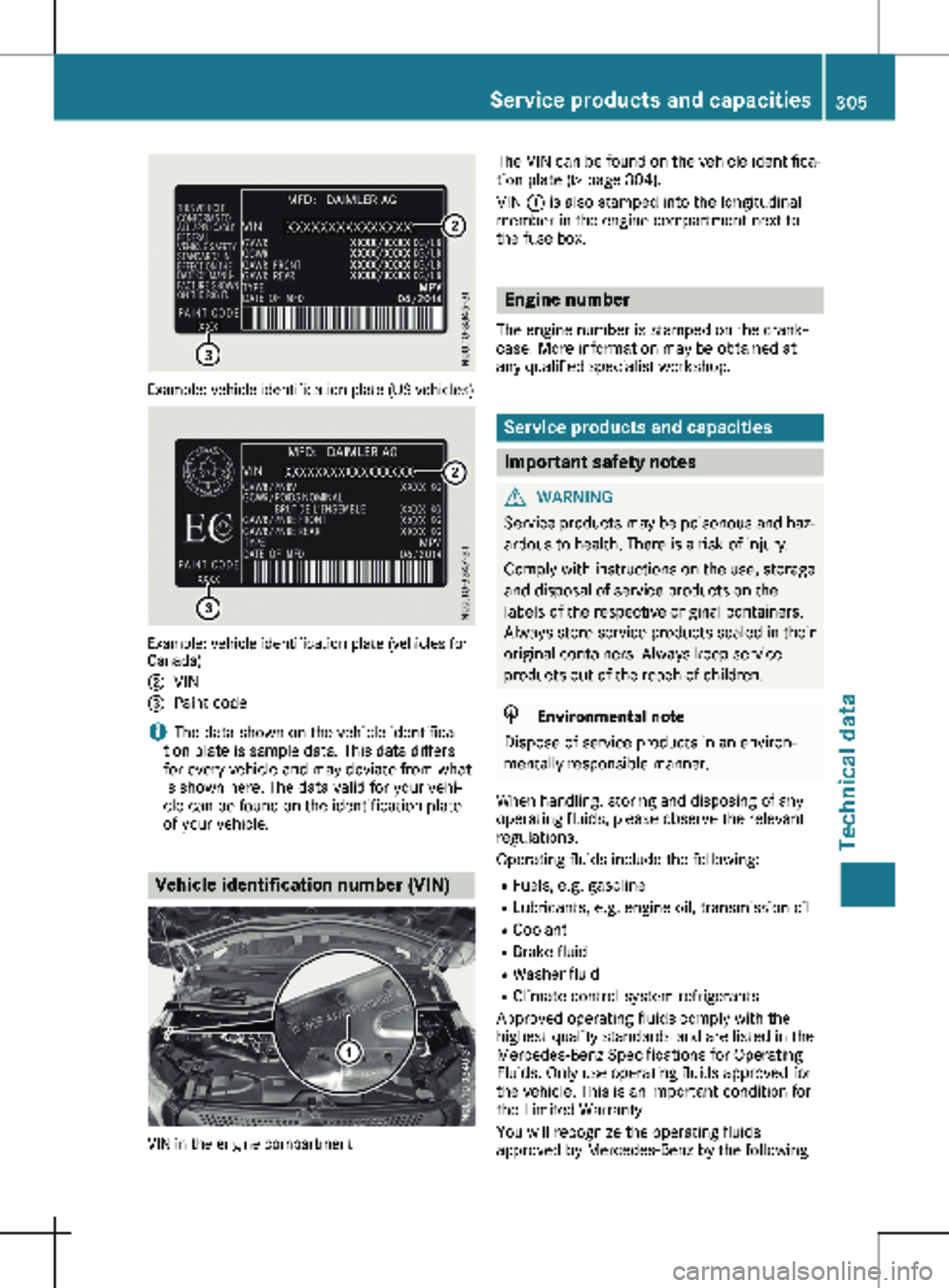
Example: vehicle identification plate (US vehicles)
Example: vehicle identification plate (vehicles for
Canada)
; VIN
= Paint code
i The data shown on the vehicle identifica-
tion plate is sample data. This data differs
for every vehicle and may deviate from what
is shown here. The data valid for your vehi-
cle can be found on the identification plate
of your vehicle. Vehicle identification number (VIN)
VIN in the engine compartment The VIN can be found on the vehicle identifica-
tion plate (Y page
304).
VIN : is also stamped into the longitudinal
member in the engine compartment next to
the fuse box. Engine number
The engine number is stamped on the crank-
case. More information may be obtained at
any qualified specialist workshop. Service products and capacities
Important safety notes
G
WARNING
Service products may be poisonous and haz-
ardous to health. There is a risk of injury.
Comply with instructions on the use, storage
and disposal of service products on the
labels of the respective original containers.
Always store service products sealed in their
original containers. Always keep service
products out of the reach of children. H
Environmental note
Dispose of service products in an environ-
mentally responsible manner.
When handling, storing and disposing of any
operating fluids, please observe the relevant
regulations.
Operating fluids include the following:
R Fuels, e.g. gasoline
R Lubricants, e.g. engine oil, transmission oil
R Coolant
R Brake fluid
R Washer fluid
R Climate control system refrigerants
Approved operating fluids comply with the
highest quality standards and are listed in the
Mercedes-Benz Specifications for Operating
Fluids. Only use operating fluids approved for
the vehicle. This is an important condition for
the Limited Warranty.
You will recognize the operating fluids
approved by Mercedes-Benz by the following Service products and capacities
305
Technical data Z
Page 312 of 320
Transmission oil
Automatic transmission Operating fluid: automatic transmission
fluid Product name/number Maintenance
interval Mobil ATF 134 FE
Valvoline ATF Pro 236.15
MB Sheet No. 236.15 —
More information can be obtained at any quali-
fied specialist workshop.
Rear axle Operating fluid: transmission oil
Product name/number Maintenance
interval Mobilube FE 75W-85
Mobilube FE Plus NG
75W-85
MB Sheet No. 235.7 —
More information can be obtained at any quali-
fied specialist workshop.
Brake fluid
G
WARNING
The brake fluid constantly absorbs moisture
from the air. This lowers the boiling point of
the brake fluid. If the boiling point of the
brake fluid is too low, vapor pockets may
form in the brake system when the brakes
are applied hard. This would impair braking
efficiency. There is a risk of an accident.
You should have the brake fluid renewed at
the specified intervals.
! Brake fluid corrodes paint, plastic and rub-
ber. If paint, plastic or rubber has come into
contact with brake fluid, rinse with water
immediately.
When handling, storing and disposing of brake
fluid, please observe the relevant regulations and the important safety notes for service
products (Y page
305).
Over a period of time, the brake fluid absorbs
moisture from the air. This reduces its boiling
point.
Have the brake fluid replaced at specified
intervals by a qualified specialist workshop.
i There is usually a notice in the engine
compartment to remind you when the next
brake fluid change is due.
Use only approved brake fluids that comply
with the Mercedes-Benz Specifications for Ser-
vice Products. Always check for the identifica-
tion DOT 4 plus.
Information about approved brake fluids can
be obtained:
R on the Internet at
http://bevo.mercedes-benz.com. Coolant
Important safety notes G
WARNING
If antifreeze comes into contact with hot
components in the engine compartment, it
may ignite. There is a risk of fire and injury.
Let the engine cool down before you add
antifreeze. Make sure that antifreeze is not
spilled next to the filler neck. Thoroughly
clean the antifreeze from components
before starting the engine.
! Take care not to spill any coolant on pain-
ted surfaces. You could otherwise damage
the paintwork.
When handling, storing and disposing of cool-
ant and antifreeze, please observe the relevant
regulations and the important safety notes for
operating fluids
(Y page 305).
Coolant additive with corrosion and
antifreeze protection !
Use only approved antifreeze/corrosion
inhibitor that complies with MB Specifica-
tion for Service Products, Sheet Number
325. Using other, non-approved antifreeze/
corrosion inhibitors may cause damage to 310
Service products and capacities
Technical data