child lock MERCEDES-BENZ METRIS 2020 MY20 Operator’s Manual
[x] Cancel search | Manufacturer: MERCEDES-BENZ, Model Year: 2020, Model line: METRIS, Model: MERCEDES-BENZ METRIS 2020Pages: 320, PDF Size: 26.38 MB
Page 67 of 320
running from the belt outlet to the belt guide
of the child restraint system. The shoulder belt
strap must be routed forward and down from
the vehicle belt outlet. Adjust the belt outlet
and co-driver's seat as required.
Always comply with the manufacturer's instal-
lation and operating instructions for the child
restraint system. Override feature/child-proof locks
Important safety notes G
WARNING
If children are traveling in the vehicle, they
could in particular:
R open doors, thereby endangering other
persons or road users.
R get out and be struck by oncoming traffic.
R operate vehicle equipment and become
trapped.
There is a risk of an accident and injury.
Always activate the child-proof locks and
override feature if children are traveling in
the vehicle. When leaving the vehicle,
always take the key with you and lock the
vehicle. Never leave children unattended in
the vehicle.
Child-proof lock/override feature for:
R Sliding doors ( Y page
66)G
WARNING
If children are left unsupervised in the vehi-
cle, they could, in particular:
R open doors, thereby endangering other
persons or road users.
R get out and be struck by oncoming traffic.
R operate vehicle equipment and become
trapped, for example.
In addition, children could set the vehicle in
motion, for example, if they:
R release the parking brake.
R change the transmission position.
R start the vehicle. There is a risk of accident and injury.
Never leave children unsupervised in the
vehicle.
When leaving the vehicle, always take the
SmartKey with you and lock the vehicle.
Keep the SmartKey out of the reach of chil-
dren.
G
WARNING
If persons, particularly children are subjec-
ted to prolonged exposure to extreme heat
or cold, there is a risk of injury, possibly
even fatal. Never leave children unattended
in the vehicle. G
WARNING
If the child restraint system is subjected to
direct sunlight, parts may get very hot. Chil-
dren may burn themselves on these parts,
particularly on the metal parts of the child
restraint system. There is a risk of injury.
If you leave the vehicle, taking the child with
you, always ensure that the child restraint
system is not exposed to direct sunlight.
Protect it with a blanket, for example. If the
child restraint system has been exposed to
direct sunlight, let it cool down before secur-
ing the child in it. Never leave children unat-
tended in the vehicle. Children in the vehicle
65
Safety Z
Page 68 of 320
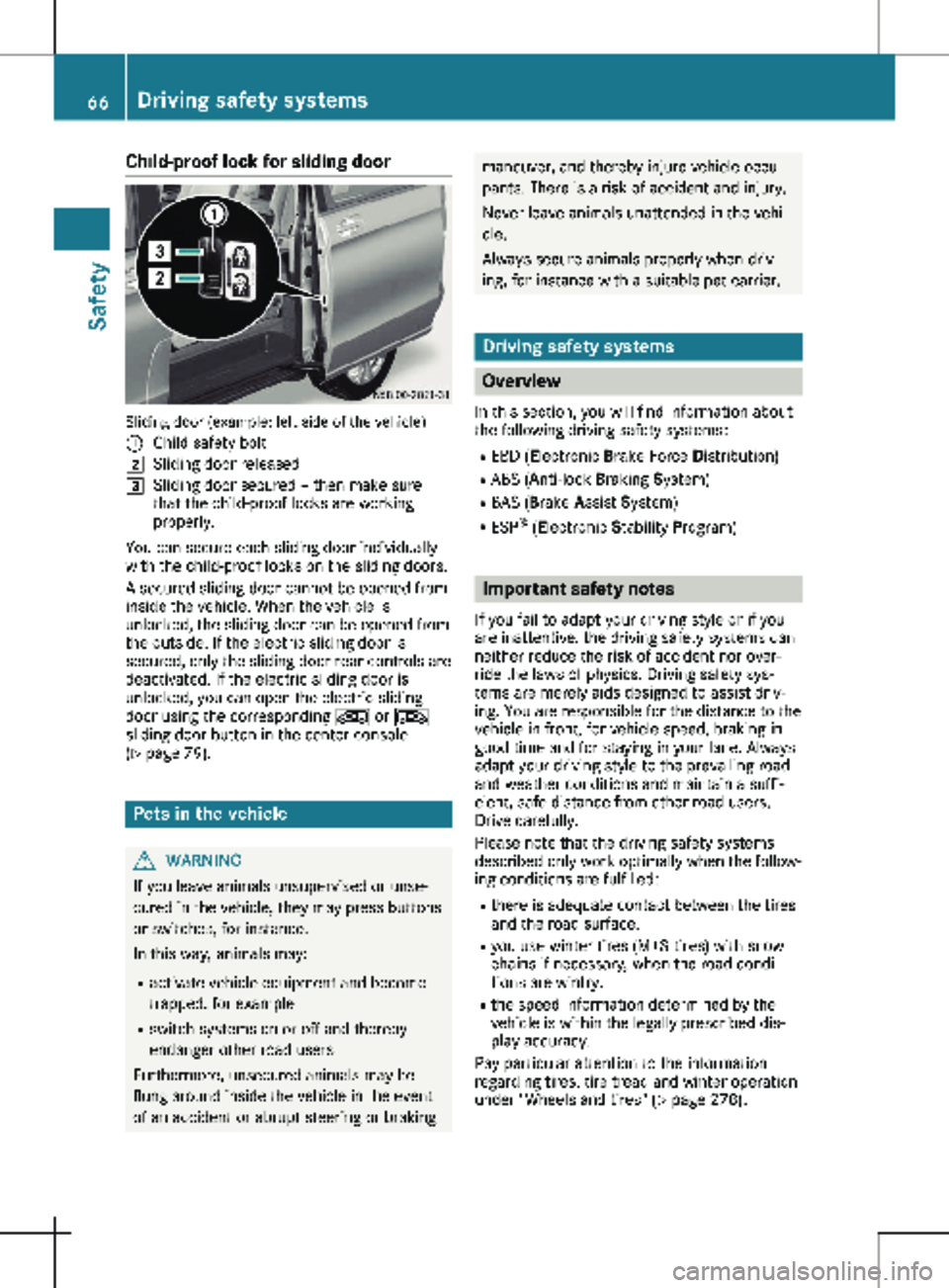
Child-proof lock for sliding door
Sliding door (example: left side of the vehicle)
: Child safety bolt
2 Sliding door released
3 Sliding door secured – then make sure
that the child-proof locks are working
properly.
You can secure each sliding door individually
with the child-proof locks on the sliding doors.
A secured sliding door cannot be opened from
inside the vehicle. When the vehicle is
unlocked, the sliding door can be opened from
the outside. If the electric sliding door is
secured, only the sliding door rear controls are
deactivated. If the electric sliding door is
unlocked, you can open the electric sliding
door using the corresponding Å or Æ
sliding door button in the center console
(Y page
79). Pets in the vehicle
G
WARNING
If you leave animals unsupervised or unse-
cured in the vehicle, they may press buttons
or switches, for instance.
In this way, animals may:
R activate vehicle equipment and become
trapped, for example
R switch systems on or off and thereby
endanger other road users
Furthermore, unsecured animals may be
flung around inside the vehicle in the event
of an accident or abrupt steering or braking maneuver, and thereby injure vehicle occu-
pants. There is a risk of accident and injury.
Never leave animals unattended in the vehi-
cle.
Always secure animals properly when driv-
ing, for instance with a suitable pet carrier. Driving safety systems
Overview
In this section, you will find information about
the following driving safety systems:
R EBD ( Electronic Brake Force Distribution)
R ABS ( Anti-lock Braking System)
R BAS ( Brake A ssist System)
R ESP ®
(Electronic Stability Program) Important safety notes
If you fail to adapt your driving style or if you
are inattentive, the driving safety systems can
neither reduce the risk of accident nor over-
ride the laws of physics. Driving safety sys-
tems are merely aids designed to assist driv-
ing. You are responsible for the distance to the
vehicle in front, for vehicle speed, braking in
good time and for staying in your lane. Always
adapt your driving style to the prevailing road
and weather conditions and maintain a suffi-
cient, safe distance from other road users.
Drive carefully.
Please note that the driving safety systems
described only work optimally when the follow-
ing conditions are fulfilled:
R there is adequate contact between the tires
and the road surface.
R you use winter tires
(M+S tires) with snow
chains if necessary, when the road condi-
tions are wintry.
R the speed information determined by the
vehicle is within the legally prescribed dis-
play accuracy.
Pay particular attention to the information
regarding tires, tire tread and winter operation
under "Wheels and tires" (Y page 278). 66
Driving safety systems
Safety
Page 73 of 320
Useful information
This Operator's Manual describes all models
as well as standard and optional equipment of
your vehicle that were available at the time of
going to print. Country-specific variations are
possible. Note that your vehicle may not be
equipped with all of the described functions.
This also applies to systems and functions rel-
evant to safety.
Read the information on qualified specialist
workshops (Y page
32).Key
Important safety notes
G
WARNING
If children are left unsupervised in the vehi-
cle, they could:
R open the doors, thus endangering other
people or road users.
R get out and disrupt traffic.
R operate the vehicle's equipment.
Additionally, children could set the vehicle in
motion if, for example, they:
R release the parking brake.
R shift the automatic transmission out of
park position P.
R start the engine.
There is a risk of an accident and injury.
When leaving the vehicle, always take the
SmartKey with you and lock the vehicle.
Never leave children or animals unattended
in the vehicle. Always keep the SmartKey
out of reach of children. G
WARNING
If you attach heavy or large objects to the
SmartKey, the SmartKey could be uninten-
tionally turned in the ignition lock. This
could cause the engine to be switched off.
There is a risk of an accident.
Do not attach any heavy or large objects to
the SmartKey. Remove any bulky key rings before inserting the SmartKey into the igni-
tion lock.
! Keep the key away from strong magnetic
fields. The remote control function may oth-
erwise be damaged.
Strong magnetic fields can occur in the
vicinity of powerful electrical installations.
Do not keep the key:
R with electronic devices, e.g. a mobile phone
or another key
R with metallic objects, e.g. coins or metal foil
R in metallic objects, e.g. metal cases
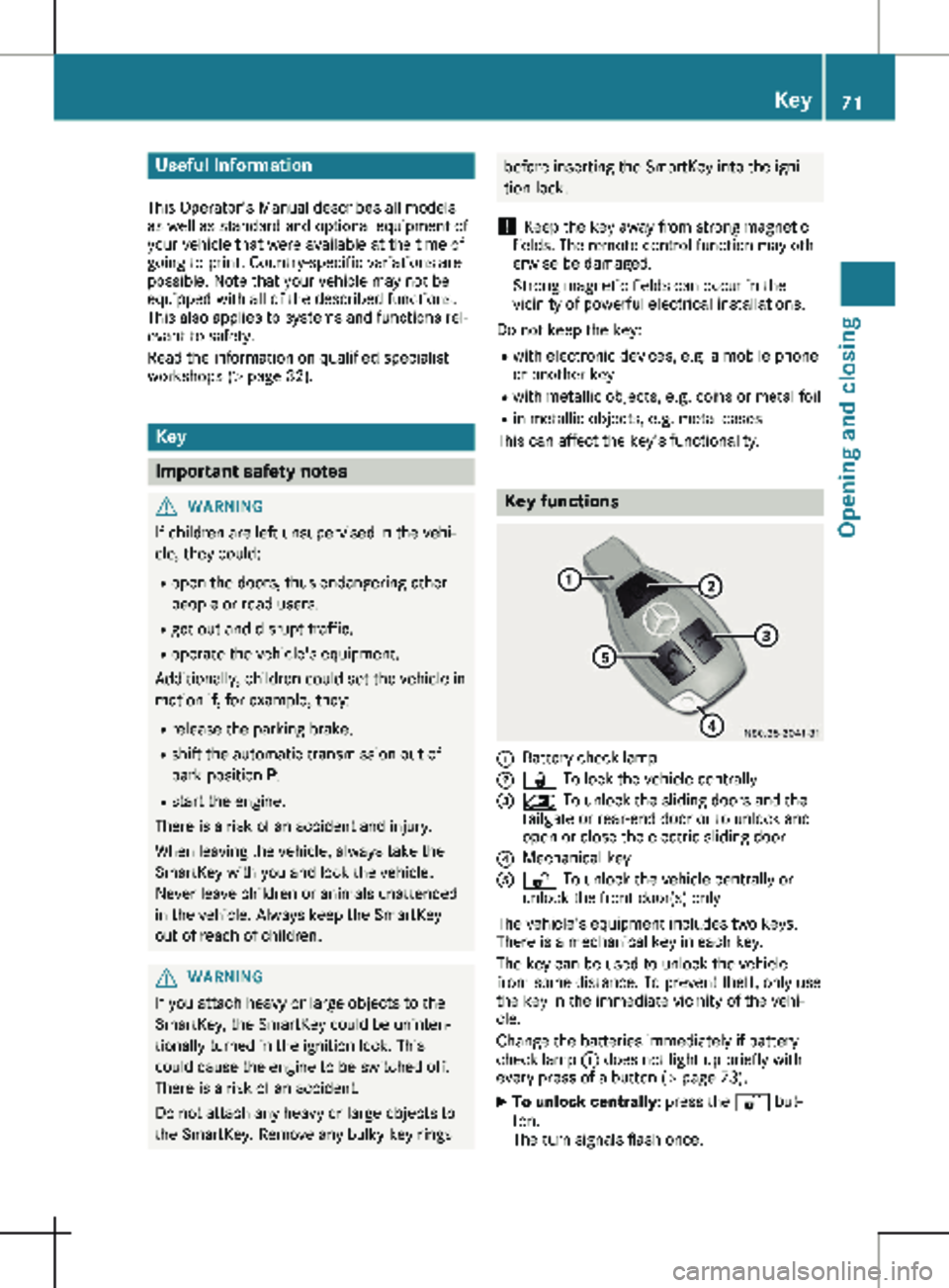
This can affect the key's functionality. Key functions
:
Battery check lamp
; & To lock the vehicle centrally
= 5 To unlock the sliding doors and the
tailgate or rear-end door or to unlock and
open or close the electric sliding door
? Mechanical key
A % To unlock the vehicle centrally or
unlock the front door(s) only
The vehicle's equipment includes two keys.
There is a mechanical key in each key.
The key can be used to unlock the vehicle
from some distance. To prevent theft, only use
the key in the immediate vicinity of the vehi-
cle.
Change the batteries immediately if battery
check lamp : does not light up briefly with
every press of a button (Y page
73).
X To unlock centrally: press the % but-
ton.
The turn signals flash once. Key
71
Opening and closing Z
Page 75 of 320
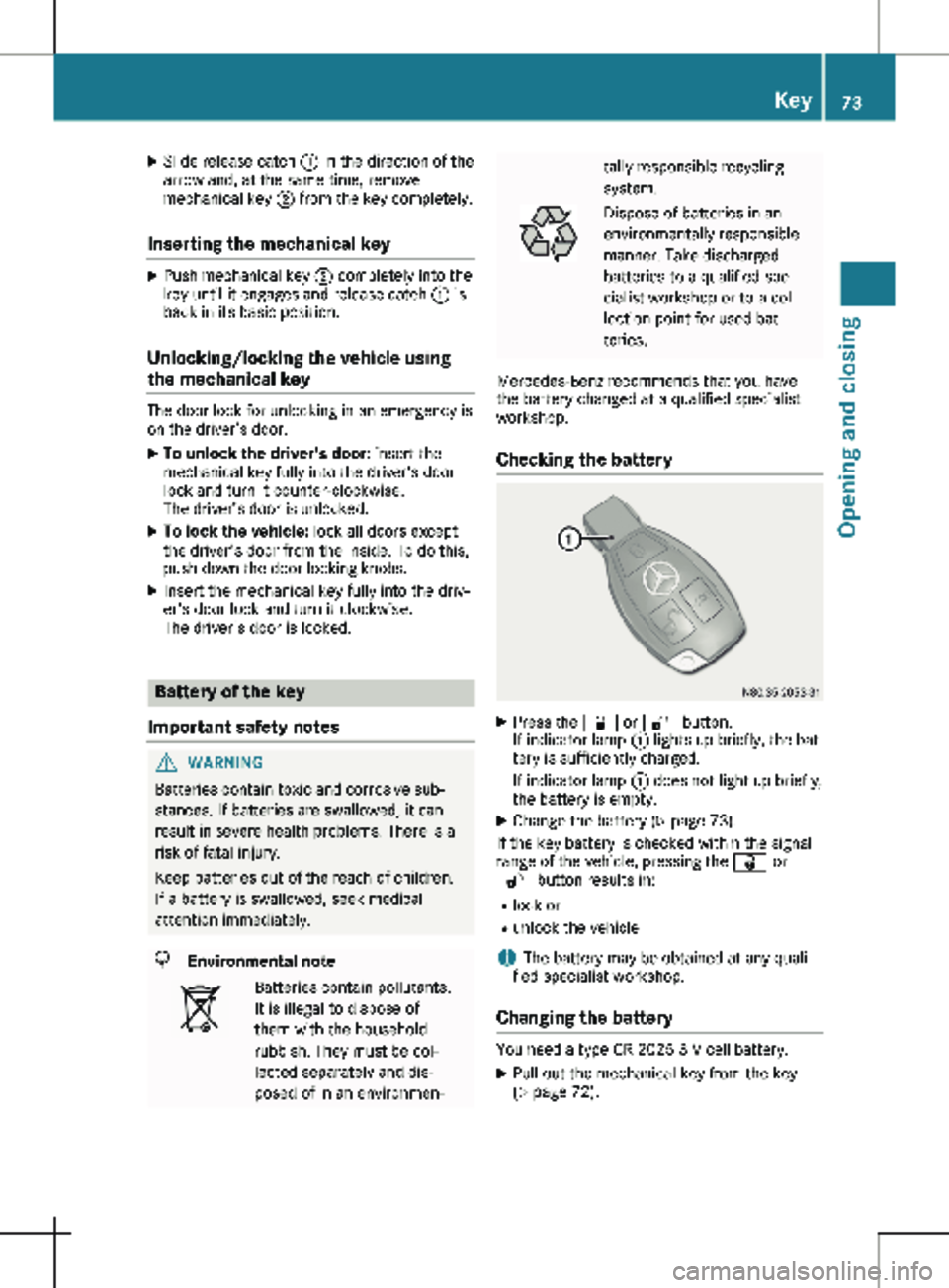
X
Slide release catch : in the direction of the
arrow and, at the same time, remove
mechanical key ; from the key completely.
Inserting the mechanical key X
Push mechanical key ; completely into the
key until it engages and release catch : is
back in its basic position.
Unlocking/locking the vehicle using
the mechanical key The door lock for unlocking in an emergency is
on the driver’s door.
X To unlock the driver's door: insert the
mechanical key fully into the driver's door
lock and turn it counter-clockwise.
The driver’s door is unlocked.
X To lock the vehicle: lock all doors except
the driver's door from the inside. To do this,
push down the door-locking knobs.
X Insert the mechanical key fully into the driv-
er's door lock and turn it clockwise.
The driver's door is locked. Battery of the key
Important safety notes G
WARNING
Batteries contain toxic and corrosive sub-
stances. If batteries are swallowed, it can
result in severe health problems. There is a
risk of fatal injury.
Keep batteries out of the reach of children.
If a battery is swallowed, seek medical
attention immediately. H
Environmental note Batteries contain pollutants.
It is illegal to dispose of
them with the household
rubbish. They must be col-
lected separately and dis-
posed of in an environmen- tally responsible recycling
system. Dispose of batteries in an
environmentally responsible
manner. Take discharged
batteries to a qualified spe-
cialist workshop or to a col-
lection point for used bat-
teries.
Mercedes-Benz recommends that you have
the battery changed at a qualified specialist
workshop.
Checking the battery X
Press the & or % button.
If indicator lamp : lights up briefly, the bat-
tery is sufficiently charged.
If indicator lamp : does not light up briefly,
the battery is empty.
X Change the battery ( Y page 73).
If the key battery is checked within the signal
range of the vehicle, pressing the & or
% button results in:
R lock or
R unlock the vehicle
i The battery may be obtained at any quali-
fied specialist workshop.
Changing the battery You need a type CR 2025 3 V cell battery.
X Pull out the mechanical key from the key
(Y page
72). Key
73
Opening and closing Z
Page 77 of 320
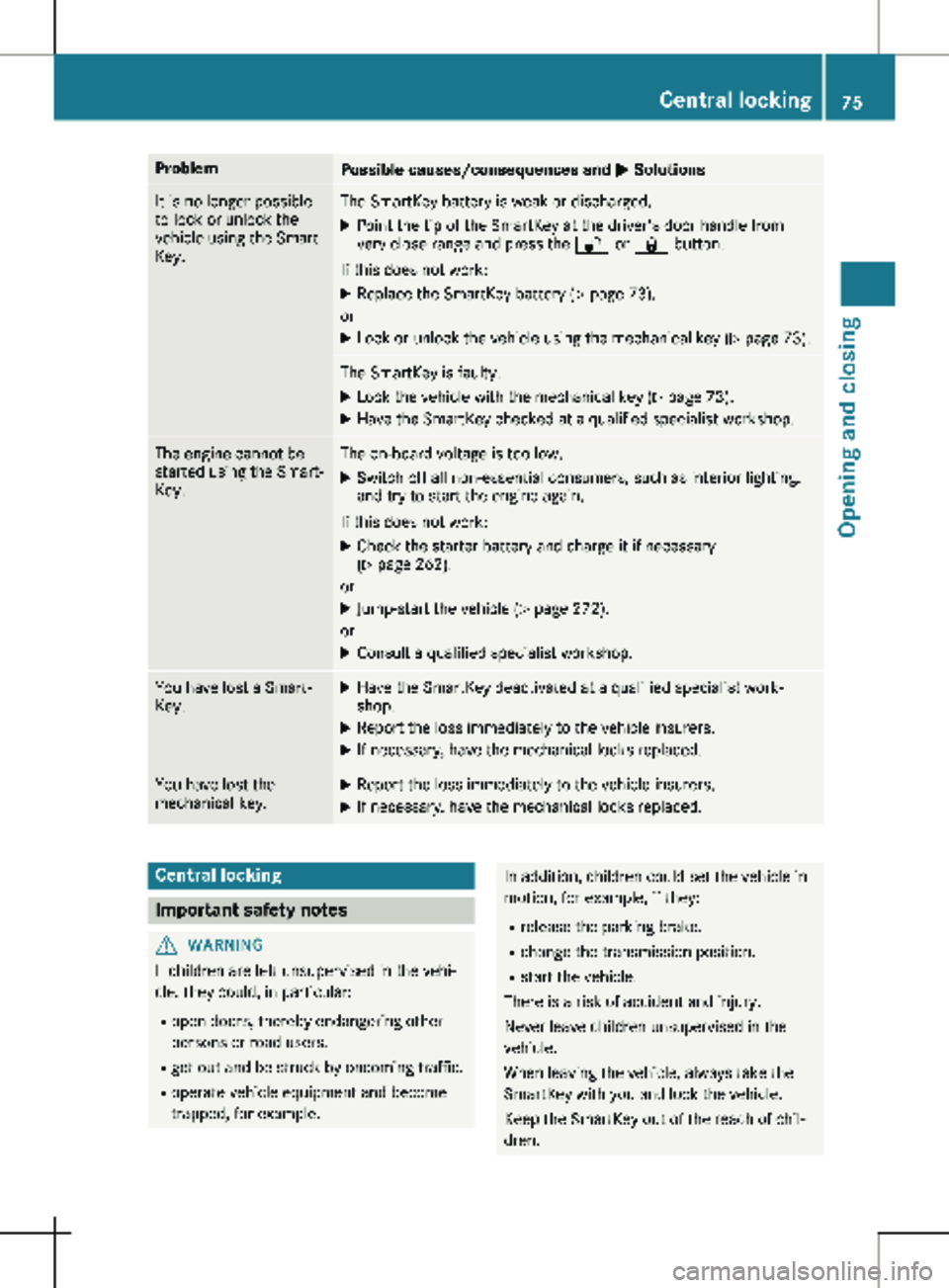
Problem
Possible causes/consequences and
M SolutionsIt is no longer possible
to lock or unlock the
vehicle using the Smart-
Key. The SmartKey battery is weak or discharged.
X Point the tip of the SmartKey at the driver's door handle from
very close range and press the % or & button.
If this does not work:
X Replace the SmartKey battery ( Y page 73).
or
X Lock or unlock the vehicle using the mechanical key ( Y page
73).The SmartKey is faulty.
X Lock the vehicle with the mechanical key (Y page
73).
X Have the SmartKey checked at a qualified specialist workshop. The engine cannot be
started using the Smart-
Key. The on-board voltage is too low.
X Switch off all non-essential consumers, such as interior lighting,
and try to start the engine again.
If this does not work:
X Check the starter battery and charge it if necessary
(Y page
262).
or
X Jump-start the vehicle ( Y page
272).
or
X Consult a qualified specialist workshop. You have lost a Smart-
Key. X
Have the SmartKey deactivated at a qualified specialist work-
shop.
X Report the loss immediately to the vehicle insurers.
X If necessary, have the mechanical locks replaced. You have lost the
mechanical key. X
Report the loss immediately to the vehicle insurers.
X If necessary, have the mechanical locks replaced. Central locking
Important safety notes
G
WARNING
If children are left unsupervised in the vehi-
cle, they could, in particular:
R open doors, thereby endangering other
persons or road users.
R get out and be struck by oncoming traffic.
R operate vehicle equipment and become
trapped, for example. In addition, children could set the vehicle in
motion, for example, if they:
R release the parking brake.
R change the transmission position.
R start the vehicle.
There is a risk of accident and injury.
Never leave children unsupervised in the
vehicle.
When leaving the vehicle, always take the
SmartKey with you and lock the vehicle.
Keep the SmartKey out of the reach of chil-
dren. Central locking
75
Opening and closing Z
Page 78 of 320
G
WARNING
If persons, particularly children are subjec-
ted to prolonged exposure to extreme heat
or cold, there is a risk of injury, possibly
even fatal. Never leave children unattended
in the vehicle.
You can open a locked door from the inside at
any time. For the sliding doors, the child-proof
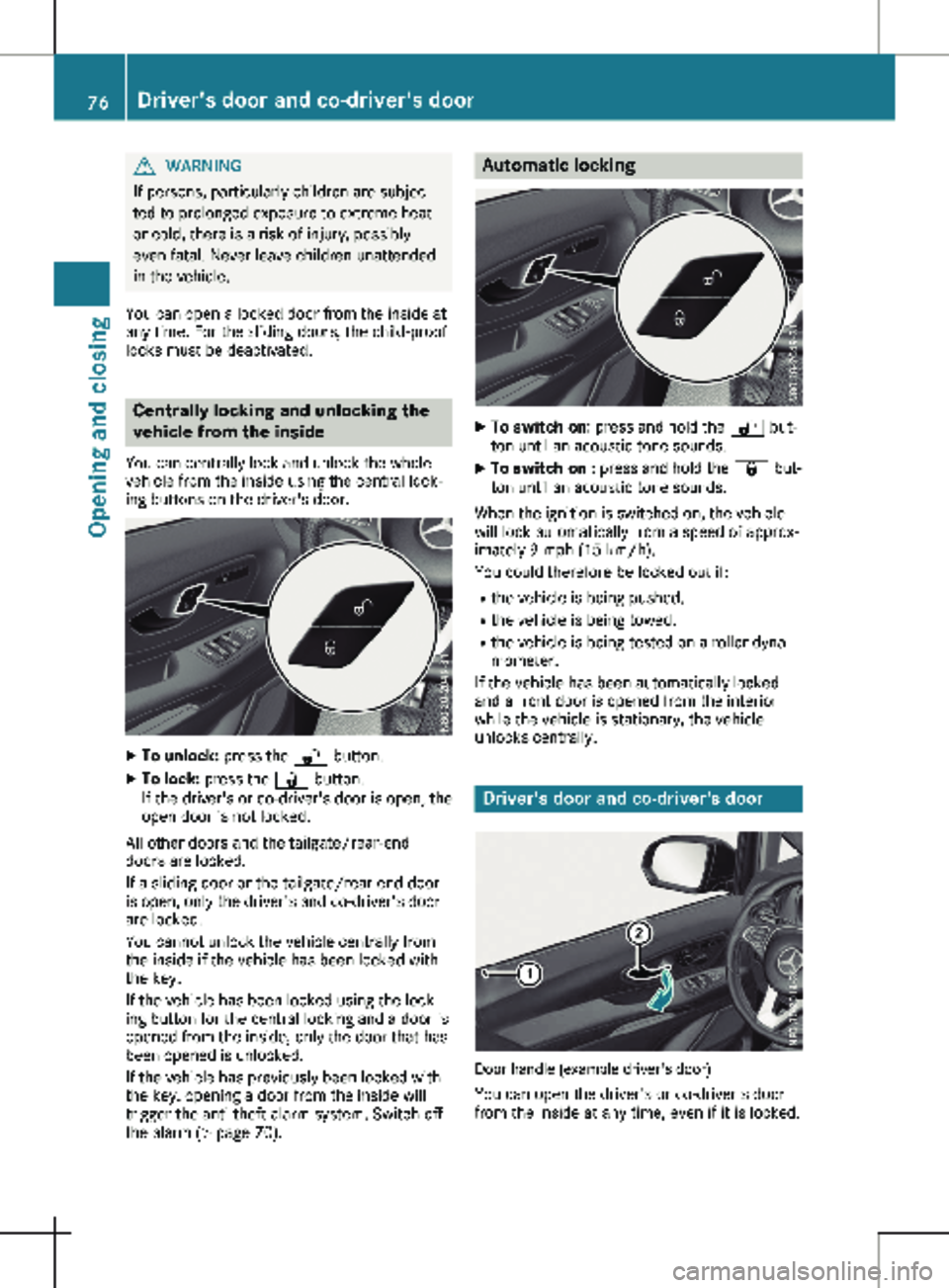
locks must be deactivated. Centrally locking and unlocking the
vehicle from the inside
You can centrally lock and unlock the whole
vehicle from the inside using the central lock-
ing buttons on the driver's door. X
To unlock: press the % button.
X To lock: press the & button.
If the driver's or co-driver's door is open, the
open door is not locked.
All other doors and the tailgate/rear-end
doors are locked.
If a sliding door or the tailgate/rear-end door
is open, only the driver's and co-driver's door
are locked.
You cannot unlock the vehicle centrally from
the inside if the vehicle has been locked with
the key.
If the vehicle has been locked using the lock-
ing button for the central locking and a door is
opened from the inside, only the door that has
been opened is unlocked.
If the vehicle has previously been locked with
the key, opening a door from the inside will
trigger the anti-theft alarm system. Switch off
the alarm
(Y page 70). Automatic locking
X
To switch on: press and hold the % but-
ton until an acoustic tone sounds.
X To switch on : press and hold the & but-
ton until an acoustic tone sounds.
When the ignition is switched on, the vehicle
will lock automatically from a speed of approx-
imately
9 mph (15 km/h).
You could therefore be locked out if:
R the vehicle is being pushed.
R the vehicle is being towed.
R the vehicle is being tested on a roller dyna-
mometer.
If the vehicle has been automatically locked
and a front door is opened from the interior
while the vehicle is stationary, the vehicle
unlocks centrally. Driver's door and co-driver's door
Door handle (example driver's door)
You can open the driver's or co-driver's door
from the inside at any time, even if it is locked. 76
Driver's door and co-driver's door
Opening and closing
Page 80 of 320
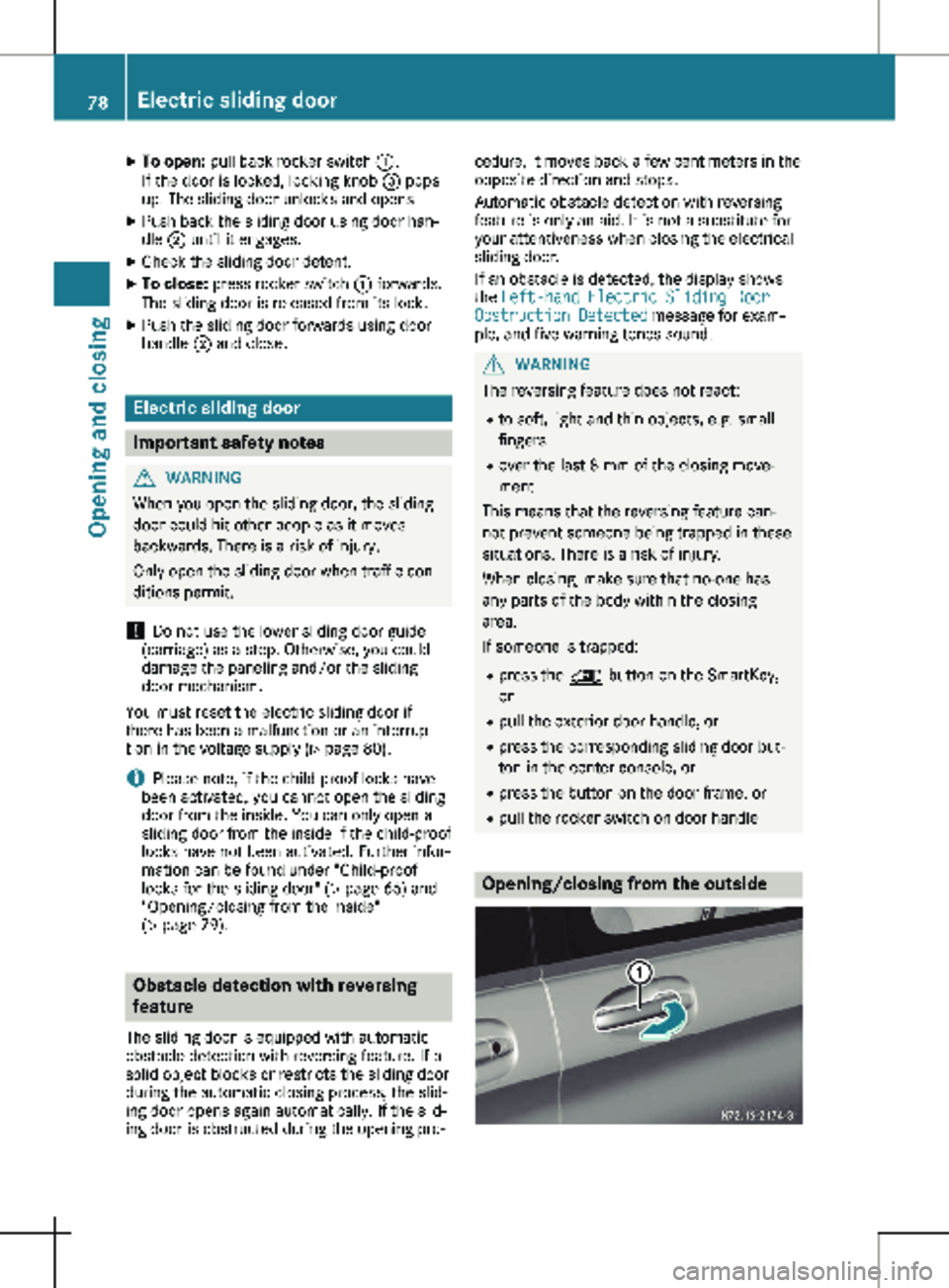
X
To open: pull back rocker switch :.
If the door is locked, locking knob = pops
up. The sliding door unlocks and opens.
X Push back the sliding door using door han-
dle ; until it engages.
X Check the sliding door detent.
X To close: press rocker switch : forwards.
The sliding door is released from its lock.
X Push the sliding door forwards using door
handle ; and close. Electric sliding door
Important safety notes
G
WARNING
When you open the sliding door, the sliding
door could hit other people as it moves
backwards. There is a risk of injury.
Only open the sliding door when traffic con-
ditions permit.
! Do not use the lower sliding door guide
(carriage) as a step. Otherwise, you could
damage the paneling and/or the sliding
door mechanism.
You must reset the electric sliding door if
there has been a malfunction or an interrup-
tion in the voltage supply
(Y page 80).
i Please note, if the child-proof locks have
been activated, you cannot open the sliding
door from the inside. You can only open a
sliding door from the inside if the child-proof
locks have not been activated. Further infor-
mation can be found under "Child-proof
locks for the sliding door" (Y page 66) and
"Opening/closing from the inside"
(Y page 79). Obstacle detection with reversing
feature
The sliding door is equipped with automatic
obstacle detection with reversing feature. If a
solid object blocks or restricts the sliding door
during the automatic closing process, the slid-
ing door opens again automatically. If the slid-
ing door is obstructed during the opening pro- cedure, it moves back a few centimeters in the
opposite direction and stops.
Automatic obstacle detection with reversing
feature is only an aid. It is not a substitute for
your attentiveness when closing the electrical
sliding door.
If an obstacle is detected, the display shows
the Left-hand Electric Sliding Door
Obstruction Detected message for exam-
ple, and five warning tones sound. G
WARNING
The reversing feature does not react:
R to soft, light and thin objects, e.g. small
fingers
R over the last 8 mm of the closing move-
ment
This means that the reversing feature can-
not prevent someone being trapped in these
situations. There is a risk of injury.
When closing, make sure that no-one has
any parts of the body within the closing
area.
If someone is trapped:
R press the 5 button on the SmartKey,
or
R pull the exterior door handle, or
R press the corresponding sliding door but-
ton in the center console, or
R press the button on the door frame, or
R pull the rocker switch on door handle Opening/closing from the outside78
Electric sliding door
Opening and closing
Page 81 of 320
The sliding door is equipped with an active
retainer, which engages the door at the end
stop when opened.
If the vehicle is equipped with two electric slid-
ing doors; the 5 button on the SmartKey
can only be used to open or close one of the
two sliding doors
(Y page 80).
X To open: pull door handle : in the direc-
tion of the arrow.
or X Press the 5 button on the SmartKey for
longer than
0.5 seconds.
The sliding door unlocks, automatic opera-
tion is started and the sliding door opens. In
addition, you will hear two warning signals.
X To close: pull door handle : in the direc-
tion of the arrow.
or X Press the 5 button on the SmartKey for
longer than
0.5 seconds.
The sliding door is released from its lock
and automatic operation is started. The slid-
ing door closes.
If you press the 5 button on the Smart-
Key, you will hear two warning signals while
the doors close.
X To interrupt automatic operation: pull
door handle : again.
or
X Press the 5 button on the SmartKey
again.
i In unfavorable operating conditions, e.g.
frost, ice or heavy soiling, you can press and
hold the relevant sliding door button. The
electric sliding door moves with increased
force. Observe that, in such circumstances,
the obstacle detection is less sensitive. To
stop the movement, release the sliding door
button. Opening/closing from the inside
If the sliding door is unlocked, you can open
and close the sliding door from the inside with
these controls:
R the Å or Æ sliding door button in the
front on the lower center console
R the sliding door button on the B-pillar next
to the door sill
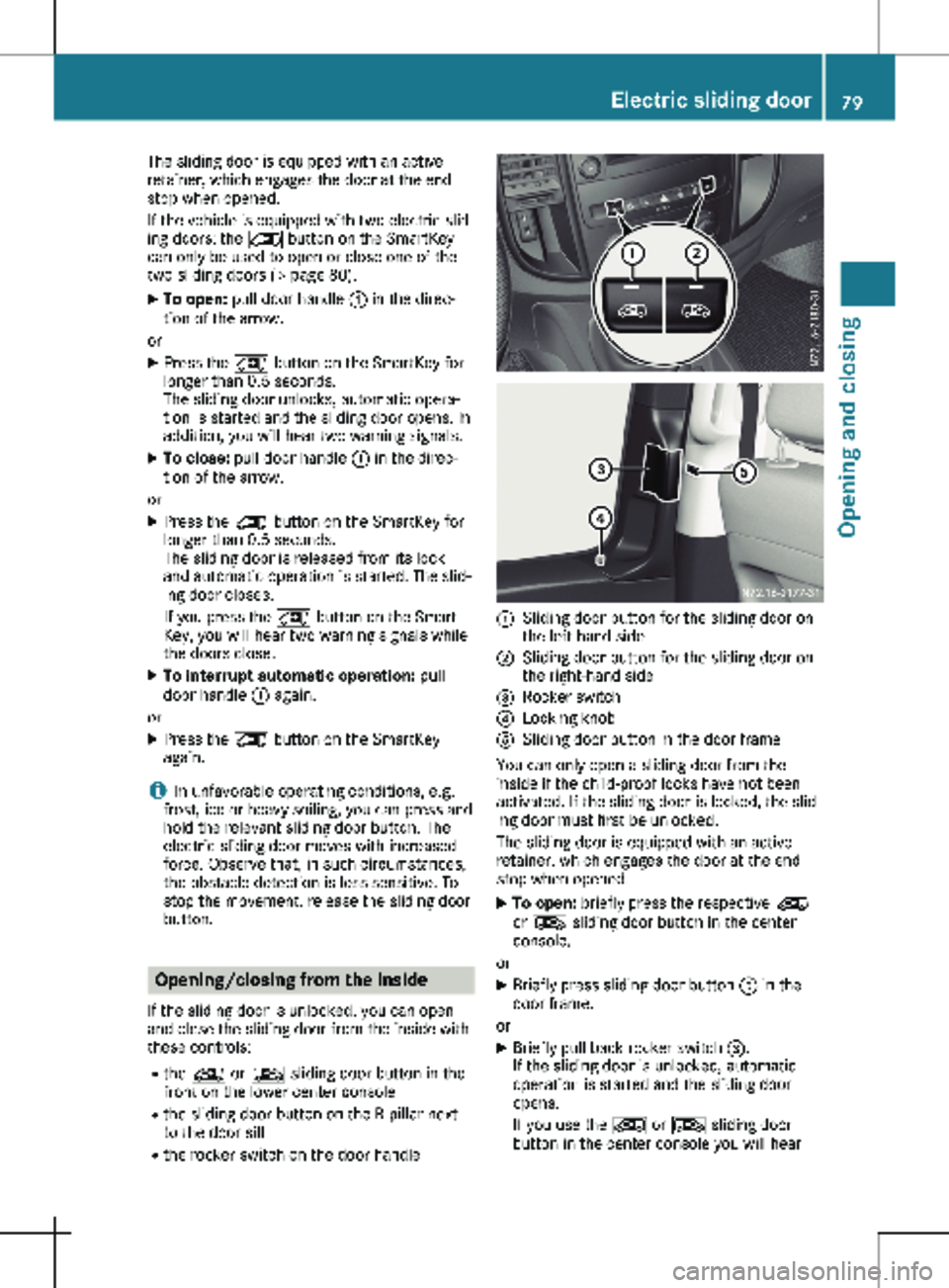
R the rocker switch on the door handle :
Sliding door button for the sliding door on
the left-hand side
; Sliding door button for the sliding door on
the right-hand side
= Rocker switch
? Locking knob
A Sliding door button in the door frame
You can only open a sliding door from the
inside if the child-proof locks have not been
activated. If the sliding door is locked, the slid-
ing door must first be unlocked.
The sliding door is equipped with an active
retainer, which engages the door at the end
stop when opened. X To open: briefly press the respective Å
or Æ sliding door button in the center
console.
or X Briefly press sliding door button A in the
door frame.
or X Briefly pull back rocker switch =.
If the sliding door is unlocked, automatic
operation is started and the sliding door
opens.
If you use the Å or Æ sliding door
button in the center console you will hear Electric sliding door
79Opening and closing Z
Page 85 of 320
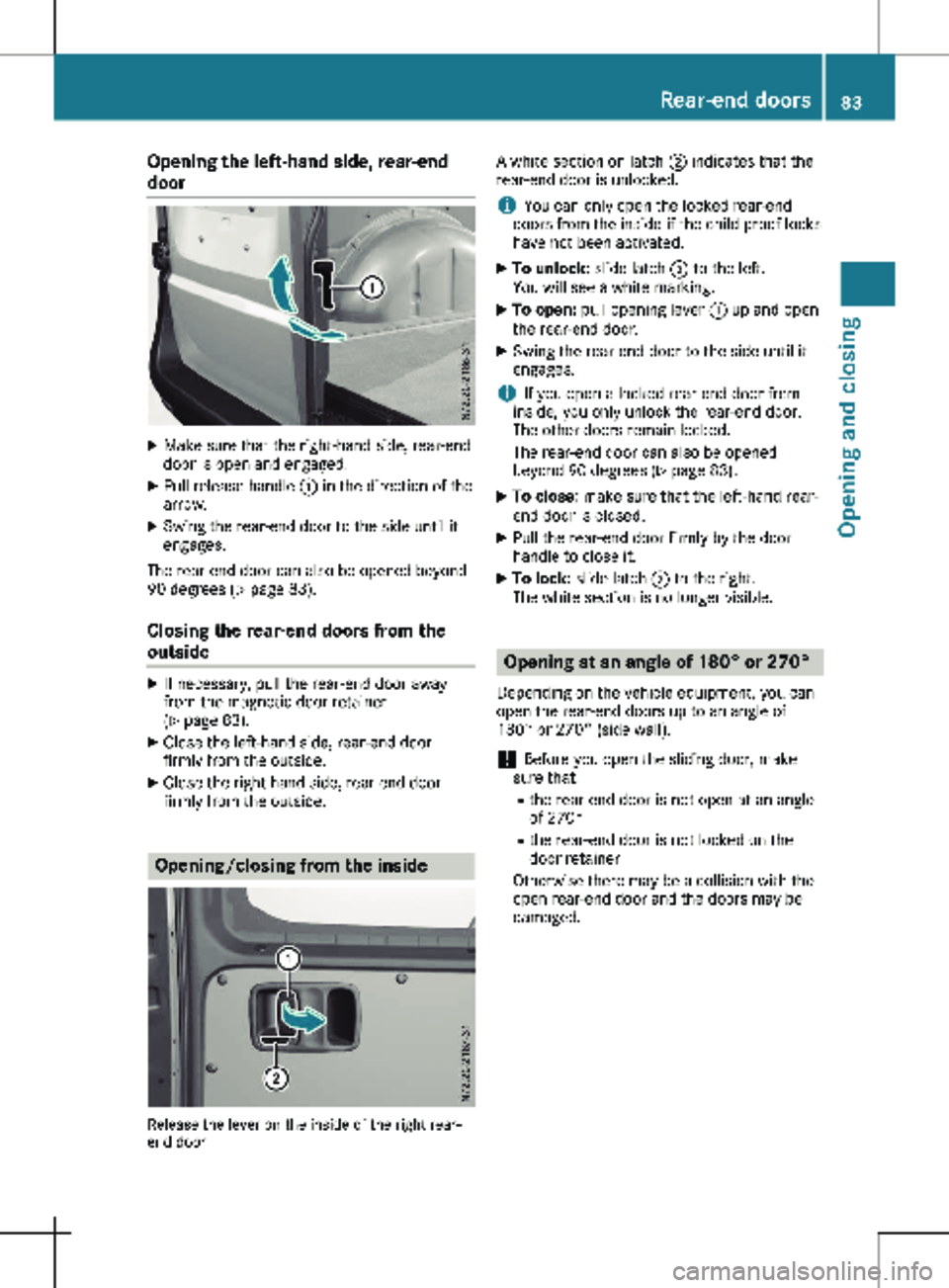
Opening the left-hand side, rear-end
door
X
Make sure that the right-hand side, rear-end
door is open and engaged.
X Pull release handle : in the direction of the
arrow.
X Swing the rear-end door to the side until it
engages.
The rear-end door can also be opened beyond
90 degrees (Y page 83).
Closing the rear-end doors from the
outside X
If necessary, pull the rear-end door away
from the magnetic door retainer
(Y page
83).
X Close the left-hand side, rear-end door
firmly from the outside.
X Close the right-hand side, rear-end door
firmly from the outside. Opening/closing from the inside
Release the lever on the inside of the right rear-
end door A white section on latch
; indicates that the
rear-end door is unlocked.
i You can only open the locked rear-end
doors from the inside if the child-proof locks
have not been activated.
X To unlock: slide latch ; to the left.
You will see a white marking.
X To open: pull opening lever : up and open
the rear-end door.
X Swing the rear-end door to the side until it
engages.
i If you open a locked rear-end door from
inside, you only unlock the rear-end door.
The other doors remain locked.
The rear-end door can also be opened
beyond 90 degrees
(Y page 83).
X To close: make sure that the left-hand rear-
end door is closed.
X Pull the rear-end door firmly by the door
handle to close it.
X To lock: slide latch ; to the right.
The white section is no longer visible. Opening at an angle of 180° or 270°
Depending on the vehicle equipment, you can
open the rear-end doors up to an angle of
180° or
270° (side wall).
! Before you open the sliding door, make
sure that:
R the rear-end door is not open at an angle
of 270°
R the rear-end door is not locked on the
door retainer
Otherwise there may be a collision with the
open rear-end door and the doors may be
damaged. Rear-end doors
83
Opening and closing Z
Page 86 of 320
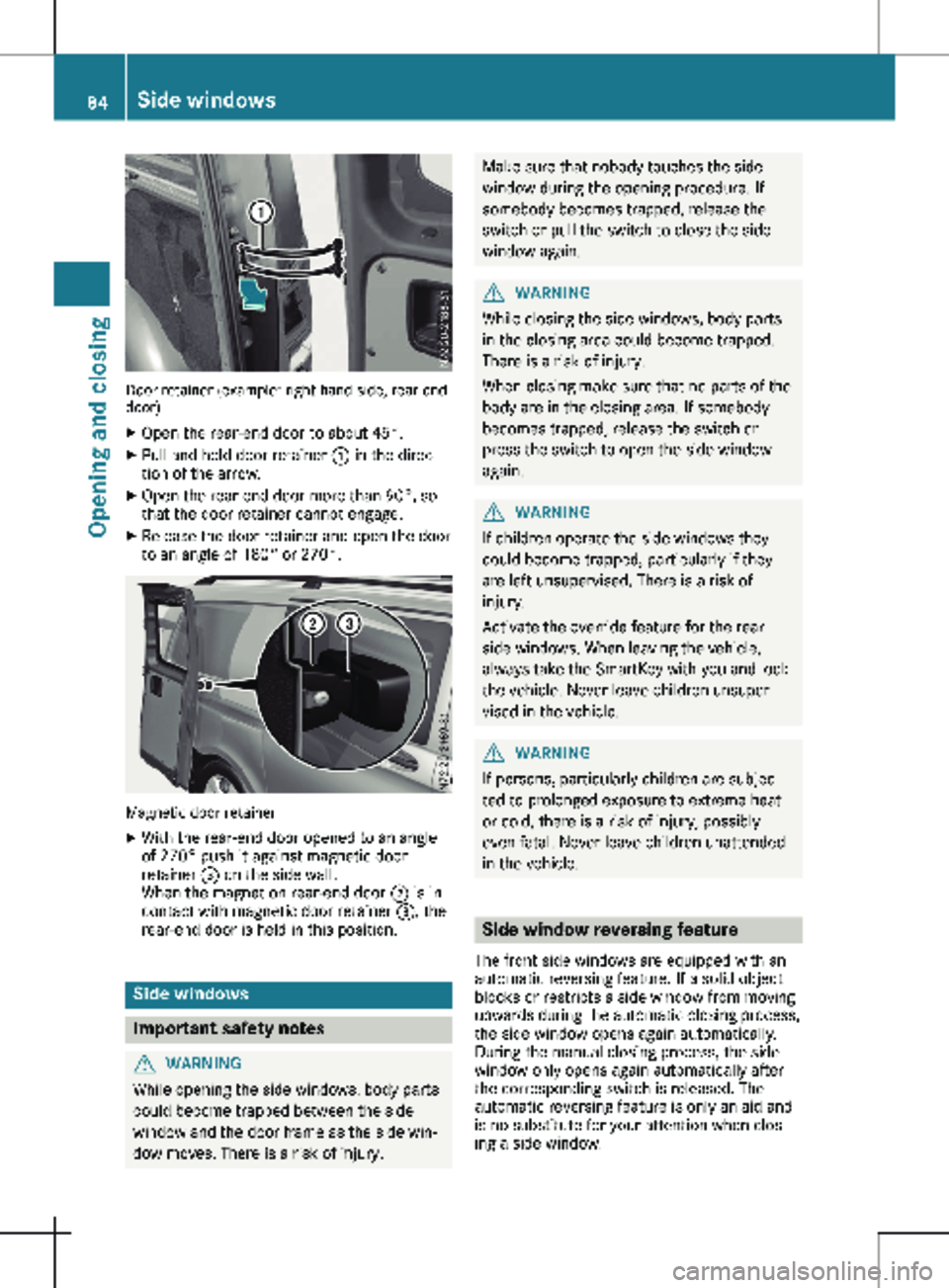
Door retainer (example: right-hand side, rear-end
door)
X Open the rear-end door to about 45°.
X Pull and hold door retainer : in the direc-
tion of the arrow.
X Open the rear-end door more than 90°, so
that the door retainer cannot engage.
X Release the door retainer and open the door
to an angle of 180° or 270°.Magnetic door retainer
X With the rear-end door opened to an angle
of
270° push it against magnetic door
retainer = on the side wall.
When the magnet on rear-end door ; is in
contact with magnetic door retainer =, the
rear-end door is held in this position. Side windows
Important safety notes
G
WARNING
While opening the side windows, body parts
could become trapped between the side
window and the door frame as the side win-
dow moves. There is a risk of injury. Make sure that nobody touches the side
window during the opening procedure. If
somebody becomes trapped, release the
switch or pull the switch to close the side
window again. G
WARNING
While closing the side windows, body parts
in the closing area could become trapped.
There is a risk of injury.
When closing make sure that no parts of the
body are in the closing area. If somebody
becomes trapped, release the switch or
press the switch to open the side window
again. G
WARNING
If children operate the side windows they
could become trapped, particularly if they
are left unsupervised. There is a risk of
injury.
Activate the override feature for the rear
side windows. When leaving the vehicle,
always take the SmartKey with you and lock
the vehicle. Never leave children unsuper-
vised in the vehicle. G
WARNING
If persons, particularly children are subjec-
ted to prolonged exposure to extreme heat
or cold, there is a risk of injury, possibly
even fatal. Never leave children unattended
in the vehicle. Side window reversing feature
The front side windows are equipped with an
automatic reversing feature. If a solid object
blocks or restricts a side window from moving
upwards during the automatic closing process,
the side window opens again automatically.
During the manual closing process, the side
window only opens again automatically after
the corresponding switch is released. The
automatic reversing feature is only an aid and
is no substitute for your attention when clos-
ing a side window. 84
Side windows
Opening and closing