wipers MERCEDES-BENZ METRIS 2020 MY20 Operator’s Manual
[x] Cancel search | Manufacturer: MERCEDES-BENZ, Model Year: 2020, Model line: METRIS, Model: MERCEDES-BENZ METRIS 2020Pages: 320, PDF Size: 26.38 MB
Page 109 of 320
X
Turn socket ; for low-beam headlamps
counter-clockwise and remove it.
X Remove the bulb from socket ;.
X Insert a new bulb into socket ;.
X Insert socket ; and tighten by turning
clockwise.
X Press on housing cover : and tighten by
turning clockwise.
X Replace the cover in the front wheel arch
(Y page
106).
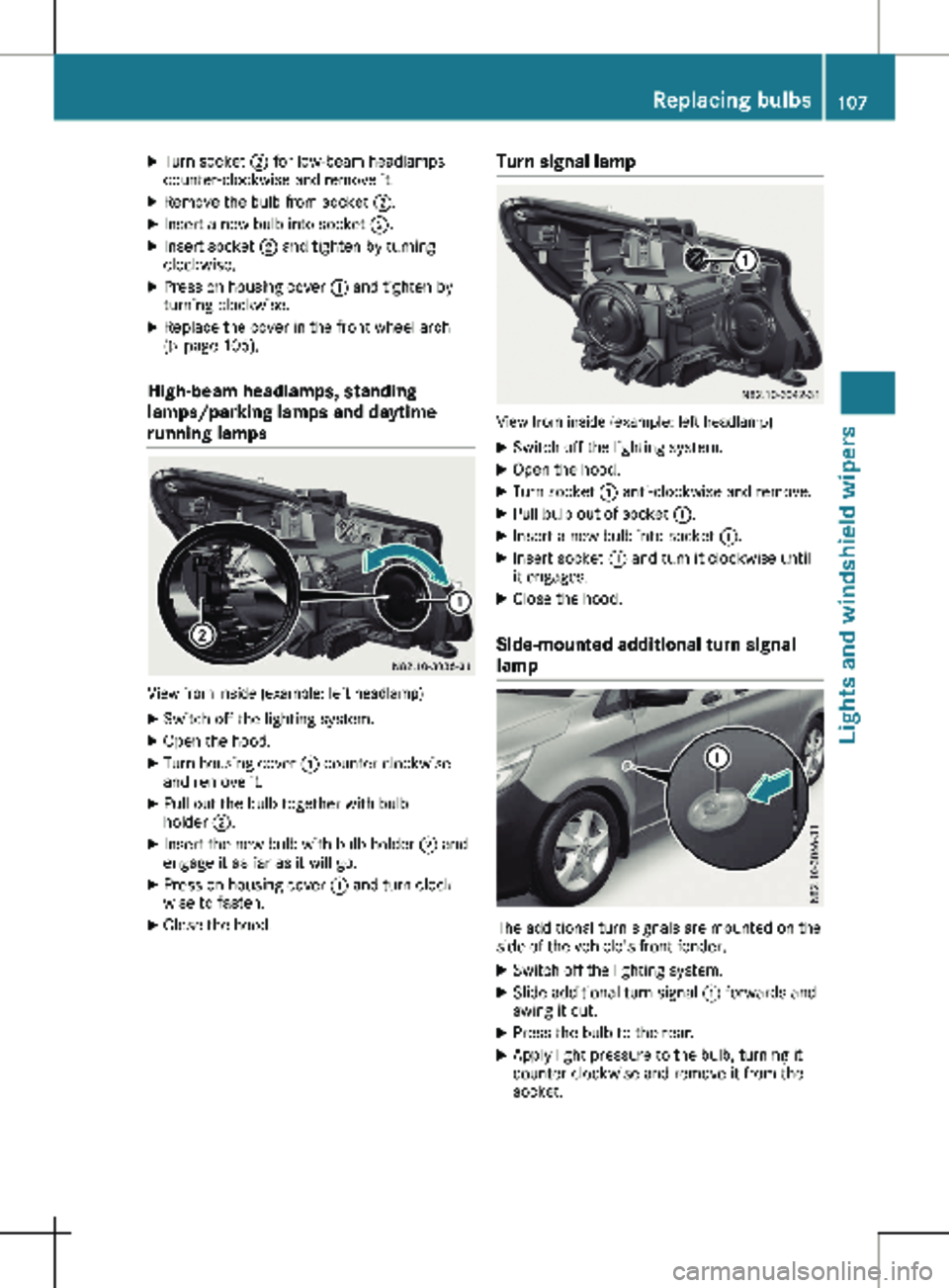
High-beam headlamps, standing
lamps/parking lamps and daytime
running lamps View from inside (example: left headlamp)
X Switch off the lighting system.
X Open the hood.
X Turn housing cover : counter-clockwise
and remove it.
X Pull out the bulb together with bulb
holder ;.
X Insert the new bulb with bulb holder ; and
engage it as far as it will go.
X Press on housing cover : and turn clock-
wise to fasten.
X Close the hood. Turn signal lamp View from inside (example: left headlamp)
X Switch off the lighting system.
X Open the hood.
X Turn socket : anti-clockwise and remove.
X Pull bulb out of socket :.
X Insert a new bulb into socket :.
X Insert socket : and turn it clockwise until
it engages.
X Close the hood.
Side-mounted additional turn signal
lamp The additional turn signals are mounted on the
side of the vehicle's front fender.
X Switch off the lighting system.
X Slide additional turn signal : forwards and
swing it out.
X Press the bulb to the rear.
X Apply light pressure to the bulb, turning it
counter-clockwise and remove it from the
socket. Replacing bulbs
107
Lights and windshield wipers Z
Page 110 of 320

X
Press the new bulb into the socket and
screw it in clockwise.
X Attach additional turn signal : at the front
and engage. Replacing the rear lamp clusters
Overview of bulb types Tail lamps
Lights Bulb type
:
High-mounted brake
lamp LED
;
License plate lamp LED
=
Rear fog lamp (driver's
side) P 21 W
?
Backup lamp P 21 W
A
Brake lamp/tail lamp/
standing lamp/turn sig-
nal P 21 W
Side marker lamp LED
Tail lamps
Installing/removing the tail lamp
! Remove the tail lamps with care so as not
to damage the paintwork.
Because of the installation position,
Mercedes-Benz recommends that you have
the tail lamp bulbs changed at a qualified
specialist workshop. Tail lamps
X To remove: switch off the lighting system.
X Open the tailgate/rear-end door.
i The vehicle tool kit contains a screwdriver
( Y page
270).
X Unscrew two side screws :.
X Press tail lamp ; out as far as bolts =.
X Remove tail lamp ; out from bolts =.
X Pull the connector off the bulb holder of the
tail lamp.
X To install: press the connector into the bulb
holder of the tail lamp.
X Press the tail lamp sideways onto bolts =
and slide onto the vehicle.
X Tighten two side screws :.
Standard tail lamp X
Remove the tail lamp ( Y page
108).
X Unscrew three screws : and remove bulb
holder ; from the tail lamp.108
Replacing bulbs
Lights and windshield wipers
Page 111 of 320

Bulb holder
=
Turn signals/brake lamps/tail lamps/
standing lamps
? Backup lamp
A Rear fog lamp (driver's side only)
X Apply light pressure to the corresponding
bulb, turn it counter-clockwise and remove
it from the bulb holder.
X Press the new bulb into the socket and
screw it in clockwise.
X Insert bulb holder ; into the tail lamp and
tighten all three screws :.
X Install the tail lamp (Y page 108).Windshield wipers
Switching the windshield wiper
on/off
! Do not operate the windshield wipers
when the windshield is dry, as this could
damage the wiper blades. Moreover, dust
that has collected on the windshield can
scratch the glass if wiping takes place when
the windshield is dry.
If it is necessary to switch on the windshield
wipers in dry weather conditions, always use
washer fluid when operating the windshield
wipers.
! If the windshield wipers leave smears on
the windshield after the vehicle has been
washed in an automatic car wash, wax or
other residues may be the reason for this.
Clean the windshield using washer fluid
after washing the vehicle in an automatic
car wash.
! Intermittent wiping with rain sensor: due
to optical influences and the windshield becoming dirty in dry weather conditions,
the windshield wipers may be activated
inadvertently. This could then damage the
windshield wiper blades or scratch the wind-
shield.
For this reason, you should always switch
off the windshield wipers in dry weather. 1
$ Windshield wipers off
2 Ä Intermittent wipe, low (rain sensor
set to low sensitivity)
3 Å Intermittent wipe, high (rain sensor
set to high sensitivity)
4 ° Continuous wipe, slow
5 ¯ Continuous wipe, fast
B î 1st pressure point – single wipe; 2nd
pressure point – wipe with washer fluid
X Turn the key to position 1 or 2 in the igni-
tion lock.
X Turn the í wiper switch to the corre-
sponding position.
In the Ä or Å
positions, the appropriate
wiping frequency is set automatically accord-
ing to the intensity of the rain. In the Å
position, the rain sensor is more sensitive to
precipitation than in the Ä position, caus-
ing the windshield wipers to wipe more fre-
quently.
The windshield will no longer be wiped prop-
erly if the wiper blades are worn. This may pre-
vent you from observing the traffic conditions.
Information on replacing the wiper blades can
be found under "Replacing wiper blades"
( Y page 110). Windshield wipers
109
Lights and windshield wipers Z
Page 112 of 320

Switching the rear window wiper
on/off
1
b To wipe with washer fluid
2 ° Intermittent wipe
3 $ Rear window wiper off
4 b To wipe with washer fluid
X Turn the key to position 1 or 2 in the igni-
tion lock.
X Move the è switch to the corresponding
position.
If the rear window wiper is activated, the
è symbol is shown in the status area of
the display.
The Status Overview in the Assist.
menu then also shows the è symbol for
vehicles with steering wheel buttons
(Y page
189).
X To wipe with washer fluid: press the è
switch beyond the current position as far as
it will go to 1 or press and hold 4.
When you release the è switch, the rear
window wiper continues to wipe for about
another five seconds. The rear window
wiper then wipes according to the original
position 2 or 3.
The rear window wiper switches on automati-
cally if you engage reverse gear and the wind-
shield wipers are on.
If the vehicle is stationary and you open the
tailgate or rear-end door, the rear window
wiper will stop automatically. The rear window
wiper will only resume wiping again when the
tailgate and rear-end door are closed and you
pull away again.
The rear window will no longer be wiped prop-
erly if the wiper blade is worn. This may pre-
vent you from observing the traffic conditions.
Information on replacing the wiper blade can be found under "Replacing wiper blades"
(
Y page
110). Replacing the wiper blades
Important safety notes G
WARNING
If the windshield wipers begin to move while
you are changing the wiper blades, you
could be trapped by the wiper arm. There is
a risk of injury.
Always switch off the windshield wipers and
ignition before changing the wiper blades.
! Never open the hood/tailgate or rear
doors if a windshield wiper arm has been
folded away from the windshield/rear win-
dow.
Never fold a windshield wiper arm without a
wiper blade back onto the windshield/rear
window.
Hold the windshield wiper arm firmly when
you change the wiper blade. If you release
the windshield wiper arm without a wiper
blade and it falls onto the windshield/rear
window, the windshield/rear window may
be damaged by the force of the impact.
Mercedes-Benz recommends that you have
the wiper blades changed at a qualified spe-
cialist workshop.
! Only hold the wiper blade by the wiper
arm. You could otherwise damage the wiper
rubber.
Wiper blades are wear parts. The windshield
will no longer be wiped properly if the wiper
blades are worn. This may prevent you from
observing the traffic conditions.
Please observe the service indicator after
changing the wiper blades of the windshield
wiper.
Service indicator Replacement wiper blades for the windshield
wiper have a service indicator on the tip of the
wiper blade.
Depending on the amount of use, the service
indicator will change color from black to yel-
low.110
Windshield wipers
Lights and windshield wipers
Page 113 of 320
Change the wiper blade if:
R the wiper blade is damaged
R the service indicator has turned yellow
In order to activate the service indicator, you
have to remove the protective film
( Y page
111).
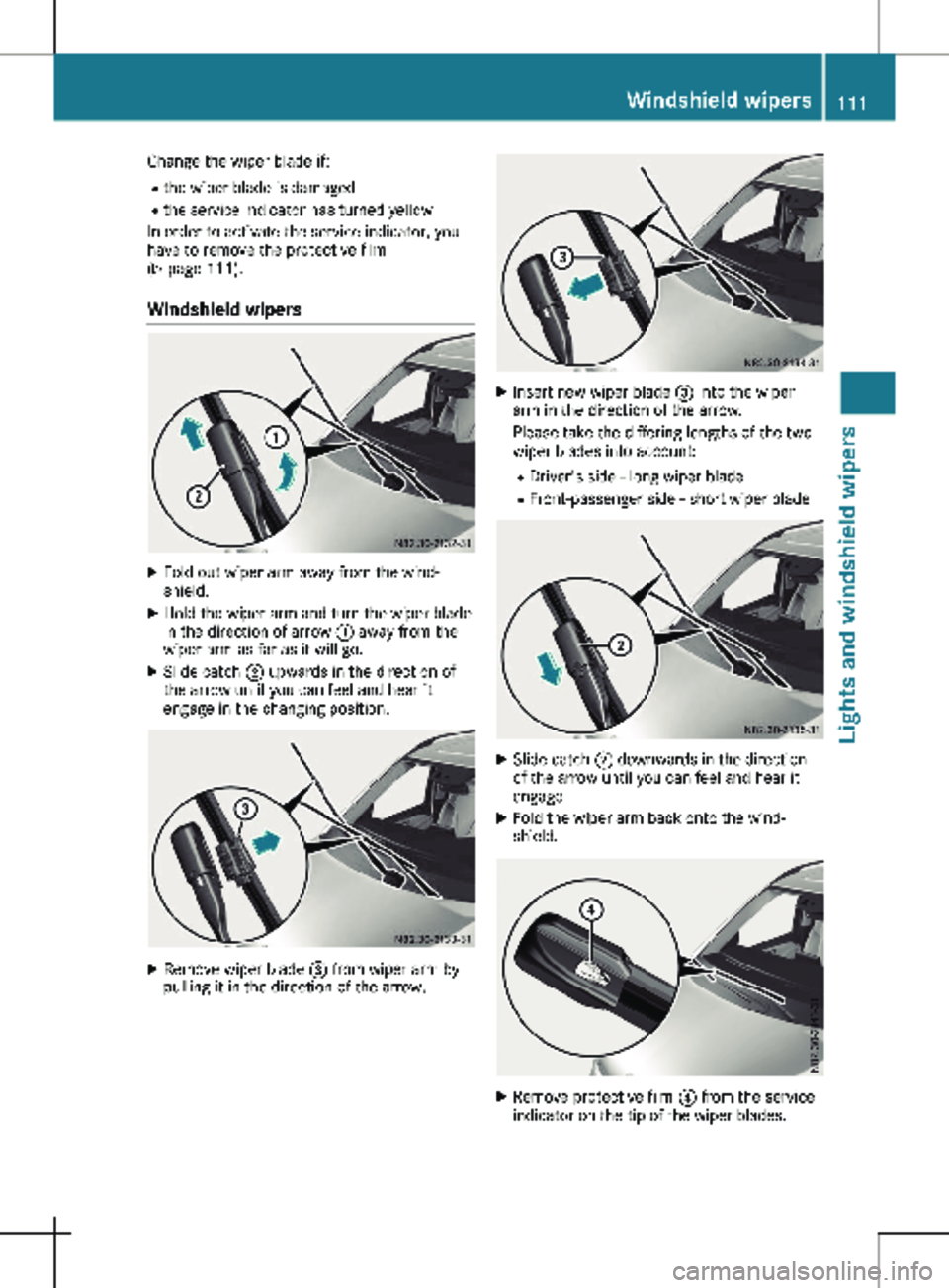
Windshield wipers X
Fold out wiper arm away from the wind-
shield.
X Hold the wiper arm and turn the wiper blade
in the direction of arrow : away from the
wiper arm as far as it will go.
X Slide catch ; upwards in the direction of
the arrow until you can feel and hear it
engage in the changing position. X
Remove wiper blade = from wiper arm by
pulling it in the direction of the arrow. X
Insert new wiper blade = into the wiper
arm in the direction of the arrow.
Please take the differing lengths of the two
wiper blades into account:
R Driver's side - long wiper blade
R Front-passenger side - short wiper blade X
Slide catch ; downwards in the direction
of the arrow until you can feel and hear it
engage.
X Fold the wiper arm back onto the wind-
shield. X
Remove protective film ? from the service
indicator on the tip of the wiper blades. Windshield wipers
111
Lights and windshield wipers Z
Page 114 of 320
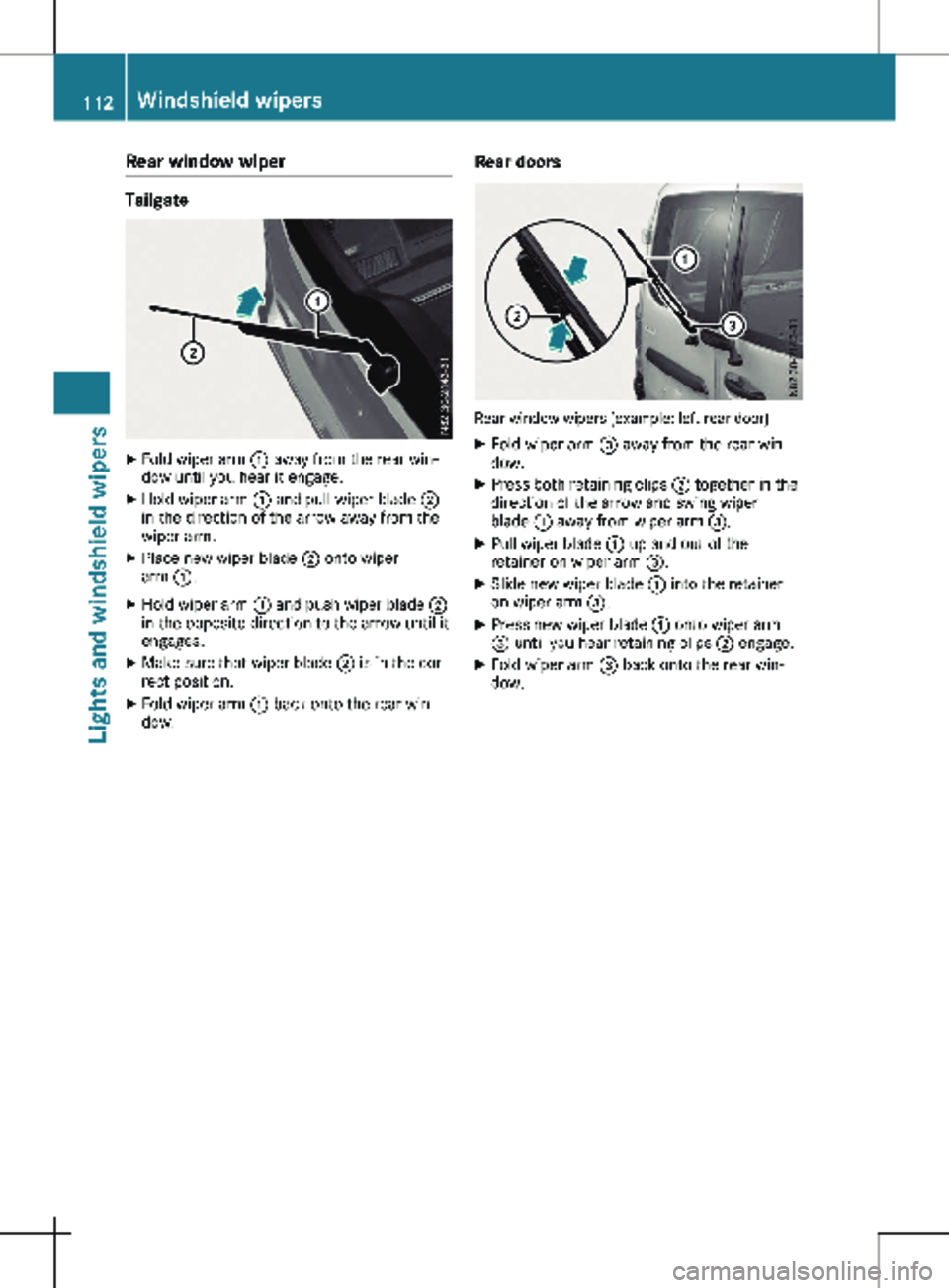
Rear window wiper
Tailgate
X
Fold wiper arm : away from the rear win-
dow until you hear it engage.
X Hold wiper arm : and pull wiper blade ;
in the direction of the arrow away from the
wiper arm.
X Place new wiper blade ; onto wiper
arm :.
X Hold wiper arm : and push wiper blade ;
in the opposite direction to the arrow until it
engages.
X Make sure that wiper blade ; is in the cor-
rect position.
X Fold wiper arm : back onto the rear win-
dow. Rear doors Rear window wipers (example: left rear door)
X Fold wiper arm = away from the rear win-
dow.
X Press both retaining clips ; together in the
direction of the arrow and swing wiper
blade : away from wiper arm =.
X Pull wiper blade : up and out of the
retainer on wiper arm =.
X Slide new wiper blade : into the retainer
on wiper arm =.
X Press new wiper blade : onto wiper arm
= until you hear retaining clips ; engage.
X Fold wiper arm = back onto the rear win-
dow. 112
Windshield wipersLights and windshield wipers
Page 115 of 320
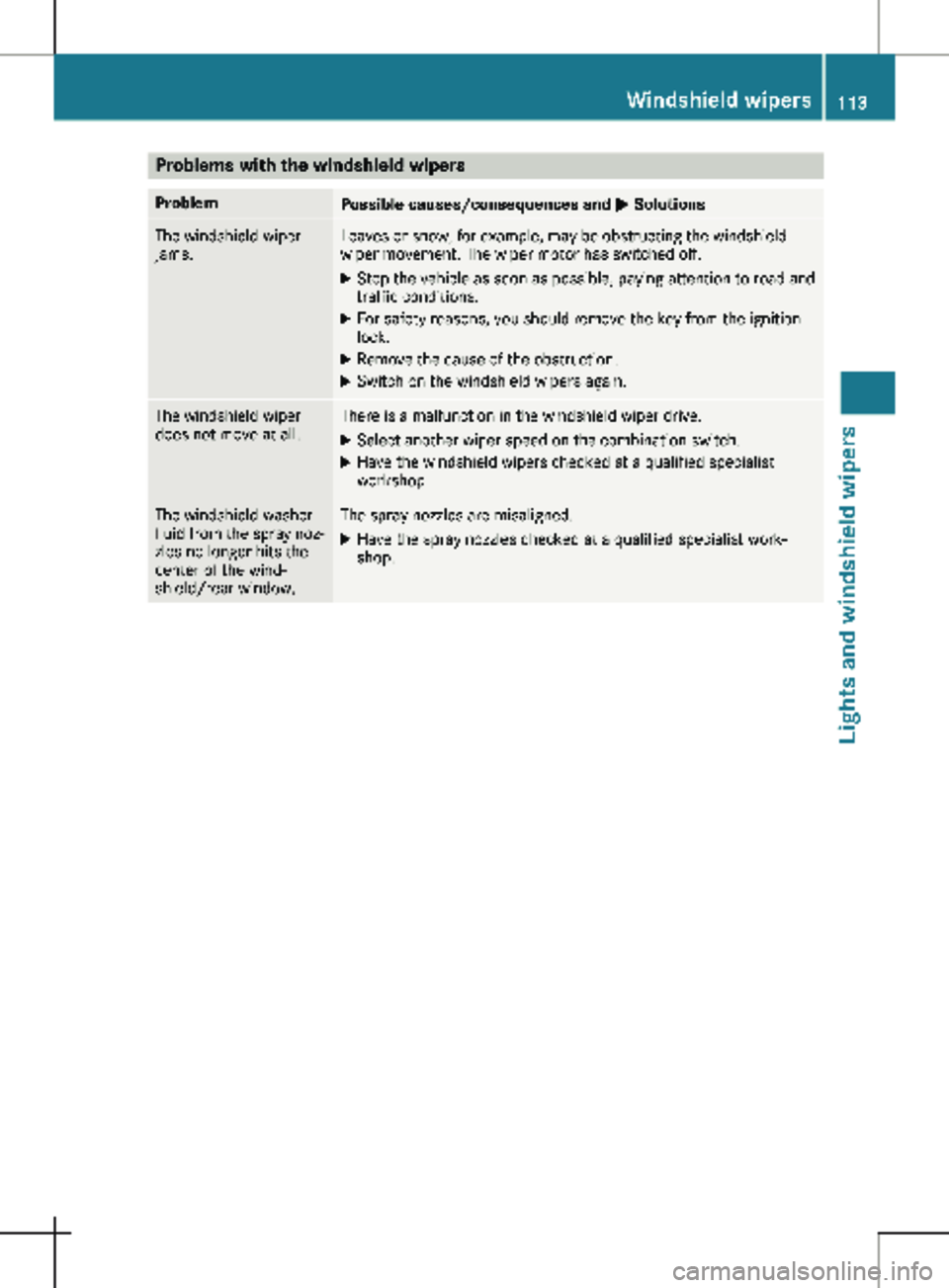
Problems with the windshield wipers
Problem
Possible causes/consequences and
M SolutionsThe windshield wiper
jams. Leaves or snow, for example, may be obstructing the windshield
wiper movement. The wiper motor has switched off.
X Stop the vehicle as soon as possible, paying attention to road and
traffic conditions.
X For safety reasons, you should remove the key from the ignition
lock.
X Remove the cause of the obstruction.
X Switch on the windshield wipers again. The windshield wiper
does not move at all. There is a malfunction in the windshield wiper drive.
X Select another wiper speed on the combination switch.
X Have the windshield wipers checked at a qualified specialist
workshop. The windshield washer
fluid from the spray noz-
zles no longer hits the
center of the wind-
shield/rear window. The spray nozzles are misaligned.
X Have the spray nozzles checked at a qualified specialist work-
shop. Windshield wipers
113Lights and windshield wipers Z
Page 124 of 320
When you deactivate the windshield defrosting
function, the previous automatic climate con-
trol settings are reactivated with the exception
of air-recirculation mode. Air-recirculation
mode remains deactivated. Clearing condensation from the win-
dows
Windows fogged up on the inside Air-conditioning system
You should only select this setting until the
windows are clear again.
X Switch on the rear window defroster if nec-
essary
(Y page 122).
X Switch on climate control (Y page
117).
X Switch off air-recirculation mode
(Y page
123).
X Turn temperature control : clockwise to a
higher temperature and air flow control A
to a blower speed between 3 and 6
( Y page
115).
X If possible, only select the ¯ setting of
the air distribution
(Y page 120).
Only the indicator lamp in the ¯ button
lights up.
X Switch on the cooling with air dehumidifica-
tion function
(Y page 118).
X If the windows still fog up, set the climate
control functions as described for defrosting
of the windshield
(Y page 121).
Dual-zone automatic climate control You should only select this setting until the
windows are clear again.
X Switch on the rear window defroster if nec-
essary
(Y page 122).
X Switch on climate control (Y page
117).
X Switch off air-recirculation mode
(Y page
123).
X Switch on the cooling with air dehumidifica-
tion function
(Y page 118).
X Switch on automatic mode ( Y page
119).
X If the windows continue to fog up, switch on
the windshield defrosting function
( Y page
121). Windows fogged up on the outside You should only select this setting until the
windshield is clear again.
X Switch on the windshield wipers
(Y page
109).
X Switch on climate control (Y page
117).
X In warm and damp weather, do not allow
cold air to flow onto the windows. Close the
side air vents if required
(Y page 124). Switching the rear window defroster
on/off
General notes The rear window defroster consumes a lot of
power. You should therefore switch off the
rear window defroster as soon as the rear win-
dow is clear.
X Turn the key to position 2 in the ignition
lock.
X Press the ¤ button on the control panel.
If the indicator lamp in the ¤ button
lights up, the rear window defroster is
switched on.
The rear window defroster switches off auto-
matically after a few minutes.
Problems with the rear window
defroster The rear window defroster has switched off
prematurely or cannot be activated.
The vehicle starter battery is not sufficiently
charged.
X Switch off any consumers that are not
required, e.g. reading lamps, interior lighting
or seat heating.
When the battery is sufficiently charged, the
rear window defroster can be activated
again.122
Operating the climate control system
Climate control
Page 253 of 320
Opening the hood
G
WARNING
Opening the hood when the engine is over-
heated or when there is a fire in the engine
compartment could expose you to hot gases
or other service products. There is a risk of
injury.
Let an overheated engine cool down before
opening the hood. If there is a fire in the
engine compartment, keep the hood closed
and contact the fire department. G
WARNING
Certain components in the engine compart-
ment, such as the engine, radiator and parts
of the exhaust system, can become very
hot. Working in the engine compartment
poses a risk of injury.
Where possible, let the engine cool down
and touch only the components described in
the following.
! Make sure that the windshield wipers are
not folded away from the windshield. You
could otherwise damage the windshield wip-
ers or the hood. Observe the safety notes when you open the
hood.
X Stop your vehicle as far away from traffic as
possible on level ground.
X Switch off the engine.
X Secure the vehicle to prevent it from rolling
away
(Y page 138).
X Pull release handle : on the hood.
The hood is released. X
Reach into the gap and push lever ; on the
hood catch to the left.
X Raise the hood and hold it in that position. X
Pull support strut ? out of retainer = and
guide it up in the direction of the arrow.
X Lower the hood in such a way that support
strut ? glides into recess A and the hood
engages.
Closing the hood G
WARNING
Cloths or other flammable materials left in
the engine compartment can ignite if they
come into contact with the exhaust system
or parts of the engine that heat up. There is
a risk of fire. After carrying out maintenance
work, make sure that no extraneous flam-
mable material is left in the engine compart-
ment or on the exhaust system.
! Do not use your hands to push the hood
down. You could damage it otherwise. Engine compartment
251
Maintenance and care Z
Page 267 of 320
X
Thoroughly hose down the vehicle with a
gentle jet of water.
X Do not point the water jet directly towards
the air inlet grilles.
X Use plenty of water and rinse out the
sponge frequently.
X Rinse the vehicle with clean water and dry
thoroughly with a chamois.
X Do not let the cleaning agents dry on the
paintwork.
When using the vehicle in winter, remove all
traces of road salt deposits carefully and as
soon as possible.
Power washers G
WARNING
The water jet from a circular jet nozzle (dirt
blasters) can cause invisible exterior dam-
age to the tires or chassis components.
Components damaged in this way may fail
unexpectedly. There is a risk of an accident.
Do not use power washers with circular jet
nozzles to clean the vehicle. Have damaged
tires or chassis components replaced imme-
diately.
! Under no circumstances use power wash-
ers in the vehicle interior. The pressurized
water and associated spray produced by the
power washer could cause extensive dam-
age to the vehicle.
! When using high-pressure cleaning equip-
ment, maintain a minimum distance of
approx. 1 ft (30 cm
) between the spray noz-
zle and the vehicle parts. Do not use a
power washer with a round-jet nozzle. You
could damage the vehicle or engine parts.
! Keep the water jet moving constantly
while cleaning. This will avoid causing dam-
age to the vehicle.
Do not point the water jet at:
R door joints
R rear view camera
R air bellows
R brake hoses
R wheel balance weights
R electrical components
R electrical connections R
seals
R drive train, especially not at the inter-
mediate bearing of the propeller shaft
Cleaning the engine !
Water must not enter intake or ventilation
openings. When cleaning with high pressure
water or steam cleaners, the spray must not
be aimed directly at electrical components
or the terminals of electrical lines.
Preserve the engine after the engine has
been cleaned. Protect the belt drive system
from exposure to the preservative agent.
Also observe the information under "Power
washers"
(Y page 265).
Cleaning the paintwork !
Do not affix:
R stickers
R films
R magnetic plates or similar items
to painted surfaces. You could otherwise
damage the paintwork.
Scratches, corrosive deposits, areas affected
by corrosion and damage caused by inade-
quate care cannot always be completely
repaired. In such cases, visit a qualified spe-
cialist workshop.
X Remove impurities immediately, where pos-
sible, whilst avoiding rubbing too hard.
X Soak insect remains with insect remover
and rinse off the treated areas afterwards.
X Soak bird droppings with water and rinse off
the treated areas afterwards.
X Remove coolant, brake fluid, tree resin, oils,
fuels and greases by rubbing gently with a
cloth soaked in petroleum ether or lighter
fluid.
X Use tar remover to remove tar stains.
X Use silicone remover to remove wax.
Cleaning the windows G
WARNING
You could become trapped by the wind-
shield wipers if they start moving while
cleaning the windshield or wiper blades.
There is a risk of injury. Care
265
Maintenance and care
Z