heating MERCEDES-BENZ METRIS 2020 MY20 Operator’s Manual
[x] Cancel search | Manufacturer: MERCEDES-BENZ, Model Year: 2020, Model line: METRIS, Model: MERCEDES-BENZ METRIS 2020Pages: 320, PDF Size: 26.38 MB
Page 266 of 320
!
Do not use the lower sliding door guide
(carriage) as a step. Otherwise, you could
damage the paneling and/or the sliding
door mechanism.
! When cleaning your car, do not use:
R dry, coarse or hard cloths
R abrasive cleaning agents
R solvents
R cleaning agents containing solvents
Do not scrub.
Do not touch the surfaces and films with
hard objects, e.g. rings or ice scrapers. Oth-
erwise, you may scratch or damage the sur-
faces and films.
! Do not park your vehicle for a long period
of time directly after cleaning, particularly
after cleaning the wheel rim with wheel
cleaner. Wheel cleaner can lead to the
increased corrosion of the brake discs and
pads. Therefore, drive for a few minutes
after cleaning. By heating up the brakes, the
brake discs and pads dry. The vehicle can
then be parked for a long period of time. H
Environmental note
Only clean your vehicle at specially designed
wash bays. Dispose of empty containers and
used cleaning products in an environmen-
tally responsible manner. H
Environmental note
Dispose of empty packaging and cleaning
cloths in an environmentally responsible
manner.
Regular care of your vehicle is a condition for
retaining the quality in the long term.
Use care products and cleaning agents recom-
mended and approved by Mercedes-Benz. Washing the vehicle and cleaning
the paintwork
Automatic car wash G
WARNING
Braking efficiency is reduced after washing
the vehicle. There is a risk of an accident. After the vehicle has been washed, brake
carefully while paying attention to the traffic
conditions until full braking power is
restored.
! Make sure that the automatic car wash is
suitable for the size of the vehicle.
Before washing the vehicle in an automatic
car wash, fold in the exterior mirrors and
remove any additional antennas. Otherwise,
the exterior mirror, antenna or the vehicle
itself could be damaged.
Make sure that the exterior mirrors are fully
folded out again and that any additional
antennas are re-installed when you leave the
automatic car wash.
! Make sure that:
R the side windows and roof are completely
closed
R the climate control blower is switched off
R the windshield wiper switch is in position
0
The vehicle may otherwise be damaged.
You can wash the vehicle in an automatic car
wash from the very start.
Wash off excess dirt before cleaning the vehi-
cle in an automatic car wash.
After putting the vehicle through an automatic
car wash, wipe off wax from:
R the windshield
R the windshield wiper blades
This will prevent smears and reduce wiping
noises caused by residue on the windshield.
R on vehicles with rear-end doors, from the
rear view camera lens in the top of the
license plate molding
(Y page 267)
Washing by hand In some countries, washing by hand is only
allowed at specially equipped washing bays.
Observe the legal requirements of the country
you are currently in when washing by hand.
X Do not use hot water and do not wash the
vehicle in direct sunlight.
X Use a soft car sponge.
X Use a mild cleaning agent, e.g. a Mercedes-
Benz approved car shampoo.264
Care
Maintenance and care
Page 268 of 320
Always switch off the windshield wipers and
the ignition before cleaning the windshield
or wiper blades.
! Do not fold the windshield wipers away
from the windshield unless the hood is
closed. Otherwise, you could damage the
hood.
! Hold the wiper arm securely when folding
back. The windshield could be damaged if
the wiper arm smacks against it suddenly.
! Do not use dry cloths, abrasive products,
solvents or cleaning agents containing sol-
vents to clean the inside of the windows. Do
not touch the insides of the windows with
hard objects, e.g. an ice scraper or ring.
There is otherwise a risk of damaging the
windows.
! Clean the water drainage channels of the
windshield and the rear window at regular
intervals. Deposits such as leaves, petals
and pollen may under certain circumstances
prevent water from draining away. This can
lead to corrosion damage and damage to
electronic components.
X Clean the inside and outside of the windows
with a damp cloth and a cleaning agent that
is recommended and approved by
Mercedes-Benz. Exterior
Cleaning the wheels !
Do not use any acidic or alkaline cleaning
agents. They can cause corrosion on the
wheel bolts or the retainer springs for the
wheel-balancing weights.
! Do not park your vehicle for a long period
of time directly after cleaning, particularly
after cleaning the wheel rim with wheel
cleaner. Wheel cleaner can lead to the
increased corrosion of the brake discs and
pads. Therefore, drive for a few minutes
after cleaning. By heating up the brakes, the
brake discs and pads dry. The vehicle can
then be parked for a long period of time.
If you clean the wheels with a power washer,
observe the safety notes for the power washer (Y page 265). You could otherwise damage
the tires.
Cleaning the wiper blades G
WARNING
You could become trapped by the wind-
shield wipers if they start moving while
cleaning the windshield or wiper blades.
There is a risk of injury.
Always switch off the windshield wipers and
the ignition before cleaning the windshield
or wiper blades.
! Do not fold the windshield wipers away
from the windshield unless the hood is
closed. Otherwise, you could damage the
hood.
! Do not pull the wiper blade. Otherwise, the
wiper blade could be damaged.
! Do not clean wiper blades too often and
do not rub them too hard. Otherwise, the
graphite coating could be damaged. This
could cause wiper noise.
! Hold the wiper arm securely when folding
back. The windshield could be damaged if
the wiper arm smacks against it suddenly.
X Turn the SmartKey to position 0 in the igni-
tion lock or remove the SmartKey.
X Fold the windshield wiper arms away from
the windshield until you feel them engage.
X Carefully clean the wiper blades with a
damp cloth.
X Fold back the wiper arms before switching
on the ignition.
Cleaning the exterior lighting !
Only use cleaning agents or cleaning
cloths that are suitable for plastic lenses.
Caustic, irritant or otherwise unsuitable
cleaning agents or cleaning cloths could
scratch or damage the exterior lighting plas-
tic lenses.
i Inquire about suitable cleaning agents or
cleaning cloths at a specialist workshop.
X Clean the plastic lenses of the exterior light-
ing with a damp sponge and a mild cleaning266
Care
Maintenance and care
Page 271 of 320
Cleaning the steering wheel and selec-
tor lever
X
Thoroughly wipe with a damp cloth.
X Vehicles with leather upholstery: after
cleaning, use leather care agents that have
been recommended and approved by
Mercedes-Benz.
Cleaning the trim elements !
Do not use solvent-based cleaning agents
such as tar remover, wheel cleaners, pol-
ishes or waxes. There is otherwise a risk of
damaging the surface.
X Wipe the trim elements with a damp, lint-
free cloth, e.g. a microfiber cloth.
X Heavy soiling: use care products and
cleaning agents recommended and
approved by Mercedes-Benz.
Cleaning the seat covers !
Do not use microfiber cloths to clean gen-
uine leather or artificial leather covers. If
used often, a microfiber cloth can damage
the cover.
! Clean:
R artificial leather covers with a cloth mois-
tened with a solution containing 1% deter-
gent, e.g. dish washing liquid.
R cloth covers with a microfiber cloth mois-
tened with a solution containing 1% deter-
gent, e.g. dish washing liquid. Wipe entire
seat sections carefully to avoid leaving
visible lines. Leave the seat to dry after-
wards. Cleaning results depend on the
type of dirt and how long it has been
there.
R genuine leather covers carefully with a
damp cloth, then wipe the covers down
with a dry cloth. Make sure that the
leather does not become soaked. Other-
wise, the leather could become rough or
cracked. Only use leather care agents
that have been tested and approved by
Mercedes-Benz. You can obtain these
from a qualified specialist workshop.
i Please keep in mind that:
R leather covers are a natural product and,
as such, are subject to a natural aging process. Leather may react differently,
e.g. increased wrinkling, to certain envi-
ronmental influences (such as high
humidity or intense heat).
R regular care is essential to make sure that
the appearance and comfort of the covers
are retained over time.
To clean genuine leather covers: X Remove any dust, crumbs etc. If necessary,
carefully vacuum-clean the seat covers.
X Carefully wipe the leather seat covers with a
damp cloth.
X Wipe over again with a dry cloth.
Make sure that the leather does not become
soaked, especially perforated parts.
X Then treat the leather seats with a leather
care foam.
Only use leather care agents that have been
tested and approved by Mercedes-Benz.
Observe the manufacturer's instructions.
Cleaning the seat belts G
WARNING
Seat belts can become severely weakened if
bleached or dyed. This could cause the seat
belts to tear or fail, for instance, in the event
of an accident. This poses an increased risk
of injury or fatal injury.
Never bleach or dye the seat belts.
! Do not clean the seat belts using chemical
cleaning agents. Do not dry the seat belts
by heating at temperatures above
176 ‡
(80 †) or in direct sunlight.
Remove any stains or dirt immediately. This
will avoid residue or damage. X Use clean, lukewarm water and soap solu-
tion.
Cleaning the headliner and carpets X
Headliner: if it is very dirty, use a soft brush
or dry shampoo.
X Carpets: use the carpet and textile cleaning
agents recommended and approved by
Mercedes-Benz. Care
269
Maintenance and care Z
Page 308 of 320
inscription on the containers: MB-Freigabe or
MB-Approval (e.g. MB-Freigabe or MB-
Approval 228.5).
You can obtain further information at a quali-
fied specialist workshop.
Additives for approved operating fluids are nei-
ther required nor permitted. Approved fuel
additives are the exception. Additives can
cause engine damage and must therefore not
be added to the operating fluids.
The use of additives is always the responsibil-
ity of the vehicle operator. The use of additives
may result in the restriction or loss of your
Limited Warranty entitlements. Fuel
Important safety notes G
WARNING
Fuel is highly flammable. Improper handling
of fuel creates a risk of fire and explosion.
Avoid fire, open flames, smoking and creat-
ing sparks under all circumstances. Switch
off the engine and, if applicable, the auxiliary
heating before refueling. G
WARNING
Fuels are toxic and harmful to health. There
is a risk of injury.
You must avoid fuels coming into contact
with skin, eyes and clothes or being swal-
lowed.
Do not inhale the fuel vapors. Keep children
away from fuels.
Keep doors and windows closed during the
refueling process.
If you or others come into contact with fuel,
observe the following points:
R Immediately rinse the fuel off your skin
with soap and water.
R If you get fuel into your eyes, immediately
rinse your eyes throughly with clean
water. Seek medical attention immedi-
ately. R
Seek medical attention immediately if fuel
has been swallowed. Do not induce vomit-
ing.
R Immediately change out of clothing which
has come into contact with fuel.
When handling, storing and disposing of fuels,
please observe the relevant regulations.
Tank contents Depending on equipment, the total capacity of
the fuel tank may vary.
Total capacity
18.5 US gal (70.0 l)
of which reserve
fuel
Approx. 3.2 US gal
(12.0 l ) Gasoline
Fuel grade
Observe the notes on service products.
! Damage due to wrong fuel
Even small amounts of the wrong fuel may
cause damage to the fuel system, engine
and emission control system.
R Only refuel low-sulfur unleaded fuel with
at least
91 AKI/95 RON.
This fuel may contain up to 10% ethanol by
volume. Your vehicle is E10 compatible.
Never refuel with one of the following fuels:
R Diesel
R Gasoline with more than 10% ethanol by
volume, e.g. E15, E20, E85, E100
R Gasoline with more than 3% methanol by
volume, e.g. M15, M30, M50, M85, M100
R Gasoline with additives containing metal
Do not mix fuels such as these with gaso-
line. Gasoline must only be mixed with
cleaning additives recommended by
Mercedes-Benz.
If the wrong fuel was accidentally used for
refueling:
R Do not switch on the ignition.
R Consult a qualified specialist workshop.
Information on fuel additives (Y page 307). If the available fuel is not sufficiently low in
sulfur, this can produce unpleasant odors. 306
Service products and capacities
Technical data
Page 309 of 320
!
Filter the fuel before transferring it to the
vehicle if you are refueling the vehicle from
barrels or containers.
This will prevent malfunctions in the fuel
system due to contaminated fuel.
i E10 fuel contains an admixture of up to
10% bioethanol. Your vehicle is E10 compat-
ible. You can refuel your vehicle with E10
fuel.
i You can obtain information on fuel grades
at a qualified specialist workshop or at a gas
station. If there is no identification on the
filling pump, consult a gas station attendant.
For more information about refueling
(Y page
136).
Fuel additives
! Operating the engine with subsequently
added fuel additives can cause engine dam-
age. Do not mix fuel additives with fuel. This
does not include additives for the removal
and prevention of deposits. Gasoline can
only be mixed with additives recommended
by Mercedes-Benz. Follow the instructions
in the product description. You can find fur-
ther information on recommended additives
in any Mercedes-Benz Commercial Van Cen-
ter.
Mercedes-Benz recommends using brand-
name fuels with additives.
If you use fuels without these additives for a
long period of time, deposits can form. This
primarily forms on the inlet valve and in the
combustion chamber.
In some countries, the available fuel grade
may be inadequate. Residue could build up in
the fuel injection system as a result. In this
case, in consultation with a Mercedes-Benz
Commercial Van Center, the fuel should be
mixed with the cleaning additive recommen-
ded by Mercedes-Benz. You must observe the
notes and mixing ratios indicated on the con-
tainer.
Do not add other fuel additives to the fuel.
This results in unnecessary costs and can
damage the engine. Information on fuel consumption H
Environmental note
CO 2 (carbon dioxide) is the gas that accord-
ing to the current state of knowledge is
mainly responsible for the heating of the
earth's atmosphere (greenhouse effect). The
CO 2 emissions of your vehicle vary in direct
correspondence with the fuel consumption
and is therefore dependent on:
R the efficient utilization of the fuel by the
engine
R the respective style of driving
R other non-technical factors, such as envi-
ronmental influences, condition of the
road or traffic flow, for example
You can help to minimize CO 2 emissions
with a conservative driving style and regular
maintenance of your vehicle .
Only for certain countries: the respective cur-
rent consumption and emission values of your
vehicle can be found in the COC papers (EC
CERTIFICATE OF CONFORMITY). These docu-
ments are supplied when the vehicle is deliv-
ered.
Consumption figures were found in the cur-
rently valid respective version: R for vehicles with exhaust gas standard Euro
6 as per directive (EC) no. 715/2007
R for vehicles with exhaust gas standard
EURO VI as per directive (EC) no. 595/2009
Fuel consumption depends on:
R the vehicle version
R the style of driving
R the operating conditions
R the fuel type and fuel grade used
The vehicle will use more fuel than usual in the
following situations:
R at very low outside temperatures
R in city traffic
R during short journeys
R on mountainous terrain
R when towing a trailer
Observe the advice in the "Protection of the
environment" section to keep fuel consump-
tion low
(Y page 29). Service products and capacities
307
Technical data Z
Page 310 of 320
The following components of the different
vehicle versions influence fuel consumption:
R tire sizes, tire tread, tire pressure, tire condi-
tion
R transmission ratios for the drive assemblies
R additional equipment (e.g. air-conditioning
system, auxiliary heating system)
For these reasons, the actual consumption fig-
ures for your vehicle may deviate from the
consumption figures determined according to
EU Directive
80/1268/EEC.
Details on fuel consumption can be called up
in the on-board computer:
R on vehicles without steering wheel buttons
(Y page 177)
R on vehicles with steering wheel buttons
(Y page 184) Engine oil
General notes When handling engine oil, observe the impor-
tant safety notes on operating fluids
(Y page
305).
The quality of the engine oil used is of decisive
importance for the engine's functionality and
operating life. Mercedes-Benz continually
approves engine oils based on complex experi-
ments according to the current state of the
art.
Therefore, only Mercedes-Benz approved
engine oils may be used in Mercedes-Benz
engines. Mercedes-Benz recommends having
the oil changed at a qualified specialist work-
shop. Information about engine oils approved by
Mercedes-Benz can be obtained:
R from any Mercedes-Benz Commercial Van
Center
R on the Internet at
http://bevo.mercedes-benz.com
by enter-
ing the designation, e.g. 229.5.
Mercedes-Benz approval is indicated on the oil
container by the inscription „MB-Freigabe“ or
„MB Approval“ and the corresponding designa-
tion, e.g. MB-Freigabe or MB Approval 229.5.
Designations of the approved engine oils for
your vehicle MB-Freigabe or MB
Approval
229.5,
229.62 Mercedes-Benz recommends that you only use
approved multigrade engine oils of the SAE
classes
SAE 0W-30 and SAE 0W-40 or
SAE 5W-30 and SAE 5W-40. These engine oils
ensure optimum lubrication even at very low
outside temperatures (Y page 309).
To achieve the lowest possible fuel consump-
tion, it is recommended to use the engine oil
specifications marked in the table for the low-
est SAE viscosity class. Observe possible
restrictions of the released SAE classifications.
When refilling, we recommend that you only
use engine oil of the same grade (MB-Freigabe
or MB Approvaldesignation) and SAE class as
the oil filled at the last oil change.
i If the engine oils listed in the table are not
available, you may add the following engine
oils until the next oil change:
R MB-Freigabe or MB Approval 229.1, or
ACEA A3
This must only be added once and the
amount must not be greater than 1 qt
(1.0 l).
Subsequently have the engine oil changed
at the earliest possible opportunity.
! Using engine oils of another grade quality
is not permitted.
2 Recommended for the lowest possible fuel consumption (lowest viscosity class in each case taking into
account possible restrictions of the approved SAE classifications). 308
Service products and capacities
Technical data
Page 314 of 320
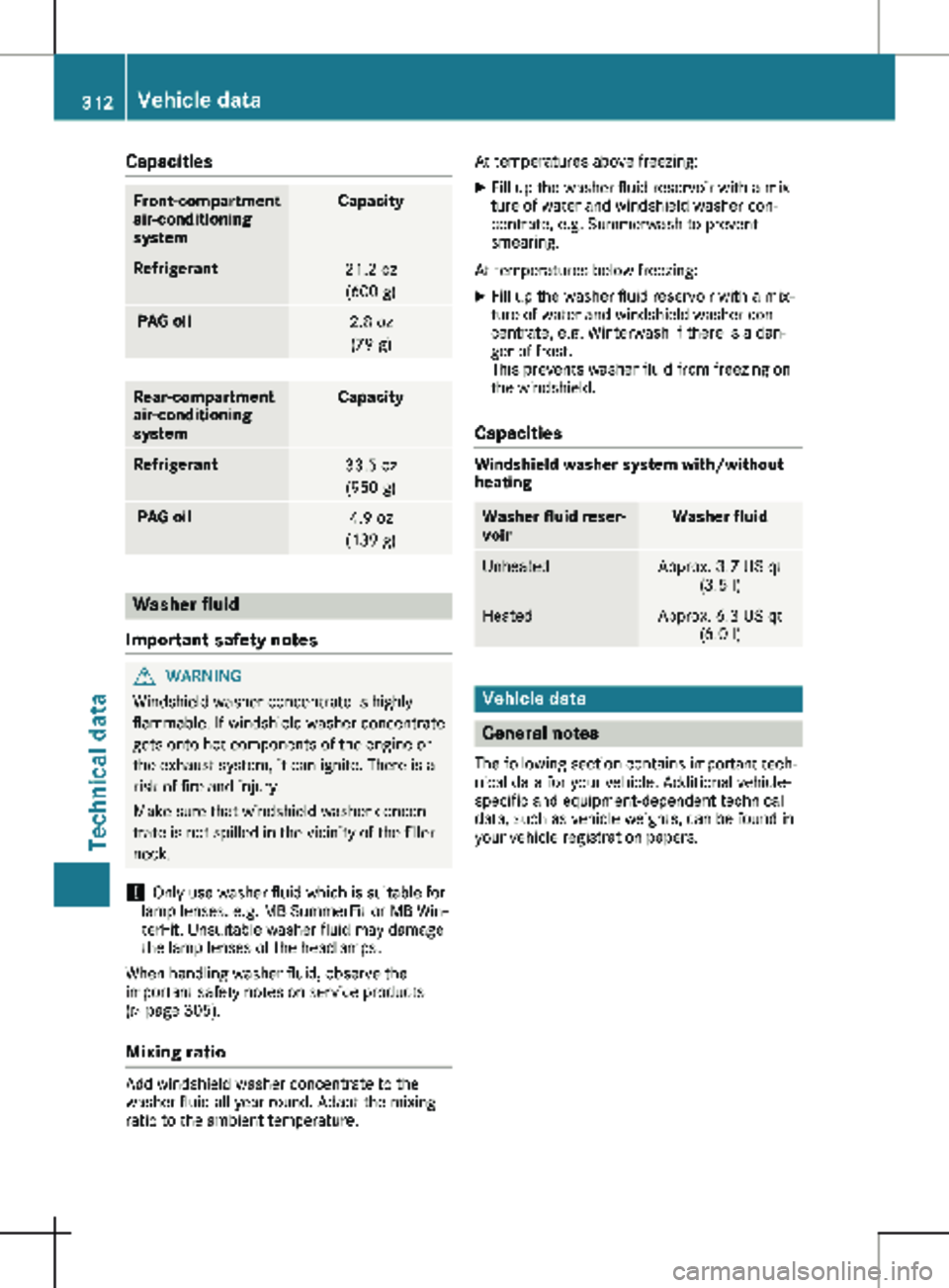
Capacities
Front-compartment
air-conditioning
system Capacity
Refrigerant
21.2 oz
(600 g) PAG oil
2.8 oz
( 79 g) Rear-compartment
air-conditioning
system Capacity
Refrigerant
33.5 oz
(950 g) PAG oil
4.9 oz
(139 g) Washer fluid
Important safety notes G
WARNING
Windshield washer concentrate is highly
flammable. If windshield washer concentrate
gets onto hot components of the engine or
the exhaust system, it can ignite. There is a
risk of fire and injury.
Make sure that windshield washer concen-
trate is not spilled in the vicinity of the filler
neck.
! Only use washer fluid which is suitable for
lamp lenses, e.g. MB SummerFit or MB Win-
terFit. Unsuitable washer fluid may damage
the lamp lenses of the headlamps.
When handling washer fluid, observe the
important safety notes on service products
(Y page
305).
Mixing ratio Add windshield washer concentrate to the
washer fluid all year round. Adapt the mixing
ratio to the ambient temperature. At temperatures above freezing:
X Fill up the washer fluid reservoir with a mix-
ture of water and windshield washer con-
centrate, e.g. Summerwash to prevent
smearing.
At temperatures below freezing:
X Fill up the washer fluid reservoir with a mix-
ture of water and windshield washer con-
centrate, e.g. Winterwash if there is a dan-
ger of frost.
This prevents washer fluid from freezing on
the windshield.
Capacities Windshield washer system with/without
heating
Washer fluid reser-
voir Washer fluid
Unheated Approx. 3.7 US qt
(3.5 l) Heated Approx. 6.3 US qt
(6.0 l) Vehicle data
General notes
The following section contains important tech-
nical data for your vehicle. Additional vehicle-
specific and equipment-dependent technical
data, such as vehicle weights, can be found in
your vehicle registration papers. 312
Vehicle data
Technical data