roof MERCEDES-BENZ METRIS 2020 MY20 Operator’s Manual
[x] Cancel search | Manufacturer: MERCEDES-BENZ, Model Year: 2020, Model line: METRIS, Model: MERCEDES-BENZ METRIS 2020Pages: 320, PDF Size: 26.38 MB
Page 251 of 320
Installing
X Clip the load protection net into upper
retainers : in such a way that tensioning
straps = face the rear of the vehicle.
X Pull tensioning straps = of the load protec-
tion net tightly.
X Clip hook ? on tensioning straps = into
cargo tie-down rings A.
X Fold tensioning element ; up.
X Pull the loose ends of tensioning straps =
down in the direction of the arrow until ten-
sioning straps = are tight.
X Fold tensioning element ; down to achieve
the final tension on the straps.
X After traveling a short distance, check that
the load protection net is taut.
X Retighten, if necessary.
Removing X Fold tensioning element ; up.
Tensioning straps = are slack.
X Unclip hook ? of tensioning straps = from
cargo tie-down rings A at the bottom.
X Unclip the load protection net from upper
retainers :.
X Roll up the load protection net and fasten it,
still rolled up, using the Velcro fasteners.
Adjusting the front seat with the load pro-
tection net installed
X Fold tensioning element ; on straps =
upwards.
The load protection net slackens.
X Correctly adjust the front seat.
X Re-tension the load protection net. Carrier systems
G
WARNING
When you load the roof, the center of gravity
of the vehicle rises and the usual driving
characteristics, as well as steering and brak-
ing, change. The vehicle tilts more severely
when cornering and may react more slug-
gishly to steering input.
If you exceed the maximum roof load, the
driving characteristics, as well as the steer- ing and braking, will be greatly impaired.
There is a risk of an accident.
Adjust your driving style and never exceed
the maximum roof load.
You will find information about the maximum
roof load under "Cargo tie-down points and
carrier systems"
(Y page 313).
! Make sure that:
R the screws of the roof carrier are tight-
ened to a maximum torque of 7.4 lb-ft
(10 Nm) in the threaded holes provided
and
R there is a minimum bolt penetration of
4 turns.
Only install roof carriers and rear racks that
have been approved or recommended for
Mercedes-Benz vehicles. This will help avoid
damage to the vehicle.
You can install a roof carrier on the roof and,
for example, a rear-mounted cycle rack on the
tailgate.
Install the protective caps on the securing
threads after you have removed the roof car-
rier.
If you have installed a rear rack on the tailgate,
the additional weight reduces the assistance
provided by the gas pressure springs when the
tailgate is opened. You will then need more
force to open the tailgate. At low outside tem-
peratures below freezing you will need to pro-
vide extra support for the tailgate to prevent it
from sinking unintentionally. Carrier systems
249
Transporting loads Z
Page 261 of 320
Always make sure that neither you nor the bat-
tery are electro statically charged.
An electrostatic charge can build up in the fol-
lowing situations:
R wearing synthetic clothing
R friction between clothing and the seat
R dragging or pushing the battery across car-
pet flooring or any other synthetic materials
R by rubbing the battery with a cloth or towels
Comply with the following safety precautions
and take protective measures when handling
batteries. Risk of explosion. Explosive oxyhy-
drogen is produced when batteries
are being charged. Only charge
batteries in well-ventilated areas.
Fire, open flames and smoking are
therefore prohibited when working
on the battery. Avoid creating
sparks.
Battery acid is caustic. Avoid con-
tact with the skin, eyes or clothing.
Wear acid-proof protective gloves.
If skin or clothes are splashed with
acid, neutralize the splashes imme-
diately with soapy water or an acid
neutralizer, and then clean the
affected areas with water. Consult
a doctor if necessary.
Wear eye protection. When mixing
water and acid, the liquid can
splash into your eyes. Rinse acid
splashes to the eyes immediately
with clean water and contact a
doctor immediately.
Keep children at a safe distance.
Children are not able to assess the
dangers posed by batteries and
acid.
When handling batteries, observe
the safety precautions and special
protective measures contained in
this Operator's Manual.
H
Environmental note Batteries contain pollutants.
It is illegal to dispose of
them with the household
rubbish. They must be col-
lected separately and dis-
posed of in an environmen- tally responsible recycling
system. Dispose of batteries in an
environmentally responsible
manner. Take discharged
batteries to a qualified spe-
cialist workshop or to a col-
lection point for used bat-
teries.
Observe the following notes: R have the batteries recharged more fre-
quently in the following situations:
- if you predominantly drive short distan-
ces.
- if you predominantly drive at low outside
temperatures.
- if you leave the vehicle parked for a
lengthy period.
In order for the batteries to achieve their
maximum possible service life, they must
always be sufficiently charged.
R Consult an authorized Mercedes-Benz Com-
mercial Van Center if you wish to leave your
vehicle parked for a long period of time.
R When you park the vehicle, remove the key
if you do not require any electrical consum-
ers. The vehicle will then use very little
energy, thus conserving battery power.
R If your vehicle requires jump-starting, or if
you wish to provide jump-starting assistance
to another vehicle, only use the jump-start-
ing connection point in the engine compart-
ment
(Y page 272).
R Have the battery removed at a qualified spe-
cialist workshop. Installation locations
Your vehicle may be equipped with the follow-
ing three batteries, depending on the equip-
ment level:
R Starter battery in the seat base of the right-
hand front seat
R Auxiliary battery in the seat base of the
right-hand front seat
R Additional battery in the seat base of the
left-hand front seat Battery
259
Maintenance and care Z
Page 266 of 320
!
Do not use the lower sliding door guide
(carriage) as a step. Otherwise, you could
damage the paneling and/or the sliding
door mechanism.
! When cleaning your car, do not use:
R dry, coarse or hard cloths
R abrasive cleaning agents
R solvents
R cleaning agents containing solvents
Do not scrub.
Do not touch the surfaces and films with
hard objects, e.g. rings or ice scrapers. Oth-
erwise, you may scratch or damage the sur-
faces and films.
! Do not park your vehicle for a long period
of time directly after cleaning, particularly
after cleaning the wheel rim with wheel
cleaner. Wheel cleaner can lead to the
increased corrosion of the brake discs and
pads. Therefore, drive for a few minutes
after cleaning. By heating up the brakes, the
brake discs and pads dry. The vehicle can
then be parked for a long period of time. H
Environmental note
Only clean your vehicle at specially designed
wash bays. Dispose of empty containers and
used cleaning products in an environmen-
tally responsible manner. H
Environmental note
Dispose of empty packaging and cleaning
cloths in an environmentally responsible
manner.
Regular care of your vehicle is a condition for
retaining the quality in the long term.
Use care products and cleaning agents recom-
mended and approved by Mercedes-Benz. Washing the vehicle and cleaning
the paintwork
Automatic car wash G
WARNING
Braking efficiency is reduced after washing
the vehicle. There is a risk of an accident. After the vehicle has been washed, brake
carefully while paying attention to the traffic
conditions until full braking power is
restored.
! Make sure that the automatic car wash is
suitable for the size of the vehicle.
Before washing the vehicle in an automatic
car wash, fold in the exterior mirrors and
remove any additional antennas. Otherwise,
the exterior mirror, antenna or the vehicle
itself could be damaged.
Make sure that the exterior mirrors are fully
folded out again and that any additional
antennas are re-installed when you leave the
automatic car wash.
! Make sure that:
R the side windows and roof are completely
closed
R the climate control blower is switched off
R the windshield wiper switch is in position
0
The vehicle may otherwise be damaged.
You can wash the vehicle in an automatic car
wash from the very start.
Wash off excess dirt before cleaning the vehi-
cle in an automatic car wash.
After putting the vehicle through an automatic
car wash, wipe off wax from:
R the windshield
R the windshield wiper blades
This will prevent smears and reduce wiping
noises caused by residue on the windshield.
R on vehicles with rear-end doors, from the
rear view camera lens in the top of the
license plate molding
(Y page 267)
Washing by hand In some countries, washing by hand is only
allowed at specially equipped washing bays.
Observe the legal requirements of the country
you are currently in when washing by hand.
X Do not use hot water and do not wash the
vehicle in direct sunlight.
X Use a soft car sponge.
X Use a mild cleaning agent, e.g. a Mercedes-
Benz approved car shampoo.264
Care
Maintenance and care
Page 299 of 320
Tire tread
The part of the tire that comes into contact
with the road.
Tire bead
The tire bead ensures that the tire sits
securely on the wheel. There are several steel
wires in the bead to prevent the tire from com-
ing loose from the wheel rim.
SidewallThe part of the tire between the tread and the
tire bead.
Weight of optional extras The combined weight of those optional extras
that weigh more than the replaced standard
parts and more than 2.3 kg
(5 lbs). These
optional extras, such as high-performance
brakes, a roof rack or a high-performance bat-
tery, are not included in the curb weight and
the weight of the accessories.
TIN (Tire Identification Number) A unique identification number which can be
used by a tire manufacturer to identify tires,
for example for a product recall, and thus iden-
tify the purchasers. The TIN is composed of
the manufacturer identification code, tire size,
tire model code and manufacturing date.
Load bearing index
The load bearing index (also load index) is a
code that contains the maximum load bearing
capacity of a tire.
Traction
Traction is the result of friction between the
tires and the road surface.
TWR (permissible trailer drawbar load)
The TWR is the maximum permissible weight
that may act on the ball coupling of the trailer
tow hitch.
Wear indicator Narrow bars (tread wear bars) that are distrib-
uted over the tire tread. If the tire tread is level
with the bars, the wear limit of á in (1.6 mm)
has been reached. Distribution of the vehicle occupants
The distribution of vehicle occupants over des-
ignated seat positions in a vehicle.
Maximum permissible payload weightNominal load and goods/luggage load plus
68 kg (150 lbs) multiplied by the number of
seats in the vehicle. Changing wheels
Rotating the wheels
! On vehicles equipped with a tire pressure
monitor, electronic components are located
in the wheel.
Tire-mounting tools should not be used near
the valve. This could damage the electronic
components.
Only have tires changed at a qualified spe-
cialist workshop.
Always observe the instructions and safety
notes under "Mounting a wheel"
(Y page
298).
The wear patterns on the front and rear tires
differ, depending on the operating conditions.
Rotate the wheels before a clear wear pattern
has formed on the tires. Front tires typically
wear more on the shoulders and the rear tires
in the center.
If your vehicle's tire configuration allows, you
can rotate the tires according to the intervals
in the tire manufacturer's warranty book in
your vehicle documents. If no warranty book is
available, the tires should be rotated every
3,000 to 6,000 miles (5,000 to 10,000 km) or
earlier if tire wear requires. Do not change the
direction of rotation.
Clean the contact surfaces of the wheel and
the brake disc thoroughly every time a wheel
is rotated. Avoid oily or greasy cleaning
agents.
Check the tire pressure and reactivate the tire
pressure monitor if necessary. Direction of rotation
Tires with a specified direction of rotation have
additional benefits, e.g. if there is a risk of
hydroplaning. You will only gain these benefits
if the correct direction of rotation is observed. Changing wheels
297
Wheels and tires Z
Page 316 of 320
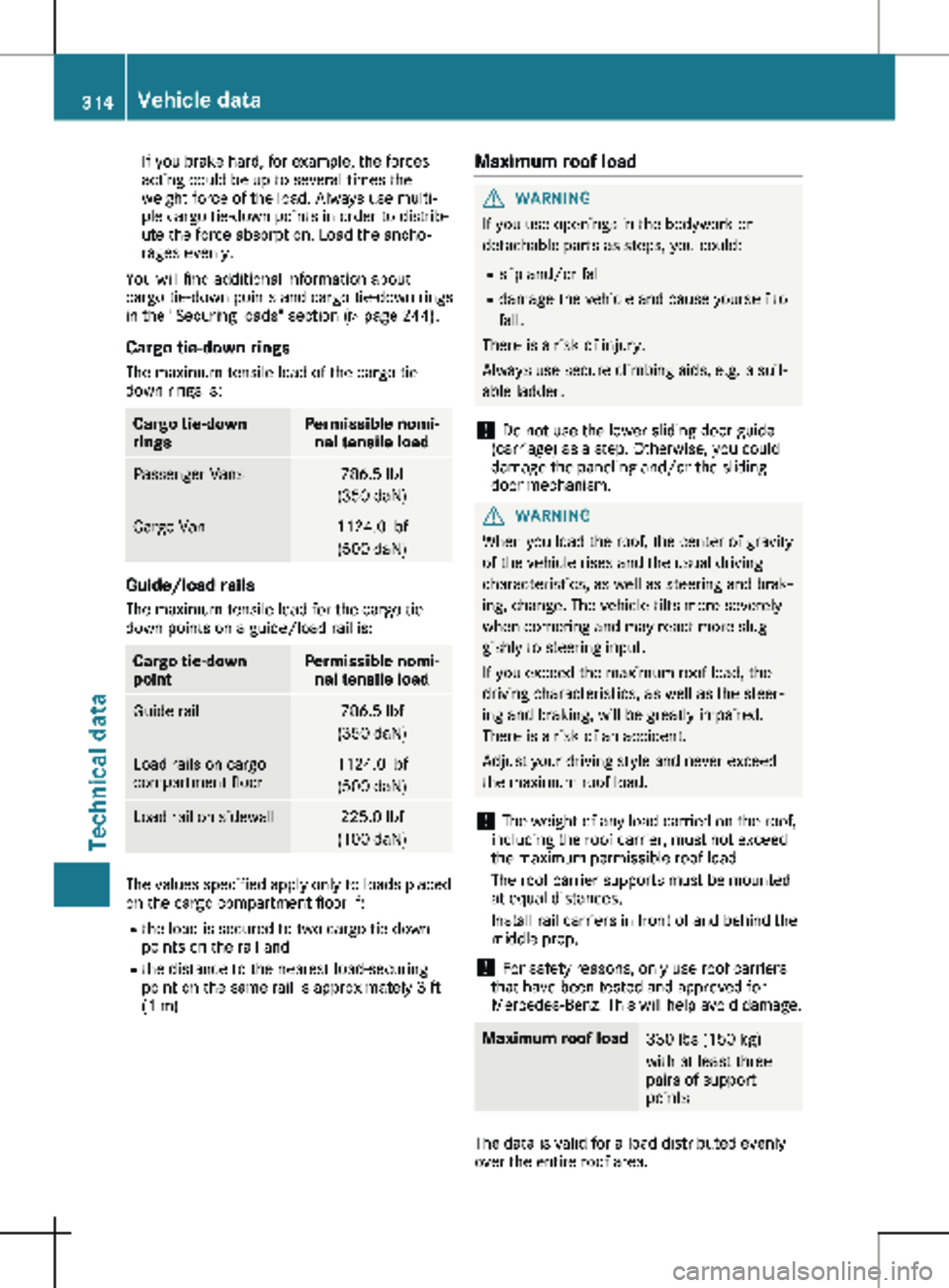
If you brake hard, for example, the forces
acting could be up to several times the
weight force of the load. Always use multi-
ple cargo tie-down points in order to distrib-
ute the force absorption. Load the ancho-
rages evenly.
You will find additional information about
cargo tie-down points and cargo tie-down rings
in the "Securing loads" section
(Y page 244).
Cargo tie-down rings
The maximum tensile load of the cargo tie-
down rings is: Cargo tie-down
rings Permissible nomi-
nal tensile load Passenger Vans 786.5 lbf
(350 daN) Cargo Van 1124.0 lbf
(500 daN) Guide/load rails
The maximum tensile load for the cargo tie-
down points on a guide/load rail is: Cargo tie-down
point Permissible nomi-
nal tensile load Guide rail 786.5 lbf
(350 daN) Load rails on cargo
compartment floor 1124.0 lbf
(500 daN) Load rail on sidewall 225.0 lbf
(100 daN) The values specified apply only to loads placed
on the cargo compartment floor if:
R the load is secured to two cargo tie-down
points on the rail and
R the distance to the nearest load-securing
point on the same rail is approximately
3 ft
(1 m) Maximum roof load G
WARNING
If you use openings in the bodywork or
detachable parts as steps, you could:
R slip and/or fall
R damage the vehicle and cause yourself to
fall.
There is a risk of injury.
Always use secure climbing aids, e.g. a suit-
able ladder.
! Do not use the lower sliding door guide
(carriage) as a step. Otherwise, you could
damage the paneling and/or the sliding
door mechanism. G
WARNING
When you load the roof, the center of gravity
of the vehicle rises and the usual driving
characteristics, as well as steering and brak-
ing, change. The vehicle tilts more severely
when cornering and may react more slug-
gishly to steering input.
If you exceed the maximum roof load, the
driving characteristics, as well as the steer-
ing and braking, will be greatly impaired.
There is a risk of an accident.
Adjust your driving style and never exceed
the maximum roof load.
! The weight of any load carried on the roof,
including the roof carrier, must not exceed
the maximum permissible roof load.
The roof carrier supports must be mounted
at equal distances.
Install rail carriers in front of and behind the
middle prop.
! For safety reasons, only use roof carriers
that have been tested and approved for
Mercedes-Benz. This will help avoid damage. Maximum roof load
330 lbs (150 kg)
with at least three
pairs of support
points
The data is valid for a load distributed evenly
over the entire roof area. 314
Vehicle data
Technical data
Page 317 of 320
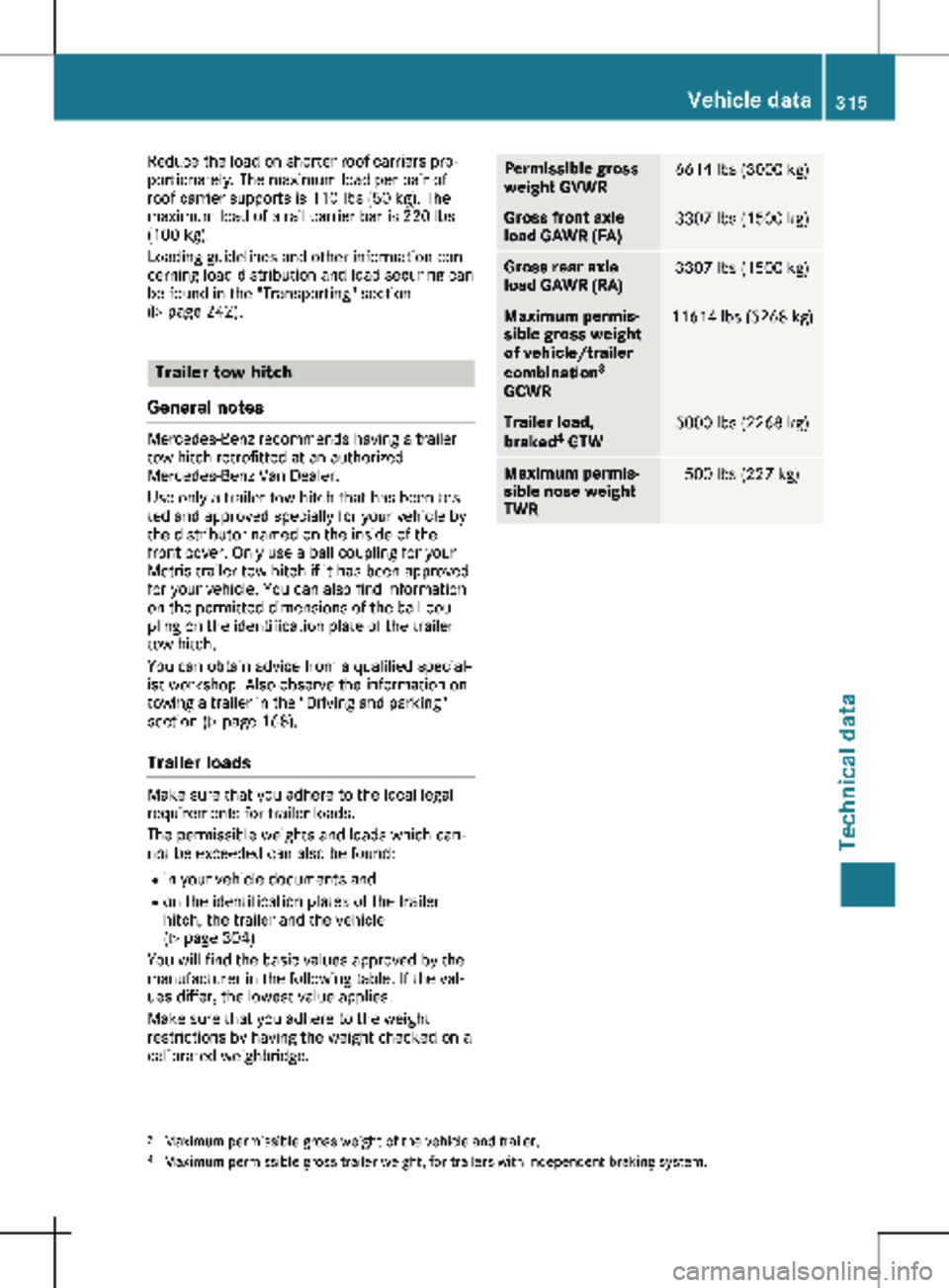
Reduce the load on shorter roof carriers pro-
portionately. The maximum load per pair of
roof carrier supports is
110 lbs (50 kg). The
maximum load of a rail carrier bar is 220 lbs
(100 kg).
Loading guidelines and other information con-
cerning load distribution and load securing can
be found in the "Transporting" section
(Y page 242). Trailer tow hitch
General notes Mercedes-Benz recommends having a trailer
tow hitch retrofitted at an authorized
Mercedes-Benz Van Dealer.
Use only a trailer tow hitch that has been tes-
ted and approved specially for your vehicle by
the distributor named on the inside of the
front cover. Only use a ball coupling for your
Metris trailer tow hitch if it has been approved
for your vehicle. You can also find information
on the permitted dimensions of the ball cou-
pling on the identification plate of the trailer
tow hitch.
You can obtain advice from a qualified special-
ist workshop. Also observe the information on
towing a trailer in the "Driving and parking"
section (Y page
168).
Trailer loads Make sure that you adhere to the local legal
requirements for trailer loads.
The permissible weights and loads which can-
not be exceeded can also be found:
R in your vehicle documents and
R on the identification plates of the trailer
hitch, the trailer and the vehicle
(Y page
304)
You will find the basic values approved by the
manufacturer in the following table. If the val-
ues differ, the lowest value applies.
Make sure that you adhere to the weight
restrictions by having the weight checked on a
calibrated weighbridge. Permissible gross
weight GVWR
6614 lbs (3000 kg)
Gross front axle
load GAWR (FA)
3307 lbs (1500 kg)
Gross rear axle
load GAWR (RA)
3307 lbs (1500 kg)
Maximum permis-
sible gross weight
of vehicle/trailer
combination
3
GCWR 11614 lbs (5268 kg)
Trailer load,
braked
4
GTW 5000 lbs (2268 kg)
Maximum permis-
sible nose weight
TWR
500 lbs (227 kg)
3
Maximum permissible gross weight of the vehicle and trailer.
4 Maximum permissible gross trailer weight, for trailers with independent braking system. Vehicle data
315
Technical data Z