trailer MERCEDES-BENZ METRIS 2020 MY20 Operator’s Manual
[x] Cancel search | Manufacturer: MERCEDES-BENZ, Model Year: 2020, Model line: METRIS, Model: MERCEDES-BENZ METRIS 2020Pages: 320, PDF Size: 26.38 MB
Page 173 of 320
Observe the following when towing a trailer:
R Practice driving around bends, stopping and
backing up at a place where there is no traf-
fic. This enables you to gain experience and
get used to the new handling characteris-
tics.
R Before driving, check:
- that the trailer tow hitch and ball coupling
are secure
- that the safety switch for a braked trailer
is functioning properly
- that the safety chains are secure and not
damaged
- that the electrical connections are secure
- that the lights are working
- that the wheels are in good order and the
tire pressure is correct
R Adjust the exterior mirrors to provide an
unobstructed view of the rear section of the
trailer.
R If the trailer is equipped with a separate
functional braking system, check before
each journey whether the brakes are func-
tioning correctly.
R Secure the load on the trailer according to
the applicable specifications and current
standards on securing loads
(Y page 244).
R When driving with a trailer, check at regular
intervals that the load is secured and that
the brakes and lights are working.
R Bear in mind that the handling will be less
stable when towing a trailer than when driv-
ing without one. Avoid sudden steering
movements.
R The vehicle/trailer combination is heavier,
accelerates more slowly and has a
decreased gradient climbing capability and a
longer braking distance.
It is more susceptible to crosswinds and
requires cautious steering.
R If possible, do not brake suddenly, but
rather moderately at first so that the trailer
can activate its brakes. Then increase the
force on the brake pedal.
R If the automatic transmission repeatedly
shifts between gears when driving on
inclines, restrict the shift range. Select shift
range 4, 3, 2 or 1.
Driving in a low gear and at a low speed
reduces the risk of damaging the engine. R
When driving on a downhill gradient, shift to
a low gear and take advantage of the
engine's braking effect.
Avoid continuous brake application as this
may overheat the vehicle brakes and, if
installed, the trailer brakes.
R If the coolant temperature increases dra-
matically while the air-conditioning system
is switched on, switch off the air-condition-
ing system.
Coolant heat can also be dissipated by
switching the airflow and the temperature of
the air conditioning to the maximum level.
Open the windows if necessary.
R When overtaking, pay particular attention to
the extended length of your vehicle/trailer
combination.
Due to the length of your vehicle/trailer
combination you need an additional dis-
tance before you can return to your original
lane. Uncoupling a trailer
G
WARNING
If you uncouple a trailer with the overrun
brake engaged, you could trap your hand
between the vehicle and the trailer drawbar.
There is a risk of injury.
Do not uncouple a trailer if the overrun
brake is engaged.
! Do not disconnect a trailer with an
engaged overrun brake. Otherwise, your
vehicle could be damaged by the rebound-
ing of the overrun brake.
X Make sure that the selector lever of the
automatic transmission is in position P.
X Engage the vehicle's parking brake.
X Close all doors.
X Apply the parking brake of the trailer.
X In addition, secure the trailer against rolling
away with a wheel chock or similar object.
X Remove the trailer cable and safety chains
and decouple the trailer. Towing a trailer
171
Driving and parking Z
Page 174 of 320
Permissible trailer loads and trailer
drawbar noseweights
Weight information !
For vehicles with a permissible gross vehi-
cle weight of 6614 lbs (3000 kg), the per-
missible gross combination mass is less
than the sum of the permissible gross vehi-
cle weight plus the permissible trailer load.
Exceeding the permissible gross combina-
tion mass can lead to damage to the drive-
train, to the transmission or to the trailer
hitch.
If either the vehicle or the trailer is fully
laden, the permitted gross vehicle weight or
the permitted trailer load values are reduced
accordingly. In this case, you may only parti-
ally load the trailer or the vehicle.
The gross trailer weight (GTW) is calculated by
adding the weight of the trailer to the weight
of the load and equipment. If the trailer is
installed with a separate functional braking
system, then the maximum gross trailer weight
is 5000 lbs (2268 kg). G
WARNING
If you tow a trailer without a separate func-
tional braking system and a gross trailer
weight (GTW) of more than
1635 lbs
(750 kg), then the vehicle brake system may
overheat. This increases the braking dis-
tance and the brake system may even fail.
There is an increased risk of accident and
injury, possibly even fatal.
Always use a trailer with a separate func-
tional braking system when towing a trailer
with a gross trailer weight (GTW) of more
than 1635 lbs (750 kg).
The maximum noseweight of the trailer draw-
bar on the ball coupling is 500 lbs (227 kg).
The actual noseweight may not exceed the
value given on the identification plates of the
trailer tow hitch or the trailer. If the values
vary, the lowest value always applies.
The gross combination weight rating (GCWR) is
calculated by adding the gross weight of the
trailer to the gross vehicle weight including a
driver's weight of approximately 150 lbs
(68 kg). The permissible Gross Combination Weight Rating is vehicle-specific and depends
on the equipment level.
When driving with a trailer, you should not
exceed the permitted Gross Combination
Weight Rating (GCWR).
The permissible values, which must not be
exceeded, can be found in your vehicle docu-
ments and on the trailer tow hitch type plates
for the trailer and the vehicle (
Y page
304).
The basic values approved by the manufac-
turer can also be found in the "Technical data"
section ( Y page 315). If the values vary, the
lowest value always applies.
Loading a trailer !
Utilize the maximum permissible nose-
weight as fully as possible. Do not allow the
weight to fall below the minimum permissi-
ble noseweight, otherwise the trailer may
come loose.
R The load must be distributed over the vehi-
cle and the trailer so as not to exceed either
the maximum permissible values for the
gross vehicle weight rating (GVWR) and
gross trailer weight (GTW), the gross combi-
nation weight rating (GCWR), nor the maxi-
mum permissible gross axle weight rating
(GAWR) and trailer drawbar noseweight rat-
ing of your vehicle.
R Add the drawbar noseweight on the ball
coupling (TWR) to the rear axle load. This
will prevent you from exceeding the permis-
sible gross axle weight (GAWR).
R Add the drawbar noseweight on the ball
coupling (TWR) to the vehicle payload. This
will ensure that you do not exceed the per-
missible gross vehicle weight rating (GVWR).
Checking the vehicle and trailer
weight R
Make sure the weights of the towing vehicle
and the trailer comply with the maximum
permissible values. Have the vehicle/trailer
combination weighed on a calibrated weigh-
bridge. The vehicle/trailer combination con-
sists of the towing vehicle including the
driver, passengers and load, as well as the
loaded trailer.
R Check the maximum permissible gross axle
weight rating of the front and rear axles
(GAWR), the gross trailer weight (GTW), the
gross combination weight rating (GCWR) 172
Towing a trailer
Driving and parking
Page 175 of 320
and the noseweight of the trailer drawbar
(TWR).
Trailer power supply
! Incorrect wiring of the connector plug
could, under certain circumstances, cause
malfunctions in the vehicle's other elec-
tronic systems. We therefore recommend
having the connector plug wired at a quali-
fied specialist workshop.
! You can connect accessories with a maxi-
mum power consumption of 240 W
to the
permanent power supply.
You must not charge a trailer battery using
the power supply.
Your vehicle may be equipped with various
electrical installations for trailer towing.
Depending on your trailer, you may need an
adapter to connect the electrical system of the
trailer with that of the vehicle.
The trailer socket of your vehicle is equipped
at the factory with a permanent power supply.
The permanent power supply is on the trailer
socket pin assignment 4.
Note that the permanent power supply of the
trailer is not switched off when the on-board
voltage is low. This can completely discharge
the starter battery of your vehicle.
Further information on the electrical equip-
ment currently installed on your vehicle and on
installing trailer electrics can be obtained at
any qualified specialist workshop. Towing a trailer
173
Driving and parking Z
Page 204 of 320
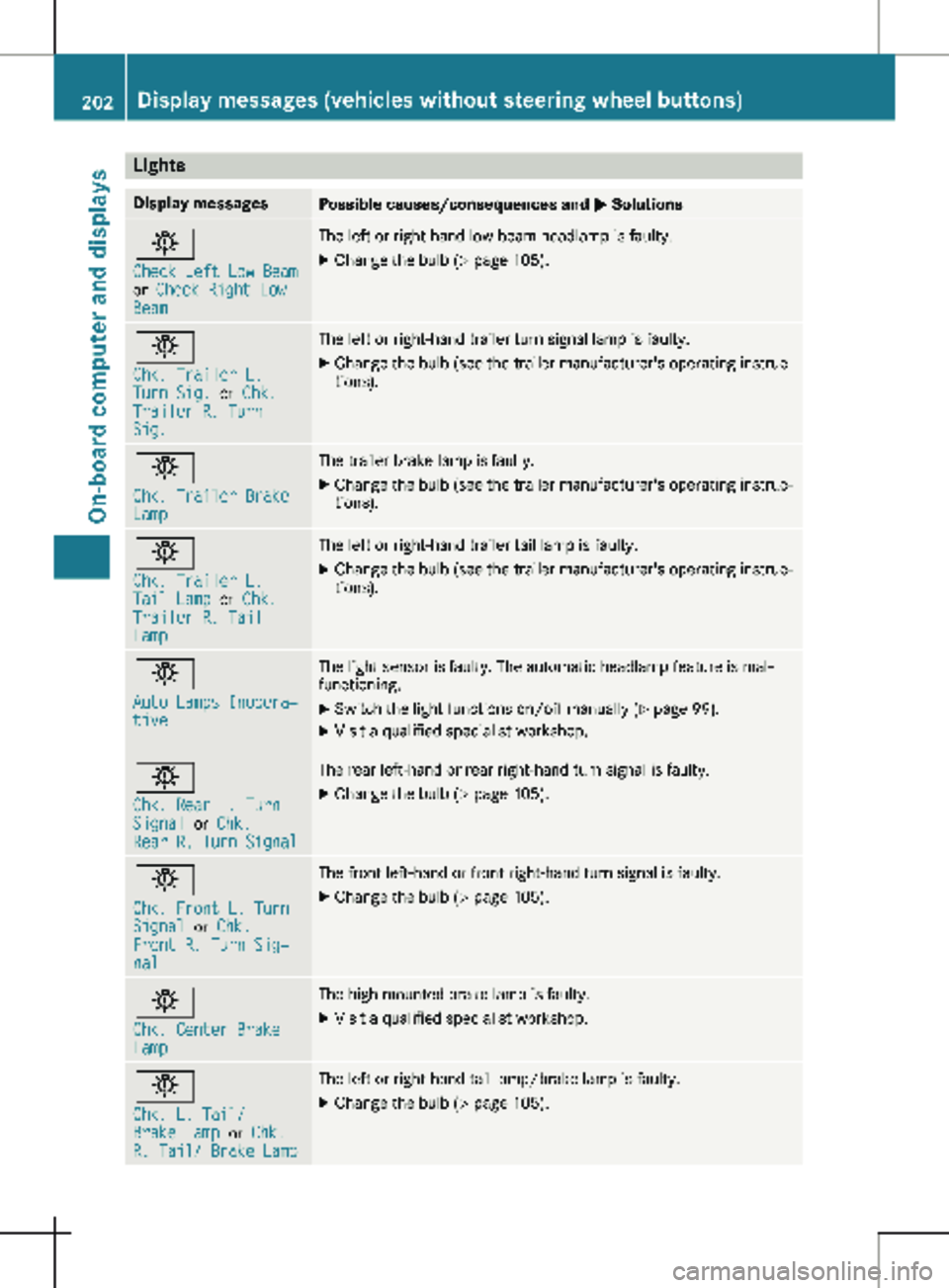
Lights
Display messages
Possible causes/consequences and
M Solutionsb
Check Left Low Beam
or
Check Right Low
Beam The left or right-hand low-beam headlamp is faulty.
X
Change the bulb ( Y page 105).b
Chk. Trailer L.
Turn Sig.
or Chk.
Trailer R. Turn
Sig. The left or right-hand trailer turn signal lamp is faulty.
X
Change the bulb (see the trailer manufacturer's operating instruc-
tions). b
Chk. Trailer Brake
Lamp The trailer brake lamp is faulty.
X Change the bulb (see the trailer manufacturer's operating instruc-
tions). b
Chk. Trailer L.
Tail Lamp
or Chk.
Trailer R. Tail
Lamp The left or right-hand trailer tail lamp is faulty.
X Change the bulb (see the trailer manufacturer's operating instruc-
tions). b
Auto Lamps Inopera‐
tive The light sensor is faulty. The automatic headlamp feature is mal-
functioning.
X
Switch the light functions on/off manually (Y page
99).
X Visit a qualified specialist workshop. b
Chk. Rear L. Turn
Signal
or Chk.
Rear R. Turn Signal The rear left-hand or rear right-hand turn signal is faulty.
X Change the bulb (Y page 105).b
Chk. Front L. Turn
Signal
or Chk.
Front R. Turn Sig‐
nal The front left-hand or front right-hand turn signal is faulty.
X Change the bulb (Y page 105).b
Chk. Center Brake
Lamp The high-mounted brake lamp is faulty.
X
Visit a qualified specialist workshop. b
Chk. L. Tail/
Brake Lamp
or Chk.
R. Tail/ Brake Lamp The left or right-hand tail lamp/brake lamp is faulty.
X Change the bulb (Y page 105).202
Display messages (vehicles without steering wheel buttons)
On-board computer and displays
Page 205 of 320
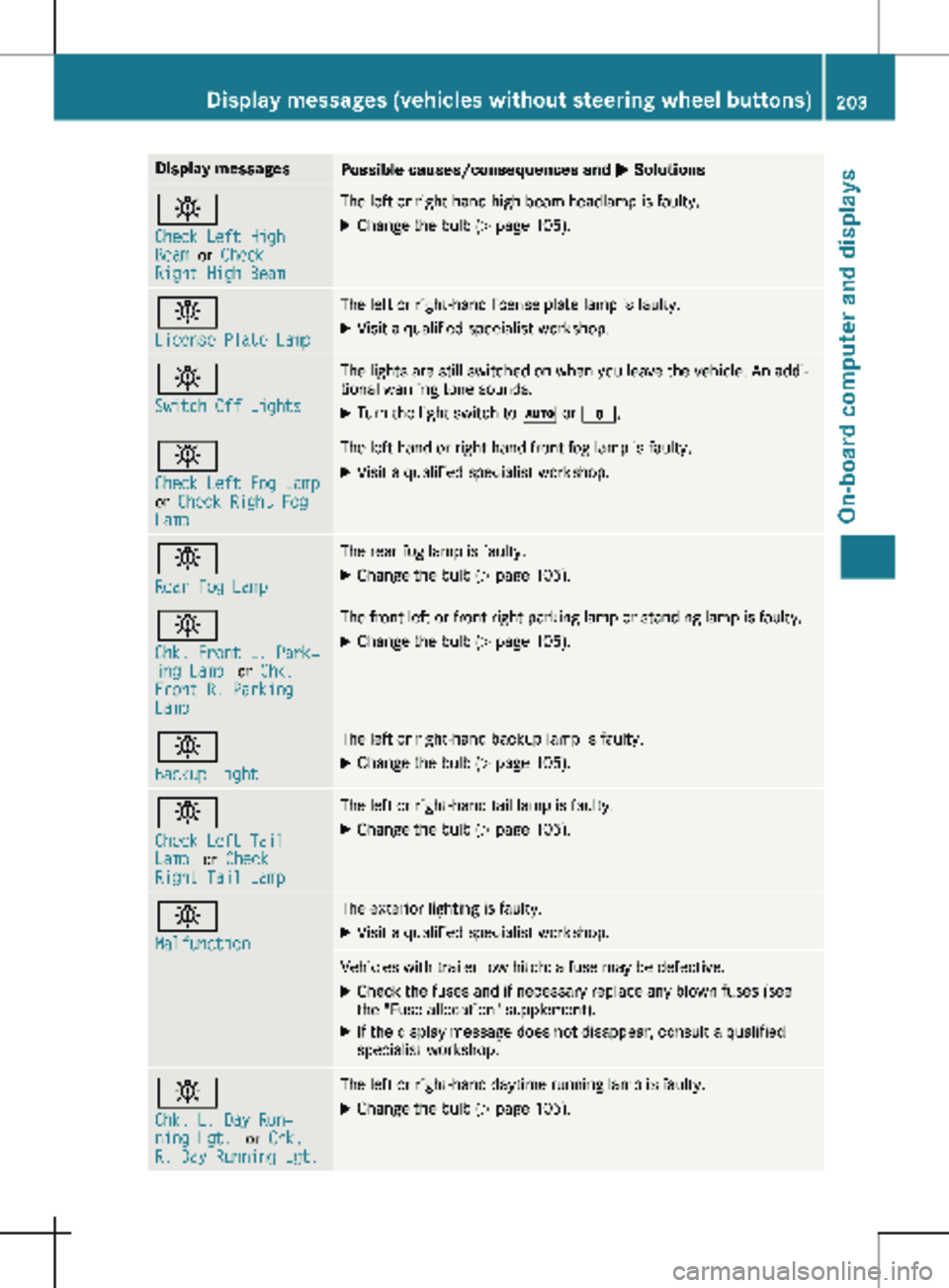
Display messages
Possible causes/consequences and
M Solutionsb
Check Left High
Beam
or Check
Right High Beam The left or right-hand high-beam headlamp is faulty.
X
Change the bulb ( Y page 105).b
License Plate Lamp The left or right-hand license plate lamp is faulty.
X Visit a qualified specialist workshop. b
Switch Off Lights The lights are still switched on when you leave the vehicle. An addi-
tional warning tone sounds.
X Turn the light switch to à or $.b
Check Left Fog Lamp
or
Check Right Fog
Lamp The left-hand or right-hand front fog lamp is faulty.
X Visit a qualified specialist workshop. b
Rear Fog Lamp The rear fog lamp is faulty.
X Change the bulb (Y page
105).b
Chk. Front L. Park‐
ing Lamp
or Chk.
Front R. Parking
Lamp The front left or front right parking lamp or standing lamp is faulty.
X Change the bulb ( Y page 105).b
Backup Light The left or right-hand backup lamp is faulty.
X Change the bulb (Y page
105).b
Check Left Tail
Lamp
or Check
Right Tail Lamp The left or right-hand tail lamp is faulty.
X Change the bulb (Y page 105).b
Malfunction The exterior lighting is faulty.
X Visit a qualified specialist workshop. Vehicles with trailer tow hitch: a fuse may be defective.
X Check the fuses and if necessary replace any blown fuses (see
the "Fuse allocation" supplement).
X If the display message does not disappear, consult a qualified
specialist workshop. b
Chk. L. Day Run‐
ning Lgt.
or Chk.
R. Day Running Lgt. The left or right-hand daytime running lamp is faulty.
X Change the bulb (Y page 105).Display messages (vehicles without steering wheel buttons)
203
On-board computer and displays Z
Page 218 of 320

Lights
Display messages
Possible causes/consequences and
M Solutionsb
Check Left Low Beam
or
Check Right Low
Beam The left or right-hand low-beam headlamp is faulty.
X
Change the bulb ( Y page 105).b
Check Trailer Left
Turn Signal
or
Check Trailer
Right Turn Signal The left or right-hand trailer turn signal lamp is faulty.
X
Change the bulb (see the trailer manufacturer's operating instruc-
tions). b
Check Trailer
Brake Lamp The trailer brake lamp is faulty.
X Change the bulb (see the trailer manufacturer's operating instruc-
tions). b
Check Trailer Left
Tail Lamp
or Check
Trailer Right Tail
Lamp The left or right-hand trailer tail lamp is faulty.
X Change the bulb (see the trailer manufacturer's operating instruc-
tions). b
Auto Lamp Function
Inoperative The light sensor is faulty. The automatic headlamp feature is mal-
functioning.
X
Switch the light functions on/off manually (Y page
99).
X Visit a qualified specialist workshop. b
Check Rear Left
Turn Signal
or
Check Rear Right
Turn Signal The rear left-hand or rear right-hand turn signal is faulty.
X Change the bulb (Y page 105).b
Check Front Left
Turn Signal
or
Check Front Right
Turn Signal The front left-hand or front right-hand turn signal is faulty.
X Change the bulb (Y page 105).b
Check Center Brake
Lamp The high-mounted brake lamp is faulty.
X
Visit a qualified specialist workshop.216
Display messages (vehicles with steering wheel buttons)
On-board computer and displays
Page 220 of 320
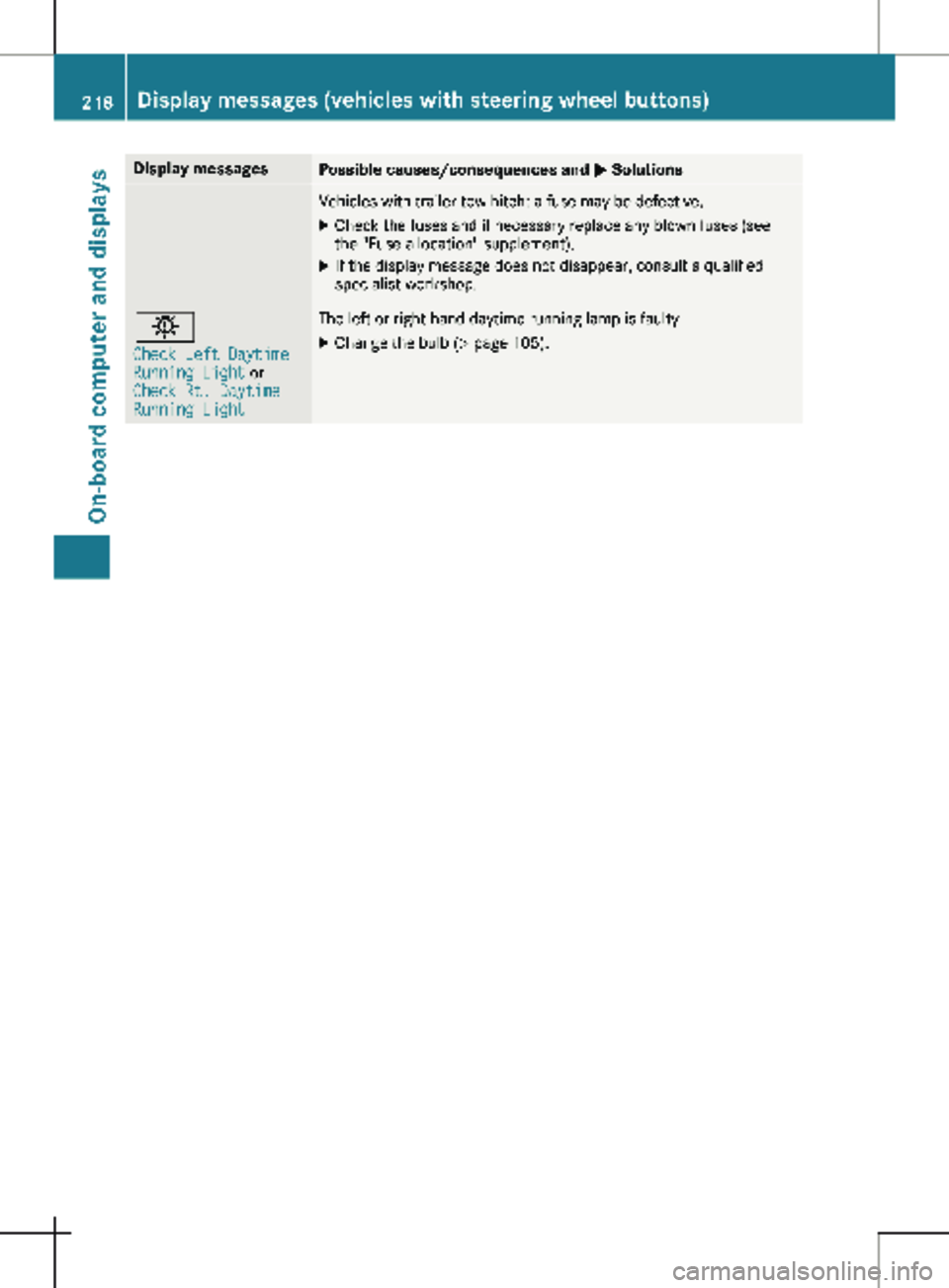
Display messages
Possible causes/consequences and
M SolutionsVehicles with trailer tow hitch: a fuse may be defective.
X Check the fuses and if necessary replace any blown fuses (see
the "Fuse allocation" supplement).
X If the display message does not disappear, consult a qualified
specialist workshop. b
Check Left Daytime
Running Light or
Check Rt. Daytime
Running Light The left or right-hand daytime running lamp is faulty.
X Change the bulb (Y page 105).218
Display messages (vehicles with steering wheel buttons)
On-board computer and displays
Page 225 of 320

Display messages
Possible causes/consequences and
M SolutionsCruise Control
- - - mph A condition for activating cruise control has not been met.
You have tried to store a speed below
20 mph (30 km/h) for exam-
ple.
X If conditions permit, drive faster than 20 mph (30 km/h) and
store the speed.
X Check the activation conditions for cruise control (Y page
147).Blind Spot Assist
Inoperative Blind Spot Assist is faulty.
X Visit a qualified specialist workshop. Blind Spot Assist
Currently Unavail.
See Operator's Man‐
ual Blind Spot Assist is temporarily inoperative. Possible causes:
R You have attached a trailer.
R The sensors in the rear bumper are dirty.
R The function is impaired due to heavy rain or snow.
R The radar sensor system is temporarily inoperative, e.g. due to
electromagnetic radiation emitted by nearby TV or radio stations
or other sources of electromagnetic radiation.
R The system is outside the operating temperature range.
Once the causes listed above no longer apply, the display message
goes out and Blind Spot Assist is operational again.
If the display message does not disappear:
X Pull over and stop the vehicle, paying attention to road and traffic
conditions.
X Secure the vehicle to prevent it from rolling away ( Y page
138).
X Switch off the engine.
X Clean the sensors in the rear bumper (Y page
267).
X Restart the engine. Display messages (vehicles with steering wheel buttons)
223
On-board computer and displays Z
Page 233 of 320
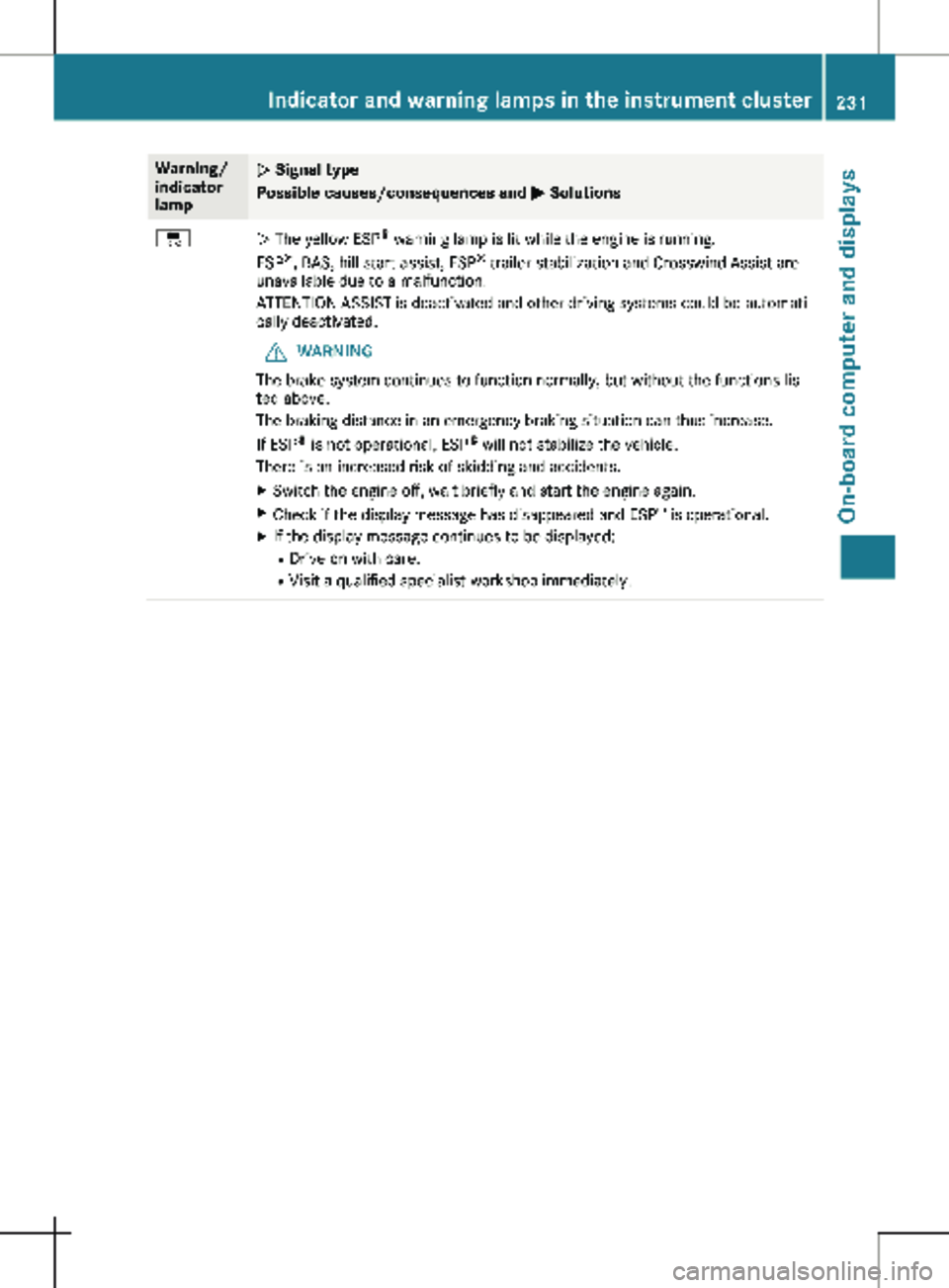
Warning/
indicator
lamp
N Signal type
Possible causes/consequences and
M Solutions÷
N The yellow ESP
®
warning lamp is lit while the engine is running.
ESP ®
, BAS, hill start assist, ESP ®
trailer stabilization and Crosswind Assist are
unavailable due to a malfunction.
ATTENTION ASSIST is deactivated and other driving systems could be automati-
cally deactivated.
G WARNING
The brake system continues to function normally, but without the functions lis-
ted above.
The braking distance in an emergency braking situation can thus increase.
If ESP ®
is not operational, ESP ®
will not stabilize the vehicle.
There is an increased risk of skidding and accidents.
X Switch the engine off, wait briefly and start the engine again.
X Check if the display message has disappeared and ESP ®
is operational.
X If the display message continues to be displayed:
R Drive on with care.
R Visit a qualified specialist workshop immediately. Indicator and warning lamps in the instrument cluster
231On-board computer and displays Z
Page 234 of 320
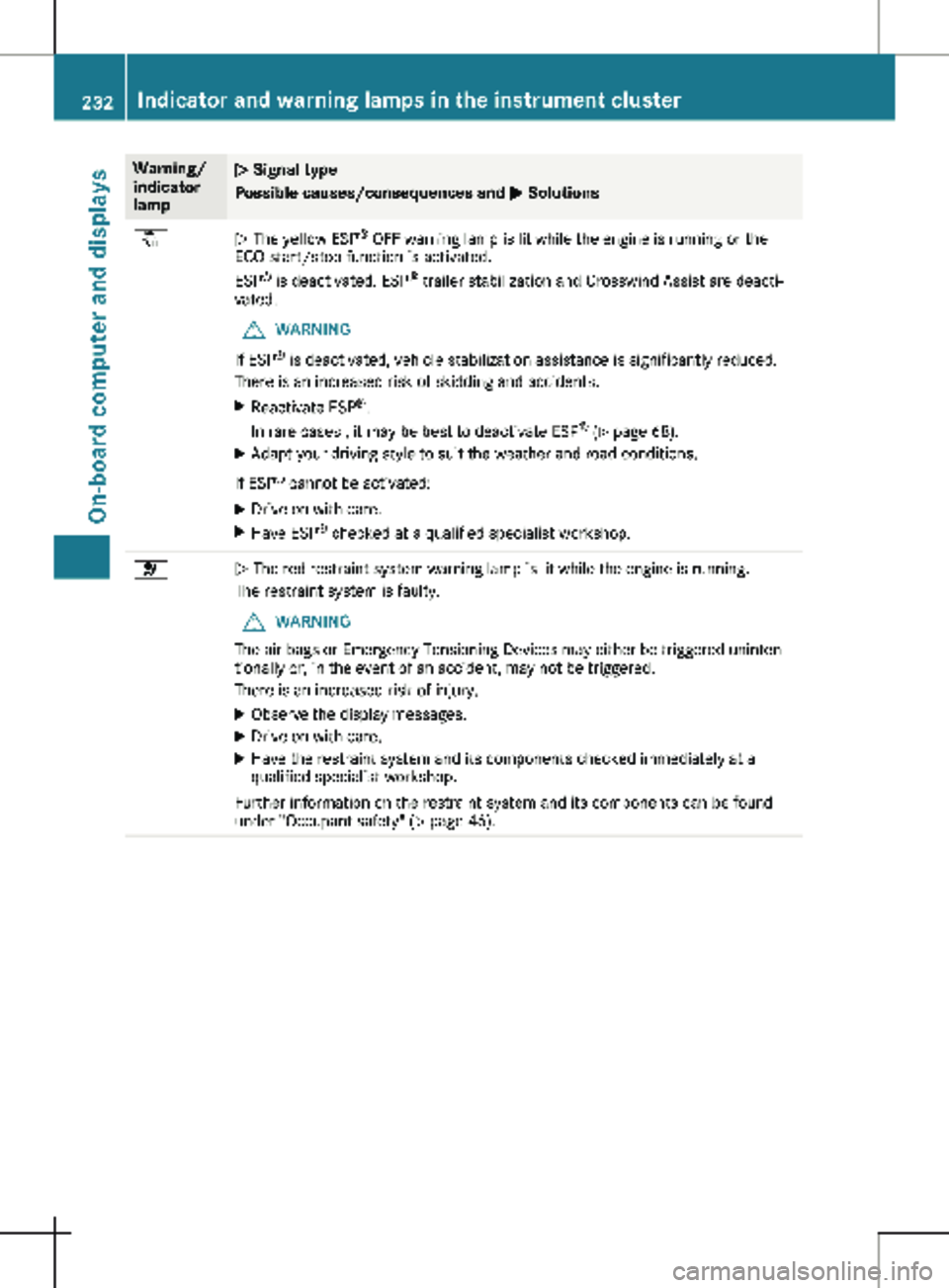
Warning/
indicator
lamp
N Signal type
Possible causes/consequences and
M Solutionså
N The yellow ESP
®
OFF warning lamp is lit while the engine is running or the
ECO start/stop function is activated.
ESP ®
is deactivated. ESP ®
trailer stabilization and Crosswind Assist are deacti-
vated.
G WARNING
If ESP ®
is deactivated, vehicle stabilization assistance is significantly reduced.
There is an increased risk of skidding and accidents.
X Reactivate ESP ®
.
In rare cases , it may be best to deactivate ESP ®
(Y page
68).
X Adapt your driving style to suit the weather and road conditions.
If ESP ®
cannot be activated:
X Drive on with care.
X Have ESP ®
checked at a qualified specialist workshop. 6
N The red restraint system warning lamp is lit while the engine is running.
The restraint system is faulty.
G WARNING
The air bags or Emergency Tensioning Devices may either be triggered uninten-
tionally or, in the event of an accident, may not be triggered.
There is an increased risk of injury.
X Observe the display messages.
X Drive on with care.
X Have the restraint system and its components checked immediately at a
qualified specialist workshop.
Further information on the restraint system and its components can be found
under "Occupant safety"
(Y page 46).232
Indicator and warning lamps in the instrument cluster
On-board computer and displays