brake light MERCEDES-BENZ METRIS 2020 MY20 Operator’s Manual
[x] Cancel search | Manufacturer: MERCEDES-BENZ, Model Year: 2020, Model line: METRIS, Model: MERCEDES-BENZ METRIS 2020Pages: 320, PDF Size: 26.38 MB
Page 237 of 320
Warning/
indicator
lamp
N Signal type
Possible causes/consequences and
M SolutionsX
Secure the vehicle to prevent it from rolling away ( Y page 138).
X Exit the vehicle and keep a safe distance from the vehicle until the engine has
cooled down.
X Check the coolant level and add coolant, observing the warning notes
(Y page
253).
X If you have to add coolant more frequently, have the engine cooling system
checked.
X Make sure that the air supply to the radiator is not obstructed, by frozen
slush for example.
X Check the coolant temperature:
R using the display in the on-board computer on vehicles without steering
wheel buttons ( Y page
178)
R using the analog display in the instrument cluster on vehicles with steering
wheel buttons ( Y page 40)
X If the coolant temperature is below the maximum value specified below, you
can continue driving to the nearest qualified specialist workshop.
Avoid heavy loads on the engine, e.g. driving in mountainous terrain, and
stop-start traffic.
Under normal driving conditions and at the correct coolant level, the coolant
temperature display may rise to the letter H or to the red mark.Driving systems
Warning/
indicator
lamp
N Signal type
Possible causes/consequences and
M Solutions·
N The red distance warning lamp lights up while the vehicle is in motion.
The distance to the vehicle in front is too small for the speed selected.
X Increase the distance. ·
N The red distance warning lamp lights up while the vehicle is in motion. An
additional warning tone sounds.
You are approaching a vehicle or a stationary obstacle in your line of travel at
too high a speed.
X Be prepared to brake immediately.
X Pay particular attention to the traffic situation. You may have to brake or take
evasive action.
Further information about the distance warning function can be found under
"COLLISION PREVENTION ASSIST"
(Y page 149). Indicator and warning lamps in the instrument cluster
235
On-board computer and displays Z
Page 248 of 320
Lashing straps
Important safety notes
G
WARNING
If you attach the tie-down incorrectly when
securing the load, the following may occur in
the event of abrupt changes in direction,
braking maneuvers or an accident:
R the cargo tie-down rings may become
detached or the tie-down may tear if the
permissible load is exceeded
R the load may not be restrained.
This may cause the load to slip, tip over or
be tossed about, striking vehicle occupants.
There is a risk of an accident and injury.
Always tension the tie-downs in the proper
manner and only between the described
cargo tie-down rings. Always use tie-downs
designed specifically for the loads.
! Observe the information on the maximum
loading capacity of the individual cargo tie-
down points.
If you use several cargo tie-down points to
secure a load, you must always take the
maximum loading capacity of the weakest
cargo tie-down point into account.
If you brake hard, for example, the forces
acting could be up to several times the
weight force of the load. Always use multi-
ple cargo tie-down points in order to distrib-
ute the force absorption. Load the ancho-
rages evenly.
Always observe the operating instructions or
the notes of the lashing strap manufacturer for
the operation of the lashing strap.
Securing loads on the cargo compartment
floor by lashing them down is only recommen-
ded for lightweight loads. Place non-slip mats
(anti-slip mats) under the load to increase load
security. Notes and information on:
R the operation of the cargo tie-down rings
and cargo tie-down points can be found in
the "Securing a load" section
(Y page 244)
R the maximum loading capacity of the cargo
tie-down points can be found in the "Techni-
cal data" section ( Y page 313)
R the maximum loading capacity of the lashing
strap can be found on the lashing strap label
If the label is missing or illegible, the lashing
strap is ready to be discarded. Such a lash-
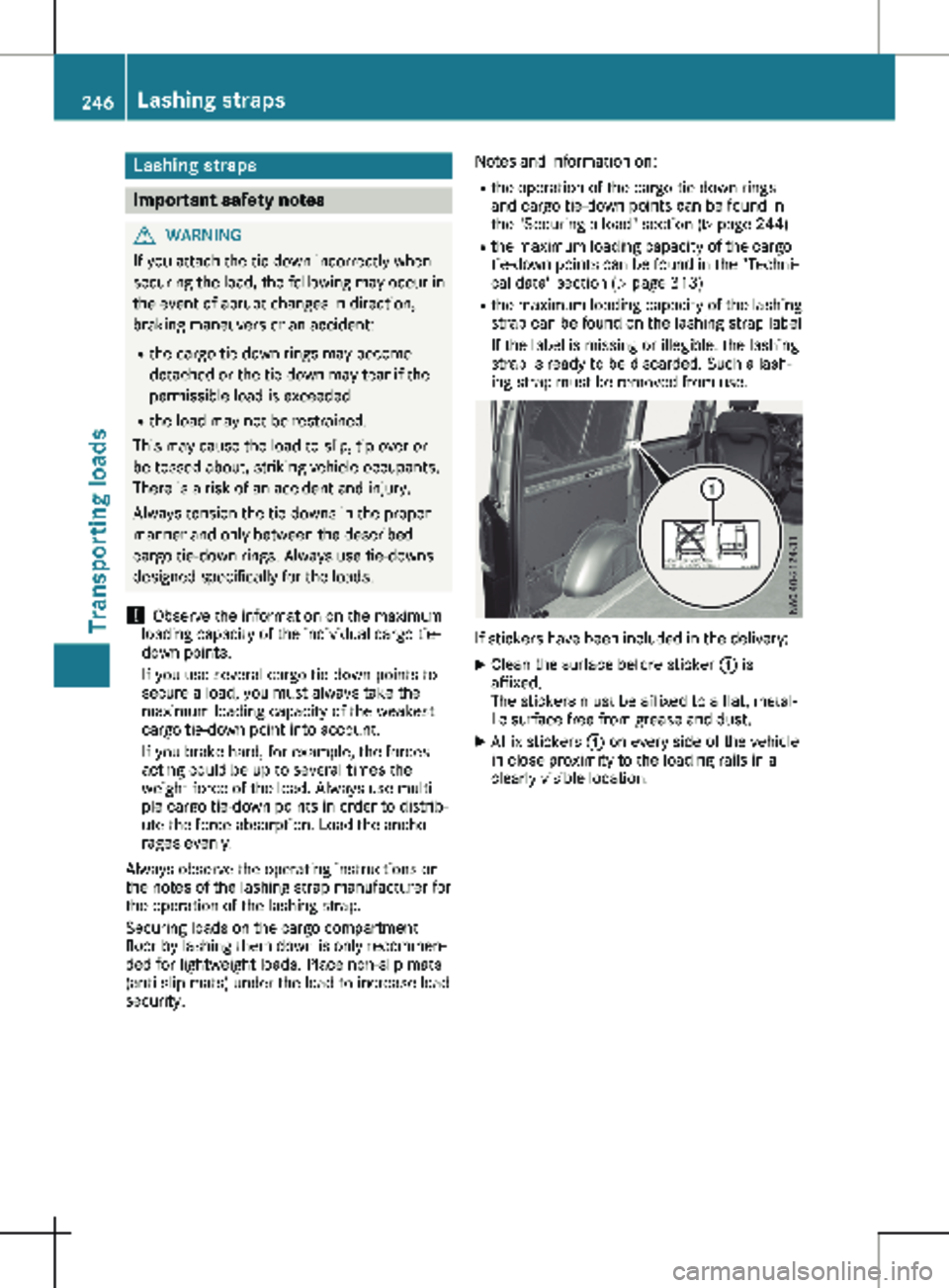
ing strap must be removed from use. If stickers have been included in the delivery:
X Clean the surface before sticker : is
affixed.
The stickers must be affixed to a flat, metal-
lic surface free from grease and dust.
X Affix stickers : on every side of the vehicle
in close proximity to the loading rails in a
clearly visible location. 246
Lashing straps
Transporting loads
Page 254 of 320
X
Hold support strut ? and lift the hood
slightly.
X Guide support strut ? towards retainer =
and apply slight pressure to make it engage.
X Lower the hood and allow it to fall with
momentum from a height of approximately
1 ft (30 cm
).
The hood locks audibly.
X Check that the hood is correctly locked.
If the hood can be raised slightly, it is not
properly engaged. If the hood is not cor-
rectly engaged, open the hood again. Let
the hood fall with a little more momentum. Overview of the engine compart-
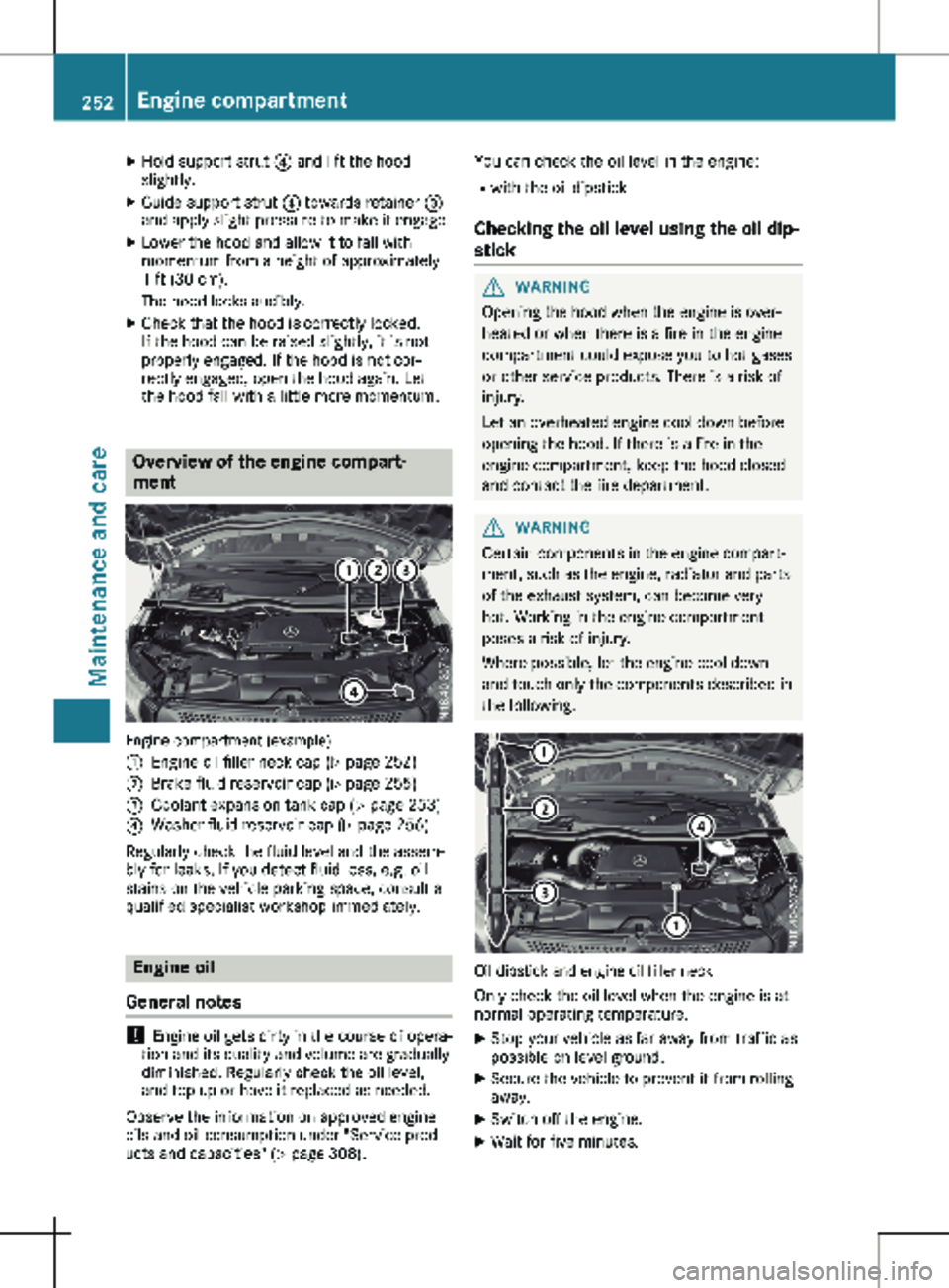
ment
Engine compartment (example)
:
Engine oil filler neck cap (Y page
252)
; Brake fluid reservoir cap (Y page
255)
= Coolant expansion tank cap ( Y page
253)
? Washer fluid reservoir cap (Y page
256)
Regularly check the fluid level and the assem-
bly for leaks. If you detect fluid loss, e.g. oil
stains on the vehicle parking space, consult a
qualified specialist workshop immediately. Engine oil
General notes !
Engine oil gets dirty in the course of opera-
tion and its quality and volume are gradually
diminished. Regularly check the oil level,
and top up or have it replaced as needed.
Observe the information on approved engine
oils and oil consumption under "Service prod-
ucts and capacities" ( Y page
308).You can check the oil level in the engine:
R with the oil dipstick
Checking the oil level using the oil dip-
stick G
WARNING
Opening the hood when the engine is over-
heated or when there is a fire in the engine
compartment could expose you to hot gases
or other service products. There is a risk of
injury.
Let an overheated engine cool down before
opening the hood. If there is a fire in the
engine compartment, keep the hood closed
and contact the fire department. G
WARNING
Certain components in the engine compart-
ment, such as the engine, radiator and parts
of the exhaust system, can become very
hot. Working in the engine compartment
poses a risk of injury.
Where possible, let the engine cool down
and touch only the components described in
the following. Oil dipstick and engine oil filler neck
Only check the oil level when the engine is at
normal operating temperature. X Stop your vehicle as far away from traffic as
possible on level ground.
X Secure the vehicle to prevent it from rolling
away.
X Switch off the engine.
X Wait for five minutes.252
Engine compartment
Maintenance and care
Page 262 of 320
Disconnecting and removing
G
WARNING
During the charging process, a battery pro-
duces hydrogen gas. If a short circuit occurs
or sparks are created, the hydrogen gas can
ignite. There is a risk of an explosion.
R Make sure that the positive terminal of a
connected battery does not come into
contact with vehicle parts.
R Never place metal objects or tools on a
battery.
R It is important that you observe the
described order of the battery terminals
when connecting and disconnecting a bat-
tery.
R When jump-starting, make sure that the
battery poles with identical polarity are
connected.
R It is particularly important to observe the
described order when connecting and dis-
connecting the jumper cables.
R Never connect or disconnect the battery
terminals while the engine is running. G
WARNING
Battery acid is caustic. There is a risk of
injury.
Avoid contact with skin, eyes or clothing. Do
not inhale any battery gases. Do not lean
over the battery. Keep children away from
batteries. Wash away battery acid immedi-
ately with plenty of clean water and seek
medical attention.
! You should have all work involving the bat-
tery carried out at a qualified specialist
workshop.
If, in exceptional circumstances, you need
to disconnect the battery yourself, please
make sure that:
R Secure the vehicle to prevent it from roll-
ing away.
R You have switched off the engine and
removed the key. Make sure the ignition
is switched off. Check to see that there
are no indicator lamps lighting in the instrument cluster. Electronic compo-
nents such as the alternator may other-
wise be damaged.
R After the battery has been disconnected,
the parking brake is automatically
engaged. You can then no longer move
the vehicle.
R For vehicles with automatic transmission,
the transmission is locked in position P
after disconnecting the battery. You can
then no longer move the vehicle.
R You have first removed the negative ter-
minal and then the positive terminal.
Never mix up the terminal clamp discon-
nection/connection order and never mix
up the terminal clamps. The vehicle's
electronics may otherwise be damaged.
The battery and the cover of the positive ter-
minal clamp must be installed securely dur-
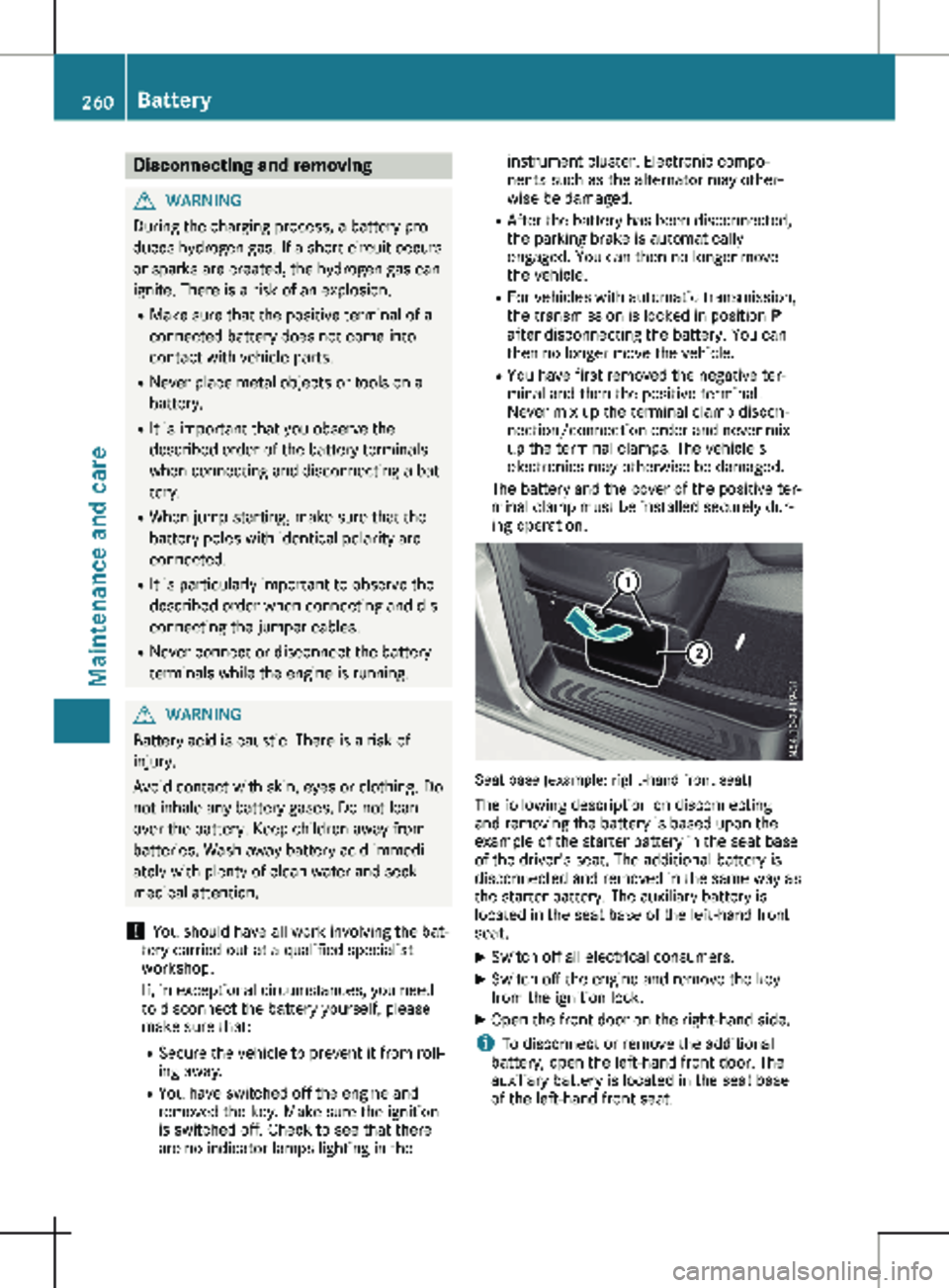
ing operation. Seat base (example: right-hand front seat)
The following description on disconnecting
and removing the battery is based upon the
example of the starter battery in the seat base
of the driver's seat. The additional battery is
disconnected and removed in the same way as
the starter battery. The auxiliary battery is
located in the seat base of the left-hand front
seat.
X Switch off all electrical consumers.
X Switch off the engine and remove the key
from the ignition lock.
X Open the front door on the right-hand side.
i To disconnect or remove the additional
battery, open the left-hand front door. The
auxiliary battery is located in the seat base
of the left-hand front seat. 260
BatteryMaintenance and care
Page 266 of 320
!
Do not use the lower sliding door guide
(carriage) as a step. Otherwise, you could
damage the paneling and/or the sliding
door mechanism.
! When cleaning your car, do not use:
R dry, coarse or hard cloths
R abrasive cleaning agents
R solvents
R cleaning agents containing solvents
Do not scrub.
Do not touch the surfaces and films with
hard objects, e.g. rings or ice scrapers. Oth-
erwise, you may scratch or damage the sur-
faces and films.
! Do not park your vehicle for a long period
of time directly after cleaning, particularly
after cleaning the wheel rim with wheel
cleaner. Wheel cleaner can lead to the
increased corrosion of the brake discs and
pads. Therefore, drive for a few minutes
after cleaning. By heating up the brakes, the
brake discs and pads dry. The vehicle can
then be parked for a long period of time. H
Environmental note
Only clean your vehicle at specially designed
wash bays. Dispose of empty containers and
used cleaning products in an environmen-
tally responsible manner. H
Environmental note
Dispose of empty packaging and cleaning
cloths in an environmentally responsible
manner.
Regular care of your vehicle is a condition for
retaining the quality in the long term.
Use care products and cleaning agents recom-
mended and approved by Mercedes-Benz. Washing the vehicle and cleaning
the paintwork
Automatic car wash G
WARNING
Braking efficiency is reduced after washing
the vehicle. There is a risk of an accident. After the vehicle has been washed, brake
carefully while paying attention to the traffic
conditions until full braking power is
restored.
! Make sure that the automatic car wash is
suitable for the size of the vehicle.
Before washing the vehicle in an automatic
car wash, fold in the exterior mirrors and
remove any additional antennas. Otherwise,
the exterior mirror, antenna or the vehicle
itself could be damaged.
Make sure that the exterior mirrors are fully
folded out again and that any additional
antennas are re-installed when you leave the
automatic car wash.
! Make sure that:
R the side windows and roof are completely
closed
R the climate control blower is switched off
R the windshield wiper switch is in position
0
The vehicle may otherwise be damaged.
You can wash the vehicle in an automatic car
wash from the very start.
Wash off excess dirt before cleaning the vehi-
cle in an automatic car wash.
After putting the vehicle through an automatic
car wash, wipe off wax from:
R the windshield
R the windshield wiper blades
This will prevent smears and reduce wiping
noises caused by residue on the windshield.
R on vehicles with rear-end doors, from the
rear view camera lens in the top of the
license plate molding
(Y page 267)
Washing by hand In some countries, washing by hand is only
allowed at specially equipped washing bays.
Observe the legal requirements of the country
you are currently in when washing by hand.
X Do not use hot water and do not wash the
vehicle in direct sunlight.
X Use a soft car sponge.
X Use a mild cleaning agent, e.g. a Mercedes-
Benz approved car shampoo.264
Care
Maintenance and care
Page 267 of 320
X
Thoroughly hose down the vehicle with a
gentle jet of water.
X Do not point the water jet directly towards
the air inlet grilles.
X Use plenty of water and rinse out the
sponge frequently.
X Rinse the vehicle with clean water and dry
thoroughly with a chamois.
X Do not let the cleaning agents dry on the
paintwork.
When using the vehicle in winter, remove all
traces of road salt deposits carefully and as
soon as possible.
Power washers G
WARNING
The water jet from a circular jet nozzle (dirt
blasters) can cause invisible exterior dam-
age to the tires or chassis components.
Components damaged in this way may fail
unexpectedly. There is a risk of an accident.
Do not use power washers with circular jet
nozzles to clean the vehicle. Have damaged
tires or chassis components replaced imme-
diately.
! Under no circumstances use power wash-
ers in the vehicle interior. The pressurized
water and associated spray produced by the
power washer could cause extensive dam-
age to the vehicle.
! When using high-pressure cleaning equip-
ment, maintain a minimum distance of
approx. 1 ft (30 cm
) between the spray noz-
zle and the vehicle parts. Do not use a
power washer with a round-jet nozzle. You
could damage the vehicle or engine parts.
! Keep the water jet moving constantly
while cleaning. This will avoid causing dam-
age to the vehicle.
Do not point the water jet at:
R door joints
R rear view camera
R air bellows
R brake hoses
R wheel balance weights
R electrical components
R electrical connections R
seals
R drive train, especially not at the inter-
mediate bearing of the propeller shaft
Cleaning the engine !
Water must not enter intake or ventilation
openings. When cleaning with high pressure
water or steam cleaners, the spray must not
be aimed directly at electrical components
or the terminals of electrical lines.
Preserve the engine after the engine has
been cleaned. Protect the belt drive system
from exposure to the preservative agent.
Also observe the information under "Power
washers"
(Y page 265).
Cleaning the paintwork !
Do not affix:
R stickers
R films
R magnetic plates or similar items
to painted surfaces. You could otherwise
damage the paintwork.
Scratches, corrosive deposits, areas affected
by corrosion and damage caused by inade-
quate care cannot always be completely
repaired. In such cases, visit a qualified spe-
cialist workshop.
X Remove impurities immediately, where pos-
sible, whilst avoiding rubbing too hard.
X Soak insect remains with insect remover
and rinse off the treated areas afterwards.
X Soak bird droppings with water and rinse off
the treated areas afterwards.
X Remove coolant, brake fluid, tree resin, oils,
fuels and greases by rubbing gently with a
cloth soaked in petroleum ether or lighter
fluid.
X Use tar remover to remove tar stains.
X Use silicone remover to remove wax.
Cleaning the windows G
WARNING
You could become trapped by the wind-
shield wipers if they start moving while
cleaning the windshield or wiper blades.
There is a risk of injury. Care
265
Maintenance and care
Z
Page 268 of 320
Always switch off the windshield wipers and
the ignition before cleaning the windshield
or wiper blades.
! Do not fold the windshield wipers away
from the windshield unless the hood is
closed. Otherwise, you could damage the
hood.
! Hold the wiper arm securely when folding
back. The windshield could be damaged if
the wiper arm smacks against it suddenly.
! Do not use dry cloths, abrasive products,
solvents or cleaning agents containing sol-
vents to clean the inside of the windows. Do
not touch the insides of the windows with
hard objects, e.g. an ice scraper or ring.
There is otherwise a risk of damaging the
windows.
! Clean the water drainage channels of the
windshield and the rear window at regular
intervals. Deposits such as leaves, petals
and pollen may under certain circumstances
prevent water from draining away. This can
lead to corrosion damage and damage to
electronic components.
X Clean the inside and outside of the windows
with a damp cloth and a cleaning agent that
is recommended and approved by
Mercedes-Benz. Exterior
Cleaning the wheels !
Do not use any acidic or alkaline cleaning
agents. They can cause corrosion on the
wheel bolts or the retainer springs for the
wheel-balancing weights.
! Do not park your vehicle for a long period
of time directly after cleaning, particularly
after cleaning the wheel rim with wheel
cleaner. Wheel cleaner can lead to the
increased corrosion of the brake discs and
pads. Therefore, drive for a few minutes
after cleaning. By heating up the brakes, the
brake discs and pads dry. The vehicle can
then be parked for a long period of time.
If you clean the wheels with a power washer,
observe the safety notes for the power washer (Y page 265). You could otherwise damage
the tires.
Cleaning the wiper blades G
WARNING
You could become trapped by the wind-
shield wipers if they start moving while
cleaning the windshield or wiper blades.
There is a risk of injury.
Always switch off the windshield wipers and
the ignition before cleaning the windshield
or wiper blades.
! Do not fold the windshield wipers away
from the windshield unless the hood is
closed. Otherwise, you could damage the
hood.
! Do not pull the wiper blade. Otherwise, the
wiper blade could be damaged.
! Do not clean wiper blades too often and
do not rub them too hard. Otherwise, the
graphite coating could be damaged. This
could cause wiper noise.
! Hold the wiper arm securely when folding
back. The windshield could be damaged if
the wiper arm smacks against it suddenly.
X Turn the SmartKey to position 0 in the igni-
tion lock or remove the SmartKey.
X Fold the windshield wiper arms away from
the windshield until you feel them engage.
X Carefully clean the wiper blades with a
damp cloth.
X Fold back the wiper arms before switching
on the ignition.
Cleaning the exterior lighting !
Only use cleaning agents or cleaning
cloths that are suitable for plastic lenses.
Caustic, irritant or otherwise unsuitable
cleaning agents or cleaning cloths could
scratch or damage the exterior lighting plas-
tic lenses.
i Inquire about suitable cleaning agents or
cleaning cloths at a specialist workshop.
X Clean the plastic lenses of the exterior light-
ing with a damp sponge and a mild cleaning266
Care
Maintenance and care
Page 275 of 320
G
WARNING
Battery acid is caustic. There is a risk of
injury.
Avoid contact with skin, eyes or clothing. Do
not inhale any battery gases. Do not lean
over the battery. Keep children away from
batteries. Wash away battery acid immedi-
ately with plenty of clean water and seek
medical attention. G
WARNING
A discharged battery can freeze at tempera-
tures below freezing point. When jump-start-
ing the vehicle or charging the battery,
gases can escape from the battery. There is
a risk of an explosion.
Allow the frozen battery to thaw out before
charging it or jump-starting.
! Vehicles with a gasoline engine:
avoid
repeated and lengthy starting attempts. Oth-
erwise, the catalytic converter could be
damaged by non-combusted fuel.
If the indicator and warning lamps in the
instrument cluster do not light up at low tem-
peratures, the discharged battery may have
frozen. In this case you may neither charge the
battery nor jump-start the vehicle. The service
life of a thawed battery may be shorter. Start-
up behavior may deteriorate, in particular at
low temperatures. Have the thawed battery
checked at a qualified specialist workshop.
Do not use a rapid charging device to start the
vehicle. If your vehicle's battery is discharged,
the engine can be jump-started from another
vehicle or from a donor battery using jumper
cables. For this purpose, the vehicle has a
jump-starting connection point in the engine
compartment.
When jump-starting, observe the following
points:
R The battery is not accessible in all vehicles.
If the other vehicle's battery is not accessi-
ble, jump-start the vehicle using a donor
battery or a jump-starting device.
R You may only jump-start the vehicle when
the engine and exhaust system are cold.
R Do not start the engine if the battery is fro-
zen. Let the battery thaw first. R
Jump-starting may only be performed from
batteries with a nominal voltage of 12 V.
R Only use jumper cables that have a suffi-
cient cross-section and insulated terminal
clamps.
R If the battery is fully discharged, attach the
battery of another vehicle for a few minutes
before attempting to start. This charges the
empty battery a little.
R Make sure that the two vehicles do not
touch.
Make sure that:
R The jumper cables are not damaged.
R Bare parts of the terminal clamps do not
come into contact with other metal parts
while the jumper cables are connected to
the battery.
R The jumper cables cannot come into contact
with parts such as the V-belt pulley or the
fan. These parts move when the engine is
started and while it is running.
Jumper cables and further information regard-
ing jump starting can be obtained at any quali-
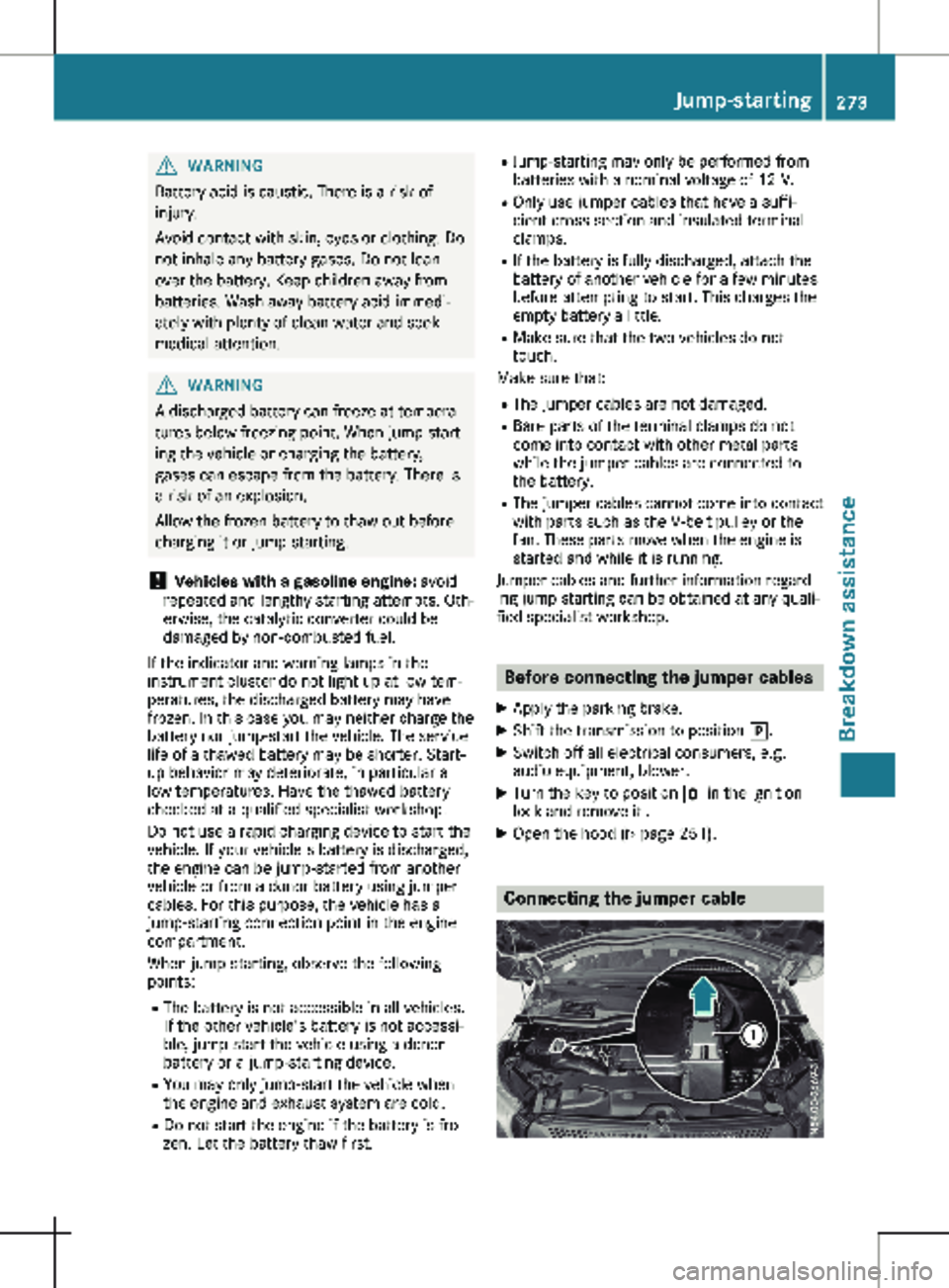
fied specialist workshop. Before connecting the jumper cables
X Apply the parking brake.
X Shift the transmission to position j.
X Switch off all electrical consumers, e.g.
audio equipment, blower.
X Turn the key to position u in the ignition
lock and remove it .
X Open the hood (Y page 251). Connecting the jumper cable Jump-starting
273
Breakdown assistance Z
Page 276 of 320
X
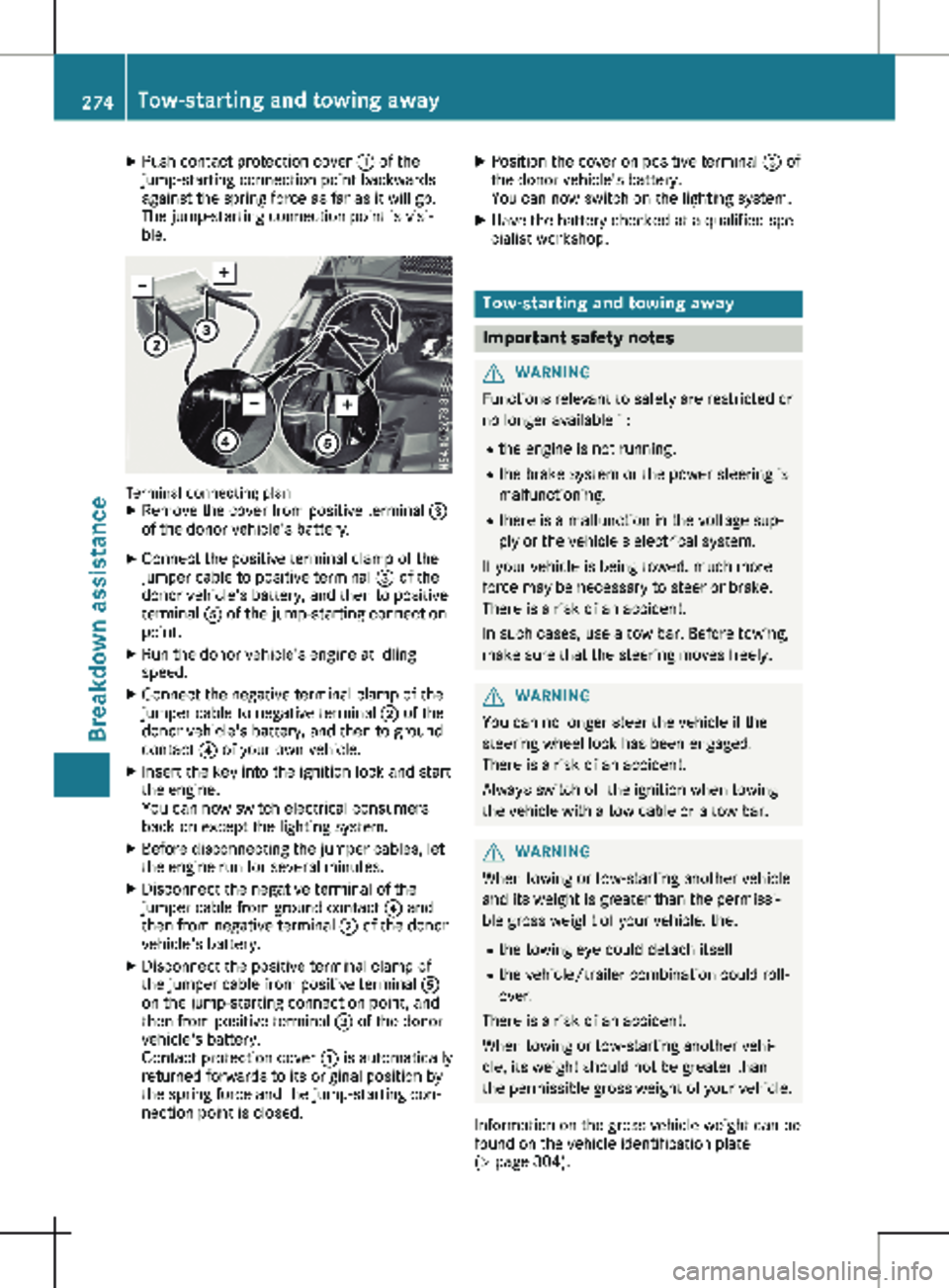
Push contact protection cover : of the
jump-starting connection point backwards
against the spring force as far as it will go.
The jump-starting connection point is visi-
ble. Terminal connecting plan
X Remove the cover from positive terminal =
of the donor vehicle's battery.
X Connect the positive terminal clamp of the
jumper cable to positive terminal = of the
donor vehicle's battery, and then to positive
terminal A of the jump-starting connection
point.
X Run the donor vehicle's engine at idling
speed.
X Connect the negative terminal clamp of the
jumper cable to negative terminal ; of the
donor vehicle's battery, and then to ground
contact ? of your own vehicle.
X Insert the key into the ignition lock and start
the engine.
You can now switch electrical consumers
back on except the lighting system.
X Before disconnecting the jumper cables, let
the engine run for several minutes.
X Disconnect the negative terminal of the
jumper cable from ground contact ? and
then from negative terminal ; of the donor
vehicle's battery.
X Disconnect the positive terminal clamp of
the jumper cable from positive terminal A
on the jump-starting connection point, and
then from positive terminal = of the donor
vehicle's battery.
Contact protection cover : is automatically
returned forwards to its original position by
the spring force and the jump-starting con-
nection point is closed. X
Position the cover on positive terminal = of
the donor vehicle's battery.
You can now switch on the lighting system.
X Have the battery checked at a qualified spe-
cialist workshop. Tow-starting and towing away
Important safety notes
G
WARNING
Functions relevant to safety are restricted or
no longer available if:
R the engine is not running.
R the brake system or the power steering is
malfunctioning.
R there is a malfunction in the voltage sup-
ply or the vehicle's electrical system.
If your vehicle is being towed, much more
force may be necessary to steer or brake.
There is a risk of an accident.
In such cases, use a tow bar. Before towing,
make sure that the steering moves freely. G
WARNING
You can no longer steer the vehicle if the
steering wheel lock has been engaged.
There is a risk of an accident.
Always switch off the ignition when towing
the vehicle with a tow cable or a tow bar. G
WARNING
When towing or tow-starting another vehicle
and its weight is greater than the permissi-
ble gross weight of your vehicle, the:
R the towing eye could detach itself
R the vehicle/trailer combination could roll-
over.
There is a risk of an accident.
When towing or tow-starting another vehi-
cle, its weight should not be greater than
the permissible gross weight of your vehicle.
Information on the gross vehicle weight can be
found on the vehicle identification plate
(Y page
304).274
Tow-starting and towing away
Breakdown assistance
Page 288 of 320
For further information on displaying the cur-
rent tire pressures, refer to "Checking the tire
pressure electronically"
(Y page 287).
Important safety notes G
WARNING
Risk of accident due to incorrect tire
pressure
Each tire, including the spare (if provided),
should be checked monthly when cold and
inflated to the inflation pressure recommen-
ded by the vehicle manufacturer on the vehi-
cle placard or tire inflation pressure label. (If
your vehicle has tires of a different size than
the size indicated on the vehicle placard or
the tire inflation pressure label, you should
determine the proper tire inflation pressure
for those tires.)
As an added safety feature, your vehicle has
been equipped with a tire pressure monitor-
ing system (TPMS) that illuminates a low tire
pressure telltale when one or more of your
tires is significantly under-inflated. Accord-
ingly, when the low tire pressure telltale illu-
minates, you should stop and check your
tires as soon as possible, and inflate them to
the proper pressure. Driving on a signifi-
cantly under-inflated tire causes the tire to
overheat and can lead to tire failure. Under-
inflation also reduces fuel efficiency and tire
tread life, and may affect the vehicle's han-
dling and stopping ability.
Please note that the TPMS is not a substi-
tute for proper tire maintenance, and it is
the driver's responsibility to maintain cor-
rect tire pressure, even if under-inflation has
not reached the level to trigger illumination
of the TPMS low tire pressure telltale.
Your vehicle has also been equipped with a
TPMS malfunction indicator to indicate
when the system is not operating properly.
The TPMS malfunction indicator is combined
with the low tire pressure telltale. When the
system detects a malfunction, the telltale
will flash for approximately one minute and
then remain continuously illuminated. This sequence will continue upon subsequent
vehicle start-ups as long as the malfunction
exists.
When the malfunction indicator is illumina-
ted, the system may not be able to detect or
signal low tire pressure as intended. TPMS
malfunctions may occur for a variety of rea-
sons, including the installation of replace-
ment or alternate tires or wheels on the
vehicle that prevent the TPMS from func-
tioning properly.
Always check the TPMS malfunction telltale
after replacing one or more tires or wheels
on your vehicle to ensure that the replace-
ment or alternate tires and wheels allow the
TPMS to continue to function properly.
It is the driver's responsibility to set the tire
pressure to the recommended cold tire pres-
sure suitable for the operating conditions
(Y page
282).
Note that the correct tire pressure for the cur-
rent operating conditions must first be pro-
gramed into the tire pressure monitor. If a sub-
stantial pressure loss occurs, the warning
threshold for the warning message is aligned
to the taught-in reference values. Restart the
tire pressure monitor after adjusting the cold
tire pressure ( Y page 288). The current pres-
sures are saved as new reference values. This
will ensure that a warning message will only
appear if the tire pressure drops significantly.
The tire pressure monitor does not warn you if
a tire pressure is incorrect. Observe the notes
on the recommended tire pressure
(Y page 282).
The tire pressure monitor is not able to warn
you of a sudden loss of pressure, e.g. following
penetration by a foreign object. In this event,
brake the vehicle until it comes to a standstill.
Avoid sudden steering movements.
The tire pressure monitor has a yellow h
warning lamp in the instrument cluster for indi-
cating pressure loss/malfunctions (USA) or
pressure loss (Canada). Depending on how the
warning lamp flashes or lights up, an underin-
flated tire or a malfunction in the tire pressure
monitor is displayed:
R if the h warning lamp is lit continuously,
the tire pressure on one or more tires is sig- 286
Tire pressure
Wheels and tires