wheel MERCEDES-BENZ METRIS 2020 MY20 Operator’s Manual
[x] Cancel search | Manufacturer: MERCEDES-BENZ, Model Year: 2020, Model line: METRIS, Model: MERCEDES-BENZ METRIS 2020Pages: 320, PDF Size: 26.38 MB
Page 69 of 320
ABS (Anti-lock Braking System)
General notes ABS regulates brake pressure in such a way
that the wheels do not lock when you brake.
This allows you to continue steering the vehi-
cle when braking.
The ò warning lamp in the instrument clus-
ter lights up when the ignition is switched on.
The lamp goes out when the engine starts run-
ning.
Important safety notes Observe the important safety guidelines for
the driving safety system (
Y page
66).
ABS works from a speed of about 5 mph
(8 km/h), regardless of road-surface condi-
tions. ABS works on slippery surfaces, even
when you only brake gently. G
WARNING
If ABS is faulty, the wheels could lock when
braking. The steerability and braking charac-
teristics may be severely impaired. Addition-
ally, further driving safety systems are deac-
tivated. There is an increased danger of
skidding and accidents.
Drive on carefully. Have ABS checked imme-
diately at a qualified specialist workshop.
If ABS is malfunctioning, the ò warning
lamp
(Y page 230) lights up while the engine
is running and the display shows a message:
R on vehicles without steering wheel buttons
(Y page 196)
R on vehicles with steering wheel buttons
(Y page 210)
BAS, Hill Start Assist and ESP ®
and its driving
safety systems and other driving systems also
fail. Observe the notes on the ò warning
lamp and the display messages.
Braking If ABS intervenes when braking, you will feel a
pulsating in the brake pedal.
The pulsating brake pedal can be an indication
of hazardous road conditions and functions as
a reminder to take extra care while driving. X
If ABS intervenes: continue to depress the
brake pedal with force until the braking sit-
uation is over.
X To make a full brake application: depress
the brake pedal with full force. BAS (Brake Assist System)
General notes BAS operates in emergency braking situations.
If you depress the brake pedal quickly, BAS
automatically boosts the braking force, thus
shortening the stopping distance.
Important safety notes Observe the important safety guidelines for
the driving safety system
(Y page 66). G
WARNING
If BAS is malfunctioning, the braking dis-
tance in an emergency braking situation is
increased. There is a risk of an accident.
In an emergency braking situation, depress
the brake pedal with full force. ABS prevents
the wheels from locking.
If BAS is malfunctioning, the ÷ warning
lamp lights up while the engine is running
(Y page
230) and the display shows a mes-
sage:
R on vehicles without steering wheel buttons
(Y page 200)
R on vehicles with steering wheel buttons
(Y page 214)
Braking X
Keep the brake pedal firmly depressed until
the emergency braking situation is over.
ABS prevents the wheels from locking.
The brakes will function as usual once you
release the brake pedal. BAS is deactivated. Driving safety systems
67
Safety Z
Page 70 of 320
EBD (electronic brake force distribu-
tion)
General notes EBD monitors and controls the brake pressure
to the rear wheels. This enables EBD to
improve handling during braking.
Important safety notes Observe the important safety guidelines for
the driving safety system
(Y page 66).G
WARNING
If EBD is malfunctioning, the rear wheels can
lock, e.g. under full braking. This increases
the risk of skidding and an accident.
You should therefore adapt your driving
style to the different handling characteris-
tics. Have the brake system checked at a
qualified specialist workshop.
If EBD is malfunctioning, the $ warning
lamp
(Y page 229) lights up while the engine
is running and the display shows a message:
R on vehicles without steering wheel buttons
(Y page 199)
R on vehicles with steering wheel buttons
(Y page 213)
Other driving systems and driving safety sys-
tems then also fail. ESP
®
(Electronic Stability Program)
General notes ESP
®
monitors driving stability and detects a
tendency of the vehicle to understeer or over-
steer (skidding) in good time. If ESP ®
detects
that the vehicle is deviating from the direction
desired by the driver, one or more wheels are
braked to stabilize the vehicle. The engine out-
put is also modified to keep the vehicle on the
desired course within physical limits. ESP ®
can
also stabilize the vehicle during braking.
ESP ®
also monitors traction, i.e. power trans-
mission between the tires and the road sur-
face. The integrated traction control supports
you when pulling away or accelerating on wet,
slippery or slick roads. Should the drive
wheels spin, traction control brakes them indi- vidually. In addition, greater drive torque is
transmitted to the wheel or wheels with trac-
tion. If traction on the road surface is not suffi-
cient, even ESP
®
will not allow you to pull
away without difficulty. The type of tires and
total weight of the vehicle as well as the gradi-
ent of the road also play a crucial role. Trac-
tion control remains active if you deactivate
ESP ®
.
If the h warning lamp in the instrument
cluster goes out before beginning the journey,
ESP ®
is automatically active.
The h warning lamp in the instrument clus-
ter flashes when ESP ®
intervenes:
X do not deactivate ESP ®
under any circum-
stances.
X when driving off, apply as little throttle as
possible.
X adapt your speed and driving style to the
prevailing road conditions.
Important safety notes Observe the important safety guidelines for
the driving safety system (
Y page
66). G
WARNING
If ESP ®
is malfunctioning it will not provide
any vehicle stabilization. There is an
increased risk of skidding or of an accident.
Exercise caution when continuing to drive.
Have ESP ®
checked at a qualified specialist
workshop.
! Do not run the vehicle on a roller dyna-
mometer (e.g. for performance tests). If you
must operate the vehicle on a roller dyna-
mometer, please consult a qualified special-
ist workshop in advance. You could other-
wise damage the drive train or the brake
system.
If ESP ®
is malfunctioning, the h warning
lamp
(Y page 230) lights up continuously
while the engine is running and the display
shows a message.
R on vehicles without steering wheel buttons
(Y page 200)
R on vehicles with steering wheel buttons
(Y page 214) 68
Driving safety systems
Safety
Page 71 of 320
ESP
®
is deactivated if the å warning lamp
in the instrument cluster is lit when the engine
is running.
Only use wheels with the recommended tire
sizes. Only then will ESP ®
function properly.
Deactivating or activating ESP ®G
WARNING
If you deactivate ESP ®
, ESP ®
no longer sta-
bilizes the vehicle. There is an increased risk
of skidding and an accident.
Only deactivate ESP ®
in the situations
described in the following.
It may be best to deactivate ESP ®
in the fol-
lowing situations:
R when using snow chains
R in deep snow
R on sand or gravel
Activate ESP ®
as soon as the situations descri-
bed above no longer apply. Otherwise, ESP ®
assistance for stabilizing the vehicle will
remain significantly reduced, even if the vehi-
cle starts to skid.
If you deactivate ESP ®
:
R the å warning lamp in the instrument
cluster lights up
R the ÷ warning lamp in the instrument
cluster flashes if the wheels are spinning
R ESP ®
assistance for stabilizing the vehicle in
the lower speed range up to approximately
37 mph (60 km/h
) is significantly reduced
R engine torque is no longer limited and the
drive wheels are able to spin. The spinning
of the wheels results in a cutting action for
better traction on loose surfaces
R traction control is still activated
R ESP ®
still provides support when you brake
Depending on the equipment in the vehicle,
you can activate or deactivate ESP ®
when the
engine is running by using the å button or
by using the on-board computer:
R on vehicles without steering wheel buttons
(Y page 179)
R on vehicles with steering wheel buttons
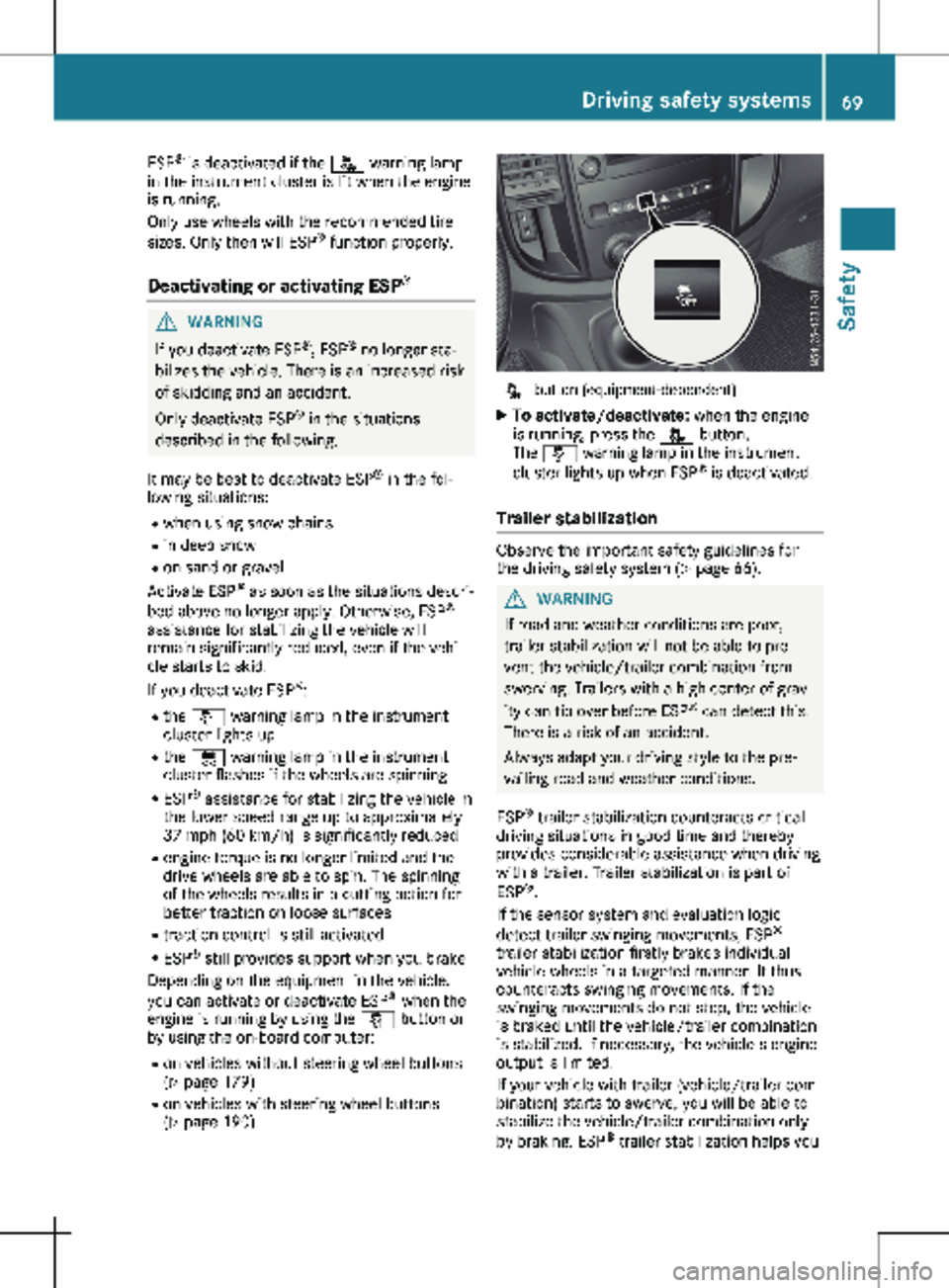
(Y page 190) å button (equipment-dependent)
X To activate/deactivate: when the engine
is running, press the å button.
The å warning lamp in the instrument
cluster lights up when ESP ®
is deactivated.
Trailer stabilization Observe the important safety guidelines for
the driving safety system (
Y page
66). G
WARNING
If road and weather conditions are poor,
trailer stabilization will not be able to pre-
vent the vehicle/trailer combination from
swerving. Trailers with a high center of grav-
ity can tip over before ESP ®
can detect this.
There is a risk of an accident.
Always adapt your driving style to the pre-
vailing road and weather conditions.
ESP ®
trailer stabilization counteracts critical
driving situations in good time and thereby
provides considerable assistance when driving
with a trailer. Trailer stabilization is part of
ESP ®
.
If the sensor system and evaluation logic
detect trailer swinging movements, ESP ®
trailer stabilization firstly brakes individual
vehicle wheels in a targeted manner. It thus
counteracts swinging movements. If the
swinging movements do not stop, the vehicle
is braked until the vehicle/trailer combination
is stabilized. If necessary, the vehicle's engine
output is limited.
If your vehicle with trailer (vehicle/trailer com-
bination) starts to swerve, you will be able to
stabilize the vehicle/trailer combination only
by braking. ESP ®
trailer stabilization helps you Driving safety systems
69
Safety Z
Page 74 of 320
X
To unlock the sliding doors and the tail-
gate or rear-end door only
: press the 5
button.
The turn signals flash once.
i If you do not open the vehicle within
approximately 40 seconds of unlocking, the
vehicle will lock again. The anti-theft protec-
tion is activated again.
X To lock centrally: press the & button.
The indicator lamps flash three times if:
R the anti-theft protection is armed.
R all the doors and the liftgate or rear-end
door are closed
X Check the locking knobs on all the doors.
The locking knobs must all be in the lowered
position.
The key's factory setting enables you to cen-
trally lock and unlock the following:
R the driver's door and co-driver's door
R the sliding doors
R the tailgate or rear-end door
In an emergency, the driver's door can also be
unlocked manually using the mechanical key
(Y page
72).
You can also set an audible signal to confirm
that the vehicle has been locked. The audible
locking-verification signal can be switched on/
off:
R using the on-board computer on vehicles
with steering wheel buttons ( Y page 194)
R at a specialist qualified workshop for vehi-
cles without steering wheel buttons
After unlocking using the remote control, the
surround lighting also goes on in the dark. For
vehicles with steering wheel buttons, the sur-
round lighting can be activated and deactiva-
ted in the on-board computer ( Y page 193).Changing the settings of the locking
system
You can change the settings of the locking
system. Press the % button to unlock:
R the driver's and co-driver's door (Cargo Van)
or
R the driver's door (Passenger Van)
X To change the setting: press and hold
down the % and & buttons simultane- ously until the indicator lamp flashes twice
(Y page
71).
If the setting of the locking system is changed
within the signal range of the vehicle, press
the & or % button to:
R lock or
R unlock the vehicle
The key now functions as follows:
X To unlock the driver's door or front
doors: press the % button once.
X To unlock centrally: briefly press the %
button twice.
X To lock centrally: press the & button.
X To restore factory settings: press and
hold down the % and & buttons
simultaneously until the indicator lamp
flashes twice ( Y page
71).
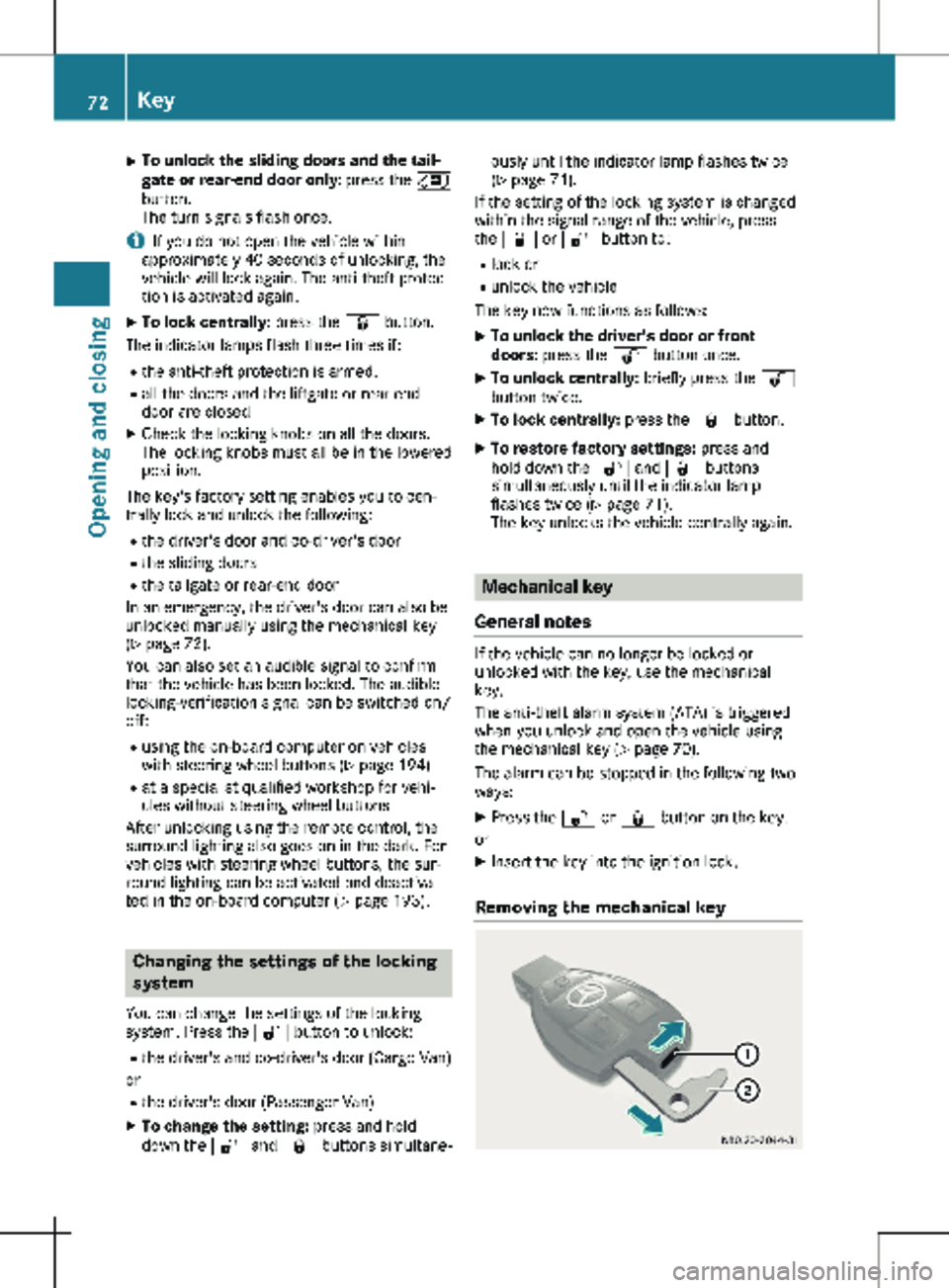
The key unlocks the vehicle centrally again. Mechanical key
General notes If the vehicle can no longer be locked or
unlocked with the key, use the mechanical
key.
The anti-theft alarm system (ATA) is triggered
when you unlock and open the vehicle using
the mechanical key
(Y page 70).
The alarm can be stopped in the following two
ways:
X Press the % or & button on the key.
or X Insert the key into the ignition lock.
Removing the mechanical key 72
Key
Opening and closing
Page 89 of 320
Useful information
This Operator's Manual describes all models
as well as standard and optional equipment of
your vehicle that were available at the time of
going to print. Country-specific variations are
possible. Note that your vehicle may not be
equipped with all of the described functions.
This also applies to systems and functions rel-
evant to safety.
Read the information on qualified specialist
workshops (Y page
32).Seats
Driver's and co-driver's seat
Important safety notes G
WARNING
Children could become trapped if they
adjust the seats, particularly when unatten-
ded. There is a risk of injury.
When leaving the vehicle, always take the
SmartKey with you and lock the vehicle.
Never leave children unsupervised in the
vehicle. G
WARNING
You could lose control of your vehicle if you
do the following while driving:
R adjust the driver's seat, head restraint,
steering wheel or mirrors
R fasten the seat belt
There is a risk of an accident.
Adjust the driver's seat, head restraint,
steering wheel and mirror and fasten your
seat belt before starting the engine. G
WARNING
When you adjust a seat, you or other vehicle
occupants could become trapped, e.g. on
the seat guide rail. There is a risk of injury.
When adjusting a seat, make sure that no
one has any body parts in the sweep of the
seat. G
WARNING
If the driver's seat is not engaged, it could
move unexpectedly while the vehicle is in
motion. This could cause you to lose control
of the vehicle. There is a risk of an accident.
Always make sure that the driver's seat is
engaged before starting the vehicle. G
WARNING
The front-air bags for could also injure the
vehicle occupants in the front If the front
seats are positioned too close to the dash-
board or steering wheel. This poses an
increased risk of injury or even fatal injury.
Always adjust the front seats so that they
are as far from the front air bags as possi-
ble. Also observe the notes on the correct
adjustment of the seats. G
WARNING
The seat belt does not offer the intended
level of protection if you have not moved the
backrest to an almost vertical position.
When braking or in the event of an accident,
you could slide underneath the seat belt and
sustain abdomen or neck injuries, for exam-
ple. This poses an increased risk of injury or
even fatal injury.
Adjust the seat properly before beginning
your journey. Always ensure that the back-
rest is in an almost vertical position and that
the shoulder section of your seat belt is
routed across the center of your shoulder. G
WARNING
If the head restraints are not installed or not
adjusted correctly, they cannot provide pro-
tection as intended. There is an increased
risk of injury in the head and neck area, e.g.
in the event of an accident or when braking.
Always drive with the head restraints instal-
led. Before driving off, make sure for every
vehicle occupant that the center of the head
restraint supports the back of the head at
about eye level. Seats
87
Seats, steering wheel and mirrors Z
Page 90 of 320
!
To prevent damage to the seats and the
seat heating, observe the following notes:
R Do not spill liquids onto the seats. Dry the
seats as soon as possible if liquid does
get spilled on the seats.
R If the seat covers are damp or wet, do not
switch on the seat heating. Also, do not
use the seat heating to dry the seats.
R Clean the seat covers as recommended;
see the "Interior care" section.
R Do not transport heavy loads on the
seats. Do not place pointed objects on
the seat cushions such as knives, nails or
tools. Where possible, use the seats only
for carrying passengers.
R When operating the seat heating, do not
cover the seats with insulating materials,
e.g. blankets, coats, bags, protective cov-
ers, child seats or booster seats.
R When the seat heating is switched on, the
seat surface can be damaged as a result
of objects being placed on the seats, for
example, seat cushions, child seats and
protective covers not approved by
Mercedes-Benz.
Your seat must be adjusted in such a way that
you can wear the seat belt correctly.
Observe the following points:
R Position the backrest in an almost vertical
position so that you are sitting virtually
upright. Do not drive with the backrest
reclined too far back.
R Your arms should be slightly bent when you
are holding the steering wheel.
R Avoid seat positions that prevent the seat
belt from being correctly routed. The shoul-
der section of the belt must be routed over
the middle of your shoulder and be pulled
tight against your upper body. The lap belt
must always pass across your lap as low
down as possible, i.e. over your hip joints.
R Adjust the head restraint so that it supports
the back of the head at eye level.
R The distance from the pedals should be
such that you can depress them fully.
Please also observe the important safety notes
on "Air bags"
(Y page 51), "Seat belts"
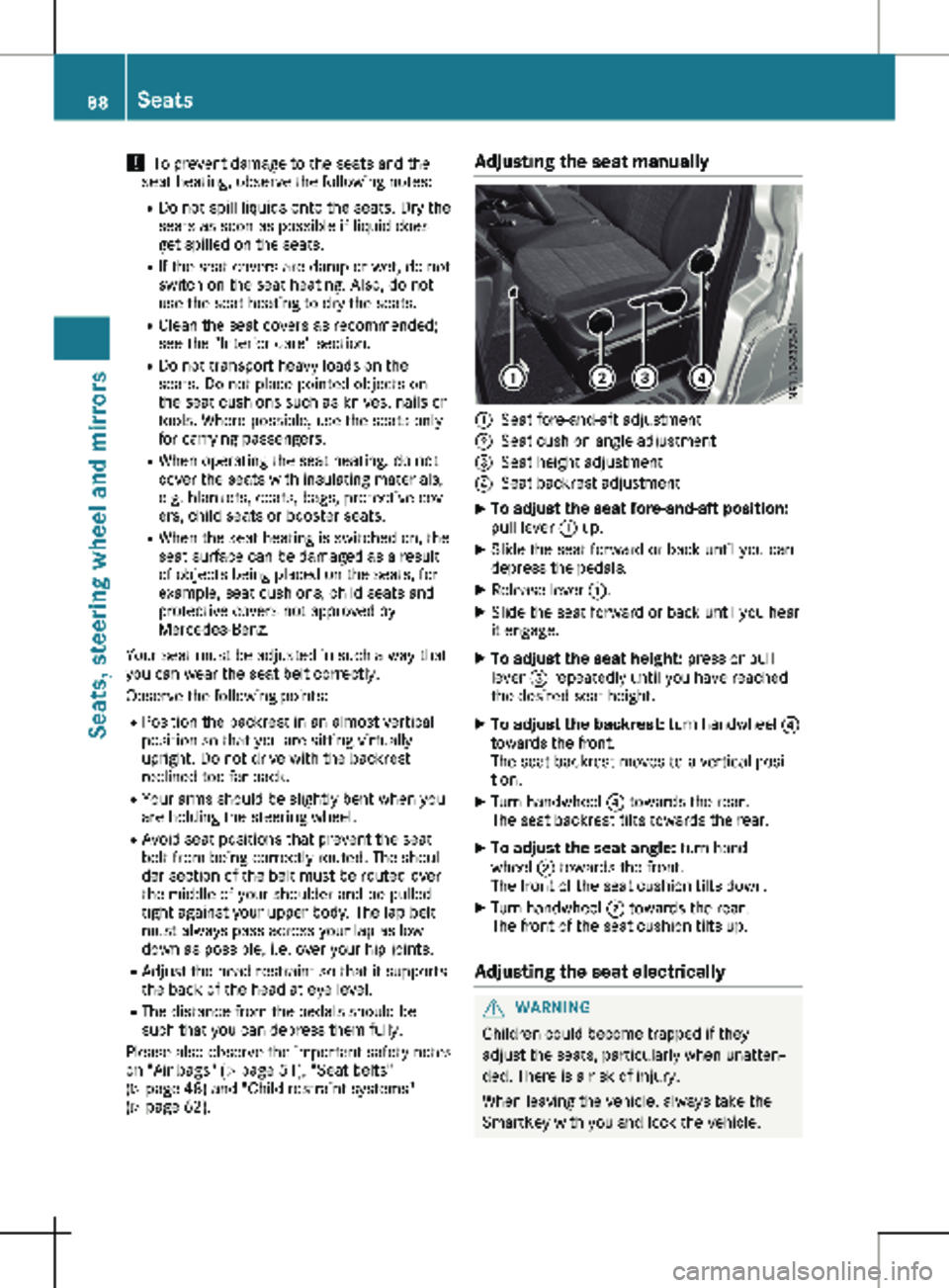
(Y page 48) and "Child restraint systems" ( Y page 62). Adjusting the seat manually
:
Seat fore-and-aft adjustment
; Seat cushion angle adjustment
= Seat height adjustment
? Seat backrest adjustment
X To adjust the seat fore-and-aft position:
pull lever
: up.
X Slide the seat forward or back until you can
depress the pedals.
X Release lever :.
X Slide the seat forward or back until you hear
it engage.
X To adjust the seat height: press or pull
lever = repeatedly until you have reached
the desired seat height.
X To adjust the backrest: turn handwheel ?
towards the front.
The seat backrest moves to a vertical posi-
tion.
X Turn handwheel ? towards the rear.
The seat backrest tilts towards the rear.
X To adjust the seat angle: turn hand-
wheel ; towards the front.
The front of the seat cushion tilts down.
X Turn handwheel ; towards the rear.
The front of the seat cushion tilts up.
Adjusting the seat electrically G
WARNING
Children could become trapped if they
adjust the seats, particularly when unatten-
ded. There is a risk of injury.
When leaving the vehicle, always take the
SmartKey with you and lock the vehicle. 88
Seats
Seats, steering wheel and mirrors
Page 91 of 320
Never leave children unsupervised in the
vehicle.
The seats can be adjusted when the key is
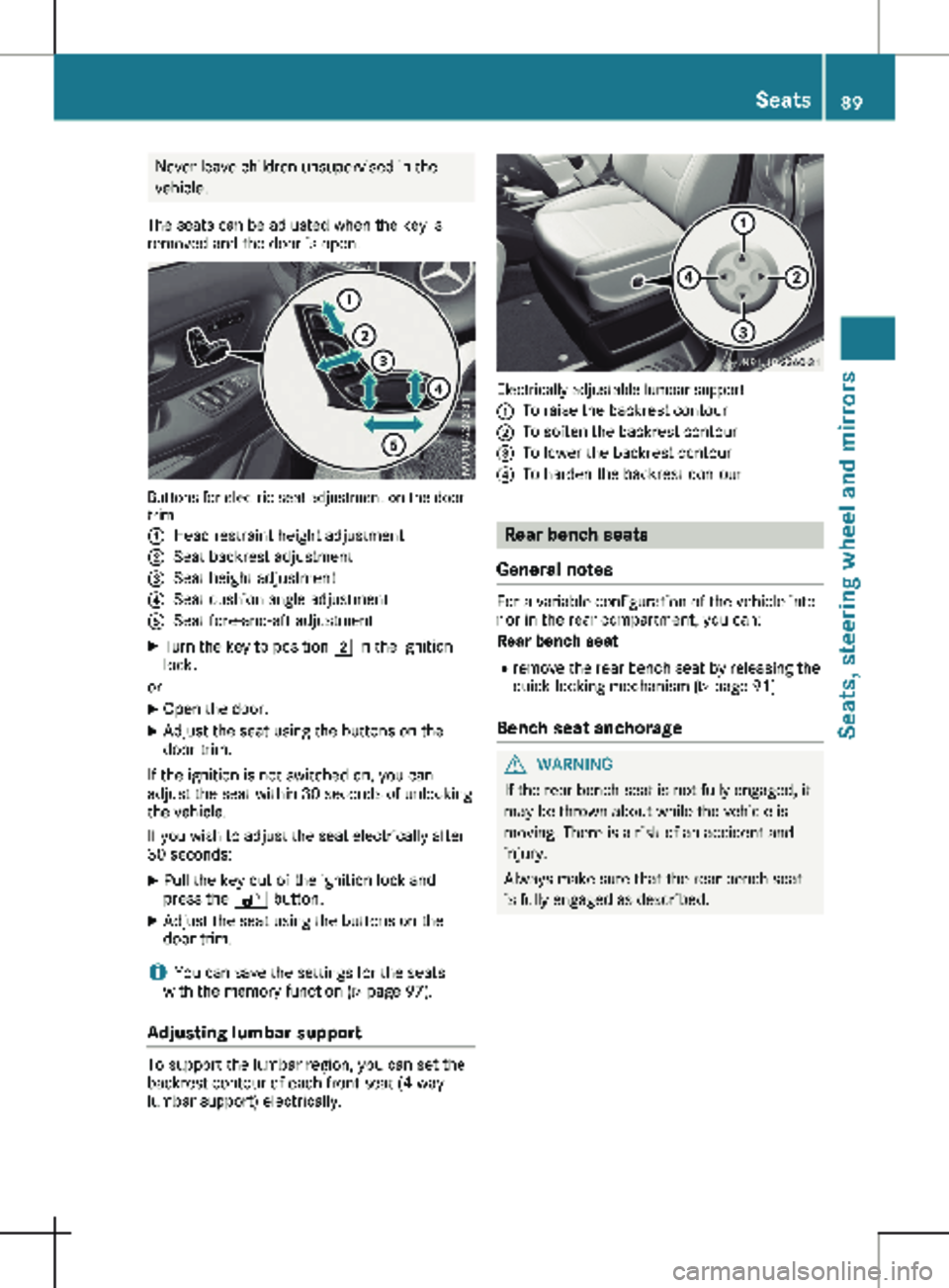
removed and the door is open. Buttons for electric seat adjustment on the door
trim
:
Head restraint height adjustment
; Seat backrest adjustment
= Seat height adjustment
? Seat cushion angle adjustment
A Seat fore-and-aft adjustment
X Turn the key to position 2 in the ignition
lock.
or X Open the door.
X Adjust the seat using the buttons on the
door trim.
If the ignition is not switched on, you can
adjust the seat within 30 seconds of unlocking
the vehicle.
If you wish to adjust the seat electrically after
30 seconds:
X Pull the key out of the ignition lock and
press the % button.
X Adjust the seat using the buttons on the
door trim.
i You can save the settings for the seats
with the memory function (Y page
97).
Adjusting lumbar support To support the lumbar region, you can set the
backrest contour of each front seat (4-way
lumbar support) electrically. Electrically adjustable lumbar support
:
To raise the backrest contour
; To soften the backrest contour
= To lower the backrest contour
? To harden the backrest contour Rear bench seats
General notes For a variable configuration of the vehicle inte-
rior in the rear compartment, you can:
Rear bench seat
R remove the rear bench seat by releasing the
quick-locking mechanism (Y page
91)
Bench seat anchorage G
WARNING
If the rear bench seat is not fully engaged, it
may be thrown about while the vehicle is
moving. There is a risk of an accident and
injury.
Always make sure that the rear bench seat
is fully engaged as described. Seats
89
Seats, steering wheel and mirrors Z
Page 92 of 320
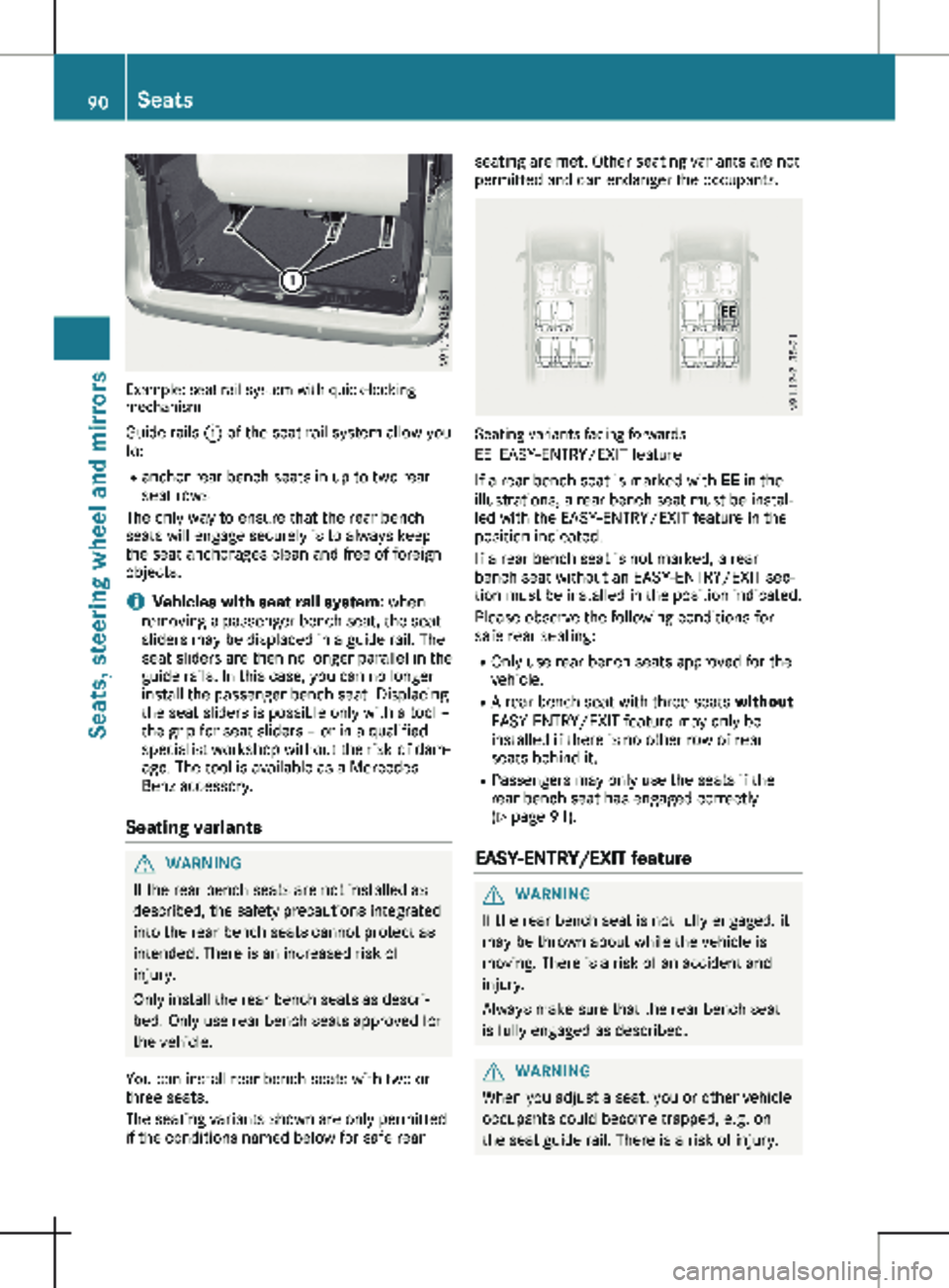
Example: seat rail system with quick-locking
mechanism
Guide rails : of the seat rail system allow you
to:
R anchor rear bench seats in up to two rear
seat rows
The only way to ensure that the rear bench
seats will engage securely is to always keep
the seat anchorages clean and free of foreign
objects.
i Vehicles with seat rail system: when
removing a passenger bench seat, the seat
sliders may be displaced in a guide rail. The
seat sliders are then no longer parallel in the
guide rails. In this case, you can no longer
install the passenger bench seat. Displacing
the seat sliders is possible only with a tool –
the grip for seat sliders – or in a qualified
specialist workshop without the risk of dam-
age. The tool is available as a Mercedes-
Benz accessory.
Seating variants G
WARNING
If the rear bench seats are not installed as
described, the safety precautions integrated
into the rear bench seats cannot protect as
intended. There is an increased risk of
injury.
Only install the rear bench seats as descri-
bed. Only use rear bench seats approved for
the vehicle.
You can install rear bench seats with two or
three seats.
The seating variants shown are only permitted
if the conditions named below for safe rear seating are met. Other seating variants are not
permitted and can endanger the occupants.
Seating variants facing forwards
EE
EASY-ENTRY/EXIT feature
If a rear bench seat is marked with EE in the
illustrations, a rear bench seat must be instal-
led with the EASY-ENTRY/EXIT feature in the
position indicated.
If a rear bench seat is not marked, a rear
bench seat without an EASY-ENTRY/EXIT sec-
tion must be installed in the position indicated.
Please observe the following conditions for
safe rear seating:
R Only use rear bench seats approved for the
vehicle.
R A rear bench seat with three seats without
EASY-ENTRY/EXIT feature may only be
installed if there is no other row of rear
seats behind it.
R Passengers may only use the seats if the
rear bench seat has engaged correctly
( Y page
91).
EASY-ENTRY/EXIT feature G
WARNING
If the rear bench seat is not fully engaged, it
may be thrown about while the vehicle is
moving. There is a risk of an accident and
injury.
Always make sure that the rear bench seat
is fully engaged as described. G
WARNING
When you adjust a seat, you or other vehicle
occupants could become trapped, e.g. on
the seat guide rail. There is a risk of injury. 90
Seats
Seats, steering wheel and mirrors
Page 93 of 320
When adjusting a seat, make sure that no
one has any body parts in the sweep of the
seat. G
WARNING
The rear bench seat will not engage when
folded forward. The rear bench seat may
inadvertently fold backward while accelerat-
ing, braking, changing direction suddenly or
in the event of an accident, for example.
People within the sweep of the rear bench
seat may become trapped. There is a risk of
injury.
Before driving off, always fold back the rear
bench seat if it is folded forward. Make sure
that the rear bench seat is fully engaged.
The only way to ensure that the rear bench
seat will engage securely is to always keep the
seat anchorages clean and free of foreign
objects.
The rear seat leg is only engaged when the red
indicator tab is no longer visible and is fully
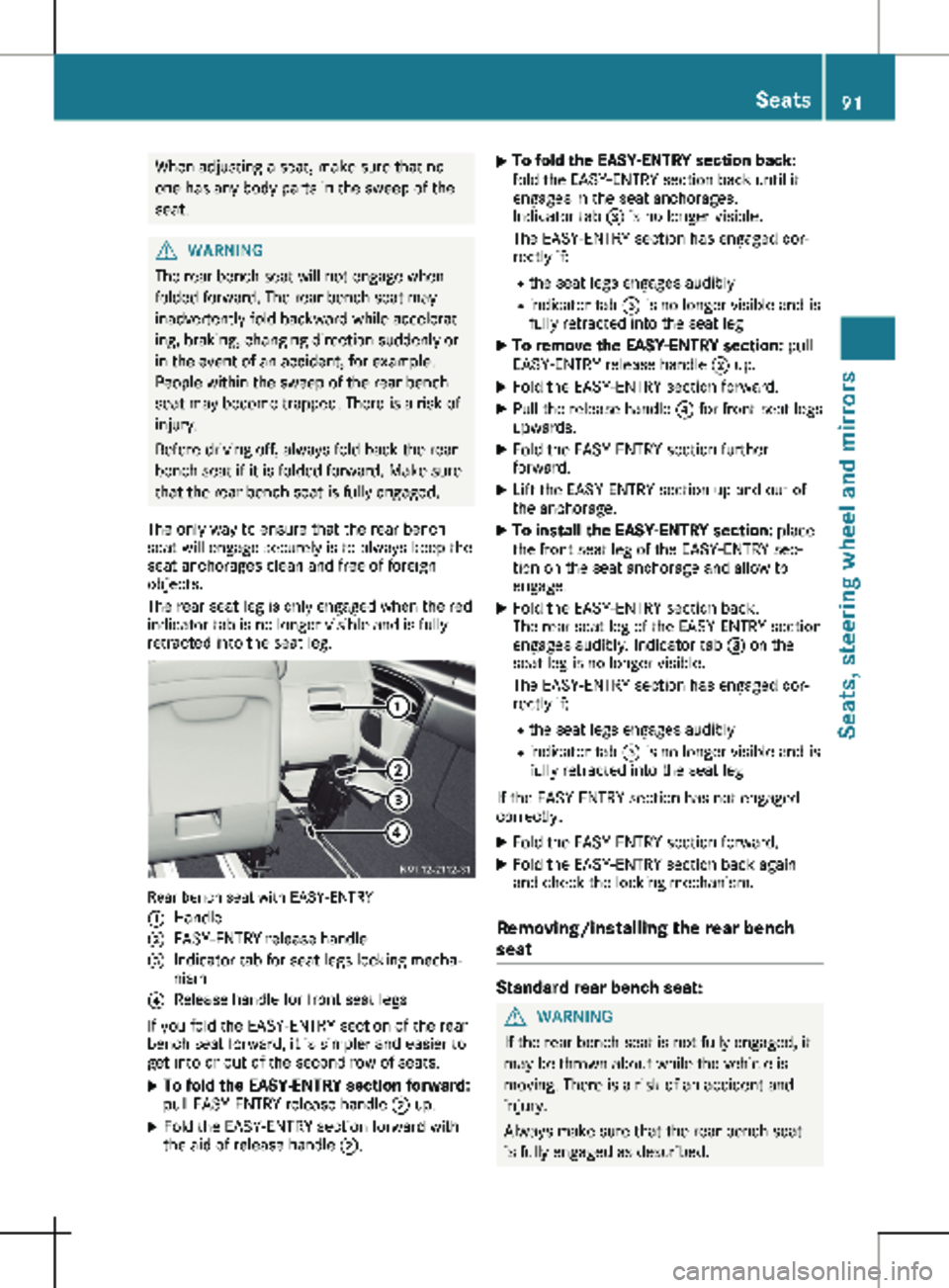
retracted into the seat leg. Rear bench seat with EASY-ENTRY
:
Handle
; EASY-ENTRY release handle
= Indicator tab for seat legs locking mecha-
nism
? Release handle for front seat legs
If you fold the EASY-ENTRY section of the rear
bench seat forward, it is simpler and easier to
get into or out of the second row of seats.
X To fold the EASY-ENTRY section forward:
pull EASY-ENTRY release handle ; up.
X Fold the EASY-ENTRY section forward with
the aid of release handle ;.X
To fold the EASY-ENTRY section back:
fold the EASY-ENTRY section back until it
engages in the seat anchorages.
Indicator tab = is no longer visible.
The EASY-ENTRY section has engaged cor-
rectly if:
R the seat legs engages audibly
R indicator tab = is no longer visible and is
fully retracted into the seat leg
X To remove the EASY-ENTRY section: pull
EASY-ENTRY release handle ; up.
X Fold the EASY-ENTRY section forward.
X Pull the release handle ? for front seat legs
upwards.
X Fold the EASY-ENTRY section further
forward.
X Lift the EASY-ENTRY section up and out of
the anchorage.
X To install the EASY-ENTRY section: place
the front seat leg of the EASY-ENTRY sec-
tion on the seat anchorage and allow to
engage.
X Fold the EASY-ENTRY section back.
The rear seat leg of the EASY-ENTRY section
engages audibly. Indicator tab = on the
seat leg is no longer visible.
The EASY-ENTRY section has engaged cor-
rectly if:
R the seat legs engages audibly
R indicator tab = is no longer visible and is
fully retracted into the seat leg
If the EASY-ENTRY section has not engaged
correctly: X Fold the EASY-ENTRY section forward.
X Fold the EASY-ENTRY section back again
and check the locking mechanism.
Removing/installing the rear bench
seat Standard rear bench seat:
G
WARNING
If the rear bench seat is not fully engaged, it
may be thrown about while the vehicle is
moving. There is a risk of an accident and
injury.
Always make sure that the rear bench seat
is fully engaged as described. Seats
91Seats, steering wheel and mirrors Z
Page 94 of 320
G
WARNING
If the rear bench seat is not installed as
described or an unsuitable rear bench seat
is installed, the seat belts may not provide
protection as intended. There is an
increased risk of injury.
Install the rear bench seat as described.
Only use rear bench seats that are approved
for your vehicle by the distributor named on
the inside cover page.
The only way to ensure that the rear bench
seat will engage securely is to always keep the
seat anchorages clean and free of foreign
objects.
Always observe the notes about the seating
variants (Y page
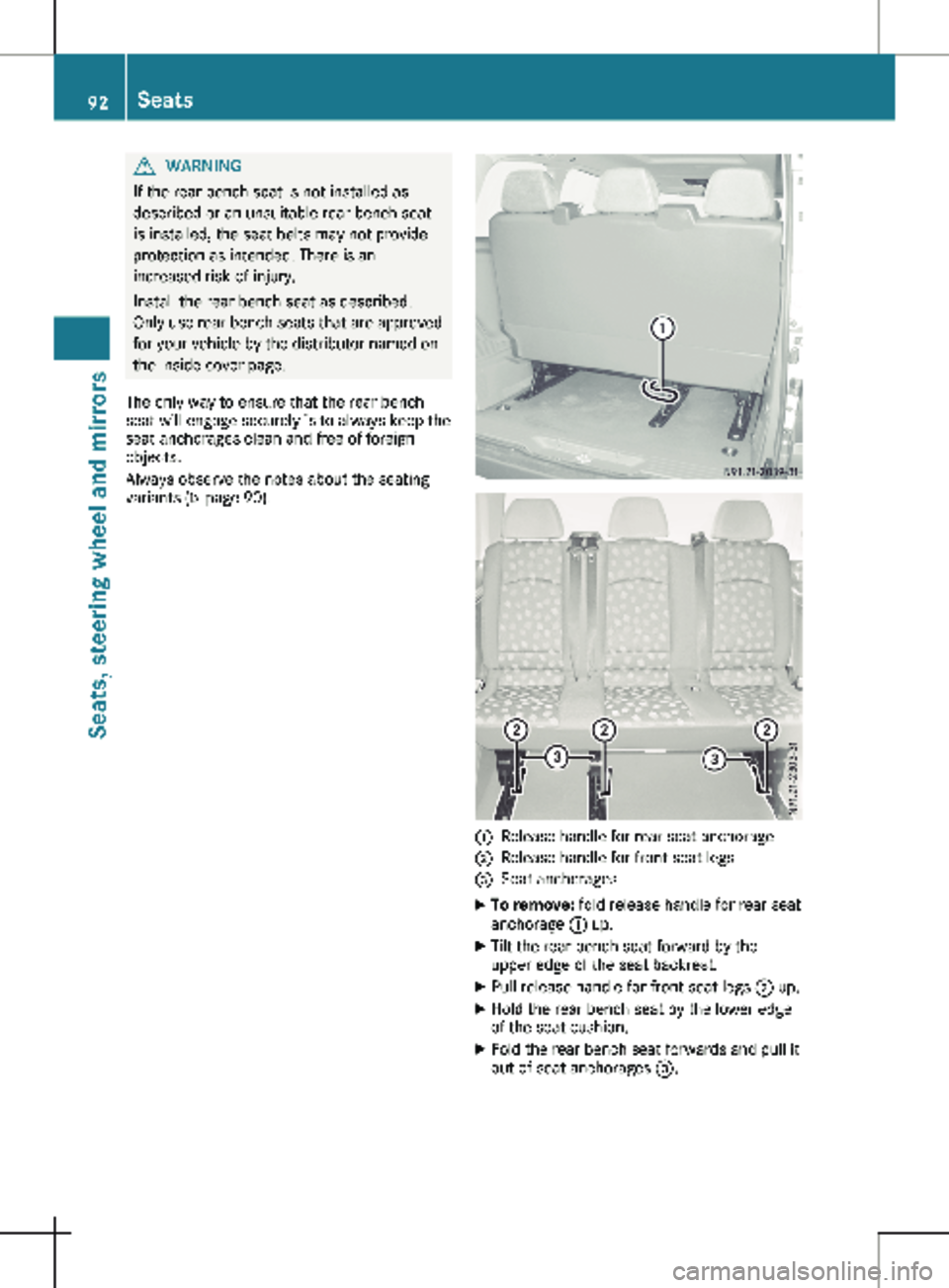
90). :
Release handle for rear seat anchorage
; Release handle for front seat legs
= Seat anchorages
X To remove: fold release handle for rear seat
anchorage : up.
X Tilt the rear bench seat forward by the
upper edge of the seat backrest.
X Pull release handle for front seat legs ; up.
X Hold the rear bench seat by the lower edge
of the seat cushion.
X Fold the rear bench seat forwards and pull it
out of seat anchorages =.92
Seats
Seats, steering wheel and mirrors