sensor MERCEDES-BENZ ML320 1997 Complete Repair Manual
[x] Cancel search | Manufacturer: MERCEDES-BENZ, Model Year: 1997, Model line: ML320, Model: MERCEDES-BENZ ML320 1997Pages: 4133, PDF Size: 88.89 MB
Page 2198 of 4133
Position sensor
Repair materials
REMOVE/INSTALL KNOCK SENSORS - AR15.12-P-2184A
ENGINE 112.910 in MODEL 202.026 /086
ENGINE 112.920 in MODEL 202.029 /089
ENGINE 112.921 in MODEL 210.063 /081 /263 /281
ENGINE 112.922 in MODEL 220.063 /163
ENGINE 112.923 in MODEL 129.059
ENGINE 112.940 in MODEL 208.365 /465
ENGINE 112.941 in MODEL 210.065/082/265/282
ENGINE 112.942 in MODEL 163.154
ENGINE 112.943 in MODEL 129.064
carried out with STAR-
DIAGNOSIS in the menu
item control unit
adaptations.
NumberDesignationEngine
112.910/911/
912/913/914/
915/916/917/
920/921/922/
923/940/941/
942/943/944/
945/946/947/
949/951/953/
954/955/960/
961/970/972/
973/975/976Engine
113.940/941/
942/943/944/
948/960/961/
962/963/964/
965/966/967/
968/969/971/
980/981/982/
984/986/992/
993/995
BA15.10-P-1001-
03ACrankshaft position
sensor to engine
blockNm88
NumberDesignationOrder number
BR00.45-Z-1002-06Alubricating pasteA 000 989 01 60
2001 Mercedes-Benz ML320
1998-2005 ENGINE Electrical System - Engine - 163 Chassis
me
Saturday, October 02, 2010 3:18:54 PMPage 44 © 2006 Mitchell Repair Information Company, LLC.
Page 2201 of 4133
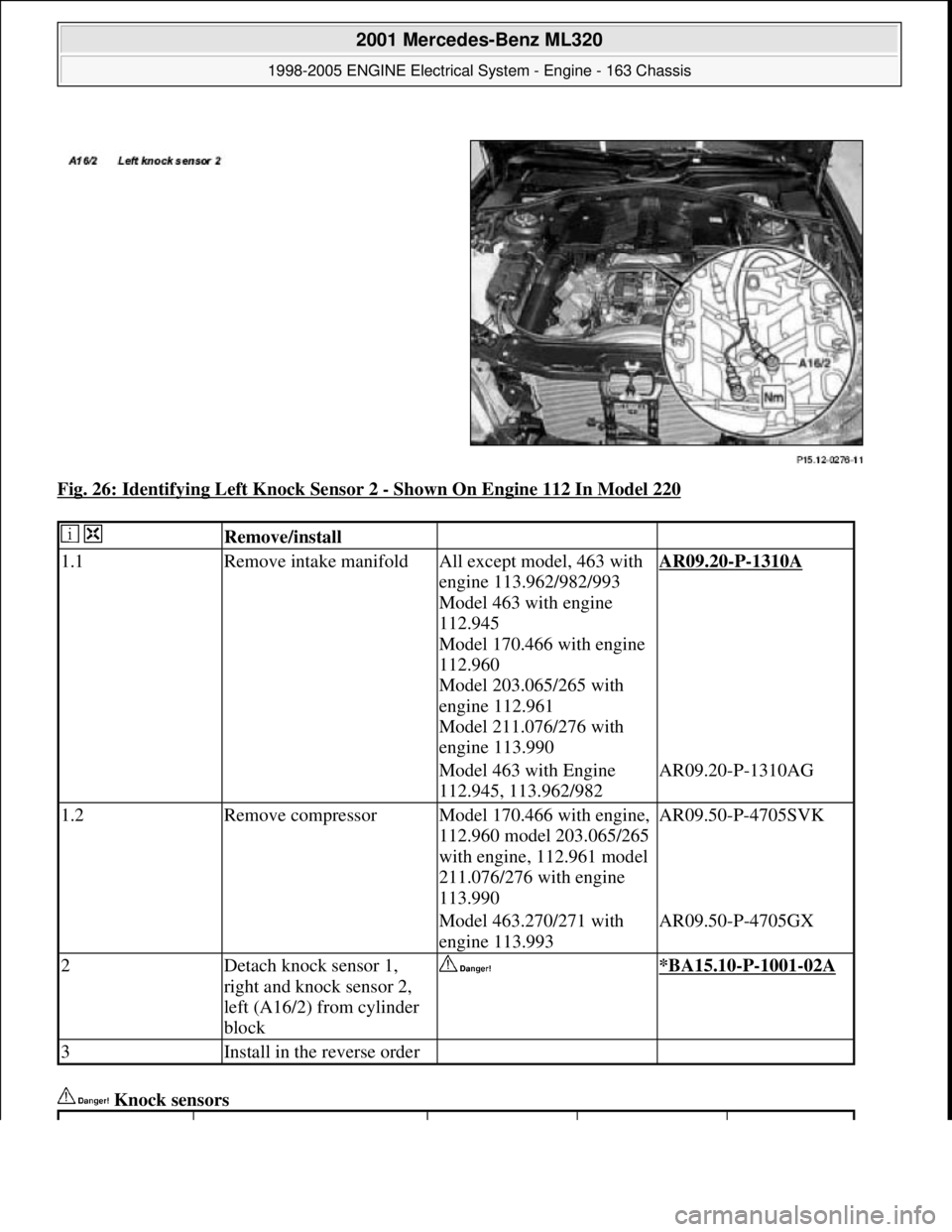
Fig. 26: Identifying Left Knock Sensor 2 - Shown On Engine 112 In Model 220
Knock sensors
Remove/install
1.1Remove intake manifoldAll except model, 463 with
engine 113.962/982/993
Model 463 with engine
112.945
Model 170.466 with engine
112.960
Model 203.065/265 with
engine 112.961
Model 211.076/276 with
engine 113.990AR09.20-P-1310A
Model 463 with Engine
112.945, 113.962/982AR09.20-P-1310AG
1.2Remove compressorModel 170.466 with engine,
112.960 model 203.065/265
with engine, 112.961 model
211.076/276 with engine
113.990AR09.50-P-4705SVK
Model 463.270/271 with
engine 113.993AR09.50-P-4705GX
2Detach knock sensor 1,
right and knock sensor 2,
left (A16/2) from cylinder
block *BA15.10-P-1001-02A
3Install in the reverse order
2001 Mercedes-Benz ML320
1998-2005 ENGINE Electrical System - Engine - 163 Chassis
me
Saturday, October 02, 2010 3:18:54 PMPage 47 © 2006 Mitchell Repair Information Company, LLC.
Page 2202 of 4133
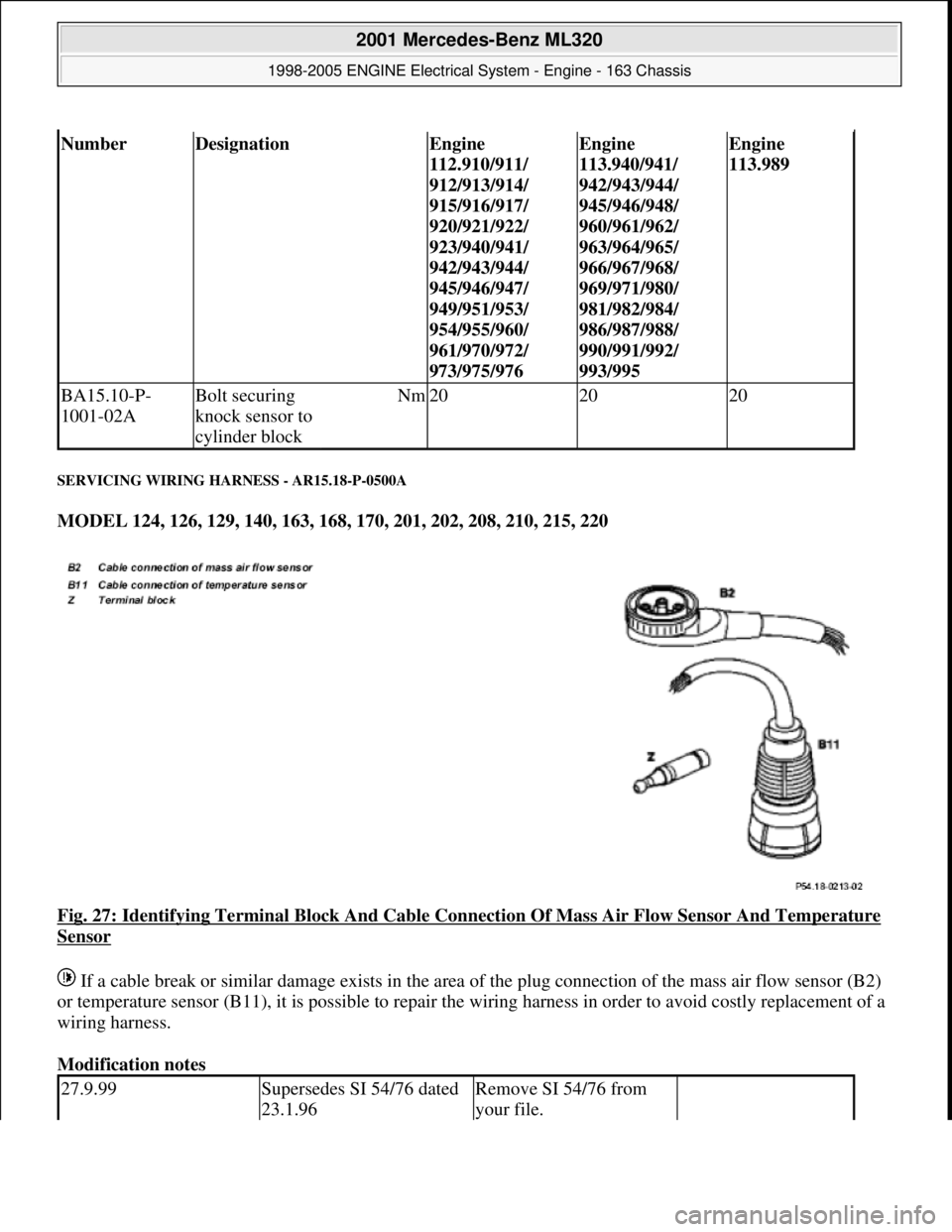
SERVICING WIRING HARNESS - AR15.18-P-0500A
MODEL 124, 126, 129, 140, 163, 168, 170, 201, 202, 208, 210, 215, 220
Fig. 27: Identifying Terminal Block And Cable Connection Of Mass Air Flow Sensor And Temperature
Sensor
If a cable break or similar damage exists in the area of the plug connection of the mass air flow sensor (B2)
or temperature sensor (B11), it is possible to repair the wiring harness in order to avoid costly replacement of a
wiring harness.
Modification notes
NumberDesignationEngine
112.910/911/
912/913/914/
915/916/917/
920/921/922/
923/940/941/
942/943/944/
945/946/947/
949/951/953/
954/955/960/
961/970/972/
973/975/976Engine
113.940/941/
942/943/944/
945/946/948/
960/961/962/
963/964/965/
966/967/968/
969/971/980/
981/982/984/
986/987/988/
990/991/992/
993/995Engine
113.989
BA15.10-P-
1001-02ABolt securing
knock sensor to
cylinder blockNm202020
27.9.99Supersedes SI 54/76 dated
23.1.96Remove SI 54/76 from
your file.
2001 Mercedes-Benz ML320
1998-2005 ENGINE Electrical System - Engine - 163 Chassis
me
Saturday, October 02, 2010 3:18:54 PMPage 48 © 2006 Mitchell Repair Information Company, LLC.
Page 2203 of 4133
Parts ordering notes
REMOVE AND INSTALLING THE STARTER - AR15.30-P-7100GH
ENGINE 112.942 in MODEL 163.154
Removing and installing
1Remove air cleaner, install. Only on engine 119
2Expose wiring harness to
mass air flow sensor or
temperature sensor. Ignition switched
off
3Unplug socket from mass
air flow sensor or
temperature sensor.
4Plug in repair socket
together with cables at
mass air flow sensor or
temperature sensor and
insert into cable duct.
5Repair wiring harness
using end soldering sleeves
(Z). Turn together cable of
engine wiring harness and
cable repair socket of the
same color and insert into
end soldered sleeves (Z).
Use end soldered
sleeves (Z) only in cross
section area Ø 0.7 - Ø 4.0
mm
2
AR54.18-P-0100-02A
6Insert cables into the cable
duct.
7Connect HHT, read faults
and erase see Diagnosis Manual
Engine Volume 2 Index 0:
Connecting and using test
equipment
8Install in the reverse order
Part no.DesignationQuantity
140 540 00 36Repair kit socket (B2)1
1) Consisting of repair socket (B2)
and 5 cable connectorsacc. to condition
140 540 00 81Repair socket (B2)acc. to condition
202 540 01 81Repair socket (B11) 3-pinacc. to condition
126 540 30 81Repair socket (B11) 4-pinacc. to condition
001 546 99 41Cable connectoracc. to condition
006 989 84 85Fabric tapeacc. to condition
2001 Mercedes-Benz ML320
1998-2005 ENGINE Electrical System - Engine - 163 Chassis
me
Saturday, October 02, 2010 3:18:54 PMPage 49 © 2006 Mitchell Repair Information Company, LLC.
Page 2236 of 4133

GF00.20-P-2009A
Engine oil monitor function
24.10.96
MODEL
129 with ENGINE 112, 113
MODEL
163 with ENGINE 112, 113, 612
MODEL
168 with ENGINE 166, 668
MODEL
202 with ENGINE 112, 611
MODEL
208 up to 31.7.99 with ENGINE 112, 113
MODEL
210 up to 30.6.99 with ENGINE 112, 113, 611
General
The oil level is constantly monitored by the oil sensor, and the
appropriate data transmitted to the processor by the ASSYST.
Oil replenishments are detected automatically and result in a bonus,
which extends the service interval accordingly.
An excess oil level or insufficient oil level appears in the display
together with the oil can symbol.
Display of low oil level at maximum:
D
at driver request
Display of warnings: D
automatically, at the earliest 60 s after engine start and oil
temperature greater than 60°C:
D
if oil level too high: the oil can symbol appears together
with the readout "OIL LEVEL ABOVE MAX". In addition, a
brief warning signal sounds. (On models not fitted with
multifunction displaly, "HI" appears flashing.)
D
if oil level too low: the oil can symbol appears together with
the readout "OIL LEVEL BELOW MIN". In addition, a brief
warning signal sounds. (On models not fitted with multifunction
display, the oil level warning lamp (A1e12) comes on and the
readout "-2L" appears flashing.)
-----------------------------------------------------------------------------------------
D
if oil at minimum: the oil can symbol appears together with
the readout "OIL LEVEL MINIMUM". In addition, a brief
warning signal sounds. (On models not fitted with multifunction
display, the oil level warning lamp (A1e12) comes on.)
D
automatically 13 s after ignition ON:
D
if
no oil
is in engine: the oil can symbol appears together
with the readout "OIL LEVEL BELOW MIN". In addition, a
warning signal sounds. (On models not fitted with multifunction
display, the oil level warning lamp (A1e12) comes on and the
readout "-2L"appears flashing. In addition a brief warning
signal sounds.)
The missing oil quantity displayed no longer changes during the
display. In other words, any change in oil level cannot be observed
directly at the display. The new oil level is only displayed once the
conditions described below exist.
Display of oil quantity at driver request
The text "DISPLAY OIL LEVEL?" appears 10 s after the start switch
has been turned into position "2" (on models not fitted with
multifunction display, the oil can and the clock symbol are displayed).
If the reset button of the trip counter is pressed twice within one sec.
during this readout, for example, "add 1.0L oil" (or "-1.0L")
-----------------------------------------------------------------------------------------
appears in the display if oil level too low. The readout appears only
after the elapse of a waiting time after engine OFF. The waiting time
depends on the engine oil temperature.
It is
D
up to 20°C
30 minutes
D
from 60°C
1 minute
D
The waiting time is between these two limits at other engine oil
temperatures.
Possible readouts are (text in parenthesis relates to models not fitted
with multifunction display.):
D
"OIL LEVEL OKAY" ("o.k."),
D
1.0L, 1.5L, 2L,
D
"Overfilling" ("HI"),
D
"OBSERVE WAITING TIME" (clock symbol flashing and oil can
symbol),
D
"DISPLAY OIL LEVEL" (clock and oil can symbols.)
If there is a fault at the oil sensor (oil level/temperature/quality, B40)
the oil can symbol and the text "OIL LEVEL SENSOR FAULTY"
appears only 30 s after the fault has occurred.
(On models not fitted with multifunction display, the oil level warning
lamp (A1e12) comes on accordingly.)
For diagnosis, read also the injection system control module (N3)
with the HHT. (The instrument cluster (A1) receives the sensor data
through the CAN from the injection system control module (N3)).
-----------------------------------------------------------------------------------------
Oil change
The ASSYST has to be reset each time the oil is changed. Resetting
ASSYST also resets the remaining time and the remaining distance.
Resetting can be performed at the instrument cluster or using the
HHT.
The following data are stored when the system is reset:
D
current kilometer reading rounded off to 100,
D
total oil replenishments in the last interval,
D
remaining distance,
D
remaining time,
D
product of the quality factors,
D
the data of the last 5 resettings in 5 data sets
These data can only be read with the HHT!
If the specified quantity of oil is not replenished when the oil is
changed, the (internal) start distance is reduced.
Detecting oil replenishments
D
With the
HHT
it is possible to retrieve the last 10 oil
replenishments and the corresponding kilometer readings of
the current interval.
D
In the normal case, detection of an oil replenishment is
displayed by the remaining distance in the instrument cluster
being extended
-----------------------------------------------------------------------------------------
Copyright DaimlerChrysler AG 05.06.2006 CD-Ausgabe G/10/04 . This WIS print-out will not be recorde
d by Modification services.
Page 1
Page 2237 of 4133
Oil replenishments are always only detected once the following
conditions are met:
D
the replenished quantity is
at least 1 l
D
after replenishing the oil, the car must be driven a distance of
at
least 5 km
under
normal driving conditions
at an
oil
temperature of at least 60 °C
.
There are instances, however, in which the readout of the remaining
distance nevertheless appears implausible after replenishing oil;
according to the display, no bonus or only a small bonus has been
issued. This is caused by the fact that the remaining distance is
always only displayed within a range from 15 000 km up to 30 000
km (or 20 000 km up to 40 000 km in the case of engine 668), but
internally the system calculates with the actual values which may also
be beyond this range. These internal values can only be displayed
with the HHT.
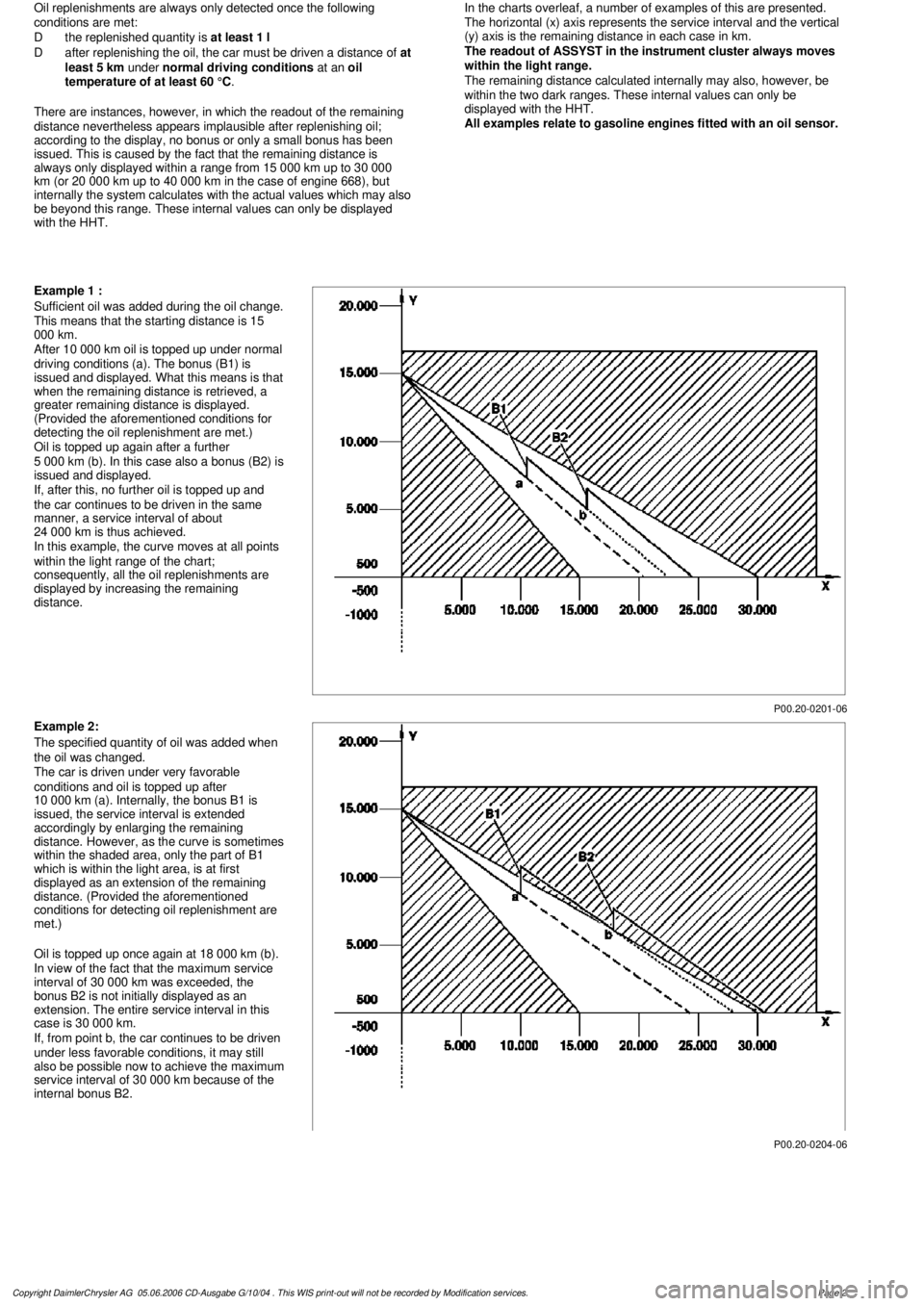
In the charts overleaf, a number of examples of this are presented.
The horizontal (x) axis represents the service interval and the vertical
(y) axis is the remaining distance in each case in km.
The readout of ASSYST in the instrument cluster always moves
within the light range.
The remaining distance calculated internally may also, however, be
within the two dark ranges. These internal values can only be
displayed with the HHT.
All examples relate to gasoline engines fitted with an oil sensor.
P00.20-0201-06
Example 1 :
Sufficient oil was added during the oil change.
This means that the starting distance is 15
000 km.
After 10 000 km oil is topped up under normal
driving conditions (a). The bonus (B1) is
issued and displayed. What this means is that
when the remaining distance is retrieved, a
greater remaining distance is displayed.
(Provided the aforementioned conditions for
detecting the oil replenishment are met.)
Oil is topped up again after a further
5 000 km (b). In this case also a bonus (B2) is
issued and displayed.
If, after this, no further oil is topped up and
the car continues to be driven in the same
manner, a service interval of about
24 000 km is thus achieved.
In this example, the curve moves at all points
within the light range of the chart;
consequently, all the oil replenishments are
displayed by increasing the remaining
distance.
P00.20-0204-06
Example 2:
The specified quantity of oil was added when
the oil was changed.
The car is driven under very favorable
conditions and oil is topped up after
10 000 km (a). Internally, the bonus B1 is
issued, the service interval is extended
accordingly by enlarging the remaining
distance. However, as the curve is sometimes
within the shaded area, only the part of B1
which is within the light area, is at first
displayed as an extension of the remaining
distance. (Provided the aforementioned
conditions for detecting oil replenishment are
met.)
Oil is topped up once again at 18 000 km (b).
In view of the fact that the maximum service
interval of 30 000 km was exceeded, the
bonus B2 is not initially displayed as an
extension. The entire service interval in this
case is 30 000 km.
If, from point b, the car continues to be driven
under less favorable conditions, it may still
also be possible now to achieve the maximum
service interval of 30 000 km because of the
internal bonus B2.
Copyright DaimlerChrysler AG 05.06.2006 CD-Ausgabe G/10/04 . This WIS print-out will not be recorde
d by Modification services.
Page 2
Page 2238 of 4133
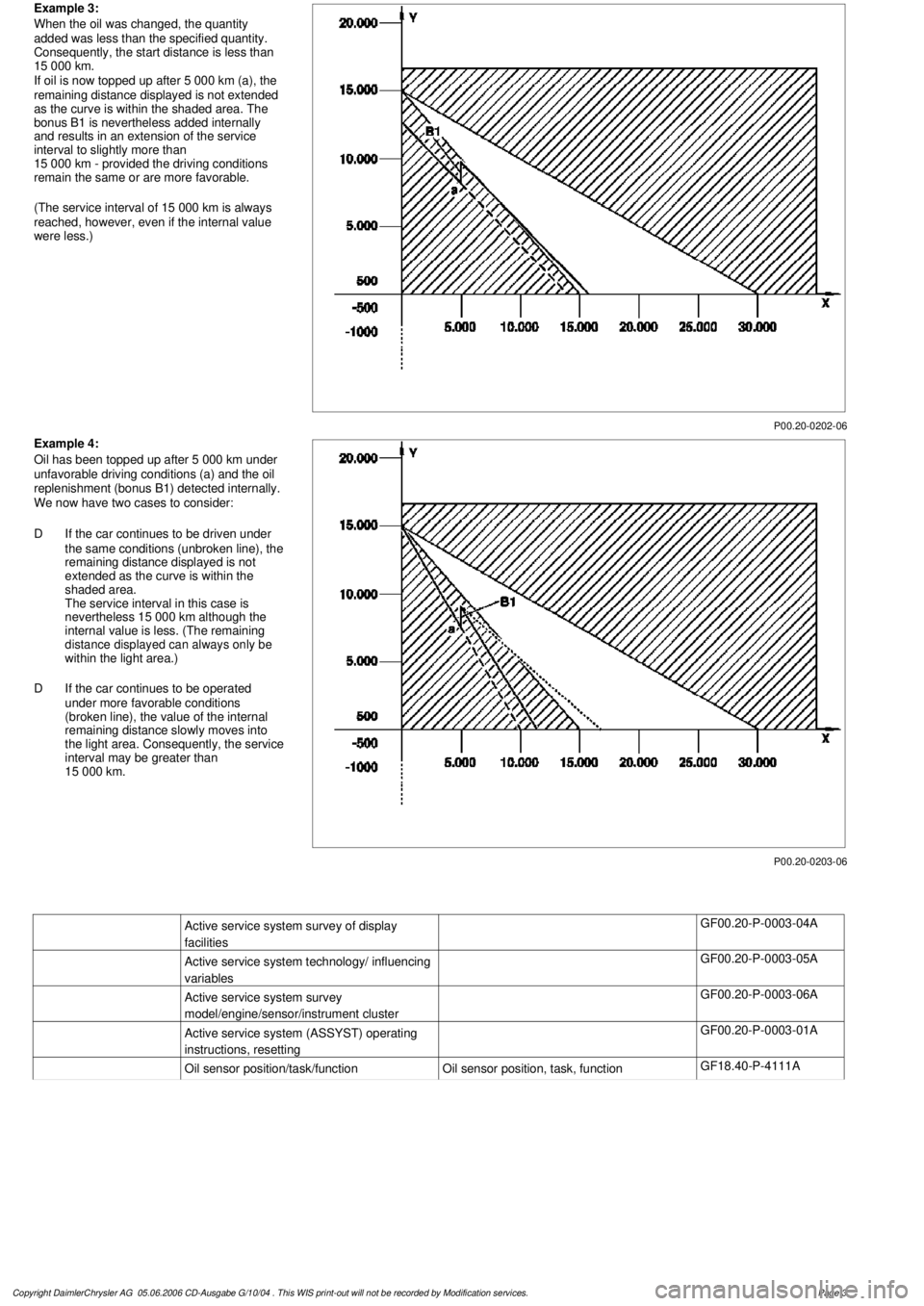
P00.20-0202-06
Example 3:
When the oil was changed, the quantity
added was less than the specified quantity.
Consequently, the start distance is less than
15 000 km.
If oil is now topped up after 5 000 km (a), the
remaining distance displayed is not extended
as the curve is within the shaded area. The
bonus B1 is nevertheless added internally
and results in an extension of the service
interval to slightly more than
15 000 km - provided the driving conditions
remain the same or are more favorable.
(The service interval of 15 000 km is always
reached, however, even if the internal value
were less.)
P00.20-0203-06
Example 4:
Oil has been topped up after 5 000 km under
unfavorable driving conditions (a) and the oil
replenishment (bonus B1) detected internally.
We now have two cases to consider:
D
If the car continues to be driven under
the same conditions (unbroken line), the
remaining distance displayed is not
extended as the curve is within the
shaded area.
The service interval in this case is
nevertheless 15 000 km although the
internal value is less. (The remaining
distance displayed can always only be
within the light area.)
D
If the car continues to be operated
under more favorable conditions
(broken line), the value of the internal
remaining distance slowly moves into
the light area. Consequently, the service
interval may be greater than
15 000 km.
Active service system survey of display
facilities
GF00.20-P-0003-04A
Active service system technology/ influencing
variables
GF00.20-P-0003-05A
Active service system survey
model/engine/sensor/instrument cluster
GF00.20-P-0003-06A
Active service system (ASSYST) operating
instructions, resetting
GF00.20-P-0003-01A
Oil sensor position/task/function
Oil sensor position, task, function
GF18.40-P-4111A
Copyright DaimlerChrysler AG 05.06.2006 CD-Ausgabe G/10/04 . This WIS print-out will not be recorde
d by Modification services.
Page 3
Page 2239 of 4133

AF07.00-P-9000B
Engine runs rough, surges or does not turn over
29.4.02
ENGINE
611 in MODEL 203, 202, 210
ENGINE
612 in MODEL 163, 203, 210, 209
ENGINE
613 in MODEL 210, 220
ENGINE
628 in MODEL 163, 220, 211
ENGINE
646 in MODEL 203, 211
ENGINE
647 in MODEL 211
ENGINE
648 in MODEL 220, 211
ENGINE
668 in MODEL 168
ENGINE
612, 628 in MODEL 463
Modification notes
23.3.01
Supersedes STIP 07.16-014 dated 11.12.00
Damage code
Cause
Remedy
07 206 D5
High-pressure pump
To verify whether high pressure pump is
damaged.
#
High pressure pump of common rail
injection system is damaged mechanically.
1
Remove/install/replace high pressure
pump.
When the high pressure pump of the common
rail injection system is damaged metal chips
and/or damage to the pump drive (timing
drive) can occur due to contamination of the
injection system components.
2
Turn high pressure pump by hand with
driver.
If mechanical resistance can be felt,
perform the following tests. Clarify additional
work with ESKULAB by specifying repair work:
#
3
Check driver of high pressure pump or
mount in sprocket for damage (visual
check).
If high pressure pump is locked:
#
4
Check timing
5
Check timing drive for damage.
In each case:
#
6
Remove/install/replace timing chain.
If timing deviates by a crankshaft angle of
more than 20 degrees (corresponding to one
tooth skipped):
#
7
Check pressure loss.
8
Open low pressure connection on high
pressure pump return (plastic line in
area of pressure regulator valve) and
check connection point in rail for chips.
If chips are present when checking
injection system:
#
9
Thoroughly clean all fuel low pressure
lines as well as feed and return lines.
Flush and blow out with compressed air.
10
Remove fuel preheater and fuel filter
with filter housing, replace.
Fuel preheater is only installed in models
202, 203 and 163.
11
Remove/install/replace fuel cooler at
vehicle and engine end.
Not installed in model 210 up to 6/99 and
model 168.
12
Remove fuel tank, replace.
On engine 628:
#
13
Remove/install/replace electric supply
pump.
14
Remove/install/replace injectors, rail
(including pressure regulation valve and
rail pressure sensor), high pressure
lines and injector leak oil rail.*
Copyright DaimlerChrysler AG 28.05.2006 CD-Ausgabe G/10/04 . This WIS print-out will not be recorde
d by Modification services.
Page 1
Page 2271 of 4133
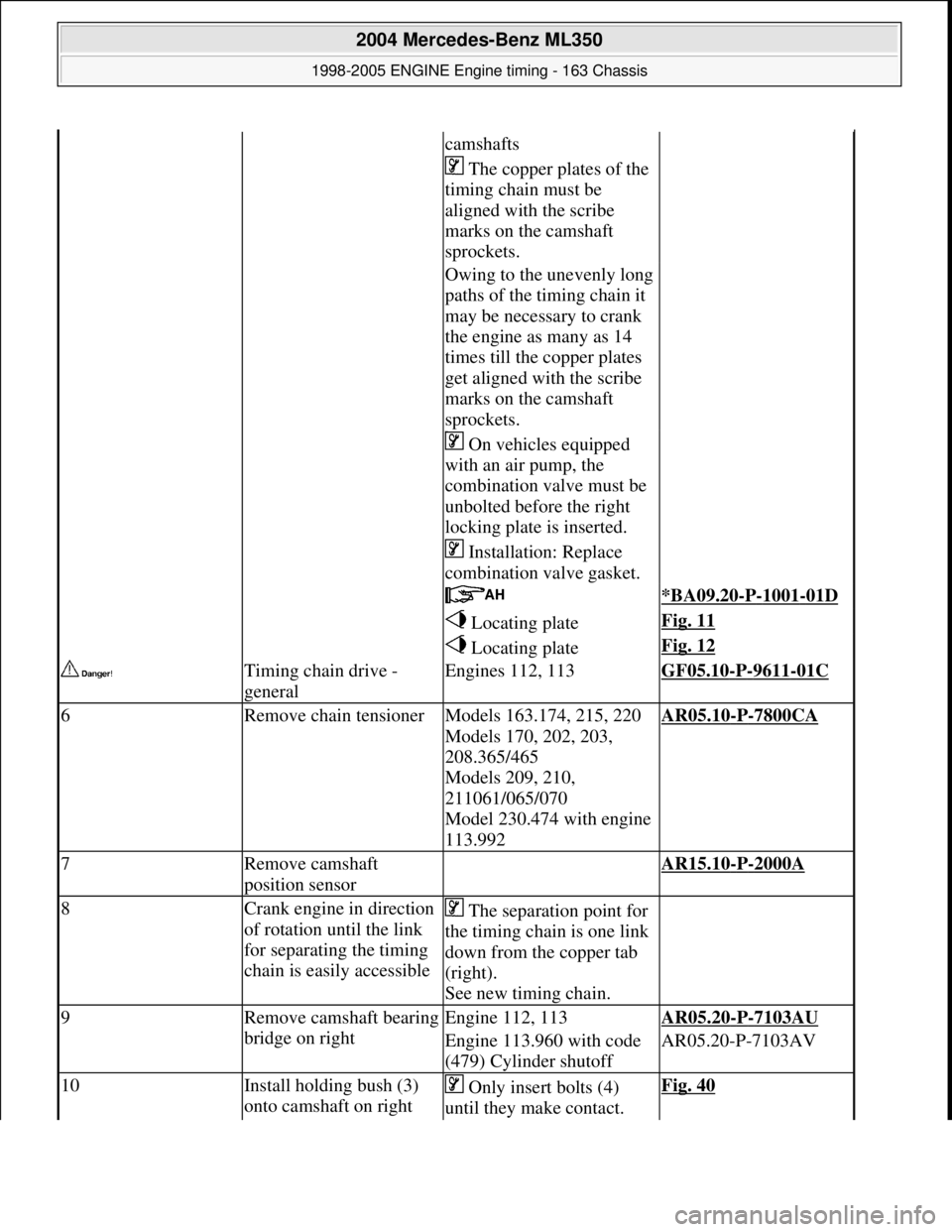
camshafts
The copper plates of the
timing chain must be
aligned with the scribe
marks on the camshaft
sprockets.
Owing to the unevenly long
paths of the timing chain it
may be necessary to crank
the engine as many as 14
times till the copper plates
get aligned with the scribe
marks on the camshaft
sprockets.
On vehicles equipped
with an air pump, the
combination valve must be
unbolted before the right
locking plate is inserted.
Installation: Replace
combination valve gasket.
*BA09.20-P-1001-01D
Locating plateFig. 11
Locating plateFig. 12
Timing chain drive -
generalEngines 112, 113GF05.10-P-9611-01C
6Remove chain tensionerModels 163.174, 215, 220
Models 170, 202, 203,
208.365/465
Models 209, 210,
211061/065/070
Model 230.474 with engine
113.992AR05.10-P-7800CA
7Remove camshaft
position sensor AR15.10-P-2000A
8Crank engine in direction
of rotation until the link
for separating the timing
chain is easily accessible The separation point for
the timing chain is one link
down from the copper tab
(right).
See new timing chain.
9Remove camsha ft bearing
bridge on rightEngine 112, 113AR05.20-P-7103AU
Engine 113.960 with code
(479) Cylinder shutoffAR05.20-P-7103AV
10Install holding bush (3)
onto camshaft on right Only insert bolts (4)
until they make contact. Fig. 40
2004 Mercedes-Benz ML350
1998-2005 ENGINE Engine timing - 163 Chassis
me
Saturday, October 02, 2010 3:39:37 PMPage 30 © 2006 Mitchell Repair Information Company, LLC.
Page 2272 of 4133
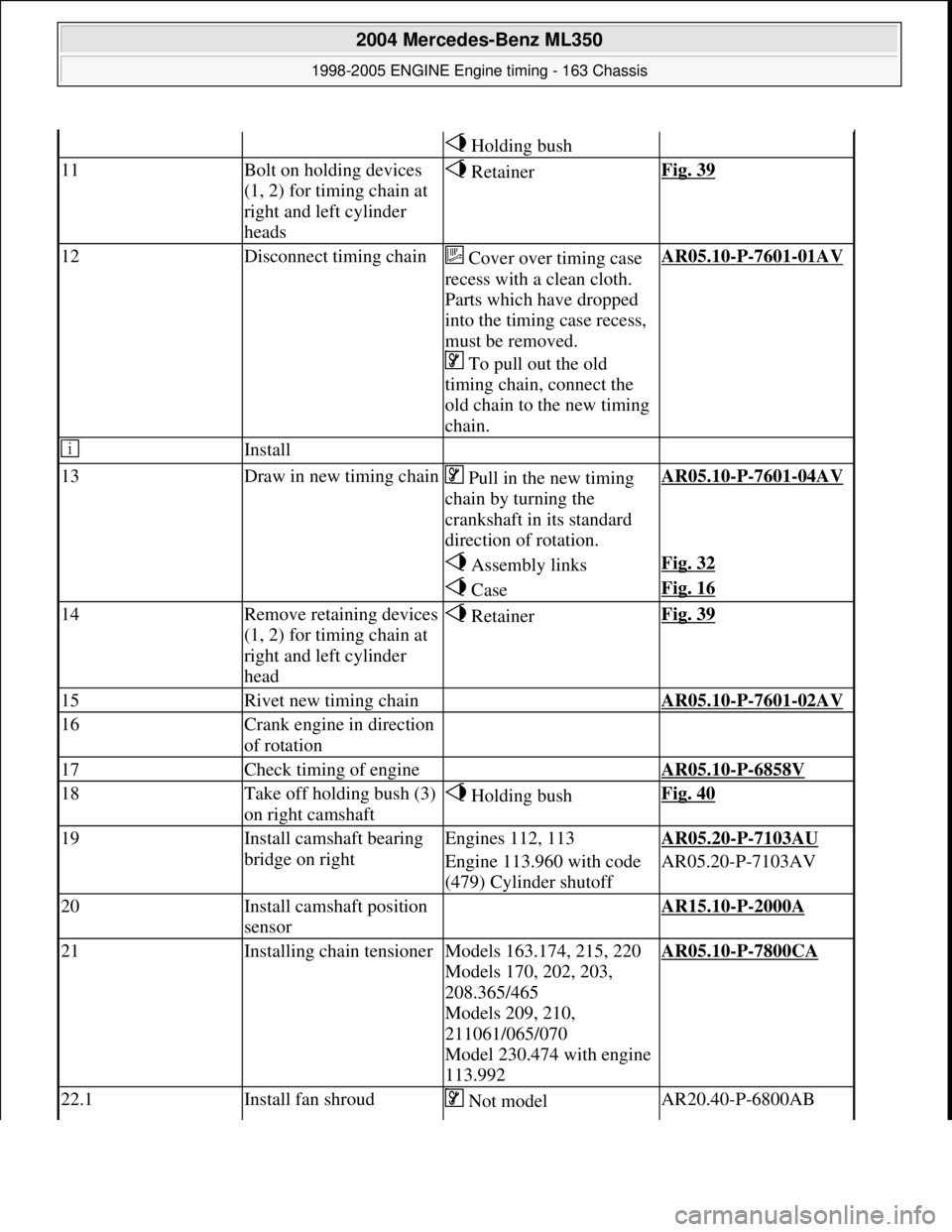
Holding bush
11Bolt on holding devices
(1, 2) for timing chain at
right and left cylinder
heads RetainerFig. 39
12Disconnect timing chain Cover over timing case
recess with a clean cloth.
Parts which have dropped
into the timing case recess,
must be removed.
To pull out the old
timing chain, connect the
old chain to the new timing
chain.AR05.10-P-7601-01AV
Install
13Draw in new timing chain Pull in the new timing
chain by turning the
crankshaft in its standard
direction of rotation.AR05.10-P-7601-04AV
Assembly linksFig. 32
CaseFig. 16
14Remove retaining devices
(1, 2) for timing chain at
right and left cylinder
head RetainerFig. 39
15Rivet new timing chain AR05.10-P-7601-02AV
16Crank engine in direction
of rotation
17Check timing of engine AR05.10-P-6858V
18Take off holding bush (3)
on right camshaft Holding bushFig. 40
19Install camshaft bearing
bridge on rightEngines 112, 113AR05.20-P-7103AU
Engine 113.960 with code
(479) Cylinder shutoffAR05.20-P-7103AV
20Install camshaft position
sensor AR15.10-P-2000A
21Installing chain tensionerModels 163.174, 215, 220
Models 170, 202, 203,
208.365/465
Models 209, 210,
211061/065/070
Model 230.474 with engine
113.992AR05.10-P-7800CA
22.1Install fan shroud Not model AR20.40-P-6800AB
2004 Mercedes-Benz ML350
1998-2005 ENGINE Engine timing - 163 Chassis
me
Saturday, October 02, 2010 3:39:37 PMPage 31 © 2006 Mitchell Repair Information Company, LLC.