wheel size MERCEDES-BENZ ML430 1997 Complete User Guide
[x] Cancel search | Manufacturer: MERCEDES-BENZ, Model Year: 1997, Model line: ML430, Model: MERCEDES-BENZ ML430 1997Pages: 4133, PDF Size: 88.89 MB
Page 1032 of 4133

228 OperationTires and wheelsTire pressure changes by approximately
1.5 psi (0.1 bar) per 18°F (10°C) of air
temperature change. Keep this in mind
when checking tire pressure where the
temperature is different from the outside
temperature.
Tire temperature and tire pressure are also
increased while driving, depending on the
driving speed and the tire load.Check the spare tire periodically for condi-
tion and inflation. Spare tire will age and
b e c o m e w o r n o v e r t i m e e v e n i f n e v e r u s e d ,
and thus should be inspected and replaced
when necessary.
Rotating wheels
The wheels can be rotated every 3000 to
6000 miles (5 000 to 10 000 km) or soon-
er if necessary, according to the degree of
tire wear. The same direction of tire rota-
tion must be retained.
Rotate the wheels before the characteris-
tic tire wear pattern becomes visible
(shoulder wear on front wheels and tread
center wear on rear wheels).
Thoroughly clean the inner side of the
wheels after each rotation. Check and en-
sure proper tire inflation pressure.
iThe pressures listed for light loads are
minimum values offering high driving
comfort.
Increased inflation pressures listed for
heavier loads may also be used for light
loads. These higher pressures produce
favorable handling characteristics. The
ride of the vehicle, however, will be
somewhat harder. Never exceed the
max. values or inflate tires below the
min. values listed in the fuel filler flap.
Warning!
G
Follow recommended inflation pressures.
Do not overinflate tires. Overinflated tires
can result in sudden deflation (blowout) be-
cause they are more likely to become punc-
tured or damaged by road debris, potholes,
etc.
Do not underinflate tires. Underinflated tires
wear unevenly, adversely affect handling
and fuel economy, and are more likely to fail
from being overheated.
Do not overload the tires by exceeding the
Gross Vehicle Weight Rating (GVWR) and
the Gross Axle Weight Rating (GAWR) as
indicated on the certification label on the
driver’s door pillar. Overloading the tires can
overheat them, possibly causing a blowout.
Warning!
G
Rotate front and rear wheels only if they are
of the same size,
Page 1575 of 4133
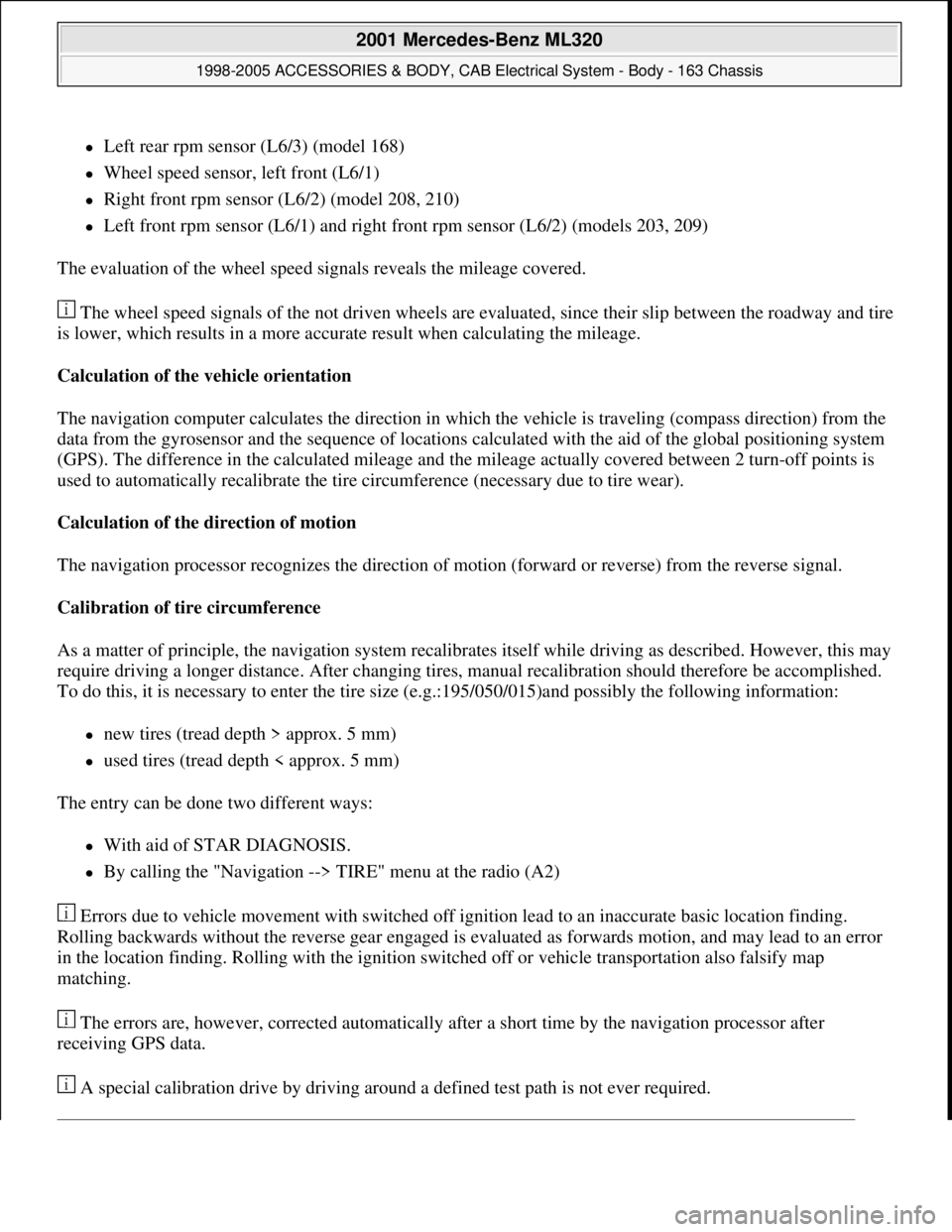
Left rear rpm sensor (L6/3) (model 168)
Wheel speed sensor, left front (L6/1)
Right front rpm sensor (L6/2) (model 208, 210)
Left front rpm sensor (L6/1) and right front rpm sensor (L6/2) (models 203, 209)
The evaluation of the wheel speed signals reveals the mileage covered.
The wheel speed signals of the not driven wheels are evaluated, since their slip between the roadway and tire
is lower, which results in a more accurate result when calculating the mileage.
Calculation of the vehicle orientation
The navigation computer calculates the direction in which the vehicle is traveling (compass direction) from the
data from the gyrosensor and the sequence of locations calculated with the aid of the global positioning system
(GPS). The difference in the calculated mileage and the mileage actually covered between 2 turn-off points is
used to automatically recalibrate the tire circumference (necessary due to tire wear).
Calculation of the direction of motion
The navigation processor recognizes the direction of motion (forward or reverse) from the reverse signal.
Calibration of tire circumference
As a matter of principle, the navigation system recalibrates itself while driving as described. However, this may
require driving a longer distance. After changing tires, manual recalibration should therefore be accomplished.
To do this, it is necessary to enter the tire size (e.g.:195/050/015)and possibly the following information:
new tires (tread depth > approx. 5 mm)
used tires (tread depth < approx. 5 mm)
The entry can be done two different ways:
With aid of STAR DIAGNOSIS.
By calling the "Navigation --> TIRE" menu at the radio (A2)
Errors due to vehicle movement with switched off ignition lead to an inaccurate basic location finding.
Rolling backwards without the reverse gear engaged is evaluated as forwards motion, and may lead to an error
in the location finding. Rolling with the ignition switched off or vehicle transportation also falsify map
matching.
The errors are, however, corrected automatically after a short time by the navigation processor after
receiving GPS data.
A special calibration drive by driving around a defined test path is not ever required.
2001 Mercedes-Benz ML320
1998-2005 ACCESSORIES & BODY, CAB Electrical System - Body - 163 Chassis
me
Saturday, October 02, 2010 3:30:05 PMPage 80 © 2006 Mitchell Repair Information Company, LLC.
Page 1710 of 4133

Fig. 125: Identifying Radio And Navigation Unit Connector Assignments
VERSION CODING FOR RADIO AND NAVIGATION UNIT - AD82.61-P-2001-03A
The table below shows the possible navigation system adaptations to the vehicle. The settings can be changed
with the aid of the handheld tester ("HHT").
Navigation parametersPossible settings
ABS pulse count (pulse count
from wheel speed sensor per
wheel rotation)Factory setting:48 (passenger cars)
Tire sizee.g.:195/50/15
Tire condition Guideline values:
Coding is required only when
tires are changed. Tire wear
occurring while driving is
recognized automatically by the
navigation system.New:Tread depth greater than 5 mm
2001 Mercedes-Benz ML320
1998-2005 ACCESSORIES & BODY, CAB Electrical System - Body - 163 Chassis
me
Saturday, October 02, 2010 3:30:08 PMPage 215 © 2006 Mitchell Repair Information Company, LLC.
Page 1830 of 4133
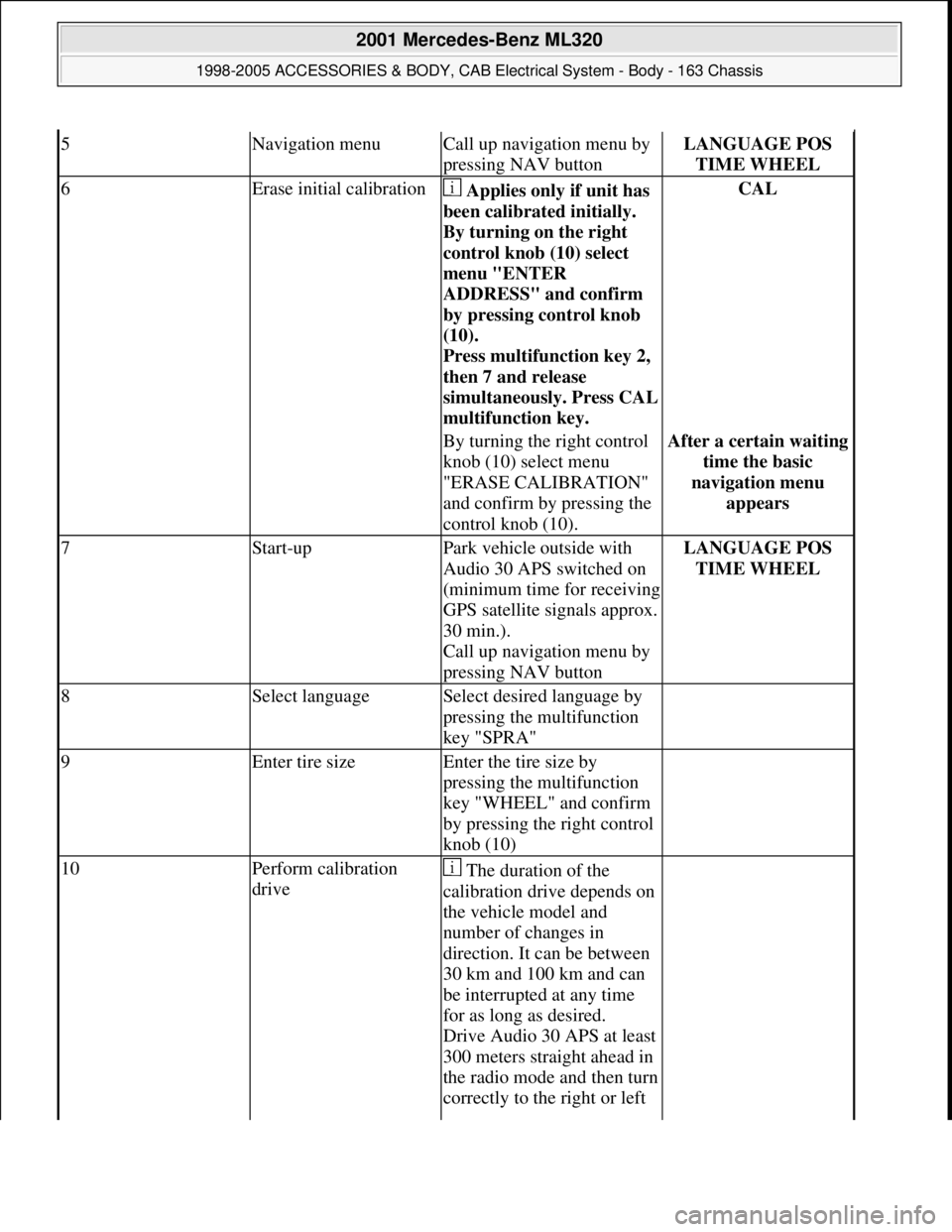
5Navigation menuCall up navigation menu by
pressing NAV buttonLANGUAGE POS
TIME WHEEL
6Erase initial calibration Applies only if unit has
been calibrated initially.
By turning on the right
control knob (10) select
menu "ENTER
ADDRESS" and confirm
by pressing control knob
(10).
Press multifunction key 2,
then 7 and release
simultaneousl
y. Press CAL
multifunction key.
CAL
By turning the right control
knob (10) select menu
"ERASE CALIBRATION"
and confirm by pressing the
control knob (10).After a certain waiting
time the basic
navigation menu
appears
7Start-upPark vehicle outside with
Audio 30 APS switched on
(minimum time for receiving
GPS satellite signals approx.
30 min.).
Call up navigation menu by
pressing NAV buttonLANGUAGE POS
TIME WHEEL
8Select languageSelect desired language by
pressing the multifunction
key "SPRA"
9Enter tire sizeEnter the tire size by
pressing the multifunction
key "WHEEL" and confirm
by pressing the right control
knob (10)
10Perform calibration
drive The duration of the
calibration drive depends on
the vehicle model and
number of changes in
direction. It can be between
30 km and 100 km and can
be interrupted at any time
for as long as desired.
Drive Audio 30 APS at least
300 meters straight ahead in
the radio mode and then turn
correctly to the right or left
2001 Mercedes-Benz ML320
1998-2005 ACCESSORIES & BODY, CAB Electrical System - Body - 163 Chassis
me
Saturday, October 02, 2010 3:30:11 PMPage 335 © 2006 Mitchell Repair Information Company, LLC.