flat tire MERCEDES-BENZ R-Class 2012 W251 User Guide
[x] Cancel search | Manufacturer: MERCEDES-BENZ, Model Year: 2012, Model line: R-Class, Model: MERCEDES-BENZ R-Class 2012 W251Pages: 368, PDF Size: 15.19 MB
Page 270 of 368
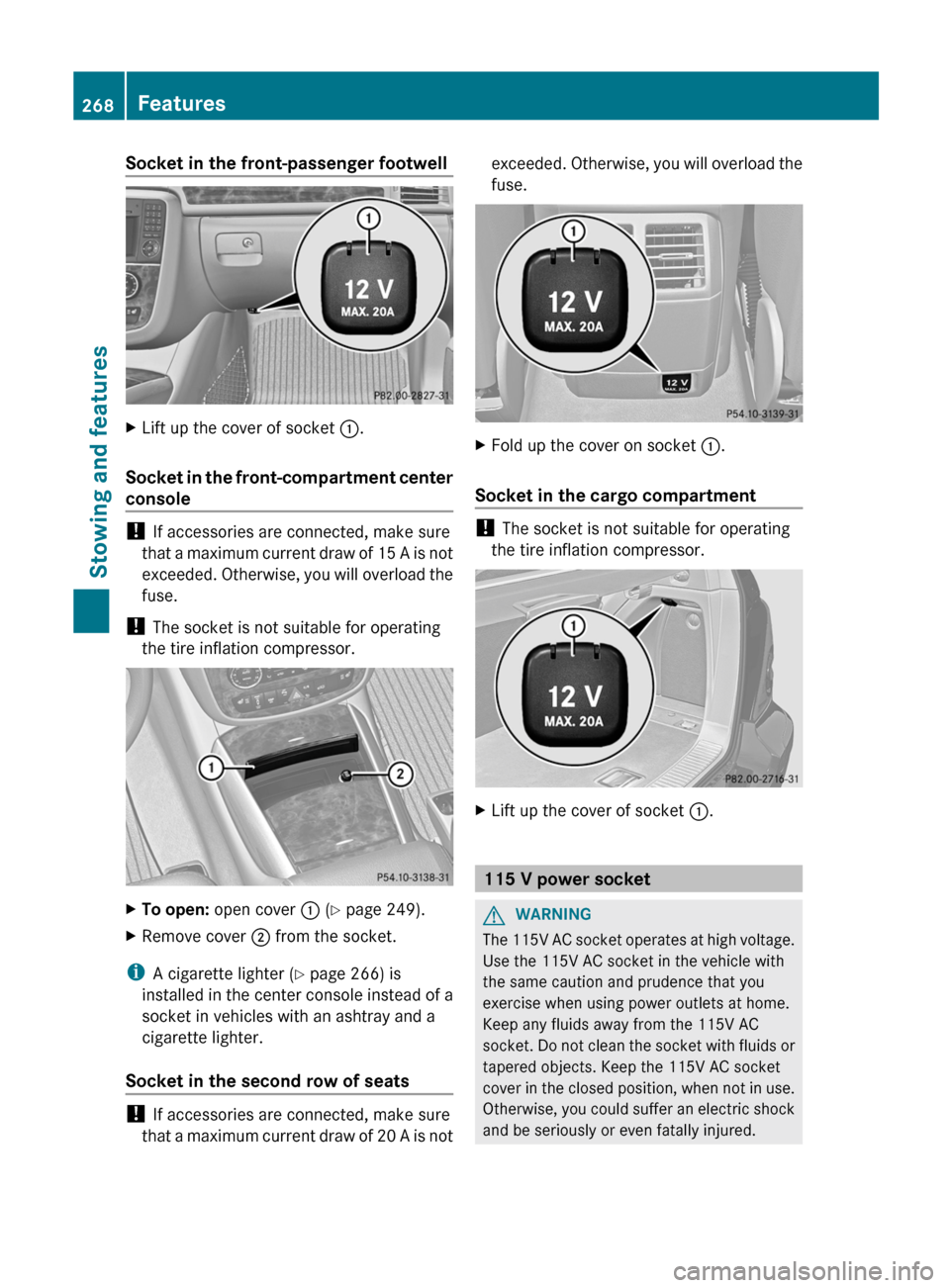
Socket in the front-passenger footwellXLift up the cover of socket :.
Socket in the front-compartment center
console
! If accessories are connected, make sure
that a maximum current draw of 15 A is not
exceeded. Otherwise, you will overload the
fuse.
! The socket is not suitable for operating
the tire inflation compressor.
XTo open: open cover : (Y page 249).XRemove cover ; from the socket.
i
A cigarette lighter ( Y page 266) is
installed in the center console instead of a
socket in vehicles with an ashtray and a
cigarette lighter.
Socket in the second row of seats
! If accessories are connected, make sure
that a maximum current draw of 20 A is not
exceeded. Otherwise, you will overload the
fuse.XFold up the cover on socket :.
Socket in the cargo compartment
!
The socket is not suitable for operating
the tire inflation compressor.
XLift up the cover of socket :.
115 V power socket
GWARNING
The 115V AC socket operates at high voltage.
Use the 115V AC socket in the vehicle with
the same caution and prudence that you
exercise when using power outlets at home.
Keep any fluids away from the 115V AC
socket. Do not clean the socket with fluids or
tapered objects. Keep the 115V AC socket
cover in the closed position, when not in use.
Otherwise, you could suffer an electric shock
and be seriously or even fatally injured.
268FeaturesStowing and features
Page 297 of 368
Useful information ............................296
Where will I find...? ...........................296
Flat tire .............................................. 299
Battery ............................................... 310
Jump-starting .................................... 313
Towing and tow-starting ..................315
Fuses .................................................. 317295Breakdown assistance
Page 299 of 368
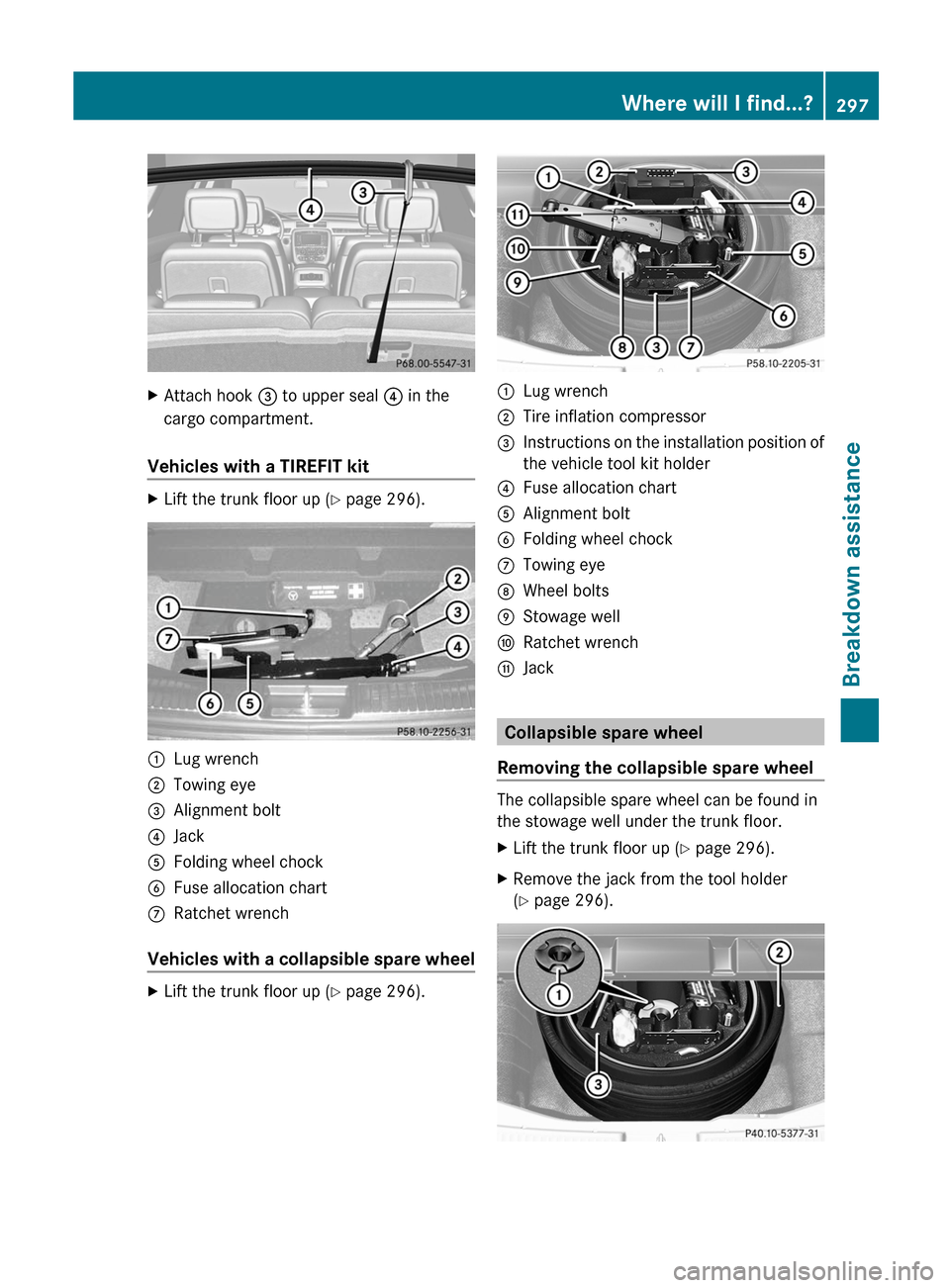
XAttach hook = to upper seal ? in the
cargo compartment.
Vehicles with a TIREFIT kit
XLift the trunk floor up ( Y page 296).:Lug wrench;Towing eye=Alignment bolt?JackAFolding wheel chockBFuse allocation chartCRatchet wrench
Vehicles with a collapsible spare wheel
XLift the trunk floor up ( Y page 296).:Lug wrench;Tire inflation compressor=Instructions on the installation position of
the vehicle tool kit holder?Fuse allocation chartAAlignment boltBFolding wheel chockCTowing eyeDWheel boltsEStowage wellFRatchet wrenchGJack
Collapsible spare wheel
Removing the collapsible spare wheel
The collapsible spare wheel can be found in
the stowage well under the trunk floor.
XLift the trunk floor up ( Y page 296).XRemove the jack from the tool holder
( Y page 296).Where will I find...?297Breakdown assistance
Page 300 of 368
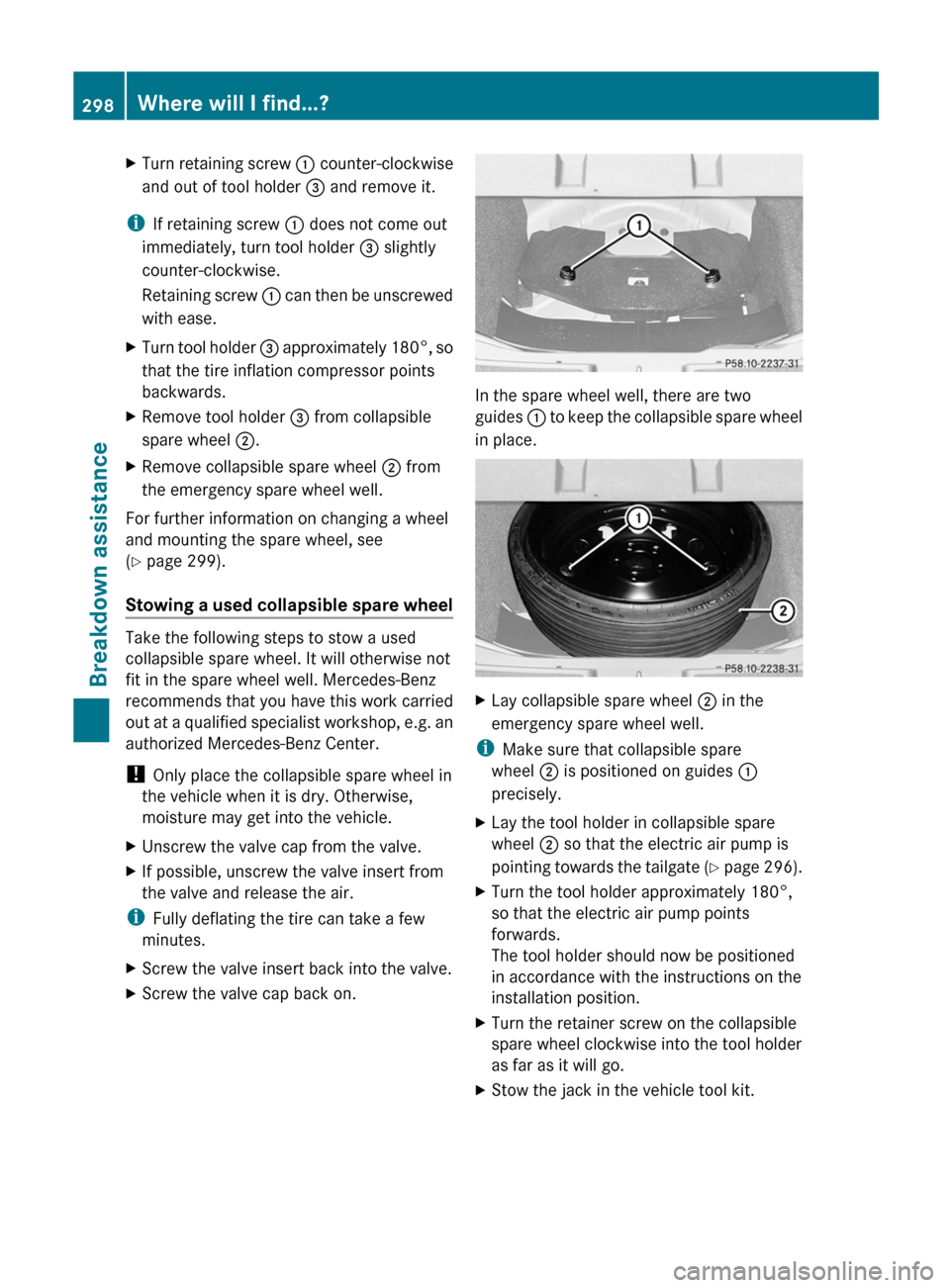
XTurn retaining screw : counter-clockwise
and out of tool holder = and remove it.
i
If retaining screw : does not come out
immediately, turn tool holder = slightly
counter-clockwise.
Retaining screw : can then be unscrewed
with ease.
XTurn tool holder = approximately 180°, so
that the tire inflation compressor points
backwards.XRemove tool holder = from collapsible
spare wheel ;.XRemove collapsible spare wheel ; from
the emergency spare wheel well.
For further information on changing a wheel
and mounting the spare wheel, see
( Y page 299).
Stowing a used collapsible spare wheel
Take the following steps to stow a used
collapsible spare wheel. It will otherwise not
fit in the spare wheel well. Mercedes-Benz
recommends that you have this work carried
out at a qualified specialist workshop, e.g. an
authorized Mercedes-Benz Center.
! Only place the collapsible spare wheel in
the vehicle when it is dry. Otherwise,
moisture may get into the vehicle.
XUnscrew the valve cap from the valve.XIf possible, unscrew the valve insert from
the valve and release the air.
i Fully deflating the tire can take a few
minutes.
XScrew the valve insert back into the valve.XScrew the valve cap back on.
In the spare wheel well, there are two
guides : to keep the collapsible spare wheel
in place.
XLay collapsible spare wheel ; in the
emergency spare wheel well.
i Make sure that collapsible spare
wheel ; is positioned on guides :
precisely.
XLay the tool holder in collapsible spare
wheel ; so that the electric air pump is
pointing towards the tailgate (Y page 296).XTurn the tool holder approximately 180°,
so that the electric air pump points
forwards.
The tool holder should now be positioned
in accordance with the instructions on the
installation position.XTurn the retainer screw on the collapsible
spare wheel clockwise into the tool holder
as far as it will go.XStow the jack in the vehicle tool kit.298Where will I find...?Breakdown assistance
Page 301 of 368
Flat tire
Preparing the vehicle
Your vehicle may be equipped with a
collapsible spare wheel or MOExtended tires
(tires with run-flat properties) ( Y page 309).
i Vehicle preparation is not necessary on
vehicles with MOExtended tires.
i Vehicles equipped with MOExtended tires
are not equipped with a TIREFIT kit at the
factory. It is therefore recommended that
you additionally equip your vehicle with a
TIREFIT kit if you mount tires that do not
feature run-flat properties, e.g. winter tires.
A TIREFIT kit can be obtained from an
authorized Mercedes-Benz Center.
XVehicles with the AIRMATIC package: make
sure that highway level is selected
( Y page 180).XStop the vehicle as far away as possible
from traffic on solid, non-slippery and level
ground.XSwitch on the hazard warning lamps.XFirmly depress the parking brake.XBring the front wheels into the straight-
ahead position.XMove the DIRECT SELECT lever to P.XSwitch off the engine.XVehicles without KEYLESS-GO: remove
the SmartKey from the ignition lock.XVehicles with KEYLESS-GO: open the
driver's door.
The on-board electronics have status 0,
which is the same as the SmartKey having
been removed.XVehicles with KEYLESS-GO: remove the
Start/Stop button from the ignition lock
( Y page 145).XAll occupants must get out of the vehicle.
Make sure that they are not endangered as
they do so.XMake sure that no one is near the danger
area while a wheel is being changed.Anyone who is not directly assisting in the
wheel change should, for example, stand
behind the barrier.XGet out of the vehicle. Pay attention to
traffic conditions when doing so.XClose the driver's door.
i Only operate the tire inflation compressor
using the socket in the footwell of the
second row of seats ( Y page 268), even if
the ignition is turned off.
An emergency cut-off ensures that the on-
board electrical system voltage does not
drop too low. If the on-board electrical
system voltage is too low, power to the
sockets is automatically cut off. This
ensures that there is sufficient power to
start the engine.
TIREFIT kit
Using the TIREFIT kit
You can use the TIREFIT kit to seal small
punctures, particularly those in the tire tread.
You can use TIREFIT at outside temperatures
down to -4 ‡ (-20 †).
GWARNING
TIREFIT is a limited repair device. TIREFIT
cannot be used for cuts or punctures larger
than approximately 0.16 in (4 mm) and tire
damage caused by driving with extremely low
tire inflation pressure, or on a flat tire, or a
damaged wheel.
Do not drive the vehicle under such
circumstances.
Contact the nearest authorized Mercedes-
Benz Center for assistance or call Roadside
Assistance.
XDo not remove any foreign objects which
have penetrated the tire, e.g. screws or
nails.XRemove the tire sealant bottle, the
accompanying "max. 80 km/h" sticker and
the tire inflation compressor from theFlat tire299Breakdown assistanceZ
Page 302 of 368
stowage well underneath the trunk floor
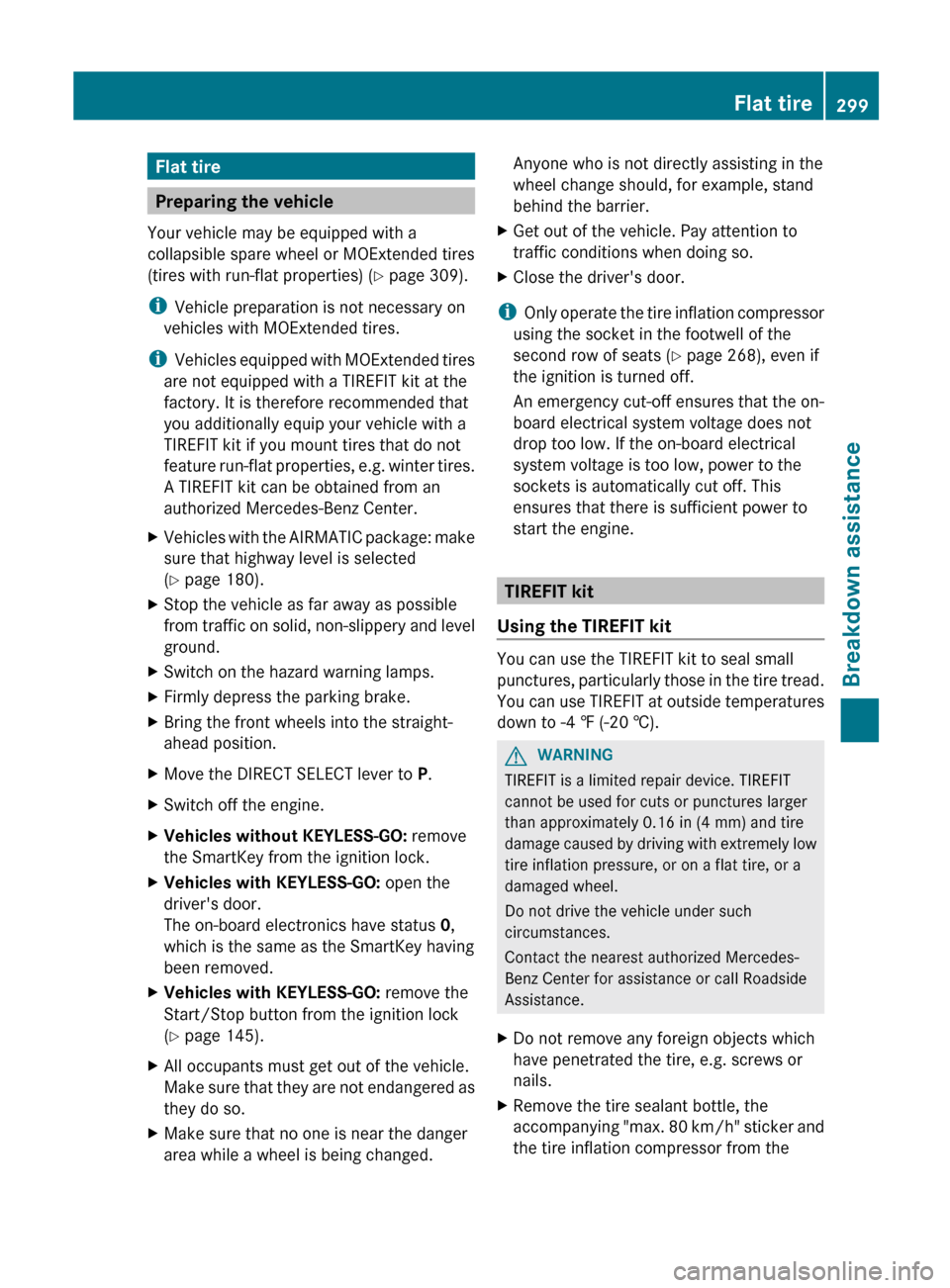
( Y page 296).XAffix part : of the sticker within the
driver's field of vision.XAffix part ; of the sticker near the valve
on the wheel with the defective tire.GWARNING
Take care not to allow the contents of TIREFIT
to come in contact with hair, eyes or clothing.
TIREFIT is harmful if inhaled, swallowed or
absorbed through the skin - causes skin, eye
and respiratory irritation.
Any contact with eyes or skin should be
flushed immediately with plenty of water.
If clothing comes in contact with TIREFIT,
change clothing as soon as possible.
In case of allergic reaction or rash, consult a
physician immediately.
GWARNING
Keep TIREFIT away from children. If
swallowed, rinse mouth immediately with
plenty of water and drink plenty of water.
Do not induce vomiting.
Consult a doctor immediately.
Keep away from open flame or heat source.
i If TIREFIT leaks out, allow it to dry. It can
then be removed like a layer of film.
If you get TIREFIT on your clothing, have it
cleaned as soon as possible with
perchloroethylene.
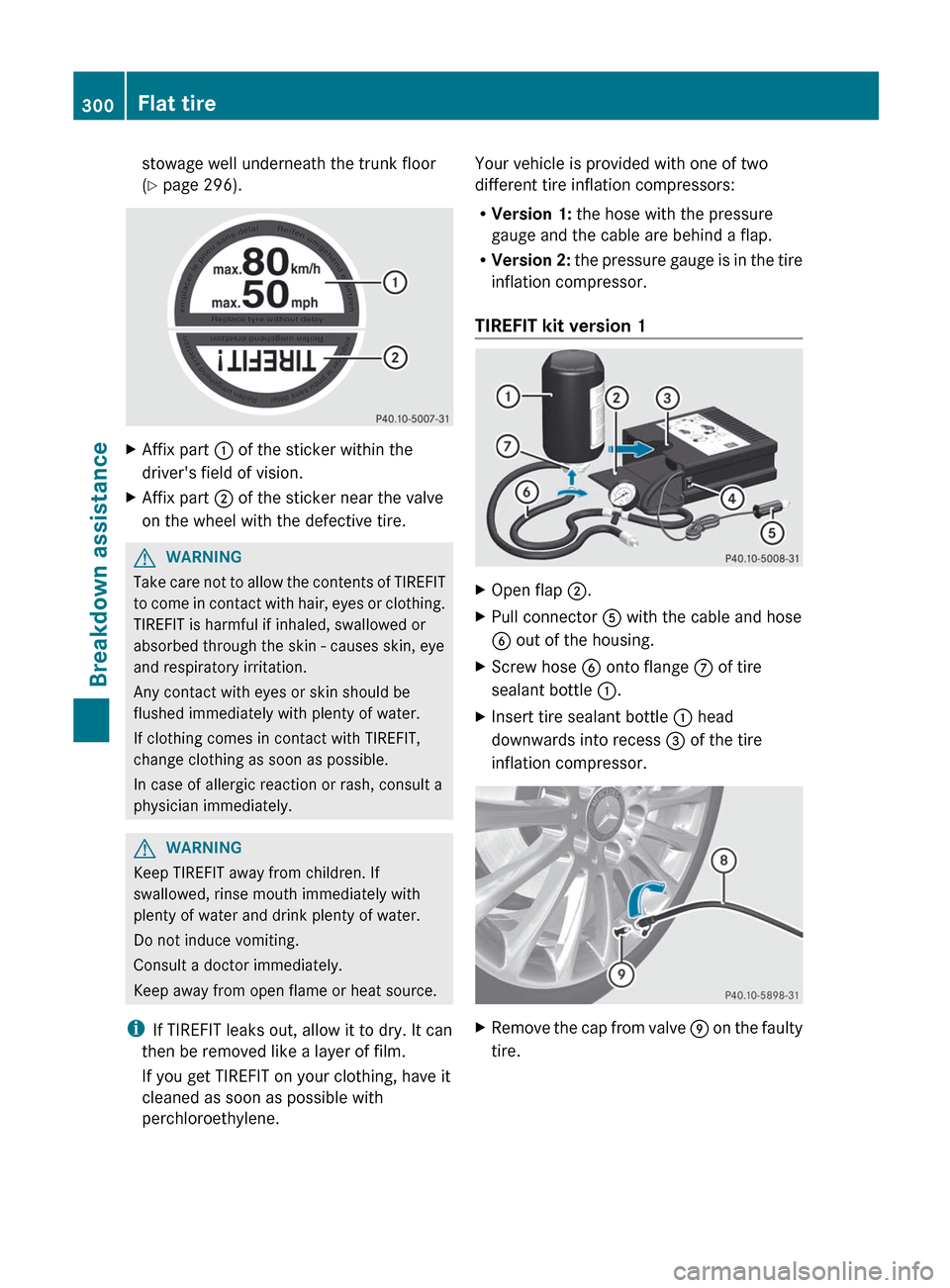
Your vehicle is provided with one of two
different tire inflation compressors:
R Version 1: the hose with the pressure
gauge and the cable are behind a flap.
R Version 2: the pressure gauge is in the tire
inflation compressor.
TIREFIT kit version 1XOpen flap ;.XPull connector A with the cable and hose
B out of the housing.XScrew hose B onto flange C of tire
sealant bottle :.XInsert tire sealant bottle : head
downwards into recess = of the tire
inflation compressor.XRemove the cap from valve E on the faulty
tire.300Flat tireBreakdown assistance
Page 303 of 368
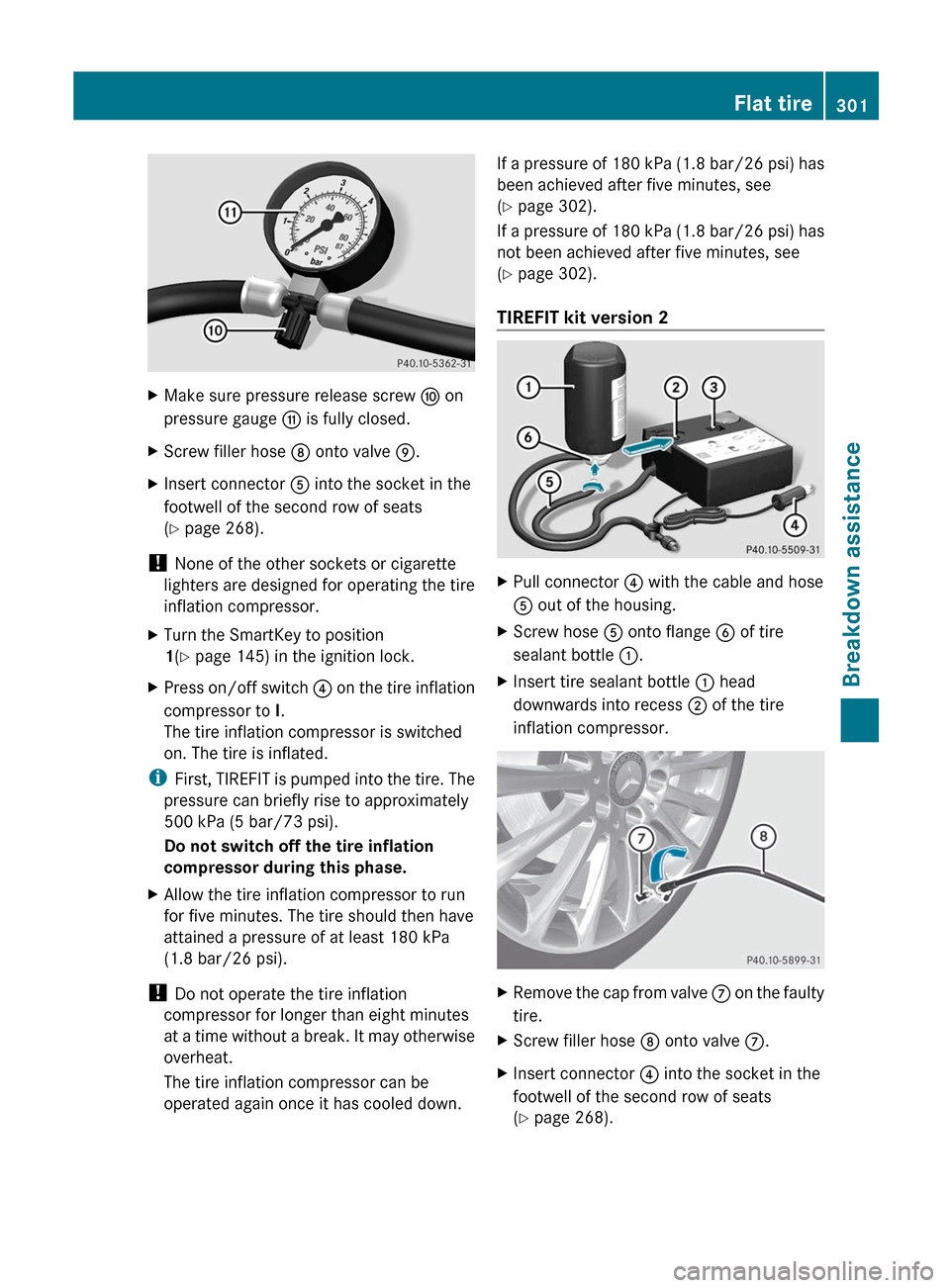
XMake sure pressure release screw F on
pressure gauge G is fully closed.XScrew filler hose D onto valve E.XInsert connector A into the socket in the
footwell of the second row of seats
( Y page 268).
!
None of the other sockets or cigarette
lighters are designed for operating the tire
inflation compressor.
XTurn the SmartKey to position
1 (Y page 145) in the ignition lock.XPress on/off switch ? on the tire inflation
compressor to I.
The tire inflation compressor is switched
on. The tire is inflated.
i First, TIREFIT is pumped into the tire. The
pressure can briefly rise to approximately
500 kPa (5 bar/73 psi).
Do not switch off the tire inflation
compressor during this phase.
XAllow the tire inflation compressor to run
for five minutes. The tire should then have
attained a pressure of at least 180 kPa
(1.8 bar/26 psi).
! Do not operate the tire inflation
compressor for longer than eight minutes
at a time without a break. It may otherwise
overheat.
The tire inflation compressor can be
operated again once it has cooled down.
If a pressure of 180 kPa (1.8 bar/26 psi) has
been achieved after five minutes, see
( Y page 302).
If a pressure of 180 kPa (1.8 bar/26 psi) has
not been achieved after five minutes, see
( Y page 302).
TIREFIT kit version 2XPull connector ? with the cable and hose
A out of the housing.XScrew hose A onto flange B of tire
sealant bottle :.XInsert tire sealant bottle : head
downwards into recess ; of the tire
inflation compressor.XRemove the cap from valve C on the faulty
tire.XScrew filler hose D onto valve C.XInsert connector ? into the socket in the
footwell of the second row of seats
( Y page 268).Flat tire301Breakdown assistanceZ
Page 304 of 368
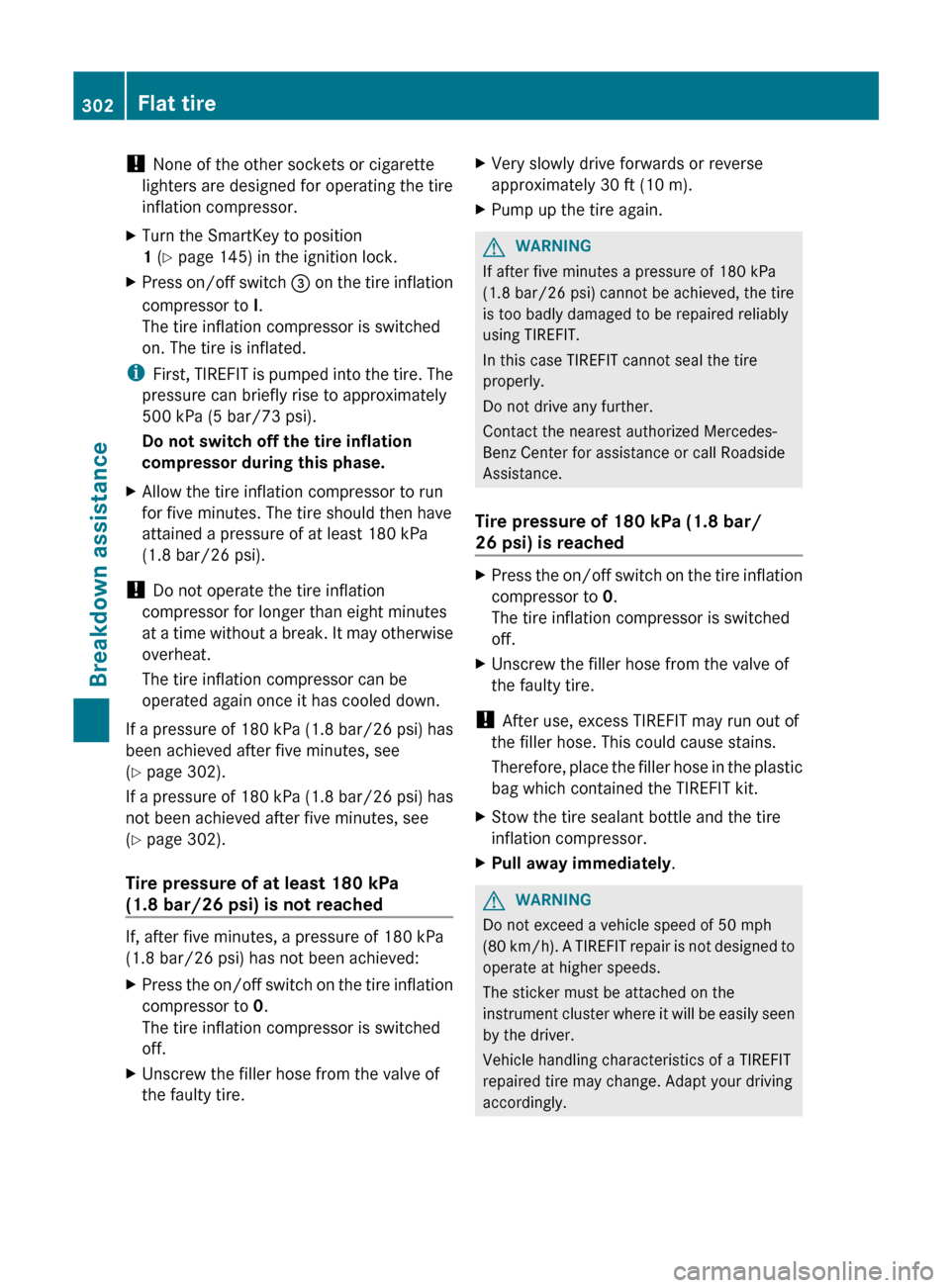
! None of the other sockets or cigarette
lighters are designed for operating the tire
inflation compressor.XTurn the SmartKey to position
1 (Y page 145) in the ignition lock.XPress on/off switch = on the tire inflation
compressor to I.
The tire inflation compressor is switched
on. The tire is inflated.
i First, TIREFIT is pumped into the tire. The
pressure can briefly rise to approximately
500 kPa (5 bar/73 psi).
Do not switch off the tire inflation
compressor during this phase.
XAllow the tire inflation compressor to run
for five minutes. The tire should then have
attained a pressure of at least 180 kPa
(1.8 bar/26 psi).
! Do not operate the tire inflation
compressor for longer than eight minutes
at a time without a break. It may otherwise
overheat.
The tire inflation compressor can be
operated again once it has cooled down.
If a pressure of 180 kPa (1.8 bar/26 psi) has
been achieved after five minutes, see
( Y page 302).
If a pressure of 180 kPa (1.8 bar/26 psi) has
not been achieved after five minutes, see
( Y page 302).
Tire pressure of at least 180 kPa
(1.8 bar/26 psi) is not reached
If, after five minutes, a pressure of 180 kPa
(1.8 bar/26 psi) has not been achieved:
XPress the on/off switch on the tire inflation
compressor to 0.
The tire inflation compressor is switched
off.XUnscrew the filler hose from the valve of
the faulty tire.XVery slowly drive forwards or reverse
approximately 30 ft (10 m).XPump up the tire again.GWARNING
If after five minutes a pressure of 180 kPa
(1.8 bar/26 psi) cannot be achieved, the tire
is too badly damaged to be repaired reliably
using TIREFIT.
In this case TIREFIT cannot seal the tire
properly.
Do not drive any further.
Contact the nearest authorized Mercedes-
Benz Center for assistance or call Roadside
Assistance.
Tire pressure of 180 kPa (1.8 bar/
26 psi) is reached
XPress the on/off switch on the tire inflation
compressor to 0.
The tire inflation compressor is switched
off.XUnscrew the filler hose from the valve of
the faulty tire.
! After use, excess TIREFIT may run out of
the filler hose. This could cause stains.
Therefore, place the filler hose in the plastic
bag which contained the TIREFIT kit.
XStow the tire sealant bottle and the tire
inflation compressor.XPull away immediately .GWARNING
Do not exceed a vehicle speed of 50 mph
(80 km/h ). A TIREFIT repair is not designed to
operate at higher speeds.
The sticker must be attached on the
instrument cluster where it will be easily seen
by the driver.
Vehicle handling characteristics of a TIREFIT
repaired tire may change. Adapt your driving
accordingly.
302Flat tireBreakdown assistance
Page 305 of 368
XStop after driving for approximately ten
minutes and check the tire pressure with
the tire inflation compressor.GWARNING
If tire inflation pressure has fallen below
130 kPa (1.3 bar/26 psi) do not continue to
drive the vehicle.
Park your vehicle safely away from the
roadway and contact the nearest authorized
Mercedes-Benz Center or Roadside
Assistance.
Have the damaged tire replaced.
XCorrect the tire pressure if it is at least
130 kPa (1.3 bar/20 psi) (for the required
values, see the Tire and Loading
Information placard on the driver's side
B-pillar or the tire pressure table inside the
fuel filler flap).XTo increase the tire pressure: switch on
the tire inflation compressor.
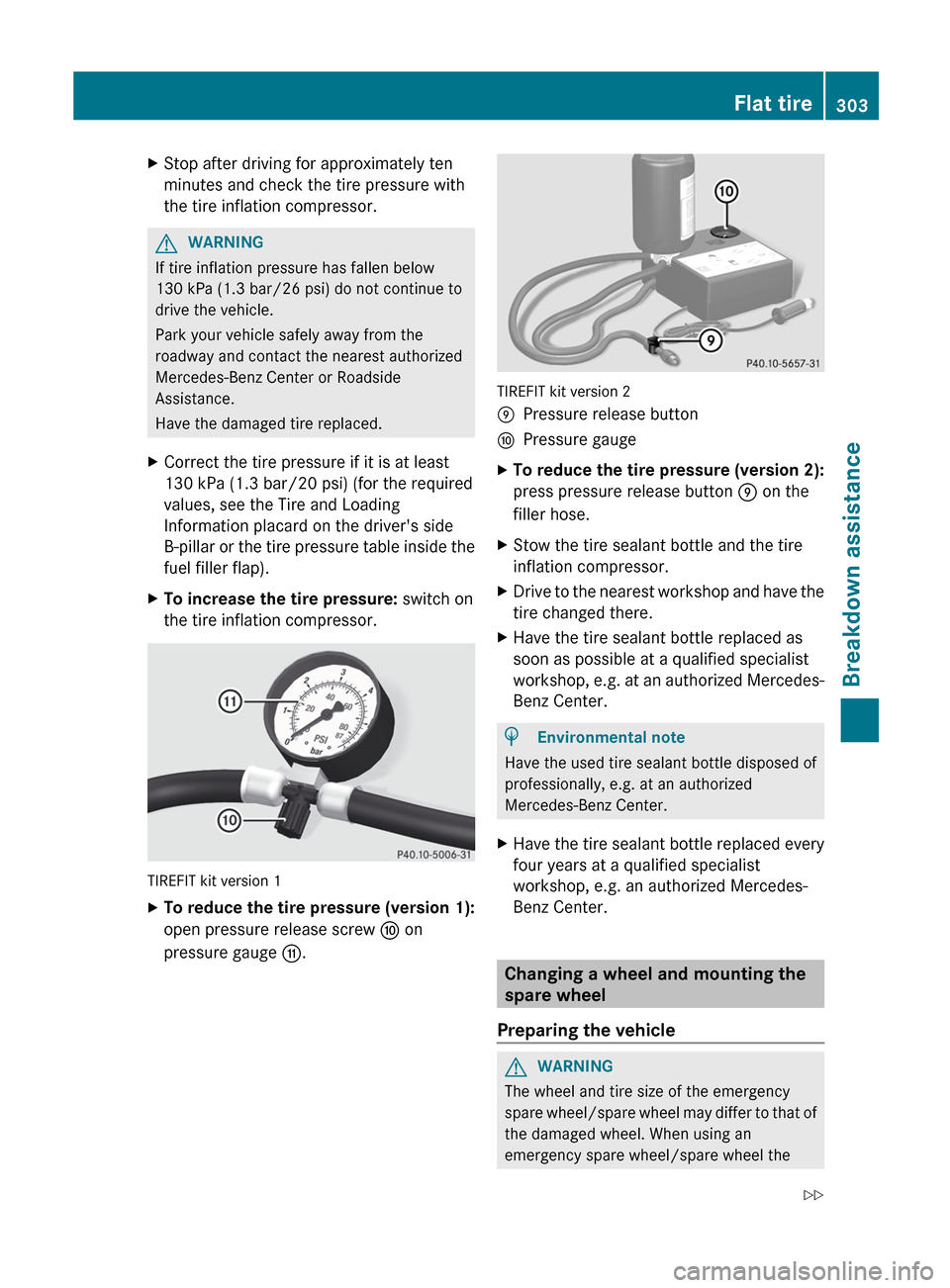
TIREFIT kit version 1
XTo reduce the tire pressure (version 1):
open pressure release screw F on
pressure gauge G.
TIREFIT kit version 2
EPressure release buttonFPressure gaugeXTo reduce the tire pressure (version 2):
press pressure release button E on the
filler hose.XStow the tire sealant bottle and the tire
inflation compressor.XDrive to the nearest workshop and have the
tire changed there.XHave the tire sealant bottle replaced as
soon as possible at a qualified specialist
workshop, e.g. at an authorized Mercedes-
Benz Center.HEnvironmental note
Have the used tire sealant bottle disposed of
professionally, e.g. at an authorized
Mercedes-Benz Center.
XHave the tire sealant bottle replaced every
four years at a qualified specialist
workshop, e.g. an authorized Mercedes-
Benz Center.
Changing a wheel and mounting the
spare wheel
Preparing the vehicle
GWARNING
The wheel and tire size of the emergency
spare wheel/spare wheel may differ to that of
the damaged wheel. When using an
emergency spare wheel/spare wheel the
Flat tire303Breakdown assistanceZ
Page 306 of 368
handling characteristics of the vehicle may
change.
Adapt your style of driving accordingly.
Never operate the vehicle with more than one
emergency spare wheel/spare wheel that
differs in size.
Only use an emergency spare wheel/spare
wheel of a differing size briefly and do not
switch off ESP ®
.
When using an emergency spare wheel, you
must not exceed the maximum speed of
50 mph (80 km/h).GWARNING
Have the emergency spare wheel/spare
wheel replaced with a new wheel as soon as
possible at a qualified specialist workshop
which has the necessary specialist knowledge
and tools to carry out the work required.
Mercedes-Benz recommends that you use an
authorized Mercedes-Benz Center for this
purpose. In particular, work relevant to safety
or on safety-related systems must be carried
out at a qualified specialist workshop.
i Vehicles without a spare wheel/
emergency spare wheel are not equipped
with a tire-change tool kit at the factory. For
more information on which tools are
required to perform a wheel change on your
vehicle, e.g. wheel chock, lug wrench or
alignment bolt, consult an authorized
Mercedes-Benz Center.
XPrepare the vehicle as described
( Y page 299).XIf a trailer is coupled to the vehicle,
uncouple it.XRemove the following items (depending on
the vehicle's equipment) from the stowage
well under the trunk floor:
R the emergency spare wheel 35
R the wheel bolts for the emergency spare
wheel 35
R the jackRthe ratchet wrench
R the lug wrench
R the folding wheel chock
R the alignment bolt
R the tire inflation compressor 35XSecure the vehicle to prevent it from rolling
away.
Securing the vehicle to prevent it from
rolling away
GWARNING
Only jack up the vehicle on level ground or on
slight inclines/declines. The vehicle could
otherwise fall off the jack and injure you or
others.
If your vehicle is equipped with a wheel chock,
it can be found in the vehicle tool kit
( Y page 296).
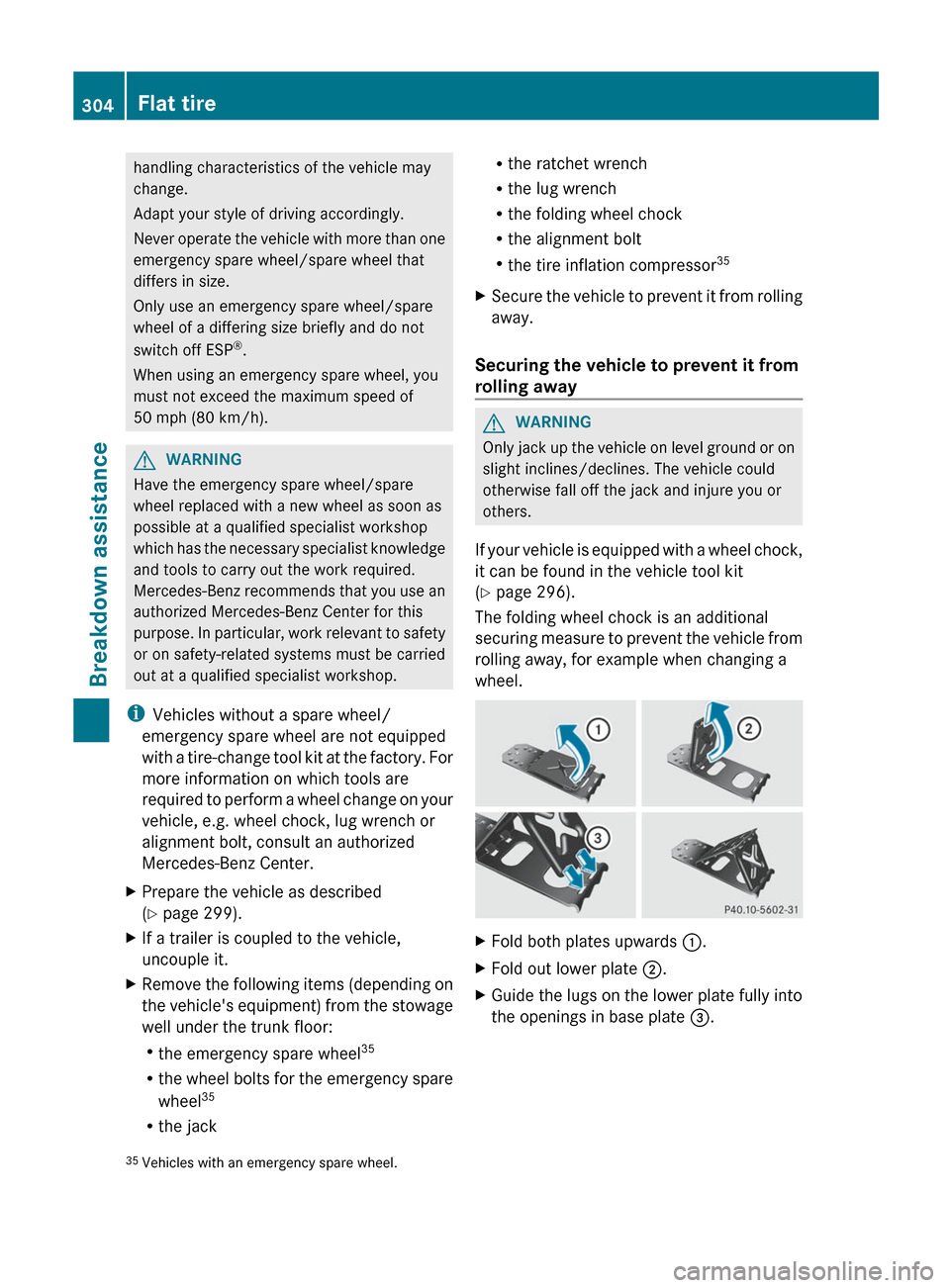
The folding wheel chock is an additional
securing measure to prevent the vehicle from
rolling away, for example when changing a
wheel.
XFold both plates upwards :.XFold out lower plate ;.XGuide the lugs on the lower plate fully into
the openings in base plate =.35
Vehicles with an emergency spare wheel.304Flat tireBreakdown assistance