display MERCEDES-BENZ R350 2010 W251 Owner's Manual
[x] Cancel search | Manufacturer: MERCEDES-BENZ, Model Year: 2010, Model line: R350, Model: MERCEDES-BENZ R350 2010 W251Pages: 364, PDF Size: 7.5 MB
Page 305 of 364
i
After 60 seconds with an unfastened seat belt the warning chime stops sounding and the
seat belt telltale illuminates continuously. The seat belt telltale will only go out if both, the
driver and front passenger’s seat belt are fastened, or the vehicle is standing still and a front
door is opened. Problem
Possible causes/consequences and
X Solutions+
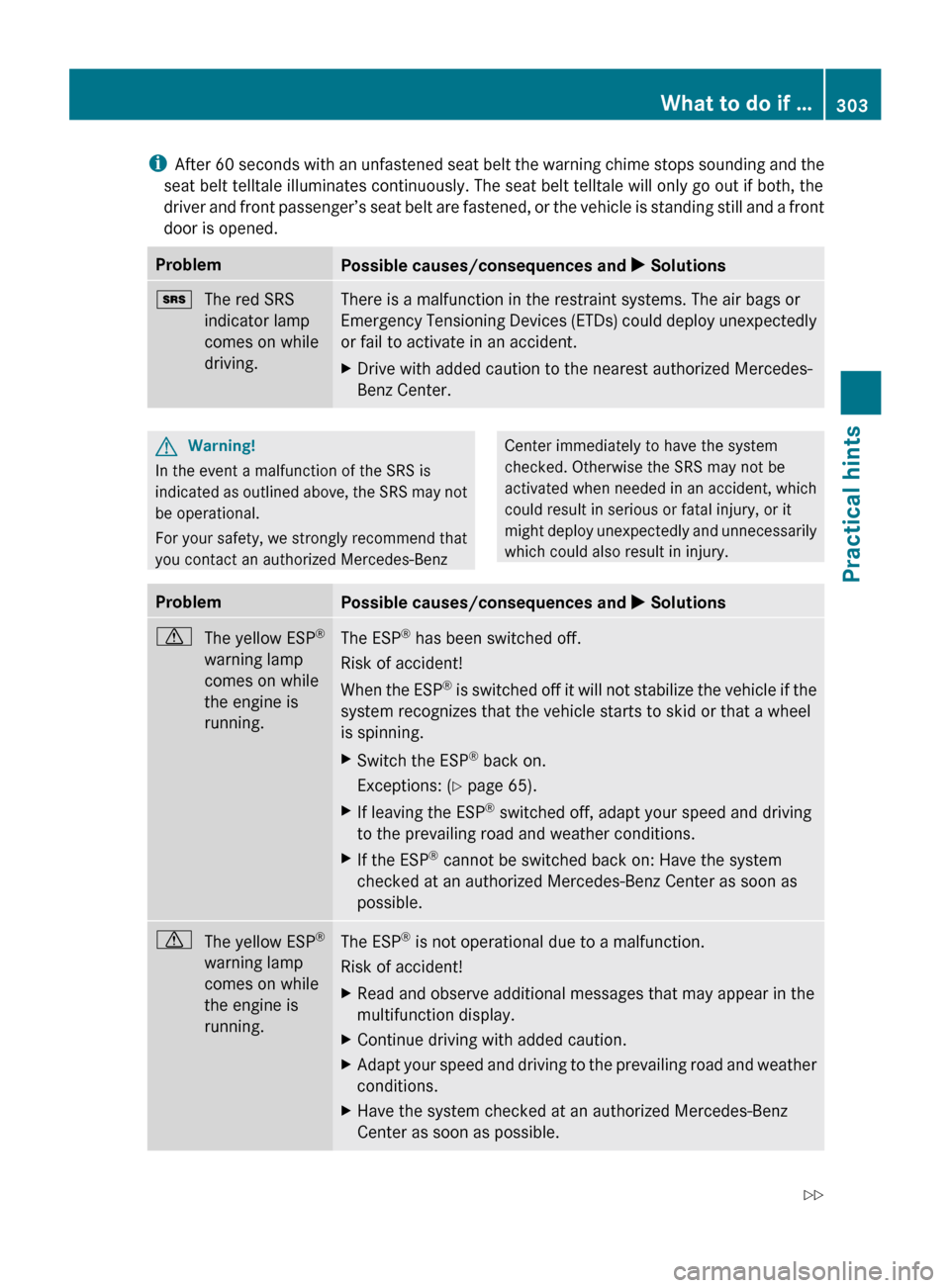
The red SRS
indicator lamp
comes on while
driving. There is a malfunction in the restraint systems. The air bags or
Emergency
Tensioning Devices (ETDs) could deploy unexpectedly
or fail to activate in an accident.
X Drive with added caution to the nearest authorized Mercedes-
Benz Center. G
Warning!
In the event a malfunction of the SRS is
indicated
as outlined above, the SRS may not
be operational.
For your safety, we strongly recommend that
you contact an authorized Mercedes-Benz Center immediately to have the system
checked. Otherwise the SRS may not be
activated
when needed in an accident, which
could result in serious or fatal injury, or it
might deploy unexpectedly and unnecessarily
which could also result in injury. Problem
Possible causes/consequences and
X Solutionsd
The yellow ESP ®
warning lamp
comes on while
the engine is
running. The ESP
®
has been switched off.
Risk of accident!
When
the ESP ®
is switched off it will not stabilize the vehicle if the
system recognizes that the vehicle starts to skid or that a wheel
is spinning.
X Switch the ESP ®
back on.
Exceptions:
(Y page 65).
X If leaving the ESP ®
switched off, adapt your speed and driving
to the prevailing road and weather conditions.
X If the ESP ®
cannot be switched back on: Have the system
checked at an authorized Mercedes-Benz Center as soon as
possible. d
The yellow ESP ®
warning lamp
comes on while
the engine is
running. The ESP
®
is not operational due to a malfunction.
Risk of accident!
X Read and observe additional messages that may appear in the
multifunction display.
X Continue driving with added caution.
X Adapt your speed and driving to the prevailing road and weather
conditions.
X Have the system checked at an authorized Mercedes-Benz
Center as soon as possible. What to do if …
303
Practical hints
251_AKB; 4; 52, en-US
d2ureepe, Version: 2.11.8.1 2009-03-23T09:22:52+01:00 - Seite 303 Z
Page 306 of 364
Problem
Possible causes/consequences and
X Solutionsd
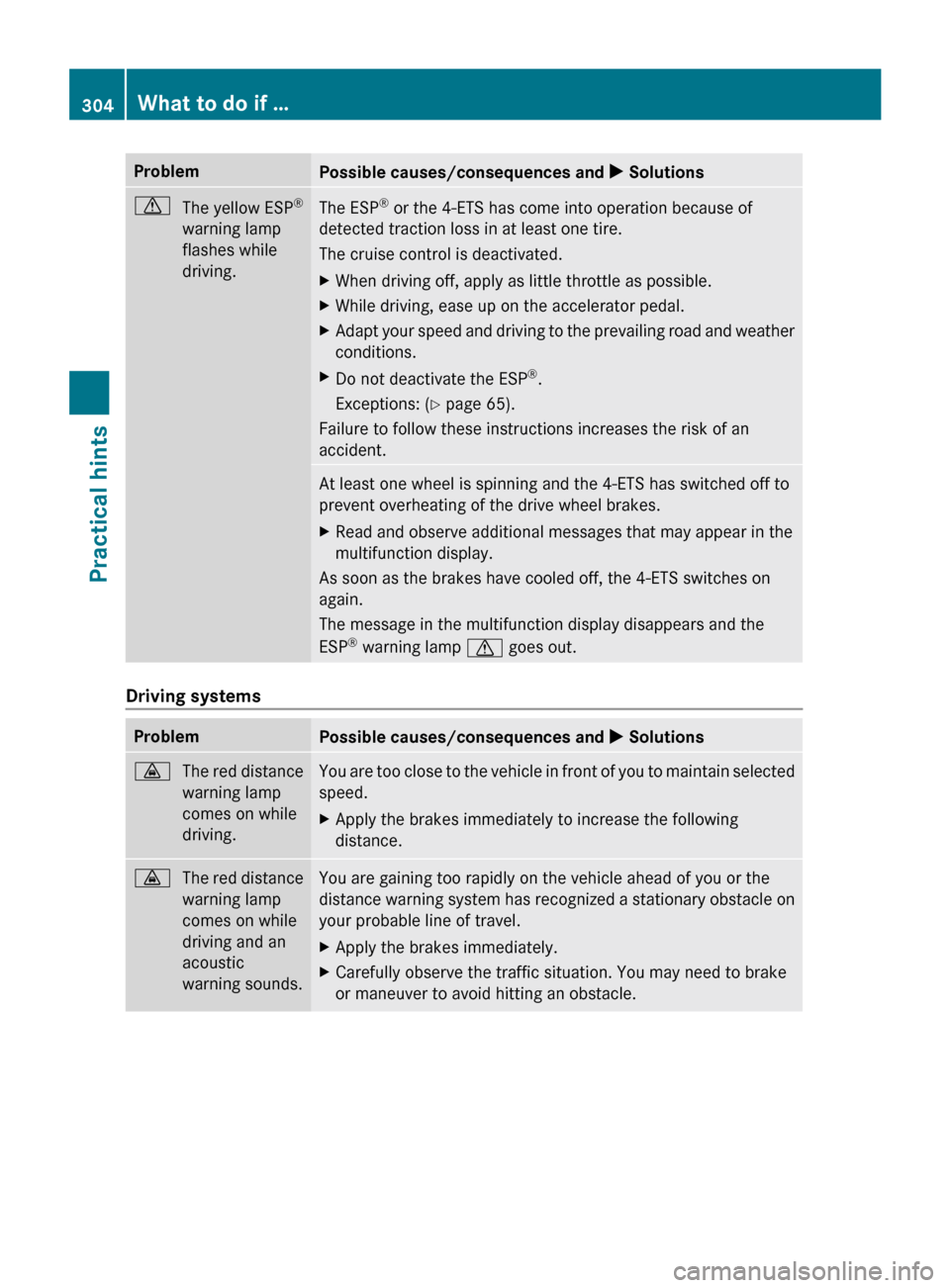
The yellow ESP ®
warning lamp
flashes while
driving. The ESP
®
or the 4-ETS has come into operation because of
detected traction loss in at least one tire.
The cruise control is deactivated.
X When driving off, apply as little throttle as possible.
X While driving, ease up on the accelerator pedal.
X Adapt your speed and driving to the prevailing road and weather
conditions.
X Do not deactivate the ESP ®
.
Exceptions: (Y page 65).
Failure to follow these instructions increases the risk of an
accident. At least one wheel is spinning and the 4-ETS has switched off to
prevent overheating of the drive wheel brakes.
X
Read and observe additional messages that may appear in the
multifunction display.
As soon as the brakes have cooled off, the 4-ETS switches on
again.
The message in the multifunction display disappears and the
ESP ®
warning lamp d goes out. Driving systems
Problem
Possible causes/consequences and
X Solutions·
The red distance
warning lamp
comes on while
driving. You are too close to the vehicle in front of you to maintain selected
speed.
X
Apply the brakes immediately to increase the following
distance. ·
The red distance
warning lamp
comes on while
driving and an
acoustic
warning sounds. You are gaining too rapidly on the vehicle ahead of you or the
distance
warning system has recognized a stationary obstacle on
your probable line of travel.
X Apply the brakes immediately.
X Carefully observe the traffic situation. You may need to brake
or maneuver to avoid hitting an obstacle. 304
What to do if …
Practical hints
251_AKB; 4; 52, en-US
d2ureepe,
Version: 2.11.8.1 2009-03-23T09:22:52+01:00 - Seite 304
Page 308 of 364
Tires
Problem
Possible causes/consequences and
X Solutionsh
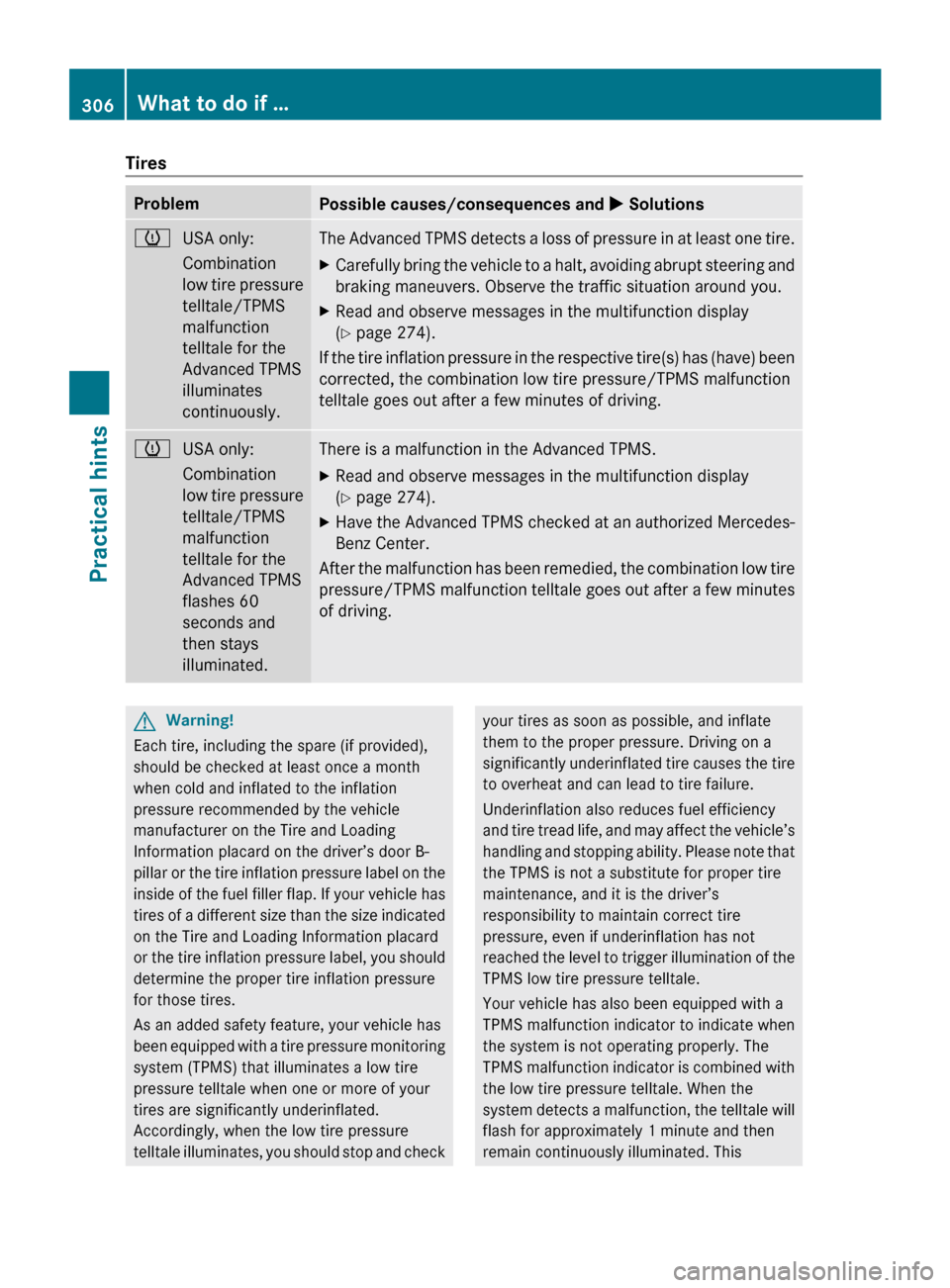
USA only:
Combination
low
tire pressure
telltale/TPMS
malfunction
telltale for the
Advanced TPMS
illuminates
continuously. The Advanced TPMS detects a loss of pressure in at least one tire.
X
Carefully bring the vehicle to a halt, avoiding abrupt steering and
braking maneuvers. Observe the traffic situation around you.
X Read and observe messages in the multifunction display
(Y page 274).
If the tire inflation pressure in the respective tire(s) has (have) been
corrected, the combination low tire pressure/TPMS malfunction
telltale goes out after a few minutes of driving. h
USA only:
Combination
low
tire pressure
telltale/TPMS
malfunction
telltale for the
Advanced TPMS
flashes 60
seconds and
then stays
illuminated. There is a malfunction in the Advanced TPMS.
X
Read and observe messages in the multifunction display
(Y page 274).
X Have the Advanced TPMS checked at an authorized Mercedes-
Benz Center.
After the malfunction has been remedied, the combination low tire
pressure/TPMS
malfunction telltale goes out after a few minutes
of driving. G
Warning!
Each tire, including the spare (if provided),
should be checked at least once a month
when cold and inflated to the inflation
pressure recommended by the vehicle
manufacturer on the Tire and Loading
Information placard on the driver’s door B-
pillar
or the tire inflation pressure label on the
inside of the fuel filler flap. If your vehicle has
tires of a different size than the size indicated
on the Tire and Loading Information placard
or the tire inflation pressure label, you should
determine the proper tire inflation pressure
for those tires.
As an added safety feature, your vehicle has
been equipped with a tire pressure monitoring
system (TPMS) that illuminates a low tire
pressure telltale when one or more of your
tires are significantly underinflated.
Accordingly, when the low tire pressure
telltale illuminates, you should stop and check your tires as soon as possible, and inflate
them to the proper pressure. Driving on a
significantly
underinflated tire causes the tire
to overheat and can lead to tire failure.
Underinflation also reduces fuel efficiency
and tire tread life, and may affect the vehicle’s
handling and stopping ability. Please note that
the TPMS is not a substitute for proper tire
maintenance, and it is the driver’s
responsibility to maintain correct tire
pressure, even if underinflation has not
reached the level to trigger illumination of the
TPMS low tire pressure telltale.
Your vehicle has also been equipped with a
TPMS malfunction indicator to indicate when
the system is not operating properly. The
TPMS malfunction indicator is combined with
the low tire pressure telltale. When the
system detects a malfunction, the telltale will
flash for approximately 1 minute and then
remain continuously illuminated. This 306
What to do if …
Practical hints
251_AKB; 4; 52, en-US
d2ureepe,
Version: 2.11.8.1 2009-03-23T09:22:52+01:00 - Seite 306
Page 309 of 364
sequence will continue upon subsequent
vehicle start-ups as long as the malfunction
exists. When the malfunction indicator is
illuminated, the system may not be able to
detect
or signal low tire pressure as intended.
TPMS malfunctions may occur for a variety of
reasons, including the installation of
incompatible replacement or alternate tires or wheels on the vehicle that prevent the
TPMS from functioning properly. Always
check the TPMS malfunction telltale after
replacing
one or more tires or wheels on your
vehicle to ensure that the replacement or
alternate tires and wheels allow the TPMS to
continue to function properly. Lamp in center console
Problem
Possible causes/consequences and
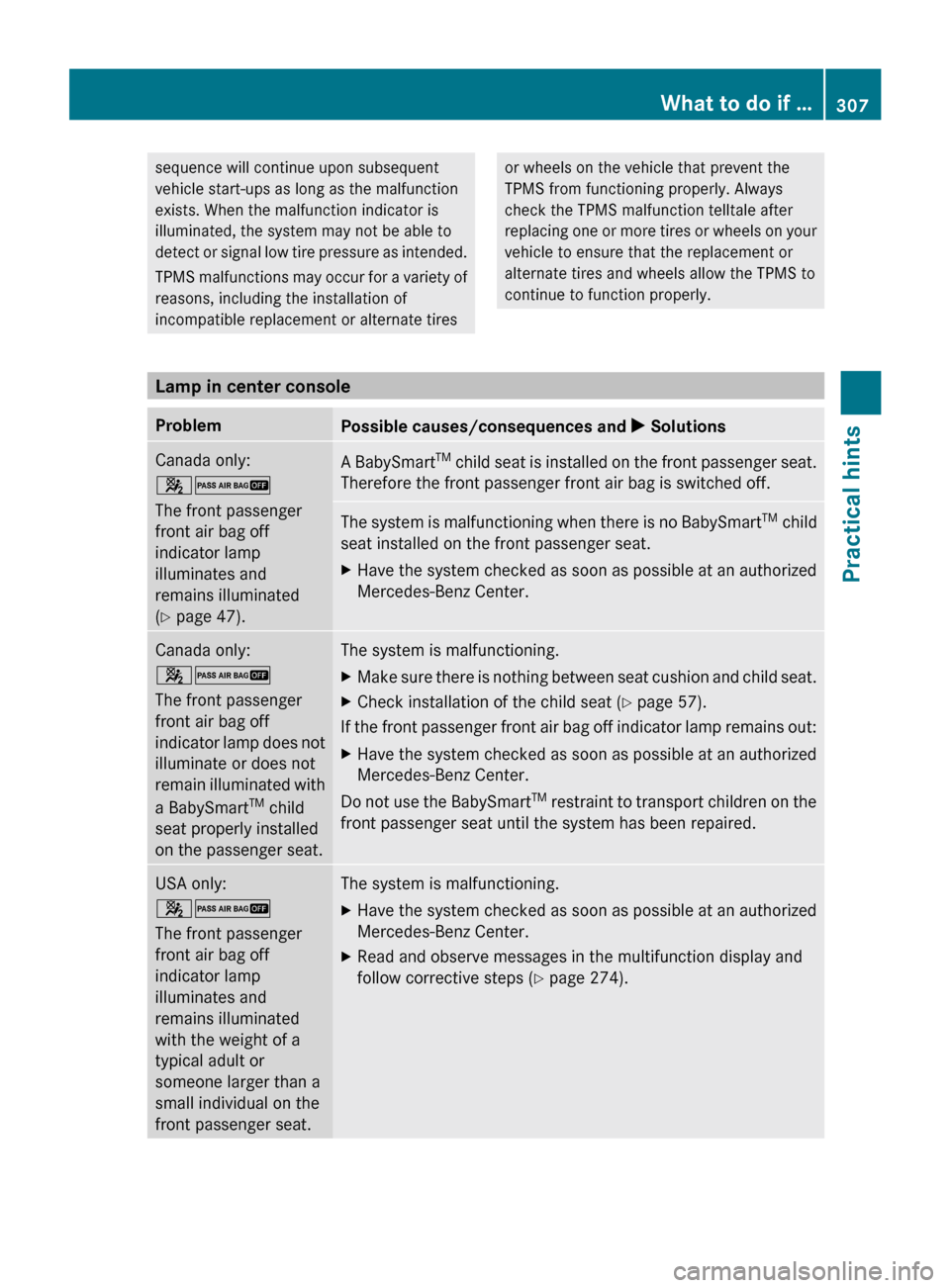
X SolutionsCanada only:
42
The front passenger
front air bag off
indicator lamp
illuminates and
remains illuminated
(Y page 47).
A BabySmart
TM
child seat is installed on the front passenger seat.
Therefore the front passenger front air bag is switched off. The system is malfunctioning when there is no BabySmart
TM
child
seat installed on the front passenger seat.
X Have the system checked as soon as possible at an authorized
Mercedes-Benz Center. Canada only:
42
The front passenger
front air bag off
indicator
lamp does not
illuminate or does not
remain illuminated with
a BabySmart TM
child
seat properly installed
on the passenger seat. The system is malfunctioning.
X
Make sure there is nothing between seat cushion and child seat.
X Check installation of the child seat ( Y page 57).
If the front passenger front air bag off indicator lamp remains out:
X Have the system checked as soon as possible at an authorized
Mercedes-Benz Center.
Do not use the BabySmart TM
restraint to transport children on the
front passenger seat until the system has been repaired. USA only:
42
The front passenger
front air bag off
indicator lamp
illuminates and
remains illuminated
with the weight of a
typical adult or
someone larger than a
small individual on the
front passenger seat. The system is malfunctioning.
X
Have the system checked as soon as possible at an authorized
Mercedes-Benz Center.
X Read and observe messages in the multifunction display and
follow corrective steps (Y page 274). What to do if …
307
Practical hints
251_AKB; 4; 52, en-US
d2ureepe, Version: 2.11.8.1 2009-03-23T09:22:52+01:00 - Seite 307 Z
Page 310 of 364
G
Warning!
If the 42 indicator lamp
illuminates and remains illuminated with the
weight of a typical adult or someone larger than a small individual on the front passenger
seat, do not have any passenger use the front
passenger seat until the system has been
repaired.
Problem
Possible causes/consequences and
X SolutionsUSA only:
42
The front passenger
front air bag off
indicator lamp does not
illuminate and/or does
not remain illuminated
with the weight of a
typical 12-month-old
child in a standard child
restraint or less on the
front passenger seat. The system is malfunctioning.
X
Make sure there is nothing between seat cushion and child seat
and check installation of the child seat.
X Make sure no objects applying supplemental weight onto the
seat are present.
X Make sure no objects which apply forces to the seat are present
(e.g. objects such as books, briefcases etc. lodged behind or
around the seat, head restraints pushing against roof etc.). The
system may recognize such forces as supplemental weight.
X If the front passenger front air bag off indicator lamp remains
out, have the system checked as soon as possible at an
authorized Mercedes-Benz Center. Do not transport a child on
the front passenger seat until the system has been repaired.
X Read and observe messages in the multifunction display and
follow corrective steps (Y page 274). G
Warning!
If the 42 indicator lamp does not
illuminate or remains out with the weight of a
typical 12-month-old child in a standard child
restraint or less on the front passenger seat,
do not transport a child on the front
passenger seat until the system has been
repaired. Unlocking/locking manually
Unlocking the vehicle
If you cannot unlock the vehicle with the
SmartKey or with KEYLESS-GO, unlock the
driver’s door using the mechanical key.
The anti-theft alarm system will trigger when
you
R unlocking the driver’s door with the
mechanical key and
R open the driver’s door
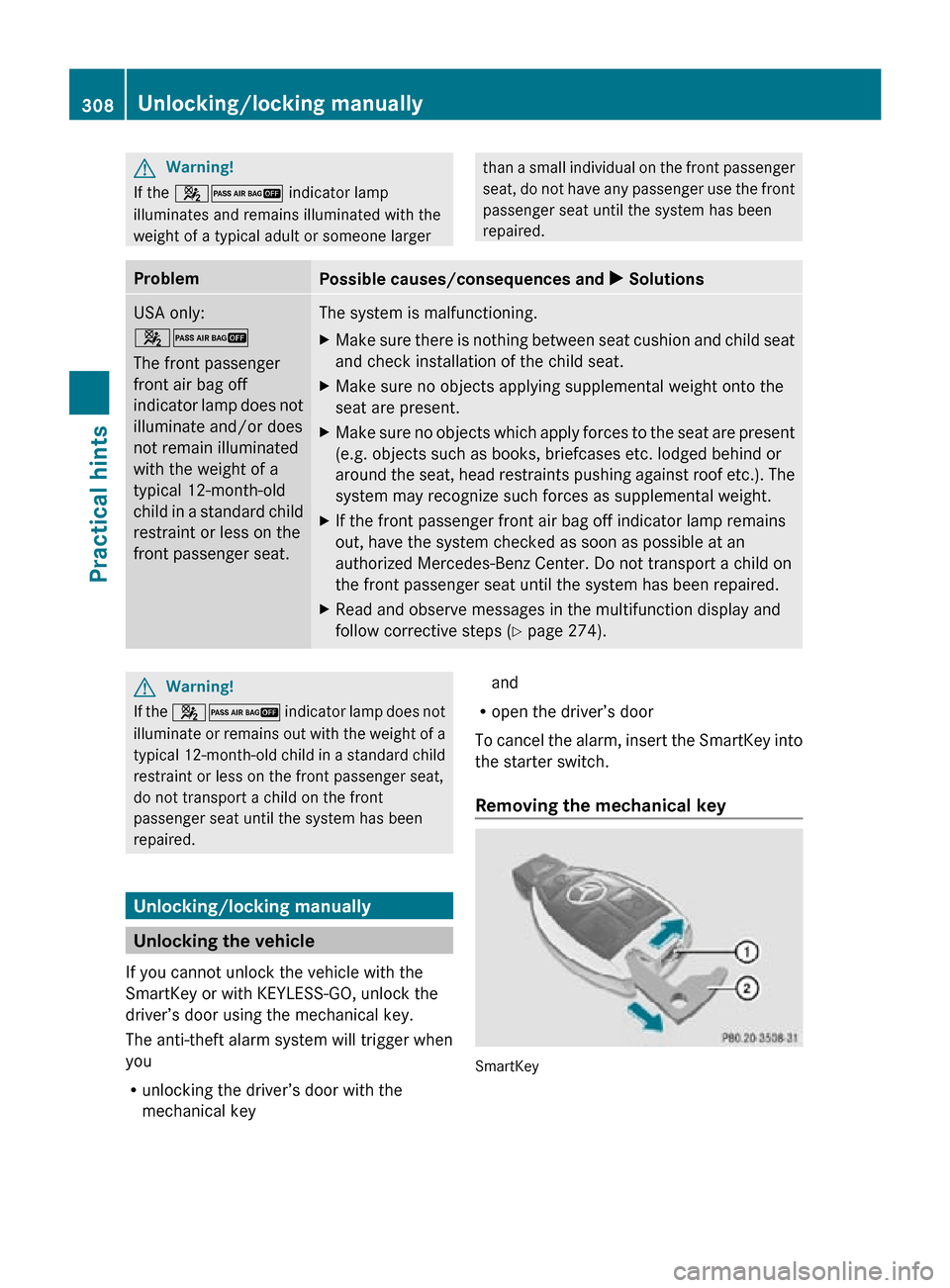
To cancel the alarm, insert the SmartKey into
the starter switch.
Removing the mechanical key SmartKey308
Unlocking/locking manuallyPractical hints
251_AKB; 4; 52, en-US
d2ureepe,
Version: 2.11.8.1 2009-03-23T09:22:52+01:00 - Seite 308
Page 324 of 364
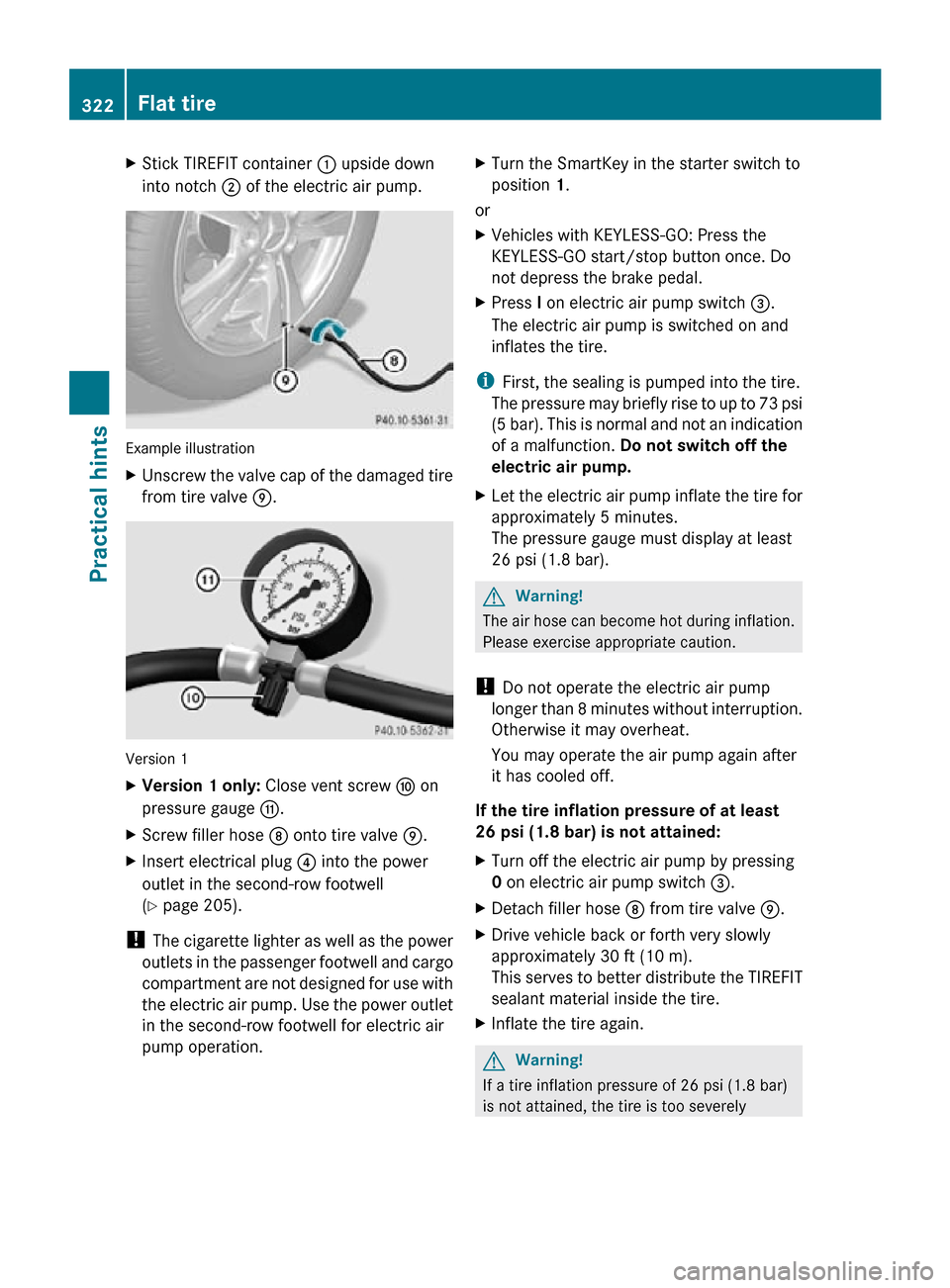
X
Stick TIREFIT container : upside down
into notch ; of the electric air pump. Example illustration
X
Unscrew the valve cap of the damaged tire
from tire valve E. Version 1
X
Version 1 only: Close vent screw F on
pressure gauge G.
X Screw filler hose D onto tire valve E.
X Insert electrical plug ? into the power
outlet in the second-row footwell
(Y page 205).
! The cigarette lighter as well as the power
outlets in the passenger footwell and cargo
compartment are not designed for use with
the electric air pump. Use the power outlet
in the second-row footwell for electric air
pump operation. X
Turn the SmartKey in the starter switch to
position 1.
or
X Vehicles with KEYLESS-GO: Press the
KEYLESS-GO start/stop button once. Do
not depress the brake pedal.
X Press I on electric air pump switch =.
The electric air pump is switched on and
inflates the tire.
i First, the sealing is pumped into the tire.
The pressure may briefly rise to up to 73 psi
(5 bar). This is normal and not an indication
of a malfunction. Do not switch off the
electric air pump.
X Let the electric air pump inflate the tire for
approximately 5 minutes.
The pressure gauge must display at least
26 psi (1.8 bar). G
Warning!
The air hose can become hot during inflation.
Please exercise appropriate caution.
! Do not operate the electric air pump
longer than 8 minutes without interruption.
Otherwise it may overheat.
You may operate the air pump again after
it has cooled off.
If the tire inflation pressure of at least
26 psi (1.8 bar) is not attained:
X Turn off the electric air pump by pressing
0 on electric air pump switch =.
X Detach filler hose D from tire valve E.
X Drive vehicle back or forth very slowly
approximately 30 ft (10 m).
This serves to better distribute the TIREFIT
sealant material inside the tire.
X Inflate the tire again. G
Warning!
If a tire inflation pressure of 26 psi (1.8 bar)
is not attained, the tire is too severely 322
Flat tirePractical hints
251_AKB; 4; 52, en-US
d2ureepe,
Version: 2.11.8.1 2009-03-23T09:22:52+01:00 - Seite 322
Page 332 of 364
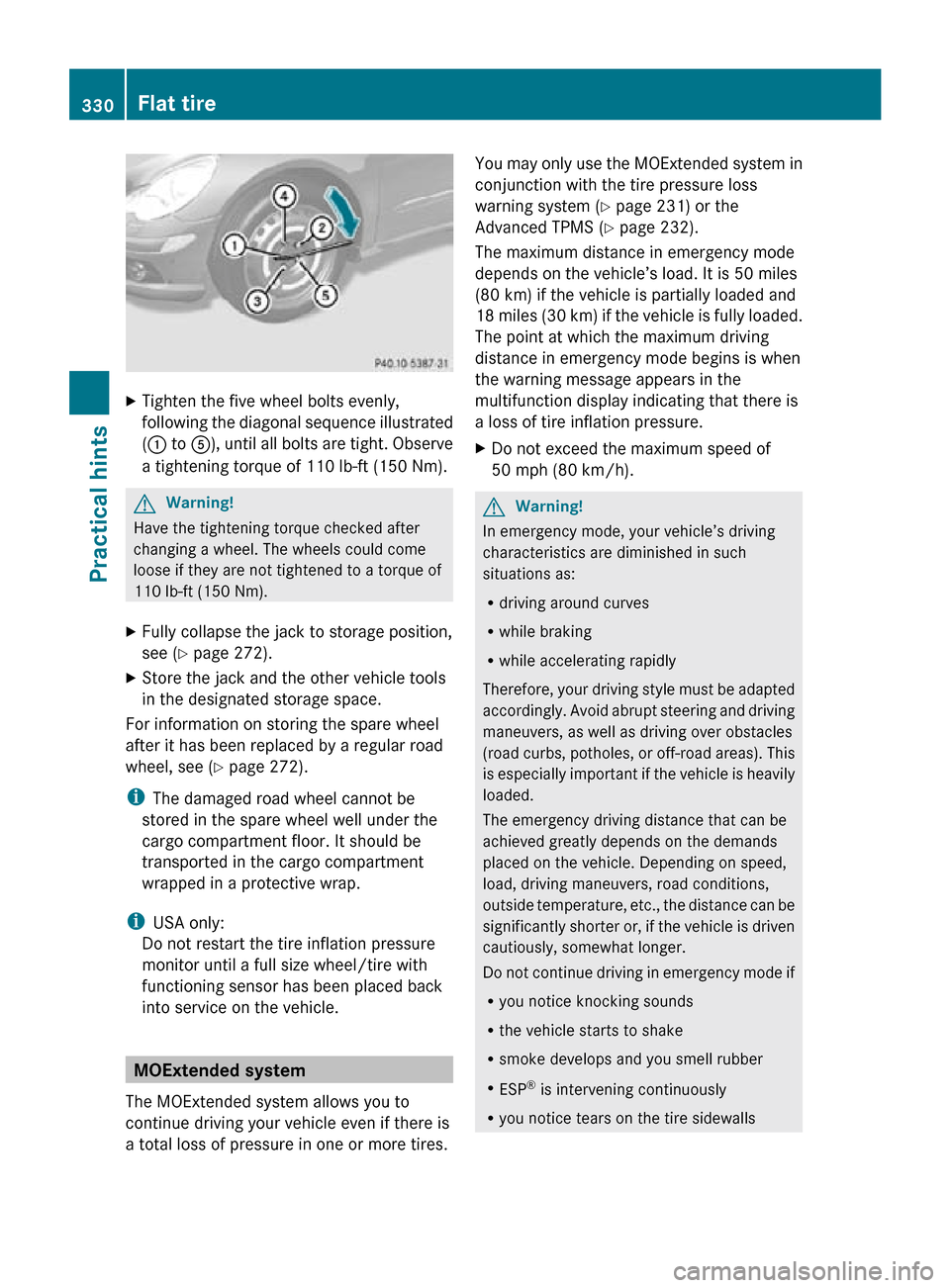
X
Tighten the five wheel bolts evenly,
following the diagonal sequence illustrated
(: to A), until all bolts are tight. Observe
a tightening torque of 110 lb-ft (150 Nm). G
Warning!
Have the tightening torque checked after
changing a wheel. The wheels could come
loose if they are not tightened to a torque of
110 lb-ft (150 Nm).
X Fully collapse the jack to storage position,
see ( Y page 272).
X Store the jack and the other vehicle tools
in the designated storage space.
For information on storing the spare wheel
after it has been replaced by a regular road
wheel, see ( Y page 272).
i The damaged road wheel cannot be
stored in the spare wheel well under the
cargo compartment floor. It should be
transported in the cargo compartment
wrapped in a protective wrap.
i USA only:
Do not restart the tire inflation pressure
monitor until a full size wheel/tire with
functioning sensor has been placed back
into service on the vehicle. MOExtended system
The MOExtended system allows you to
continue driving your vehicle even if there is
a total loss of pressure in one or more tires. You may only use the MOExtended system in
conjunction with the tire pressure loss
warning system (
Y page 231) or the
Advanced TPMS (Y page 232).
The maximum distance in emergency mode
depends on the vehicle’s load. It is 50 miles
(80 km) if the vehicle is partially loaded and
18 miles (30 km) if the vehicle is fully loaded.
The point at which the maximum driving
distance in emergency mode begins is when
the warning message appears in the
multifunction display indicating that there is
a loss of tire inflation pressure.
X Do not exceed the maximum speed of
50 mph (80 km/h). G
Warning!
In emergency mode, your vehicle’s driving
characteristics are diminished in such
situations as:
R driving around curves
R while braking
R while accelerating rapidly
Therefore, your driving style must be adapted
accordingly. Avoid abrupt steering and driving
maneuvers, as well as driving over obstacles
(road curbs, potholes, or off-road areas). This
is especially important if the vehicle is heavily
loaded.
The emergency driving distance that can be
achieved greatly depends on the demands
placed on the vehicle. Depending on speed,
load, driving maneuvers, road conditions,
outside temperature, etc., the distance can be
significantly shorter or, if the vehicle is driven
cautiously, somewhat longer.
Do not continue driving in emergency mode if
R you notice knocking sounds
R the vehicle starts to shake
R smoke develops and you smell rubber
R ESP ®
is intervening continuously
R you notice tears on the tire sidewalls 330
Flat tirePractical hints
251_AKB; 4; 52, en-US
d2ureepe,
Version: 2.11.8.1 2009-03-23T09:22:52+01:00 - Seite 330
Page 333 of 364
After driving in emergency mode, you must
have the rims inspected by an authorized
Mercedes-Benz Center to check if they are
suitable for further use. The failed tire must
be replaced in any case.
When replacing individual or all tires on the
vehicle, make sure only tires marked with
“MOExtended” are mounted in the size
specified for your vehicle
(Y page 347). Bleeding the fuel system (diesel
engine only)
Driving
the vehicle until the fuel tank is empty
is not recommended. Otherwise, air may be
sucked into the fuel system. If this happens,
the malfunction indicator lamp = (USA
only) or ; (Canada only) comes on and the
engine may not start immediately after
refueling the vehicle.
After refueling:
X Make sure the automatic transmission is in
park position P.
The gear position indicator in the
multifunction display should be on P.
X Do not depress the accelerator.
X If necessary, remove the KEYLESS-GO
start/stop button from the starter switch.
X Turn the SmartKey in the starter switch to
position 2 for at least 10 seconds.
X Return the SmartKey in the starter switch
to position 0.
X Turn the SmartKey in the starter switch to
position 3
and hold it there for a maximum
of 40 seconds or until the engine runs
surge-free.
If the engine does not start:
X Wait for approximately 2 minutes.
X Turn the SmartKey in the starter switch to
position 3
and hold it there for a maximum
of 40 seconds or until the engine runs
surge-free. If the engine still does not start, do not make
any further attempts to start the engine.
Contact
an authorized Mercedes-Benz Center
or call Roadside Assistance ( Y page 210).
i When the malfunction indicator lamp
= (USA only) or ; (Canada only) in
the instrument cluster has been illuminated
for the above condition, it will remain
illuminated until the engine was cycled on
and off four times in a row. AdBlue
®
(diesel engine only)
The BlueTEC exhaust gas aftertreatment
system requires a reducing agent (AdBlue ®
)
in order to function properly. Refilling with
AdBlue ®
is part of the regular maintenance
service work. A tankful of AdBlue ®
should
suffice until the next maintenance service
under normal driving conditions.
When the AdBlue ®
tank is low, the message
Check Additive See Operator’s
Manual appears in the multifunction display.
When the AdBlue ®
level drops to the
minimum level, the message Remaining
Starts: 20 appears in the multifunction
display.
i When
the message Remaining Starts:
20 appears in the multifunction display, you
can start the engine 20 more times. If you
do not add AdBlue ®
, the engine cannot be
started beyond that point. Fill the
AdBlue ®
tank with approximately 1 gal
(3.79 l) AdBlue ®
(corresponds to
approximately 2 AdBlue ®
refill containers)
or have the AdBlue ®
tank filled by an
authorized Mercedes-Benz Center.
i For refilling outside the maintenance
service intervals, refill the AdBlue ®
tank
with approximately 1 gal (3.79 l) AdBlue ®
(corresponds to approximately 2 AdBlue ®
refill containers). AdBlue
®
(diesel engine only) 331
Practical hints
251_AKB; 4; 52, en-US
d2ureepe,
Version: 2.11.8.1 2009-03-23T09:22:52+01:00 - Seite 331 Z
Page 335 of 364
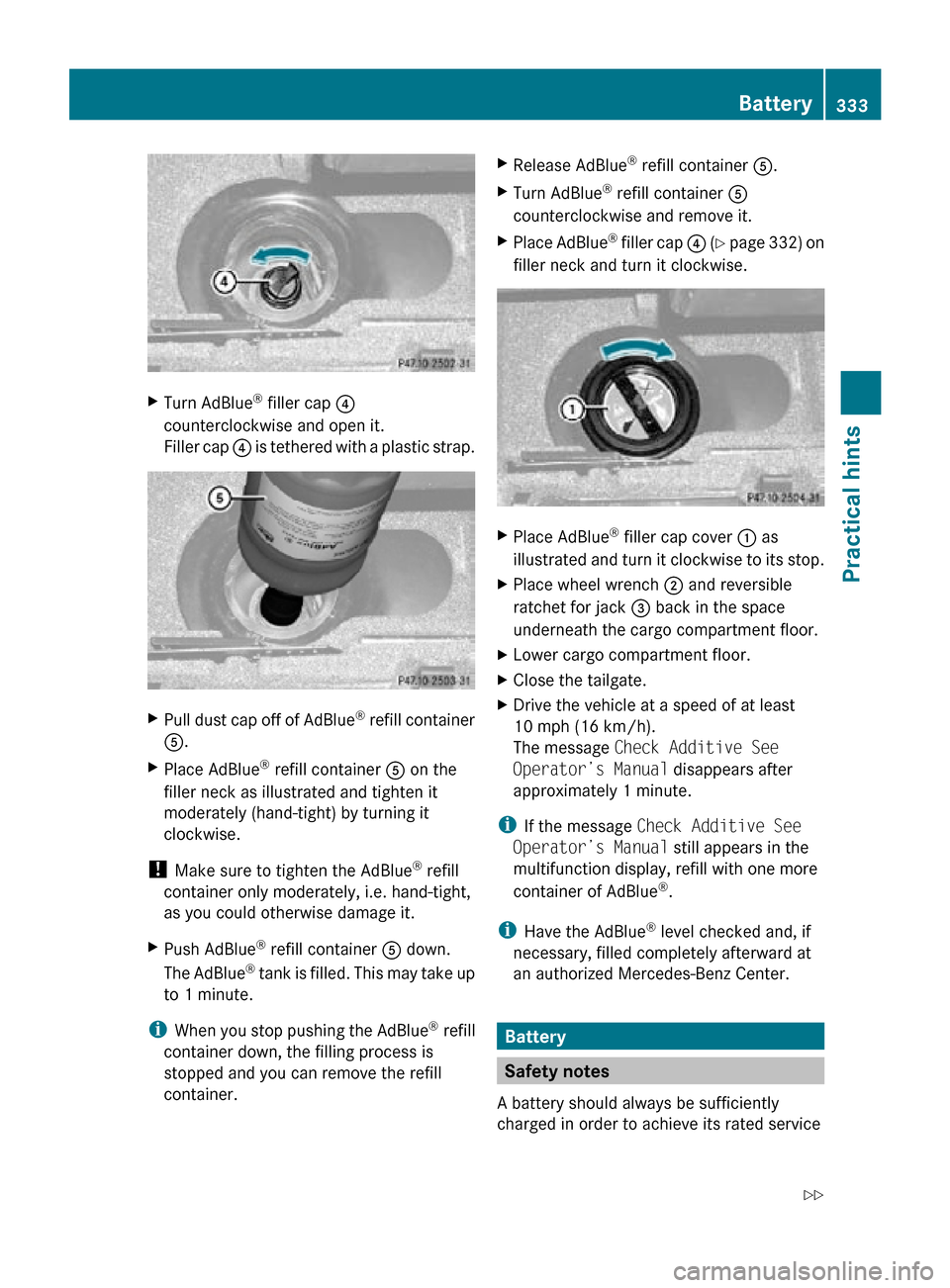
X
Turn AdBlue ®
filler cap ?
counterclockwise and open it.
Filler cap ? is tethered with a plastic strap. X
Pull dust cap off of AdBlue ®
refill container
A.
X Place AdBlue ®
refill container A on the
filler neck as illustrated and tighten it
moderately (hand-tight) by turning it
clockwise.
! Make sure to tighten the AdBlue ®
refill
container only moderately, i.e. hand-tight,
as you could otherwise damage it.
X Push AdBlue ®
refill container A down.
The AdBlue ®
tank is filled. This may take up
to 1 minute.
i When you stop pushing the AdBlue ®
refill
container down, the filling process is
stopped and you can remove the refill
container. X
Release AdBlue ®
refill container A.
X Turn AdBlue ®
refill container A
counterclockwise and remove it.
X Place AdBlue ®
filler cap ? (Y page 332) on
filler neck and turn it clockwise. X
Place AdBlue ®
filler cap cover : as
illustrated and turn it clockwise to its stop.
X Place wheel wrench ; and reversible
ratchet for jack = back in the space
underneath the cargo compartment floor.
X Lower cargo compartment floor.
X Close the tailgate.
X Drive the vehicle at a speed of at least
10 mph (16 km/h).
The message Check Additive See
Operator’s Manual disappears after
approximately 1 minute.
i If the message Check Additive See
Operator’s Manual still appears in the
multifunction display, refill with one more
container of AdBlue ®
.
i Have the AdBlue ®
level checked and, if
necessary, filled completely afterward at
an authorized Mercedes-Benz Center. Battery
Safety notes
A battery should always be sufficiently
charged in order to achieve its rated service Battery
333Practical hints
251_AKB; 4; 52, en-US
d2ureepe, Version: 2.11.8.1 2009-03-23T09:22:52+01:00 - Seite 333 Z
Page 343 of 364
A blown fuse must be replaced by an
appropriate spare fuse (recognizable by its
color or the fuse rating given on the fuse) of
the amperage recommended in the fuse
chart. Any Mercedes-Benz Center will be glad
to advise you on this subject.
i
In case of a blown fuse contact Roadside
Assistance or an authorized Mercedes-
Benz Center.
If a newly inserted fuse blows again, have the
cause determined and rectified by an
authorized Mercedes-Benz Center.
The fuse chart is located in the cargo
compartment with the vehicle tool kit
(Y page 270). The fuse chart explains the fuse
allocation and fuse amperages. Before replacing fuses
X Engage the parking brake.
X Make sure the automatic transmission is in
park position P.
The transmission position indicator in the
multifunction display should be on P.
X Switch off all electrical consumers.
X Turn off the engine.
X Remove the SmartKey from the starter
switch.
X Vehicles with KEYLESS-GO: Open the
driver’s door (this puts the starter switch in
position 0, same as with the SmartKey
removed from the starter switch). The
driver’s door then can be closed again. Fuse box in passenger compartment
! Do not use sharp objects such as a
screwdriver to open the fuse box cover in
the dashboard. You could damage the fuse
box cover or the dashboard.
The fuse box is located behind a cover in the
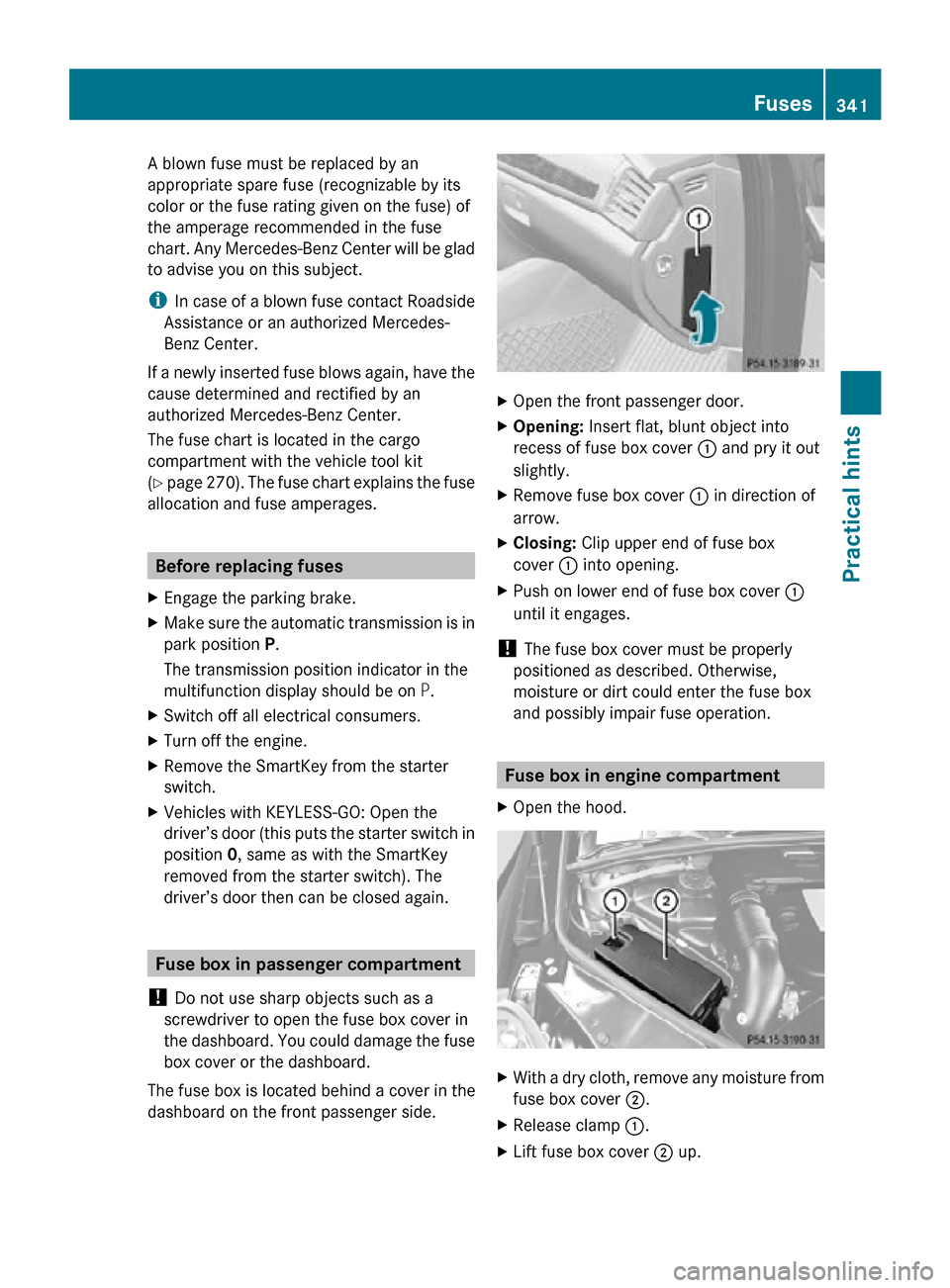
dashboard on the front passenger side. X
Open the front passenger door.
X Opening: Insert flat, blunt object into
recess of fuse box cover : and pry it out
slightly.
X Remove fuse box cover : in direction of
arrow.
X Closing: Clip upper end of fuse box
cover : into opening.
X Push on lower end of fuse box cover :
until it engages.
! The fuse box cover must be properly
positioned as described. Otherwise,
moisture or dirt could enter the fuse box
and possibly impair fuse operation. Fuse box in engine compartment
X Open the hood. X
With a dry cloth, remove any moisture from
fuse box cover ;.
X Release clamp :.
X Lift fuse box cover ; up. Fuses
341Practical hints
251_AKB; 4; 52, en-US
d2ureepe, Version: 2.11.8.1 2009-03-23T09:22:52+01:00 - Seite 341 Z