display MERCEDES-BENZ S CLASS 2016 Owners Manual
[x] Cancel search | Manufacturer: MERCEDES-BENZ, Model Year: 2016, Model line: S CLASS, Model: MERCEDES-BENZ S CLASS 2016Pages: 438, PDF Size: 13.22 MB
Page 382 of 438
PLUG-IN HYBRID vehicles may not be towed
away but must instead be transported, if: R
the multifunction display is not working or R
the á Towing Not Permitted See
Operator's Manual message appears in the
multifunction display.
If the vehicle is in a dangerous area, it can be
towed out of that area with both axles on the
ground. In this case, the towing distance must
not be greater than 165 ft (50 m) and must not
exceed a towing speed of 6 mph (10 km/h). For
longer distances, have the vehicle loaded and
transported.
Installing/removing the towing eye
Installing the towing eye
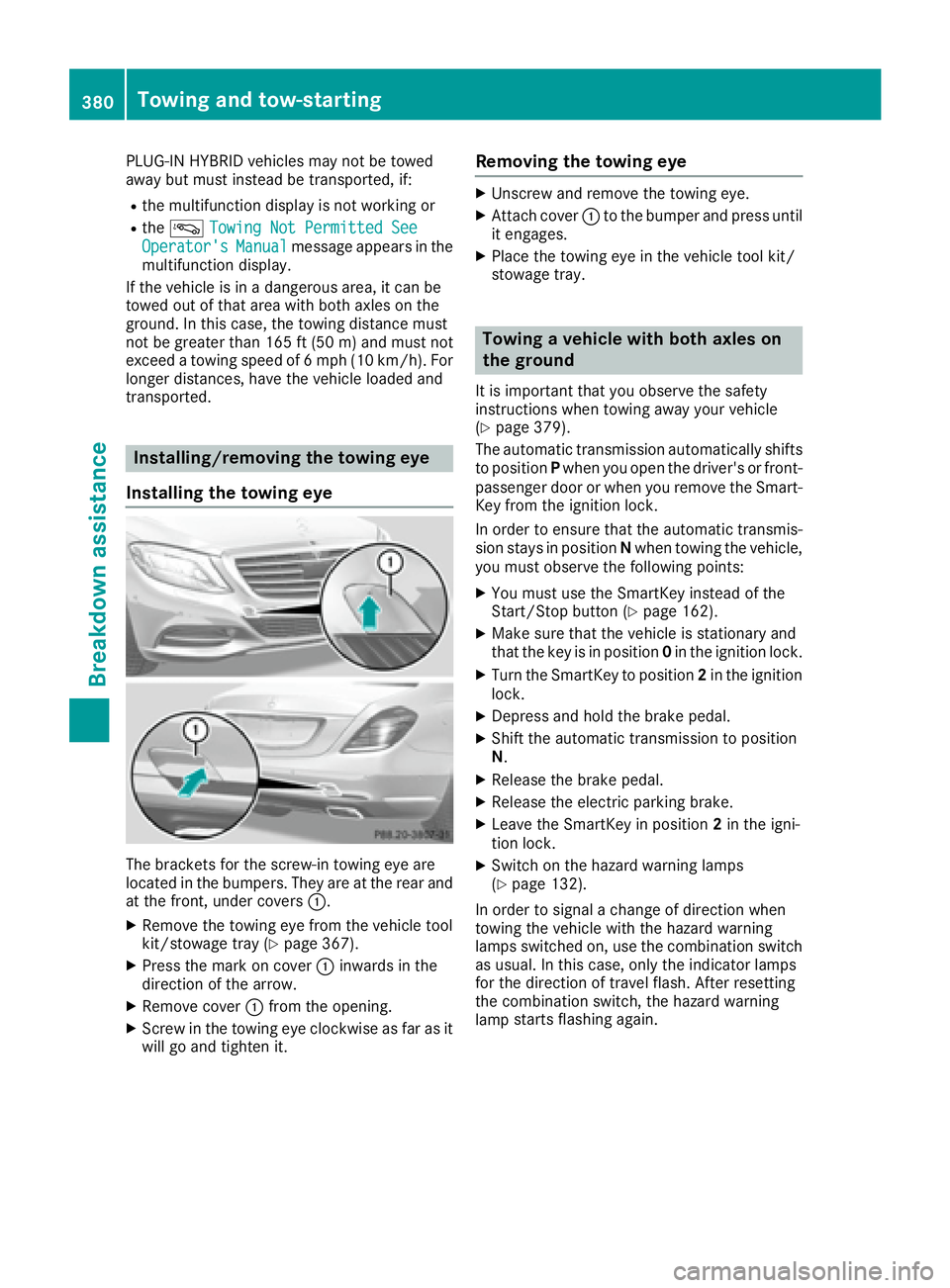
The brackets for the screw-in towing eye are
located in the bumpers. They are at the rear and
at the front, under covers C .X
Remove the towing eye from the vehicle tool
kit/stowage tray ( Y
page 367).X
Press the mark on cover C inwards in the
direction of the arrow. X
Remove cover C from the opening.X
Screw in the towing eye clockwise as far as it
will go and tighten it. Removing the towing eye X
Unscrew and remove the towing eye. X
Attach cover C to the bumper and press until
it engages. X
Place the towing eye in the vehicle tool kit/
stowage tray.
Towing a vehicle with both axles on
the ground It is important that you observe the safety
instructions when towing away your vehicle
( Y
page 379).
The automatic transmission automatically shifts
to position P when you open the driver's or front-
passenger door or when you remove the Smart-
Key from the ignition lock.
In order to ensure that the automatic transmis-
sion stays in position N when towing the vehicle,
you must observe the following points: X
You must use the SmartKey instead of the
Start/Stop button ( Y
page 162).X
Make sure that the vehicle is stationary and
that the key is in position 0 in the ignition lock.X
Turn the SmartKey to position 2 in the ignition
lock. X
Depress and hold the brake pedal. X
Shift the automatic transmission to position
N . X
Release the brake pedal. X
Release the electric parking brake. X
Leave the SmartKey in position 2 in the igni-
tion lock. X
Switch on the hazard warning lamps
( Y
page 132).
In order to signal a change of direction when
towing the vehicle with the hazard warning
lamps switched on, use the combination switch
as usual. In this case, only the indicator lamps
for the direction of travel flash. After resetting
the combination switch, the hazard warning
lamp starts f lashing again.380
Towing and tow-starting
Breakdown assistance
Page 392 of 438
Overinflated tires may: R
increase the braking distance R
adversely affect handling R
wear excessively and/or unevenly R
have an adverse effect on ride comfort R
be more susceptible to damage
Maximum tire pressures
C
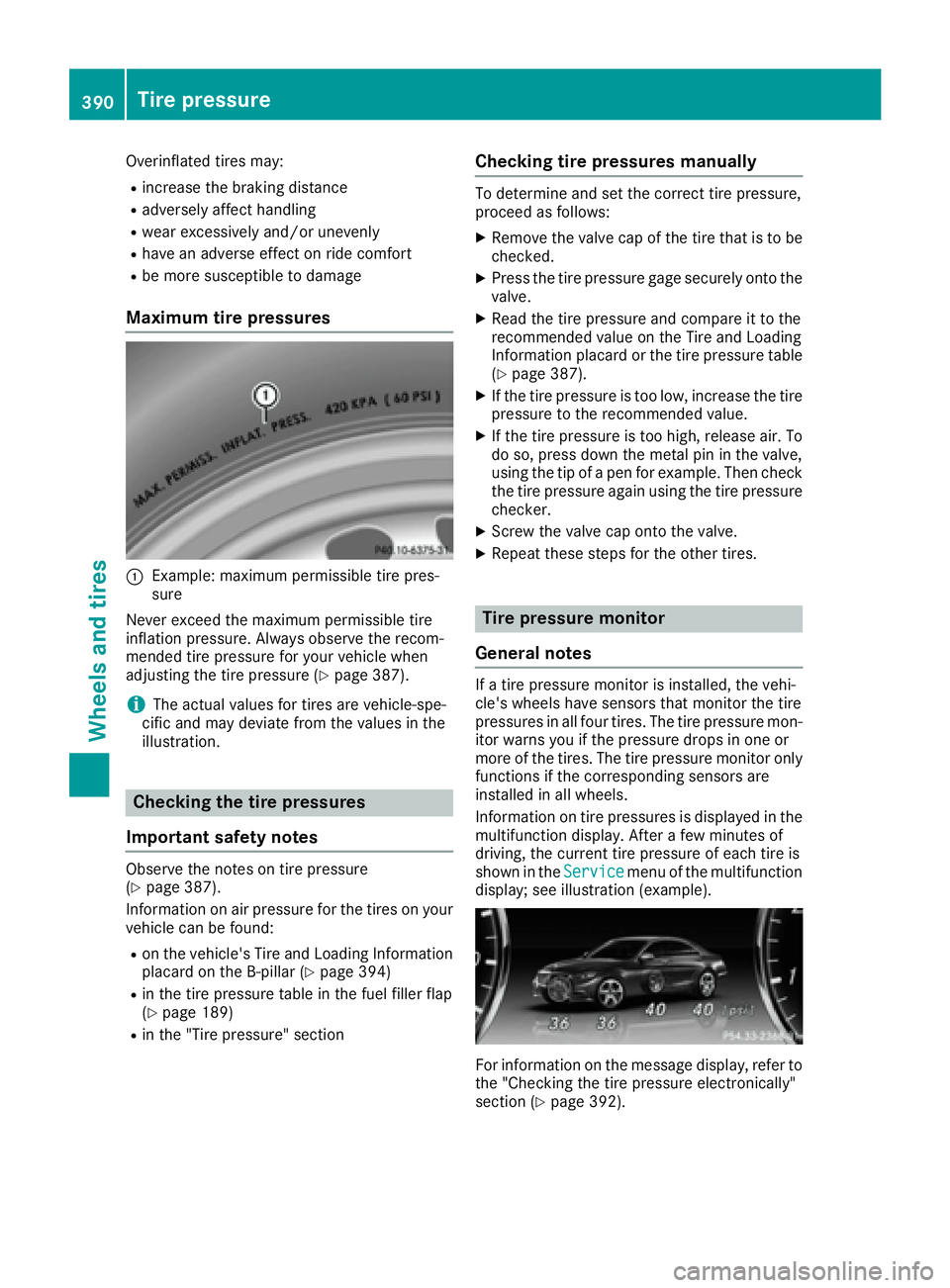
Example: maximum permissible tire pres-
sure
Never exceed the maximum permissible tire
inflation pressure. Always observe the recom-
mended tire pressure for your vehicle when
adjusting the tire pressure ( Y
page 387).
i The actual values for tires are vehicle-spe-
cific and may deviate from the values in the
illustration.
Checking the tire pressures
Important safety notes Observe the notes on tire pressure
( Y
page 387).
Information on air pressure for the tires on your
vehicle can be found: R
on the vehicle's Tire and Loading Information
placard on the B-pillar ( Y
page 394)R
in the tire pressure table in the fuel filler flap
( Y
page 189)R
in the "Tire pressure" section Checking tire pressures manually To determine and set the correct tire pressure,
proceed as follows: X
Remove the valve cap of the tire that is to be
checked. X
Press the tire pressure gage securely onto the
valve. X
Read the tire pressure and compare it to the
recommended value on the Tire and Loading
Information placard or the tire pressure table
( Y
page 387). X
If the tire pressure is too low, increase the tire
pressure to the recommended value. X
If the tire pressure is too high, release air. To
do so, press down the metal pin in the valve,
using the tip of a pen for example. Then check
the tire pressure again using the tire pressure
checker. X
Screw the valve cap onto the valve. X
Repeat these steps for the other tires.
Tire pressure monitor
General notes If a tire pressure monitor is installed, the vehi-
cle's wheels have sensors that monitor the tire
pressures in all four tires. The tire pressure mon-
itor warns you if the pressure drops in one or
more of the tires. The tire pressure monitor only
functions if the corresponding sensors are
installed in all wheels.
Information on tire pressures is displayed in the
multifunction display. After a few minutes of
driving, the current tire pressure of each tire is
shown in the Service menu of the multifunction
display; see illustration (example).
For information on the message display, refer to
the "Checking the tire pressure electronically"
section ( Y
page 392).390
Tire pressure
Wheels and tires
Page 393 of 438
Important safety notes
G WARNIN G
Eac h tire, includin g th e spar e (if provided),
should be checke d at least once every two
week s when cold and inflated to th e pressur e
recommended by th e vehicl e manufacturer
on th e Tir e and Loading Information placard
on th e driver' s door B-pillar or th e tire pres-
sur e label on th e inside of th e fuel filler flap . If
your vehicl e has tires of a differen t siz e than
th e siz e indicated on th e Tir e and Loading
Information placard or, if available, th e tire
pressur e label, you should determine th e
proper tire pressur e for those tires .
As an added safet y feature, your vehicl e has
been equipped wit h a tire pressur e monitoring
system (TPMS) that illuminate s a low tire pres-
sur e telltale when on e or mor e of your tires
are significantly underinflated. Accordingly,
when th e low tire pressur e telltale lights up,
you should stop and chec k your tires as soo n
as possible , and inflat e them to th e proper
pressure. Drivin g on a significantly underin-
flated tire causes th e tire to overheat and can
lead to tire failure.
Underinflation also reduce s fuel efficiency
and tire tread life , and may affec t th e vehicle's
handlin g and stopping ability. Pleas e note that
th e TPM S is no t a substitut e for proper tire
mainte
nance , a nd it is th e d river' s responsi-
bilit y to maintai n correc t tire pressure, eve n if
underinflation has no t reached th e level to
trigge r illumination of th e TPM S low tire pres-
sur e telltale.
Your vehicl e has also been equipped wit h a
TPM S malfunction indicator to indicat e when
th e system is no t operating properly. The
TPM S malfunction indicator is combined wit h
th e low tire pressur e telltale. When th e sys-
te m detects a malfunction , th e warning lamp
will flas h for approximately a minute and then
remain continuously illuminated. This
sequenc e will be repeated every time th e vehi-
cle is started as lon g as th e malfunction
exists. When th e malfunction indicator is illu- minated, th e system may no t be able to detec t
or signal low tire pressur e as intended.
TPM S malfunction s may occur for a variet y of
reasons, includin g th e installation of incom-
patible replacemen t or alternate tires or
wheels on th e vehicl e that preven t th e TPM S
from functioning properly. Always chec k th e
TPM S malfunction telltale after replacing on e
or mor e tires or wheels on your vehicl e to
ensur e that th e replacemen t or alternate Tires
and wheels allow th e TPM S to continue to
function properly.
It is th e driver' s responsibilit y to set th e tire
pressur e to that recommended for cold tires
whic h is suitable for th e operating situation
( Y
page 387). Not e that th e correc t tire pressur e
for th e curren t operating situation must first be
taught-in to th e tire pressur e monitor. If there is
a substantial loss of pressure, th e warning
threshold for th e warning message is aligned to
th e referenc e value s taught-in . Restart th e tire
pressur e monitor after adjusting th e pressur e of
th e cold tires ( Y
page 392). The curren t pres-
sures are saved as ne w referenc e values. As a
result , a warning message will appear if th e tire
pressur e drops significantly.
The tire pressur e mon ito r does no t w
arn you of
an incorrectl y set tire pressure. Observ e th e
note s on th e recommended tire pressur e
( Y
page 387).
The tire pressur e monitor is no t able to warn you
of a sudde n loss of pressure, e.g. if th e tire is
penetrated by a foreign object. In th e event of a
sudde n loss of pressure, brin g th e vehicl e to a
halt by braking carefully. Avoid abrup t steering
movements.
The tire pressur e monitor has a yellow warning
lamp in th e instrumen t cluste r for indicating
pressur e loss or a malfunction . Whether th e
warning lamp flashes or lights up indicates
whether a tire pressur e is to o low or th e tire
pressur e monitor is malfunctioning :R
if th e warning lamp is lit continuously, th e tire
pressur e on on e or mor e tires is significantly
to o low. The tire pressur e monitor is no t mal-
functioning . R
if th e warning lamp flashes for aroun d a
minute and then remain s lit constantly, th e
tire pressur e monitor is malfunctioning .
In addition to th e warning lamp , a message
appear s in th e multifunction display. Observ eTire pressure 391
Wheels and tires Z
Page 394 of 438
the information on display messages
( Y
page 306).
It may take up to ten minutes for a malfunction
of the tire pressure monitor to be indicated. A
malfunction will be indicated by the tire pres-
sure warning lamp flashing for approximately
one minute and then remaining lit. When the
malfunction has been rectified, the tire pressure
warning lamp goes out after a few minutes of
driving.
The tire pressure values indicated by the on-
board computer may differ from those meas-
ured at a gas station with a pressure gauge. The
tire pressures shown by the on-board computer
refer to those measured at sea level. At high
altitudes, the tire pressure values indicated by a
pressure gauge are higher than those shown by
the on-board computer. In this case, do not
reduce the tire pressures.
The operation of the tire pressure monitor can
be affected by interference from radio transmit-
ting equipment (e.g. radio headphones, two-way
radios) that may be being operated in or near the
vehicle.
Checking the tire pressure electroni-
cally X
Make sure that the SmartKey is in position 2
in the ignition lock ( Y
page 162).X
Use
Page 431 of 438

R
M30 (gasoline with 30% methanol) R
M85 (gasoline with 85% methanol) R
M100 (100% methanol) R
Gasoline with metalliferous additives R
Diesel
Do not mix such fuels with the fuel recom-
mended for your vehicle.
! To ensure the longevity and full perform-
ance of the engine, only premium-grade
unleaded gasoline must be used.
If standard unleaded gasoline is unavailable
and you have to refuel with unleaded gasoline
of a lower grade, observe the following pre-
cautions: R
Only fill the fuel tank to half full with regular
unleaded gasoline and fill the rest with pre-
mium-grade unleaded gasoline as soon as
possible. R
Do not drive at the maximum speed. R
Avoid sudden acceleration and engine
speeds over 3,000 rpm.
You will usually find information about the fuel
grade on the pump. If you cannot find the label
on the pump, ask the staff for assistance.
i For further information, consult a qualified
specialist workshop or visit
http://www.mbusa.com (USA only).
As a temporary measure, if the recommended
fuel is not available, you may also use regular
unleaded gasoline with an octane rating of
87 AKI/91 RON. This may reduce engine per-
formance and increase fuel consumption. Avoid
driving at full throttle and sudden acceleration.
Never refuel using fuel with a lower AKI.
Information on refueling .
Additives
! Operating the engine with fuel additives
added later can lead to engine failure. Do not
mix fuel additives with fuel. This does not
include additives for the removal and preven-
tion of residue buildup. gasoline must only be
mixed with additives recommended by
Mercedes-Benz. Comply with the instructions
for use on the product label. More information
about recommended additives can be
obtained from any authorized Mercedes-Benz
Center.
Mercedes-Benz recommends that you use bran-
ded fuels that have additives. The quality of the fuel available in some coun-
tries may not be sufficient. Residue could build
up in the injection system as a result. In such
cases, and in consultation with an authorized
Mercedes-Benz Center, the gasoline may be
mixed with the cleaning additive recommended
by Mercedes-Benz. You must observe the notes
and mixing ratios specified on the container.
Engine oil
General notes
! Never use engine oil or an oil filter of a spec-
ification other than is necessary to fulfill the
prescribed service intervals. Do not change
the engine oil or oil filter in order to achieve
longer replacement intervals than those pre-
scribed. You could otherwise cause engine
damage or damage to the exhaust gas after-
treatment.
Follow the instructions in the service interval
display regarding the oil change. Otherwise,
you may damage the engine and the exhaust
gas aftertreatment.
When handling engine oil, observe the important
safety notes on service products ( Y
page 427).
The engine oils are matched to the performance
of Mercedes-Benz engines and service intervals.
You should therefore only use engine oils and oil
filters that are approved for vehicles with main-
tenance systems.
For a list of approved engine oils and oil filters,
consult an authorized Mercedes-Benz Center.
Or visit the website
http://bevo.mercedes-benz.com.
The table shows which engine oils have been
approved for your vehicle.Service products and filling capacities 429
Technical data Z