tires MERCEDES-BENZ S CLASS 2018 User Guide
[x] Cancel search | Manufacturer: MERCEDES-BENZ, Model Year: 2018, Model line: S CLASS, Model: MERCEDES-BENZ S CLASS 2018Pages: 562, PDF Size: 7.25 MB
Page 420 of 562
Fu rt her re lated subjects:R
No te s on tire pressure ( →
page 41 4)R
Ti re pressure ta ble ( →
page 41 6)R
Ti re and Loading In fo rm ation placard
( →
page 420)
Ti re pressure moni to ri ng sy st em
Fu nction of th e tire pressure moni to ri ng sys‐
te m
q
DA NG ER Risk of accident due to incor‐
re ct tire pressure
Every tire, including th e spare (if pr ov ided),
should be ch ec ke d when cold at least once a
month and inflated to th e pressure re com‐
mended by th e ve hicle manufacturer (see
Ti re and Loading In fo rm ation placard on th e
B-pillar on th e driver ’s side or th e tire pres‐
sure label on th e inside of th e fuel fi ller fl ap
of yo ur ve hicle). If yo ur ve hicle has tires of a
dif fe re nt size th an th e size indicated on th e
Ti re and Loading In fo rm ation placard or th e tire pressu re ta ble, yo u need to de te rm ine
th e proper tire pressure fo r th ose tires.
As an added saf et y fe ature, yo ur ve hicle has
been equipped with a tire pressure monitor‐
ing sy st em (TPMS) th at illuminates a low tire
pressure indicator lamp when one or more of
yo ur tires are sign if icantly underinflated.
Ac cording ly , if th e low tire pressure indicator
lamp lights up, yo u should st op and ch eck
yo ur tires as soon as possible, and inflate
th em to th e proper pressure. Driving on a
significant ly underinflated tire causes th e tire
to ove rh eat and can lead to tire fa ilure.
Und erinflation also increases fuel consump‐
tion and re duces tire tread life, and may
af fe ct th e ve hicle's handling and braking abil‐
ity. Please no te th at th e TPMS is not a substi‐
tute fo r proper tire maintenance, and it is th e
driver's re sponsibility to maintain cor re ct tire
pressure, ev en if underinflation has not
re ached th e le ve l to trig ge r illumination of
th e TPMS low tire pressure indicator lamp.
Yo ur ve hicle has also been equipped with a
TPMS malfunction indicator to indicate when th e sy st em is not operating properly. The
TPMS malfunction indicator is combined with
th e low tire pressure indicator lamp. When
th e sy st em de te cts a malfunction, th e indica‐
to r lamp will fl ash fo r app ro xima te ly a minute
and th en re main continuously illumina te d.
This sequence will continue upon subsequent
ve hicle st art-ups as long as th e malfunction
ex ists.
When th e malfunction indicator is illumina‐
te d, th e sy st em may not be able to de te ct or
signal low tire pressure as intended. TPMS
malfunctions may occur fo r a va ri et y of re a‐
sons, including th e ins ta llation of incompati‐
ble re placement or alternate tires or wheels
on th e ve hicle th at pr ev ent th e TPMS from
functioning proper ly .
Alw ay s ch eck th e TPMS malfunction wa rn ing
lamp af te r re placing one or more tires or
wheels on yo ur ve hicle to ensure th at th e
re placement or alternate tires and wheels
allow th e TPMS to continue to function prop‐
er ly .41 8
Wheels and tires
Page 421 of 562
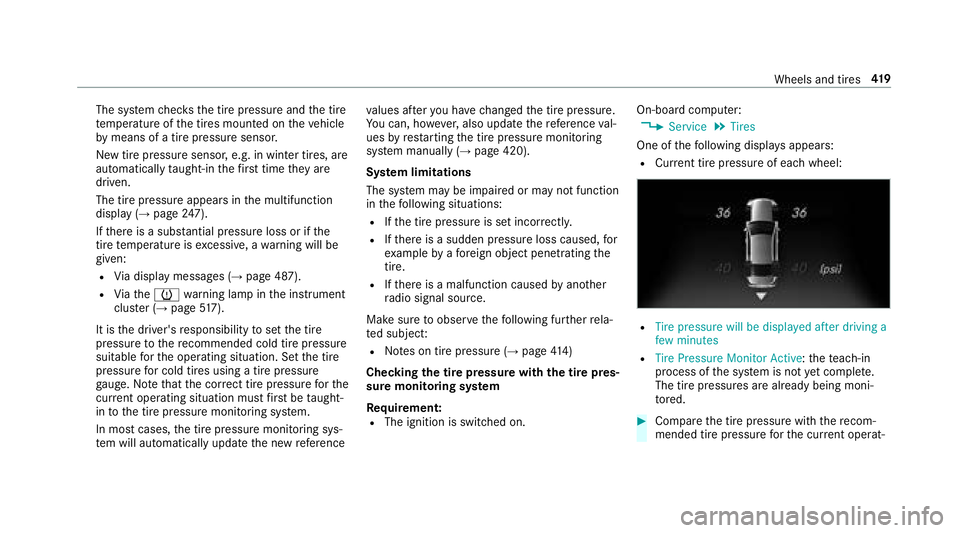
The sy st em ch ec ks th e tire pressure and th e tire
te mp erature of th e tires mounted on th e ve hicle
by means of a tire pressu re sensor.
New tire pressure sensor, e.g. in winter tires, are
automatically ta ught-in th e fi rs t time th ey are
driven.
The tire pressure appears in th e multifunction
display ( →
page 24 7).
If th ere is a subs ta ntial pressure loss or if th e
tire te mp erature is exc essive, a wa rn ing will be
given: R
Vi a display messages ( →
page 487).R
Vi a th e w wa rn ing lamp in th e instrument
clus te r ( →
page 51 7) .
It is th e driver's re sponsibility to set th e tire
pressure to th e re commended cold tire pressure
suitable fo r th e operating situation. Set th e tire
pressure fo r cold tires using a tire pressu re
ga uge. No te th at th e cor re ct tire pressure fo r th e
cur re nt operating situation mu st fi rs t be tau ght-
in to th e tire pressure monitoring sy st em.
In most cases, th e tire pressure monitoring sys‐
te m will au to matically update th e new re fe re nce va lues af te r yo u ha ve ch anged th e tire pressure.
Yo u can, ho we ve r, also update th e re fe re nce va l‐
ues by re st arting th e tire pressure monitoring
sy st em manually ( →
page 420).
Sy st em limitations
The sy st em may be impaired or may not function
in th e fo llowing situations: R
If th e tire pressure is set incor re ctly.R
If th ere is a sudden pressure loss caused, fo r
ex ample by a fo re ign object penetrating th e
tire. R
If th ere is a malfunction caused by ano th er
ra dio signal source.
Make sure to obser ve th e fo llowing fur th er re la‐
te d subjec t: R
No te s on tire pressure ( →
page 41 4)
Checking th e tire pressure with th e tire pres‐
sure moni to ri ng sy st em
Requ irement: R
The ignition is switched on. On-board computer:
Page 425 of 562
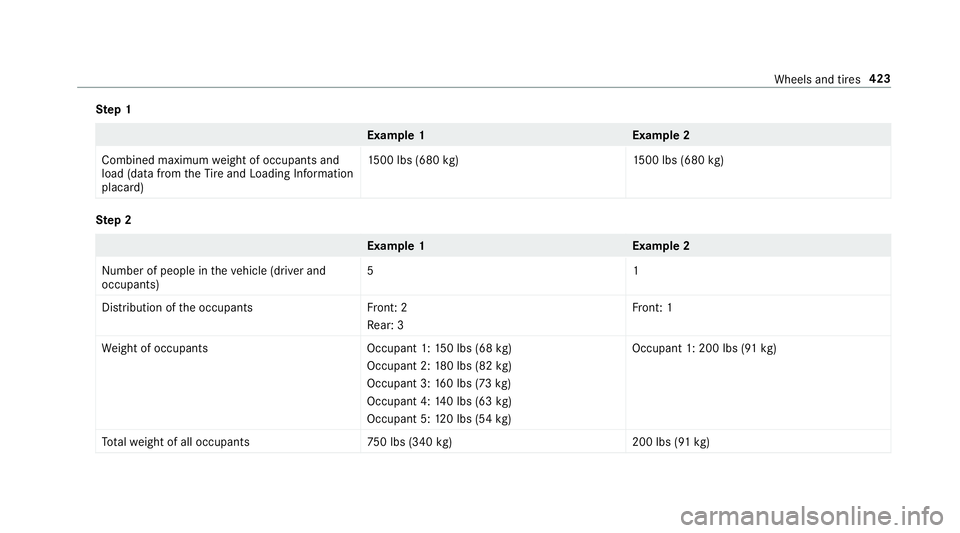
Ste p 1
Example 1E xa mp le 2
Combined maximum we ight of occupants and
load (data from th e Ti re and Loading In fo rm ation
placard) 15 00 lbs (680 kg )1 500 lbs (680 kg )
Ste p 2
Example 1E xa mp le 2
Numb er of people in th e ve hicle (driver and
occupants) 51
Distribution of th e occupant sF ro nt: 2
Re ar: 3 Fr ont: 1
We ight of occupant sO ccupant 1: 15 0 lbs (68 kg )
Occupant 2: 18 0 lbs (82 kg )
Occupant 3: 16 0 lbs (73 kg )
Occupant 4: 14 0 lbs (63 kg )
Occupant 5: 12 0 lbs (54 kg ) Occupant 1: 200 lbs (91 kg )
To ta l we ight of all occupant s7 50 lbs (340 kg )2 00 lbs (91 kg ) Wheels and tires 423
Page 428 of 562
and one-half times as we ll on th e go ve rn ment
te st track as a tire graded 10 0.
The re lative per fo rm ance of tires depends upon
th e actual conditions of th eir use, ho we ve r, and
may depart significantly from th e norm due to
va ri ations in driving habits, service practices and
dif fe re nces in ro ad ch aracteristics and climate
conditions.
Tr action gr ade
q
DA NG ER Risk of accident due to inade‐
qu ate traction
The traction gr ade assigned to th is tire is
based on st ra ight-ahead braking traction
te st s, and does not include either accelera‐
tion, cornering, hy droplaning or peak traction
ch aracteristics.
Page 431 of 562
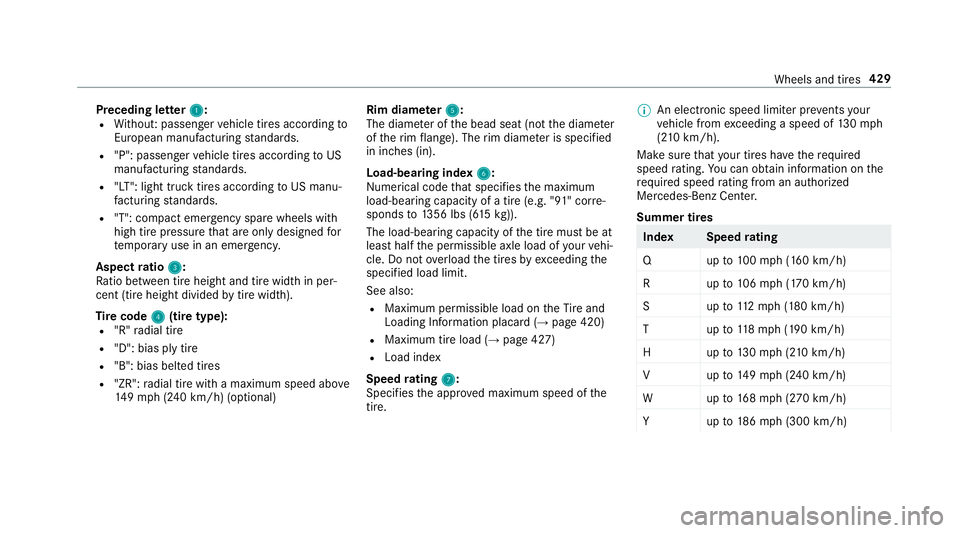
Preceding letter 1 :R
Wi th out: passenger ve hicle tires according to
European manufactu ri ng st andards.R
"P": passenger ve hicle tires according to US
manufacturing st andards.R
"LT": light truck tires according to US manu‐
fa cturing st andards.R
"T": compact emer ge ncy spa re wheels with
high tire pressure th at are on ly designe d fo r
te mp orary use in an emer ge ncy.
Aspect ra tio 3 :
Ra tio between tire height and tire width in per‐
cent (ti re height divided by tire width).
Tire code 4 (ti re type):R
"R" ra dial tireR
"D": bias ply tire R
"B": bias belted tires R
"ZR": ra dial tire with a maximum speed abo ve
14 9 mp h (240 km/h) (optional) Rim diame te r 5 :
The diam et er of th e bead seat (not th e diame te r
of th e ri m fl ange). The ri m diame te r is specified
in inches (in).
Load-bearing index 6 :
Numerical code th at specifies th e maximum
load-bearing capacity of a tire (e.g. "91" cor re ‐
sponds to 13 56 lbs (6 15 kg )).
The load-bearing capacity of th e tire must be at
least half th e permissible axle load of yo ur ve hi‐
cle. Do not ove rl oad th e tires by exc eeding th e
specified load limit.
See also: R
Maximum permissible load on th e Ti re and
Loading In fo rm ation placard ( →
page 420)R
Maximum tire load ( →
page 427)R
Load ind ex
Speed ra ting 7 :
Specifies th e appr ove d maximum speed of th e
tire.
Page 432 of 562
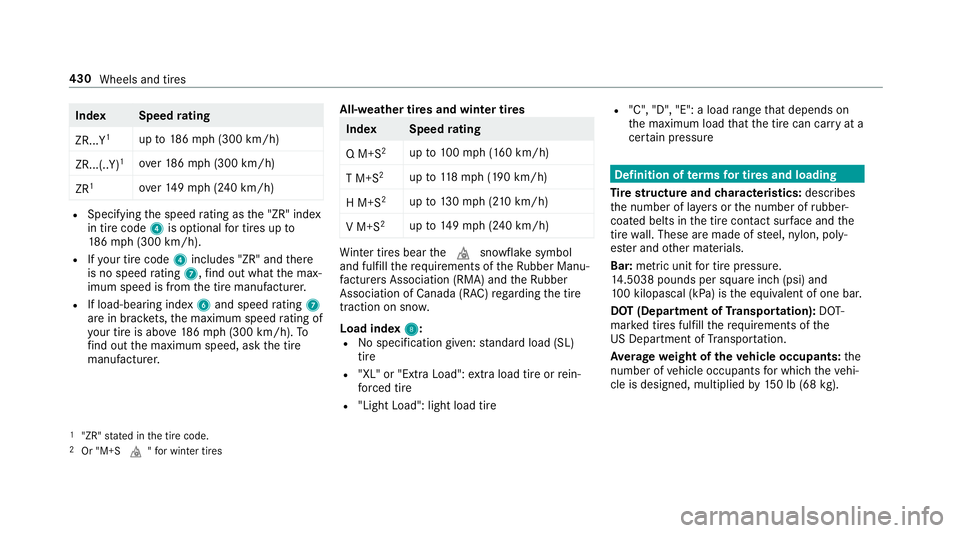
Inde xS peed ra ting
ZR...Y 1
up to 18 6 mp h (3 00 km/h)
ZR...(..Y) 1
ove r 18 6 mp h (3 00 km/h)
ZR 1
ove r 14 9 mp h (240 km/h)R
Specifying th e speed ra ting as th e "ZR" index
in tire code 4 is optional fo r tires up to
18 6 mp h (3 00 km/h).R
If yo ur tire co de 4 includes "ZR" and th ere
is no speed ra ting 7 , fi nd out what th e max‐
imum speed is from th e tire manufacturer.R
If load-bearing index 6 and speed ra ting 7
are in brac ke ts, th e maximum speed ra ting of
yo ur tire is abo ve 18 6 mp h (300 km/h). To
fi nd out th e maximum speed, ask th e tire
manufacturer. All-weather tires and winter tires
Inde xS peed ra ting
Q M+S 2
up to 10 0 mp h (160 km/h)
T M+S 2
up to 11 8 mp h (1 90 km/h)
H M+S 2
up to 13 0 mp h (2 10 km/h)
V M+S 2
up to 14 9 mp h (240 km/h)
Wi nter tires bear th e M snowflake symbol
and fulfill th e requ irements of th e Ru bber Manu‐
fa cturers Association (RMA) and th e Ru bber
Association of Canada (RAC) re ga rd ing th e tire
traction on sno w.
Load index 8 : R
No specification given: st andard load (SL)
tire R
"XL" or "Extra Load": ex tra load tire or re in‐
fo rc ed tire R
"Light Load": light load tire R
"C", "D", "E": a load ra nge th at depends on
th e maximum load th at th e tire can car ry at a
cer ta in pressure
Definition of term s fo r tires and loading
Ti re stru ctu re and ch aracteristics: describes
th e number of la ye rs or th e number of ru bber-
coated belts in th e tire con ta ct su rf ace and th e
tire wa ll. These are made of st eel, ny lon, poly‐
es te r and ot her materials.
Bar: metric unit fo r tire pressu re .
14 .5038 pounds per square inch (psi) and
10 0 kilopascal (kPa) is th e equivalent of one bar.
DOT (Department of Tr anspo rt ation): DO T-
mar ke d tires fulfill th e requ irements of th e
US Department of Tr anspor ta tio n.
Av erage we ight of th e ve hicle occupants: th e
number of ve hicle occupants fo r whi ch th e ve hi‐
cle is designed, multiplied by 15 0 lb (68 kg ).
1
"ZR" st ated in th e tire code.2
Or "M+S M " fo r winter tires430
Wheels and tires
Page 433 of 562
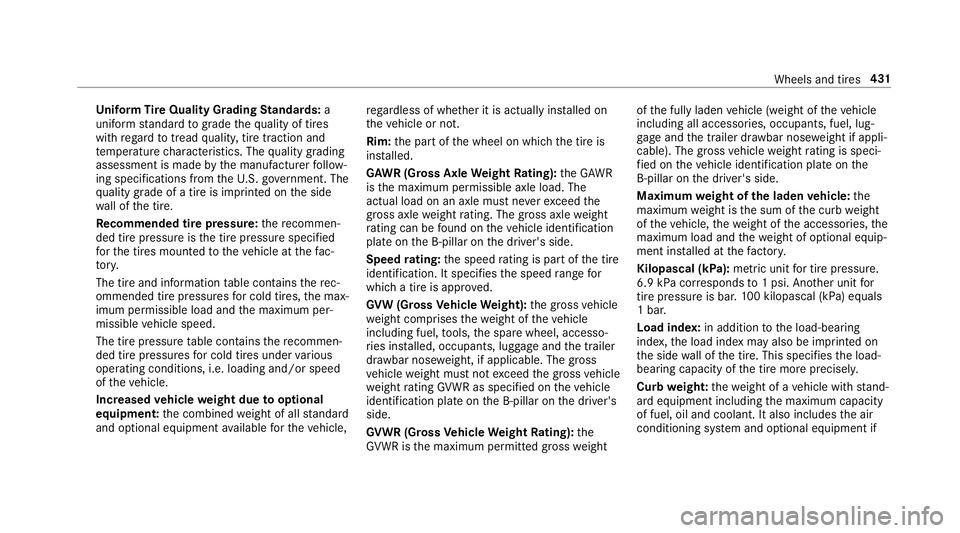
Un iform Ti re Quality Grading St andards: a
uniform st andard to gr ade th e qu ality of tires
with re ga rd to tread qu alit y, tire traction and
te mp erature ch aracteristics. The qu ality grading
assessment is made by th e manufacturer fo llow‐
ing specifications from th e U. S. go ve rn ment. The
qu ality gr ade of a tire is imprinted on th e side
wa ll of th e tire.
Re commended tire pressu re : th e re commen‐
ded tire pressure is th e tire pressure specified
fo r th e tires mounted to th e ve hicle at th e fa c‐
to ry .
The tire and information ta ble con ta ins th e re c‐
ommended tire pressures fo r cold tires, th e max‐
imum permissible load and th e maximum per‐
missible ve hicle speed.
The tire pressure ta ble con ta ins th e re commen‐
ded tire pressures fo r cold tires under va ri ous
operating conditions, i.e. loading and/or speed
of th e ve hicle.
Increased ve hicle we ight due to optional
equipment: th e combined we ight of all st andard
and optional equipment av ailable fo r th e ve hicle, re ga rd less of whe th er it is actually ins ta lled on
th e ve hicle or not.
Rim: th e part of th e wheel on which th e tire is
ins ta lled.
GA WR (Gross Axle We ight Ra ting): th e GAWR
is th e maximum permissible axle load. The
actual load on an axle must ne ve r exc eed th e
gros s axle we ight ra ting. The gross axle we ight
ra ti ng
can be fo und on th e ve hicle identification
plate on th e B‑pillar on th e driver's side.
Speed ra ting: th e speed ra ting is pa rt of th e tire
identification. It specifies th e speed ra nge fo r
which a tire is appr ove d.
GV W (Gross Ve hicle We ight): th e gross ve hicle
we ight comprises th e we ight of th e ve hicle
including fuel, to ols, th e spare wheel, accesso‐
ri es ins ta lled, occupants, luggage and th e trailer
dr aw bar nose we ight, if applicable. The gros s
ve hicle we ight must not exc eed th e gross ve hicle
we ight ra ting GV WR as specified on th e ve hicle
identification plate on th e B‑pillar on th e driver's
side.
GV WR (Gross Ve hicle We ight Ra ting): th e
GV WR is th e maximum permitted gross we ight of th e fully laden ve hicle (weight of th e ve hicle
including all accessories, occupants, fuel, lug‐
ga ge and th e trailer dr aw bar nose we ight if appli‐
cable). The gros s ve hicle we ight ra ting is speci‐
fi ed on th e ve hicle identification plate on th e
B‑pillar on th e driver's side.
Maximum we ight of th e laden ve hicle: th e
maximum we ight is th e sum of th e curb we ight
of th e ve hicle, th e we ight of th e accesso ri es, th e
maximum load and th e we ight of optional equip‐
ment ins ta lled at th e fa ctor y.
Kilopascal (kPa): metric unit fo r tire pressu re .
6.9 kPa cor re sponds to 1 psi. Ano th er unit fo r
tire pressu re is bar . 10 0 ki lopascal (kPa) equals
1
bar.
Load index: in addition to th e load-bearing
index, th e load index may also be imprinted on
th e side wa ll of th e tire. This specifies th e load-
bearing capacity of th e tire more precisel y.
Curb we ight: th e we ight of a ve hicle with st and‐
ard equipment including th e maximum capacity
of fuel, oil and coolant. It also includes th e air
conditioning sy st em and optional equipment if Wheels and tires 431
Page 434 of 562
th ese are ins ta lled on th e ve hicle, but does not
include passengers or luggage.
Maximum tire load: th e maximum tire load is
th e maximum permissible we ight in kilog ra ms or
lbs fo r whi ch a tire is appr ove d.
Maximum permissible tire pressure: maxi‐
mum permissible tire pressure fo r one tire.
Maximum load on one tire: maximum load on
one tire. This is calculated by dividing th e maxi‐
mum axle load of one axle by two.
PSI (pounds per square in ch ): st andard unit of
measurement fo r tire pressu re .
Aspect ra tio: ra tio between tire height and tire
width in pe rc ent.
Ti re pressure: pressure inside th e tire applying
an outward fo rc e to eve ry square inch of th e tire.
The tire pressure is specified in pounds per
square inch (psi), in kilopascals (kPa) or in bar.
The tire pressure should only be cor re cted when
th e tires are cold.
Cold tire pressure: th e tires are cold when th e
ve hicle has been par ke d fo r at lea st 3 hou rs without direct sunlight on th e tires or th e ve hicle
has been driven fo r less th an 1 mile (1.6 km).
Ti re contact sur fa ce: th e part of th e tire th at
comes into con ta ct wi th th e ro ad.
Ti re bead: th e purpose of th e tire bead is to
ensure th at th e tire sits securely on th e wheel
ri m. There are se ve ra l wire cores in th e tire bead
to pr eve nt th e t ir
e from ch anging length on th e
wheel ri m.
Side wa ll: th e part of th e tire between th e tread
and th e tire bead.
We ight of optional equipment: th e combined
we ight of th e optional equipment we ighing more
th an th e re placed st andard parts and more th an
5 lbs (2.3 kg ). This optional equipment, such as
high-per fo rm ance brakes, le ve l control sy st em, a
ro of luggage ra ck or high-per fo rm ance bat te ri es,
is not included in th e curb we ight and th e we ight
of th e accessories.
TIN (Tire Identification Nu mber): a uni qu e
identification number which can be used by a
tire manufactu re r to identify tires, fo r ex ample,
in a product re call, and th us identify th e pur‐
ch asers. The TIN is made up of th e manufactur‐ er's identity code, tire size, tire type code and
th e manufacturing date.
Load-bearing index: th e load-bearing index is a
code th at con ta ins th e maximum load-bearing
capacity of a tire.
Tr action: traction is th e grip re sulting from fric‐
tion between th e tires and th e ro ad sur fa ce.
We ar indicator: nar row bars (tread we ar bars)
th at are distributed ove r th e tire con ta ct su rf ace.
If th e tire tread is le ve l with th e bars, th e we ar
limit of 1/ 16 in (1.6 mm) has been re ached.
Distribution of ve hicle occupants: distribution
of ve hicle occupants ov er designated seat posi‐
t ions in a ve hicle.
Maximum permissible pa yl oad we ight: nomi‐
nal load and luggage load plus 15 0 lb (68 kg )
multiplied by th e number of seats in th e ve hicle.432
Wheels and tires
Page 435 of 562
Changing a wheel
Note s on selecting, mounting and re placing
tires
Mercedes -A MG ve hicles: be sure to obser ve
th e no te s in th e Supplement. Otherwise, yo u
may not re cognize dangers.
Yo u can ask fo r information re ga rd ing permit te d
wheel/tire combinations at an authorized
Mercedes-Benz Center.
q
WA RNING Risk of accident due to incor‐
re ct dimensions of wheels and tires
If wheels and tires of th e wrong size are
ins ta lled, th e wheel brakes or wheel suspen‐
sion components may be damaged.
Page 436 of 562
Only use tires, wheels or accessories te st ed
and appr ove d by Mercedes-Benz.
u NO TE Risk to driving saf et y from re trea‐
ded tires
Re treaded tires are nei th er te st ed nor re com‐
mended by Mercedes-Benz, since pr ev ious
damage cannot alw ay s be de te cted on
re treaded tires.
Fo r th is re ason driving saf et y canno t be guar ‐
anteed.