ECU MERCEDES-BENZ S CLASS 2019 Owner's Manual
[x] Cancel search | Manufacturer: MERCEDES-BENZ, Model Year: 2019, Model line: S CLASS, Model: MERCEDES-BENZ S CLASS 2019Pages: 578, PDF Size: 23.31 MB
Page 60 of 578
Thechild could bestruckbythe airbag.
Always ensurethatthe front passenger air‐bag is deactivated. ThePASSENGER AIRBAGOFF indicator lamp must be lit.
NEVER use arearward-facingchildrestraintsystem on a seat protectedbyan ENABLEDFRONT AIRBAGin front of it, DEATH or SERI‐OUS INJURYtotheCHILD can occur.
Observethe specific instructionsfortherear‐ward-facing andforward-facingchildrestraintsystems (→page 58).
Warning notice onthe front passenger sun visor
Always observethestatus ofthe front passengerfront airbag onthePASSENGER AIRBAG OFFindicator lamp:
RWhen using arearward-facingchildrestraintsystem onthe front passenger seat,the frontpassenger front airbag must always be disa‐bled. This is onlythe case ifthePASSENGERAIRBAG OFF indicator lamp is lit continu‐ously (→page 43).
RIfthePASSENGER AIRBAG OFF indicatorlamp is off,the front passenger front airbagis enabled. The front passenger front airbagmay deploy during an accident.
Securingthechildrestraint system withtheseat belt onthe front passenger seat
When installing a belt-securedchildrestraintsystem onthe front passenger seat, alwaysobservethefollowing:
sObservethechildrestraint system manufac‐turer's installation and operating instruc‐tions.
sWhen using aforward-facingchildrestraintsystem in Group I:removethe headrestraint fromtherespective seat, if possi‐ble.
Whenyouremovethechildrestraint sys‐tem, installthe headrestraint again immedi‐ately and adjust allthe headrestraints cor‐rectly.
sThe backrest oftheforward-facingchildrestraint system must lie asflat as possible
againstthe backrest ofthe front passengerseat.
sFor certainchildrestraint systems inweightgroup II or III,there may berestrictions inthe maximum size setting, e.g. duetopossi‐ble contact with theroof.
sThechildrestraint system must not be putunderstrain betweentheroof andthe seatcushion and/or be installedfacingthewrong direction.Adjustthe seat backrestinclination accordingly.
sThechildrestraint system must not be putunderstrainbythe headrestraints.Adjustthe headrestraints accordingly.
sNever place objects under or behindthechildrestraint system, e.g. cushions.
The seat belt onthe front passenger side isequipped with a special seatbeltretractor.
When activated,the special seatbeltretractorensuresthatthe seat belt does not slacken oncethechildrestraint system is secured(→page 53).
58Occupant safety
Page 62 of 578
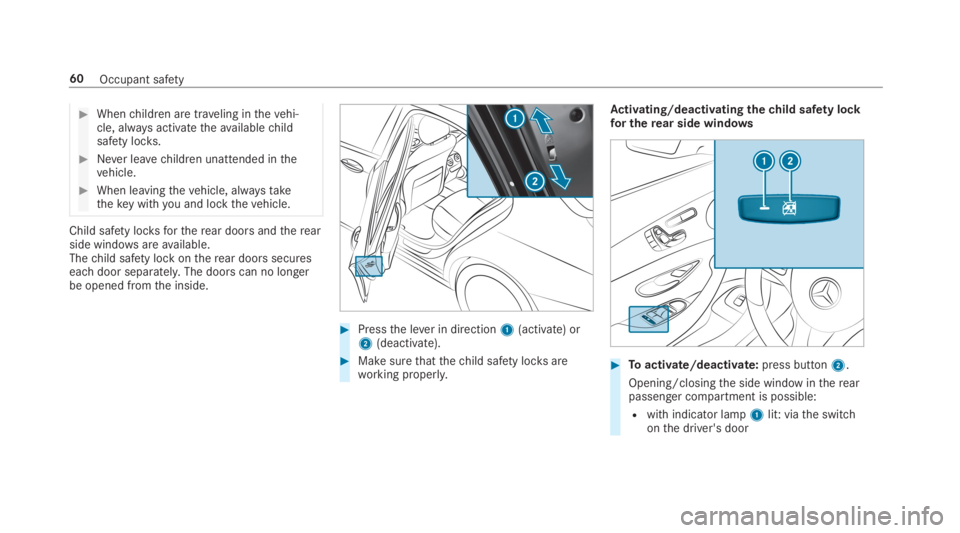
#Whenchildren are traveling inthevehi‐cle, always activatetheavailablechildsafety locks.
#Never leavechildren unattended inthevehicle.
#When leavingthevehicle, alwaystakethekey withyou and lockthevehicle.
Child safety locksfortherear doors andtherearside windowsareavailable.Thechild safety lock ontherear doors secureseach door separately.The doors can no longerbe opened fromthe inside.
#Pressthe lever in direction1(activate) or2(deactivate).
#Make surethatthechild safety locksareworking properly.
Activating/deactivating thechild safety lockfor therear side windows
#Toactivate/deactivate:press button2.
Opening/closingthe side window intherearpassenger compartment is possible:
Rwith indicator lamp1lit: viathe switchonthe driver's door
60Occupant safety
Page 63 of 578
Rwith indicator lamp1off: viathe switchonthe correspondingrear door or driv‐er's door
Whenthechild safety lock is activated,the con‐trols intherear passenger compartment are dis‐abledfor:
Rtherear side windows
Rthe adjustment ofthe front passenger seatfromtherear passenger compartment
Rtheroller sunblinds:
-oftherear side windows
-oftherear window
-intheroof
Notes on pets inthevehicle
&WARNINGRisk of accident and injuryduetoanimals left unsecured or unat‐tended inthevehicle
Ifyou leaveanimals inthevehicle unatten‐ded or unsecured,theycould possibly pressdown buttons or switches.
Therebyan animal may:
Ractivatevehicle equipment and becometrapped,forexample
Rswitchsystems on or off and endangerotherroad users
Unsecured animals may bethrown around inthevehicle intheevent of an accident orsuddensteering and braking maneuver andinjurevehicle occupants inthe process.
#Never leaveanimals inthevehicle unat‐tended.
#Always correctly secureanimals whiledriving,forexample using a suitableanimal carrier.
Occupant safety61
Page 73 of 578
#Vehicles with HANDS-FREEACCESS:Makea kicking movement withyourfootbelowthebumper (→page73).
Vehicles with trunk lid convenience closing:If an item obstructsthe trunk lid duringthe auto‐matic opening process,the obstacle detectionsystem willstopthe trunk lid. The obstacledetection function is only an aid and is not asubstituteforyour attentiveness.
Plug-inhybrid:observethe notes inthe Supple‐ment. Otherwise,you mayfailtorecognize dan‐gers.
Closingthe trunk lid
&WARNINGRisk of injuryfrom unsecureditems inthevehicle
If objects, luggage or loads are not securedor not secured sufficiently,theycould slip,tipover or bethrown around andthereby hitvehicle occupants.
There is arisk of injury,particularly intheevent of sudden braking or a suddenchangein direction.
#Alwaysstowobjects in such awaythattheycannot bethrown around.
#Beforethe journey,secure objects, lug‐gageor loads against slipping or tippingover.
Observethe notes on loadingthevehicle.
&WARNINGRisk of becoming trappedduring automatic closing ofthe trunk lid
Parts ofthe body could become trapped dur‐ing automatic closing ofthe trunk lid. More‐over,people, e.g.children, may bestandinginthe closing area or may enterthe closingarea duringthe closing process.
#Make surethat nobody is inthe vicinityofthe closing area duringthe closingprocess.
#Use one ofthefollowing optionstostopthe closing process:
RPressthe
Page 76 of 578
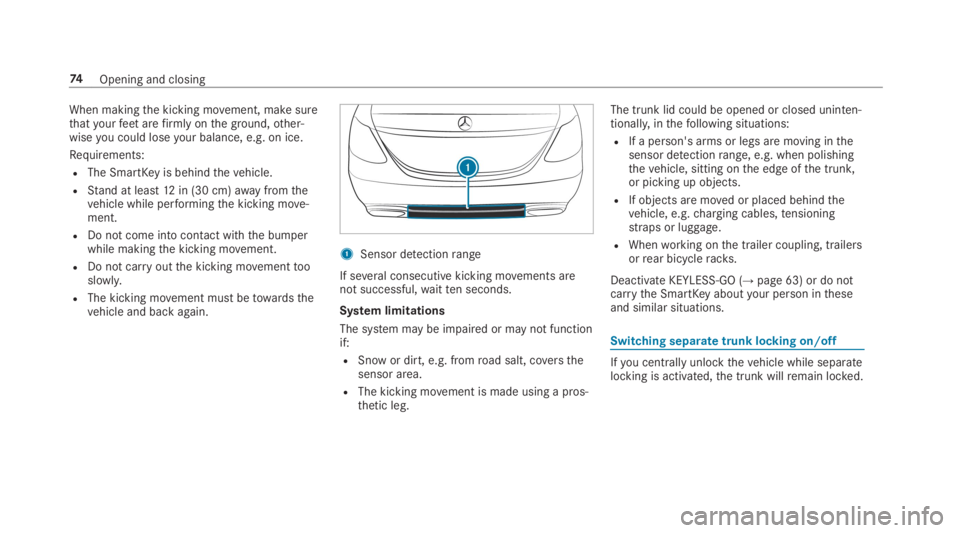
When makingthe kicking movement, make surethatyourfeetarefirmly onthe ground,other‐wiseyou could loseyour balance, e.g. on ice.
Requirements:
RThe SmartKeyis behindthevehicle.
RStand at least12in (30 cm)awayfromthevehicle while performingthe kicking move‐ment.
RDo not come into contact withthe bumperwhile makingthe kicking movement.
RDo not carryoutthe kicking movementtooslowly.
RThe kicking movement must betowardsthevehicle and back again.
1Sensor detectionrange
If several consecutive kicking movements arenot successful,waitten seconds.
System limitations
The system may be impaired or may not functionif:
RSnow or dirt, e.g. fromroad salt, coversthesensor area.
RThe kicking movement is made using a pros‐thetic leg.
The trunk lid could be opened or closed uninten‐tionally, inthefollowing situations:
RIf a person's arms or legs are moving inthesensor detectionrange, e.g. when polishingthevehicle, sitting onthe edge ofthe trunk,or picking up objects.
RIf objects are moved or placed behindthevehicle, e.g.charging cables,tensioningstraps or luggage.
RWhenworking onthe trailer coupling, trailersorrear bicycleracks.
Deactivate KEYLESS-GO (→page 63) or do notcarrythe SmartKeyaboutyour person intheseand similar situations.
Switching separate trunk locking on/off
Ifyou centrally unlockthevehicle while separatelocking is activated,the trunk willremain locked.
74Opening and closing
Page 99 of 578
Thefootrestcan be adjusted only when one ofthefollowing conditions has been fulfilled:
RThe front passenger seat is moved fullyforward
RThe front passenger seat is inthe positionforchauffeur mode
#Adjusttherear seat (→page97).
#Adjusttherecliningrear seat (→page97).
#Toselectthe front passenger seat:pressbutton1.Whenthe indicator lamp lights up,the frontpassenger seat is selected.
#Adjustthe front passenger seat usingthebuttons onthe door control panel intherearcompartment.
%Mercedes-Maybachvehicles:it is suffi‐cienttoadjustthefootrestifthe frontpassenger seat is moved intothe center set‐ting area.
%You can usetherear-compartmentchildsafety locktodisablethis function(→page 60).
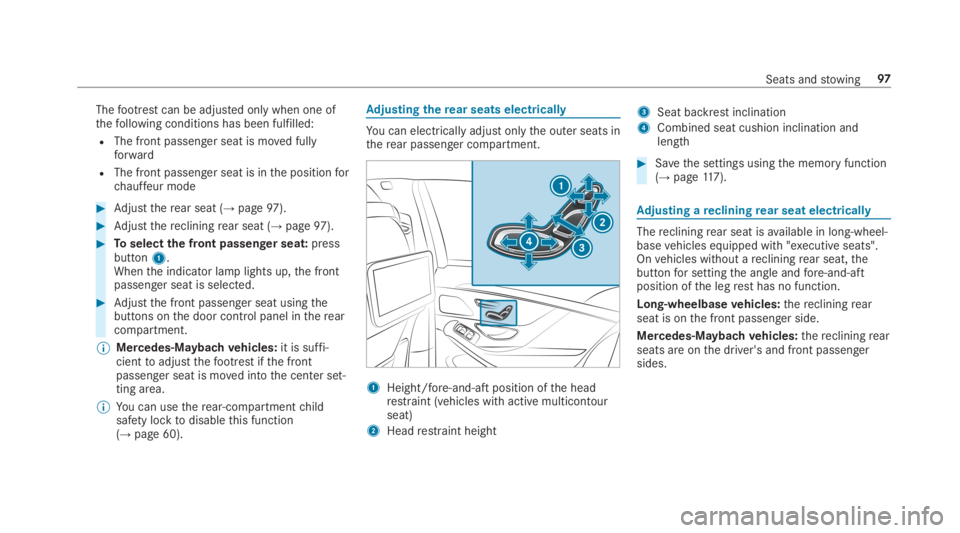
Adjusting therear seats electrically
You can electrically adjust onlythe outer seats intherear passenger compartment.
1Height/fore-and-aft position ofthe headrestraint (vehicles with active multicontourseat)
2Headrestraint height
3Seat backrest inclination
4Combined seat cushion inclination andlength
#Savethe settings usingthe memory function(→page117).
Adjusting arecliningrear seat electrically
Therecliningrear seat isavailable in long-wheel‐basevehicles equipped with "executiveseats".Onvehicles without arecliningrear seat,thebuttonfor settingthe angle andfore-and-aftposition ofthe legresthas no function.
Long-wheelbasevehicles:therecliningrearseat is onthe front passenger side.
Mercedes-Maybachvehicles:therecliningrearseats are onthe driver's and front passengersides.
Seats andstowing97
Page 123 of 578
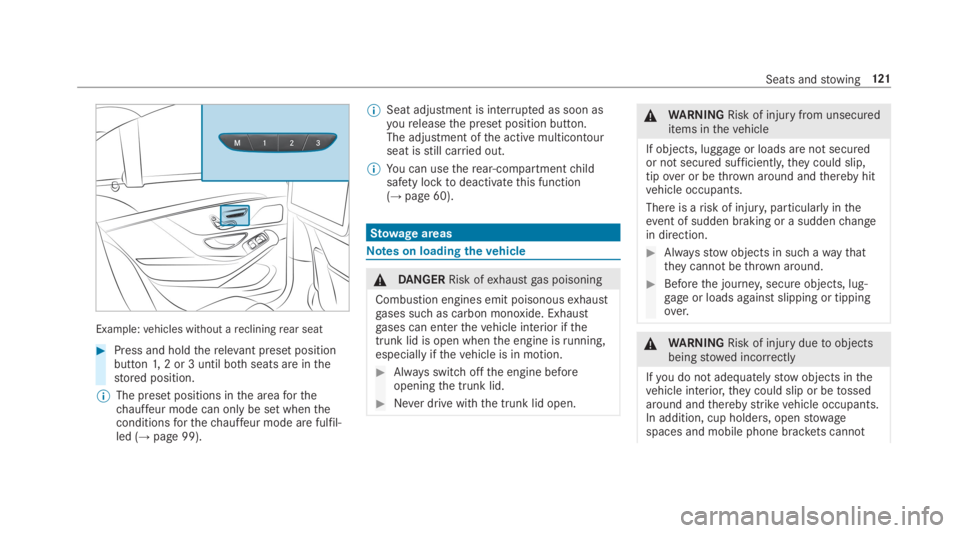
Example:vehicles without arecliningrear seat
#Press and holdtherelevant preset positionbutton1,2 or 3 until bothseats are inthestored position.
%The preset positions inthe areaforthechauffeur mode can only be set whentheconditionsforthechauffeur mode are fulfil‐led (→page 99).
%Seat adjustment is interrupted as soon asyoureleasethe preset position button.The adjustment ofthe active multicontourseat isstill carried out.
%You can usetherear-compartmentchildsafety locktodeactivatethis function(→page 60).
Stowage areas
Notes on loadingthevehicle
&DANGERRisk ofexhaustgas poisoning
Combustion engines emit poisonousexhaustgases such as carbon monoxide. Exhaustgases can enterthevehicle interior ifthetrunk lid is open whenthe engine isrunning,especially ifthevehicle is in motion.
#Always switch offthe engine beforeopeningthe trunk lid.
#Never drive withthe trunk lid open.
&WARNINGRisk of injuryfrom unsecureditems inthevehicle
If objects, luggage or loads are not securedor not secured sufficiently,theycould slip,tipover or bethrown around andthereby hitvehicle occupants.
There is arisk of injury,particularly intheevent of sudden braking or a suddenchangein direction.
#Alwaysstowobjects in such awaythattheycannot bethrown around.
#Beforethe journey,secure objects, lug‐gageor loads against slipping or tippingover.
&WARNINGRisk of injuryduetoobjectsbeingstowed incorrectly
Ifyou do not adequatelystowobjects inthevehicle interior,theycould slip or betossedaround andtherebystrikevehicle occupants.In addition, cup holders, openstowagespaces and mobile phone brackets cannot
Seats andstowing121
Page 124 of 578
alwaysrestrainthe objectstheycontain intheevent of an accident.
There is arisk of injury,particularly intheevent of sudden braking or a suddenchangein direction.
#Alwaysstowobjects in such awaythattheycannot betossed about inthese orsimilar situations.
#Always make surethat objects do notproject fromstowage spaces, parcelnets orstowage nets.
#Closethe lockablestowage spacesbeforestarting a journey.
#Alwaysstowand secure objectsthatare heavy, hard, pointed, sharp-edged,fragile ortoo large inthe trunk.
Observethe notes onthe cup holders.
&WARNINGRisk of burning fromthetail‐pipe ortailpipe trim
Thetailpipe andtailpipe trim can becomeveryhot. Ifyou come into contact withthesecar parts,you could burnyourself.
#Always be particularlycareful when inthe vicinity ofthetailpipe andtailpipetrims and supervisechildrenveryclosely when inthis area.
#Before any contact, allowthe car partstocool down.
The drivingcharacteristics ofyourvehicle aredependent onthe distribution ofthe load withinthevehicle.You should bearthefollowing inmind when loadingthevehicle:
Rneverexceedthe permissible gross mass orthe gross axleweightratingforthevehicle(including occupants). Thevalues are speci‐fied onthevehicle identification plate onthevehicle's B-pillar.
Rthe load must not protrude abovethe upperedge ofthe seat backrests.
Ralways placethe load behind unoccupiedseats if possible.
Rsecurethe load usingthe parcel net hooks.Distributethe load onthe parcel net hooksevenly.
Stowage spaces inthevehicle interior
Overview ofthe frontstowagecompart‐ments
&WARNINGRisk of injuryduetoobjectsbeingstowed incorrectly
Ifyou do not adequatelystowobjects inthevehicle interior,theycould slip or betossedaround andtherebystrikevehicle occupants.In addition, cup holders, openstowagespaces and mobile phone brackets cannotalwaysrestrainthe objectstheycontain intheevent of an accident.
Thereis arisk of injury,particularly intheevent of sudden braking or a suddenchangein direction.
12 2Seats andstowing
Page 125 of 578
#Alwaysstowobjects in such awaythattheycannot betossed about inthese orsimilar situations.
#Always make surethat objects do notproject fromstowage spaces, parcelnets orstowage nets.
#Closethe lockablestowage spacesbeforestarting a journey.
#Alwaysstowand secure objectsthatare heavy, hard, pointed, sharp-edged,fragile ortoo large inthe trunk.
Observethe notes on loadingthevehicle.
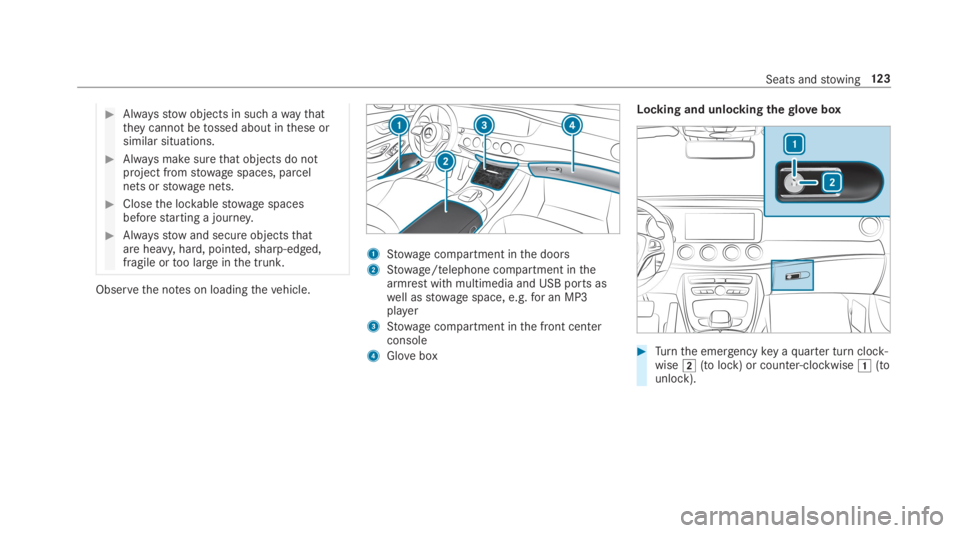
1Stowage compartment inthe doors
2Stowage/telephone compartment inthearmrest with multimedia and USB ports aswell asstowage space, e.g.for an MP3player
3Stowage compartment inthe front centerconsole
4Glovebox
Locking and unlockingtheglovebox
#Turnthe emergencykey aquarter turn clock‐wiseH(to lock) or counter-clockwiseG(tounlock).
Seats andstowing12 3
Page 128 of 578
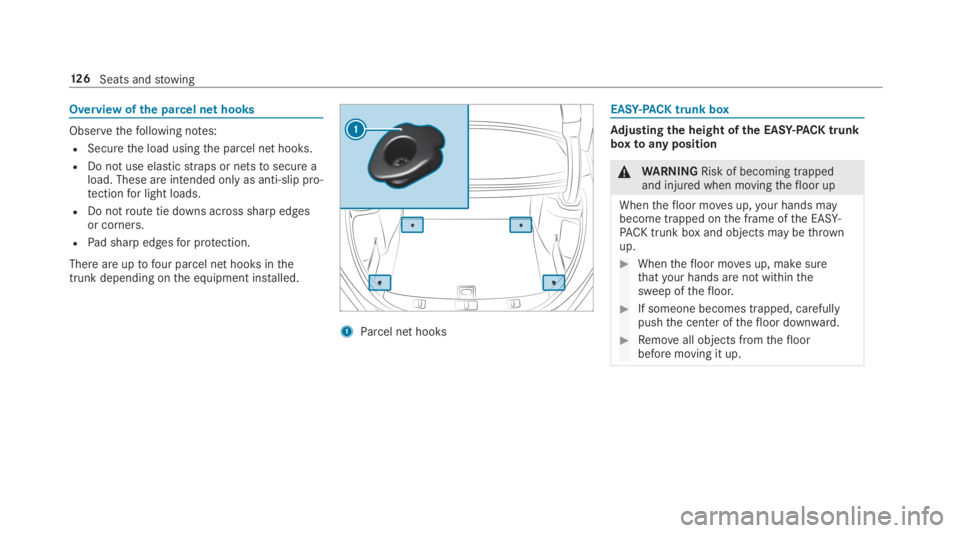
Overview ofthe parcel net hooks
Observethefollowing notes:
RSecurethe load usingthe parcel net hooks.
RDo not use elasticstraps or netstosecure aload. These are intended only as anti-slip pro‐tectionfor light loads.
RDo notroute tie downs across sharp edgesor corners.
RPad sharp edgesfor protection.
There are uptofour parcel net hooks inthetrunk depending onthe equipment installed.
1Parcel net hooks
EASY-PACKtrunk box
Adjusting the height of the EASY-PACK trunkboxtoany position
&WARNINGRisk of becoming trappedand injured when movingthefloor up
Whenthefloor moves up,your hands maybecome trapped onthe frame ofthe EASY-PACK trunk box and objects may bethrownup.
#Whenthefloor moves up, make surethatyour hands are not withinthesweep ofthefloor.
#If someone becomes trapped, carefullypushthe center ofthefloor downward.
#Removeall objects fromthefloorbefore moving it up.
12 6Seats andstowing