ECU MERCEDES-BENZ S CLASS 2019 Repair Manual
[x] Cancel search | Manufacturer: MERCEDES-BENZ, Model Year: 2019, Model line: S CLASS, Model: MERCEDES-BENZ S CLASS 2019Pages: 578, PDF Size: 23.31 MB
Page 455 of 578
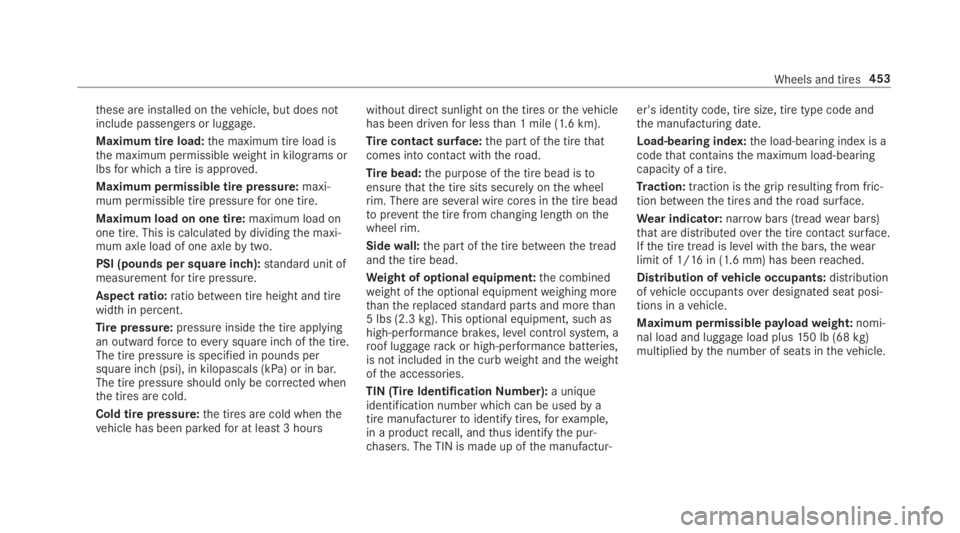
these are installed onthevehicle, but does notinclude passengers or luggage.
Maximum tire load:the maximum tire load isthe maximum permissibleweight in kilograms orlbsfor whicha tire is approved.
Maximum permissible tire pressure:maxi‐mum permissible tire pressurefor one tire.
Maximum load on one tire:maximum load onone tire. This is calculatedbydividingthe maxi‐mum axle load of one axlebytwo.
PSI (pounds per square inch):standard unit ofmeasurementfor tire pressure.
Aspectratio:ratio between tire height and tirewidth in percent.
Tirepressure:pressure insidethe tire applyingan outwardforcetoeverysquare inch ofthe tire.The tire pressure is specified in pounds persquare inch (psi), in kilopascals (kPa) or in bar.The tire pressure should only be corrected whenthe tires are cold.
Cold tire pressure:the tires are cold whenthevehicle has been parkedfor at least3 hours
without direct sunlight onthe tires orthevehiclehas been drivenfor lessthan 1 mile (1.6 km).
Tirecontact surface:the part ofthe tirethatcomes into contact with theroad.
Tirebead:the purpose ofthe tire bead istoensurethatthe tire sits securely onthe wheelrim. There are several wire cores inthe tire beadtopreventthe tire fromchanging length onthewheelrim.
Sidewall:the part ofthe tire betweenthe treadandthe tire bead.
Weight of optional equipment:the combinedweight ofthe optional equipmentweighing morethanthereplacedstandard parts and morethan5 lbs (2.3kg).This optional equipment, such ashigh-performance brakes, level control system, aroof luggagerackor high-performance batteries,is not included inthe curbweight andtheweightofthe accessories.
TIN (Tire IdentificationNumber):a uniqueidentification number which can be usedby atire manufacturertoidentify tires,forexample,in a productrecall, andthus identifythe pur‐chasers. The TIN is made up ofthe manufactur‐
er's identity code, tire size, tire type code andthe manufacturing date.
Load-bearing index:the load-bearing index is acodethat containsthe maximum load-bearingcapacity of a tire.
Traction:traction isthe gripresulting from fric‐tion betweenthe tires andtheroad surface.
Wear indicator:narrowbars (treadwear bars)that are distributedoverthe tire contact surface.Ifthe tire tread is level withthe bars,thewearlimit of 1/16in (1.6 mm) has beenreached.
Distribution ofvehicle occupants:distributionofvehicle occupantsover designated seat posi‐tions in avehicle.
Maximum permissible payloadweight:nomi‐nal load and luggage load plus150 lb (68kg)multipliedbythe number of seats inthevehicle.
Wheels and tires453
Page 478 of 578
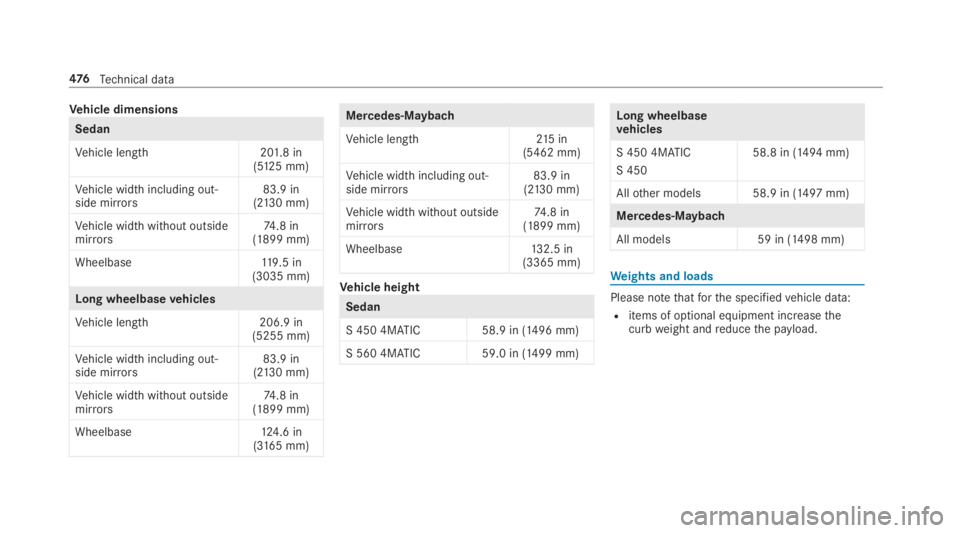
Vehicle dimensions
Sedan
Vehicle length201.8 in(5125 mm)
Vehicle width including out‐side mirrors83.9 in(2130 mm)
Vehicle width without outsidemirrors74.8 in(1899 mm)
Wheelbase119.5 in(3035 mm)
Long wheelbasevehicles
Vehicle length206.9 in(5255 mm)
Vehicle width including out‐side mirrors83.9 in(2130 mm)
Vehicle width without outsidemirrors74.8 in(1899 mm)
Wheelbase124.6 in(3165 mm)
Mercedes‑Maybach
Vehicle length215in(5462 mm)
Vehicle width including out‐side mirrors83.9 in(2130 mm)
Vehicle width without outsidemirrors74.8 in(1899 mm)
Wheelbase132.5 in(3365 mm)
Vehicle height
Sedan
S 450 4MATIC 58.9 in (1496 mm)
S 560 4MATIC 59.0 in (1499 mm)
Long wheelbasevehicles
S 450 4MATIC
S 450
58.8 in (1494 mm)
Allother models 58.9 in (1497 mm)
Mercedes‑Maybach
All models59 in (1498 mm)
Weights and loads
Please notethatforthe specifiedvehicle data:
Ritems of optional equipment increasethecurbweight andreducethe payload.
476Technical data
Page 491 of 578
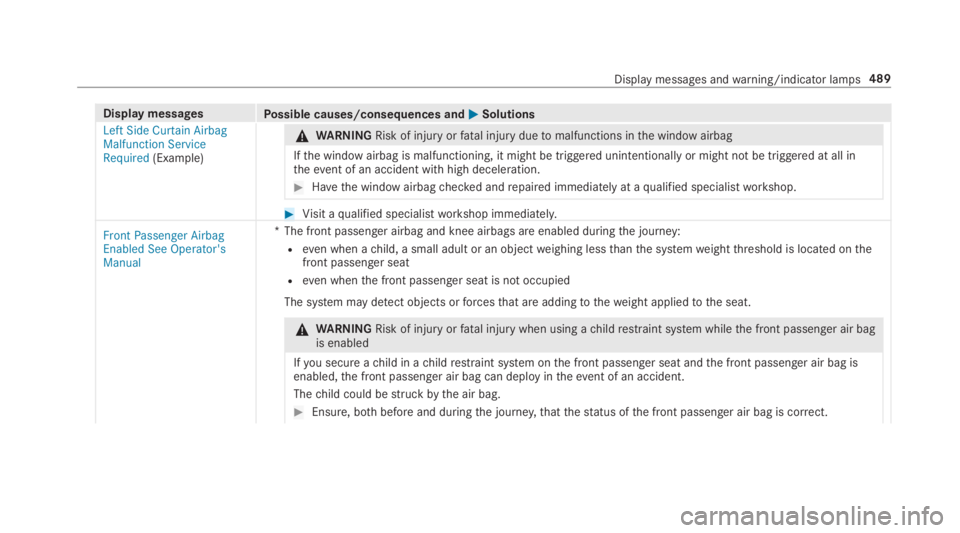
Display messagesPossible causes/consequences andPPSolutions
Left Side Curtain AirbagMalfunction ServiceRequired(Example)
&WARNINGRisk of injuryorfatal injury duetomalfunctions inthe window airbag
Ifthe window airbag is malfunctioning, it might be triggered unintentionally or might not be triggered at all intheevent of an accident with high deceleration.
#Havethe window airbagchecked andrepaired immediately at aqualified specialistworkshop.
#Visit aqualified specialistworkshop immediately.
Front Passenger AirbagEnabled See Operator'sManual
*The front passenger airbag and knee airbags are enabled duringthe journey:
Reven when achild, a small adult or an objectweighing lessthanthe systemweightthreshold is located onthefront passenger seat
Reven whenthe front passenger seat is not occupied
The system may detect objects orforcesthat are addingtotheweight appliedtothe seat.
&WARNINGRisk of injuryorfatal injury when using achildrestraint system whilethe front passenger air bagis enabled
Ifyou secure achild in achildrestraint system onthe front passenger seat andthe front passenger air bag isenabled,the front passenger air bag can deploy intheevent of an accident.
Thechild could bestruckbythe air bag.
#Ensure, bothbefore and duringthe journey,thatthestatus ofthe front passenger air bag is correct.
Display messages andwarning/indicator lamps489
Page 544 of 578
Seat belts ............................................41 0Seat cover ............................................41 0Sensors............................................... 409Tailpipes .............................................. 409Washingbyhand ................................. 404Wheels/rims ....................................... 409Windows.............................................. 409Wiper blades .......................................409
Carpet (Care)............................................41 0
Champagneglass....................................131
Change of address.....................................21
Change ofownership................................21
Changing a wheelPreparation .........................................458Raisingthevehicle .............................. 459
Changinggears........................................178Manually ..............................................178
Changing hub caps.................................458
Character entryOnthetouchpad .................................286Usingthe controller ............................. 286
ChargingBattery (vehicle) ..................................423
Mobile phone (wireless) .......................141USB port ..............................................138
Chassis level (MAGICBODYCON‐TROL)Setting .................................................221
Chauffeur mode......................................... 99Fullyreclined position ..........................104Information ............................................ 99Installing/removing headrestraint ......101Movingthe front passenger seat intothechauffeur position .........................100Movingthe front passenger seat intothe normal position .............................102
Child safety lockActivating/deactivating (multimediasystem) ............................................... 293Rear door .............................................. 59Rear side windows................................. 60
Child seatAttaching (notes) ................................... 52Basic instructions ..................................47front-passenger seat (notes) ..................57LATCH-type (ISOFIX) (installing) ............ 53Notes onrisks and dangers ...................48
Securing onthe front passenger seat ....58Securing ontherear seat ...................... 56TopTether ..............................................55
ChildrenAvoiding dangers inthevehicle .............48Basic instructions ..................................47Special seat beltretractor ..................... 53
Chock....................................................... 457Storage location ..................................457
Chocksee Chock
CigarettelighterFront center console ...........................13 5Rear passenger compartment .............135
Cleaningsee Care
Climate controlActivating/deactivatingthe A/Cfunction (control panel) .......................160Activating/deactivatingthe A/Cfunction (multimedia system) ..............16 0Activating/deactivatingthe synchro‐nization function (multimedia sys‐tem) .....................................................16 2
542Index
Page 557 of 578
K
KEYLESS-GOLockingthevehicle ................................67Problem .................................................68Unlocking setting .................................. 63Unlockingthevehicle ............................67
Kickdown.................................................180Using ...................................................180
Knee airbag................................................ 38
L
Labeling (tires)seeTirelabeling
Lampsee Interior lighting
Lamps (Instrument Display)seeWarning/indicator lamps
Lane detection (automatic)seeActive LaneKeeping Assist
LaneKeeping AssistseeActive LaneKeeping Assist
Language.................................................293Notes .................................................. 293Setting .................................................293
LATCH-type (ISOFIX)child seat secur‐ing systemInstalling ................................................ 53
Level control systemsee AIRMATICsee MAGICBODYCONTROL
Light switchOverview .............................................145
Lightingsee Interior lightingsee Lights
Lights........................................................14 5Adaptive Highbeam Assist ...................148Adjustingthe instrument lighting ........ 255Automatic driving lights .......................14 6Combination switch.............................14 6Cornering light function .......................14 8Hazardwarning lights ..........................147High beam ...........................................14 6High-beamflasher ...............................146Light switch .........................................14 5
Low-beam headlamps .........................145Parking lights .......................................145Rearfog lamp ......................................14 5Responsibilityfor lighting systems ......14 5Settingtheexterior lighting switch-off delay time ......................................14 9Settingthe surround lighting ...............149Standing lights .....................................145Turnsignals .........................................14 6
LimitedWarrantyVehicle .................................................. 25
LiveTraffic InformationDisplaying subscription information .....318Displayingthe traffic map ....................319Displaying traffic incidents .................. 320Extending a subscription ......................318Issuing hazard alerts ........................... 320
Load index (tires)....................................449
Load-bearing capacity (tires).................449
LoadingDefinitions ...........................................451Notes ...................................................121Roof carrier .........................................12 9Stowage space underthe trunkfloor ...12 9
Index555
Page 558 of 578
Loading guidelines..................................121
Loading information table......................442
LoadsSecuring ..............................................121
Locator lightingsee Surround lighting
Locking/unlockingActivating/deactivatingthe auto‐matic lockingfeature .............................68Emergencykey ...................................... 69KEYLESS-GO ..........................................67Unlocking and opening doors fromthe inside ..............................................66
Low-beam headlampsSwitching on/off .................................14 5
Lubricant additivesseeAdditives
LuggageNet hooks ............................................12 6Securing ..............................................121
M
MAGICBODYCONTROL...........................217Setting ................................................. 221Suspension ..........................................217
MAGIC SKY CONTROL...............................86Function ................................................ 86Operating .............................................. 86
MAGIC VISION CONTROLWindshield wipers...............................15 3
MaintenanceMenu (on-boardcomputer) .................. 256Vehicle ...................................................21
Maintenancesee ASSYST PLUS
MalfunctionRestraint system ................................... 32
Malfunction messagesee Display message
Map...........................................319, 320, 321Avoiding an area ..................................323Avoiding an area (overview) .................323Changing an area ................................ 324Deleting an area .................................. 324
Displayingthe compass ....................... 325Displayingthe mapversion .................323Displayingthe next intersectingstreet................................................... 323Displayingthe satellite map ................326Displayingthe traffic map ....................319Displayingweather information ...........326Map data ............................................. 325Moving ................................................ 322Overview ............................................. 320Selecting POI symbols ......................... 322Selectingtext information ................... 322Selectingthe map orientation .............322Settingthe map scale .......................... 321Settingthe map scale automatically ....325Updating .............................................. 324
Map and compassOverview .............................................320
Massage programOverview .............................................109Resettingthe settings ..........................11 0
Massage programsSelectingthe front seats ......................110
556Index
Page 571 of 578
T
TableseeFoldingtable
Tailpipes (Care)........................................ 409
Tank contentFuel .....................................................470Reserve(fuel) ......................................470
Technical dataInformation .......................................... 464Tirepressure monitor ..........................441Vehicle identification plate .................. 466
Telephone........................................ 260, 328Activating functions during a call ........ 333Call andringtonevolume .....................333Calls with several participants .............333Connecting a mobile phone (NearField Communication (NFC)) ...............332Connecting a mobile phone (Pass‐key) .....................................................329Connecting a mobile phone (SecureSimplePairing) .................................... 329De-authorizing a mobile phone ............ 331Disconnecting a mobile phone ............ 331Importing contacts ..............................335
Importing contacts (overview) .............335Incoming call during anexisting call .... 334Information .......................................... 329Interchanging mobile phones .............. 331Menu (on-board computer) .................. 260Mobile phonevoicerecognition .......... 333Notes .................................................. 326Operating modes ................................. 329Reception and transmissionvolume .... 332Switching mobile phones (Near FieldCommunication (NFC)) ........................ 332Telephone menuoverview ...................328Telephone operation ............................ 333Using Near Field Communication(NFC) ...................................................332Voice commands (Voice Control Sys‐tem) .....................................................270Wirelesscharging (mobile phone intherear passenger compartment) .......142Wirelesscharging (mobile phone) ........14 2
Telephonesee Secondtelephone
Telephone numberDialing (on-board computer) ................ 260
Telephony operating modes
Bluetooth®Telephony .......................... 329
Telephony operating modessee Secondtelephone
Temperaturegrade..................................446
Text messages......................................... 337Calling a message sender .................... 338Changingfolders .................................338Composing .......................................... 337Configuringthe displayedtext mes‐sages ................................................... 337Deleting ............................................... 338Drafts .................................................. 338Notes ................................................... 337Options ................................................ 338Outbox ................................................ 338Read-aloud function ............................ 337Reading ...............................................337Replying .............................................. 338Sending ...............................................337Voice commands (Voice Control Sys‐tem) .....................................................274
TimeManual time setting ............................. 288
Index569