fuel MERCEDES-BENZ S CLASS 2019 Owner's Manual
[x] Cancel search | Manufacturer: MERCEDES-BENZ, Model Year: 2019, Model line: S CLASS, Model: MERCEDES-BENZ S CLASS 2019Pages: 578, PDF Size: 23.31 MB
Page 313 of 578
The multimedia system announcesthenames oftheroadsthat willfollowtheupcomingchange of direction.
This function is notavailable in all countriesand languages.
Displaying destination information
Requirements:RA destination is entered.
Multimedia system:
,Navigation
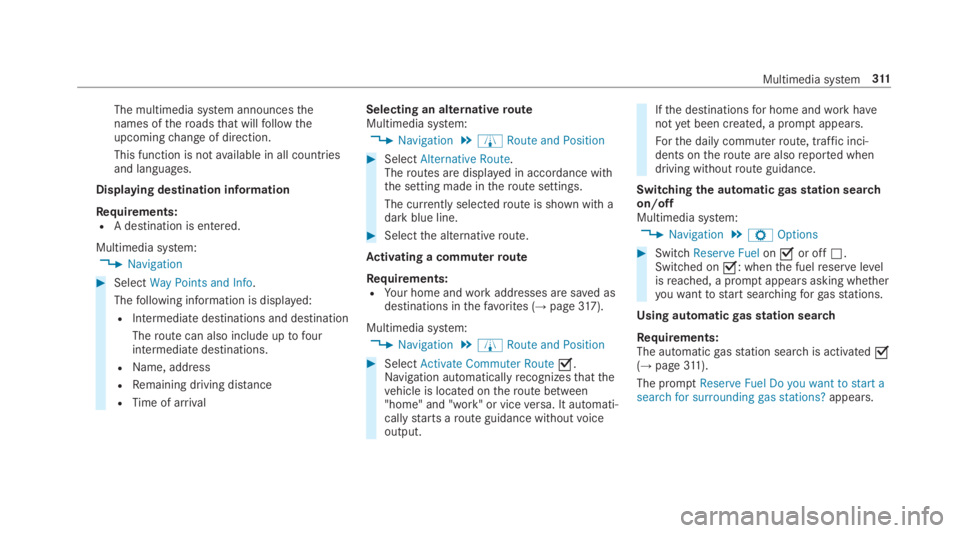
#SelectWay Points and Info.
Thefollowing information is displayed:
RIntermediate destinations and destination
Theroute can also include uptofourintermediate destinations.
RName, address
RRemaining driving distance
RTime of arrival
Selecting an alternativerouteMultimedia system:
,Navigation.ÀRoute and Position
#SelectAlternative Route.Theroutes are displayed in accordance withthe setting made intheroute settings.
The currently selectedroute is shown with adark blue line.
#Selectthe alternativeroute.
Activating a commuterroute
Requirements:RYour home andworkaddresses are saved asdestinations inthefavorites (→page317).
Multimedia system:
,Navigation.ÀRoute and Position
#SelectActivate Commuter Routes.Navigation automaticallyrecognizesthatthevehicle is located ontheroute between"home" and "work" or viceversa. It automati‐callystarts aroute guidance withoutvoiceoutput.
Ifthe destinationsfor home andworkhavenotyet been created, a promptappears.
Forthe daily commuterroute, traffic inci‐dents ontheroute are alsoreported whendriving withoutroute guidance.
Switchingthe automaticgasstation searchon/offMultimedia system:
,Navigation.ZOptions
#SwitchReserve Fuelonsor offS.Switched ons: whenthe fuelreservelevelisreached, a promptappears asking whetheryouwanttostart searchingforgasstations.
Using automaticgasstation search
Requirements:The automaticgasstation searchis activateds(→page311).
The promptReserve Fuel Do you want to start asearch for surrounding gas stations?appears.
Multimedia system311
Page 323 of 578
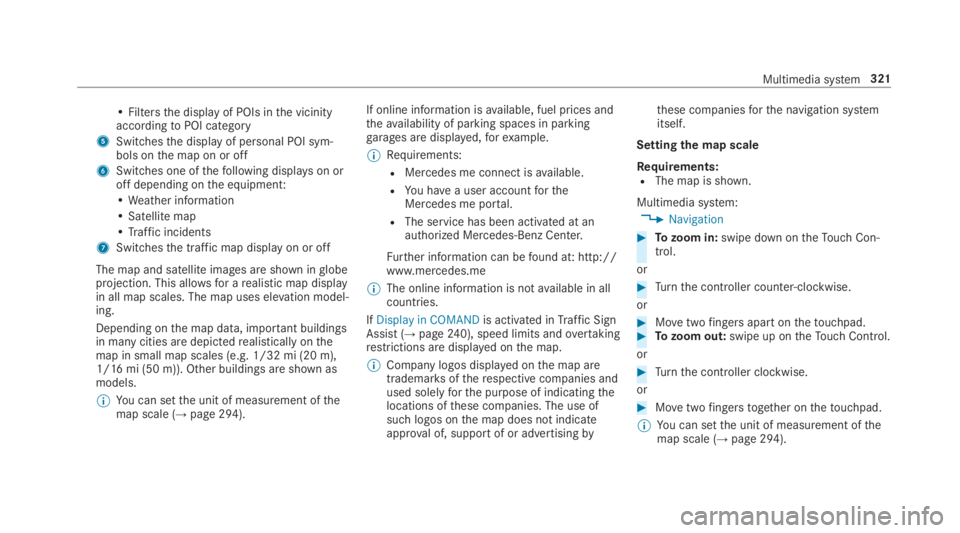
• Filtersthe display of POIs inthe vicinityaccordingtoPOI category
5Switchesthe display of personal POI sym‐bols onthe map on or off
6Switches one ofthefollowing displayson oroff depending onthe equipment:
•Weather information
• Satellite map
•Traffic incidents
7Switchesthe traffic map display on or off
The map and satellite images are shown inglobeprojection. This allowsfor arealistic map displayin all map scales. The map uses elevation model‐ing.
Depending onthe map data, important buildingsin manycities are depictedrealistically onthemap in small map scales (e.g. 1/32 mi (20 m),1/16 mi (50 m)). Other buildings are shown asmodels.
%You can setthe unit of measurement ofthemap scale (→page 294).
If online information isavailable, fuel prices andtheavailability of parking spaces in parkinggarages are displayed,forexample.
%Requirements:
RMercedes me connect isavailable.
RYou havea user accountfortheMercedes me portal.
RThe service has been activated at anauthorized Mercedes-Benz Center.
Further information can befound at: http://www.mercedes.me
%The online information is notavailable in allcountries.
IfDisplay in COMANDis activated inTraffic SignAssist (→page240), speed limits andovertakingrestrictions are displayed onthe map.
%Company logos displayed onthe map aretrademarksoftherespective companies andused solelyforthe purpose of indicatingthelocations ofthese companies. The use ofsuch logos onthe map does not indicateapproval of, supportof or advertisingby
these companiesforthe navigation systemitself.
Settingthe map scale
Requirements:RThe map is shown.
Multimedia system:
,Navigation
#Tozoom in:swipe down ontheTouch Con‐trol.
or
#Turnthe controller counter-clockwise.
or
#Movetwofingers apart onthetouchpad.#Tozoom out:swipe up ontheTouch Control.
or
#Turnthe controller clockwise.
or
#Movetwofingerstogether onthetouchpad.
%You can setthe unit of measurement ofthemap scale (→page 294).
Multimedia system321
Page 399 of 578
Opening/closingthe hood
&WARNINGRisk of accident ifthe enginehood is unlatched while driving
An unlocked engine hood may open up whenthevehicle is in motion and blockyour view.
#Never unlatchthe engine hood whiledriving.
#Beforeevery trip, ensurethattheengine hood is latched.
&WARNINGRisk of accident and injurywhen opening and closingthe enginehood
When opening or closingthe engine hood, itmay suddenly drop intothe end position.
There is arisk of injuryfor anyone intheengine hood'srange of movement.
#Only open or closethe engine hoodwhenthere are no persons intheengine hood'srange of movement.
&WARNINGDanger of burns when open‐ingthe hood
Ifyou openthe hood whenthe engine hasoverheated or during afireinthe enginecompartment,you could come into contactwith hotgases orother escaping operatingfluids.
#Before openingthe hood, allowtheenginetocool down.
#Intheevent of afireinthe engine com‐partment,keepthe hood closed andcallthefireservice.
&WARNINGRisk of injuryduetomovingparts
Certain components inthe engine compart‐ment may continuetomoveor suddenlymoveagaineven afterthe ignition has beenswitched off, e.g.the coolerfan.
Makesure ofthefollowing before performingtasks inthe engine compartment:
#Switchthe ignition off.
#Nevertouchthe danger zone surround‐ing moving component parts, e.g.therotation area ofthefan.
#Removejewelry andwatches.
#Keep items of clothing and hairawayfrom moving parts.
&WARNINGRisk of injuryfromtouchingcomponent parts undervoltage
The ignition system andthe fuel injectionsystemworkunder highvoltage. Ifyoutouchcomponent parts which are undervoltage,you couldreceivean electric shock.
#Nevertouch component parts oftheignition system orthe fuel injection sys‐tem whenthe ignition is switched on.
&WARNINGRisk of burns from hot com‐ponent parts inthe engine compartment
Certain components inthe engine compart‐ment can beveryhot, e.g.the engine,theradiator and parts oftheexhaust system.
Maintenance and care397
Page 407 of 578
Notes on paintwork/mattefinish paintworkcare
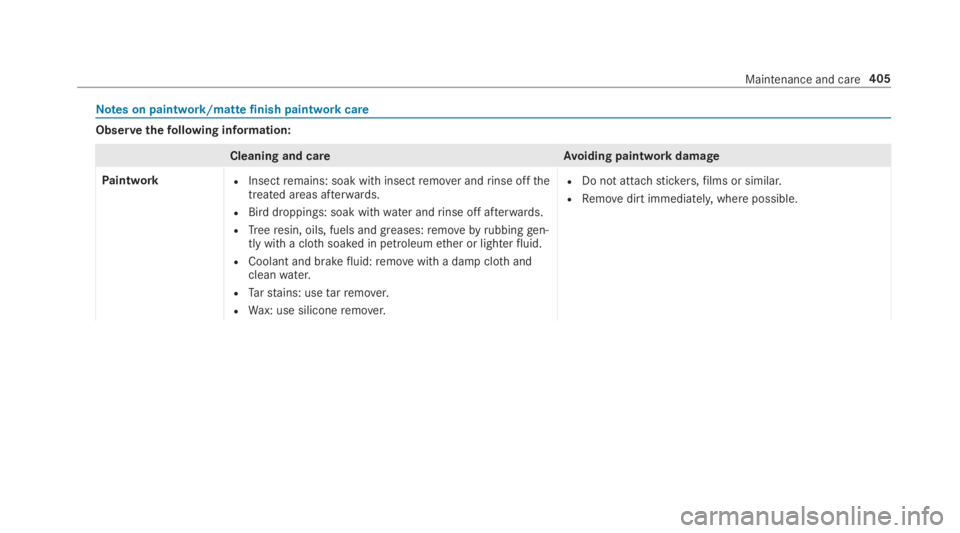
Observethefollowing information:
Cleaning and careAvoiding paintwork damage
PaintworkRInsectremains: soak with insectremover andrinse offthetreated areas afterwards.
RBird droppings: soak withwater andrinse off afterwards.
RTreeresin, oils, fuels and greases:removebyrubbinggen‐tly witha clothsoaked in petroleumether or lighterfluid.
RCoolant and brakefluid:removewith a damp clothandcleanwater.
RTarstains: usetarremover.
RWax: use siliconeremover.
RDo not attachstickers,films or similar.
RRemovedirt immediately,where possible.
Maintenance and care405
Page 420 of 578
If a tire pressureof180 kPa (1.8 bar/26 psi)has been attained after eight minutes:
&WARNINGRisk of accident from drivingwithsealed tires
A tiretemporarily sealed with tire sealantimpairs drivingcharacteristics and is notsuitablefor higher speeds.
#Adaptyour drivingstyle accordinglyanddrive carefully.
#Do notexceedthe maximum speedlimit with a tirethat has beenrepairedusing tire sealant.
Observethe maximum permissible speedfor atire sealed with tire sealant 50mph (80 km/h).#Affixthe upper section ofthe TIREFITstickertothe instrument cluster in a location whereit will be easilyseenbythe driver.
*NOTEStaining causedbyleaking tiresealant
After use,excess tire sealant may leak outfromthefilling hose.
#Therefore, placethefilling hose intheplastic bagthat containedthe TIREFITkit.
+ENVIRONMENTALNOTEEnvironmentalpollution causedbyenvironmentally irre‐sponsible disposal
Tiresealant contains pollutants.
#Havethe tire sealant bottle disposed ofprofessionally,e.g. at an authorizedMercedes-Benz Center.
#Switch offthe tire inflation compressor.
#Unscrewthefilling hose fromthevalve ofthefaulty tire.
#Stow the tire sealant bottle,the tire inflationcompressor andthewarning triangle.
#Pullawayimmediately.
#Stop driving after approximatelyten minutesandcheckthe tire pressure usingthe tireinflation compressor.The tire pressure must now be at least130 kPa (1.3 bar/19 psi).
&WARNINGRisk of accident duetothespecified tire pressure not beingreached
Ifthe specified tire pressure is notreachedafter a brief drive,the tire istoo badly dam‐aged. The tire sealant cannotrepairthe tireinthis instance.
Damaged tires and tire pressurethat istoolow can significantly impairthe braking prop‐erties andthe handlingcharacteristics.
#Do not continue driving.
#Consult aqualified specialistworkshop.
In cases such asthe one mentioned above, con‐tact an authorized Mercedes-Benz Center. Orcall 1-800-FOR-MERCedes (inthe USA) or1-800-387-0100(in Canada).
#Correctthe tire pressure if it isstill at least130 kPa (1.3 bar/19 psi).You willfindthevalues intheTireand Loading Informationplacard onthe B-pillar onthe driver's side orinthe tire pressuretable inthe fuelfillerflap.
#Toincreasethe tire pressure:switchonthe tire inflation compressor.
41 8Breakdown assistance
Page 424 of 578
#When givingstarting assistance, alwaysmake surethatyou onlyconnect bat‐teryterminals with identical polarity.
#Duringstarting assistance,you mustobservethe described orderfor con‐necting and disconnectingthe jumpercables.
#Do not connect or disconnectthe bat‐teryclamps whilethe engine isrunning.
&WARNINGRisk ofexplosion duringcharging process andstarting assistance
Duringthecharging process andstartingassistance,the battery mayrelease anexplo‐sivegas mixture.
#Avoidfire, openflames, creating sparksand smoking.
#Make surethatthere is sufficientventi‐lation duringthecharging process andduringstarting assistance.
#Do not leanover a battery.
&WARNINGRisk ofexplosion from a fro‐zen battery
A discharged battery may freeze attempera‐tures slightly aboveor below freezing point.
Duringstarting assistance or batterycharg‐ing, batterygas may bereleased.
#Alwaysthawa frozen batteryoutfirstbeforecharging it or performingstart‐ing assistance.
Ifthe indicator/warning lamps inthe instrumentcluster do not light up at lowtemperatures, it isverylikelythatthe discharged battery has fro‐zen. Inthis caseyou may neither jump-startthevehicle norchargethe battery.
The service life of a batterythat has beenthawed may be dramatically shortened. Thestartingcharacteristics may be impaired, espe‐cially at lowtemperatures.
It isrecommendedthatyou haveathawed bat‐terychecked at aqualified specialistworkshop.
Allvehicles
*NOTEDamagecausedbynumerous orextended attemptstostartthe engine
Numerous orextended attemptstostarttheengine may damagethe catalytic converterduetonon-combusted fuel.
#Avoid numerous andextended attemptstostartthe engine.
Observethefollowing points duringstartingassistance and whenchargingthe battery:
ROnly use undamaged jumper cables/charg‐ing cables with a sufficient cross-section andinsulatedterminal clamps.
RNon-insulated parts oftheterminal clampsmust not come into contact withother metalparts whilethe jumper cable/charging cableis connectedtothe battery/jump-startcon‐nection point.
RThe jumper cable/charging cable must notcome into contact withany parts which maymovewhenthe engine isrunning.
422Breakdown assistance
Page 438 of 578
RThe tires maywearexcessively and/orunevenly,which maygreatlyimpair tiretraction.
RThe drivingcharacteristics, aswell assteering and braking, may be greatlyimpaired.
#Comply withtherecommended tirepressure andcheckthe tire pressure ofall tires includingthe spare wheelregu‐larly:
Rat least once a month
Rwhenthe loadchanges
Rbefore embarking on a longer journey
Rif operating conditionschange, e.g. off-road driving
#Adjustthe tire pressure as necessary.
Driving withtire pressurethat istoo high ortoolow can:
RShortenthe service life ofthe tires.
RCause increased tire damage.
RAdversely affect drivingcharacteristics andthus driving safety,e.g. dueto hydroplaning.
&WARNINGRisk of an accident duetoinsufficient tire pressure
Tires with pressurethat istoo low canover‐heat and burstas aresult.
In addition,theyalso suffer fromexcessiveand/or irregularwear, which can significantlyimpairthe braking properties andthe han‐dlingcharacteristics.
#Avoidexcessively low tire pressures inallthe tires, includingthe spare wheel.
Tirepressure which istoo low can cause:
RTiredefects as aresult ofoverheating
RImpaired handlingcharacteristics
RIrregularwear
RIncreased fuel consumption
&WARNINGRisk of accident fromexces‐sive tire pressure
Tires withexcessively high pressure canburst becausetheyare damaged more easilybyhighwayfill, pot holesetc.
In addition,theyalso suffer from irregularwear, which can significantly impairthe brak‐ing properties andthe handlingcharacteris‐tics.
#Avoidexcessively high tire pressures inallthe tires, includingthe spare wheel.
Excessively high tire pressure canresult in:
RIncreased braking distance
RImpaired handlingcharacteristics
RIrregularwear
RImpaired driving comfort
RSusceptibilitytodamage
436Wheels and tires
Page 439 of 578
&WARNINGRisk of accident causedbyrepeated drop in tire pressure
Ifthe tire pressure dropsrepeatedly,thewheel,valve or tire may be damaged.
Insufficient tire pressure can causethe tirestoburst.
#Inspectthe tirefor signs offoreignobjects.
#Check whetherthe wheel orvalve has aleak.
#Ifyou are unabletorectifythe damage,contact aqualified specialistworkshop.
You canfind information on tire pressureforthevehicle'sfactory-installed tires onthefollowinglabels:
RTireand Loading Information placard ontheB‑pillar ofyourvehicle (→page442).
RTirepressuretable onthe inside ofthe fuelfillerflap (→page 437).
Observethe maximum tire pressure(→page448).
Use a suitable tire pressuregaugetocheckthetire pressure. The outer appearance of a tiredoes not permit anyreliable conclusion aboutthe tire pressure.
Vehicles with a tire pressure monitoring sys‐tem:You can alsocheckthe tire pressure usingthe on-board computer.
Only correct tire pressure whenthe tires arecold. Conditionsfor cold tires:
RThevehicle has been parked withthe tiresout of direct sunlightfor at leastthree hours.
RThevehicle has traveled lessthan 1 mile(1.6 km).
Arise inthe tiretemperature of18°F (10 °C)increasesthe tire pressurebyapprox.10kPa(0.1 bar/1.5 psi).Takethis into account whencheckingthe tire pressure ofwarmtires.
The tire pressure recommendedfor increasedload/speed inthe tire pressuretable can affecttheride comfort.
&WARNINGRisk of accident from unsuita‐ble accessories onthe tirevalves
Ifyou mount unsuitable accessories ontotirevalves,the tirevalves may beoverloaded andmalfunction, which can cause tire pressureloss.Tirepressure monitoring systemsforretrofitting will causethe tirevalvetoremainopen. This can alsoresult in tire pressureloss.
#Only screwstandardvalve caps orvalvecaps specifically approvedbyMercedes-Benzforyourvehicle ontothe tirevalve.
Tirepressure table
The tire pressuretable is onthe inside ofthefuelfillerflap.
%The data shown inthe images isexampledata.
Wheels and tires437
Page 441 of 578
Furtherrelated subjects:
RNotes on tire pressure (→page 435)
RTirepressuretable (→page 437)
RTireand Loading Information placard(→page442)
Tirepressure monitoring system
Function ofthe tire pressure monitoring sys‐tem
&DANGERRisk of accident duetoincor‐rect tire pressure
Every tire, includingthe spare (if provided),should bechecked when cold at least once amonth and inflatedtothe pressurerecom‐mendedbythevehicle manufacturer (seeTireand Loading Information placard ontheB-pillar onthe driver’sside orthe tire pres‐sure label onthe inside ofthe fuelfillerflapofyourvehicle). Ifyourvehicle has tires of adifferent sizethanthe size indicated ontheTireand Loading Information placard orthe
tire pressuretable,you needtodeterminethe proper tire pressureforthose tires.
As an added safetyfeature,yourvehicle hasbeen equipped with a tire pressure monitor‐ing system (TPMS)that illuminates a low tirepressure indicator lamp when one or more ofyour tires are significantly underinflated.Accordingly, ifthe low tire pressure indicatorlamp lights up,you shouldstop andcheckyour tires as soon as possible, and inflatethemtothe proper pressure. Driving on asignificantly underinflated tire causesthe tiretooverheat and can leadtotirefailure.Underinflation also increases fuel consump‐tion andreduces tire tread life, and mayaffectthevehicle's handling and braking abil‐ity. Please notethatthe TPMS is not a substi‐tutefor proper tire maintenance, and it isthedriver'sresponsibilitytomaintain correct tirepressure,even if underinflation has notreachedthe leveltotrigger illumination ofthe TPMS low tire pressure indicator lamp.
Yourvehicle has also been equipped with aTPMS malfunction indicatortoindicate when
the system is not operating properly. TheTPMS malfunction indicator is combined withthe low tire pressure indicator lamp. Whenthe system detects a malfunction,the indica‐tor lamp willflashfor approximatelya minuteandthenremain continuously illuminated.This sequence will continue upon subsequentvehiclestart-ups as long asthe malfunctionexists.
Whenthe malfunction indicator is illumina‐ted,the system may not be abletodetect orsignal low tire pressure as intended. TPMSmalfunctions may occurfor avariety ofrea‐sons, includingthe installation of incompati‐blereplacement or alternate tires or wheelsonthevehiclethat preventthe TPMS fromfunctioning properly.
Alwayscheckthe TPMS malfunctionwarninglamp afterreplacing one or more tires orwheels onyourvehicletoensurethatthereplacement or alternate tires and wheelsallowthe TPMStocontinuetofunction prop‐erly.
Wheels and tires439
Page 454 of 578
UniformTireQuality GradingStandards:auniformstandardtogradethequality of tireswithregardtotreadquality,tire traction andtemperaturecharacteristics. Thequality gradingassessment is madebythe manufacturerfollow‐ing specifications fromtheU.S. government. Thequalitygrade of a tire is imprinted onthe sidewall ofthe tire.
Recommended tire pressure:therecommen‐ded tire pressure isthe tire pressure specifiedforthe tires mountedtothevehicle atthefac‐tory.
The tire and informationtable containstherec‐ommended tire pressuresfor cold tires,the max‐imum permissible load andthe maximum per‐missiblevehicle speed.
The tire pressuretable containstherecommen‐ded tire pressuresfor cold tires undervariousoperating conditions, i.e. loading and/or speedofthevehicle.
Increasedvehicleweight duetooptionalequipment:the combinedweight of allstandardand optional equipmentavailableforthevehicle,
regardless of whether it is actually installed onthevehicle or not.
Rim:the part ofthe wheel on whichthe tire isinstalled.
GAWR (Gross AxleWeightRating):the GAWRisthe maximum permissible axle load. Theactual load on an axle must neverexceedthegrossaxleweightrating. The gross axleweightrating can befound onthevehicle identificationplate onthe B‑pillar onthe driver's side.
Speedrating:the speedrating is partofthe tireidentification. It specifiesthe speedrangeforwhich a tire is approved.
GVW (GrossVehicleWeight):the grossvehicleweight comprisestheweight ofthevehicleincluding fuel,tools,the spare wheel, accesso‐ries installed, occupants, luggage andthe trailerdrawbar noseweight, if applicable. Thegrossvehicleweight must notexceedthe grossvehicleweightratingGVWR as specified onthevehicleidentification plate onthe B‑pillar onthe driver'sside.
GVWR (GrossVehicleWeightRating):theGVWR isthe maximum permitted grossweight
ofthe fully ladenvehicle (weight ofthevehicleincluding all accessories, occupants, fuel, lug‐gageandthe trailer drawbar noseweight if appli‐cable). Thegrossvehicleweightrating is speci‐fied onthevehicle identification plate ontheB‑pillar onthe driver's side.
Maximumweight ofthe ladenvehicle:themaximumweight isthe sum ofthe curbweightofthevehicle,theweight ofthe accessories,themaximum load andtheweight of optional equip‐ment installed atthefactory.
Kilopascal (kPa):metric unitfor tire pressure.6.9 kPa correspondsto1 psi. Another unitfortire pressureis bar.100 kilopascal (kPa) equals1 bar.
Load index:in additiontothe load-bearingindex,the load index may also be imprinted onthe sidewall ofthe tire. This specifiesthe load-bearing capacity ofthe tire more precisely.
Curbweight:theweight of avehicle withstand‐ard equipment includingthe maximum capacityof fuel, oil and coolant. It also includesthe airconditioning system and optional equipment if
452Wheels and tires