light MERCEDES-BENZ S-CLASS CABRIOLET 2017 Workshop Manual
[x] Cancel search | Manufacturer: MERCEDES-BENZ, Model Year: 2017, Model line: S-CLASS CABRIOLET, Model: MERCEDES-BENZ S-CLASS CABRIOLET 2017Pages: 521, PDF Size: 10.48 MB
Page 161 of 521
th
ep reviously pressed but tona gain until the
ga rage door opens or closes.
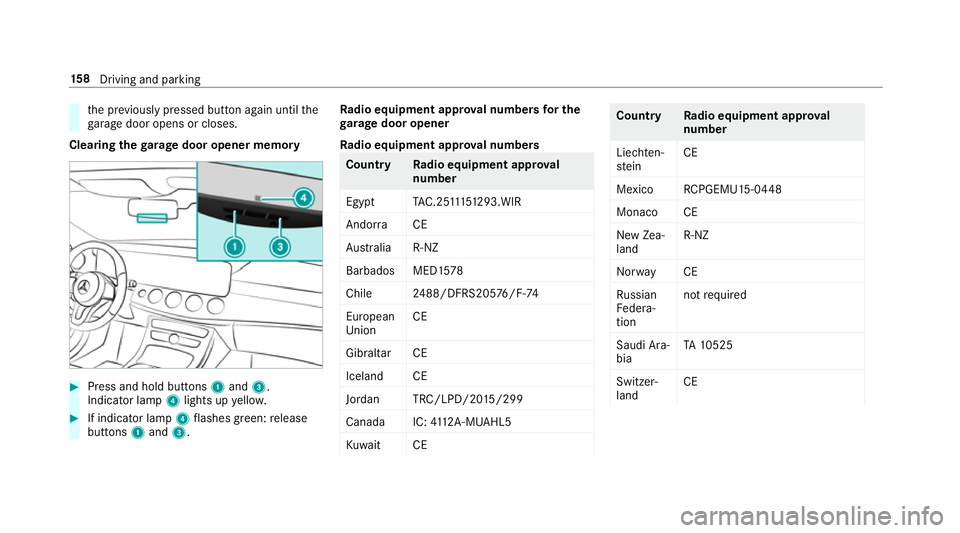
Clearing theg arag edooro pene rmemo ry #
Press and hold buttons 1and 3.
Indicator lamp 4lights up yello w. #
If indicator lamp 4flashes green: release
buttons 1and 3. Ra
dio equipment appr oval number sfor the
ga rage doo ropener
Ra dio equipment appr oval numbers Countr
yRadio equipment appr oval
number
Egyp tT AC.25 111 51293.WIR
Andor ra CE
Au stra lia R-NZ
Barbados MED1 578
Chile 2488/DFRS205 76/F-74
European
Union CE
Gibral tarCE
Iceland CE
Jordan TRC/LPD/20 15/299
Canad aI C:4112 A-MUAHL5
Ku wa it CE Count
ryRadio equipment appr oval
number
Liechten‐
st ein CE
Mexico RCPGEMU15-0448
Monaco CE
Ne wZ ea‐
land R-
NZ
Nor wayCE
Ru ssian
Fe dera‐
tion no
trequired
Saudi Ara‐
bia TA
10525
Switzer‐
land CE 15 8
Driving and pa rking
Page 163 of 521
function is activated via
theM ercedes
me connect weba pp. The elect
ricp arkin gb rake is applied if thet rans‐
mission is in position jand one of thef ollow‐
ing condition sisfulfilled:
R The engin eisswitched off.
R The seat belt tongu eisn otinser tedint he
seat belt buckle of thed rive r's seat and the
driver's door is opened.
% Toprev ent application: pull theh andle of the
electric parking brake.
In thef ollowing situations, thee lectric parking
brak eisa lso engaged:
R The ActiveD ista nce Assi stant DI STRO NIC is
bringing thev ehicle toas tandstill.
R The HOL Dfunction is keeping thev ehicle sta‐
tionar y.
R ActiveP arking Assis tiskeeping thev ehicle
st ationar y. This is onl
ythe case if one of thef ollowing con‐
ditions is also fulfilled:
R The engine is switched off.
R The seat belt tongu eisn otinser tedint he
seat belt buckle of thed rive r's seat and the
driver's door is opened.
R Ther eisas ystemm alfunction.
R The po wersupply is insuf ficient.
R The vehicle is stationar yfor alengt hyperiod.
When thee lectric parking brak eisapplied,
the ! indicator lam plights up in thei nstru‐
ment clus ter.
The electric parking brak eisnotautomatically
applied if thee ngine is switched of fbythe ECO
st art/ stop function.
Fu nction of thee lectric pa rking brake
(releasing automatically)
The elect ricp arkin gb rake isreleased when the
fo llowing condition sarefulfilled:
R The engin eisrunning.
R Thes eatb eltt ongue is inser tedi ntot he seat
belt buckle of thed rive r's seat. R
The transmission is in position hork and
yo ud epress thea ccelera torp eda lory ou
shif tfromt ransmission position jtoh or
k.
R Ifth et ransmission is in position k,the boot
lid mus tbeclosed.
If th es eat belt tongu eisn otinser tedi ntot he
seat belt buckle of thed rive r's seat, thef ollow‐
ing condition smustbef ulfilled:
R The driver's door is closed.
R Youm ovet he transmission out of transmis‐
sion position joryouh ave prev iously
driven fasterthan 3k m/ h.
R Ifth et ransmission is in position k,the boot
lid mus tbeclosed.
If th ee lectric parking brak eisreleased,
the ! indicator lam pinthe instrument clus‐
te rg oes out. 16 0
Driving and pa rking
Page 166 of 521
Ac
tivatin gordeactivatin gstandb ymode
Multimedi asystem:
, Vehicle .
î Vehicle set-
tings .
Standby mode #
Activate Oor deacti vate ª thef unction.
When youa ctivat ethe function,ap rompt
appears. #
Select Yes.
St andb ymode is activated. Driving and driving saf
etys ystems Driving sy
stems and your responsibility Yo
ur vehicle is equipped wit hdriving sy stems
whic hassis tyou in driving, parking and manoeu‐
vring thev ehicle. The driving sy stems ar etools
and do no trelie veyouofy ourresponsibility .Pay
attention tothet raffic condition satall times
and inter vene when necessa ry.Bea wareofthe
limitation sregarding thes afeu se of these sys‐
te ms. Fu
nction of ther adar senso rs Some driving and driving sa
fety sy stems use
ra dar sensor stomonitor thea reainf ront of,
behind or next tothev ehicle (depending on the
ve hicle's equipment).
Depending on thev ehicle's equipment, ther adar
senso rsarei ntegrated behind theb umpers
and/or behind ther adiator grille. Keep these
parts free of dirt, ice and slush (→ page360).
The sensor smustn otbe co vered, fore xamp le
by bicycle rack s, ove rhanging loads or radar-
re flecting sticke rs.F ollowing an impact and in
th ee vent of associated dama ge,w hic hm aynot
be visible, totheb umper sorradiator grille, ha ve
th ef unction of ther adar senso rscheckedata
qu alified specialis tworks hop. The driver assis‐
ta nce sy stem ma ynolonger workproperly. Overvie
wofdriving sy stems and driving
saf etys ystems In
this section, youw illfind informatio nabout
th ef ollowing driving sy stems and driving saf ety
sy stems:
R 360° Camer a(→pag e199)
R ABS ( Anti-lock BrakingSystem)
(→ pag e166)
R ActiveD ista nce Assi stDISTRONIC
(→ page 178)
R Adaptiv ebrake light s(→pag e174 )
R AIR BOD YCONTROL (→ page191 )
R ActiveB rake Assi st (→pag e169)
R ActiveL aneK eeping Assis t(→pag e217 )
R ATTENTION ASSIS T(→ pag e208)
R BAS(Bra ke Assist System) (→ page166)
R EBD ( Electronic Brakeforce Distribution)
(→ pag e169)
R ESP ®
(Electronic Stability Program)
(→ pag e167 )
R Hill StartA ssist Drivin
gand parking 16 3
Page 167 of 521
R
HOLD functio n(→ page 190)
R STEER CONTROL (→ page 169)
R ActiveS teering Assis t(→ pag e184)
R Limi ter( →pag e175)
R Nigh tViewA ssist ( →pag e212 )
R ActiveP arking Assis t(→ pag e202)
R Parking Assis tPARKTRONIC (→ page 194)
R Reversing camer a(→pag e197)
R Cruis econtrol (→ page 174)
R Blind Spo tAssis tand ActiveB lind Spo tAssist
( → pag e214 )
R Traf ficS ign Assi st (→pag e209) Fu
nctions of ABS (anti-loc kbraking sy stem) AB
Sr egulates theb rake pressur eincritical driv‐
ing situations:
R During braking, e.g. at maximum full-s top
braking or insuf ficient traction of thet yres,
th ew heels ar epreve nted from blocking.
R Vehicle steerability while braking is ensured. If ABS inter
venes when braking, youw illfeel a
pulsing in theb rake pedal. The pulsating brake
pedal can be an indication of hazardous road
condition sand can ser veas areminder totake
ex trac arew hile driving.
Sy stem limitations
R ABSisa ctivefroms peeds of appr ox.
8k m/h.
R ABS ma ybeimpaire dorm aynotfunction if a
malfunction has occur reda nd they el‐
low ! ABSwarning lam plight supc ontin‐
uousl yinthe instrument clus tera fter the
engine is star ted. Fu
nction of BAS(Brak eAssis tSystem) &
WARNING Risk of an accident caused by
am alfunctio ninBAS (Brak eAssistSys‐
te m)
If BA Sism alfunctioning ,the braking dis tance
in an eme rgency braking situation is
increased. #
Depress theb rake pedal wit hfull force
in emer gency braking situations. ABS
pr eve nts thew heels from locking. BA
Ss uppo rtsy our emer gency braking situation
wit ha dditional brak eforce.
If yo ud epress theb rake pedal quickl y,BA Sis
acti vated:
R BASa utomatically boosts theb rake pres‐
sure.
R BASc an sho rten theb raking dis tance.
R ABS pr events thew heels from locking.
The brakes will function as usual oncey ou
re lease theb rake pedal. BASisd eactivated. 16 4
Driving and pa rking
Page 168 of 521
Fu
nctions of ESP ®
(Electronic Stability Pro‐
gr am) &
WARNING Risk of skidding if ESP ®
is
malfunctioning
If ESP ®
is malfunctioning ,ESP ®
canno tcarry
out vehicle stabilisation .Inaddition ,other
driving saf etys ystems ar eswitched off. #
Driv eonc arefull y. #
Have ESP ®
ch eckedataq ualified spe‐
cialis tworks hop. &
WARNING Risk of skidding if ESP ®
is
deactivated
If yo ud eactivat eESP®
,E SP ®
canno tcarry
out vehicle stabilisation. #
ESP ®
shoul donly be deacti vatedint he
fo llowing situations. Mercedes‑AM
Gvehicles: observethen otes in
th eS upplement .Otherwise, youm ayfailto rec‐
ognise dangers. ESP
®
can moni tora nd impr ovedriving stability
and traction in thef ollowing situations, within
ph ysical limits:
R When pulling away on wetors lipper ycarria‐
ge wa ys.
R When braking.
R Instro ng sidewinds when youa redriving
fast erthan 80 km/h.
If th ev ehicle deviates from thed irection desired
by thed rive r,ESP ®
can stabilise thev ehicle by
inter vening in thef ollowing ways:
R One or mor ewheels ar ebrake d.
R The engine output is adap teda ccording to
th es ituation.
ESP ®
is deactivated if theE SP®
OFF å warn‐
ing lam plight supc ontinuousl yinthe instrument
clus ter:
R Driving stabilit ywill no lon gerbei mprove d.
R Crosswind Assis tisnolonger active.
R The driv ewheels could spin.
R ETS/4ET Straction control is still active. %
When ESP ®
is deactivated, youa restill assis‐
te dbyE SP®
when braking.
ESP ®
is inter vening if theE SP®
÷ warning
lam pflashes in thei nstrument clus ter:
R Do no tdeacti vate ESP ®
.
R Only depress thea ccelera torp eda lasf ar as
is necessar y.
R Adapty our driving styletos uitthec urrent
ro ad and weather conditions.
Deactivat eESP®
in thef ollowing situations to
impr ovetraction:
R When using sno wchains.
R In deep sno w.
R On sand or gr avel.
% Spinning thew heels results in acutting
action whic hprovide sbette rg rip.
If th eE SP®
÷ warning lam plight supc ontinu‐
ousl y,ESP ®
is no tavailable due toam alfunction.
Obse rvet he following information:
R Warning and indicator lamps (→ page464) Drivin
gand parking 16 5
Page 170 of 521
Ac
tivating/deactivatin gESP®
(Electronic Sta‐
bility Prog ram) Multimedia sy
stem:
, Vehicle .
k Assistance .
ESP
Mercedes‑AMG vehicles: observet he no tesin
th eS upplement .Otherwise, youm ayfailto rec‐
ognise dangers. #
Activate Oor deacti vate ª thef unction.
ESP ®
is deactivated if theå ESP®
OFF warn‐
ing lam plight supc ontinuousl yinthe instrument
clus ter.
Obser vethei nformation on warning lamps and
displa ymessages whic hmaybe shown in the
instrumen tclus ter. Fu
nctions of ESP ®
Crosswind Assist ESP
®
Crosswind Assis tdetects sudden gusts of
side wind and helps thed rive rtok eepthev ehi‐
cle in thel ane:
R ESP ®
Crosswind Assis tisactiveatv ehicle
speeds between 80 km/h and 200 km/h when driving
stra ight ahead or cornering
slight ly.
R The vehicle is stabilise dbym eans of individ‐
ualb rake application on one side. Fu
nction of EBD (Electronic Brak eforce Dis‐
tribution) EB
Disc haracterised bythef ollowing:
R Monitoring and regulating theb rake pressure
on ther ear wheels.
R Impr oveddriving stabilit ywhen braking,
especiall yonb ends. ST
EER CONT ROLfunction ST
EER CONTROL help syou bytransmitting a
noticeable steering forc etot hesteering wheel in
th ed irection requiredforv ehicle stabilisation.
This steering recommendation is given pa rticu‐
lar lyin thef ollowing situations:
R Both right wheels or bo thleftw heels ar eon
aw etor slippe ryroad sur face whe nyou
brake. R
The vehicle starts toskid.
Sy stem limitations
ST EER CONTROL ma ybeimpaire dorm aynot
functio ninthefollowing situations:
R ESP ®
is deactivated.
R ESP ®
is malfunctioning.
R The steering is malfunctioning.
If ESP ®
is malfunctioning, youw ill be assis ted
fur ther by thee lectric po wersteering. Fu
nction of Activ eB rake Assi st Ac
tiveB rake Assi stconsi stso f:
R Distance warning function
R Autonomous braking function
R Situation-dependent braking assi stance
R Vehicles with Drivin gAssistanc ePack‐
age: Evasi veSteering Assist
Ac tiveB rake Assi stcan hel pyou tominimis ethe
ri sk of acollision wit hvehicles or pedestrians or
to reduce thee ffects of suc hacollision. Drivin
gand parking 167
Page 171 of 521
If
Ac tiveB rake Assi sthas de tected arisk of colli‐
sion ,you will be warned visuall yand acousti‐
cally.
If yo udon otreact tothev isual or acoustic warn‐
ing, autonomous brakin gcan be initiated in criti‐
cal situations.
In especially critical situations ,Activ eBrake
Assi stcan initia teautonomous brakin gdirect ly.
In this case, thev isual and acoustic warning
occur ssimultaneousl ywitht he braking applica‐
tion.
If yo ua ppl ythe brak eyourself in acritical situa‐
tio nora pplythe brak eduring autonomous brak‐
ing, situation-dependen tbraking assis tance
occu rs.T he brak epressur eincreases up tomax‐
imum full-s topb raking if necessar y.
If th ea utonomous braking function or thes itua‐
tion-dependen tbraking assis tance is trig gered,
additional pr eventiv em easu resf or occup ant
pr otection (PRE-SAFE ®
)m ayalso be initiated, if
th ev ehicle is equipped wit hthese. &
WARNING Risk of an accident caused by
limited de tection per form anc eofA ctive
Brak eAssist
Ac tiveB rake Assi stcanno talway sc lear ly
identify object sand comple xtraf fics itua‐
tions.
In su chcases, ActiveB rake Assi stmight:
R Giveaw arning or brak ewithout reason
R Notgiveaw arning or no tbrake #
Alw aysp aycareful attention tothet raf‐
fi cs ituation; do no trely on ActiveB rake
Assi stalone. ActiveB rake Assi stis only
an aid. The driver is responsible for
maintaining asuita ble dis tance tothe
ve hicle in front, vehicle speed and for
braking in good time. #
Be prepared tobrak eors werveifn ec‐
essar y. Als
oo bserve thes ysteml imitations of Active
Brak eAssist.
The individua lsubfunctions ar eavailable in
th ef ollowing speed ranges:
Distance warning function
The dis tance warning function issues awarning
at speeds:
R From appr oximatel y30k m/h, if overseveral
seconds thed ista nce maintained tothev ehi‐
cle tra velling in front is insuf ficient fort he
driving speed. The ·distance warning
lam pthen lights up in thei nstrument clus ter.
R From appr oximatel y7km/h, if your vehicle
is criticall yclose toav ehicle or pedestrian.
An intermittent warning tone sounds and the
· distance warning lam plight supint he
instrument clus ter.
Brak eimmediately or take evasiv eaction ,provi‐
ded it is saf etodosoa ndthet raffic situation
allo wsthis. 16 8
Driving and pa rking
Page 174 of 521
R
Can assis tduring swervin gand stra ightening
of thev ehicle.
R Can react from aspee dofa pproximately
20 km/h up toas pee dofa pproximately
70 km/h.
Yo uc an pr eventthea ssis tance at an ytime by
activel ysteering. &
WARNING Risk of an accident despi te
Evasiv eSteering Assist
Evasiv eSteering Assis tcann otalw aysc learly
identify objects and comple xtraffic situa‐
tions.
In addition ,the steering suppor tofEvasive
St eering Assis tisgenerallyn otsufficien tto
av oid acollision.
In suc hcases Evasiv eSteering Assis tcan:
R giveanu nnecessar ywarning or pr ovide
assis tance
R notg iveaw arning or no tprovide assis‐
ta nce #
Alw aysp aycareful attention tothet raf‐
fi cs ituation; do no trely on Evasive
St eering Assis talone. #
Beready tobrak eand take evasive
action ,ifnecessar y. #
Preve ntthea ssis tance byactivel ysteer‐
ing in non-critical driving situations. #
Driv eatana ppropriat espeed if pedes‐
trians ar eclose tothep athofy ourvehi‐
cle. Also obser
vethes ysteml imitations of Evasive
St eering Assist.
Sy stem limitations
The sy stem ma ybeimpaired or ma ynotfunction
in thef ollowing situations:
R In sno w,rain, fog, heavy spr ay,ift hereis
gl are, in direct sunlight or in greatlyvarying
light conditions.
R Ifth es ensor saredirty ,miste du p, damaged
or co vered. R
Ifth es ensor smalfunction due to otherradar
source inter fere nce, fore xamp lestro ng radar
re flections in multi-s toreyc ar par ks.
R Ifal oss of tyr epressur eorad efectivetyre
has been de tected and displ ayed.
The sy stem ma ynotreact cor rectly:
R In compl extraf fics ituations whe reobjects
cannot alwaysbec learly identified.
R Topedestrians or vehicles if they mo ve
qu ickl yintot he sensor de tection range.
R Topedestrians who ar ehidden by other
objects.
R Ifth et ypical outline of apedestrian cann ot
be distinguished from theb ackg round.
R Ifap edestrian is no trecognised as such, e.g.
due tospecial clo thing or other objects.
R On bends wit hatightradius. Driving and parking
171
Page 175 of 521
Setting
Activ eB rake Assi st Multimedia sy
stem:
, Vehicle .
k Assistance .
Active
Brak eAssist
Ve hicles without Drivin gAssistanc epack‐
age: The settings can be made af ters tarti ngthe
ve hicle.
Ve hicles with Drivin gAssistanc epacka ge:
The setting scan be made when thei gnition is
switched on.
% It is recommended that youa lway sl ea ve
Ac tiveB rake Assi stswitched on.
Select one of thef ollowing settings: #
Early :your selection is retained when the
ve hicle is next star ted. #
Medium :your selection is retained when the
ve hicle is next star ted. #
Late:y our selection is retained when the
ve hicle is next star ted. #
Off:
The dis tance warning function and thea uton‐
omous braking function ar edeactivated. Ve
hicles without Drivin gAssistanc epack‐
age: when thev ehicle is next star ted, the
mediu msetting is auto matically selected.
Ve hicles with Drivin gAssistanc epack‐
age: Evasi veSteering Assis tisnotavailable.
When thei gnition is next star ted, them iddle
setting is selected automaticall yand Evasive
St eering Assis tisavailable.
% When ActiveB rake Assi stis deactivated, the
æ symbol appears inthea ssis tance
graphi cinthe multifunction displa y. Ad
aptiv eBrake Lights function Ad
aptiv eBrake Lights warnfollowing traf ficinan
emergency braking situation:
R Byflashin gbrake lamps
R By activatin gthe hazard warning lights
If th ev ehicle is braked sharpl yfroms peeds
abo ve50 km/h, theb rake lamps flash rapidly.
This pr ovides traf fict rave lling behin dyou wit han
eve nm oren oticeable warning. If
th ev ehicle is tra velling at speeds of mor ethan
70 km/h at theb eginnin gofthe brak eapplica‐
tion ,the hazar dwarning light sswitc hono nce
th ev ehicle is stationar y.When pulling away
again, theh azar dwarning light sswitc hoffauto‐
maticall yatapproximatel y10k m/h .You can
also switc hofftheh azar dwarning light susing
th eh azar dwarning button. Cruise control and limiter
Fu
nction of cruise control
Cruise cont rola ccelerates and brakes thev ehi‐
cle automaticall yinorder tomaintain aprevi‐
ous lystored speed.
If yo ua ccelerat etoovertake, fore xamp le,the
st ored speed is no tdele ted. If your emo veyour
fo ot from thea ccelerator pedal af tero vertaking,
cruise control will resume speed regulation back
to thes tore ds peed.
Cruise contro lisoperated using thec orrespond‐
ing steering wheel buttons. Youc an stor ea ny
ro ad spee dabove 20 km/h.
If yo uf ail toadap tyour driving style, cruise con‐
trol can neither reduce ther isk of an accident 17 2
Driving and pa rking
Page 176 of 521
nor
override thel aws of ph ysics. It canno ttake
int oa ccount road, weather or traf ficc onditions.
Cruise control is only an aid. Youa re re sponsible
fo rt he dis tance tothev ehicle in front, forv ehi‐
cle speed, forb raking in good time and fors tay‐
ing in lane.
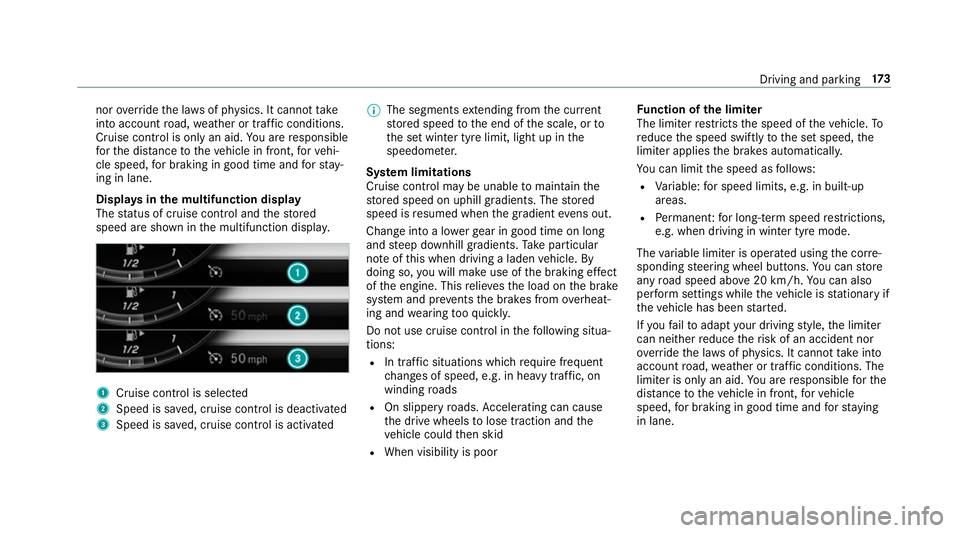
Displa ysinthem ultifunction display
The status of cruise control and thes tored
speed ar eshown in them ultifunction displa y. 1
Cruise cont roliss elected
2 Spee diss aved, cruise control is deactivated
3 Speed is sa ved, cruise control is activated %
The segments extending from thec urrent
st ored speed tothee nd of thes cale, or to
th es etwinter tyr elimit, light up in the
speedome ter.
Sy stem limitations
Cruise control ma ybeunable tomaintain the
st ored speed on uphill gradients. The stored
speed is resumed when theg radient evens out.
Chang eintoal owergear in good time on long
and steep downhill gradients. Take particular
no te ofthis when drivin galaden vehicle. By
doing so, youw ill mak euse of theb raking ef fect
of thee ngine. This relie vest he load on theb rake
sy stem and pr events theb rake sf romo verheat‐
ing and wearing tooq uickl y.
Do no tuse cruise control in thef ollowing situa‐
tions:
R In traf fics ituations whi chrequ iref requ ent
ch anges of speed, e.g .inheavy traf fic, on
winding roads
R On slippe ryroads. Accelerating can cause
th ed rive wheels tolose traction and the
ve hicle could then skid
R When visibility is poor Fu
nction of thel imiter
The limiter restricts thes peed of thev ehicle. To
re duce thes peed swiftl ytothe se tspeed, the
limiter applies theb rake sa utomatically.
Yo uc an limit thes peed as follo ws:
R Variable: fors pee dlimits, e.g. in built-up
areas.
R Perm anen t:forl ong-ter mspee drestrictions,
e.g .whend riving in winter tyr emode.
The variable limiter is operated usin gthe cor re‐
sponding steering wheel buttons. Youc an store
an yr oad speed abo ve20 km/h. Youc an also
per form settings while thev ehicle is stationar yif
th ev ehicle has been star ted.
If yo uf ail toadap tyour driving style, thel imiter
can neither reduce ther isk of an accident nor
ov erride thel aw sofp hysics. It canno ttak ei nto
account road, weather or traf ficc onditions .The
limiter is only an aid. Youa re re sponsible fort he
dis tance tothev ehicle in front, forv ehicle
speed, forb raking in good time and fors taying
in lane. Drivin
gand parking 17 3