ECU MERCEDES-BENZ SL CLASS 2019 User Guide
[x] Cancel search | Manufacturer: MERCEDES-BENZ, Model Year: 2019, Model line: SL CLASS, Model: MERCEDES-BENZ SL CLASS 2019Pages: 330, PDF Size: 16.53 MB
Page 60 of 330

Installing a child restraint system:
XMake sure you observe the child restraintsystem manufacturer's installation instruc-tions.
XPull the seat belt smoothly out of the seatbelt guide.
XEngage seat belt tongue in belt buckle.
Activating the special seat belt retractor:
XPull the seat belt out fully and let the inertiareel retract it again.While the seat belt is retracting, you shouldhear a ratcheting sound. The special seatbelt retractor is enabled.
XPush the child restraint system down so thatthe seat belt is tight and does not loosen.
Removing the child restraint system and deac-tivating the special seat belt retractor:
XMake sure you observe the child restraintsystem manufacturer's installation instruc-tions.
XPress the release button of the seat beltbuckle and route the seat belt tongue backtowards the seat belt guide.The special seat belt retractor is deactiva-ted.
child restraint system
The use of seat belts and child restraint sys-tems is required by law in:
Rall 50 states
Rthe U.S. territories
Rthe District of Columbia
Rall Canadian provinces
You can obtain further information about thecorrect child restraint system from any author-ized Mercedes-Benz Center.
GWARNING
If the child restraint system is installed
incorrectly on a suitable seat, it cannot pro-
tect as intended. The child cannot then be
restrained in the event of an accident, heavy
braking or sudden changes of direction.
There is an increased risk of injury, possibly
even fatal.
Make sure that you observe the child
restraint system manufacturer's installation
instructions and the notes on use. Please
ensure, that the base of the child restraint
system is always resting completely on the
seat cushion. Never place objects, e.g. cush-
ions, under or behind the child restraint sys-
tem. Only use child restraint systems with
the original cover designed for them. Only
replace damaged covers with genuine cov-
ers.
GWARNING
If the child restraint system is installed
incorrectly or is not secured, it can come
loose in the event of an accident, heavy
braking or a sudden change in direction. The
child restraint system could be thrown
about, striking vehicle occupants. There is
an increased risk of injury, possibly even
fatal.
Always install child restraint systems prop-
erly, even if they are not being used. Make
sure that you observe the child restraint sys-
tem manufacturer's installation instructions.
Further information on stowing objects, lug-gage and loads securely can be found under“Stowing options/stowage compartments”(Ypage 249).
GWARNING
Child restraint systems or their securing sys-
tems which have been damaged or subjec-
ted to a load in an accident can no longer
protect as intended. The child cannot then
be restrained in the event of an accident,
heavy braking or sudden changes of direc-
tion. There is an increased risk of injury,
possibly even fatal.
Replace child restraint systems which have
been damaged or subjected to a load in an
accident as soon as possible. Have the
securing systems on the child restraint sys-
tem checked at a qualified specialist work-
shop, before you install a child restraint sys-
tem again.
The securing system of child restraint systemsis the seat belt system.
58Children in the vehicle
Safety
Page 61 of 330

If you install a child restraint system on thefront passenger seat, be sure to observe theinstructions and safety notes on the "Occu-pant Classification System (OCS)" (Ypage 48).There you will also find information on disa-bling the front passenger front air bag.
All child restraint systems must meet the fol-lowing standards:
RU.S. Federal Motor Vehicle Safety Standards213 and 225
RCanadian Motor Vehicle Safety Standards213 and 210.2
Confirmation that the child restraint systemcorresponds to the standards can be found onan instruction label on the child restraint sys-tem. This confirmation can also be found inthe installation instructions that are includedwith the child restraint system.
Observe the warning labels in the vehicle inte-rior and on the child restraint system.
Child restraint system on the front-
passenger seat
General notes
If you install a child restraint system on thefront-passenger seat, always observe theinstructions and safety notes on the "Occu-pant Classification System (OCS)" (Ypage 48).
You can thus avoid the risks that could ariseas a result of:
Ran incorrectly categorized person in thefront-passenger seat
Rdeactivating the front passenger front airbag unintentionally
Rthe unsuitable positioning of the childrestraint system, e.g. too close to the dash-board
Rearward-facing child restraint system
If circumstances require you to secure a childin a rearward-facing child restraint system onthe front-passenger seat, always make surethat the front passenger front air bag is deacti-vated. Only if the PASSENGER AIR BAG OFFindicator lamp is lit continuously (Ypage 41),is the front passenger front air bag deactiva-ted.
Always observe the child restraint systemmanufacturer's installation and operatinginstructions.
Forward-facing child restraint system
If you secure a child in a forward-facing childrestraint system on the front-passenger seat,always move the front-passenger seat as farback as possible. Fully retract the seat cushionlength. The entire base of the child restraintsystem must always rest on the seat cushionof the front-passenger seat. The backrest ofthe child restraint system must lie as flat aspossible against the backrest of the front-passenger seat. The child restraint systemmust not touch the roof or be subjected to aload by the head restraint. Adjust the angle ofthe seat backrest and the head restraint posi-tion accordingly. Always make sure that theshoulder belt strap is correctly routed from thefront-passenger seat belt guide to the shoulderbelt guide on the child restraint system. Theshoulder belt strap must be routed forwardand down from the front-passenger seat beltguide. If necessary, adjust the front-passengerseat accordingly.
Always observe the child restraint systemmanufacturer's installation and operatinginstructions.
Pets in the vehicle
GWARNING
If you leave animals unsupervised or unse-
cured in the vehicle, they may press buttons
or switches, for instance.
In this way, animals may:
Ractivate vehicle equipment and become
trapped, for example
Rswitch systems on or off and thereby
endanger other road users
Furthermore, unsecured animals may be
flung around inside the vehicle in the event
of an accident or abrupt steering or braking
maneuver, and thereby injure vehicle occu-
pants. There is a risk of accident and injury.
Never leave animals unattended in the vehi-
cle.
Pets in the vehicle59
Safety
Z
Page 62 of 330

Always secure animals properly when driv-
ing, for instance with a suitable pet carrier.
Driving safety systems
Overview of driving safety systems
In this section, you will find information aboutthe following driving safety systems:
RABS (Anti-lockBrakingSystem)(Ypage 60)
RBAS (BrakeAssistSystem) (Ypage 61)
RBrake Assist with cross-traffic function(Ypage 61)
RActive Brake Assist (Ypage 63)
RAdaptive brake lights (Ypage 65)
RESP®(ElectronicStabilityProgram)(Ypage 65)
REBD (ElectronicBrake forceDistribution)(Ypage 69)
RADAPTIVE BRAKE (Ypage 70)
RActive Brake Assist with cross-traffic func-tion (Ypage 70)
RSTEER CONTROL (Ypage 72)
Important safety notes
If you fail to adapt your driving style or if youare inattentive, the driving safety systems canneither reduce the risk of an accident noroverride the laws of physics. Driving safetysystems are merely aids designed to assistdriving.
You are responsible for maintaining the dis-tance to the vehicle in front, for vehicle speed,for braking in good time, and for staying inlane. Always adapt your driving style to suitthe prevailing road and weather conditions andmaintain a safe distance from the vehicle infront. Drive carefully.
The driving safety systems described onlywork as effectively as possible when there isadequate contact between the tires and theroad surface. Pay particular attention to theinformation regarding tires, recommendedminimum tire tread depths etc. in the "Wheelsand tires" section (Ypage 293).
In wintry driving conditions, always use wintertires (M+S tires) and if necessary, snow
chains. Only in this way will the driving safetysystems described in this section work aseffectively as possible.
ABS (Anti-lock Braking System)
General information
ABS regulates brake pressure in such a waythat the wheels do not lock when you brake.This allows you to continue steering the vehi-cle when braking.
The%ABS warning lamp in the instrumentcluster lights up when the ignition is switchedon. It goes out when the engine is running.
ABS works from a speed of about 5 mph(8 km/h), regardless of road-surface condi-tions. ABS works on slippery surfaces, evenwhen you only brake gently.
Important safety notes
iObserve the "Important safety notes" sec-tion (Ypage 60).
GWARNING
If ABS is malfunctioning, the wheels could
lock when braking. The steerability and
braking characteristics would be severely
affected. There is an increased danger of
skidding and accidents.
Drive on carefully. Have ABS checked imme-
diately at a qualified specialist workshop.
When ABS is malfunctioning, other systems,including driving safety systems, will alsobecome inoperative. Observe the informationon the ABS warning lamp (Ypage 236) anddisplay messages which may be shown in theinstrument cluster (Ypage 206).
Brakes
XIf ABS intervenes:continue to depress thebrake pedal vigorously until the braking sit-uation is over.
XTo make a full brake application:depressthe brake pedal with full force.
If ABS intervenes when braking, you will feel apulsing in the brake pedal.
60Driving safety systems
Safety
Page 83 of 330
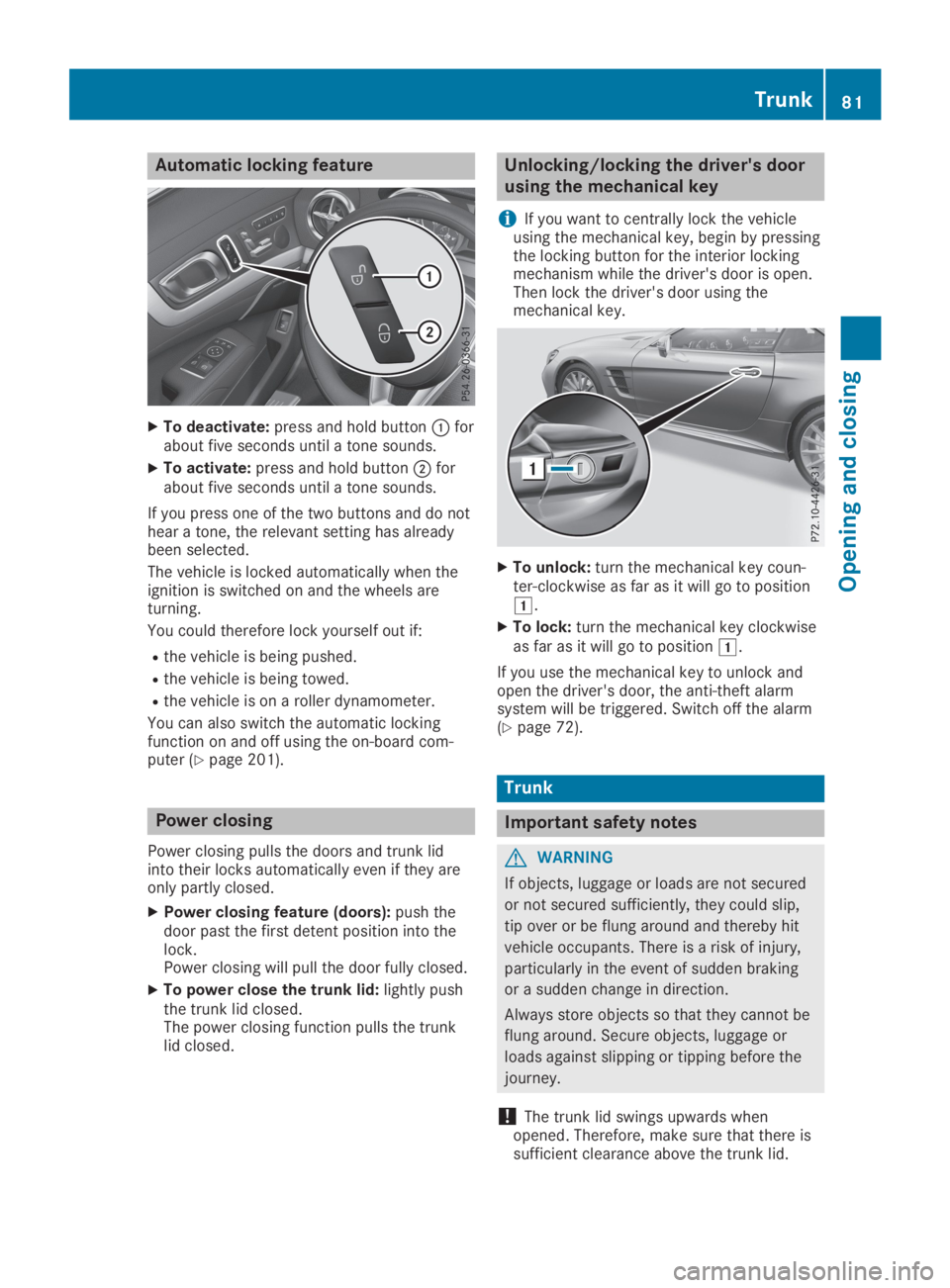
Automatic locking feature
XTo deactivate:press and hold buttonCforabout five seconds until a tone sounds.
XTo activate:press and hold buttonDforabout five seconds until a tone sounds.
If you press one of the two buttons and do nothear a tone, the relevant setting has alreadybeen selected.
The vehicle is locked automatically when theignition is switched on and the wheels areturning.
You could therefore lock yourself out if:
Rthe vehicle is being pushed.
Rthe vehicle is being towed.
Rthe vehicle is on a roller dynamometer.
You can also switch the automatic lockingfunction on and off using the on-board com-puter (Ypage 201).
Power closing
Power closing pulls the doors and trunk lidinto their locks automatically even if they areonly partly closed.
XPower closing feature (doors):push thedoor past the first detent position into thelock.Power closing will pull the door fully closed.
XTo power close the trunk lid:lightly pushthe trunk lid closed.The power closing function pulls the trunklid closed.
Unlocking/locking the driver's door
using the mechanical key
iIf you want to centrally lock the vehicleusing the mechanical key, begin by pressingthe locking button for the interior lockingmechanism while the driver's door is open.Then lock the driver's door using themechanical key.
XTo unlock:turn the mechanical key coun-ter-clockwise as far as it will go to positionG.
XTo lock:turn the mechanical key clockwiseas far as it will go to positionG.
If you use the mechanical key to unlock andopen the driver's door, the anti-theft alarmsystem will be triggered. Switch off the alarm(Ypage 72).
Trunk
Important safety notes
GWARNING
If objects, luggage or loads are not secured
or not secured sufficiently, they could slip,
tip over or be flung around and thereby hit
vehicle occupants. There is a risk of injury,
particularly in the event of sudden braking
or a sudden change in direction.
Always store objects so that they cannot be
flung around. Secure objects, luggage or
loads against slipping or tipping before the
journey.
!The trunk lid swings upwards whenopened. Therefore, make sure that there issufficient clearance above the trunk lid.
Trunk81
Opening and closing
Z
Page 100 of 330
The seats can still be adjusted when there isno SmartKey in the ignition lock.
GWARNING
When you adjust a seat, you or other vehicle
occupants could become trapped, e.g. on
the seat guide rail. There is a risk of injury.
When adjusting a seat, make sure that no
one has any body parts in the sweep of the
seat.
GWARNING
If the driver's seat is not engaged, it could
move forwards as far as the next catch dur-
ing movement such as braking or abrupt
changes of direction. As a result, you would
be pushed against your seat belt by the
unsecured driver's seat.
This could cause you to lose control of the
vehicle. The seat belt cannot protect as
intended and could result in additional
injury.
There is a risk of an accident and injury.
Before every journey, make sure that the
driver's seat is fully engaged.
Observe the safety notes on "Air bags"(Ypage 45) and "Children in the vehicle"(Ypage 57).
GWARNING
If you adjust the seat height carelessly, you
or other vehicle occupants could be trapped
and thereby injured. Children in particular
could accidentally press the electrical seat
adjustment buttons and become trapped.
There is a risk of injury.
While moving the seats, make sure that your
hands or other body parts do not get under
the lever assembly of the seat adjustment
system.
GWARNING
If the head restraints are not installed or not
adjusted correctly, they cannot provide pro-
tection as intended. There is an increased
risk of injury in the head and neck area, e.g.
in the event of an accident or when braking.
Always drive with the head restraints instal-
led. Before driving off, make sure for every
vehicle occupant that the center of the head
restraint supports the back of the head at
about eye level.
GWARNING
You could lose control of your vehicle if you
do the following while driving:
Radjust the driver's seat, head restraint,
steering wheel or mirrors
Rfasten the seat belt
There is a risk of an accident.
Adjust the driver's seat, head restraint,
steering wheel and mirror and fasten your
seat belt before starting the engine.
!To prevent damage to the seats and theseat heating, observe the following notes:
RDo not spill liquids onto the seats. Dry theseats as soon as possible if liquid doesget spilled on the seats.
RIf the seat covers are damp or wet, do notswitch on the seat heating. Also, do notuse the seat heating to dry the seats.
RClean the seat covers as recommended;see the "Interior care" section.
RDo not transport heavy loads on theseats. Do not place pointed objects onthe seat cushions such as knives, nails ortools. Where possible, use the seats onlyfor carrying passengers.
RWhen operating the seat heating, do notcover the seats with insulating materials,e.g. blankets, coats, bags, protective cov-ers, child seats or booster seats.
RWhen the seat heating is switched on, theseat surface can be damaged as a resultof objects being placed on the seats, forexample, seat cushions, child seats andprotective covers not approved byMercedes-Benz.
!Make sure that there are no objects in thefootwell under or behind the seats whenmoving the seats back. There is a risk thatthe seats and/or the objects could be dam-aged.
iThe head restraints cannot be removed.
98Seats
Seats, steering wheel and mirrors
Page 106 of 330
If somebody becomes trapped:
Rpress one of the memory function posi-
tion buttons, or
Rmove the switch for steering wheel
adjustment in the opposite direction to
that in which the steering wheel is mov-
ing.
The adjustment process is stopped.
GWARNING
When the EASY-ENTRY/EXIT feature adjusts
the steering wheel and the driver's seat, you
and other vehicle occupants – particularly
children – could become trapped. There is a
risk of injury.
While the EASY-ENTRY/EXIT feature is mak-
ing adjustments, make sure that no one has
any body parts in the sweep of the seat and
the steering wheel.
If somebody becomes trapped:
Rpress one of the memory function posi-
tion buttons, or
Rpress one of the memory function mem-
ory buttons, or
Rmove the switch for steering wheel
adjustment in the opposite direction to
that in which the steering wheel is moving
The adjustment process is stopped.
GWARNING
If you use openings in the bodywork or
detachable parts as steps, you could:
Rslip and/or fall
Rdamage the vehicle and cause yourself to
fall.
There is a risk of injury.
Always use secure climbing aids, e.g. a suit-
able ladder.
The EASY-ENTRY/EXIT feature makes gettingin and out of your vehicle easier.
You can activate and deactivate the EASY-ENTRY/EXIT feature in the on-board computer(Ypage 201).
Position of the steering wheel when
the EASY-ENTRY/EXIT feature is active
The steering wheel swings up when you:
Rremove the SmartKey from the ignition lock
Ropen the driver's door with KEYLESS-GO inposition1
Ropen the driver's door and the SmartKey isin position
Page 131 of 330
![MERCEDES-BENZ SL CLASS 2019 User Guide It is only possible to shift the transmissionfrom position]to the desired position if youdepress the brake pedal. Only then is the shiftlock released.
iUpshifts take place at higher enginespeeds afte](/img/4/59125/w960_59125-130.png "MERCEDES-BENZ SL CLASS 2019 User Guide It is only possible to shift the transmissionfrom position]to the desired position if youdepress the brake pedal. Only then is the shiftlock released.
iUpshifts take place at higher enginespeeds afte")
It is only possible to shift the transmissionfrom position]to the desired position if youdepress the brake pedal. Only then is the shiftlock released.
iUpshifts take place at higher enginespeeds after a cold start. This helps the cat-alytic converter to reach its operating tem-perature more quickly.
Information on the automatic release of theelectric parking brake (Ypage 148).
Hill start assist
Hill start assist helps you when pulling awayforward or in reverse on an uphill gradient. Itholds the vehicle for a short time after youhave removed your foot from the brake pedal.This gives you enough time to move your footfrom the brake pedal to the accelerator pedaland to depress it before the vehicle begins toroll.
GWARNING
After a short time, hill start assist will no lon-
ger brake your vehicle and it could roll away.
There is a risk of an accident and injury.
Therefore, quickly move your foot from the
brake pedal to the accelerator pedal. Never
leave the vehicle when it is held by hill start
assist.
Hill start assist is not active if:
Ryou are pulling away on a level road or on adownhill gradient
Rthe transmission is in position\\
Rthe electric parking brake is applied
RESP®is malfunctioning
ECO start/stop function
Introduction
The ECO start/stop function switches theengine off automatically if the vehicle is stop-ped under certain conditions.
The engine starts automatically when thedriver wants to pull away again. The ECOstart/stop function thereby helps you toreduce the fuel consumption and emissions ofyour vehicle.
Important safety notes
GWARNING
If the engine is switched off automatically
and you exit the vehicle, the engine is
restarted automatically. The vehicle may
begin moving. There is a risk of accident and
injury.
If you wish to exit the vehicle, always turn
off the ignition and secure the vehicle
against rolling away.
General notes
CECO start/stop display
The ECO start/stop function is activatedwhenever you switch on the engine using theSmartKey or the Start/Stop button.
If the engine has been switched off automati-cally by the ECO start/stop function, the
Page 132 of 330
Rthe system detects that the windshield isnot fogged up when the air-conditioning sys-tem is switched on
Rthe hood is closed
Rthe driver's door is closed and the driver'sseat belt is fastened
All of the vehicle's systems remain activewhen the engine is stopped automatically.
All vehicles (except Mercedes-AMG vehi-cles):automatic engine switch-off can takeplace a maximum of four times in a row (initialstop, then three subsequent stops).
Mercedes-AMG vehicles:the number of con-secutive automatic engine switch-offs isunlimited.
The HOLD function can be activated if theengine has been switched off automatically. Itis then not necessary to continue applying thebrakes during the automatic stop phase. Whenyou depress the accelerator pedal, the enginestarts automatically and the braking effect ofthe HOLD function is deactivated.
Automatic engine start
The engine starts automatically if:
Ryou switch off the ECO start/stop functionby pressing the ECO button
Rin transmission position[or\\, the brakepedal is released and the HOLD function isnot active
Ryou depress the accelerator pedal
Ryou engage reverse gear^
Ryou move the transmission out of position]
Ryou switch to drive programS+
Ryou switch to drive programSorM(Mercedes-AMG vehicles)
Ryou unfasten your seat belt or open the driv-er's door
Rthe vehicle starts to roll
Rthe brake system requires this
Rthe temperature in the vehicle interior devi-ates from the set range
Rthe system detects moisture on the wind-shield when the air-conditioning system isswitched on
Rthe battery's condition of charge is too low
Shifting the transmission to position]doesnot start the engine.
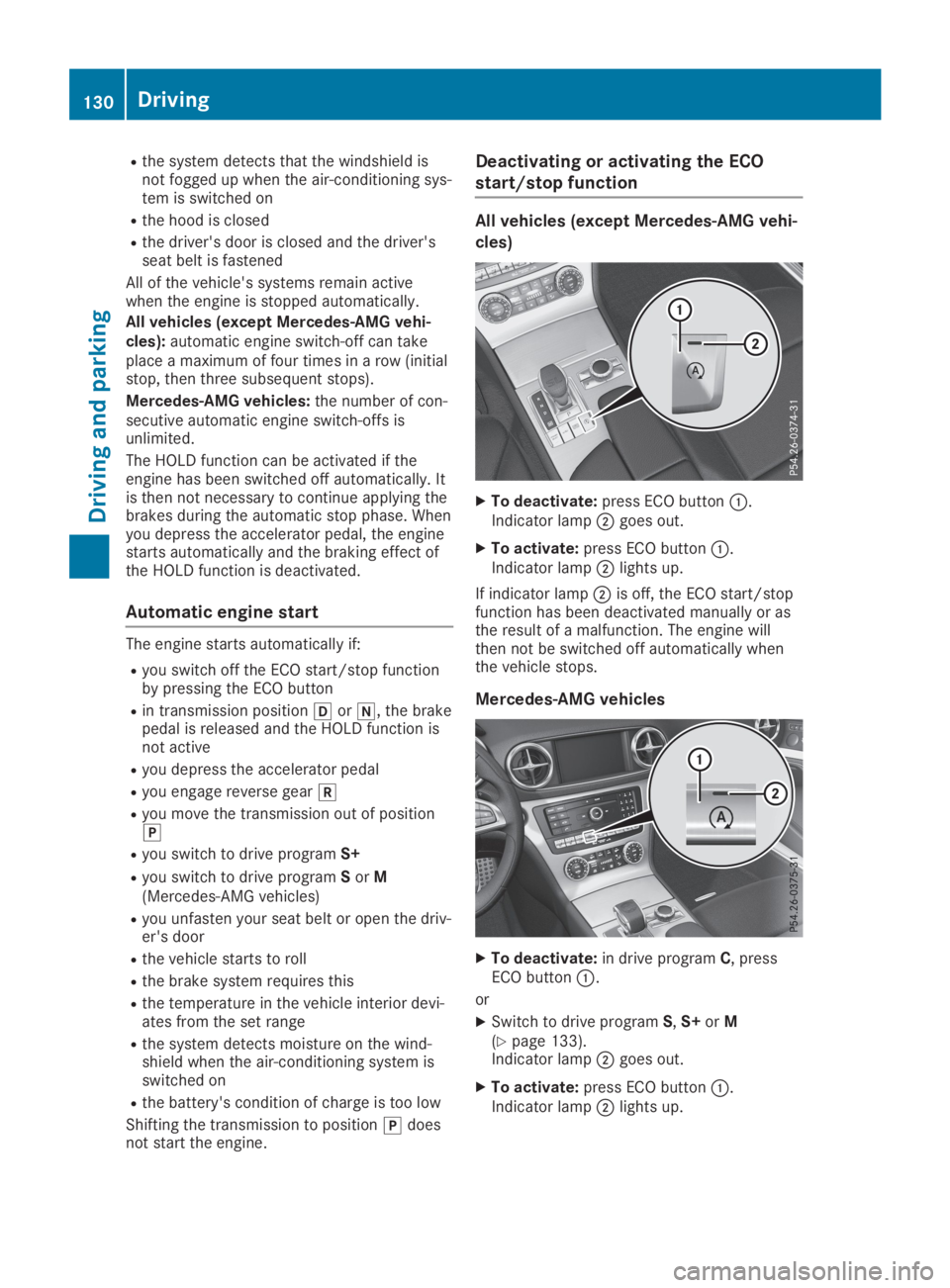
Deactivating or activating the ECO
start/stop function
All vehicles (except Mercedes-AMG vehi-
cles)
XTo deactivate:press ECO buttonC.Indicator lampDgoes out.
XTo activate:press ECO buttonC.Indicator lampDlights up.
If indicator lampDis off, the ECO start/stopfunction has been deactivated manually or asthe result of a malfunction. The engine willthen not be switched off automatically whenthe vehicle stops.
Mercedes-AMG vehicles
XTo deactivate:in drive programC, pressECO buttonC.
or
XSwitch to drive programS,S+orM(Ypage 133).Indicator lampDgoes out.
XTo activate:press ECO buttonC.Indicator lampDlights up.
130Driving
Driving an d parking
Page 139 of 330
![MERCEDES-BENZ SL CLASS 2019 User Guide With the SmartKey:if you then open the driv-er's door or the front-passenger door orremove the SmartKey from the ignition, theautomatic transmission shifts to]automati-cally.
With KEYLESS-GO:if y](/img/4/59125/w960_59125-138.png "MERCEDES-BENZ SL CLASS 2019 User Guide With the SmartKey:if you then open the driv-er's door or the front-passenger door orremove the SmartKey from the ignition, theautomatic transmission shifts to]automati-cally.
With KEYLESS-GO:if y")
With the SmartKey:if you then open the driv-er's door or the front-passenger door orremove the SmartKey from the ignition, theautomatic transmission shifts to]automati-cally.
With KEYLESS-GO:if you then open the driv-er's or front-passenger door, the automatictransmission shifts to]automatically.
If you want the automatic transmission toremain in neutral\\, e.g. when having thevehicle cleaned in an automatic car wash witha towing system:
XVehicles with KEYLESS-GO:remove theStart/Stop button from the ignition lock.
XInsert the SmartKey into the ignition lock.
XAll vehicles:switch the ignition on.
XDepress the brake pedal and keep itdepressed.
XShift to neutral\\.
XRelease the brake pedal.
XRelease the electric parking brake.
XSwitch off the ignition and leave the Smart-Key in the ignition lock.
Engaging drive position D
XWhen the vehicle is stationary, depress thebrake pedal.
XPush the selector lever back past the firstpoint of resistance.
Transmission positions
EPark position
This prevents the vehicle from roll-ing away when stopped.
Only shift the transmission intopositionE(Ypage 134) whenthe vehicle is stationary. The park-ing lock should not be used as abrake when parking. Always applythe electronic parking brake in addi-tion to the parking lock in order tosecure the vehicle.
If the SmartKey is removed from theignition lock, the transmission islocked.
The automatic transmission shiftstoEautomatically:
Rwhen the SmartKey is removedfrom the ignition lock
Rwhen the engine is switched offwith the transmission in positionFor:and one of thedoors is opened
In the event of a malfunction of thevehicle's electronics, the transmis-sion may lock in positionE.Have the vehicle electronicschecked immediately at a qualifiedspecialist workshop.
FReverse gear
Only shift the transmission intopositionFwhen the vehicle isstationary.
Automatic transmission137
Driving and parking
Z
Page 141 of 330
Rthe steering exhibits sporty steering charac-teristics.
RESP®provides the optimum compromisebetween traction and stability. Further infor-
mation about ESP®(Ypage 66).
Drive program S+ (Sport Plus)
Drive programS+is characterized by the fol-lowing:
Rthe vehicle exhibits particularly sporty driv-ing characteristics.
Rthe vehicle pulls away in first gear.
Rthe automatic transmission shifts up later.The fuel consumption possibly being higheras a result of the later automatic transmis-sion shift points.
Rthe suspension exhibits particularly firmdamping settings (vehicles with adaptivedamping system).
Rthe suspension exhibits firm damping set-tings (vehicles with Active Body Control).
Rthe steering exhibits sporty steering charac-teristics.
RESP®emphasizes the vehicle's own over-steering and understeering characteristics.This enables a more active driving style. Thisdrive program requires increased driver
interaction. Further information about ESP®
(Ypage 66).
iOnly select this drive program if the roadconditions are good, e.g. the road is dry andthe route ahead is clearly visible.
Drive program I (Individual)
In drive programIthe following properties ofthe drive program can be selected:
Rthe drive (engine and transmission manage-ment)
Rthe suspension
Rthe steering
Rthe control thresholds of ESP®
Information about configuring drive programIwith the multimedia system can be found inthe Digital Operator's Manual.
Vehicles with adaptive damping system:
drive program E (Economy)
Drive programEis characterized by the follow-ing:
Rthe vehicle exhibits comfortable, economicalhandling characteristics.
Rthe vehicle pulls away more gently inforward and reverse gears, unless the accel-erator pedal is depressed fully.
Roptimal fuel consumption resulting from theautomatic transmission shifting up sooner.The vehicle is driven in the low engine speedrange and the wheels are less likely to spin.
Rthe suspension exhibits comfortable damp-ing settings.
Rthe steering exhibits comfortable steeringcharacteristics.
Rduring deceleration, the engine is discon-nected from the drive train. The vehicle useskinetic energy and consumes less fuel(coasting mode).
RESP®provides the optimum compromisebetween traction and stability. Further infor-
mation about ESP®(Ypage 66).
Vehicles with Active Body Control:
CURVE drive program
TheCURVEdrive program is characterized bythe following:
Rincreased driving comfort on bends.
Rthe vehicle tilts actively into the bend. Fur-ther information on the curve tilting function(Ypage 169).
Rthe vehicle exhibits comfortable, economicalhandling characteristics.
Rthe vehicle pulls away more gently inforward and reverse gears, unless the accel-erator pedal is depressed fully.
Rcomfortable suspension setting.
Rthe steering exhibits comfortable steeringcharacteristics.
Roptimal fuel consumption resulting from theautomatic transmission shifting up sooner.
Rthe automatic transmission shifting upsooner. This results in the vehicle beingdriven at lower engine speeds and thewheels being less likely to spin.
Rduring deceleration, the engine is discon-nected from the drive train. The vehicle uses
Automatic transmission139
Driving an d parking
Z