lock MERCEDES-BENZ SL CLASS 2019 Owner's Manual
[x] Cancel search | Manufacturer: MERCEDES-BENZ, Model Year: 2019, Model line: SL CLASS, Model: MERCEDES-BENZ SL CLASS 2019Pages: 330, PDF Size: 16.53 MB
Page 63 of 330

The pulsating brake pedal can be an indicationof hazardous road conditions, and functions asa reminder to take extra care while driving.
BAS (Brake Assist System)
General information
BAS operates in emergency braking situations.If you depress the brake pedal quickly, BASautomatically boosts the braking force, thusshortening the stopping distance.
Important safety notes
iObserve the "Important safety notes" sec-tion (Ypage 60).
GWARNING
If BAS is malfunctioning, the braking dis-
tance in an emergency braking situation is
increased. There is a risk of an accident.
In an emergency braking situation, depress
the brake pedal with full force. ABS prevents
the wheels from locking.
Braking
XKeep the brake pedal firmly depressed untilthe emergency braking situation is over.ABS prevents the wheels from locking.
The brakes will function as usual once yourelease the brake pedal. BAS is deactivated.
Brake Assist with cross-traffic func-
tion
General information
Brake Assist with cross-traffic function canhelp you to minimize the risk of a collision witha vehicle or a pedestrian and reduce theeffects of such a collision. If Brake Assist withcross-traffic function detects a danger of colli-sion, you are assisted when braking.
iObserve the "Important safety notes" sec-tion (Ypage 60).
Brake Assist with cross-traffic function is onlyavailable in vehicles with the Driving Assis-tance package.
For Brake Assist with cross-traffic function toassist you when driving, the radar sensor sys-tem and the camera system must be opera-tional.
The sensor system and camera system helpBrake Assist with cross-traffic function detectobstacles:
Rthat are in the path of your vehicle for anextended period of time
Rthat cross the path of your vehicle
In addition, pedestrians in the path of yourvehicle can be detected.
Brake Assist with cross-traffic function detectspedestrians using typical characteristics suchas body contours and the posture of a personstanding upright.
If the radar sensor system or the camera sys-tem is malfunctioning, Brake Assist with cross-traffic function is restricted or no longer availa-ble. The brake system is still available withcomplete brake boosting effect and BAS.
iObserve the restrictions described in the"Important safety notes" section(Ypage 61).
Important safety notes
GWARNING
Active Brake Assist with cross-traffic func-
tion cannot always clearly identify objects
and complex traffic situations.
In such cases, Active Brake Assist with
cross-traffic function might:
Rissue an unnecessary warning or brake
Rissue no warning or not brake
Always pay careful attention to the traffic
situation; do not rely on the Active Brake
Assist with cross-traffic function alone.
Always be ready to brake and possibly take
evasive action.
GWARNING
Brake Assist with cross-traffic function can-
not always clearly identify people, particu-
larly if they are moving. Brake Assist with
cross-traffic function cannot intervene in
these cases. There is a risk of an accident.
Driving safety systems61
Safety
Z
Page 65 of 330

Up to a speed of approximately 44 mph(70 km/h), Brake Assist with cross-trafficfunction may react to:
Rstationary objects in the path of your vehi-cle, e.g. stopped or parked vehicles
Rpedestrians in the path of your vehicle
Robstacles crossing your path which move inthe detection range of the sensors and aredetected
iIf Brake Assist with cross-traffic functionrequires a particularly high braking force,preventative passenger protection measures
(PRE-SAFE®) are activated at the same time(Ypage 55).
XKeep the brake pedal depressed until theemergency braking situation is over.ABS prevents the wheels from locking.
Brake Assist with cross-traffic function isdeactivated and the brakes function as usualagain if:
Ryou release the brake pedal
Rthere is no longer a risk of collision
Rno obstacle is detected in front of your vehi-cle
Ryou depress the accelerator pedal
Ryou activate kickdown
Active Brake Assist
General information
iObserve the "Important safety notes" sec-tion (Ypage 60).
Active Brake Assist consists of a distancewarning function with an autonomous brakingfunction and Adaptive Brake Assist.
Active Brake Assist can help you to minimizethe risk of a collision with the vehicle in frontor reduce the effects of such a collision.
If Active Brake Assist detects that there is arisk of collision, you will be warned visuallyand acoustically. If you do not react to the vis-ual collision warning or the warning tone,autonomous braking can be initiated in criticalsituations. If you apply the brake yourself in acritical situation, Adaptive Brake Assist of theActive Brake Assist system supports you.
Important safety notes
In particular, the detection of obstacles can beimpaired if:
Rthere is dirt on the sensors or anything elsecovering the sensors
Rthere is snow or heavy rain
Rthere is interference by other radar sources
Rthere are strong radar reflections, for exam-ple in parking garages
Ra narrow vehicle is traveling in front, e.g. amotorbike
Ra vehicle is traveling in front on a differentline
Ryou are driving a new vehicle or servicing onthe Active Brake Assist system has justbeen carried out
Observe the important safety notes in the"Breaking-in notes" section (Ypage 125).
Following damage to the front end of the vehi-cle, have the configuration and operation ofthe radar sensor checked at a qualified spe-cialist workshop. This also applies to collisionsat slow speeds where there is no visible dam-age to the front of the vehicle.
Activating/deactivating
Active Brake Assist is automatically activeafter switching on the ignition.
You can activate or deactivate Active BrakeAssist using the on-board computer(Ypage 198). When deactivated, the distancewarning function and the autonomous brakingfunction are also deactivated.
If Active Brake Assist is deactivated, the
Page 67 of 330

Adaptive Brake Assist provides braking assis-tance in hazardous situations at speeds above4 mph (7 km/h). It uses radar sensor technol-ogy to assess the traffic situation.
Up to a speed of approximately 155 mph(250 km/h), Adaptive Brake Assist is capableof reacting to moving objects that havealready been detected as such at least onceover the period of observation.
Up to a speed of approximately 44 mph(70 km/h), Adaptive Brake Assist reacts tostationary obstacles.
If Adaptive Brake Assist demands particularlyhigh braking force, preventative passenger
protection measures (PRE-SAFE®) are activa-ted simultaneously (Ypage 55).
XKeep the brake pedal depressed until theemergency braking situation is over.ABS prevents the wheels from locking.
The brakes will work normally again if:
Ryou release the brake pedal
Rthere is no longer any danger of a collision
Rno obstacle is detected in front of your vehi-cle
Adaptive Brake Assist is then deactivated.
Important safety notes
GWARNING
Adaptive Brake Assist cannot always clearly
identify objects and complex traffic situa-
tions.
In such cases, Adaptive Brake Assist can:
Rintervene unnecessarily
Rnot intervene
There is a risk of an accident.
Always pay careful attention to the traffic
situation and be ready to brake. Terminate
the intervention in a non-critical driving sit-
uation.
GWARNING
Adaptive Brake Assist does not react:
Rto people or animals
Rto oncoming vehicles
Rto crossing traffic
Rwhen cornering
As a result, the Adaptive Brake Assist may
not intervene in all critical conditions. There
is a risk of an accident.
Always pay careful attention to the traffic
situation and be ready to brake.
Always adapt your speed to suit the prevail-
ing road and traffic conditions.
Due to the nature of the system, particularlycomplicated but non-critical driving conditionsmay also cause Adaptive Brake Assist to inter-vene.
If Adaptive Brake Assist is not available due toa malfunction in the radar sensor system, thebrake system remains available with full brakeboosting effect and BAS.
Adaptive brake lights
iObserve the "Important safety notes" sec-tion (Ypage 60).
If you brake sharply from a speed of more than50 km/h or if braking is assisted by BAS orBrake Assist with Cross-Traffic Assist, thebrake lamps flash rapidly. In this way, traffictraveling behind you is warned in an evenmore noticeable manner.
If you brake sharply from a speed of more than70 km/h to a standstill, the hazard warninglamps are activated automatically. If thebrakes are applied again, the brake lamps lightup continuously. The hazard warning lampsswitch off automatically if you travel fasterthan 10 km/h. You can also switch off thehazard warning lamps using the hazard warn-ing button (Ypage 111).
ESP®(Electronic Stability Program)
General notes
iObserve the "Important safety notes" sec-tion (Ypage 60).
ESP®monitors driving stability and traction,i.e. power transmission between the tires andthe road surface.
If ESP®detects that the vehicle is deviatingfrom the direction desired by the driver, one ormore wheels are braked to stabilize the vehi-cle. The engine output is also modified to keep
Driving safety systems65
Safety
Z
Page 74 of 330
Up to a speed of approximately 44 mph(70 km/h), Active Brake Assist with cross-traf-fic function may react to:
Rstationary objects in the path of your vehi-cle, e.g. stopped or parked vehicles
Rpedestrians in the path of your vehicle
iIf there is an increased risk of a collision,preventive passenger protection measures
(PRE-SAFE®) are triggered (Ypage 55).
If the risk of collision with the vehicle in frontremains and you do not brake, take evasiveaction or accelerate significantly, the vehiclemay perform automatic emergency braking, upto the point of full brake application. Auto-matic emergency braking is not performeduntil immediately prior to an imminent acci-dent.
You can prevent the intervention of ActiveBrake Assist with cross-traffic function at anytime by:
Rdepressing the accelerator pedal further
Ractivating kickdown
Rreleasing the brake pedal
The braking application of Active Brake Assistwith cross-traffic function is ended automati-cally if:
Ryou maneuver to avoid the obstacle
Rthere is no longer a risk of collision
Ran obstacle is no longer detected in front ofyour vehicle
STEER CONTROL
General information
STEER CONTROL helps you by transmitting anoticeable steering force to the steering wheelin the direction required for vehicle stabiliza-tion.
This steering assistance is provided in particu-lar if:
Rboth right wheels or both left wheels are ona wet or slippery road surface when youbrake
Rthe vehicle starts to skid
Important safety notes
iObserve the "Important safety notes" sec-tion (Ypage 60).
No steering support is provided from STEERCONTROL, if:
RESP®is deactivated
RESP®is malfunctioning
Rthe steering is faulty
If ESP®is malfunctioning, you will be assistedfurther by the electrical power steering.
Protection against theft
Immobilizer
XTo activate with the SmartKey:removethe SmartKey from the ignition lock.
XTo activate with KEYLESS-GO:switch theignition off and open the driver's door.
XTo deactivate:switch on the ignition.
The immobilizer prevents your vehicle frombeing started without the correct SmartKey.
When leaving the vehicle, always take theSmartKey with you and lock the vehicle. Theengine can be started by anyone with a validSmartKey that is left inside the vehicle.
iThe immobilizer is always deactivatedwhen you start the engine.
In the event that the engine cannot be star-ted (yet the vehicle's battery is charged),the system is not operational. Contact anauthorized Mercedes-Benz Center or call1-800-FOR-MERCedes (in the USA) or1-800-387-0100 (in Canada).
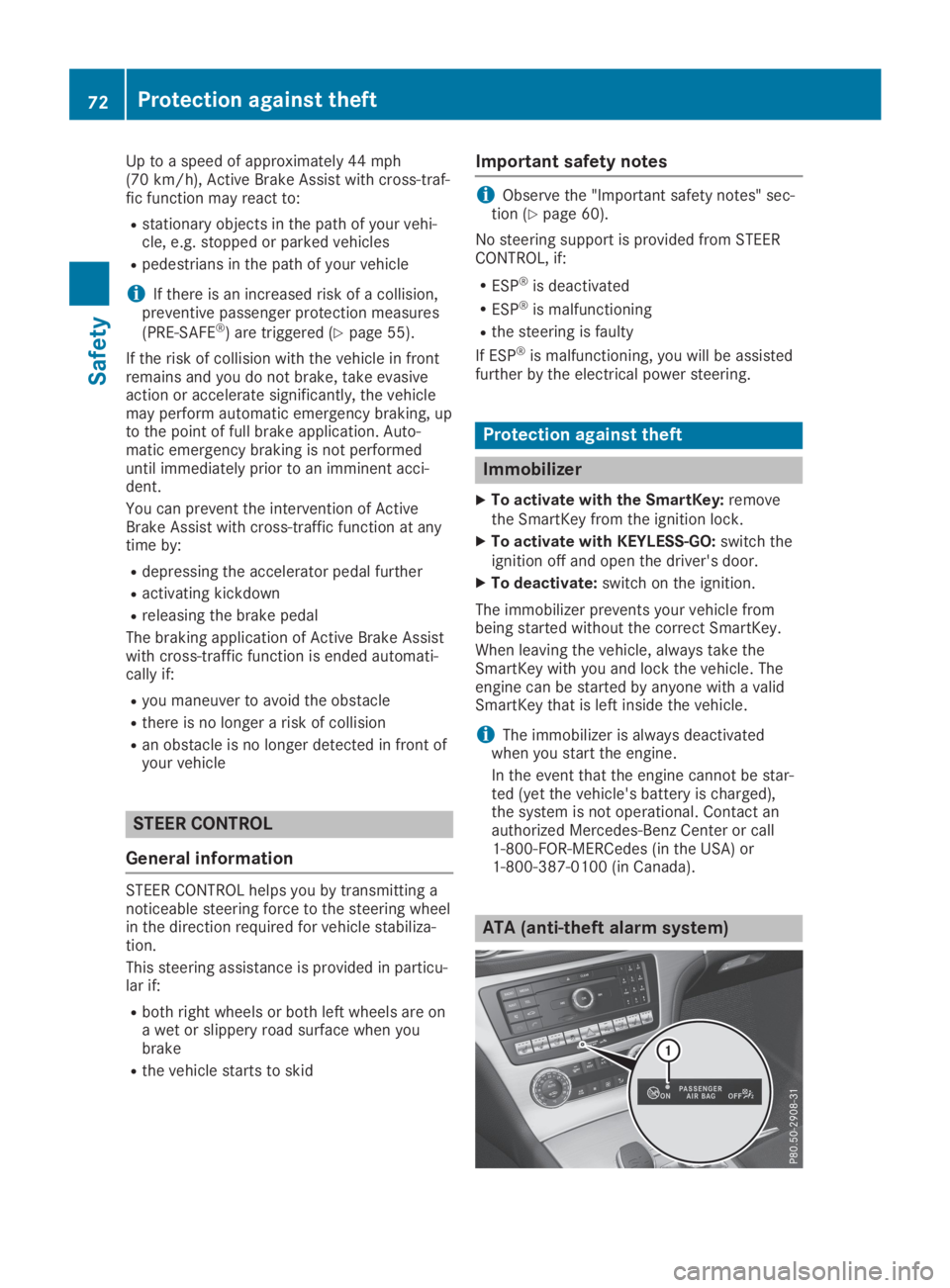
ATA (anti-theft alarm system)
72Protection against theft
Safety
Page 75 of 330
XTo arm:lock the vehicle with the SmartKeyor KEYLESS-GO.Indicator lampCflashes. The alarm systemis armed after approximately 15 seconds.
XTo switch off:unlock the vehicle with theSmartKey or KEYLESS-GO.
A visual and audible alarm is triggered if thealarm system is armed and you open:
Ra door
Rthe vehicle with the mechanical key
Rthe trunk lid
Rthe hood
Rthe glove compartment
Rthe stowage space under the armrest
Ra stowage compartment in the rearpassenger compartment
XTo stop the alarm with the SmartKey:press the6or7button on theSmartKey.The alarm is stopped.
or
XInsert the SmartKey into the ignition lock.The alarm is stopped.
XTo stop the alarm using KEYLESS-GO:grasp the outside door handle. The Smart-Key must be outside the vehicle.The alarm is stopped.
or
XPress the Start/Stop button on the dash-board. The SmartKey must be inside thevehicle.The alarm is stopped.
The alarm is not stopped, even if you close theopen door that triggered it, for example.
If the alarm stays on for more than30 seconds, the Mercedes me connectemergency call system automatically sendsa message to the Customer Center.
This is done either by text message or dataconnection. The emergency call systemsends the message or data provided that:
Ryou have subscribed to Mercedes meconnect
Rthe Mercedes me connect service hasbeen activated properly
Rthe necessary mobile phone network isavailable
Protection against theft73
Safety
Z
Page 76 of 330
SmartKey
Important safety notes
GWARNING
If children are left unsupervised in the vehi-
cle, they could:
Roperate the vehicle's equipment
Additionally, children could set the vehicle in
motion if, for example, they:
Rrelease the parking brake
Rshift the automatic transmission out of
park position]
Rstart the engine
There is a risk of an accident and injury.
Never leave children or animals unattended
in the vehicle.
When leaving the vehicle, always take the
SmartKey with you and lock the vehicle. This
also applies for the Digital Vehicle Key if the
"Digital Vehicle Key" function is activated via
Mercedes me connect.
GWARNING
If you attach heavy or large objects to the
SmartKey, the SmartKey could be uninten-
tionally turned in the ignition lock. This
could cause the engine to be switched off.
There is a risk of an accident.
Do not attach any heavy or large objects to
the SmartKey. Remove any bulky key rings
before inserting the SmartKey into the igni-
tion lock.
!Keep the SmartKey away from strong mag-netic fields. Otherwise, the remote controlfunction could be affected.
Strong magnetic fields can occur in thevicinity of powerful electrical installations.
Do not keep the SmartKey:
Rwith electronic devices, e.g. a mobile phoneor another SmartKey
Rwith metallic objects, e.g. coins or metal foil
Rinside metallic objects, e.g. a metal case
This can affect the functionality of theSmartKey.
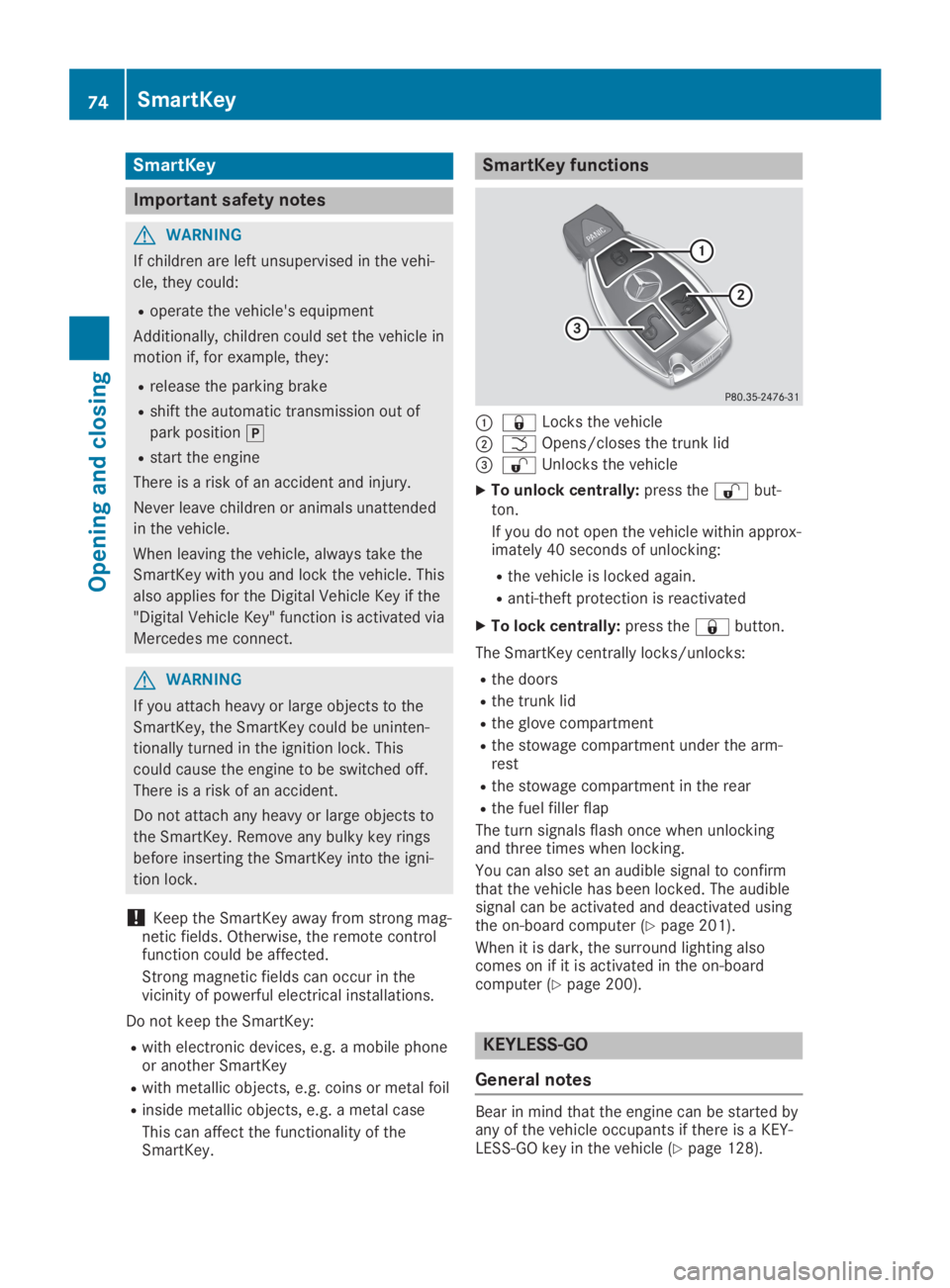
SmartKey functions
C7Locks the vehicle
DTOpens/closes the trunk lid
Page 77 of 330

Locking/unlocking centrally
You can start, lock or unlock the vehicle usingKEYLESS-GO. To do this, you only need carrythe SmartKey with you. You can combine thefunctions of KEYLESS-GO with those of a con-ventional SmartKey. Unlock the vehicle byusing KEYLESS-GO, for instance, and lock itusing the7button on the SmartKey.
The driver's door and the door at which thehandle is used, must both be closed. TheSmartKey must be outside the vehicle. Whenlocking or unlocking with KEYLESS-GO, thedistance between the key and the correspond-ing door handle must not be greater than 3 ft(1 m).
A check which periodically establishes a radioconnection between the vehicle and theSmartKey determines whether a valid Smart-Key is in the vehicle. This occurs, for example:
Rwhen starting the engine
Rwhile driving
Rwhen using HANDS-FREE ACCESS
Rwhen the external door handles are touched
XTo unlock the vehicle:touch the inner sur-face of the door handle.
XTo lock the vehicle:touch sensor sur-faceCorD.
Make sure that you do not touch the innersurface of the door handle.
XConvenience closing feature:touchrecessed sensor surfaceDfor an extendedperiod.
Further information on the convenienceclosing feature (Ypage 89).
Deactivating and activating
If you do not intend to use a SmartKey for anextended period of time, you can deactivatethe KEYLESS-GO function of the key. TheSmartKey will then use very little power,thereby conserving battery power. For the pur-poses of activation/deactivation, the vehiclemust not be nearby.
XTo deactivate:press the7button onthe SmartKey twice in rapid succession.The battery check lamp (Ypage 77) of theSmartKey flashes twice briefly and lights uponce, then KEYLESS-GO is deactivated.
XTo activate:press any button on the Smart-Key.
or
XInsert the SmartKey into the ignition lock.KEYLESS-GO and all of its associated fea-tures are available again.
Changing the settings of the locking
system
You can change the settings of the lockingsystem. This means only the driver's door, thelockable stowage compartments in the vehicleinterior and the fuel filler flap are unlockedwhen the vehicle is unlocked. This is useful ifyou frequently travel alone.
XTo change the setting:press and holddown the6and7buttons simultane-ously for about six seconds until the batteryindicator lamp (Ypage 77) flashes twice.
If the setting of the locking system is changedwithin the signal range of the vehicle, pressingthe7or6button:
Rlocks or
Runlocks the vehicle
The SmartKey now functions as follows:
XTo unlock:press the6button once.
XTo unlock centrally:press the6buttontwice.
XTo lock centrally:press the7button.
SmartKey75
Opening and closing
Z
Page 78 of 330

The KEYLESS-GO function is changed as fol-lows:
XTo unlock the driver's door:touch theinner surface of the door handle on the driv-er's door.
XTo unlock centrally:touch the inner sur-face of the driver or front-passenger doorhandle.
XTo lock centrally:touch the outer sensorsurface on one of the door handles.
XTo restore the factory settings:press andhold down the6and7buttonssimultaneously for approximately six sec-onds until the battery check lamp(Ypage 77) flashes twice.
Mechanical key
General notes
If the vehicle can no longer be locked orunlocked with the SmartKey or with KEYLESS-GO, use the mechanical key.
If you use the mechanical key to unlock andopen the driver's door or the trunk lid, theanti-theft alarm system will be triggered.Switch off the alarm (Ypage 72).
Removing the mechanical key
XPush release catchCin the direction of thearrow and at the same time removemechanical keyDfrom the SmartKey.
For further information about:
Runlocking the driver's door (Ypage 81)
Runlocking the trunk (Ypage 86)
Rlocking the vehicle (Ypage 81)
Inserting the mechanical key
XPush mechanical keyDcompletely into theSmartKey until it engages and releasecatchCis back in its basic position.
SmartKey battery
Important safety notes
GWARNING
Batteries contain toxic and corrosive sub-
stances. If batteries are swallowed, it can
result in severe health problems. There is a
risk of fatal injury.
Keep batteries out of the reach of children.
If a battery is swallowed, seek medical
attention immediately.
HEnvironmental note
Batteries contain pollutants.
It is illegal to dispose of
them with the household
rubbish. They must be col-
lected separately and dis-
posed of in an environmen-
tally responsible recycling
system.
Dispose of batteries in an
environmentally responsible
manner. Take discharged
batteries to a qualified spe-
cialist workshop or to a col-
lection point for used bat-
teries.
The SmartKey batteries contain perchloratematerial, which may require special handlingand regard for the environment. Nationalguidelines must be observed during disposal.In California, seewww.dtsc.ca.gov/HazardousWaste/Perchlorate/index.cfm.
Mercedes-Benz recommends that you havethe batteries replaced at a qualified specialistworkshop.
76SmartKey
Opening and closing
Page 79 of 330
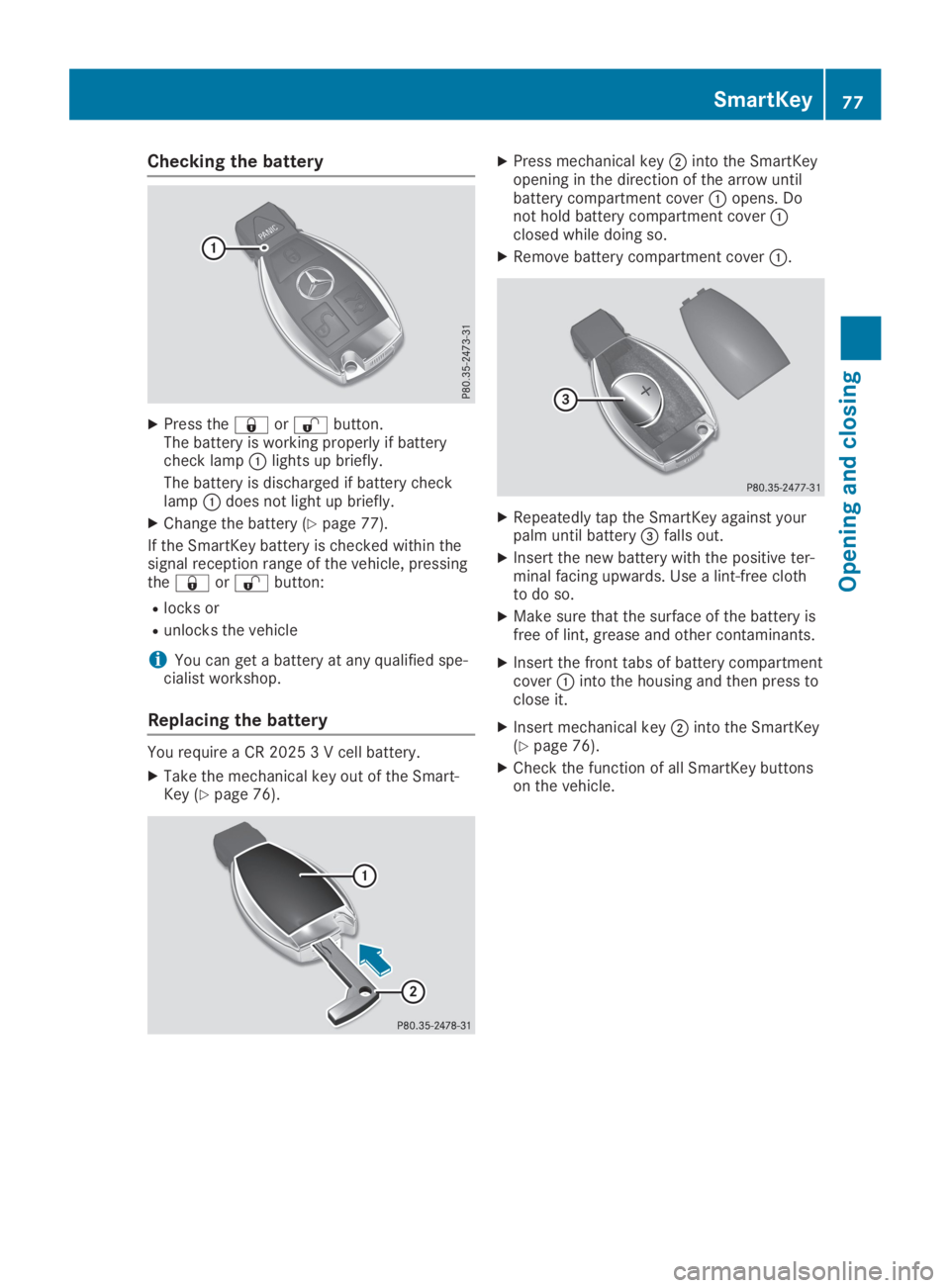
Checking the battery
XPress the7or6button.The battery is working properly if batterycheck lampClights up briefly.
The battery is discharged if battery checklampCdoes not light up briefly.
XChange the battery (Ypage 77).
If the SmartKey battery is checked within thesignal reception range of the vehicle, pressingthe7or6button:
Rlocks or
Runlocks the vehicle
iYou can get a battery at any qualified spe-cialist workshop.
Replacing the battery
You require a CR 2025 3 V cell battery.
XTake the mechanical key out of the Smart-Key (Ypage 76).
XPress mechanical keyDinto the SmartKeyopening in the direction of the arrow untilbattery compartment coverCopens. Donot hold battery compartment coverCclosed while doing so.
XRemove battery compartment coverC.
XRepeatedly tap the SmartKey against yourpalm until battery
Page 80 of 330
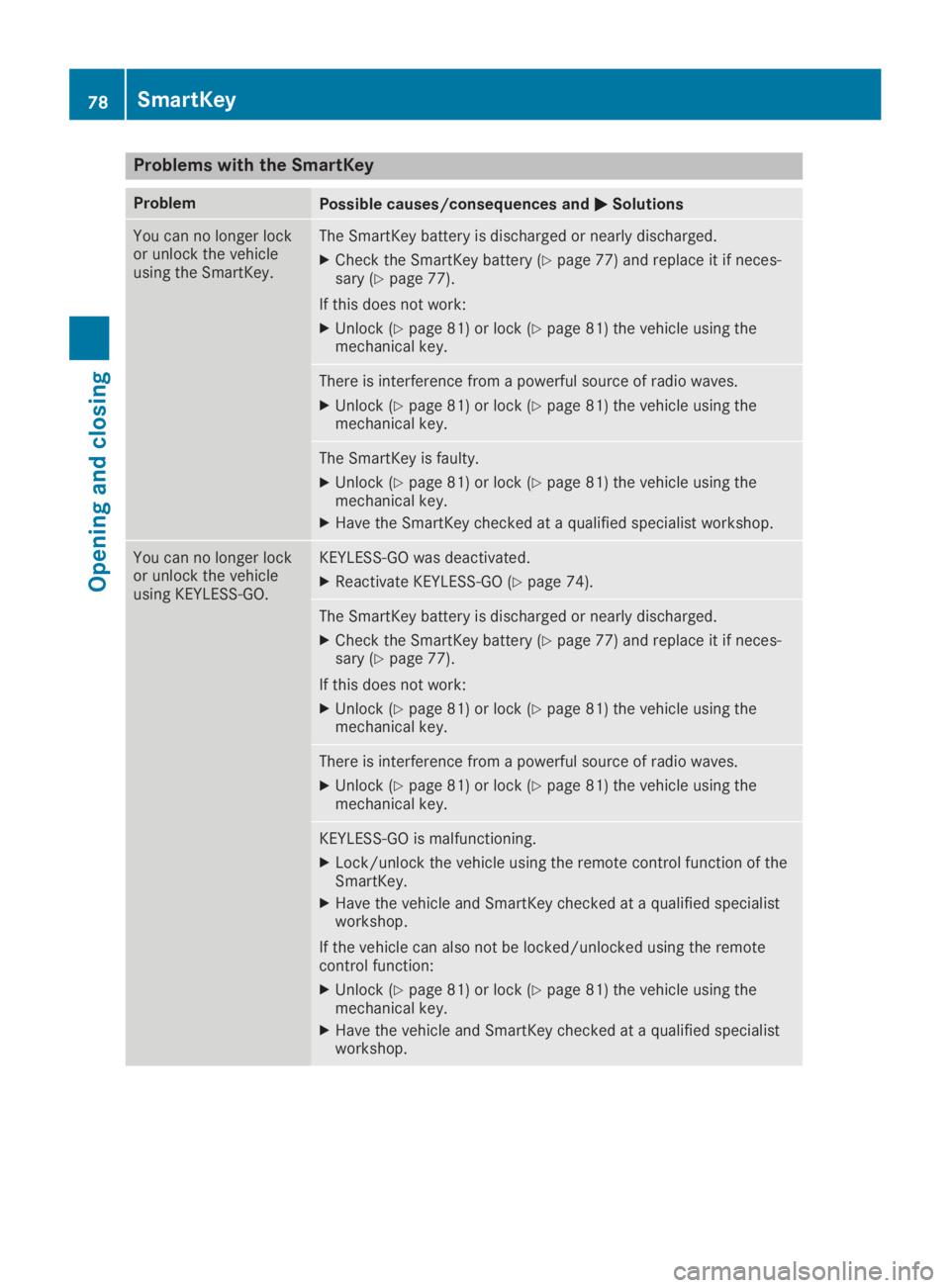
Problems with the SmartKey
ProblemPossible causes/consequences andPPSolutions
You can no longer lockor unlock the vehicleusing the SmartKey.
The SmartKey battery is discharged or nearly discharged.
XCheck the SmartKey battery (Ypage 77) and replace it if neces-sary (Ypage 77).
If this does not work:
XUnlock (Ypage 81) or lock (Ypage 81) the vehicle using themechanical key.
There is interference from a powerful source of radio waves.
XUnlock (Ypage 81) or lock (Ypage 81) the vehicle using themechanical key.
The SmartKey is faulty.
XUnlock (Ypage 81) or lock (Ypage 81) the vehicle using themechanical key.
XHave the SmartKey checked at a qualified specialist workshop.
You can no longer lockor unlock the vehicleusing KEYLESS-GO.
KEYLESS-GO was deactivated.
XReactivate KEYLESS-GO (Ypage 74).
The SmartKey battery is discharged or nearly discharged.
XCheck the SmartKey battery (Ypage 77) and replace it if neces-sary (Ypage 77).
If this does not work:
XUnlock (Ypage 81) or lock (Ypage 81) the vehicle using themechanical key.
There is interference from a powerful source of radio waves.
XUnlock (Ypage 81) or lock (Ypage 81) the vehicle using themechanical key.
KEYLESS-GO is malfunctioning.
XLock/unlock the vehicle using the remote control function of theSmartKey.
XHave the vehicle and SmartKey checked at a qualified specialistworkshop.
If the vehicle can also not be locked/unlocked using the remotecontrol function:
XUnlock (Ypage 81) or lock (Ypage 81) the vehicle using themechanical key.
XHave the vehicle and SmartKey checked at a qualified specialistworkshop.
78SmartKey
Opening and closing