wheel MERCEDES-BENZ SL CLASS 2020 User Guide
[x] Cancel search | Manufacturer: MERCEDES-BENZ, Model Year: 2020, Model line: SL CLASS, Model: MERCEDES-BENZ SL CLASS 2020Pages: 334, PDF Size: 17.43 MB
Page 31 of 334
Problems
withyour vehicle
If you should experience aproblem withyour
vehicle, particularly onethat youbelieve may
affect itssafe operation, weurge youtocon-
tact anauthorized Mercedes-B enzCenter
immediately tohave theproblem diagnosed
and rectified. Ifthe problem isnot resolved to
your satisfaction ,please discuss theproblem
again withanauthorized Mercedes-B enzCen-
ter or,ifnecessary, contactusatone ofthe
following addresses.
In the USA
Mercedes-B enzUSA, LLC
Customer AssistanceCenter
One Mercedes-B enzDrive
Sandy Springs, GA30328
In Canada
Mercedes-B enzCanada, Inc.
Customer RelationsDepartmen t
98 Vanderhoof Avenue
Toront o,Ontario M4G4C9 Report
ingsafety defects
USA only:
The following textispublished asrequired of
manufacturers underTitle49,Code ofU.S.
Federal Regulations, Part575pursuant tothe
"National TrafficandMotor Vehicle SafetyAct
of 1966".
If you believe thatyour vehicle hasadefect
which couldcause acrash orcould cause
injury ordeath, youshould immediately inform
the National Highway TrafficSafety Adminis-
tration (NHTSA )in addition tonotifying
Mercedes-B enzUSA, LLC.
If NHTSA receives similarcomplaints, itmay
open aninvestigation ,and ifit finds thata
safety defect existsinagroup ofvehicles, it
may order arecall andremedy campaign.
However, NHTSAcannotbecome involved in
individual problemsbetweenyou,your dealer,
or Mercedes-B enzUSA, LLC.
To cont actNHTSA ,you may calltheVehicle
Safety Hotline toll-free at
1-88 8-327-4236(TTY: 1-800-424-91 53);go to
htt <0053001D00120012005A005A005A001100560044004900480055004600440055
0011> gov;or write to:
Administ rator,NHTSA ,400 Sevent hStr eet,
SW., Washington, DC20590 . You
canalso obtain otherinformation about
motor vehicle safetyfrom
htt <0053001D00120012005A005A005A001100560044004900480055004600440055
0011> gov Limited
Warrant y
! Observe
thenotes inthis Operator's Man-
ual regarding thecorrect operation ofyour
vehicle andpossible damagetothe vehicle.
Damage tothe vehicle whichiscaused by
violation ofthese notes isnot covered by
the Mercedes-B enzimplied warranty orthe
new orused-vehicle warranty. QR
code forrescue card
The QRcodes aresecured inthe fuel filler flap
and onthe opposite sideonthe B-pillar. Inthe
event ofan accident, rescueservices canuse
the QRcode toquickly findtheappropriate
rescue cardforyour vehicle. Thecurrent res-
cue card contains themost important informa-
tion about yourvehicle inacompact form,e.g.
the routing ofthe electric cables.
You canfind more information athttp: //
<005A005A005A0011005000480055004600480047004800560010004500480051
005D[ .de/qr-code. Data
storage Data
storage
A wide range ofelectron iccomponen tsinyour
vehicle containdata memories.
These datamemories temporarily orperma-
nent lystore technicalinformation about:
R the vehicle's operating state
R incident s
R malfunction s
In general, thistechn icalinformation docu-
ment sthe state ofacomponen t,amodule, a
system orthe surroundings.
These include, forexample:
R operating conditionsof system componen ts.
For example, fluidlevels
R the vehicle's statusmessages andthose of
its individual componen ts,e.g. number of
wheel <0055004800590052004F00580057004C00520051005600120056005300480048
0047000F[ decelerationin
movement ,lateral acceleration, accelerator
pedal position Data
storage
29Introdu ction Z
Page 34 of 334

Cockp
it Funct
ion Pag
e 0043
St
eer ing wheel paddle shift-
ers 14
2 0044
Comb
inationswit ch 11
0 0087
Adj
uststh est eer ing wheel
elec tricall y 10
3 0085
Hor
n 0083
In
st rum entclus ter 33
0084
Park
ingAssist PARKTRO NIC
warn ingdispl ay 17
4 006B
Ove
rheadcon trol pan el 38 Funct
ion Pag
e 006C
Climat
econ trol syst ems 11
6 006D
Ign
ition lock 12
6 St
art /S topbut ton 12
6 006E
Cruis
econ trol leve r 15
6 006F
Ele
ctric park ingbrak e 14
8 0070
Ligh
tswit ch 10
9 0071
Diag
nostics con nection 28
0072
Open
sth ehood 26
8 32
Cockp
itAtaglan ce
Page 36 of 334
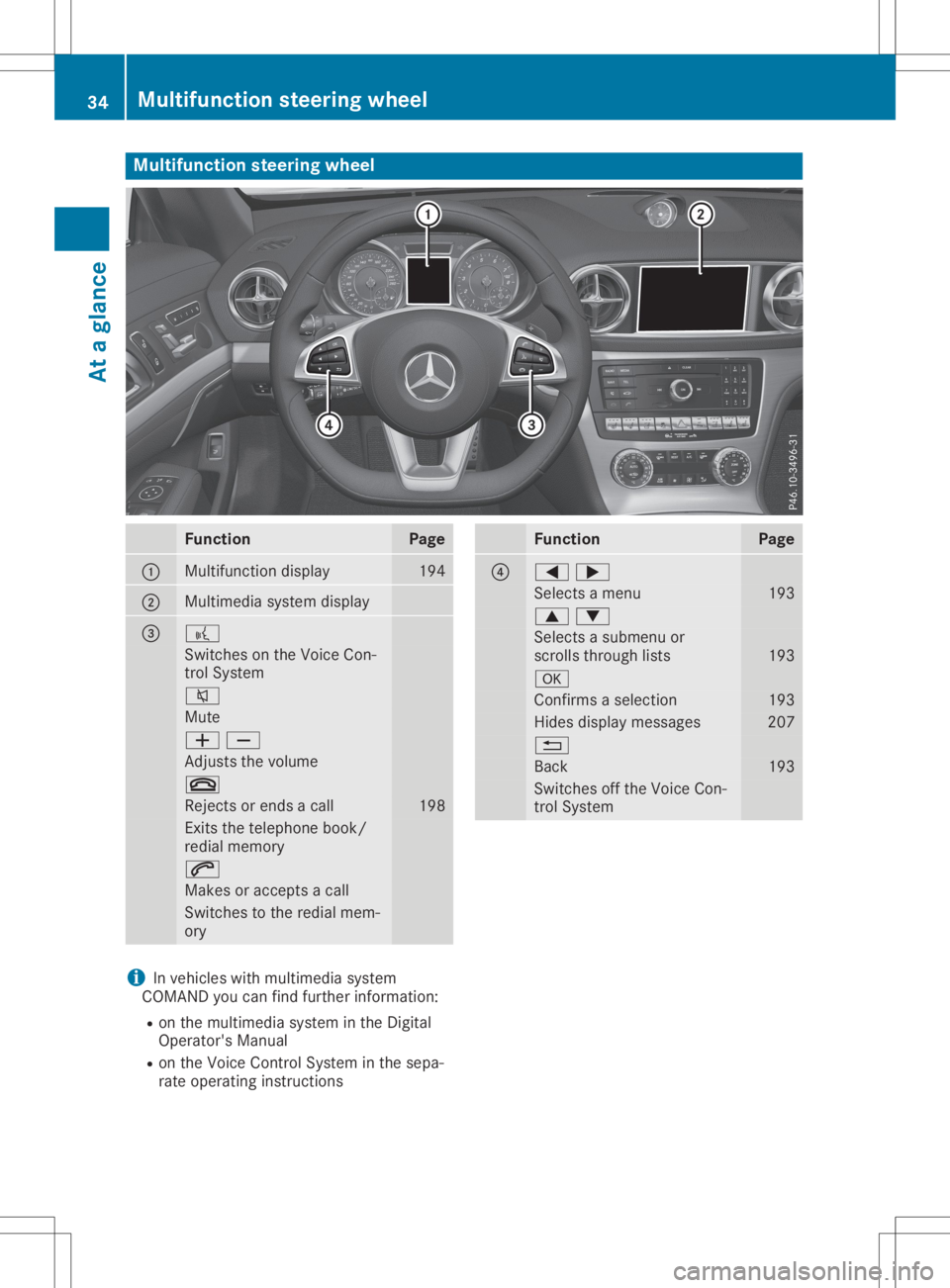
Multifunc
tionsteering wheel Func
tion Page
0043
Mul
tifunction display 194
0044
Mul
timedi asystem display 0087 0059
Switches
onthe Voice Con-
trol System 0063
Mute
00810082
Adju
ststhe volum e 0076
Re
jects orend sa cal l 198
Exits
thetelephone book/
red ialmem ory 0061
Ma
kes oracce ptsacal l Swi
tche sto the redialmem -
ory Fun
ction Pag
e 0085
00590065
Sel
ects amenu 193
00630064
Sel
ects asu bme nuor
scrol lsthrou ghlists 193
0076
Co
nfirm sa sel ectio n 193
Hid
esdispl aymes sages 207
0038
Back 193
Swi
tches offthe VoiceCon-
trol System i
Inveh icles with mul time diasy stem
CO MAND youcan find further informa tion:
R on the multime diasy stem inthe Digi tal
Ope rator'sManua l
R on the VoiceControl System inthe sepa-
rate operatinginstru ctions 34
Multi
functionste ering wheelAt agl anc e
Page 42 of 334

Panic
alarm X
To activate: press0033button 0043for at
least onesecond.
A visual andaudib lealarm istriggered ifthe
alarm system isarmed.
X To deactivat e:press 0033button 0043again.
or X Insert theSmartK eyinto theignition lock.
or X Press theKEYLE SS-GO Start /Stopbutton.
The KEYLE SS-GO key must beinthe vehicle. Occupant
safety Introduct
iontothe restr aintsystem
The restraint systemcanreduce therisk of
vehicle occupants comingintocontactwith
parts ofthe vehicle's interiorinthe event ofan
accident. Inthe event ofan accident, the
restraint systemcanalso reduce theforces to
which thevehicle occupants aresubjected.
The restraint systemincludes thefollowing
componen ts:
R Seat beltsystem
R Air bags
The componen tsof the restraint systemwork
in conj unction witheach other. Theycanonly
deploy theirprotect ivefunct ionif,at all times,
all vehicle occupants:
R have fastened theirseatbelts correct ly
(Y page 43)
R have theseat andhead restraint adjusted
properly (Ypage 97)
As the driver, youalso have tomake surethat
the steering wheelisadjusted correctly. Observe
theinformation relatingtothe correct
driver's seatposition (Ypage 97).
You also have tomake surethatanair bag can
inflate properly ifdeploye d(Y page 45).
An airbag supplements acorrect lyworn seat
belt. Asanadditional safetydevice, theairbag
increases thelevel ofprotect ionforvehicle
occupants inthe event ofan accident. For
example, if,inthe event ofan accident, the
protect ionoffered bythe seat beltissufficient,
the airbags arenot deploye d.When anacci-
dent occurs, onlytheairbags thatincrease
protect ioninthat particular accidentsituation
are deploye d.However, seatbelts andairbags
generally donot protect againstobjectspene-
tratin gthe vehicle fromtheoutside.
Inform ationonrestraint systemoperation can
be found under "Triggering ofthe Emergen cy
Tensioning Devicesandairbags"
(Y page 53).
See "Chil dren inthe vehicle" forinformation
on children traveling withyouinthe vehicle as
well ason child restraint systems
(Y page 57). Import
antsafety notes G
WARNING
Modifications tothe restraint systemmay
cause itto no longer workasinten ded.The
restraint systemmaythen notperform its
inten dedprotect ivefunct ionand may failin
an accident ortrigger unexpect edly,for
example. Thisposes anincreased riskof
injury oreven fatalinjury.
Never modify partsofthe restraint system.
Never tamper withthewiring, theelectron ic
componen tsor their software.
If it is necessary tomodify componen tsof the
restraint systemtoaccommodate aperson
with disabil ities,contactanauthorized
Mercedes-B enzCenter fordetails. USAonly:
for further information contactour Customer
Assistanc eCenter at1-80 0FOR-MERCED ES
(1‑800‑3 67‑6372).
Mercedes-B enzrecommen dsthat youonly use
driving aidswhich havebeen approved specifi-
cally foryour vehicle byMercedes-B enz. 40
Occ
upantsafetySafety
Page 47 of 334
passenger
seatbelts arenot fasten ed,awarn-
ing tonesounds. Awarning tonealso sounds
with increasing intensit yfor 60secon dsor
until thedriver orfron tpassenger havefas-
ten edtheir seatbelts.
If the driver orfron tpassenger unfastentheir
seat belts during thejourn ey,the seat belt
warning isactiv ated again. Air
bags
Introd uction The
installation pointofan airbag canberec-
ogniz edbythe AIRB AGmarkin g.
An airbag complem entsthe corr ectlyfasten ed
seat belt. Itis no substit uteforthe seat belt.
When deployed, anairbag canincrease the
prote ction provided forthe respect ivevehicle
occ upant.
Not allairbags aredeployed inan acciden t.
The various airbags workindepen dentlyof
each other (Ypage 53).
However ,no system available todaycancom-
pletely eliminate injuries andfatalities .
It is also notpossible torule outarisk ofinjury
caused byan airbag duetothe high speed at
which theairbag mustbedeployed.
Impor tantsafet ynotes G
WARN
ING
If the fron tpassenger airbag hasbeen acti-
vated, achild onthe fron tpassenger seat
may behit bythe fron tpassenger airbag in
the event ofan acciden t.There isarisk of
inj ury orfatal injury.
NEV ERuse arearward-f acingchildrestraint
system onaseat prote cted byan ACTIVE
FRONT AIRBAG;DEATH orSERIOUS INJURY
to the CHILD canoccur.
When installing achild restraint system onthe
fron tpassenger seatobserve thevehicle- spe-
cific notes(Y page 59).Youmust observe
the noteson rearward andforward- facingchild
rest raint systems onthe fron t-passenger seat. G
WARN
ING
If you deviate fromthecorr ectseat position ,
the airbag cann otperfor mits intended pro- tec
tive func tion anddeployment mayeven
cause furtherinjuries. Thisposes an
incr eased riskofinjury oreven fatalinjury.
To avoid anyrisks ,each vehicle occupant
must always makesureofthe following:
R Faste nthe seat beltcorrectly.Inthe case
of pregnan twomen inpartic ular,make
sure thatthelapbelt isnever routed
across thestom achorabdomen.
R Adopt thecorr ectseat position andkeep
as far away aspossible fromtheairbags.
R Observe thefollowing notes.
Always makesurethatthereare noobjec ts
between theairbag and vehicle occupant.
All vehicle occupants mustobserve thefollow-
ing notestoavoid risksposed bythe airbag
when itdeploys.
R Adj ust the seats properly beforebeginning
your journ ey.Always makesurethatthe
seat isin an almost upright position .The
cen terofthe head restraint must support
the head atabout eyelevel.
R Move thedriver' sand front-passenger seats
as far back aspossible. Thedriver' sseat
position mustallow thevehicle tobe driven
safely.
R Only holdthesteer ingwheel onthe outside.
This allows theairbag tobe fully deployed.
R Always leanagainst thebackr estwhile driv-
ing. Donot lean forward orlean against the
door orside window. Youmay other wisebe
in the deployment areaofthe airbags.
R Always keepyourfeetinthe foot well in
fron tof the seat. Donot putyour feetonthe
dashboard, forexample. Yourfeetmay oth-
erwise beinthe deployment areaofthe air
bag.
R For this reason, alwayssecurepersonsless
than 5ft (1.5 0m) tall insuitable restraint
systems .Up tothis height, theseat belt
cann otbe worn correctly.
If achild istraveling inyour vehicle, also
observe thefollowing notes:
R Always securechildren undertwelve years
of age and less than 5ft (1.5 0m) tall insuit-
able child restraint systems .
R Secur eachild tothe fron t-passenger seat
only when thefron t-passenger frontair bag
is disabled, andthen onlyinarearward- Occupant
safety
45Safet y Z
Page 48 of 334
facing
childrestrai ntsystem .The front-
pas senger frontairbag isdisa bledwhen the
PASSENGER AIRBAG OFFindica torlam pis
lit continuou sly(Ypag e41).
R Alwa ysobse rvethe instructions andsafety
notes onthe "Occu pantClassifi cation Sys-
tem (OCS)"(Ypag e48) and on"Children
in the vehicl e"(Y pag e57) inadd ition to
the child restrai ntsystem manufacturer's
instal lation and opera tinginstructions.
Objec tsinthe vehi cleinteri ormay restrict
the airbag from functi oningcorrectly. To
avoi drisks resulting from thespee dof the air
bag asitdepl oys,vehicl eoccupa ntsmust
ensure thefollowi ngpoints.
Before commencing yourjourney ,ensure that:
R there arenopeop le,anima lsor objects
betwe enthe vehicl eoccupa ntsand anair
bag
R there arenoobjects betweenthe seat,door
and B-pill ar
R there arenohard objects, e.g.coat hange rs,
hangi ngon the grab handl esorcoat hooks
R no accesso ries,such ascup hold ers, are
attached tothe vehicl ewithi nthe depl oy-
ment areaofan air bag ,e.g. todoors orside
wind ows
R no hea vy,sharp -edged orfragi leobjects are
in the pockets ofyou rclothing. Storesuch
objects inasui tabl epla ce G
WARNING
If you modi fythe cover ofan air bag oraffix
objects suchasstickers toit,the airbag
can nolonge rperform itsintended function.
There isan increas edrisk ofinjury .
Never modifythe cover ofan air bag oraffix
objects toit. G
WARNING
Sensors tocontrol theairbag sare loca ted
in the doors .Modi ficatio nsorwork notper-
formed correctly tothe doors ordoor panel -
ing, aswel las dama geddoors ,can leadto
the function ofthe sensors being impa ired.
The airbag smight therefore notfunction
prope rlyanymo re.Conse quently, theair
bag scannot protect vehicleoccupa ntsas
they aredesi gned todo. There isan
increas edrisk ofinjury . Never
modifythe doors orparts ofthe
doors .Alwa yshave work onthe doors or
door panel ingcarrie dout ataqua lified spe-
cial istworksho p.
Fron tair bags !
Do
not placehea vyobjects onthe front-
pas senger seat.This couldcaus ethe sys-
tem toide ntify theseatas bei ng occupi ed.
In the event ofan accid ent,therestrai nt
system son the front-passe ngersidemay be
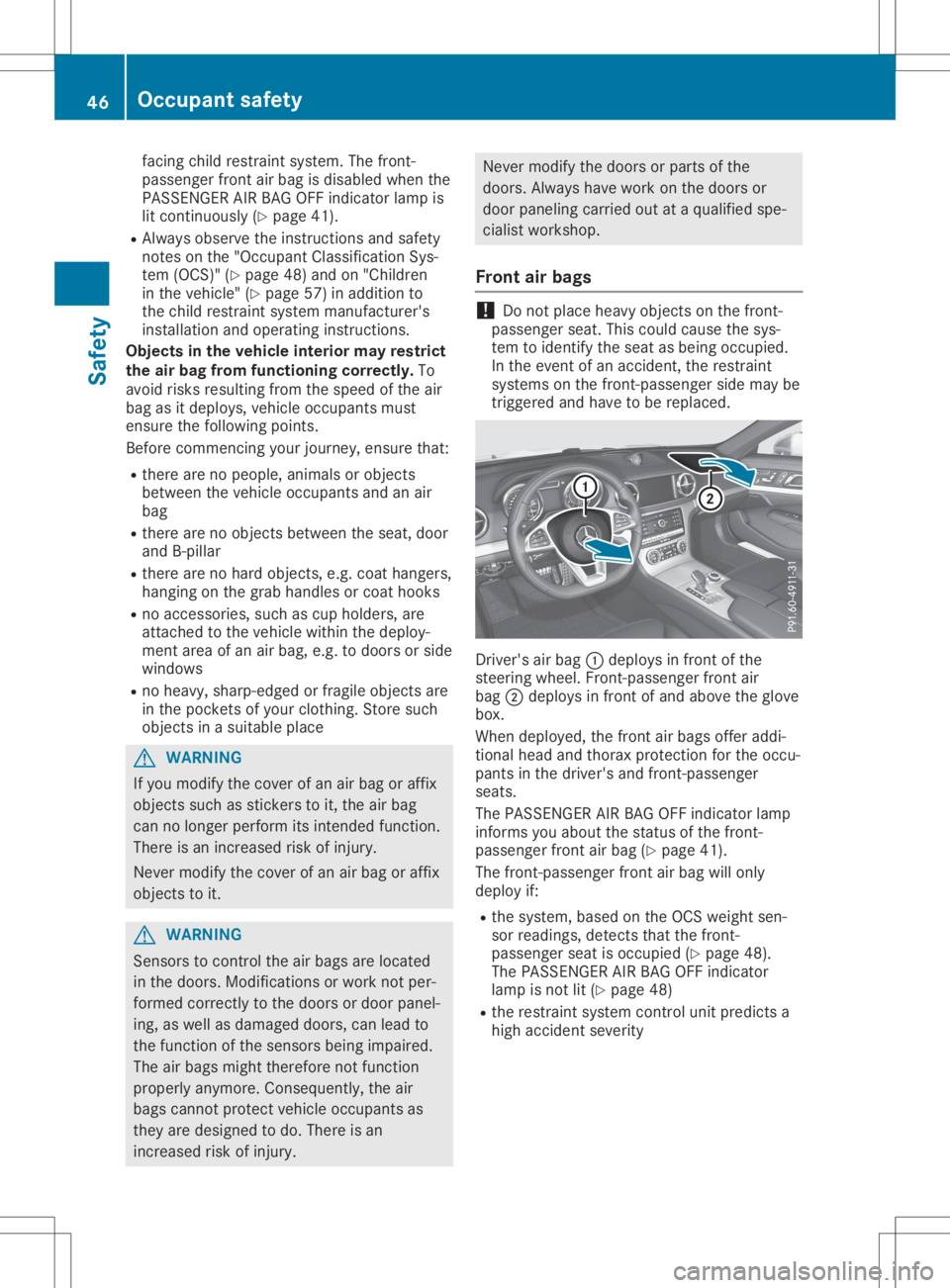
trigger edand have tobe repl aced . Driver's
airbag 0043depl oysinfront ofthe
steering wheel.Front-passeng erfront air
bag 0044depl oysinfront ofand abovethe glove
box.
When deployed,the front airbag soffer addi-
tional headand thorax protection forthe occu-
pants inthe drive r'sand front-passe nger
sea ts.
The PASSENGER AIRBAG OFFindica torlam p
informs youaboutthe status ofthe front-
pas senger frontairbag (Ypag e41).
The front-passe ngerfront airbag willonly
depl oyif:
R the system ,bas edon the OCS weight sen-
sor read ings, detects thatthefront-
pas senger seatis occupi ed(Ypag e48).
The PASSENGER AIRBAG OFFindica tor
lam pis not lit(Y pag e48)
R the restrai ntsyste mcontrol unitpredi ctsa
high accid entseveri ty 46
Oc
cupant safetySafety
Page 58 of 334
R
setting amore favorable seatposition for
the front -passenger seat.
R vehicles withamulticontour seat:increasing
the airpressure inthe side bolsters ofthe
seat backrest.
! Make
surethatthere arenoobjects inthe
footwell orbehind theseats. Thereisadan-
ger that theseats and/or objects couldbe
damaged whenPRE-SA FE®
is activated.
Should anaccident notoccur, thepreventative
measures takenarereversed. Certainsettings
must bemade yoursel f.
X Ifthe seat beltpre-tensionin gis not
reduced, movetheseat backrest back
slightly.
Seat beltpre-tensionin gis released . PRE-SAFE
®
PLUS (anticipatory occu-
pant protection systemPLUS)
Introduction PRE-SA
FE®
PLUS isonly available invehicles
with theDriving Assistance package.
Using theradar sensor system, PRE-SAFE®
PLUS isable todetect thatahead-on orrear-
end collision isimminent. Incertain hazardous
situations, PRE-SAFE®
PLUS takes pre-emptive
measures toprotect thevehicle occupants.
Importa ntsafety notes The
intervent ionofPRE-SA FE®
PLUS cannot
prevent animminent collision.
The driver isnot warned abouttheintervent ion
of PRE-SA FE®
PLUS.
PRE-SA FE®
PLUS doesnotintervene ifthe
vehicle isbacking up.
When driving, orwhen parking orexiting a
parking spaceusingActive Parking Assist,
PRE-SA FE®
PLUS willnotapply thebrakes.
Function PRE-SA
FE®
PLUS intervenes incertain situa-
tions ifthe radar sensor system detects an
imminent head-onorrear-end collision. PRE-SA
FE®
PLUS takes thefollowi ngmeas-
ures depending onthe hazardous situation
detected:
R ifthe radar sensor system detects thata
head-on collision isimminent, theseat belts
are pre-tensioned.
R ifthe radar sensor system detects thata
rear-end collisionisimminent:
- the brake pressure isincreased ifthe
driver appliesthe brakes whenthevehicle
is stationary.
- the seat belts arepre-tensioned.
The PRE-SA FE®
PLUS braking application is
canceled:
R ifthe accelerator pedalisdepressed whena
gear isengaged
R ifthe risk ofacollision passesorisno lon-
ger detected
R ifAct ive Distance AssistDISTRONIC indi-
cates anintent iontointervene
If the hazardous situationpasseswithout
resulting inan accident, theoriginal settings
are restored. Automatic
measuresafteranacci-
dent
Immediately afteranaccident, thefollowi ng
measures areimplemented, dependingonthe
type andseverity ofthe impact:
R the hazard warning lampsareswitched on
R the emergency lightingisactivated
R the vehicle doorsareunlocked
R the front sidewindows arelowered
R the electrically adjustablesteeringwheelis
raised whenthedriver's doorisopened
R the engine isswitched offand thefuel sup-
ply iscut off
R vehicles withMercedes meconn ect:auto-
matic emergency call 56
Occ
upant safetySafety
Page 62 of 334
Alw
ayssec ureani ma lspro perly when driv-
ing ,for instance with asu ita ble pe tcar rier. Dri
ving safe tysys tems Ove
rviewof driv ingsafe tysys tems
In thi ssec tion,youwi llfind informa tionab ou t
the followi ng driving safety system s:
R ABS (Anti -lock Bra king Syste m)
(Y page 60)
R BAS (Bra keAssist Sy stem )(Y page 61)
R Bra keAssi stwith cros s-tra fficfu nctio n
(Y page 61)
R Active BrakeAssi st(Y page 63)
R Ada ptive bra kelights (Ypage 65)
R ESP ®
(El ectro nicStability Pro gram)
(Y page 65)
R EBD (El ectro nicBrake forceDi stri butio n)
(Y page 69)
R ADAPTI VEBRAK E(Y page 70)
R Active BrakeAssi stwith cros s-tra fficfu nc-
tio n(Y page 70)
R STEER CONTR OL(Ypage 72) Impo
rtant safetynotes
If yo ufai lto adap tyo ur driving styleor ifyo u
ar eina ttenti ve,the driving safety system scan
nei ther reduce theriskof an acci dent nor
ove rride the laws ofphy sics. Driv ingsafety
sy stem sar emer elyai ds designe dto assist
dri ving .
Yo uar eres ponsi ble for mainta ining the dis-
tance tothe vehiclein front, forveh iclespe ed,
for braking ingoo dtime ,and forstaying in
la ne. Alwaysad aptyo ur driving styleto suit
the prevailing roadand weath ercond itions and
ma inta inasa fe dista nce from thevehiclein
front. Drivecar efully.
The driving safety system sde scri bedonl y
wo rkas effe ctive lyas possi ble wh en ther eis
ad eq uate conta ctbetwe enthe tiresand the
roa dsu rfa ce. Paypa rticu laratte ntionto the
info rma tionreg arding tire s,reco mme nded
mini mumtire trea dde pths etc.inthe "Whee ls
and tires"sec tion(Y page 296 ).
In wintry driving cond itions, alwa ysusewi nter
tire s(M +S tire s)and ifnece ssary,snow cha
ins.Onl yin thi swa ywi llthe driving safety
sy stem sde scri bedin thi ssec tionwo rkas
effe ctive lyas possi ble. ABS
(Anti -lock Braki ngSys tem)
Ge neral info rmatio n ABS
regulate sbra kepre ssu reinsuch awa y
tha tthe wheelsdo not lock when youbra ke.
Thi sal lo ws youto conti nuesteering thevehi-
cle when bra king .
The 0025 ABSwarning lamp inthe instrum ent
clu ster lights upwhen the igniti onissw itch ed
on. Itgoe sou twh en the engineisrunning .
ABS works from aspe edofabou t5 mph
(8 km/h ),reg ardless ofroa d-su rface cond i-
tio ns. ABS works onslip pe ry surfa ces ,eve n
wh en youonl ybra kegently .
Impo rtant safetynotes i
Obs
ervethe "Impo rtant safety notes "sec -
tio n(Y page 60). G
WA
RNING
If ABS isma lfunctio ning,the wheelscou ld
lo ck when bra king .The stee rability and
bra king characteri stics wo uld be sev erely
aff ecte d.The reisan incr eased dange rof
ski dding and accidents.
Driv eon car efully. Hav eABS checked imme-
di ate lyat aqu alifi ed spe cialist wo rksh op.
Whe nABS isma lfunctio ning,othe rsy stem s,
incl uding driving safety system s,willal so
be come inoperative .Obs ervethe informa tion
on the ABS warning lamp (Ypage 239 )and
di spl aymes sages which maybe sho wninthe
ins trum entcluster (Ypage 209 ).
Brake s X
IfABS interv enes:conti nuetodepre ssthe
bra kepedalvig oro uslyunti lthe braking sit-
ua tio nis ove r.
X To make aful lbrake application:de pre ss
the brakepedalwi th fullforc e.
If ABS intervenes when bra king ,yo uwi llfee la
pu lsing inthe brakepedal. 60
Dri
ving safe tysys temsSafe ty
Page 63 of 334

The
pulsating brakepedalcanbeanindication
of hazardous roadcondit ions,andfunct ionsas
a reminder totake extracare while driving. BAS
(BrakeAssist System)
General information BAS
operates inemergenc ybraking situations.
If you depress thebrake pedalquickly, BAS
automatically booststhebraking force,thus
shorten ingthe stopping distance.
Import antsafety notes i
Observe
the"Importan tsafety notes" sec-
tion (Ypage 60). G
WARNIN
G
If BAS ismalfunct ioning,thebraking dis-
tanc ein an emergenc ybraking situation is
increased. Thereisarisk ofan accident .
In an emergenc ybraking situation, depress
the brake pedalwithfullforce. ABSprevent s
the wheels fromlockin g.
Br aking X
Keep thebrake pedalfirmly depressed until
the emergenc ybraking situation isover.
ABS prevent sthe wheels fromlockin g.
The brakes willfunct ionasusual onceyou
release thebrake pedal. BASisdeactivated. Br
ake Assist withcross-tr afficfunc-
tion
General information Brake
Assist withcross- trafficfunct ioncan
help youtominimize therisk ofacollision with
a vehicle orapedestrian andreduce the
effect sof such acollision. IfBrake Assist with
cross- trafficfunct iondetect sa danger ofcolli-
sion, youareassisted whenbraking.
i Observe
the"Importan tsafety notes" sec-
tion (Ypage 60).
Brake Assist withcross- trafficfunct ionisonly
availabl ein vehicles withtheDrivin gAssis-
tanc epackage. For
Brake Assist withcross- trafficfunct ionto
assist youwhen driving, theradar sensor sys-
tem andthecamera systemmustbeopera-
tional.
The sensor system andcamera systemhelp
Brake Assist withcross- trafficfunct iondetect
obstacles:
R that areinthe path ofyour vehicle foran
exten dedperiod oftime
R that cross thepath ofyour vehicle
In addition, pedestrians inthe path ofyour
vehicle canbedetect ed.
Brake Assist withcross- trafficfunct iondetect s
pedestrians usingtypical charact eristics such
as body contours andtheposture ofaperson
standin gupright.
If the radar sensor system orthe camera sys-
tem ismalfunct ioning,BrakeAssist withcross-
traff icfunct ionisrestr icted orno longer availa-
ble. Thebrake system isstill availab lewith
complete brakeboosting effectandBAS.
i Observe
therestr iction sdescribed inthe
"Importan tsafety notes" section
(Y page 61).
Import antsafety notes G
WARNIN
G
Act ive Brake Assist withcross- trafficfunc-
tion cann otalway sclearly identify objects
and complex trafficsituations.
In such cases, Active Brake Assist with
cross- trafficfunct ionmight:
R issue anunneces sarywarning orbrake
R issue nowarning ornot brake
Always paycareful attentiontothe traff ic
situation; donot rely onthe Active Brake
Assist withcross- trafficfunct ionalone.
Always beready tobrake andpossibly take
evasive action. G
WARNIN
G
Brake Assist withcross- trafficfunct ioncan-
not alway sclearly identify people,particu-
larly ifthey aremoving. BrakeAssist with
cross- trafficfunct ioncann otinter vene in
these cases. Thereisarisk ofan accident . Driving
safetysystems
61Safety
Z
Page 65 of 334

Up
toaspeed ofapproximately 44mph
(70 km/h), BrakeAssist withcross-t raffic
function mayreact to:
R stationary objectsinthe path ofyour vehi-
cle, e.g. stopped orparked vehicles
R pedestrians inthe path ofyour vehicle
R obstacles crossingyourpath which movein
the detection rangeofthe sensors andare
detected
i If
Brake Assist withcross-t rafficfunction
requires aparticularl yhigh braking force,
preventative passengerprotectionmeasures
(PRE-SAF E®
)are activated atthe same time
(Y page 55).
X Keep thebrake pedaldepressed untilthe
emergency brakingsituation isover.
ABS prevents thewheels fromlocking.
Brake Assist withcross-t rafficfunction is
deactivated andthebrakes function asusua l
agai nif:
R you release thebrake pedal
R there isno longer arisk ofcollision
R no obstacle isdetected infront ofyour vehi-
cle
R you depress theaccelerator pedal
R you activate kickdown Active
BrakeAssis t
General information i
Observe
the"Important safetynotes" sec-
tion (Ypage 60).
Act ive Brake Assist consists ofadistance
warning function withanautonomous braking
function andAdaptive BrakeAssist.
Act ive Brake Assist canhelp youtominimize
the risk ofacollision withthevehicle infront
or reduce theeffects ofsuch acollision.
If Act ive Brake Assist detects thatthere isa
risk ofcollision, youwillbewarned visually
and acousticall y.Ifyou donot react tothe vis-
ual collision warningorthe warning tone,
autonomous brakingcanbeinitiated incritical
situations. Ifyou apply thebrake yoursel fin a
critical situation, AdaptiveBrakeAssist ofthe
Act ive Brake Assist system supports you. Importa
ntsafety notes In
particular, thedetection ofobstacles canbe
impaired if:
R there isdirt onthe sensors oranything else
covering thesensors
R there issnow orheavy rain
R there isinterferenc eby other radarsources
R there arestrong radarreflections, forexam-
ple inparking garages
R anarrow vehicle istraveling infront ,e.g. a
motorbike
R avehicle istraveling infront onadifferent
line
R you aredriving anew vehicle orservicing on
the Active Brake Assist system hasjust
been carried out
Observe theimportant safetynotesinthe
"Breaking-in notes"section (Ypage 125).
Followi ngdamage tothe front endofthe vehi-
cle, have theconfiguration andoperation of
the radar sensor checked ataqual ified spe-
cialist workshop. Thisalso appli estocollisions
at slow speeds wherethereisno visible dam-
age tothe front ofthe vehicle.
Activating/ deactivating Act
ive Brake Assist isautomaticall yactive
after switching onthe ignition.
You canactivate ordeactivate Active Brake
Assist usingtheon-board computer
(Y page 200). When deactivated, thedistance
warning function andtheautonomous braking
function arealso deactivated.
If Act ive Brake Assist isdeactivated, the00D4
symbol appearsinthe assistance graphicdis-
play .
Distance warningfunction General
information
The distance warningfunction canhelp youto
minimize therisk ofafront -end collision witha
vehicle aheadorreduce theeffects ofsuch a
collision. Ifthe distance warningfunction
detects thatthere isarisk ofacollision, you
will bewarned visuallyand acousticall y. Driving
safetysystems
63Safety Z