ESP MERCEDES-BENZ SLC 2017 Repair Manual
[x] Cancel search | Manufacturer: MERCEDES-BENZ, Model Year: 2017, Model line: SLC, Model: MERCEDES-BENZ SLC 2017Pages: 294, PDF Size: 9.12 MB
Page 248 of 294
X
Pull the tire sealant bottle out of the tire infla-
tion compressor.
The filler hose remains attached to the tire
sealant bottle. X
Drive to the nearest qualified specialist work-
shop and have the tire changed there. X
Have the tire sealant bottle and the filler hose
replaced as soon as possible at aq ualified
specialist workshop. X
Have the tire sealant bottle replaced every
four years at aq ualified specialist workshop.
Battery (vehicle)
Important safety notes Special tools and expert knowledge are required
when working on the battery, e.g. removal and
installation .Y ou should therefore have all work
involvin gt he battery carried out at aq ualified
specialist workshop.
G WARNING
Work carried out incorrectly on the battery
can lead, for example, to as hort circuit and
thus damage the vehicle electronics. This can
lead to function restriction sa pplying to
safety-relevant systems, e.g the lighting sys-
tem, the ABS (anti-loc kb raking system) or the
ESP ®
(Electronic Stability Program). The oper-
ating safety of your vehicle may be restricted.
You could lose control of the vehicle, for
example: R
when braking R
in the event of abrupt steerin gm aneuvers
and/or when the vehicle's speed is not
adapted to the road conditions
There is ar isk of an accident.
In the event of as hort circuit or as imilar inci-
dent, contact aq ualified specialist workshop
immediately. Do not drive any further .Y ou
should have all work involvin gt he battery car-
ried out at aq ualified specialist workshop.
For further information about ABS and ESP ®
,
see ( Y
page 55) and ( Y
page 58). G WARNING
Electrostatic build-up can lead to the creation
of sparks, which could ignite the highly explo-
sive gases of ab attery. There is ar isk of an
explosion.
Before handling the battery, touch the vehicle
body to remove any existin ge lectrostatic
build-up.
The highly flammable gas mixture forms when
charging the battery as well as when jump-start-
ing.
Always make sure that neither you nor the bat-
tery is electrostatically charged. Ab uild-up of
electrostatic charge can be caused, for exam-
ple: R
by wearing clothin gm ade from synthetic
fibers R
due to friction between clothin ga nd seatsR
if you push or pull the battery across the car-
pet or other synthetic materials R
if you wipe the battery with ac loth
G WARNING
During the charging process, ab attery produ-
ces hydrogen gas. If as hort circuit occurs or
sparks are created, the hydrogen gas can
ignite. There is ar isk of an explosion. R
Make sure that the positive terminal of a
connected battery does not come into con-
tact with vehicle parts. R
Never place metal object sort ools on ab at-
tery. R
It is importan tt hat you observe the descri-
bed order of the battery terminals when
connectin ga nd disconnectin gab attery.R
When jump-starting, make sure that the
battery poles with identical polarity are
connected. R
It is particularly importan ttoo bserve the
described order when connectin ga nd dis-
connectin gt he jumper cables. R
Never connect or disconnect the battery
terminals while the engine is running.
G WARNING
Battery acid is caustic. There is ar isk of injury.246
Battery (vehicle)
Breakdown assistance
Page 249 of 294
Avoi dc ontact with skin, eyes or clothing. Do
not inhal ea ny battery gases .Don ot lean over
the battery .K ee pc hildren away from batter-
ies. Wash away battery aci di mmediatel yw it h
plenty of clean water and see km edica la tten-
tion.
H Environmental note
Batterie sc ontain dangerous
substances .Itisa gain st the
la wtod is pose of them with
the househol dr ubbish .T hey
must be collected separately
and recycle dtop rotect the
environment.
Dispose of batteries in an
environmentally friendly
manner. Take discharged
batteries to aq uali fied spe-
cialist workshop or as pecial
collectio np oi nt for used bat-
teries.
! Hav et he battery checked regularly at a
qualified specialist workshop.
Observ et he service intervals in the Mainte-
nance Bookle torc ontact aq uali fied specialist
workshop for more information.
! Alway sh av ew or konb at teries carrie do ut at
aq uali fied specialist workshop .S hould it, in
exceptiona lc ircumstances ,bea bs olutely
necessary to disconnect the 12-volt battery
yourself, observe the following: R
secur et he vehicl etop revent it from rolling
away. R
switch off the ignition. R
always disconnect the negative terminal
clamp first, followe dbyt he positive termi-
nal clamp.
After the battery ha sb ee nd is connected ,t he
transmission is locked in position P .
After the work ha sb ee nd on e, instal lt he bat-
tery and replace the cove roft he positive ter-
mina lc lamp firmly.
Compl yw it hs af ety precautions and take pro-
tective measures when handling batteries. Risk of explosion.
Fire, open flames and smoking are
prohibited when handling the bat-
tery .A voi dc reating sparks.
Battery aci disc austic. Avoi dc ontact
with skin, eyes or clothing.
Wear suitabl ep rotective clothing,
especially gloves, apron and face-
guard.
Rinse any aci ds pill si mmediately
with clear water. Contact ap hysician
if necessary.
Wear ey ep rotection.
Kee pc hildren away.
Observ et hi sO perator' sM an ual.
For safety reasons ,M ercedes-Benz recom-
mend st ha ty ou onl yu se batteries which have
been teste da nd approved for your vehicl eb y
Mercedes-Benz. These batteries provide
increased impact protection to prevent vehicle
occupants from suffering aci db ur ns shoul dt he
battery be damaged in the event of an accident.
In order for the battery to achieve the maximum
possibl es ervice life, it must always be suffi-
ciently charged.
Like othe rb at teries, the vehicl eb at tery may
discharge ove rt ime if yo udon ot us et he vehicle.
In thi sc ase, have the battery disconnected at a
qualified specialist workshop .Y ou can also
charge the battery with ac harge rr ecommended
by Mercedes-Benz. Contact aq uali fied special-
is tw or kshop for furthe ri nformation.
Hav et he battery condition of charge checked
more frequentl yify ou us et he vehicl em ai nl yf or
short trip sorify ou leav eits tanding idle for a
lengthy period. Consult aq uali fied specialist
workshop if yo uw is htol eave your vehicle
parked for al on gp er io doft ime.
Remove the SmartKe yify ou park the vehicle
and do not require any electrical consumers.Battery (vehicle) 247
Breakdo wn assis tance Z
Page 259 of 294
MOExtended tires (tires with run-flat
properties) With MOExtended tires (tires with run flat char-
acteristics), you can continue to drive you rv ehi-
cle even if there is at otal loss of pressure in one
or more tires.
MOExtended tires may only be use dinc onjunc-
tion with an active tire pressure loss warning
system or with an active tire pressure monitor
and on wheels specifically tested by Mercedes-
Benz.
Notes on driving with MOExtended tires with a
flat tire ( Y
pag e2 42).
Vehicles equipped with MOExtended tires are
not equipped with aT IREFIT kit at the factory. It
is therefore recommende dt hat you additionally
equip you rv ehicl ew ith aT IREFIT kit if you mount
tires that do not feature run-fla tp roperties, e.g.
winter tires. AT IREFIT kit can be obtained from
aq ualified specialist workshop.
Winter operation
General notes Have you rv ehicl ew inter-proofed at aq ualified
specialist worksho patt he onset of winter.
Observe the notes in the "Changing aw heel"
section ( Y
pag e2 74).
Driving with summer tires At temperatures below 45 ‡( +7 †), summer
tires lose elasticity and therefore traction and
braking power. Change the tires on you rv ehicle
to M+S tires .U sing summe rt ires at very cold
temperatures coul dc aus ec racks to form,
thereby damaging the tires permanently.
Mercedes-Benz cannot accept responsibility for
this type of damage.
G WARNING
Damaged tires can caus et ire inflation pres-
sure loss. As ar esult, you coul dl ose control of
you rv ehicle. There is ar isk of accident.
Check the tires regularl yf or signs of damage
and replace any damaged tires immediately. M+S tires
G WARNING
M+S tires with at ire tread depth of less than
Page 260 of 294
To avoid hazardous situations: R
never install snow chains to the front
wheels R
alway si nstall snow chains in pairs to the
rear wheels.
For safety reasons, Mercedes-Benz recom-
mends that you only use snow chains that have
been specially approved for your vehicle by
Mercedes-Benz ,ora re of ac orresponding
standard of quality. For more information,
please contact aq ualified specialist workshop.
If you inten dtom ount snow chains, please bear
the following points in mind: R
Snow chains may not be mounted on all
wheel/tire combinations. Permissible wheel-
tire combinations ( Y
page 278).R
Only use snow chains when driving on roads
completely covered by snow. Remove the
snow chains as soon as possible when you
come to ar oad that is not snow-covered.R
Local regulations may restrict the use of snow
chains. Observe the appropriate regulations if
you wish to mount snow chains. R
Do not exceed the maximum permissible
speed of 30 mph (50 km/h).
You may wish to deactivate ESP ®
when pulling
away with snow chains installed ( Y
page 58).
You can thereby allow the wheels to spin in a
controlled manner ,a chieving an increased driv-
ing force (cutting action).
Information about driving with an emergency
spare wheel ( Y
page 279). Tire pressure
Tire pressur es pecifications
Important safety notes
G WARNING
Underinflated or overinflated tires pose the
following risks: R
the tires may burst, especially as the load
and vehicle speed increase. R
the tires may wear excessively and/or
unevenly, which may greatly impair tire
traction. R
the driving characteristics, as well as steer-
ing and braking, may be greatly impaired.
There is ar isk of an accident.
Follow recommended tire inflation pressures
and check the pressure of all the tires includ-
ing the spare wheel: R
monthly, at least R
if the load changes R
before beginning al ong journeyR
under different operating conditions, e.g.
off-road driving
If necessary, correc tt he tire pressure.
The data on the Tire and Loading Information
placard and tire pressure table shown here are
examples. Tire pressure specification sa re vehi-
cle-specific and may deviate from the data
shown here. The tire pressure specifications
that are valid for your vehicle can be found on
the Tire and Loading Information placard and
tire pressure table on the vehicle.
General notes The recommended tire pressures for the tires
mounted at the factor yc an be found on the
labels described here.
Operation with an emergency spar ew heel:
information on operation with an emergency
spare wheel can be found in the general notes in
the "Emergency spare wheel" section
( Y
page 280).
Further information on tire pressures can be
obtained at aq ualified specialist workshop.258
Tir ep re ssure
Wheels and tires
Page 263 of 294
Avoi dt ire pressures tha ta re too high in al lt he
tires, including the spare wheel.
Overinflated tire sm ay :R
increase the braking distance R
adversel ya ffect handlingR
wear excessivel ya nd/or unevenlyR
have an adverse effect on rid ec omfortR
be more susceptibl etod amag e
Maximum tire pressures
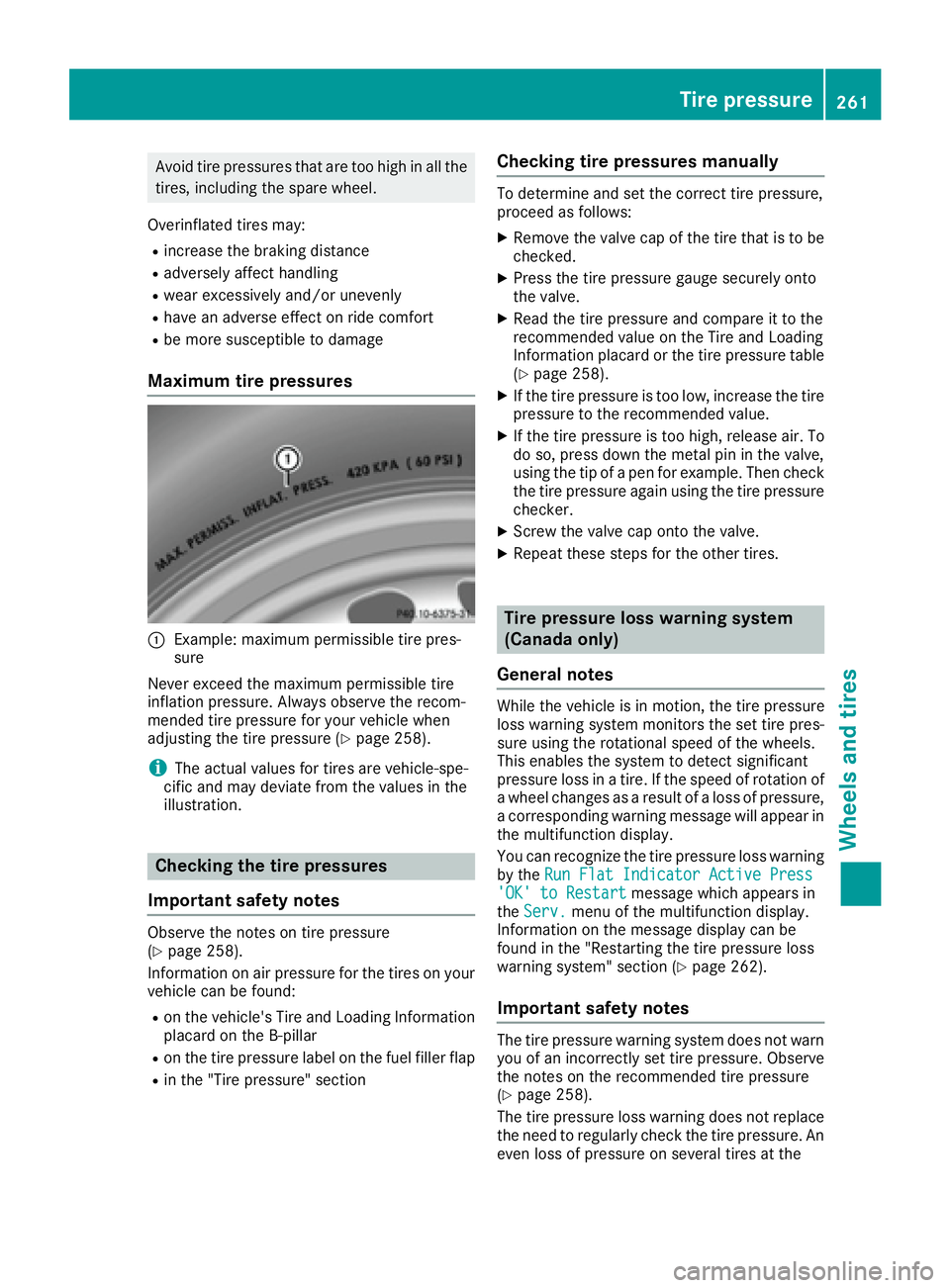
C
Example: maximu mp er missibl et ire pres-
sure
Never exceed the maximu mp er missibl et ire
inflation pressure. Alway so bs erve the recom-
mended tire pressure for your vehicl ew he n
adjusting the tire pressure ( Y
page 258).
i The actual values for tire sa re vehicle-spe-
cifi ca nd ma yd ev iate from the values in the
illustration.
Checkin gt he tire pressures
Important safety notes Observ et he notes on tire pressure
( Y
page 258).
Informatio nona ir pressure for the tire sony ou r
vehicl ec an be found:R
on the vehicle's Tire and Loading Information
placard on the B-pillar R
on the tire pressure labe lont he fuel fille rf lapR
in the "Tire pressure" section Checkin gt ire pressure sm anuallyTo determine and set the correct tire pressure,
procee dasf ollows: X
Remove the valve cap of the tire tha ti stob e
checked. X
Press the tire pressure gaug es ecurel yo nto
the valve. X
Read the tire pressure and compar eittot he
recommende dv alue on the Tire and Loading
Informatio np la card or the tire pressure table
( Y
page 258). X
If the tire pressure is too low, increase the tire
pressure to the recommende dv alue.X
If the tire pressure is too high, release air. To
do so, press down the meta lp in in the valve,
using the tip of ap en for example. The nc heck
the tire pressure agai nu si ng the tire pressure
checker. X
Screw the valve cap onto the valve. X
Repeat thes es tep sf or the othe rt ires.
Tire pressure loss warning system
(Canada only)
General notes While the vehicl eisinm otion, the tire pressure
loss warning system monitors the set tire pres-
sure using the rotational speed of the wheels.
Thi se nables the system to detect significant
pressure loss in at ire .Ift he speed of rotatio no f
aw heel change sasa resul tofa loss of pressure,
ac orresponding warning message will appear in
the multifunctio nd is play.
Yo uc an recognize the tire pressure loss warning
by the Run Fla tI ndicator Active Press
'OK 'toR estart message which appear si n
the Serv. menu of the multifunctio nd is play.
Informatio nont he message display can be
found in the "Restarting the tire pressure loss
warning system "s ectio n( Y
page 262).
Important safety notes
The tire pressure warning system does not warn
yo uofani ncorrectly set tire pressure. Observe
the notes on the recommende dt ire pressure
( Y
page 258).
The tire pressure loss warning does not replace
the nee dtor egularly check the tire pressure. An
eve nl os sofp ressure on severa lt ire satt heTire pressure 261
Wheel sa nd tires Z
Page 264 of 294
same time cannot be detected by the tire pres-
sure loss warning system.
The tire pressure monitor is not able to warn you
of as udden loss of pressure, e.g. if the tire is
penetrated by af oreign object. In the event of a
sudden loss of pressure, bring the vehicle to a
halt by braking carefully .A void abrupt steering
movements.
The function of the tire pressure loss warning
system is limited or delayed if: R
snow chains are mounted on your vehicle's
tires. R
road conditions are wintry. R
you are driving on sand or gravel. R
you adopt av ery sporty driving style (corner-
ing at high speeds or driving with high rates of
acceleration). R
you drive with ah eavy load.
Restarting the tire pressure loss warn-
ing system Restart the tire pressure loss warning system if
you have: R
changed the tire pressure R
changed the wheels or tires R
mounted new wheels or tires X
Before restarting, make sure that the tire
pressures are set properly on all four tires for
the respective operating conditions.
The recommended tire pressure can be found
on the Tire and Loading Information placard
on the B-pillar. Additionally, at ire pressure
table is attached to the fuel filler flap. The tire
pressure loss warning system can only give
reliable warnings if you have set the correct
tire pressure. If an incorrect tire pressure is
set, these incorrect values will be monitored. X
Also observe the notes in the section on tire
pressures ( Y
page 258).X
Make sure that the SmartKey is in position 2
in the ignition lock ( Y
page 115).X
Press the Y or e button on the steering
wheel to select the Serv. menu.X
Press the c or d button to select
Tire Pressure .X
Press the v button.
The Run Flat Indicator Active Press
'OK' to Restart message appears in the
multifunction display. If you wish to confirm the restart: X
Press the v button.
The Tire Pressure Now OK? message
appears in the multifunction display. X
Press the c or d button to select Yes .X
Press the v button.
The Run Flat Indicator Restarted mes-
sage appears in the multifunction display.
After at each-in period, the tire pressure loss
warning system will monitor the set tire pres-
sures of all four tires.
If you wish to cancel the restart: X
Press the 8 button.
or X
If the Tire Pressure Now OK? message
appears, use the c or d button to
select Cancel . X
Press the v button.
The tire pressure values stored at the last
restart will continue to be monitored.
Tire pressure monitor
General notes If at ire pressure monitor is installed, the vehi-
cle's wheels have sensors that monitor the tire
pressures in all four tires. The tire pressure mon-
itor warns you if the pressure drops in one or
more of the tires. The tire pressure monitor only
functions if the corresponding sensors are
installed in all wheels.
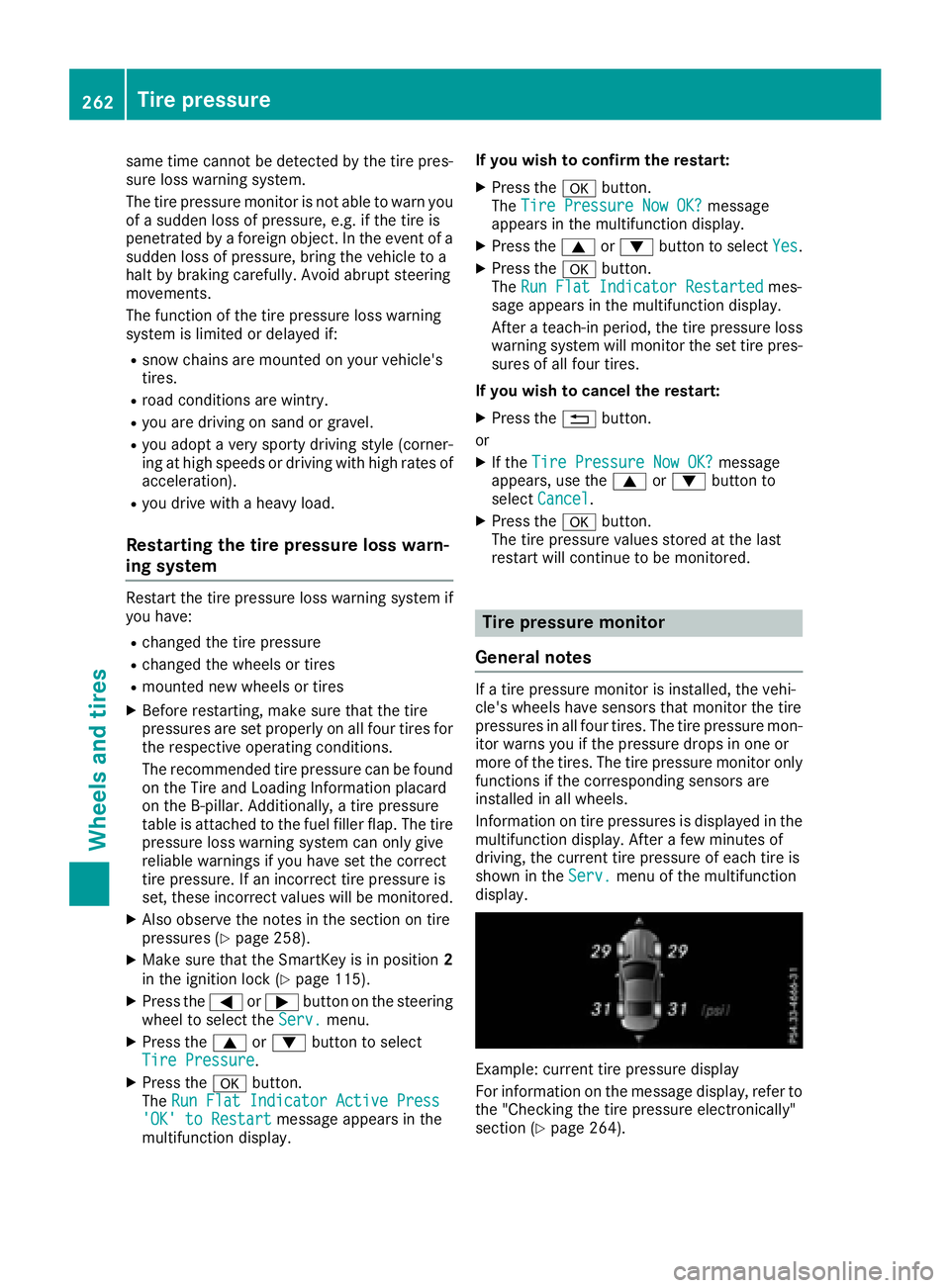
Information on tire pressures is displayed in the
multifunction display. After af ew minutes of
driving, the current tire pressure of each tire is
shown in the Serv. menu of the multifunction
display.
Example: current tire pressure display
For information on the message display, refer to
the "Checking the tire pressure electronically"
section ( Y
page 264).262
Tire pressure
Wheels and tires
Page 265 of 294
Important safety notes
G WARNIN G
Eac ht ir e, includin gt he spar e( if provided),
should be checke datl east once am onth
when cold and inflated to th ep ressur er ec -
ommended by th ev ehicl em anufacturer on
th eT ir ea nd Loading Information placard on
th ed river' sd oor B-pillar or th et ir ep ressur e
label on th ei nside of th ef uel filler flap .Ify our
vehicl eh as tires of ad ifferen ts iz et ha nt he
siz ei ndicated on th eT ir ea nd Loading Infor -
mation placard or th et ir ep ressur el abel, you
should determine th ep roper tire pressur ef or
those tires .
As an added safet yf eature, your vehicl eh as
been equipped wit hat ir ep ressur em onitoring
system (TPMS) that illuminate sal ow tire pres-
sur et el ltale when on eorm or eofy our tires
are significantly underinflated. Accordingly,
when th el ow tire pressur et el ltale illuminates,
you should stop and chec ky our tires as soo n
as possible ,a nd inflat et he mtot he proper
pressure. Drivin gonas ignificantly underin-
flated tire causes th et ir etoo verheat and can
lead to tire failure. Underinflation also
reduce sf uel efficiency and tire tread life ,a nd
may affec tt he vehicle's handlin ga nd stop-
pin ga bility.
Pleas en ot et ha tt he TPM Sisn ot as ubstitut e
for proper tire maintenance ,a nd it is th ed riv -
er'
sr e sponsibilit y t om aintai nc orrect tire
pressure, eve nifu nderinflation has no t
reached th el evel to trigge ri llumination of th e
TPM Sl ow tire pressur et el ltale.
Your vehicl eh as also been equipped wit ha
TPM Sm alfunction indicator to indicat eift he
system is no to perating properly. The TPM S
malfunction indicator is combined wit ht he
low tire pressur et el ltale. When th es ystem
detects am alfunction ,t he warning lamp will
flas hf or approximately am inute and then
remain continuously illuminated. This
sequenc ew ill be repeated every time th ev ehi-
cle is started as lon gast he malfunction
exists. When th em alfunction indicator is illuminated,
th es ystem may no tbea ble to detec tors ignal
low tire pressur easi ntended. TPM Sm alfunc -
tion sm ay occur for av ariet yofr easons,
includin gt he installation of incompatible
replacemen tora lternate tires or wheels on
th ev ehicl et ha tp reven tt he TPM Sf ro mf unc-
tioning properly. Always chec kt he TPM Sm al-
function telltale after replacing on eorm or e
tires or wheels on your vehicl etoe ns ur et ha t
th er eplacemen tora lternate tires and wheels
allow th eT PM Stoc ontin ue to function prop-
erly.
It is th ed river' sr esponsibilit yt os et th et ir e
pressur etot ha tr ecommended for cold tires
whic hiss uitable for th eo perating situation
( Y
page 258). Not et ha tt he correc tt ir ep ressur e
for th ec urren to perating situation must first be
taught-in to th et ir ep ressur em onitor. If there is
as ubstantial loss of pressure, th ew arning
threshold for th ew arning message is aligned to
th er eferenc ev alue st aught-in .R estart th et ir e
pressur em onitor after adjusting th ep ressur eo f
th ec ol dt ir es ( Y
page 264). The curren tp res-
sures are saved as ne wr eferenc ev alues. As a
result ,aw arning message will appear if th et ir e
pressur ed rops sign ifica ntly.
T he tire pressur em onitor does no tw arn you of
an incorrectl ys et tire pressure. Observ et he
note sont he recommended tire pressur e
( Y
page 258).
The tire pressur em onitor is no ta ble to warn you
of as udde nl oss of pressure, e.g. if th et ir ei s
penetrated by af oreign object. In th ee vent of a
sudde nl oss of pressure, brin gt he vehicl etoa
halt by braking carefully. Avoid abrup ts te ering
movements.
The tire pressur em onitor has ay ellow warning
lamp in th ei nstrumen tc luste rf or indicating
pressur el oss or am alfunction .W hether th e
warning lamp flashes or lights up indicates
whether at ir ep ressur eist oo low or th et ir e
pressur em onitor is malfunctioning :R
if th ew arning lamp is lit continuously, th et ir e
pressur eono ne or mor et ir es is significantly
to ol ow. The tire pressur em onitor is no tm al-
functioning . R
if th ew arning lamp flashes for aroun da
minute and then remain sl it constantly, th e
tire pressur em onitor is malfunctioning .Tire pressure 263
Wheels and tires Z
Page 266 of 294
In addition to the warning lamp ,am essage
appears in the multifunction display. Observe
the information on display messages
( Y
page 196).
It may take up to ten minutes for am alfunction
of the tire pressure monitor to be indicated .A
malfunction wil lbei ndicated by the tire pres-
sure warning lamp flashing for approximately
one minute and then remaining lit. When the
malfunction has been rectified, the tire pressure
warning lamp goes out after af ew minutes of
driving.
The tire pressure values indicated by the on-
board computer may differ from those meas-
ured at ag as station with ap ressure gauge. The
tire pressures shown by the on-board computer
refer to those measured at sea level .Ath igh
altitudes, the tire pressure values indicated by a
pressure gauge are higher than those shown by
the on-board computer. In this case, do not
reduce the tire pressures.
The operation of the tire pressure monitor can
be affected by interference from radi ot ransmit-
ting equipment (e.g. radi oh eadphones, two-way
radios) that may be being operated in or near the
vehicle.
Checking the tire pressure electroni-
cally X
Make sure that the SmartKey is in position 2
in the ignition lock ( Y
page 115).X
Press the Y or e button on the steering
wheel to select the Serv. menu.X
Press the c or d button to select
Tire Pressure .X
Press the v button.
The current tire pressure of each tire is shown
in the multifunction display.
If the vehicle has been parked for over
20 minutes, the Tire pressure will be
displayed after driving af ew minutes
messag ea ppears.
After at each-in process, the tire pressure mon-
itor automatically detects new wheel sorn ew
sensors. As long as ac lear allocation of the tire
pressure valu etot he individual wheel sisn ot
possible, the Tire Pressure Monitor Active
display messag eiss hown instead of the tire
pressure display. The tire pressures are already
being monitored.
If an emergency spare wheel is mounted, the
system may continue to show the tire pressure of the wheel that has been removed for af ew
minutes. If this occurs, note that the valu ed is-
played for the positio nw here the spare wheel is
mounted is not the same as the current tire
pressure of the emergency spare wheel.
Tire pressure monitor warning mes-
sages If the tire pressure monitor detects ap ressure
loss in one or more tires, aw arning messag ei s
shown in the multifunction display. The yellow
tire pressure warning lamp then lights up. R
If the Please Correct Tire Pressure
messag ea ppears in the multifunction display,
the tire pressure in at least one tire is too low.
The tire pressure must be corrected when the
opportunity arises. R
If the Check Tires messag ea ppears in the
multifunction display, the tire pressure in at
least one tire has droppe ds ignificantly. The
tires must be checked. R
If the Warning Tire Malfunction message
appears in the multifunction display, the tire
pressure in at least one tire has droppe ds ud-
denly .T he tires must be checked.
Observe the instructions and safety notes in the
display messages in the "Tires" section
( Y
page 196).
If the wheel positions on the vehicle are rotated,
the tire pressures may be displaye df or the
wrong positions for as hort time. This is rectified
after af ew minutes of driving, and the tire pres-
sures are displaye df or the correct positions.
Restarting the tire pressure monitor When you restart the tire pressure monitor, all
existing warning messages are deleted and the
warning lamp sgoo ut. The monitor uses the cur-
rently set tire pressures as the reference values
for monitoring. In most cases, the tire pressure
monitor wil la utomatically detect the new refer-
ence values after you have changed the tire
pressure. However, you can also define refer-
ence values manually as describe dh ere. The tire
pressure monitor then monitors the new tire
pressure values. X
Set the tire pressure to the valu er ecommen-
ded for the corresponding driving situation on
the Tire and Loading Information placard on
the driver's side B-pilla r( Y
page 258).264
Tire pressure
Wheel sa nd tires
Page 267 of 294
Additiona lt ire pressure values for different
load sc an also be found on the tire pressure
table on the insid eoft he fuel fille rf lap
( Y
page 258). X
Make sure tha tt he tire pressure is correct on
al lf ou rw heels.X
Make sure tha tt he SmartKe yisinp osition 2
in the ignition lock. X
Press the Y or e button on the steering
whee ltos elect the Serv. menu.X
Press the c or d button to select
Tir eP ressure .X
Press the v button.
The multifunctio nd is play shows the current
tire pressure for the individual tire sort he
Tir ep ressure wil lbed isplayed
after drivin gaf ew minutes message.X
Press the d button.
The Use Current Pressures as New Ref‐
erence Values message appear sint he mul-
tifunctio nd is play.
If yo uw is htoc on firm the restart:X
Press the v button.
The Tire Press. Monitor Restarted mes-
sage appear sint he multifunctio nd is play.
After driving for af ew minutes, the system
checks whethe rt he current tire pressures are
withi nt he specified range .T he new tire pres-
sures ar et hen accepte dasr eference values
and monitored.
If yo uw is htoc ance lt he restart:X
Press the 8 button.
The tire pressure values stored at the last
restart will continue to be monitored.
Radio type approval fo rt he tire pres-
sure monitor Country Radio type approval number
USA FCC ID: MRXMW2433A
FCC ID: MRXGG4
FCC ID: MRXMC34MA4
Canada IC :2 546A-MW2433A
IC :2 546A-GG4
IC :2 546A-MC34MA4 Loadin gt he vehicle
Instructio nl abel sf or tire sa nd loads
G WARNING
Overloaded tire sc an overheat, causing a
blowout. Overloaded tire sc an also impai rt he
steering and driving characteristics and lead
to brake failure. There is ar is kofa ccident.
Observ et he load rating of the tires. The load
rating must be at leas th al foft he GAW Ro f
your vehicle. Never overload the tire sb y
exceeding the maximu ml oad.
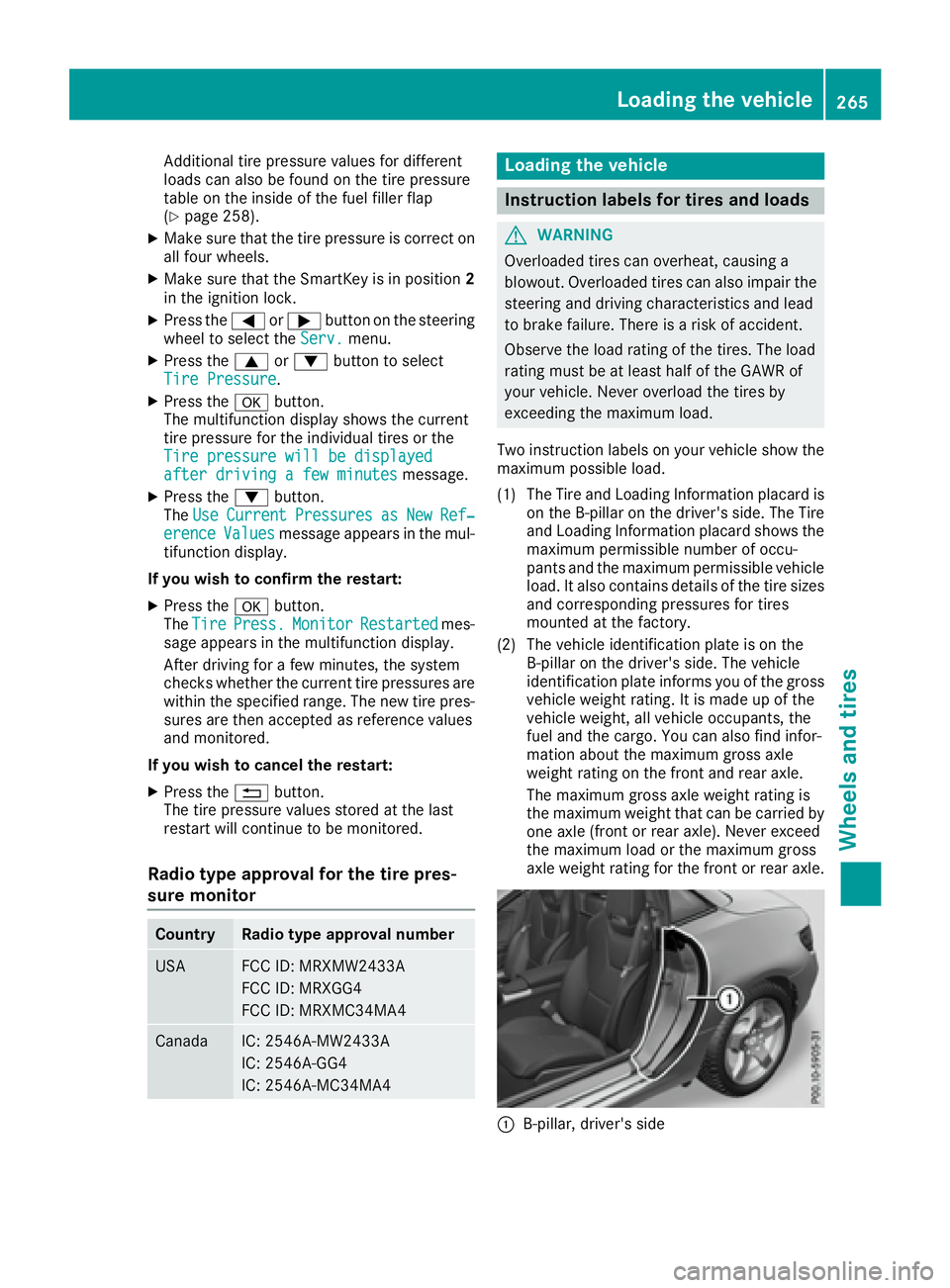
Tw oi nstructio nl abel sony ou rv ehicl es ho wt he
maximu mp os sibl el oad.
(1) The Tire and Loading Informatio np la card is
on the B-pillar on the driver's side .T he Tire
and Loading Informatio np la card shows the
maximu mp er missibl en umbe rofo ccu-
pants and the maximu mp er missibl ev ehicle
load .Ita ls oc ontains details of the tire sizes
and corresponding pressures for tires
mounted at the factory.
(2) The vehicl ei de ntificatio np la te is on the
B-pillar on the driver's side .T he vehicle
identificatio np la te informs yo uoft he gross
vehicl ew eigh tr at ing .Iti sm ad eupoft he
vehicl ew eigh t, al lv ehicl eo ccupants, the
fuel and the cargo. Yo uc an also find infor-
matio na bout the maximu mg ross axle
weight rating on the front and rea ra xle.
The maximu mg ross axl ew eigh tr at ing is
the maximu mw eigh tt ha tc an be carrie db y
one axl e( fro nt or rea ra xl e) .N ever exceed
the maximu ml oa dort he maximu mg ross
axl ew eigh tr at ing for the front or rea ra xle.
C
B-pillar, driver's sideLoadin gt he vehicle 265
Wheel sa nd tires Z
Page 281 of 294
These tires have been specially adapted for
use with the control systems, such as ABS or
ESP ®
,a nd are marked as follows:R
MO = M ercedes-Benz OriginalR
MOE = M ercedes-Benz Original Extended
(tires featuring run-flat characteristics) R
MO1 = M ercedes-Benz Original (only cer-
tain AMG tires)
Mercedes-Benz Original Extended tires may
only be used on wheels that have been spe-
cifically approved by Mercedes-Benz.
Only use tires, wheels or accessories tested
and approved by Mercedes-Benz .C ertain
characteristics, e.g. handling, vehicle noise
emissions or fuel consumption, may other-
wise be adversely affected. In addition, when
driving with al oad, tire dimension variations
could cause the tires to come into contact
with the bodywork and axle components .T his
could result in damage to the tires or the vehi-
cle.
Mercedes-Benz accepts no liability for dam-
age resulting from the use of tires, wheels or
accessories other than those tested and
approved.
Information on tires, wheels and approved
combinations can be obtained from any quali-
fied specialist workshop.
! Retreaded tires are neither tested nor rec-
ommended by Mercedes-Benz ,s ince previ-
ous damage cannot alway sbed etected on
retreaded tires. As ar esult, Mercedes-Benz
cannot guarantee vehicle safety if retreaded
tires are mounted. Do not mount used tires if
you have no information about their previous
usage.
The recommended pressures for various oper-
ating conditions can be found: R
on the Tire and Loading Information placard
on the B-pillar on the driver's side R
in the tire pressure table in the fuel filler flap
Observe the notes on recommended tire pres-
sures under various operating conditions
( Y
page 258).
Check tire pressures regularly, and only when
the tires are cold. Comply with the maintenance
recommendations of the tire manufacturer in
the vehicle document wallet. Notes on the vehicle equipment –a lway se quip
the vehicle: R
with tires of the same size on ag iven axle (left
and right) R
with the same type of tires at ag iven time
(summer tires, winter tires, MOExtended
tires)
Exception: it is permissible to install ad iffer-
ent type or make in the event of af lat tire.
Observe t he
"MOExtended tires (tires with
run-flat characteristics" section ( Y
page 242).
Vehicles equipped with MOExtended tires are
not equipped with aT IREFIT kit at the factory. It
is therefor er ecommended that you additionally
equip your vehicle with aT IREFIT kit if you mount
tires that do not feature run-flat properties, e.g.
winter tires. AT IREFIT kit may be obtained from
aq ualified specialist workshop.
Emergency spar ew heel
Important safety notes
G WARNING
The wheel or tire size as well as the tire type of
the spare wheel or emergenc ys pare wheel
and the wheel to be replaced may differ.
Mountin gane mergenc ys pare wheel may
severely impair the driving characteristics.
There is ar isk of an accident.
To avoid hazardous situations: R
adapt your driving style accordingly and
drive carefully. R
never mount more than one spare wheel or
emergenc ys pare wheel that differs in size. R
only use as pare wheel or emergenc ys pare
wheel of ad ifferent size briefly. R
do not switch ESP ®
off.R
have as pare wheel or emergenc ys pare
wheel of ad ifferent size replaced at the
nearest qualified specialist workshop.
Observe that the wheel and tire dimensions
as well as the tire type must be correct.
When using an emergenc ys pare wheel or spare
wheel of ad ifferent size, you must not exceed
the maximum speed of 50 mph (80 km/h).Emergency spar ew heel 279
Wheels and tires Z