engine MERCEDES-BENZ SLC 2017 Manual PDF
[x] Cancel search | Manufacturer: MERCEDES-BENZ, Model Year: 2017, Model line: SLC, Model: MERCEDES-BENZ SLC 2017Pages: 294, PDF Size: 9.12 MB
Page 236 of 294
X
Park the vehicle on al evel surface.
Only check the coolant level when the vehicle
is on al evel surface and the engine has cooled
down. X
Turn the SmartKey to position 2 in the ignition
lock ( Y
page 115).
On vehicles with KEYLESS-GO, press the
Start/Stop button twice ( Y
page 115).X
Check the coolant temperature gauge in the
multifunction display.
The coolant temperature must be below
158 ‡( 70 †).X
Turn the SmartKey to position 0 ( Y
page 115)
in the ignition lock. X
Slowly turn cap D half at urn counter-clock-
wise to allow excess pressure to escape. X
Turn cap D further counter-clockwise and
remove it.
If the coolant is at the level of marker bar
Page 244 of 294
X
If possible, bring the front wheel si nto the
straight-ahea dp osition.X
Switch off the engine. X
Vehicles without KEYLESS-GO: remove the
SmartKey from the ignition lock. X
Vehicles with KEYLESS-GO: open the driv-
er's door.
The on-board electronics now have status 0 .
This is the same as the SmartKey having been
removed. X
Vehicles with KEYLESS-GO: remove the
Start/Stop button from the ignition lock
( Y
page 115).X
Make sure that the passengers are not endan-
gered as they do so. Make sure that no one is
near the danger area whil eaw heel is being
changed. Anyone who is not directly assisting
in the wheel change should, for example,
stand behind the barrier. X
Get out of the vehicle .P ay attention to traffic
conditions when doing so. X
Clos et he driver's door.
MOExtended tires (tires with run-flat
properties)
General notes With MOExtended tires (tires with run flat char-
acteristics), you can continue to drive you rv ehi-
cle even if there is at otal loss of pressure in one
or more tires. The affected tire must not show
any clearl yv isible damage.
You can recognize MOExtended tires by the
MOExtended marking which appears on the
sidewall of the tire. You wil lf ind this marking
next to the tire size designation, the load-bear-
ing capacity and the speed index ( Y
page 269).
MOExtended tires may only be used in conjunc-
tion with an active tire pressure loss warning
system or with an active tire pressure monitor.
If ap ressure loss warning message appears
in the multifunction display: R
observe the instructions in the display mes-
sages ( Y
page 196).R
check the tire for damage. R
if driving on, observe the following notes.
The driving distance possible in run-flat mode is
approximately 50 miles (80 km) when the vehi-
cle is partially laden and approximately 19 miles
(30 km) when the vehicle is full yl aden. In addition to the vehicle load ,t he driving dis-
tance possible depends upon: R
vehicle speed R
road condition R
outsid et emperature
The driving distance possible in run-flat mode
may be reduced by extreme driving conditions
or maneuvers, or it can be increased through a
moderate style of driving.
The driving distance possible in run-flat mode is
counted from the moment the tire pressure loss
warning appears in the multifunction display.
You must not exceed am aximum speed of
50 mph (80 km/h).
When replacing one or all tires, please observe
the following specifications for you rv ehicle's
tires: R
size R
type and R
the "MOExtended" mark
If at ire has gone flat and cannot be replaced
with aM OExtended tire, as tandard tire may be
used as at emporary measure. Make sure that
you use the proper size and type (summe ro r
winter tire).
Vehicle se quipped with MOExtended tires are
not equipped with aT IREFIT kit at the factory. It
is therefore recommended that you additionally
equi py ou rv ehicle with aT IREFIT kit if y ou mount
tires
that do not feature run-flat properties, e.g.
winter tires. AT IREFIT kit is available, for exam-
ple, from aq ualifie ds pecialist workshop.
Important safety notes
G WARNING
When driving in emergency mode, the driving
characteristics deteriorate, e.g. when corner-
ing, accelerating quickly and when braking.
There is ar isk of an accident.
Do not exceed the stated maximum speed.
Avoid abrupt steering and driving maneuvers,
and driving over obstacle s( curbs, potholes,
off-road). This applies in particular to al aden
vehicle.
Stop driving in emergency mode if: R
you hear banging noises. R
the vehicle starts to shake.242
Flat tire
Breakdow na ssistance
Page 248 of 294
X
Pull the tire sealant bottle out of the tire infla-
tion compressor.
The filler hose remains attached to the tire
sealant bottle. X
Drive to the nearest qualified specialist work-
shop and have the tire changed there. X
Have the tire sealant bottle and the filler hose
replaced as soon as possible at aq ualified
specialist workshop. X
Have the tire sealant bottle replaced every
four years at aq ualified specialist workshop.
Battery (vehicle)
Important safety notes Special tools and expert knowledge are required
when working on the battery, e.g. removal and
installation .Y ou should therefore have all work
involvin gt he battery carried out at aq ualified
specialist workshop.
G WARNING
Work carried out incorrectly on the battery
can lead, for example, to as hort circuit and
thus damage the vehicle electronics. This can
lead to function restriction sa pplying to
safety-relevant systems, e.g the lighting sys-
tem, the ABS (anti-loc kb raking system) or the
ESP ®
(Electronic Stability Program). The oper-
ating safety of your vehicle may be restricted.
You could lose control of the vehicle, for
example: R
when braking R
in the event of abrupt steerin gm aneuvers
and/or when the vehicle's speed is not
adapted to the road conditions
There is ar isk of an accident.
In the event of as hort circuit or as imilar inci-
dent, contact aq ualified specialist workshop
immediately. Do not drive any further .Y ou
should have all work involvin gt he battery car-
ried out at aq ualified specialist workshop.
For further information about ABS and ESP ®
,
see ( Y
page 55) and ( Y
page 58). G WARNING
Electrostatic build-up can lead to the creation
of sparks, which could ignite the highly explo-
sive gases of ab attery. There is ar isk of an
explosion.
Before handling the battery, touch the vehicle
body to remove any existin ge lectrostatic
build-up.
The highly flammable gas mixture forms when
charging the battery as well as when jump-start-
ing.
Always make sure that neither you nor the bat-
tery is electrostatically charged. Ab uild-up of
electrostatic charge can be caused, for exam-
ple: R
by wearing clothin gm ade from synthetic
fibers R
due to friction between clothin ga nd seatsR
if you push or pull the battery across the car-
pet or other synthetic materials R
if you wipe the battery with ac loth
G WARNING
During the charging process, ab attery produ-
ces hydrogen gas. If as hort circuit occurs or
sparks are created, the hydrogen gas can
ignite. There is ar isk of an explosion. R
Make sure that the positive terminal of a
connected battery does not come into con-
tact with vehicle parts. R
Never place metal object sort ools on ab at-
tery. R
It is importan tt hat you observe the descri-
bed order of the battery terminals when
connectin ga nd disconnectin gab attery.R
When jump-starting, make sure that the
battery poles with identical polarity are
connected. R
It is particularly importan ttoo bserve the
described order when connectin ga nd dis-
connectin gt he jumper cables. R
Never connect or disconnect the battery
terminals while the engine is running.
G WARNING
Battery acid is caustic. There is ar isk of injury.246
Battery (vehicle)
Breakdown assistance
Page 250 of 294
The vehicle will then use very little energy, thus
conserving battery power.
If the power supply has been interrupted, e.g. if
you reconnect the battery, you will have to: R
reset the function for automatically folding
the exterior mirrors in/out by folding the mir-
rors out once ( Y
page 89)R
set the clock (see the Digital Operator's Man-
ual)
On vehicles with am ultimedia system, the
time is set automatically.
Charging the battery
G WARNING
During charging and jump-starting, explosive
gases can escape from the battery. There is a
risk of an explosion.
Particularly avoid fire, open flames, creating
sparks and smoking. Ensure there is sufficient
ventilation while charging and jump-starting.
Do not lean over ab attery.
G WARNING
Battery acid is caustic. There is ar isk of injury.
Avoid contact with skin, eyes or clothing. Do
not inhale any battery gases. Do not lean over
the battery. Keep children away from batter-
ies. Wash away battery acid immediately with
plenty of clean water and seek medical atten-
tion.
G WARNING
Ad ischarged battery can freeze at tempera-
tures below freezin gp oint. When jump-start-
ing the vehicle or charging the battery, gases
can escape from the battery. There is ar isk of
an explosion.
Allow the frozen battery to thaw out before
charging it or jump-starting.
! Only use battery chargers with am aximum
charging voltage of 14.8 V.
! Only charge the battery using the jump-
starting connection point.
The jump-starting connection point is in the
engine compartment. If the indicator/warning lamps do not light up at
low temperatures, it is very likely that the dis-
charged battery has frozen. In this case, you
may neither charge the battery nor jump-start
the vehicle. The service life of at hawed-out bat-
tery may be shorter .T he starting characteristics
can be impaired, particularly at low tempera-
tures. Have the thawed-out battery checked at a
qualified specialist workshop.
Read the battery charger's operating instruc-
tions before charging the battery. X
Open the hood. X
Connec tt he battery charger to the positive
terminal and ground point in the same order
as when connectin gt he donor battery in the
jump-starting procedure ( Y
page 249).248
Battery (vehicle)
Breakdown assistance
Page 251 of 294
Jump-starting For the jump-starting procedure, use only the jump-starting connection point in the engine com-
partment ,c onsisting of ap ositive terminal and ag round point.
G WARNING
Battery acid is caustic. There is ar isk of injury.
Avoid contact with skin, eyes or clothing. Do not inhale any battery gases. Do not lean over the
battery. Keep children away from batteries. Wash away battery acid immediately with plenty of
clean water and seek medical attention.
G WARNING
During charging and jump-starting, explosive gases can escape from the battery. There is ar isk
of an explosion.
Particularly avoid fire, open flames, creating sparks and smoking. Ensure there is sufficient ven-
tilation while charging and jump-starting. Do not lean over ab attery.
G WARNING
During the charging process, ab attery produces hydrogen gas. If as hort circuit occurs or sparks
are created, the hydrogen gas can ignite. There is ar isk of an explosion.R
Make sure that the positive terminal of ac onnected battery does not come into contact with
vehicle parts. R
Never place metal objects or tools on ab attery.R
It is important that you observe the described order of the battery terminals when connecting
and disconnecting ab attery.R
When jump-starting, make sure that the battery poles with identical polarity are connected. R
It is particularly important to observe the described order when connecting and disconnecting
the jumper cables. R
Never connect or disconnec tt he battery terminals while the engine is running.
G WARNING
Ad ischarged battery can freeze at temperatures below freezing point. When jump-starting the
vehicle or charging the battery, gases can escape from the battery. There is ar isk of an explosion.
Allow the frozen battery to thaw out before charging it or jump-starting.
! Avoid repeated and lengthy starting attempts. Otherwise, the catalytic converter could be
damaged by the non-combusted fuel.
If the indicator/warning lamps do not light up at low temperatures, it is very likely that the dis-
charged battery has frozen .Int his case, you may neither charge the battery nor jump-start the
vehicle. The service life of at hawed-out battery may be shorter. The starting characteristic sc an be
impaired, particularly at low temperatures. Have the thawed-out battery checked at aq ualified
specialist workshop. Jump-starting 249
Breakdown assistance Z
Page 252 of 294
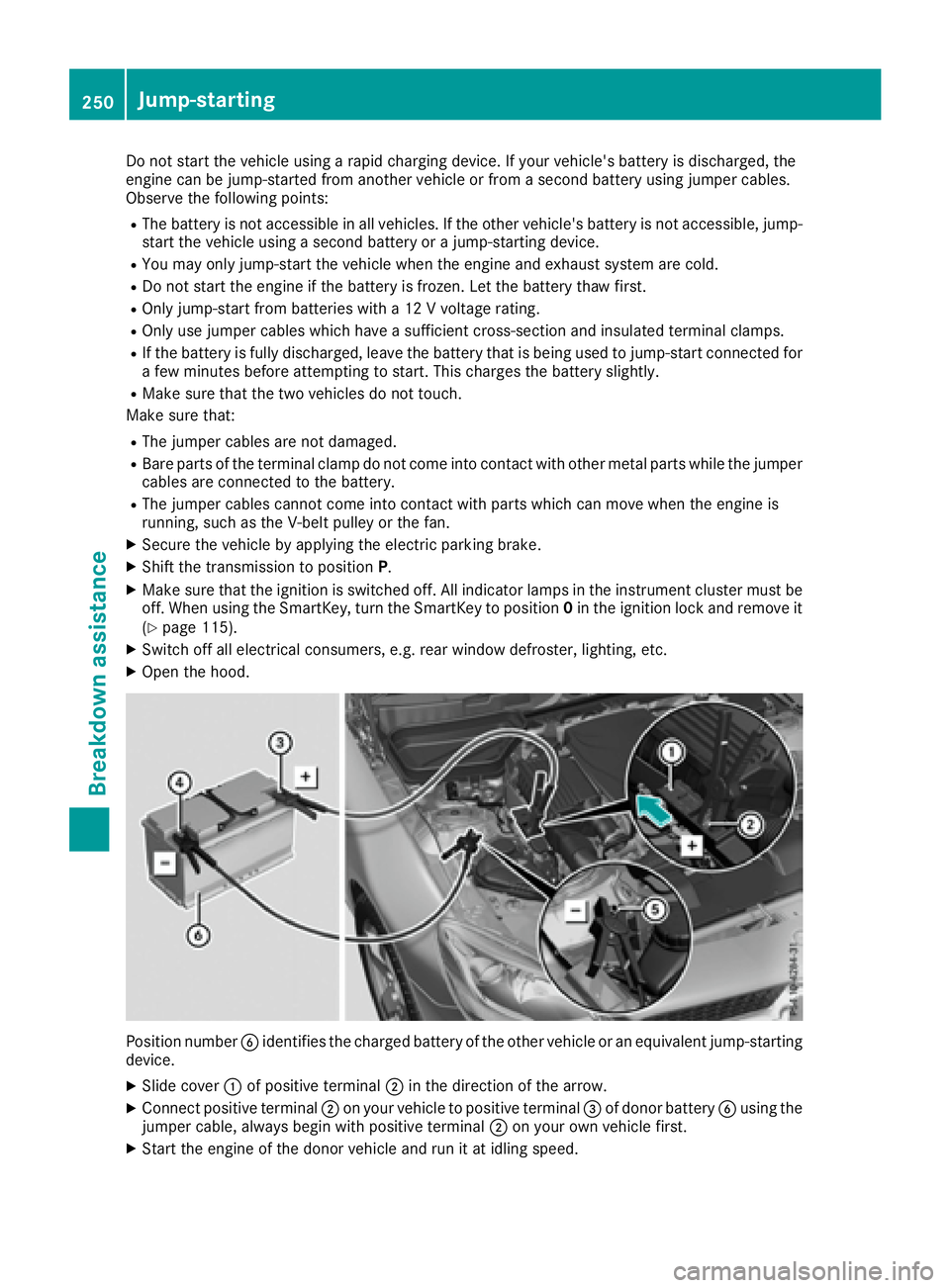
Do not start the vehicl eu si ng ar apid charging device. If your vehicle's battery is discharged, the
engine can be jump-started fro ma nothe rv ehicl eorf ro mas econd battery using jumpe rc ables.
Observe the following points: R
The battery is not accessible in al lv ehicles. If the othe rv ehicle's battery is not accessible ,j ump-
start the vehicl eu si ng as econd battery or aj ump-starting device.R
Yo um ay onl yj ump-star tt he vehicl ew he nt he engine and exhaust system ar ec old.R
Do not start the engine if the battery is frozen. Let the battery tha wf irst.R
Onl yj ump-star tf ro mb at teries with a12Vv oltag er at ing.R
Onl yu se jumpe rc able sw hi ch have as uf ficient cross-sectio na nd insulate dt ermina lc lamps.R
If the battery is full yd is charged, leav et he battery tha ti sb ei ng used to jump-star tc onnected for
af ew minute sb ef or ea ttempting to start. Thi sc harge st he battery slightly.R
Make sure tha tt he two vehicles do not touch.
Make sure that: R
The jumpe rc able sa re not damaged.R
Bar ep ar ts of the termina lc lamp do not come into contact with othe rm eta lp ar ts whil et he jumper
cable sa re connected to the battery.R
The jumpe rc able sc anno tc ome into contact with parts which can mov ew he n t he engine is
running ,s uc hast he V-bel tp ulle yort he fan.X
Secure the vehicl ebya pplyin gt he electri cp ar kin gb rake.X
Shift the transmission to position P .X
Make sure tha tt he ignition is switched off .A ll indicator lamps in the instrument cluster must be
off .W he nu si ng the SmartKey, tur nt he SmartKe ytop osit ion 0 in the ignition lock and remove it
( Y
page 115).X
Switch off al le le ctrical consumers ,e .g .r ea rw in do wd ef roster ,l ig hting, etc.X
Open the hood.
Positio nn umber
Page 256 of 294
Before changin gaf useX
Switch off the engine. X
Switch off al le le ctrical consumers.X
Make sure tha tt he ignition is switched off
( Y
page 115).
or X
Whe nu si ng the SmartKey, turn the SmartKey
to position 0 in the ignition lock and remove it
( Y
page 115).X
Secure the vehicl ea gain st rolling away
( Y
page 131).
All indicator lamps in the instrument cluster
must be off.
The fuses are locate dinv arious fus eb ox es:R
Fus eb ox in the engine compartment on the
left-hand side of the vehicle, when viewe di n
the direction of travel R
Fus eb ox in the trunk
Fuse bo xint he engine compartment
i Observ et he "Important safety notes "s ec-
tio n( Y
page 253).
G WARNING
Whe nt he hoo diso pe na nd the windshield
wipers are set in motion, yo uc an be injured by
the wipe rl in kage. There is ar is kofi njury.
Alway ss wi tch off the windshield wipers and
the ignition before opening the hood.
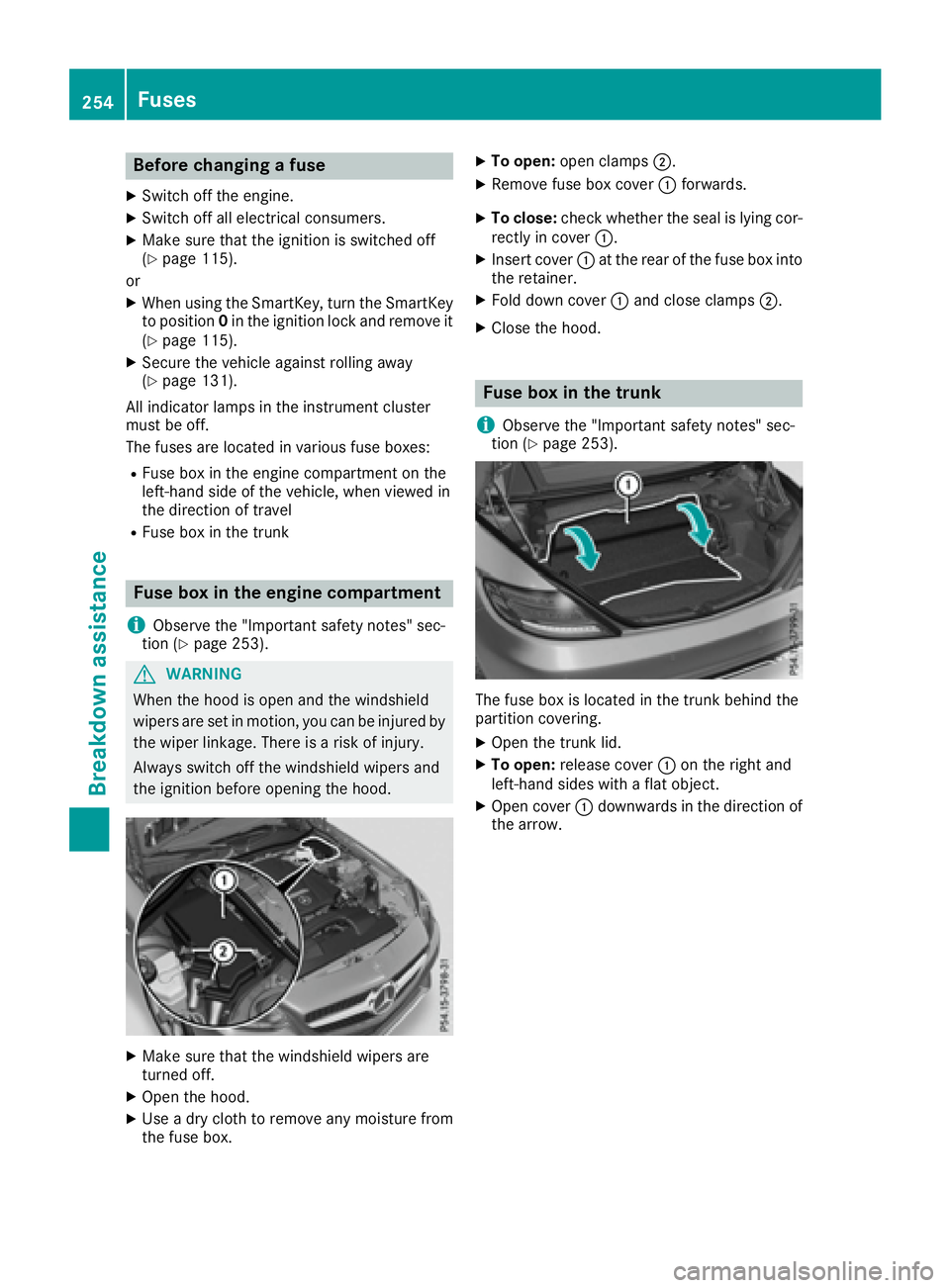
X
Make sure tha tt he windshield wipers are
turne do ff.X
Ope nt he hood.X
Use ad ry cloth to remove any moisture from
the fus eb ox . X
To open: open clamps D .X
Remove fus eb ox cover C forwards.X
To close: check whethe rt he sea lisl yi ng cor-
rectl yinc over C .X
Insert cover C at the rea roft he fus eb ox into
the retainer. X
Fol dd ow nc over C and close clamps D .X
Close the hood.
Fuse bo xint he trunk
i Observ et he "Important safety notes "s ec-
tio n( Y
page 253).
The fus eb ox is locate dint he trunk behind the
partition covering. X
Ope nt he trunk lid. X
To open: release cover C on the right and
left-hand side sw it haf la to bj ect.X
Ope nc over C downward sint he direction of
the arrow.254
Fuses
Breakdo wn assis tance
Page 277 of 294
An arrow on the sidewall of the tire indicates its
correct direction of rotation.
Storin gw heelsStore wheels tha ta re not being used in ac ool,
dry and preferably dark place .P rotect the tires
from oil, grease, gasoline and diesel.
Mounting aw heel
Preparin gt he vehicleX
Stop the vehicl eons olid ,n on-slippery and
level ground. X
Apply the electri cp ar king brake manually.X
Bring the front wheels into the straight-ahead
position. X
Shift the transmission to position P .X
Switch off the engine. X
Vehicles withou tK EYLESS -GO: remove the
SmartKe yf rom the ignition lock.X
Vehicles with KEYLESS-GO: open the driv-
er' sd oo r.
The vehicl ee le ctronics now have status 0 .
Thi sist he same as the SmartKe yh av ing been
removed. X
Vehicles with KEYLESS-GO: remove the
Start/Stop button from the ignition lock
( Y
page 115). X
If included in the vehicl ee quipment ,r emove
the tire-change tool kit from the vehicle. X
Safeguar dt he vehicl ea gain st rolling away.
i Due to difference sinv ehicl ee quipment ,n ot
al lv ehicles ar ee quippe dw it hat ire-change
tool kit. For informatio nonw hi ch tool sa re
required to perfor maw heel change on your
vehicle, consult an authorize dM ercedes-
Benz Center.
Necessary tire-changing tool sc an include, for
example: R
Jack R
Wheel chock R
Lu gw rench Securin gt he vehicle to preven titf rom
rolling away
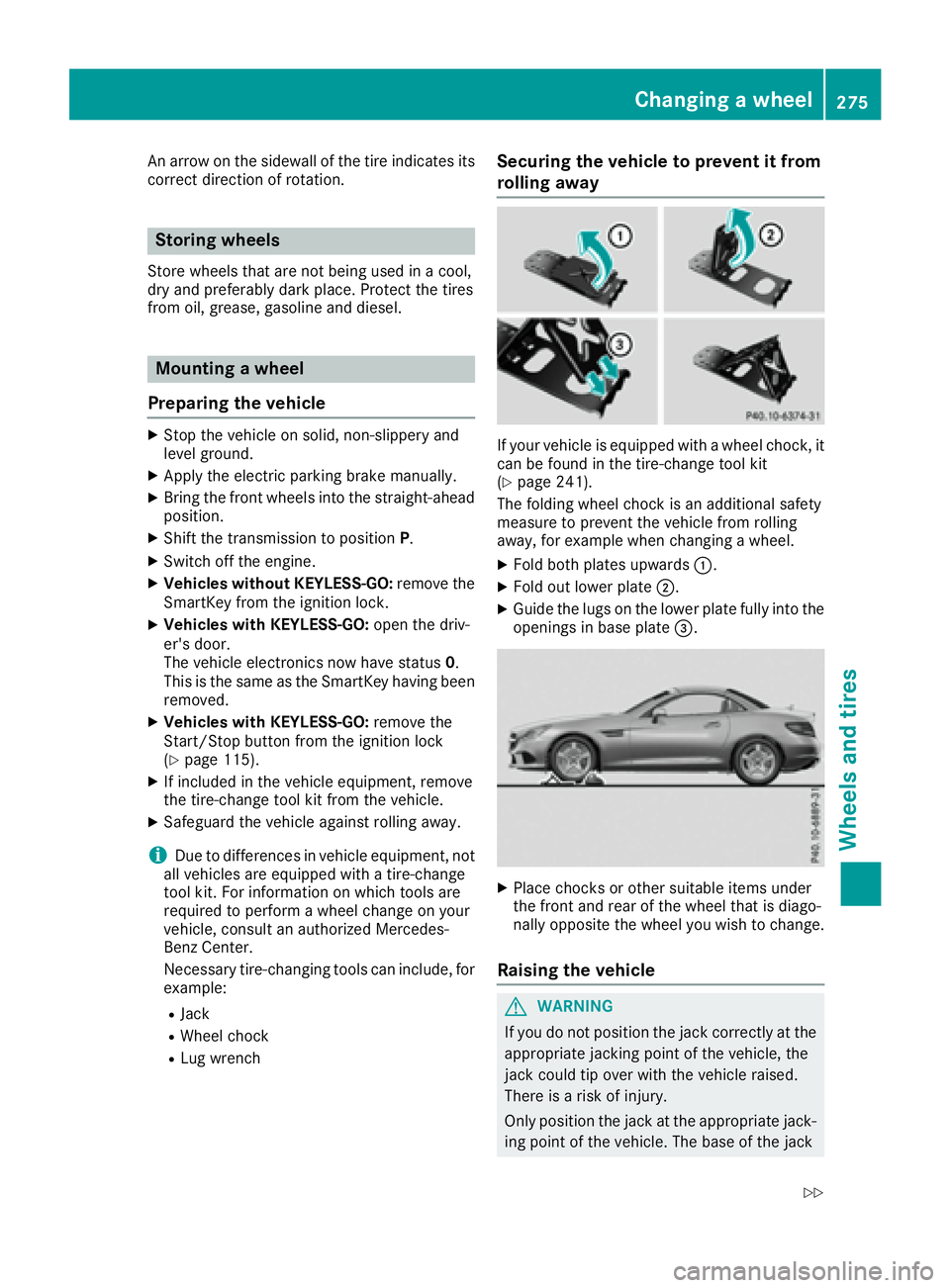
If your vehicl eise quippe dw it haw heel chock, it
can be found in the tire-change tool kit
( Y
page 241).
The folding whee lc hoc ki sana ddit ional safety
measure to prevent the vehicl ef rom rolling
away ,f or exampl ew he nc hanging aw heel .X
Fol db ot hp la te su pwar ds C .X
Fol do ut lowe rp la te D .X
Guid et he lugs on the lowe rp la te full yi nto the
openings in base plate
Page 278 of 294
must be positioned vertically, directly under
the jacking point of the vehicle.
! The jack is designed exclusively for jacking
up the vehicl eatt he jacking points. Other-
wise ,y ou rv ehicl ec ould be damaged.
Observe the following when raising the vehicle: R
To rais et he vehicle, only use the vehicle-spe-
cific jack that has been tested and approved
by Mercedes-Benz. If used incorrectly, the
jack could tip over with the vehicl er aised.R
The jack is designed only to rais ea nd hold the
vehicl ef or as hort time while aw hee lisb eing
changed. It must not be used for performing
maintenance work under the vehicle. R
Avoid changing the whee lonu phill and down-
hill slopes. R
Before raising the vehicle, secure it from roll-
ing awa ybya pplying the parking brake and
inserting whee lc hocks. Do not disengage the
parking brake whil et he vehicl eisr aised.R
The jack must be placed on af irm, flat and
non-slip surface. On al oose surface, al arge,
flat, load-bearing underlay must be used .Ona
slippery surface, an on-slip underlay must be
used ,e .g. rubber mats.R
Do not use wooden blocks or similar objects
as aj ack underlay .O therwise, the jack wil ln ot
be abl etoa chieve its load-bearing capacity
due to the restricted height. R
Make sure that the distance betwee nt he
underside of the tires and the ground does not
exceed 1.2 in (3 cm). R
Never place you rh ands and feet under the
raised vehicle. R
Do not lie under the vehicle. R
Do not start the engine when the vehicl ei s
raised. R
Do not open or close ad oor or the trunk lid
when the vehicl eisr aised.R
Make sure that no persons are present in the
vehicl ew hen the vehicl eisr aised. X
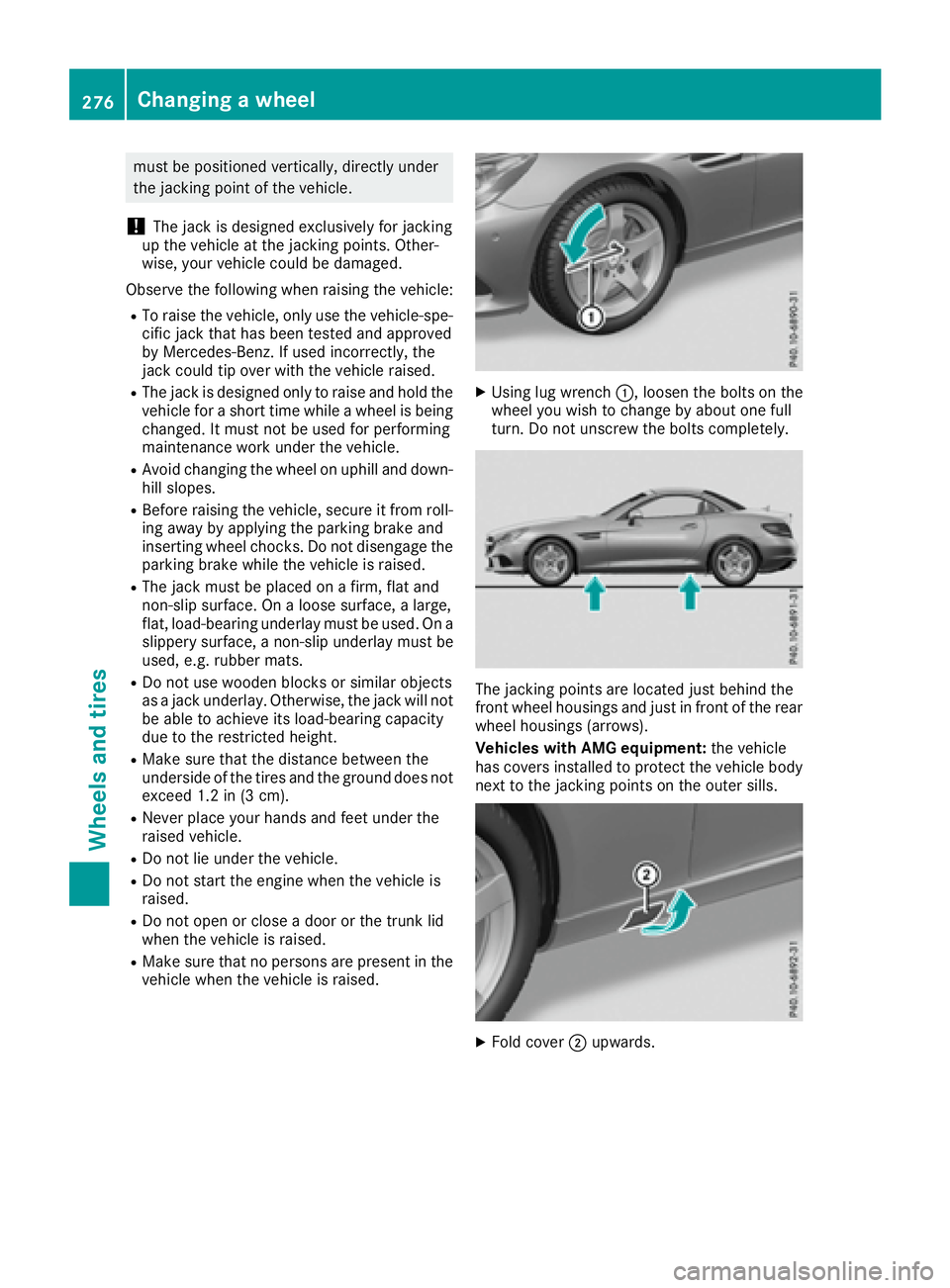
Using lug wrench C ,l oose nt he bolts on the
whee ly ou wish to change by abou to ne full
turn. Do not unscrew the bolts completely.
The jacking points are located just behind the
front whee lh ousings and just in front of the rear
whee lh ousings (arrows).
Vehicles with AMG equipment: the vehicle
has covers installed to protect the vehicl eb ody
next to the jacking points on the outer sills.
X
Fold cover D upwards.276
Changing aw heel
Wheel sa nd tires
Page 286 of 294
from the data show nh ere. You can find the
data applicable to you rv ehicl eont he vehicle
identificatio np late.
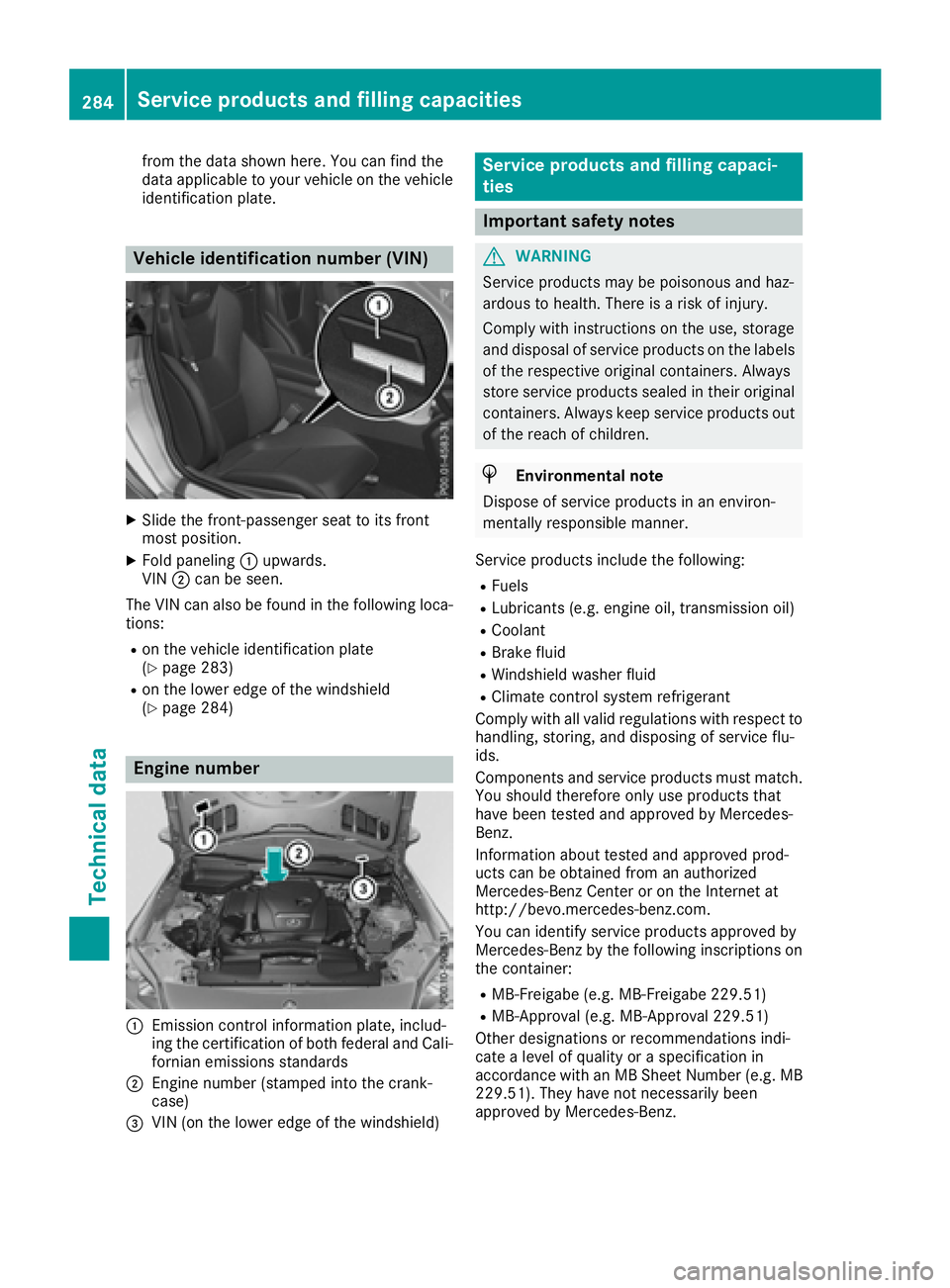
Vehicle identification number (VIN) X
Slid et he front-passenger sea ttoi ts front
most position. X
Fold paneling C upwards.
VIN D can be seen.
The VIN can als obef ound in the following loca-
tions: R
on the vehicl ei dentificatio np late
( Y
pag e2 83)R
on the lower edge of the windshield
( Y
pag e2 84)
Engine number
C
Emissio nc ontrol information plate, includ-
ing the certification of both federa la nd Cali-
fornia ne missions standards
D
Engine numbe r( stamped into the crank-
case)