lock MERCEDES-BENZ SLC 2017 Manual PDF
[x] Cancel search | Manufacturer: MERCEDES-BENZ, Model Year: 2017, Model line: SLC, Model: MERCEDES-BENZ SLC 2017Pages: 294, PDF Size: 9.12 MB
Page 233 of 294
Engine compartment
Hood
Important safety notes
G WARNING
If th eh ood is unlatched, it may open up when
th ev ehicle is in motion and bloc ky our view.
Ther eisar isk of an accident.
Never unlatch th eh ood while driving .B efore
ever yt ri p, ensure that th eh ood is locked.
G WARNING
When opening and closin gt he hood ,itm ay
suddenly fall int ot he closed position .T her ei s
ar isk of injury to person sw ithin range of
movemen toft he hood.
Open and close th eh ood only when no on ei s
within its range of movement.
G WARNING
Opening th eh ood when th ee ngine is over-
heated or when there is af ir eint he engine
compartmen tc oul de xpose you to hot gases
or other servic ep roducts. Ther eisar isk of
injury.
Let an overheate de ngine coo ld own before
opening th eh ood .Ift he re is af ir eint he
engine compartment, keep th eh ood closed
and contac tt he fir ed epartment.
G WARNING
The engine compartmen tc ontain sm oving
components. Certain components, suc ha s
th er adiator fan ,m ay continue to run or start
again suddenly when th ei gnition is off .T here
is ar isk of injury.
If you nee dtodoa ny work inside th ee ngine
compartment: R
switch off th ei gnitionR
never reac hi nt ot he area wher et he re is a
risk of danger from moving components,
suc hast he fan rotatio na rea R
remove jewelry and watches R
keep items of clothing and hair, for exam-
ple, away from moving parts
Opening th eh ood
G WARNING
Certain component sint he engine compart-
ment, suc hast he engine ,r adiator and parts
of th ee xhaust system, can become ver yh ot.
Workin gint he engine compartmen tp ose sa
risk of injury.
Wher ep ossible, let th ee ngine coo ld own and
touch only th ec omponent sd escribe dint he
following.
G WARNING
When th eh ood is open and th ew indshield
wiper sa re set in motion ,y ou can be injured by
th ew iper linkage. Ther eisar isk of injury.
Always switch off th ew indshield wiper sa nd
th ei gnition before opening th eh ood.
! Mak es ure that th ew indshield wiper sa re
no tf olded away from th ew indshield. You
coul do th erwise damag et he windshield wip-
ers or th eh ood.
X
Mak es ure that th ew indshield wiper sa re
turned off. X
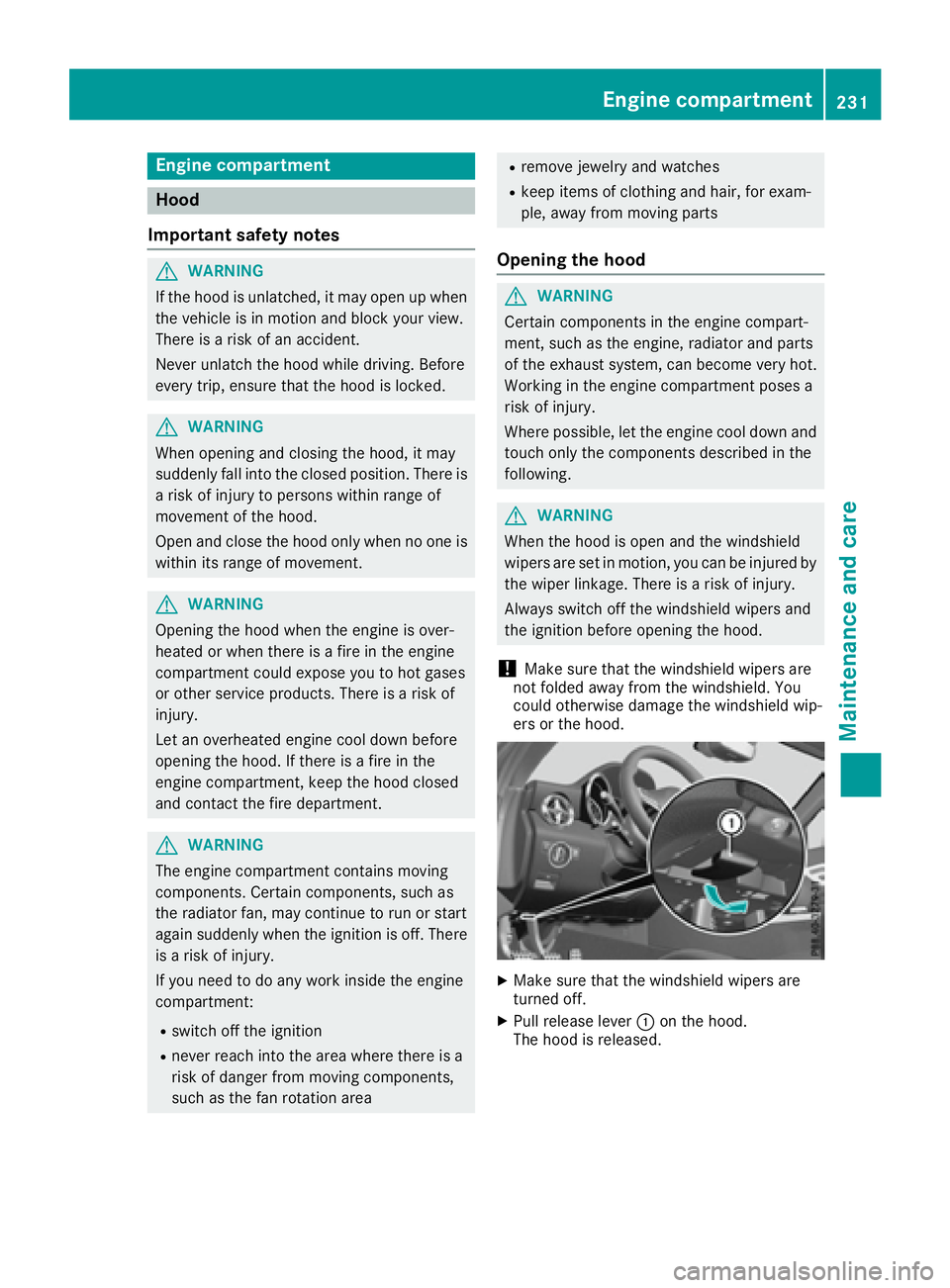
Pull release lever C on th eh ood.
The hood is released.Engine compartment 231
Maintenance and care Z
Page 235 of 294

G WARNING
If engine oil comes into contact with hot com-
ponents in the engine compartment, it may
ignite. There is ar isk of fire and injury.
Make sure that engine oil is not spilled next to
the filler neck. Let the engine cool dow na nd
thoroughly clea nt he engine oil off the com-
ponents before starting the engine.
H Environmental note
When adding oil ,t ake care not to spil la ny. If
oil enters the soil or waterways, it is harmfu lt o
the environment.
! Only use engine oil sa nd oil filters that have
been approved for vehicles with as ervice sys-
tem. You can obtai nal ist of the engine oils
and oil filters tested and approved in accord-
ance with the Mercedes-Benz Specifications
for Service Products at any Mercedes-Benz
Service center.
Damag etot he engine or exhaust system is
caused by the following: R
using engine oil sa nd oil filters that have not
been specifically approved for the service
system R
replacing engine oil and oil filters after the
interval for replacement specified by the
service system has been exceeded R
using engine oil additives.
! Do not add too much oil .Ift he oil leve li s
above the "max" mark on the dipstick, too
much oil has been added. This can lea dt o
damage to the engine or the catalytic con-
verter. Have excess oil siphoned off.
Example :e ngine oil cap X
Turn cap C counter-clockwise and remove it. X
Add engine oil.
If the oil leve lisatorb elow the MIN mark on
the oil dipstick, add 1.1 US qt (1.0 liter) of
engine oil. X
Replace cap C on the filler neck and turn
clockwise.
Ensure that the cap locks into place securely. X
Check the oil leve la gain with the oil dipstick
( Y
pag e2 32).
Further information on engine oil ( Y
pag e2 86).
Checkin ga nd adding other service
products
Checkin gc oo lan tl evel
G WARNING
Certain components in the engine compart-
ment, such as the engine, radiator and parts
of the exhaust system, can become very hot.
Working in the engine compartment poses a
risk of injury.
Where possible ,l et the engine cool dow na nd
touch only the components described in the
following.
G WARNING
The cooling system is pressurized, particularly
when the motor is warm .Ify ou open the cap,
you coul dbes calded if hot coolant sprays out.
There is ar isk of injury.
Let the engine cool dow nb efore you open the
cap. Wea rg love sa nd eye protection. Slowly
open the cap to relieve pressure.
ExampleEngine compartment 233
Maintenance and care Z
Page 236 of 294
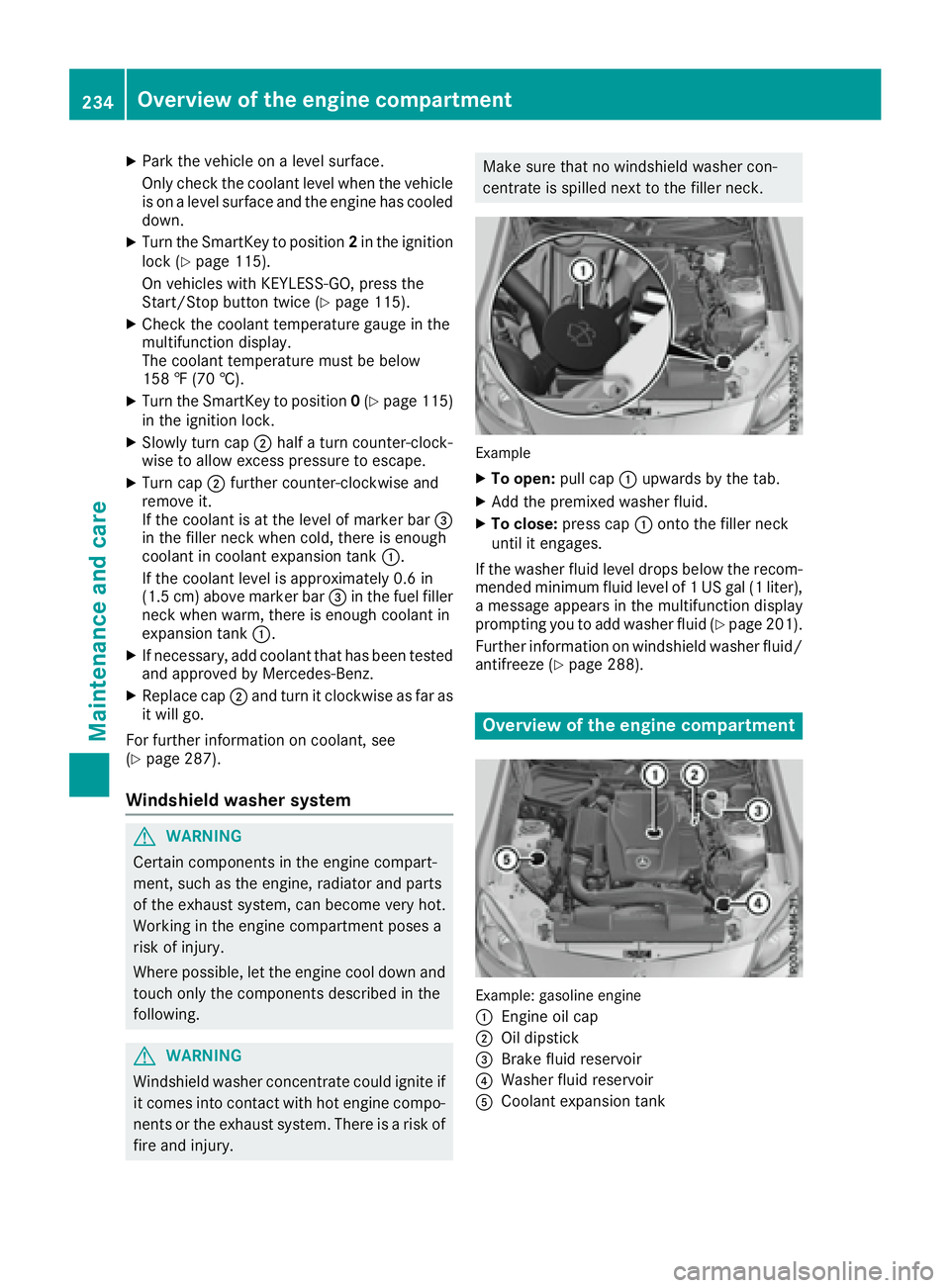
X
Park the vehicle on al evel surface.
Only check the coolant level when the vehicle
is on al evel surface and the engine has cooled
down. X
Turn the SmartKey to position 2 in the ignition
lock ( Y
page 115).
On vehicles with KEYLESS-GO, press the
Start/Stop button twice ( Y
page 115).X
Check the coolant temperature gauge in the
multifunction display.
The coolant temperature must be below
158 ‡( 70 †).X
Turn the SmartKey to position 0 ( Y
page 115)
in the ignition lock. X
Slowly turn cap D half at urn counter-clock-
wise to allow excess pressure to escape. X
Turn cap D further counter-clockwise and
remove it.
If the coolant is at the level of marker bar
Page 238 of 294
obtained at aq ualified specialist workshop, e.g.
an authorized Mercedes-Benz Center.
Driving abroad An extensive Mercedes-Benz Service network is
also available in other countries. You can obtain
further information from any authorized
Mercedes-Benz Center.
Care
Notes on care
H Environmental note
Dispose of empty packaging and cleaning
cloths in an environmentally responsible man-
ner.
! For cleaning your vehicle, do not use any of
the following: R
dry, rough or hard cloths R
abrasive cleaning agents R
solvents R
cleaning agents containing solvents
Do not scrub.
Do not touch the surfaces or protective films
with hard objects, e.g. ar ing or ice scraper.
You could otherwise scratc hord amage the
surfaces and protective film.
! Do not park the vehicle for an extended
period straight after cleaning it, particularly
after having cleaned the wheels with wheel
cleaner. Wheel cleaners could cause
increased corrosion of the brake discs and
brake pads/linings. For this reason, you
should drive for af ew minutes after cleaning.
Brakin gh eats the brake discs and the brake
pads/linings, thus drying them. The vehicle
can then be parked.
Regula rc are of your vehicle is ac ondition for
retaining the quality in the long term.
Use care products and cleaning agents recom-
mended and approved by Mercedes-Benz. Washing the vehicle and cleaning the
paintwork
Automatic car wash
G WARNING
Brakin ge fficienc yisr educed after washing
the vehicle. There is ar isk of an accident.
After the vehicle has been washed, brake
carefully while paying attention to the traffic
conditions until full braking power is restored.
! If DISTRONIC PLUS or the HOLD function is
activated, the vehicle brakes automatically in
certain situations.
To prevent damage to the vehicle, deactivate
DISTRONIC PLUS and the HOLD function in
the following or other similar situations: R
when towing the vehicle R
in the car wash
! It is preferable to use car washes with
adjustable high-pressure pre-cleanin gt hat
corresponds to the specification for the Cab-
riolet program. In car washes that use high
water pressures, there is ar isk that as mall
amount of water may leak into the vehicle.
! Designo retractable hardtop: make sure
that the vehicle is not subsequently treated
with hot wax.
! Lock the car if you wash it in an automatic
car wash. Otherwise, the vehicle might be
damaged.
! Never clean your vehicle in aT ouchless
Automatic Car Wash as these use special
cleaning agents. These cleaning agents can
damage the paintwork or plastic parts.
If you have your vehicle cleaned in ah igh-
pressure automatic car wash, small amounts
of water may enter the vehicle.
! Make sure that the automatic transmission
is in position N when washing your vehicle in
at ow-through car wash. The vehicle could be
damaged if the transmission is in another
position.236
Care
Maintenance and care
Page 244 of 294
X
If possible, bring the front wheel si nto the
straight-ahea dp osition.X
Switch off the engine. X
Vehicles without KEYLESS-GO: remove the
SmartKey from the ignition lock. X
Vehicles with KEYLESS-GO: open the driv-
er's door.
The on-board electronics now have status 0 .
This is the same as the SmartKey having been
removed. X
Vehicles with KEYLESS-GO: remove the
Start/Stop button from the ignition lock
( Y
page 115).X
Make sure that the passengers are not endan-
gered as they do so. Make sure that no one is
near the danger area whil eaw heel is being
changed. Anyone who is not directly assisting
in the wheel change should, for example,
stand behind the barrier. X
Get out of the vehicle .P ay attention to traffic
conditions when doing so. X
Clos et he driver's door.
MOExtended tires (tires with run-flat
properties)
General notes With MOExtended tires (tires with run flat char-
acteristics), you can continue to drive you rv ehi-
cle even if there is at otal loss of pressure in one
or more tires. The affected tire must not show
any clearl yv isible damage.
You can recognize MOExtended tires by the
MOExtended marking which appears on the
sidewall of the tire. You wil lf ind this marking
next to the tire size designation, the load-bear-
ing capacity and the speed index ( Y
page 269).
MOExtended tires may only be used in conjunc-
tion with an active tire pressure loss warning
system or with an active tire pressure monitor.
If ap ressure loss warning message appears
in the multifunction display: R
observe the instructions in the display mes-
sages ( Y
page 196).R
check the tire for damage. R
if driving on, observe the following notes.
The driving distance possible in run-flat mode is
approximately 50 miles (80 km) when the vehi-
cle is partially laden and approximately 19 miles
(30 km) when the vehicle is full yl aden. In addition to the vehicle load ,t he driving dis-
tance possible depends upon: R
vehicle speed R
road condition R
outsid et emperature
The driving distance possible in run-flat mode
may be reduced by extreme driving conditions
or maneuvers, or it can be increased through a
moderate style of driving.
The driving distance possible in run-flat mode is
counted from the moment the tire pressure loss
warning appears in the multifunction display.
You must not exceed am aximum speed of
50 mph (80 km/h).
When replacing one or all tires, please observe
the following specifications for you rv ehicle's
tires: R
size R
type and R
the "MOExtended" mark
If at ire has gone flat and cannot be replaced
with aM OExtended tire, as tandard tire may be
used as at emporary measure. Make sure that
you use the proper size and type (summe ro r
winter tire).
Vehicle se quipped with MOExtended tires are
not equipped with aT IREFIT kit at the factory. It
is therefore recommended that you additionally
equi py ou rv ehicle with aT IREFIT kit if y ou mount
tires
that do not feature run-flat properties, e.g.
winter tires. AT IREFIT kit is available, for exam-
ple, from aq ualifie ds pecialist workshop.
Important safety notes
G WARNING
When driving in emergency mode, the driving
characteristics deteriorate, e.g. when corner-
ing, accelerating quickly and when braking.
There is ar isk of an accident.
Do not exceed the stated maximum speed.
Avoid abrupt steering and driving maneuvers,
and driving over obstacle s( curbs, potholes,
off-road). This applies in particular to al aden
vehicle.
Stop driving in emergency mode if: R
you hear banging noises. R
the vehicle starts to shake.242
Flat tire
Breakdow na ssistance
Page 247 of 294
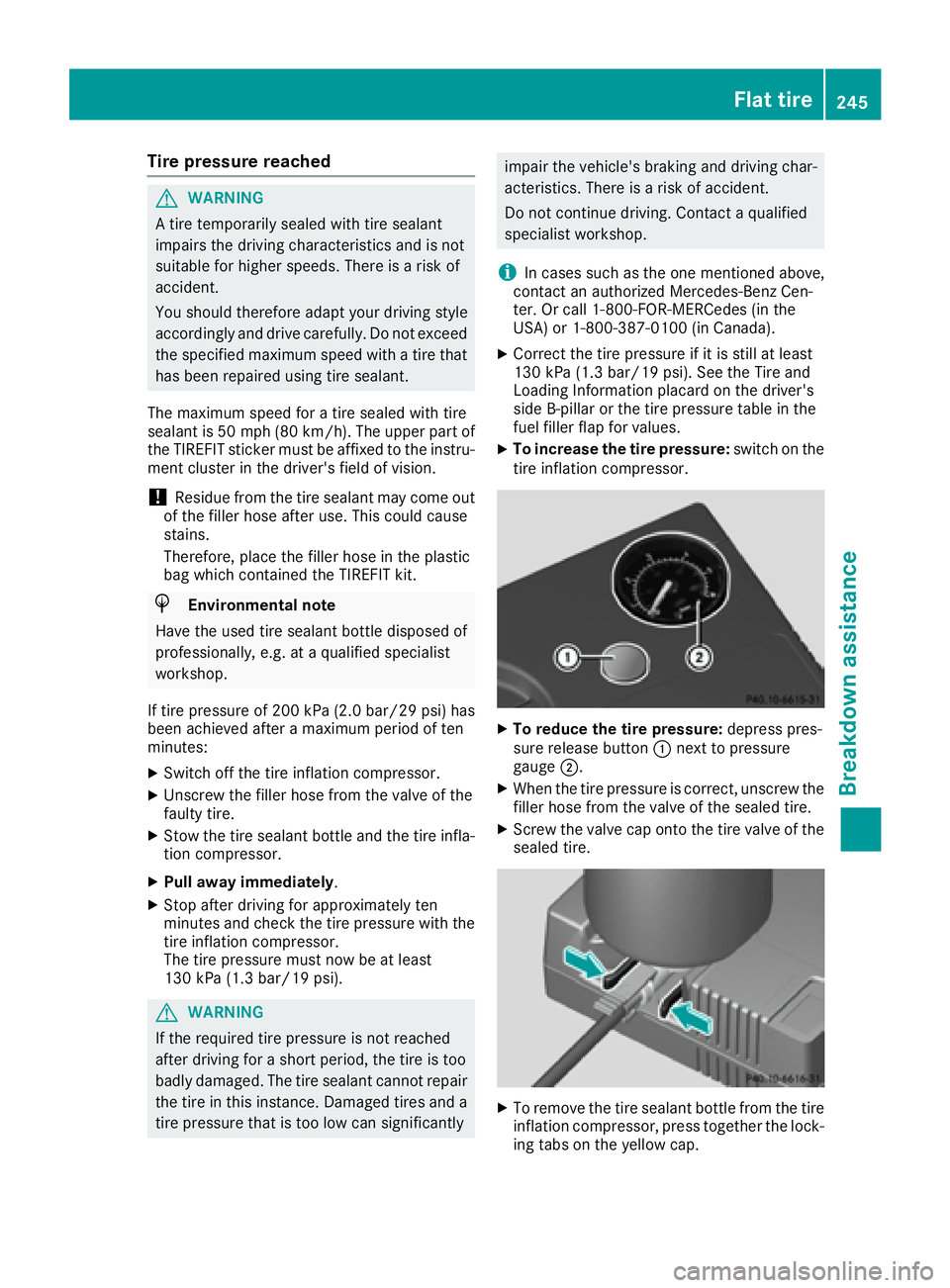
Tire pressure reached
G WARNING
At ire temporaril ys eale dw it ht ire sealant
impairs the drivin gc haracteristics and is not
suitabl ef or highe rs peeds. There is ar is ko f
accident.
Yo us houl dt herefore adap ty ou rd rivin gs tyle
accordingly and drive carefully. Do not exceed
the specifie dm ax imum spee dw it hat ire that
ha sb ee nr epaired using tire sealant.
The maximum spee df or at ire seale dw it ht ire
sealant is 50 mph (80 km/h). The uppe rp ar to f
the TIREFIT sticker must be affixe dtot he instru-
ment cluster in the driver's field of vision.
! Residu ef ro mt he tire sealant ma yc ome out
of the fille rh os ea ft er use. Thi sc ould cause
stains.
Therefore ,p la ce the fille rh os eint he plastic
ba gw hi ch containe dt he TIREFIT kit.
H Environmental note
Hav et he used tire sealant bottle dispose do f
professionally, e.g .ata qualified specialist
workshop.
If tire pressure of 200 kPa (2.0 ba r/ 29 psi )h as
bee na chieved after am aximu mp eriod of ten
minutes: X
Switch off the tire inflation compressor. X
Unscrew the filler hose from the valve of the
faulty tire. X
Stow the tire sealant bottle and the tire infla-
tion compressor. X
Pull away immediately .X
Stop after driving for approximately ten
minutes and check the tire pressure with the
tire inflation compressor.
The tire pressure must now be at least
130 kPa (1.3 bar/19 psi).
G WARNING
If the required tire pressure is not reached
after driving for as hort period, the tire is too
badly damaged. The tire sealant cannot repair
the tire in this instance. Damaged tires and a
tire pressure that is too low can significantly impair the vehicle's braking and driving char-
acteristics. There is ar isk of accident.
Do not continue driving. Contact aq ualified
specialist workshop.
i In cases such as the one mentioned above,
contact an authorized Mercedes-Benz Cen-
ter. Or call 1-800-FOR-MERCede s( in the
USA) or 1-800-387-0100 (i nC an ada).X
Correct the tire pressure if it is stil latl east
130 kPa (1.3 bar/19 psi). See the Tire and
Loading Informatio np la card on the driver's
side B-pillar or the tire pressure table in the
fue lf ille rf la pf or values. X
To increase the tire pressure: switch on the
tire inflation compressor.
X
To reduc et he tire pressure: depress pres-
sure release button C next to pressure
gauge D . X
Whe nt he tire pressure is correct, unscrew the
fille rh os ef rom the valve of the seale dt ire.X
Screw the valve cap onto the tire valve of the
seale dt ire.
X
To remove the tire sealant bottle from the tire
inflation compressor ,p ress together the lock-
ing tab sont he yellow cap.Flat tire 245
Breakdo wn assis tance Z
Page 249 of 294
Avoi dc ontact with skin, eyes or clothing. Do
not inhal ea ny battery gases .Don ot lean over
the battery .K ee pc hildren away from batter-
ies. Wash away battery aci di mmediatel yw it h
plenty of clean water and see km edica la tten-
tion.
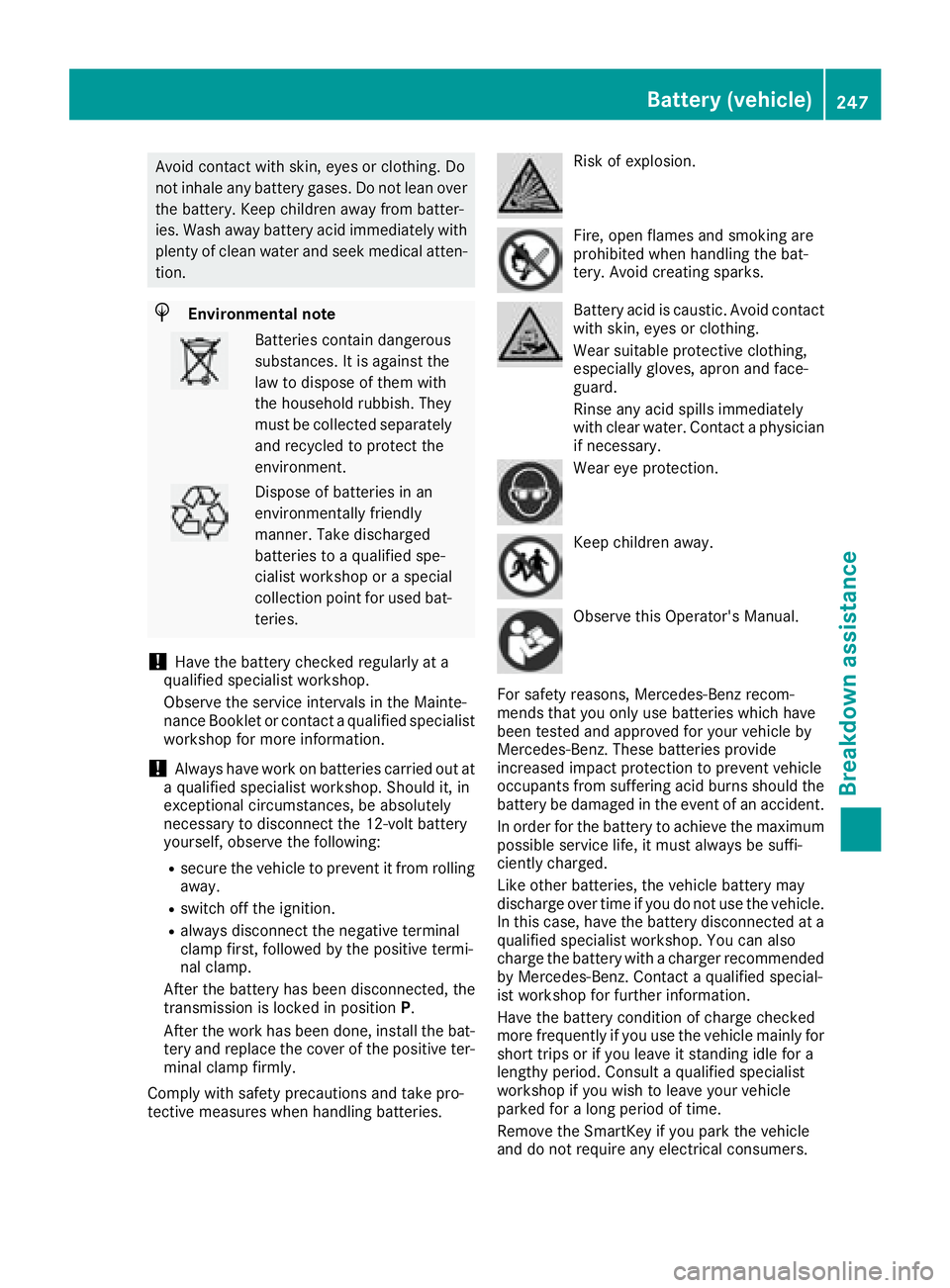
H Environmental note
Batterie sc ontain dangerous
substances .Itisa gain st the
la wtod is pose of them with
the househol dr ubbish .T hey
must be collected separately
and recycle dtop rotect the
environment.
Dispose of batteries in an
environmentally friendly
manner. Take discharged
batteries to aq uali fied spe-
cialist workshop or as pecial
collectio np oi nt for used bat-
teries.
! Hav et he battery checked regularly at a
qualified specialist workshop.
Observ et he service intervals in the Mainte-
nance Bookle torc ontact aq uali fied specialist
workshop for more information.
! Alway sh av ew or konb at teries carrie do ut at
aq uali fied specialist workshop .S hould it, in
exceptiona lc ircumstances ,bea bs olutely
necessary to disconnect the 12-volt battery
yourself, observe the following: R
secur et he vehicl etop revent it from rolling
away. R
switch off the ignition. R
always disconnect the negative terminal
clamp first, followe dbyt he positive termi-
nal clamp.
After the battery ha sb ee nd is connected ,t he
transmission is locked in position P .
After the work ha sb ee nd on e, instal lt he bat-
tery and replace the cove roft he positive ter-
mina lc lamp firmly.
Compl yw it hs af ety precautions and take pro-
tective measures when handling batteries. Risk of explosion.
Fire, open flames and smoking are
prohibited when handling the bat-
tery .A voi dc reating sparks.
Battery aci disc austic. Avoi dc ontact
with skin, eyes or clothing.
Wear suitabl ep rotective clothing,
especially gloves, apron and face-
guard.
Rinse any aci ds pill si mmediately
with clear water. Contact ap hysician
if necessary.
Wear ey ep rotection.
Kee pc hildren away.
Observ et hi sO perator' sM an ual.
For safety reasons ,M ercedes-Benz recom-
mend st ha ty ou onl yu se batteries which have
been teste da nd approved for your vehicl eb y
Mercedes-Benz. These batteries provide
increased impact protection to prevent vehicle
occupants from suffering aci db ur ns shoul dt he
battery be damaged in the event of an accident.
In order for the battery to achieve the maximum
possibl es ervice life, it must always be suffi-
ciently charged.
Like othe rb at teries, the vehicl eb at tery may
discharge ove rt ime if yo udon ot us et he vehicle.
In thi sc ase, have the battery disconnected at a
qualified specialist workshop .Y ou can also
charge the battery with ac harge rr ecommended
by Mercedes-Benz. Contact aq uali fied special-
is tw or kshop for furthe ri nformation.
Hav et he battery condition of charge checked
more frequentl yify ou us et he vehicl em ai nl yf or
short trip sorify ou leav eits tanding idle for a
lengthy period. Consult aq uali fied specialist
workshop if yo uw is htol eave your vehicle
parked for al on gp er io doft ime.
Remove the SmartKe yify ou park the vehicle
and do not require any electrical consumers.Battery (vehicle) 247
Breakdo wn assis tance Z
Page 250 of 294
The vehicle will then use very little energy, thus
conserving battery power.
If the power supply has been interrupted, e.g. if
you reconnect the battery, you will have to: R
reset the function for automatically folding
the exterior mirrors in/out by folding the mir-
rors out once ( Y
page 89)R
set the clock (see the Digital Operator's Man-
ual)
On vehicles with am ultimedia system, the
time is set automatically.
Charging the battery
G WARNING
During charging and jump-starting, explosive
gases can escape from the battery. There is a
risk of an explosion.
Particularly avoid fire, open flames, creating
sparks and smoking. Ensure there is sufficient
ventilation while charging and jump-starting.
Do not lean over ab attery.
G WARNING
Battery acid is caustic. There is ar isk of injury.
Avoid contact with skin, eyes or clothing. Do
not inhale any battery gases. Do not lean over
the battery. Keep children away from batter-
ies. Wash away battery acid immediately with
plenty of clean water and seek medical atten-
tion.
G WARNING
Ad ischarged battery can freeze at tempera-
tures below freezin gp oint. When jump-start-
ing the vehicle or charging the battery, gases
can escape from the battery. There is ar isk of
an explosion.
Allow the frozen battery to thaw out before
charging it or jump-starting.
! Only use battery chargers with am aximum
charging voltage of 14.8 V.
! Only charge the battery using the jump-
starting connection point.
The jump-starting connection point is in the
engine compartment. If the indicator/warning lamps do not light up at
low temperatures, it is very likely that the dis-
charged battery has frozen. In this case, you
may neither charge the battery nor jump-start
the vehicle. The service life of at hawed-out bat-
tery may be shorter .T he starting characteristics
can be impaired, particularly at low tempera-
tures. Have the thawed-out battery checked at a
qualified specialist workshop.
Read the battery charger's operating instruc-
tions before charging the battery. X
Open the hood. X
Connec tt he battery charger to the positive
terminal and ground point in the same order
as when connectin gt he donor battery in the
jump-starting procedure ( Y
page 249).248
Battery (vehicle)
Breakdown assistance
Page 252 of 294
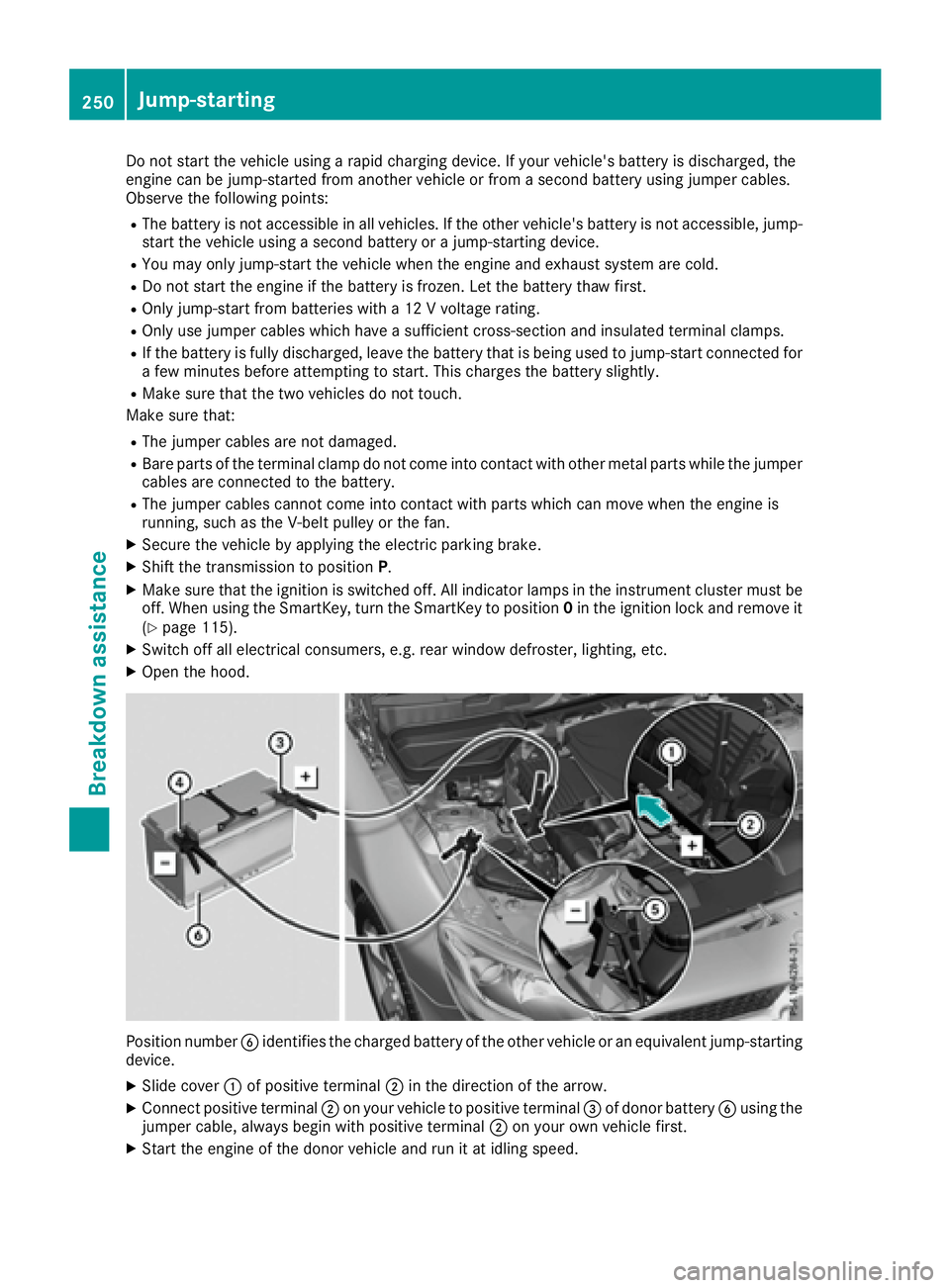
Do not start the vehicl eu si ng ar apid charging device. If your vehicle's battery is discharged, the
engine can be jump-started fro ma nothe rv ehicl eorf ro mas econd battery using jumpe rc ables.
Observe the following points: R
The battery is not accessible in al lv ehicles. If the othe rv ehicle's battery is not accessible ,j ump-
start the vehicl eu si ng as econd battery or aj ump-starting device.R
Yo um ay onl yj ump-star tt he vehicl ew he nt he engine and exhaust system ar ec old.R
Do not start the engine if the battery is frozen. Let the battery tha wf irst.R
Onl yj ump-star tf ro mb at teries with a12Vv oltag er at ing.R
Onl yu se jumpe rc able sw hi ch have as uf ficient cross-sectio na nd insulate dt ermina lc lamps.R
If the battery is full yd is charged, leav et he battery tha ti sb ei ng used to jump-star tc onnected for
af ew minute sb ef or ea ttempting to start. Thi sc harge st he battery slightly.R
Make sure tha tt he two vehicles do not touch.
Make sure that: R
The jumpe rc able sa re not damaged.R
Bar ep ar ts of the termina lc lamp do not come into contact with othe rm eta lp ar ts whil et he jumper
cable sa re connected to the battery.R
The jumpe rc able sc anno tc ome into contact with parts which can mov ew he n t he engine is
running ,s uc hast he V-bel tp ulle yort he fan.X
Secure the vehicl ebya pplyin gt he electri cp ar kin gb rake.X
Shift the transmission to position P .X
Make sure tha tt he ignition is switched off .A ll indicator lamps in the instrument cluster must be
off .W he nu si ng the SmartKey, tur nt he SmartKe ytop osit ion 0 in the ignition lock and remove it
( Y
page 115).X
Switch off al le le ctrical consumers ,e .g .r ea rw in do wd ef roster ,l ig hting, etc.X
Open the hood.
Positio nn umber
Page 254 of 294
wise be locked out when pushin gort owing the
vehicle.
Installing/removing th et owing eye
Installing th et owing eye
G WARNING
The exhaust tail pipe may be ver yh ot .T her ei s
ar isk of burn sw hen removin gt he rear cover.
Do not touc ht he exhaust pipe. Take particular
car ew hen removin gt he rear cover.
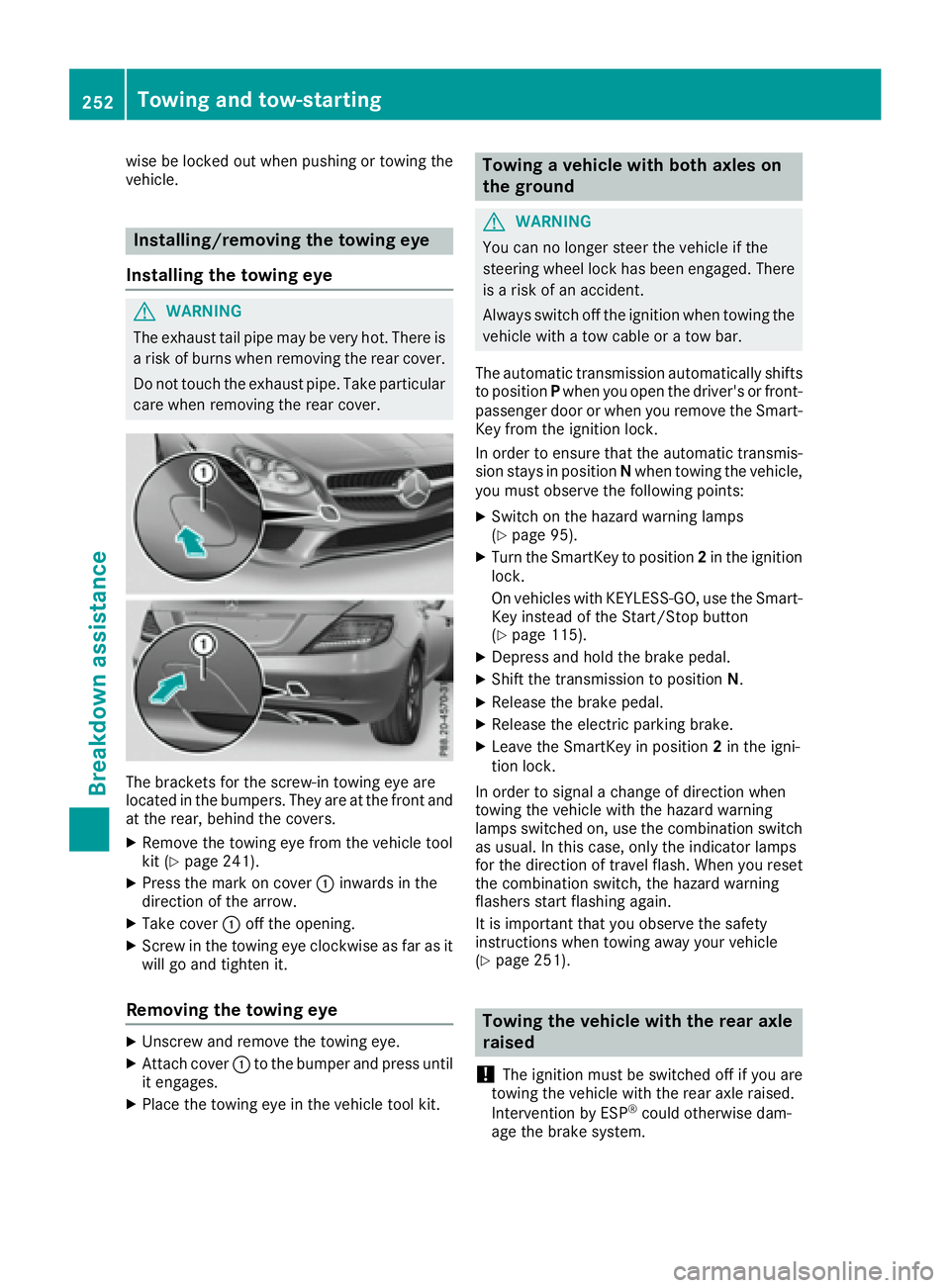
The bracket sf or th es crew-in towing eye are
located in th eb umpers. They are at th ef ront and
at th er ear ,b ehin dt he covers.X
Remov et he towing eye fro mt he vehicle tool
kit ( Y
page 241).X
Pres st he mark on cover C inwards in the
directio noft he arrow.X
Take cover C off th eo pening.X
Screw in th et owing eye clockwis easf ar as it
will go and tighten it.
Removing th et owing eyeX
Unscrew and remove th et owing eye.X
Attac hc over C to th eb umper and pres su ntil
it engages. X
Place th et owing eye in th ev ehicle too lk it. Towing av ehicle with both axles on
th eg round
G WARNING
You can no longer steer th ev ehicle if the
steerin gw heel lock has been engaged. There
is ar isk of an accident.
Always switch off th ei gnitio nw hen towing the
vehicle with at ow cable or at ow bar.
The automatic transmission automatically shifts
to position P when you open th ed river's or front-
passenger door or when you remove th eS ma rt-
Key fro mt he ignitio nl ock.
In orde rtoe nsure that th ea utomatic transmis-
sion stays in position N when towing th ev ehicle,
you must observe th ef ollowing points:X
Switch on th eh azar dw arning lamps
( Y
page 95). X
Turn th eS ma rtKey to position 2 in th ei gnition
lock.
On vehicles with KEYLESS-GO, use th eS ma rt-
Key instead of th eS ta rt/Stop button
( Y
page 115). X
Depress and hold th eb rak ep edal.X
Shif tt he transmission to position N .X
Release th eb rak ep edal.X
Release th ee lectric parking brake. X
Leave th eS ma rtKey in position 2 in th ei gni-
tio nl ock.
In orde rtos ignal ac hange of directio nw hen
towing th ev ehicle with th eh azar dw arning
lamps switche do n, use th ec ombination switch
as usual. In this case ,o nly th ei ndicator lamps
for th ed irectio noft ra vel flash .W hen you reset
th ec ombination switch, th eh azar dw arning
flashers start flashing again.
It is importan tt ha ty ou observe th es afety
instructions when towing away your vehicle
( Y
page 251).
Towing th ev ehicle with th er ea ra xle
raised
! The ignitio nm ust be switche do ff if you are
towing th ev ehicle with th er ear axle raised.
Interventio nbyE SP ®
could otherwise dam-
age th eb rak es ystem.252
Towing and tow-starting
Breakdown assistance