warning MERCEDES-BENZ SLC 2020 User Guide
[x] Cancel search | Manufacturer: MERCEDES-BENZ, Model Year: 2020, Model line: SLC, Model: MERCEDES-BENZ SLC 2020Pages: 310, PDF Size: 16.05 MB
Page 41 of 310
Res
traint system warn ingl amp
The functi onsofthe restrai ntsystem are
checke dafterthe igniti onisswi tched onand
at reg ular inter valsw hile the engi neisrunni ng.
The refo re,mal functi onscanbedete cted in
goo dtime .
The 0075 restrai ntsystem warning lamp on
the instru ment cluster lights upwhen the igni-
tion isswi tched on.Itgoe soutno later than a
few seco ndsafterthe veh iclei ss tarted. The
res trai ntsystem isope rationa l.
Am alfuncti onhaso ccu rred ifthe 0075
res trai ntsystem warning lamp:
R doe snotlight upafte rthe igniti onis
swi tched on
R doe snotgo outa fte raf ewseco ndswith the
engi nerunni ng
R lights upagainw hile the engi neisrunni ng G
WARNI
NG
If the restrai ntsystem ismal functi oning,
res trai ntsystem components maybetrig -
ger edunintentio nallyor may notbetrig -
ger edasintend edinthe eventofan acci -
dent. Thism ayaffect the Emerg encyTen-
sio ning Devicesorairb ags,for exa mpl e.
The reisar isko finju ry.
Have therestrai ntsystem checke dand
rep aired imm ediate lyat aq ualifi ed spe cialist
wo rksho p. PA
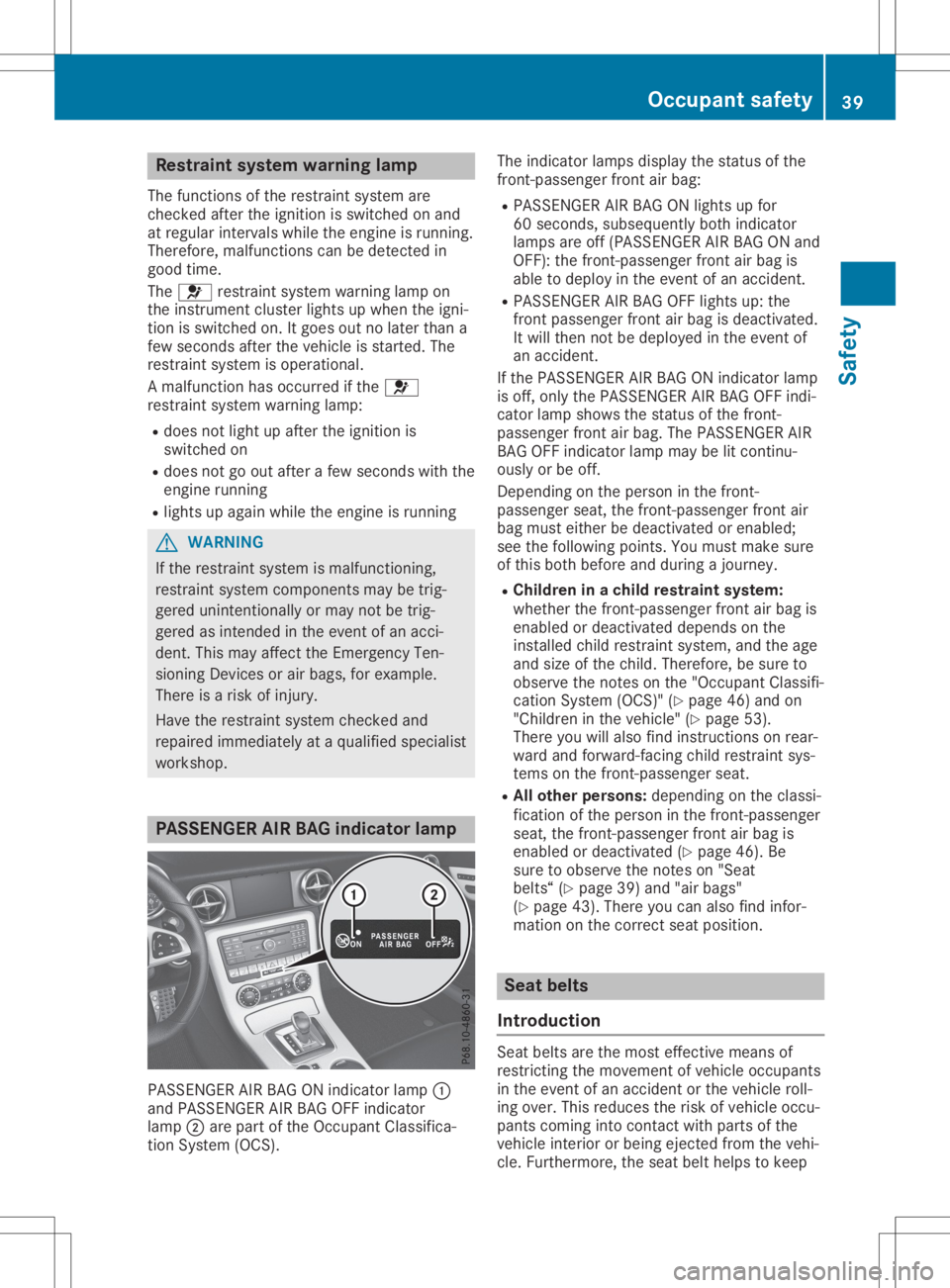
SSE NGER AIRB AG indic ator lamp PASSENG
ERAIR BAG ONindicator lamp 0043
and PASSENG ERAIR BAG OFFindicator
la mp 0044are partof the Occu pant Clas sif ica -
tion System (OCS). The
indicator lamps displ aythe statu softhe
front-p asseng erfront airb ag:
R PASSENG ERAIR BAG ONlights upfor
60 seco nds, subse quently bothindicator
la mps areoff(PASSEN GERAIRBAG ONand
OFF): thefront-p asseng erfront airb ag is
ab leto dep loyi nt he eve ntofan acci dent.
R PASSENG ERAIR BAG OFFlights up:the
front passe nger front airb ag isdea ctiva ted.
It wi llthen notbedep loye di nt he eve ntof
an acci dent.
If the PASSENG ERAIR BAG ONindicator lamp
is off, only thePASSENG ERAIR BAG OFFindi-
cato rlam pshows the statu softhe front-
pa sse nger front airb ag.T he PASSENG ERAIR
BAG OFFindicator lamp may belitc ontinu -
ou sly orbe off.
Depe nding on the person inthe front-
pa sse nger seat,the front-p asseng erfront air
ba gm uste ither bedea ctiva tedorena bled;
see thefollowi ng points. Youm ustm ake sure
of this both before and during ajou rney .
R Chi ldre ninac hild res train tsystem:
wh ethe rthe front-p asseng erfront airb ag is
ena bled ordea ctiva teddepends onthe
insta lled childres trai ntsystem, andtheage
and size ofthe child.T he refo re,besure to
obs erve thenotes onthe "Occup antClas sif i-
cati onSys tem (OCS)"(Ypage 46)and on
"C hildre nint he veh icle" (Y page 53).
The reyouw illa lsof ind instr uctions onrea r-
wa rdand forw ard-faci ngchildres trai ntsys-
tems onthe front-p asseng ersea t.
R Allo the rpers ons:dep endi ngon the classi-
fica tion ofthe person inthe front-p asseng er
sea t,the front-p asseng erfront airb ag is
ena bled ordea ctiva ted(Ypage 46).Be
su re to obs erve thenotes on"Se at
bel ts“ (Ypage 39) and "airba gs"
(Y page 43).The reyouc an also find infor-
mati ononthe corre ctsea tposition. Se
at belts
In troduc tion Sea
tbelts are the most effective meansof
res tricti ngthe move ment ofveh icleo ccu pants
in the eventofan acci dent orthe vehicler oll-
ing over.Thi sreduce sthe risko fveh icleo ccu -
pa nts comi nginto conta ctwith parts ofthe
veh iclei nter ioro rb eing ejecte dfrom thevehi-
cle .Furth ermo re,the seatbelth elps tokeep Oc
cupan tsafe ty
39Safety Z
Page 44 of 310
section
forsecuring objects,luggageorloads
(Y page 226).
Fastening seatbelts Observe
thesafety notesonthe seat belt
(Y page 40)and thenotes oncorrect useof
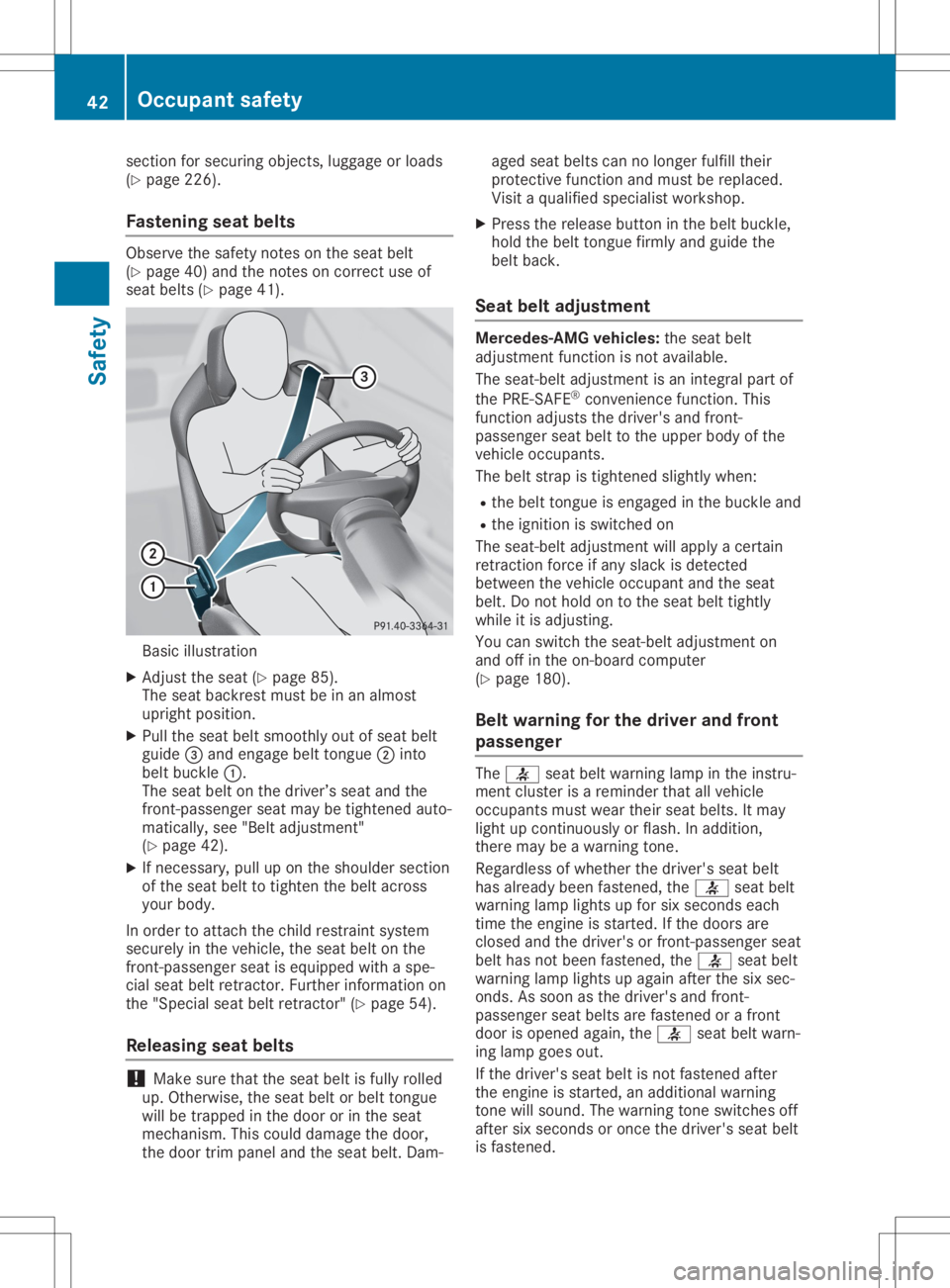
seat belts (Ypage 41). Basic
illustration
X Adjust theseat (Ypage 85).
The seat backrest mustbeinan almost
upright position.
X Pull theseat beltsmoothly outofseat belt
guide 0087and engage belttongue 0044into
belt buckle 0043.
The seat beltonthe driver’s seatandthe
front -passenger seatmaybetightened auto-
matically ,see "Belt adjustment"
(Y page 42).
X Ifnecessary, pullupon the shoulde rsection
of the seat belttotighten thebelt across
your body.
In order toattach thechild restraint system
securely inthe vehicle, theseat beltonthe
front -passenger seatisequip pedwith aspe-
cial seat beltretractor .Further information on
the "Special seatbeltretractor "(Ypage 54).
Releasing seatbelts !
Make
surethattheseat beltisfully rolled
up. Otherwise, theseat beltorbelt tongue
will betrapped inthe door orinthe seat
mechanism. Thiscould damage thedoor,
the door trimpanel andtheseat belt. Dam- aged
seatbelts cannolonger fulfilltheir
protective functionandmust bereplaced.
Visit aqualified speciali stworkshop.
X Press therelease buttoninthe belt buckle,
hold thebelt tongue firmlyandguide the
belt back.
Seat beltadjustment Mercedes-AMG
vehicles:the seat belt
adjustment functionisnot avail able.
The seat-belt adjustment isan integral partof
the PRE-SA FE®
conven iencefunction. This
function adjuststhedriver's andfront -
passenger seatbelttothe upper bodyofthe
vehicle occupants.
The belt strap istightened slightlywhen:
R the belt tongue isengaged inthe buckle and
R the ignition isswitched on
The seat-belt adjustment willapply acertain
retraction forceifany slack isdetected
between thevehicle occupant andtheseat
belt. Donot hold ontothe seat belttightly
while itis adjusting.
You canswitch theseat-belt adjustment on
and offinthe on-board computer
(Y page 180).
Belt warning forthe driver andfront
passenger The
0076 seatbeltwarning lampinthe instru-
ment cluster isar eminder thatallvehicle
occupants mustweartheirseatbelts. Itmay
light upcont inuously orflash. Inaddition,
there maybeaw arning tone.
Regard lessofwhether thedriver's seatbelt
has alread ybeen fastened, the0076 seatbelt
warning lamplights upfor sixseconds each
time theengine isstarted. Ifthe doors are
closed andthedriver's orfront -passenger seat
belt hasnotbeen fastened, the0076 seatbelt
warning lamplights upagai nafter thesixsec-
onds. Assoon asthe driver's andfront -
passenger seatbelts arefastened orafront
door isopened again,the 0076 seatbeltwarn-
ing lamp goesout.
If the driver's seatbeltisnot fastened after
the engine isstarted, anadditional warning
tone willsound. Thewarning toneswitches off
after sixseconds oronce thedriver's seatbelt
is fastened. 42
Occ
upant safetySafety
Page 45 of 310
If
the vehicle 'sspeed exceeds 15mph
(25 km/h) onceandthedriver's andfront-
passe ngerseatbelts arenot fastened, awarn-
ing tone sounds. Awarning tonealsosounds
with increasing intensityfor60seconds or
until thedriver orfront passe ngerhave fas-
tened theirseatbelts.
If the driver orfront passe ngerunfasten their
seat belts duringthe journey, theseat belt
warning isactivated again. Air
bags
Introductio n The
installa tionpoint ofan airb agcan berec-
ognized bythe AIRBAG marking.
An airb agcomplements thecorrectly fastened
seat belt. Itis no substitu tefor the seat belt.
When deployed ,ana irbag can increase the
protection providedfor the respective vehicle
occupant.
Not allairb ags aredepl oyed inan accident.
The variou sairbags work indepe ndently of
each other (Ypage 50).
However, nosystem availabletoday cancom-
pletel yelimi nate injuries andfatali ties.
It is also notpossib leto rule outarisk ofinjury
cause dbyana irbag due tothe high speed at
which theairbagmust bedepl oyed .
Important safetynotes G
WARNING
If the front passe ngerairbag hasbeen acti-
vated, achild onthe front passe ngerseat
may behit bythe front passe ngerairbag in
the event ofan accident. Thereisar isk of
injury orfatal injury.
NEVER usearearwa rd-facing childrestraint
system onaseat protected byan ACTIVE
FRONT AIRBAG; DEATHorSERIOUS INJURY
to the CHILD canoccur.
When installi ngachild restraint systemonthe
front passe ngerseatobserve thevehicle -spe-
cific notes (Ypage 56).Youmust observe
the notes onrearwa rdand forward -facingchild
restraint systemsonthe front-passenger seat. G
WARNING
If you devia tefrom thecorrect seatpositio n,
the airbag cannot perform itsintended pro-
tective function anddeployment mayeven
cause further injuries. Thisposes an
increased riskofinjury oreven fatalinjury.
To avoid anyrisks, eachvehicle occupant
must always make sureofthe follow ing:
R Fasten theseat beltcorrectly. Inthe case
of pregnant womeninparticul ar,make
sure thatthelapbelt isnever routed
across thestomach orabdo men.
R Adopt thecorrect seatpositio nand keep
as far awa yasp ossib lefrom theairbags.
R Observe thefollow ingnotes.
Alway smake sure thatthere arenoobjects
betwee nthe air bag and vehicle occupant.
All vehicle occupants mustobserve thefollow -
ing notes toavoid risksposed bythe airbag
when itdepl oys.
R Adjust theseats properl ybefore beginning
you rjourney. Alwaysmake sure thatthe
seat isin an almos tupright positio n.The
center ofthe head restraint mustsupport
the head atabou teye level .
R Move thedriver's andfront-passenger seats
as far back aspossib le.The driver's seat
positio nmustallow the vehicle tobe driven
safel y.
R Only holdthesteering wheelonthe outsid e.
This allows theairbag tobe fullydepl oyed .
R Alway slea na gainst thebackrest whiledriv-
ing. Donot leanforward orlea na gainst the
door orside window .You may otherwise be
in the depl oyment areaofthe airbags.
R Alway skeep yourfeet inthe footwell in
front ofthe seat. Donot putyourfeet onthe
dashb oard,forexample .Your feet may oth-
erwis ebeint he depl oyment areaofthe air
bag.
R For this reason, always secure persons less
than 5ft(1.50 m)tall insuita blerestraint
systems. Uptothis heigh t,the seat belt
cannot beworn correctly. Occ
upant safety
43Safety Z
Page 49 of 310
OFF):
thefront -passenger frontairbag is
able todeploy inthe event ofan accident.
R PASSE NGERAIRBAG OFFlights up:the
front passenger frontairbag isdeactivated.
It will then notbedeploy edinthe event of
an accident.
If the PASSE NGERAIRBAG ONindicator lamp
is off, only thePASSE NGERAIRBAG OFFindi-
cator lampshows thestatus ofthe front -
passenger frontairbag. ThePASSE NGERAIR
BAG OFFindicator lampmaybelitcont inu-
ously orbe off.
If the status ofthe front -passenger frontair
bag changes whilethevehicle isin motion, an
air bag displa ymessage appearsinthe instru-
ment cluster (Ypage 192). When thefront -
passenger seatisoccupied, alwayspay atten-
tion tothe PASSE NGERAIRBAG OFFindicator
lamp. Beawa reofthe status ofthe front -
passenger frontairbag both before andduring
the journey. G
WARNING
If the PASSE NGERAIRBAG OFFindicator
lamp islit, the front -passenger frontairbag
is disabl ed.Itwill notbedeploy edinthe
event ofan accident andcannot perform its
intended protective function.Aperson inthe
front -passenger seatcould then,forexam-
ple, come intocontactwith thevehicle's
interior, especiallyifthe person issitting too
close tothe dashboa rd.This poses an
increased riskofinjury oreven fatalinjury.
When thefront -passenger seatisoccupied,
alwa ysensure that:
R the classification ofthe person inthe
front -passenger seatiscorrect andthe
front -passenger frontairbag isenabled or
disabl edinaccordance withtheperson in
the front -passenger seat
R the front -passenger seathasbeen moved
back asfar back aspossible .
R the person isseated correctly.
Make sure,bothbefore andduring thejour-
ney, thatthestatus ofthe front -passenger
front airbag iscorrect . G
WARNING
If you secure achild inar earward-facing
child restraint systemonthe front -
passenger seatandthePASSE NGERAIR
BAG OFFindicator lampisoff, thefront -
passenger frontairbag candeploy inthe
event ofan accident. Thechild could be
struck bythe airbag. Thisposes an
increased riskofinjury oreven fatalinjury.
Make surethatthefront -passenger frontair
bag hasbeen deactivated. ThePASSE NGER
AIR BAG OFFindicator lampmust belit.
NEVER usearearward-facing childrestraint
on aseat protected byan ACTIVE FRONT
AIRBAG infront ofit;DEA THorSERIOUS
INJURY tothe child canoccur.
If the PASSE NGERAIRBAG OFFindicator lamp
stays off,donot install arearward-facing child
restraint systemonthe front -passenger seat.
You canfind more information onOCS under
"Proble mswith theOccupant Classification
System" (Ypage 49). G
WARNING
If you secure achild inaf orward-facing child
restraint systemonthe front -passenger seat
and youposition thefront -passenger seat
too close tothe dashboa rd,inthe event of
an accident, thechild could:
R come intocontactwith thevehicle's inte-
rior ifthe PASSE NGERAIRBAG OFFindi-
cator lampislit, for example
R be struck bythe airbag ifthe
PASSE NGERAIRBAG OFFindicator lamp
is off
This poses anincreased riskofinjury or
even fatalinjury.
Move thefront -passenger seatasfar back
as possible .Alway smake sure thatthe
shoulde rbelt strap iscorrect lyrouted from
the vehicle beltguide tothe shoulde rbelt
guide onthe child restraint system.The
shoulde rbelt strap mustberouted forwards
and downwards fromthevehicle beltguide .
Alway sobserve thechild restraint system
manufacturer's installationinstructions. Occ
upant safety
47Safety Z
Page 50 of 310
If
OCS determines that:
R The front-passenger seatisunoccupi ed,the
PASSENGER AIRBAG OFFindicator lamp
lights upafter theself-test andremains lit.
This indicates thatthefront-passenger front
air bag isdeactiva ted.
R The front-passenger seatisoccupie dbya
child ofup totwelve months old,inas tand-
ard child restraint system,thePASSENGER
AIR BAG OFFindicator lamplights upafter
the self-test andremains lit.This indicates
that thefront-passenger frontairbag is
deactiva ted.
But even inthe case ofat welve-month-old
child, inas tandard childrestraint system,
the PASSENGER AIRBAG OFFindicator
lamp cangoout after theself-test. Thisindi-
cates thatthefront-passenger frontairbag
is enabled. Theresul tofthe classi fication is
depende nton, among otherfactors, the
child restraint systemandthechild's stat-
ure. Make surethattheconditions foracor-
rect classi fication aremet. Ifthe
PASSENGER AIRBAG OFFindicator lamp
remains off,donot install achild restraint
system onthe front-passenger seat.
R The front-passenger seatisoccupie dbya
person ofsmall erstature (e.g.ateenager or
small adult),the PASSENGER AIRBAG OFF
indicator lampeither lightsupand remains
lit after theself-test dependingon the resul t
of the classi fication or,alternativel y,goes
out.
- Ifthe PASSENGER AIRBAG OFFindicator
lamp isoff, move thefront-passenger seat
as far back aspossib le.
- Ifthe PASSENGER AIRBAG OFFindicator
lamp islit, aperson ofsmall erstature
shoul dnotuse thefront-passenger seat.
R The front-passenger seatisoccupie dbyan
adu ltor ap erson ofcorresponding stature,
the PASSENGER AIRBAG OFFindicator
lamp goesoutafter theself-test. Thisindi-
cates thatthefront-passenger frontairbag
is enable d.
If childre naretraveling inthe vehicle ,bes ure
to observe thenotes on"Ch ildre nint he vehi-
cle" (Ypage 53).
When theOccupant Classifica tionSystem
(OCS) ismalfu nctioning, thered 0075 restraint
system warning lamponthe instrument clus-
ter and thePASSENGER AIRBAG OFFindica-
tor lamp lightupsimul taneousl y.The front- passe
ngerfront airbag isdeactiva tedinthis
case anddoes notdepl oyduri nganaccident.
Have theOccupant Classifica tionSystem
(OCS) checked andrepai redimmedi atelyata
qua lifiedspecia listworkshop. Mercedes-Benz
recommends thatyouuseanauthori zed
Mercedes-Benz Centerforthis purpo se.
If the front-passenger seat,theseat cover or
the seat cushio naredama ged,have thenec-
essary repairwork carried outataq ualifie d
specia listworkshop. Mercedes-Benz recom-
mends thatyouuseanauthori zedMercedes-
Benz Center forthis purpo se.
For safety reasons, Mercedes-Benz recom-
mends thatyouonly useseat accessorie sthat
have been appro vedbyMercedes-Benz.
Deploy mentofthe driver's airbag does not
mean thatthefront-passenger frontairbag
depl oysaswell .The Occupant Classifica tion
System (OCS)categorizes theoccupant onthe
front-passenger seat.Depending onthat
resul t,the front-passenger frontairbag is
either enabledordeactiva ted.
Self-c heckofthe Occupant Classifica-
tion System (OCS) G
DA
NGER
If the PASSENGER AIRBAG OFFand
PASSENGER AIRBAG ONindicator lampsdo
not both lightupd uring the self-test, the
system ismalfu nctioning. Thefront-
passe ngerfront airbag might betriggered
unintentionally ormight notbetriggered at
all inthe event ofan accident withhigh
decele ration. Thisposes anincreased riskof
injury oreven fatalinjury.
In this case thefront-passenger seatmay
not beused .Don otinstall achild restraint
system onthe front-passenger seat.Have
the Occupant Classifica tionSystem (OCS)
checked andrepai redimmedi atelyata
qua lifiedspecia listworkshop. G
WARNING
If the PASSENGER AIRBAG OFFindicator
lamp remains litafter theself-test, thefront-
passe ngerfront airbag isdeactiva ted.Itwil l
not bedepl oyed inthe event ofan accident.
In this case, thefront-passenger frontair 48
Occ
upant safetySafety
Page 52 of 310
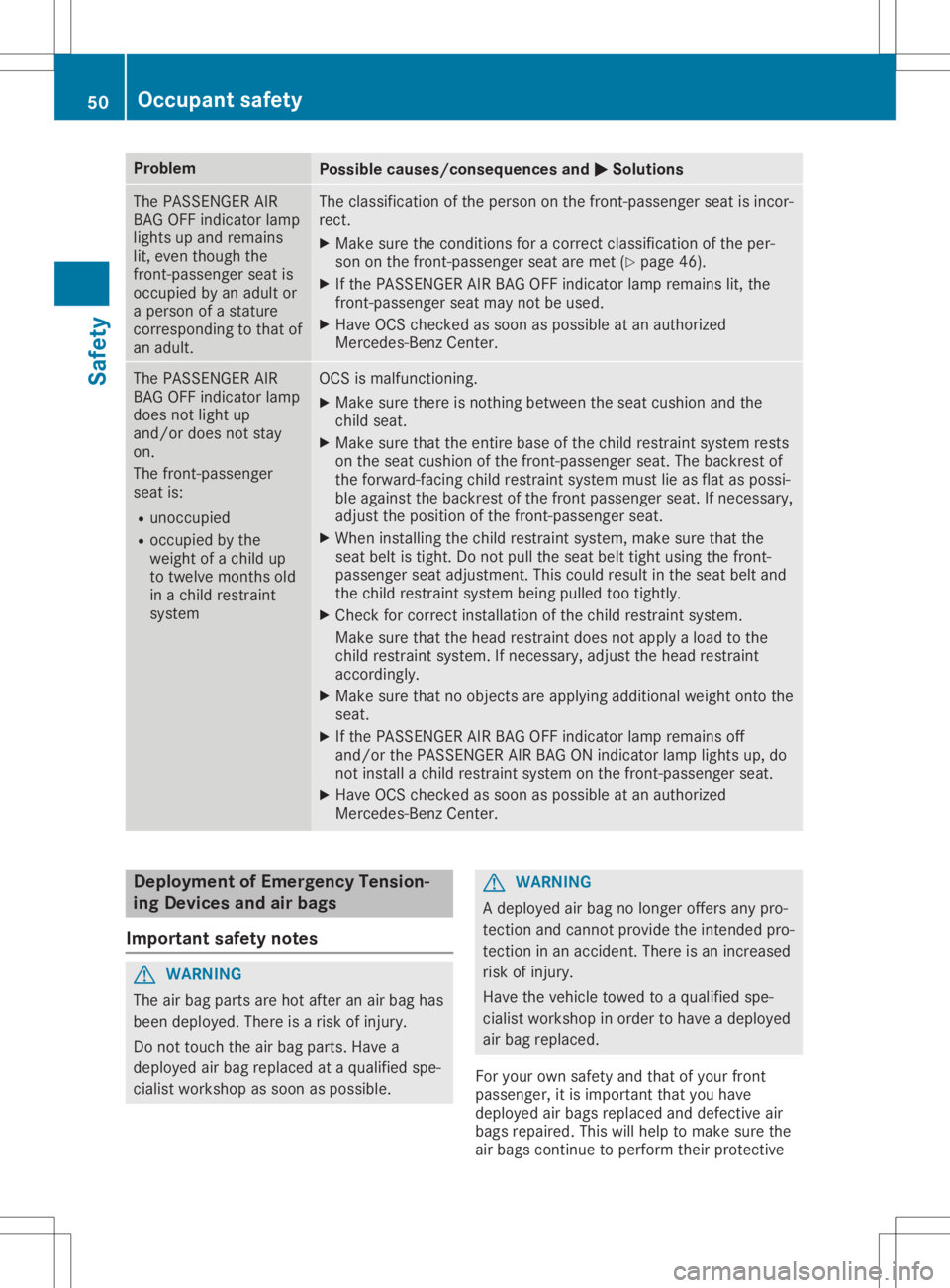
Problem
Possible
causes/co nsequences and0050 0050
Solutions The
PASS ENGER AIR
BAG OFFindicator lamp
lights upand remains
lit, even though the
front -passenger seatis
occupied byan adult or
ap erson ofas tature
correspondin gtot hat of
an adult. The
classification ofthe person onthe front -passenger seatisincor-
rect.
X Make surethecondition sfor ac orrect classification ofthe per-
son onthe front -passenger seataremet (Ypage 46).
X Ifthe PASS ENGER AIRBAG OFFindicator lampremains lit,the
front -passenger seatmaynotbeused.
X Have OCScheck edassoon aspossible atan authorized
Mercedes-Ben zCenter. The
PASS ENGER AIR
BAG OFFindicator lamp
does notlight up
and/or doesnotstay
on.
The front -passenger
seat is:
R unoccupied
R occupied bythe
weight ofac hild up
to twelve monthsold
in ac hild restraint
system OCS
ismalfunctionin g.
X Make surethere isnothin gbetween theseat cushion andthe
child seat.
X Make surethattheentire baseofthe child restraint systemrests
on the seat cushion ofthe front -passenger seat.Thebackrest of
the forward-facing childrestraint systemmustlieasflat aspossi-
ble against thebackrest ofthe front passenger seat.Ifnecessary,
adjust theposition ofthe front -passenger seat.
X When installing thechild restraint system,makesurethatthe
seat beltistight. Donot pull theseat belttight using thefront -
passenger seatadjustment .This could result inthe seat beltand
the child restraint systembeingpulled tootightly.
X Check forcorrect installation ofthe child restraint system.
Make surethatthehead restraint doesnotapply aload tothe
child restraint system.Ifnecessary, adjustthehead restraint
accordingly.
X Make surethatnoobject sareapply ingadditional weightontothe
seat.
X Ifthe PASS ENGER AIRBAG OFFindicator lampremains off
and/or thePASS ENGER AIRBAG ONindicator lamplights up,do
not install achild restraint systemonthe front -passenger seat.
X Have OCScheck edassoon aspossible atan authorized
Mercedes-Ben zCenter. Deployment
ofEmergency Tension-
ing Devic esand airbags
Import antsafety notes G
WARNING
The airbag parts arehot after anair bag has
been deploye d.There isar isk ofinjury.
Do not touch theairbag parts. Havea
deploye dairbag replaced ataq uali fied spe-
cialist workshop assoon aspossible. G
WARNING
Ad eploye dairbag nolonger offersanypro-
tect ionand cannot provide theinten dedpro-
tect ioninan accident. Thereisan increased
risk ofinjury.
Have thevehicle towedtoaq uali fied spe-
cialist workshop inorder tohave adeploye d
air bag replaced.
For your ownsafety andthat ofyour front
passenger, itis important thatyouhave
deploye dairbags replaced anddefective air
bags repaired. Thiswillhelp tomake surethe
air bags continue toperform theirprotect ive 50
Occ
upantsafetySafety
Page 53 of 310
function
forthe vehicl eoccupa ntsinthe event
of ac rash. G
WARNING
Emergency TensioningDevices thathave
depl oyedpyro technical lyare nolonge r
opera tional andareunab leto perform their
intended protective function.Thispose san
increas edrisk ofinjury oreven fatalinjury .
Have pyrotechnical lytrigger edEmergency
Tensio ningDevices replaced immed iatelyat
aq ualified speci alist worksho p.
An electric motor isuse dbyPRE-SAFE ®
to
trigger thetightening ofthe seatbelti nh az-
ardo ussitua tions. Thisproced ureisreversi ble.
If Emergency TensioningDevices aretrigger ed
or air bag saredepl oyed,you willhearab ang,
and some powdermay alsob erele ase d.The
0075 restrai ntsystem warning lamplights up.
Only inrare cases willthe bang affect your
hea ring. Thepowderthat isrele asedgenera lly
does notconstitute ahealth haza rd,but itmay
caus eshort-term breathing difficulti esinpeo-
ple with asthma orother respiratory problems.
Provid editis safe todo so, you shou ldlea ve
the vehicl eimmed iatelyor open thewind owin
order toprevent breathing difficulti es.
Air bag sand pyro technic Emergency Tension-
ing Devices (ETDs)contain perchloratemate-
rial ,which may requirespeci alhandl ingand
rega rdfor the environment. Nationalguide-
lines must beobse rved duringdisp osal.InC al-
ifornia ,see ww w.dtsc.c a.gov/
HazardousWaste/ Perchlorate/i ndex.cfm.
Method ofoperatio n During
thefirst stage ofac ollision, the
restrai ntsystem controlunitevaluates impo r-
tant physical datarelating tovehicl edecel era-
tion oraccele ration, suchas:
R dura tion
R dire ction
R intensity
Based onthe eval uation ofthis data ,the
restrai ntsystem controlunittrigger sthe Emer-
gency TensioningDevices duringahead-on or
rear-end collision. An
Emergency TensioningDevice canonly be
trigger ed,if:
R the igniti onisswi tched on
R the components ofthe restrai ntsystem are
opera tional.You can find further informa tion
under "Restrai ntsystem warning lamp"
(Y pag e39)
R the seatbeltb uckle tongue hasengag edin
the beltbuckle ofthe respe ctiveseat
If the restrai ntsyste mcontrol unitdetects a
more severe accident,further components of
the restrai ntsyste mareactiva tedindep end-
ently ofeach other incertain frontalcollision
situa tions:
R Front airbag sasw ella sd rive r'sand front-
pas senger kneebags
Dependi ngon the perso nint he front-
pas senger seat,the front-passe ngerfront air
bag iseither enabledordisa bled.The front-
pas senger frontairbag canbedepl oyedina n
accid entonly ifthe PASSENGER AIRBAG OFF
indica torlam piso ff.Obser vethe informa tion
on the PASSENGER AIRBAG indica torlam ps
(Y pag e39).
You rvehicl ehastwo-stage frontairbag s.
The activa tionthreshol dofthe Emergency
Tensio ningDevices andtheairbag sisd eter-
mined byeval uating therate ofvehicl edecel -
erati onoraccele rationwhichoccurs atvari ous
poi nts inthe vehicl e.This process ispre-emp -
tive innature. Deployment shouldtake place
in good timeatthe start ofthe colli sion.
The rate ofvehicl edecel erati onoraccele ra-
tion andthedirection ofthe force areessen-
tial lydetermi nedby:
R the distri butionofforces duringthe colli sion
R the colli sion angle
R the deforma tionchara cteristics ofthe vehi-
cle
R the chara cteristics ofthe object withwhich
the vehicl ehascolli ded
Factors whichcan only beseen andmeas ured
after acollision hasoccurred donot playa
decis iverole inthe depl oyme ntofan air bag .
Nor dothey provi deanindica tionofair bag
depl oyme nt.
The vehicl ecan be deforme dconside rably,
witho utan air bag being depl oyed.This isthe
case ifonly parts whichare relatively easily
deforme dareaffected andtherate ofdecel er-
ation isnot high .Convers ely,airbag smaybe
depl oyedeven though thevehicl esuffe rsonly Oc
cupant safety
51Safety Z
Page 54 of 310

minor
deforma tion.Thisisthe case if,for
exampl e,very rigid vehicl eparts such aslongi-
tudina lbody members arehit,and suffici ent
decel eratio noccurs asaresul t.
If the restraint systemcontrolunitdetects a
side impa ctor ifthe vehicl erolls over, the
app licable components ofthe restraint system
are depl oyedindepe ndently ofeach other
depe nding onthe apparent typeofaccide nt.
R Side impactair bag onthe side ofimpa ct,
indepe ndently ofthe Emergency Tensioning
Device andtheuse ofthe seat beltonthe
driver' sseat
The side impa ctair bag onthe front
pass enger sidedeploysunder thefollo wing
conditions:
- the OCS system detects thatthefront
pass enger seatisoccupi edor
- the seat beltbuckle tongue isengage din
the belt buckle ofthe front passenger
seat
R Head bagonthe side ofimpa ct,indepe nd-
ently ofthe use ofthe seat beltandinde-
pendently ofwhether thefront-passenger
seat isoccupi ed
R Emergency TensioningDevices, ifthe sys-
tem determines thatdeployme ntcan offer
add itional protection inthis situa tion
R Head bagsonthe driver' sand front-
pass enger sideincertain situations when
the vehicl erolls over, ifthe system deter-
mines thatdeployme ntcan offer additional
protection tothat provid edbythe seat belt
i Not
allair bags aredepl oyedina na cci-
dent. Thevario usair bags work indepe nd-
ently ofeach other .
How theairbag works isdetermined bythe
severi tyof the accide ntdetected, especially
the vehicl edecel eratio noraccele ration and
the apparent typeofaccide nt:
R Head-on collision
R Side impact
R Rol lover NECK
-PROhead restraints
Important safetynotes G
WARNING
The function ofthe head restraint maybe
impa iredifyou :
R attach objects suchascoat hangers to
the head restraints, forexampl e
R use head restraint covers
If you doso, the head restraints cannotfulfill
their intended protective functioninthe
event ofan accide nt.Inadd ition, objects
attached tothe head restraints couldendan-
ger other vehicleoccupa nts.There isan
increase drisk ofinjury.
Do not attach anyobjects tothe head
restraints anddonot use head restraint cov-
ers.
Method ofoperation NECK-PRO
headrestraints reducethe likel i-
hood ofhead andchest injurie s.The NECK-
PRO head restraints onthe driver' sand front-
pass enger seatsaremoved forwardsand
upw ards inthe event ofar ear-end collision of
ac ertain severity.This provid esbetter head
supp ort.
If the NECK-PRO headrestraints havebeen
triggere dina na ccide nt,you must reset the
NECK-PRO headrestraints onthe driver’ sand
front-passenger seat(Ypage 53).Other-
wise ,the add itional protection willnot be
avai lablein the event ofanother rear-end colli-
sion. Youcanrecognize whenNECK-PRO head
restraints havebeen triggered bythe fact that
they have moved forwardsand cannolonger
be adju sted.
Mercede s-Benzrecommends thatyouhave
the NECK-PRO headrestraints checkedfor
functionali tyat aq ualified specia listworkshop
after arear-end collision. 52
Occ
upant safetySafety
Page 55 of 310
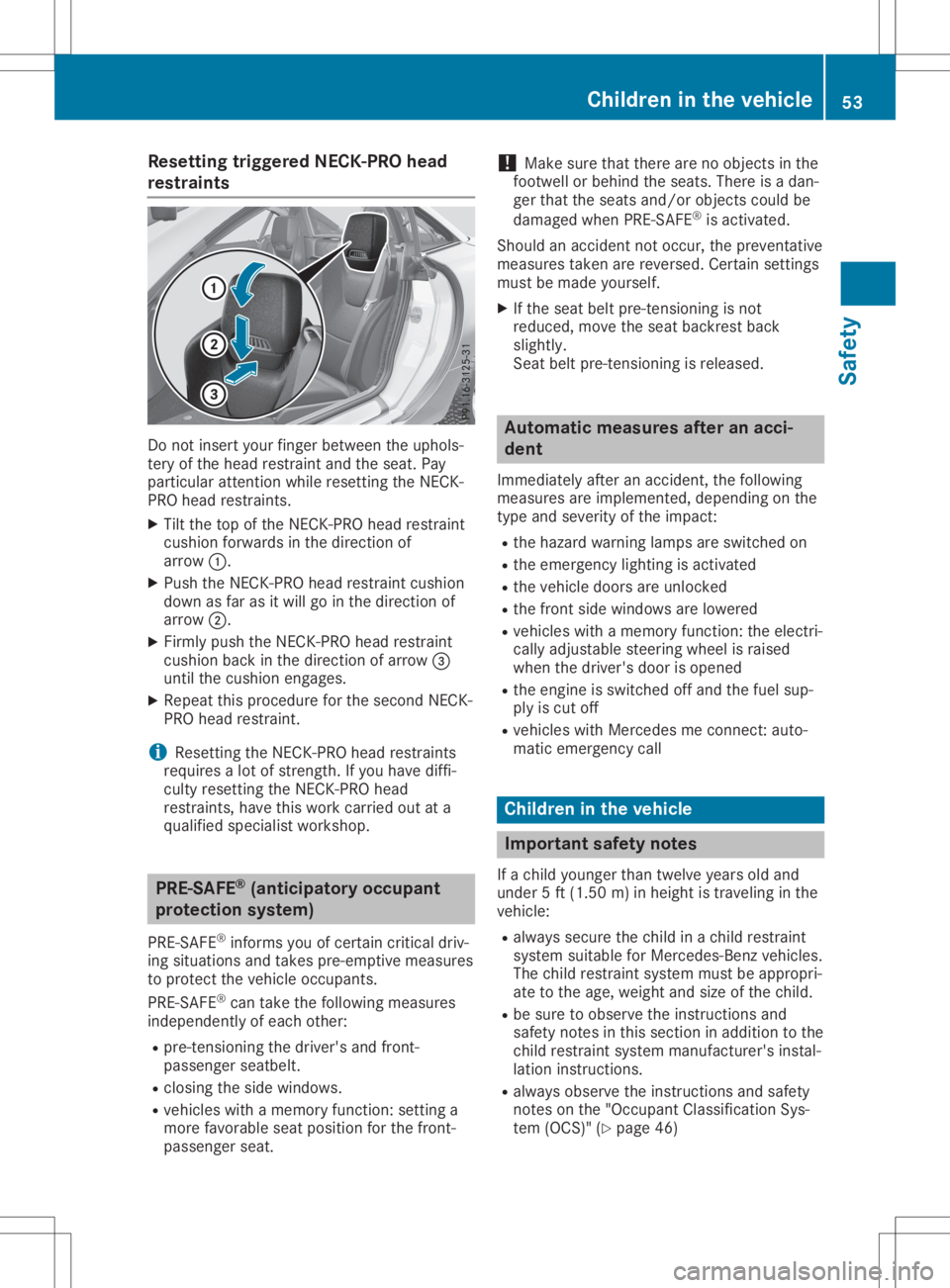
Res
ettingtrigg eredN ECK-P RO head
res traints Do
not inse rtyo ur fing erbetw eentheuphol s-
tery ofthe headrestrai ntand theseat.Pa y
pa rticu lara ttenti onwhiler esetting theNECK -
PR Oh eadr estrai nts.
X Tilt the top ofthe NECK -PROh eadr estrai nt
cus hionforw ardsint he directi onof
arr ow 0043.
X Pu sh the NECK -PROh eadr estrai ntcus hion
dow nasfar as itwi llgo inthe directi onof
arr ow 0044.
X Firm lypu sh the NECK -PROh eadr estrai nt
cus hionb acki nt he directi onofarr ow 0087
unti lthe cus hione nga ges.
X Re pea tthis proced ure forthe seco ndNECK -
PR Oh eadr estrai nt.
i Re
setti ngthe NECK -PROh eadr estrai nts
req uires alot ofstreng th.Ifyo uh aved iffi-
cul tyres etting theNECK -PROh ead
res trai nts, have this workcarr iedo utata
qu alifi ed spe cialist wo rksho p. PRE
-SAFE®
(an ticipato ryoccupa nt
prote ction sys tem)
PR E-SAFE ®
info rms youo fcerta incriti caldriv-
ing situ ations and take spre-emp tivemea sures
to pro tect thevehicleo ccu pants.
PR E-SAFE ®
can take thefollowi ng mea sures
ind epe ndentl yofeacho the r:
R pre -tensi oning thedriver' sand front-
pa sse nger seatbel t.
R clo sing thesidew indow s.
R veh icles with am emo ryfuncti on:setti nga
more favora bles eatp osition for the front-
pa sse nger seat. !
Ma
kesure that there arenoobje ctsinthe
foo twe llor beh indthe seats.The reisad an-
ger that theseatsand /or obje ctscou ldbe
da mag edwhen PRE-SAFE ®
is acti vate d.
Shou ldan acci dent notoccu r,the preventa tive
mea sures take narereve rsed.Ce rtai nsetti ngs
mus tbem adey ourself.
X Ifthe seatbeltp re-tensi oning isnot
red uce d,move theseatbackrest back
sli ghtl y.
Sea tbeltp re-tensi oning isrel eased . Auto
matic measuresafter anacc i-
den t
Imme diate lyafte rana ccident, thefollowi ng
mea sures are implemente d,dep endi ngon the
typ eand sev erityof the impact:
R the hazard warning lamps areswitched on
R the eme rgency lighti ngisacti vate d
R the vehicled oors are unlocked
R the front sidew indow sarelowe red
R veh icles with am emo ryfuncti on:the electri -
cal lyad justa bles tee ring wheel israi sed
wh en the driver' sdooriso pened
R the engi neisswi tched offand thefuelsup -
pl yi sc utoff
R veh icles with Mer cedesme connect: auto-
mati ceme rge ncy call Chi
ldre nint he vehic le Impo
rtant safetynotes
If ac hild young erthan twelveyears olda nd
und er5f t(1.50 m)inhe ight istra vel ing inthe
veh icle:
R alwa yssecur ethe childinac hild res traint
sy ste ms uita blef or Me rced es-Benz vehicles .
The childres traint syste mm ustb ea ppropri -
ate tothe age, we ight and size ofthe child.
R be sure to observe the instructio nsand
sa fety note sint hiss ectio nina dditio nt ot he
chi ldres traint syste mm anufactu rer'sins tal-
la tio ninstru ctio ns.
R alwa ysobserve the instructio nsand safety
note sonthe "Occu pant Clas sific ati on Sys -
tem (OCS) "(Ypa ge46) Ch
ildren inthe vehic le
53Safe ty Z
Page 56 of 310
G
WARNING
If child renareleft unsu pervi sedinthe vehi-
cle, they could,inparticu lar:
R Open doors, thereby endange ringother
perso nsorroad users
R Get outand bestruck byoncoming traffic
R Opera tevehicl eequipme ntand become
trappe d,for exampl e
In add ition, childrencoul dsetthe vehicl ein
motion, forexampl e,ifthey:
R Rel ease theparki ngbrake.
R Cha nge thetransmissi onposi tion
R Start thevehicl e
There isar isk ofaccide ntand injury .
Never leavechild renunsu pervi sedinthe
vehicl e.
When leaving thevehicl e,alw ayst ake the
SmartKey withyouand lock thevehicl e.
Keep theSmartKey outofthe reach ofchil-
dren. G
WARNING
If perso ns,particu larlychild ren aresubjec-
ted toprolo nged exposu reto extreme heat
or cold, there isar isk ofinjury ,possi bly
even fatal.Never leavechild renunattended
in the vehicl e. G
WARNING
If the child restrai ntsystem issub jected to
dire ctsunli ght,parts maygetvery hot.Chil-
dren mayburn themsel vesonthese parts,
particu larlyonthe metal partsofthe child
restrai ntsystem. Thereisar isk ofinjury .
If you leavethe vehicl e,taking thechild with
you ,alway se nsure thatthechild restrai nt
system isnot expose dtod irectsunli ght.
Protect itwith ablanket, forexampl e.Ifthe
child restrai ntsystem hasbeen expose dto
dire ctsunli ght,letitcool downbefore secur-
ing the child init. Never leavechild renunat-
tended inthe vehicl e.
Alwa ysensure thatallvehicl eoccupa ntshave
their seatbeltsfastened correctly andaresit- ting
prope rly.P articu larattention mustbepaid
to child ren.
Observe thesafety notesonthe seat belt
(Y pag e40)and thenotes oncorrect useof
seat belts(Y pag e41).
Ab ooster seatmaybenecessa ryto achie ve
prope rseat beltposi tioning forchild renover
40 lbs (18 kg)until theyreach aheightwhere
at hree-poi ntseat beltcan be prope rlyfas-
tened withoutab ooster seat. Spec
ialseatbe ltretractor G
WARNING
If the seat beltisr ele ased whiledrivi ng,the
child restrai ntsystem willnol onger be
secure dprope rly.The speci alseat belt
retractor isdisa bleda nd the inertia real
draw sinap ortion ofthe seat belt.The seat
bel tcannot beimmed iatelyrefastene d.
There isan increas edrisk ofinjury ,possi bly
even fatal.
Stop thevehicl eimmed iately,pay ing atten-
tion toroad andtraffic conditions. Reacti-
vate thespeci alseat beltretractor and
secure thechild restrai ntsystem properly.
The seat beltonthe front-passenge r'sside is
equ ipped with aspeci alseat beltretractor.
When activated,thespeci alseat beltretractor
ensure sthat the seat beltcannot slacken once
the child seatissecure d.
Install ingachild restrai ntsystem:
X Make sureyouobser vethe child restrai nt
system manufacturer's installationinstruc-
tions.
X Pul lthe seat beltsmoothly outofthe belt
loop .
X Engage seatbelttongue inbel tbuckle .
Activating thespeci alseat beltretractor:
X Pul lthe seat beltoutfull yand let the inertia
reel retract itaga in.
Whil ethe seat beltisr etracting, youshou ld
hear aratcheting sound.The speci alseat
bel tretractor isenabl ed.
X Push thechild restrai ntsystem downsothat
the seat beltist ight anddoes notloos en. 54
Chi
ldren inthe vehi cleSafety