engine MERCEDES-BENZ SLC-Class 2017 R172 Owner's Guide
[x] Cancel search | Manufacturer: MERCEDES-BENZ, Model Year: 2017, Model line: SLC-Class, Model: MERCEDES-BENZ SLC-Class 2017 R172Pages: 294, PDF Size: 7.28 MB
Page 54 of 294
GWARNING
If you leave children unsupervised in the vehi-
cle, they coul dset it in motion by, for example:
Rrelease the parking brake.
Rshift the automatic transmission out of the
parking position P.
Rstart the engine.
In addition, they may operate vehiclee quip-
ment and become trapped. There is arisk of
an accident and injury.
When leaving the vehicle, alway stake the
SmartKey with you and lock the vehicle. Never
leave children unsupervised in the vehicle.
GWARNING
If persons, particularl ychildren are subjected
to prolonged exposure to extreme heato r
cold, there is arisk of injury ,possibly even
fatal .Never leave children unattended in the
vehicle.
GWARNING
If the child restraint system is subjected to
direct sunlight, parts may get very hot. Chil-
dren may burn themselves on these parts,
particularl yonthe metal parts of the child
restraint system. There is arisk of injury.
If you leave the vehicle, taking the child with
you ,alway sensure that the child restraint
system is not exposedtod irect sunlight. Pro-
tect it with ablanket, for example. If the child
restraint system has been exposedtod irect
sunlight, let it cool downb efore securing the
child in it. Never leave children unattended in
the vehicle.
Always ensure that all vehicleo ccupants have
their seat belts fastened correctly and are sitting
properly.P articular attention must be pai dto
children.
Observe the safety notes on the seat belt
(
Ypag e39) and the notes on correct use of seat
belts (Ypag e40).
Ab ooster seat may be necessary to achieve
propers eat beltp ositioning for children over
41 lbs (18 kg )until they reach aheight where a three-point seat beltc
an be properly fastened
without abooster seat.
Special seat bel tretractor
GWARNING
If the seat beltisr eleased while driving, the
child restraint system wil lnolonger be
secure dproperly.T he special seat beltr etrac-
tor is disable dand the inertia real draw sina
portion of the seat belt. The seat beltc annot
be immediatel yrefastened. There is an
increased risk of injury,p ossibly even fatal.
Stop the vehiclei mmediately, paying atten-
tion to road and traffic conditions. Reactivate
the special seat beltr etractor and secure the
child restraint system properly.
The seat beltont he front-passenge rside is
equipped with aspecial seat beltr etractor.
When activated, the special seat beltr etractor
ensure sthat the seat beltw illn ot slacken once
the child restraint system has been secured.
Installing achild restraint system:
XAlways comply with the child restraint system
manufacturer's installation instructions.
XPul lthe seat belts moothly out of the belt
loop.
XEngage the seat beltt ongue in the beltbuckle.
Activating the special seat beltr etractor:
XPullthe seat belto ut fullyand let the inertia
reel retract it again.
Whil ethe seat beltisr etracting, you should
hear aratcheting sound .The special seat belt
retractor is activated.
XPush the child seat restraint system downs o
that the seat beltist ight and does not loosen.
Removing achild restraint system and deacti-
vating the special seat beltr etractor:
XAlways comply with the child restraint system
manufacturer's installation instructions.
XPress the release button of the beltb uckle,
hold the beltt ongue firmly and guide it back
toward sbeltl oop.
The special seat beltr etractor is deactivated.
52Children in the vehicle
Safety
Page 57 of 294
good time, and for staying in lane. Always adapt
your driving style to suit the prevailing road and
weather conditions and maintainasafe distance
from the vehicle in front.D rive carefully.
The driving safety systems described only work
as effectively as possible when there is ade-
quate contact between the tires and the road
surface. Pay particular attention to the informa-
tion regarding tires, recommended minimum
tire tread depths etc. in the "Wheels and tires"
section (
Ypage 255).
In wintry driving conditions, always use winter
tires (M+S tires) and if necessary, snow chains.
Only in this way will the driving safety systems
described in this section work as effectively as
possible.
ABS (Anti-lock Braking System)
General information
ABS regulates brake pressure in such away that
the wheels do not lock when you brake. This
allows you to continue steering the vehicle when
braking.
The ! ABS warning lamp in the instrument
cluster lights up when the ignition is switched
on. It goes out when the engine is running.
ABS works from aspeed of about 5mph
(8 km/h), regardless of road-surface conditions.
ABS works on slippery surfaces, even when you
only brake gently.
Important safety notes
iObserve the "Important safety notes" sec-
tion (Ypage 54).
GWARNING
If ABS is faulty, the wheels could lock when
braking. The steerability and braking charac-
teristics may be severely impaired. Addition-
ally,f urther driving safety systems are deac-
tivated. There is an increased danger of skid-
ding and accidents.
Drive on carefully. Have ABS checked imme-
diately at aqualified specialist workshop.
When ABS is malfunctioning, other systems,
including driving safety systems, will also
become inoperative. Observe the information
on the ABS warning lamp (
Ypage 204) and dis- play messages which may be shown in the
instrument cluster (
Ypage 179).
Braking
XIf ABS intervenes:
continue to depress the
brake pedal vigorously until the braking sit-
uation is over.
XTo make afull brake application: depress
the brake pedal with full force.
If ABS intervenes when braking, you will feel a
pulsing in the brake pedal.
The pulsating brake pedal can be an indication
of hazardous road conditions, and functions as a reminder to take extr acare while driving.
BAS (Brake Assist System)
General information
BAS operates in emergencyb raking situations.
If you depress the brake pedal quickly, BAS
automatically boosts the braking force, thus
shortening the stopping distance.
Important safety notes
iObserve the "Important safety notes" sec-
tion (Ypage 54).
GWARNING
If BAS is malfunctioning, the braking distance
in an emergencyb raking situation is
increased. There is arisk of an accident.
In an emergencyb raking situation, depress
the brake pedal with full force. ABS prevents
the wheels from locking.
Braking
XKeep the brake pedal firmly depressed until
the emergencyb raking situation is over.
ABS prevent sthe wheels from locking.
The brakes will function as usual once you
release the brake pedal. BAS is deactivated.
Driving safety systems55
Safety
Z
Page 60 of 294
Important safety notes
GWARNING
Adaptive Brake Assist canno talways clearly
iden tifyo bject sand co mplextraffic situa-
tions.
In suchc ases, Adaptive Brake Assist can:
Rinterveneu nnecessarily
Rnotintervene
Thereisar iskofana cciden t.
Always pay careful attentio ntothetraff icsit-
uation and beread ytob rake. Terminate the
interventio ninanon-criticaldriving situation.
GWAR NING
Adaptive Brake Assist does no treact:
Rto people or animals
Rto oncomin gvehicle s
Rto crossing traff ic
Rwhen cornering
As aresult, th eAdaptive Brake Assist may not
interveneina llcritical conditions. Thereisa
ris kofana cciden t.
Always pay careful attentio ntothetraff icsit-
uation and beread ytob rake.
Due to th enature of th esystem, particularly
co mpli cated but non-critical driving conditions
may also caus eBrake Assist to intervene.
If adaptive Brake Assist isno tavailab ledue to a
malfunctio nintheradar sensor system, the
brak esystem remains availab le withfull brake
boostin geffect and BA S.
ESP®(Electronic Stability Program)
General notes
iObserv ethe "Im portan tsafety notes" sec-
tio n(Ypage 54).
ESP
®monitors driving stabilit yand traction,i .e.
power transmission between th etires and the
road surface.
If ESP
®detect stha tthe veh icle is deviating from
th ed irection desired bythed river, oneorm ore
wheelsa re braked to stabiliz ethe veh icle.The
engineo utputisalso mod ifiedtok eept he veh i- cle on th
edesired course within physical limits.
ESP
®assists th edriver when pullingaway on
wet or slippery roads. ESP®can also stabilize
th ev ehicle durin gbraking.
ETS (Electronic Traction System)
iObserv ethe "Importan tsafety notes" sec-
tio n(Ypage 54).
ET St raction control is part of ESP
®.
ET Sb rakes th edrivew heelsi ndivid ually if they
spin.T his enables you to pull away and acceler-
ate on slippery surfaces, for example if th eroad
surface is slippery on ones ide.Inaddition,m ore
drivet orque istransferred to th ewheel or
wheelsw itht raction.
ET Sr emains active when you deactivate ESP
®.
Important safety notes
GWARNING
If ESP
®is malfunctioning, ESP®is unab leto
stabilizet hevehicle .Add itionally, further driv-
ing safety systems are deactivate d.This
increases th eriskofs kiddin gand an accident.
Drive on carefully. Hav eESP
®checked at a
qualified specialist workshop.
When to wingthe vehicle witht herear axle
raised, observ ethe note sonE SP
®
(Ypage 252).
If the å ESP®OFFw arning lamp lightsu p
continuously, then ESP®is deactivate d.
If the ÷ ESP®warning lamp and the å
ESP®OFFw arning lamp are lit continuously,
ESP®is no ta vailab ledue to amalfunction.
Observ ethe information on warning lamps
(
Ypage 205) and display messagesw hichmay
be shown in thei nstrumen tcluster
(
Ypage 179).
iOnly use wheelsw itht he recommended tire
sizes. Only then willESP®function properly.
Characteristics of ESP®
General information
Ifthe ÷ ESP®warning lamp goes out before
beginnin gthe journey, ESP®is automatically
active.
58Driving safety systems
Safety
Page 61 of 294
If ESP®intervenes, the÷ESP®warning lamp
flashe sinthe instrument cluster.
If ESP
®intervenes:
XDo not deactivate ESP®under any circum-
stances.
XOnly depresst he accelerator pedalasf ar as
necessary when pulling away.
XAdapt you rdriving style to suit the prevailing
road and weather conditions.
ECO start/stop function
The ECO start/stop function switches the
engine off automatically when the vehicle stops
moving. The engine starts automatically when
the driver wants to pul lawa ya gain. ESP
®
remains in its previously selected status, e.g. if
ESP®was deactivated before the engine was
automatically switched off.
Deactivating/activating ESP®(except
SLC 43 AMG)
Important safety notes
iObserve the "Important safety notes" sec-
tion (Ypage 54).
You can select between the following states of
ESP
®:
RESP®is activated.
RESP®is deactivated.
GWARNING
If you deactivate ESP
®,E SP®no longer sta-
bilizes the vehicle.T here is an increased risk
of skidding and an accident.
Only deactivate ESP
®in the situations descri-
bed in the following.
It may be best to deactivate ESP
®in the follow-
ing situations:
Rwhen using snow chains
Rin deep snow
Ron sand or gravel
Spinning the wheel sresults in acutting action
which providesb etter grip.
iActivate ESP®as soon as the situations
describeda bove no longer apply. ESP®will
otherwise not be abl etostabilize the vehicle if the vehicle starts to skid or
awheel starts to
spin.
!Avoid spinning the driven wheel sfor an
extended period with ESP®deactivated. You
could otherwise damage the drivetrain.
Deactivating/activating ESP®
XTo deactivate: press button:.
The å ESP®OFF warning lamp in the
instrument cluster lights up.
XTo activate: press button :.
The å ESP®OFF warning lamp in the
instrument cluster goes out.
Characteristic swhen ESP®is deactivated
If ESP®is deactivated and one or more wheels
start to spin, the ÷ESP®warning lamp in the
instrument cluster flashes. In such situations,
ESP
®wil lnot stabilize the vehicle.
If you deactivate ESP®:
RESP®no longer improves driving stability.
REngine torque is no longer limited and the
drive wheel sare abl etospin.
RTraction control is still activated.
RActive Brake Assist is not available and is not
activated even if you brake firmly with assis-
tance from ESP
®
RPRE-SAFE®is no longer available, nor is it
activated if you brake firmly and ESP®inter-
venes.
RESP®still providess upport when you brake
firmly.
Driving safety systems59
Safety
Z
Page 63 of 294
REngine torque is no longerlim ite da nd the
drive wheels ar eabletos pin.
RESP®still provides support when yo ubrake
firmly.
Characteristics when ESP®is deactivated
If ESP®is deactivated and one or mor ewheel s
start to spin, the ÷ESP®warning lamp in the
instrument cluster flashes. In such situations,
ESP
®will not stabilize the vehicle.
If yo udeactivate ESP®:
RESP®no longe rimproves drivin gstability.
REngine torque is no longe rlim ite da nd the
drive wheels ar eabletos pin.
RTractio ncontro lisstill activated.
RActiv eBrake Assist is not availabl eand is not
activated eve nifyoubrake firmly with assis-
tance fromE SP
®
RPRE-SAFE®is no longeravailable, nor is it
activated if yo ubrake firmly and ESP®inter-
venes.
RESP®still provides support when yo ubrake
firmly.
EBD (electroni cbrak eforce distribu-
tion)
General information
EBD monitors and controls the brake pressure
on the rea rwheel stoi mprov edrivin gstability
whil ebraking.
Important safety notes
iObserve the "Important safety notes" sec-
tio nfor drivin gsafety system s(Ypage 54).
GWARNING
If EBD is malfunctioning ,the rea rwheel scan
lock, e.g .under full braking .Thisi ncreases the
ris kofs kidding and an accident.
Yo us houl dtherefore adap tyou rd rivin gstyle
to the different handling characteristics. Have
the brake system checked at aquali fied spe-
cialist workshop.
Observe informatio nregarding indicator and
warning lamps (
Ypage 204 )aswellasd isplay
message s(Ypage 181).
ADAPTIVE BRAKE
i
Observe the "Important safety notes" sec-
tio n(Ypage 54).
ADAPTIVE BRAKE enhance sbraking safety and
offers increased braking comfort. In additio nto
the braking function, ADAPTIVE BRAKE also has
the HOLD functio n(
Ypage 148) and hill start
assist (Ypage 117).
Protectio nagainst theft
Immobilizer
XTo activate with the SmartKey: remove the
SmartKeyf romthe ignition lock.
XTo activate with KEYLESS-GO: switch the
ignition off and open the driver's door.
XTo deactivate: switch on the ignition.
The immobilize rprevents your vehicl efrom
being started withou tthe correct SmartKey.
When leaving the vehicle, always take the
SmartKeyw ithy ou and lock the vehicle. The
engine can be started by anyone with avalid
SmartKeyt hatislefti nsid ethe vehicle.
iThe immobilize risalwaysdeactivated when
yo us tart the engine.
In the event thatt he engine cannotbes tarted
(yet the vehicle's battery is charged) ,the sys-
tem is not operational .Contact an authorized
Mercedes-Benz Center or call
1-800-FOR-MERCede s(in the USA) or
1-800-387-0100 (i nCanada).
ATA (anti-theft alarm system)
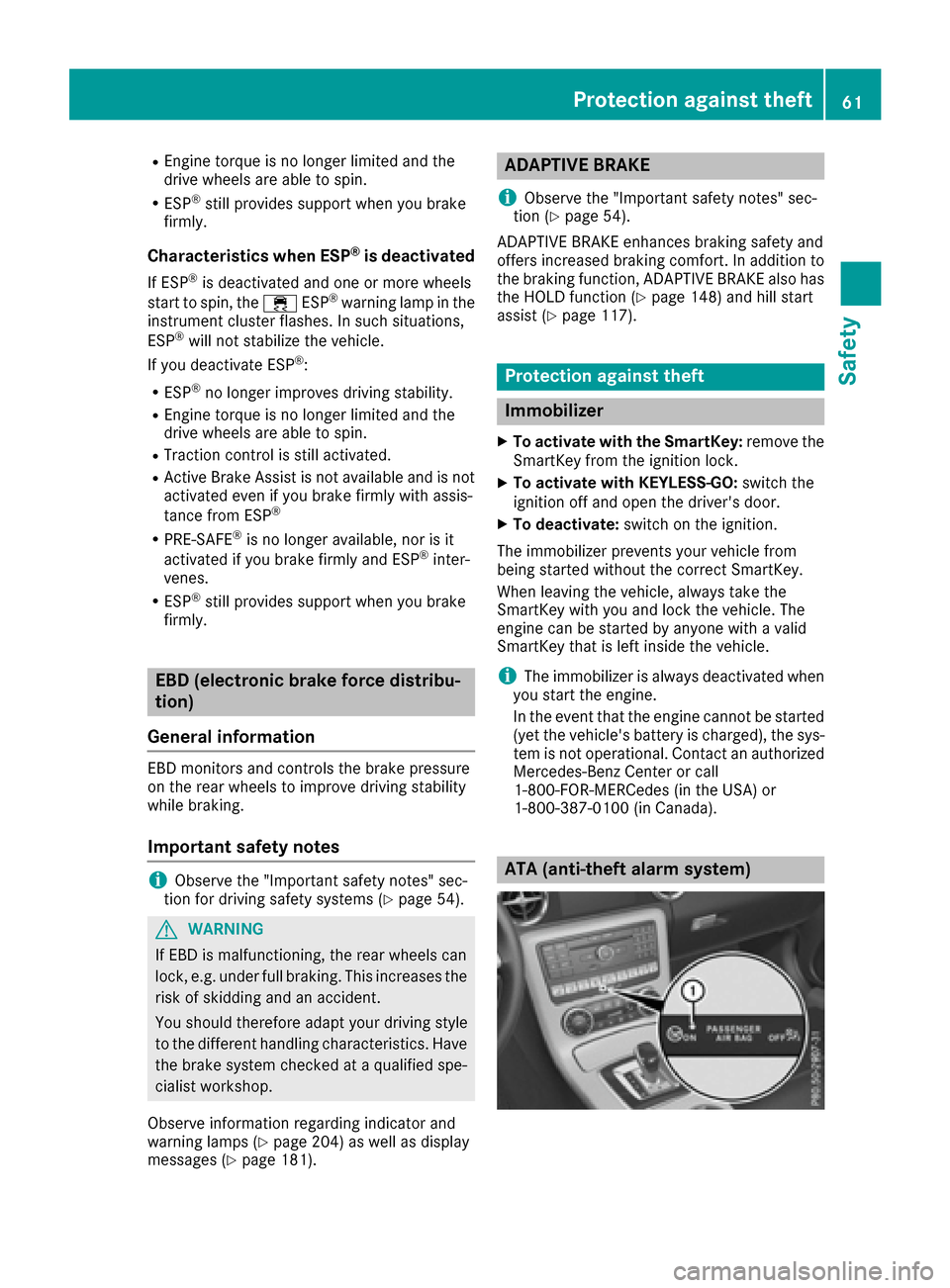
Protectiona gainsttheft61
Safety
Z
Page 65 of 294
SmartKey
Important safety notes
GWARNING
If children are left unsupervised in the vehicle,
they could:
Ropen the doors, thus endangering other
people or road users.
Rget out and disrupt traffic.
Roperate the vehicle's equipment.
Additionally, children could set the vehicle in
motion if, for example, they:
Rrelease the parking brake.
Rshifting the automatic transmission out of
park position P
RStart the engine.
There is arisk of an accident and injury.
When leaving the vehicle, always take the
SmartKey with you and lock the vehicle. Never
leave children or animals unattended in the
vehicle. Always keep the SmartKey out of
reach of children.
GWARNING
If you attach heavy or large object stothe
SmartKey, the SmartKey could be uninten-
tionally turned in the ignition lock. This could
cause the engine to be switched off. There is a risk of an accident.
Do not attach any heavy or large object stothe
SmartKey. Remove any bulky key rings before
insertingt he SmartKey into the ignition lock.
!Keep the SmartKey away from stron gmag-
netic fields. Otherwise, the remote control
function could be affected.
Strong magnetic fields can occur in the vicin-
ity of powerful electrical installations.
Do not keep the SmartKey:
Rwith electronic devices, e.g. amobile phone
or another SmartKey.
Rwith metallic objects, e.g. coins or metal foil.
Rinside metallic objects, e.g. ametal case.
This can affect the functionality of the Smart- Key.
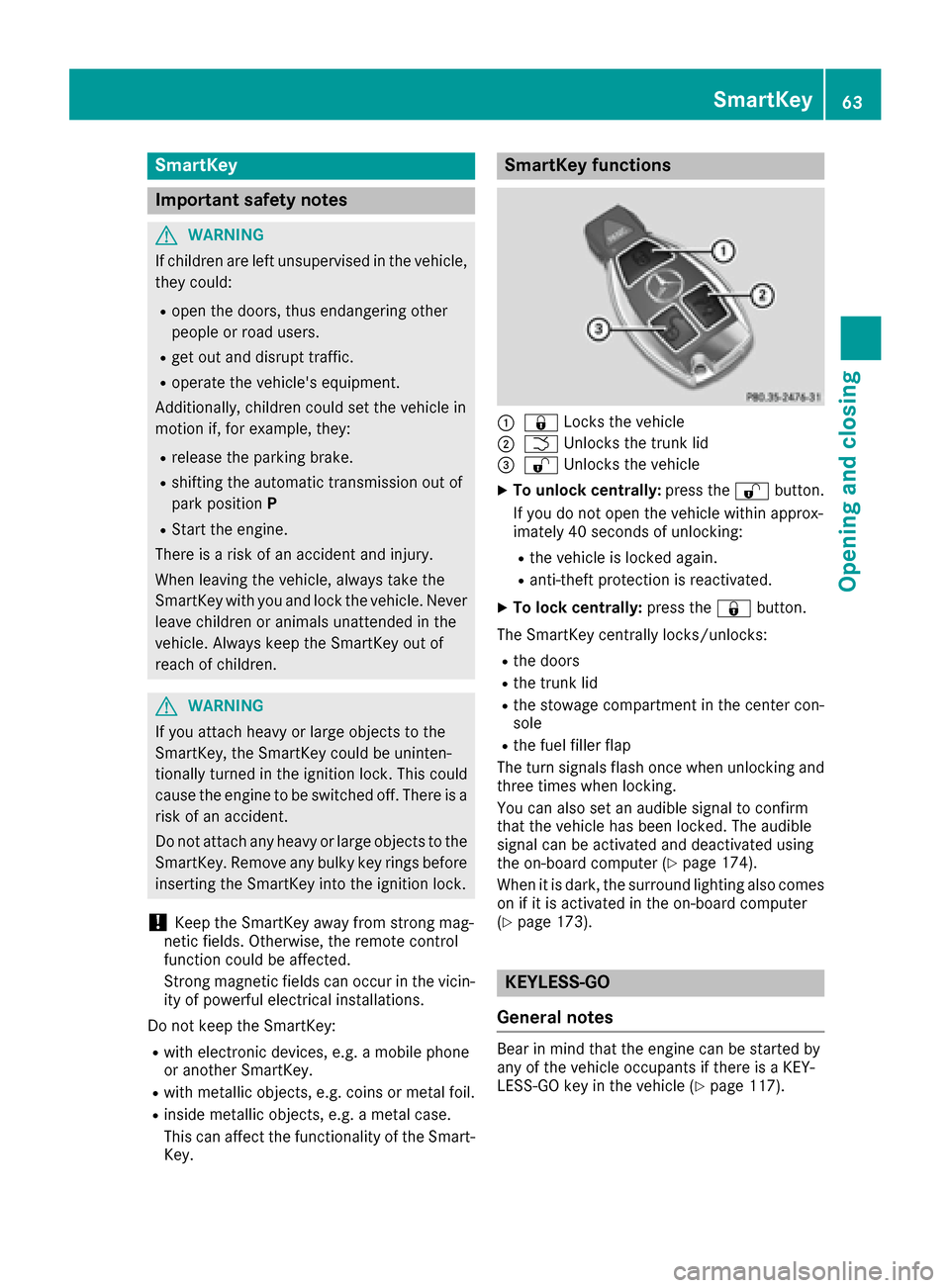
SmartKey functions
:& Locks the vehicle
;FUnlockst he trunk lid
=%Unlockst he vehicle
XTo unlock centrally: press the%button.
If you do not open the vehicle within approx-
imately 40 seconds of unlocking:
Rthe vehicle is locked again.
Ranti-theft protection is reactivated.
XTo lock centrally: press the&button.
The SmartKey centrally locks/unlocks:
Rthe doors
Rthe trunk lid
Rthe stowage compartmentint he center con-
sole
Rthe fuel filler flap
The turn signals flash once when unlocking and
three times when locking.
You can also set an audible signal to confirm
that the vehicle has been locked. The audible
signal can be activated and deactivated using
the on-board computer (
Ypage 174).
When it is dark, the surround lighting also comes
on if it is activated in the on-board computer
(
Ypage 173).
KEYLESS-GO
General notes
Bear in mind that the engine can be started by
any of the vehicle occupants if there is aKEY-
LESS-GO key in the vehicle (
Ypage 117).
SmartKey63
Opening and closing
Z
Page 66 of 294
Locking/unlockingcentrally
You can start,lockorunlock thevehicle using
KEYLESS-GO .Todothis, you onl yneedc arry the
SmartKey with you. You can combine th efunc-
tions of KEYLESS-GO with those of aconven-
tional SmartKey. Unlockt hevehicle by using
KEYLESS-GO ,for instance, and lockitu singthe
& button on th eSmartKey.
The driver' sdoor and th edoor at whicht hehan-
dle is used, must bothbec losed. The SmartKey
must be outside th evehicle .When locking or
unlocking with KEYLESS-GO ,the distance
between th ekey and th ecorresponding door
handle must not be greater than 3ft(1m).
Ac heck whichp eriodicallyestablishesar adio
connectio nbetween th evehicle and th eSmart-
Key determine swhether avalid SmartKey is in
th ev ehicle .This occurs, for example:
Rwhen starting th eengine
Rwhile driving
Rwhen th eexternal door handles are touched
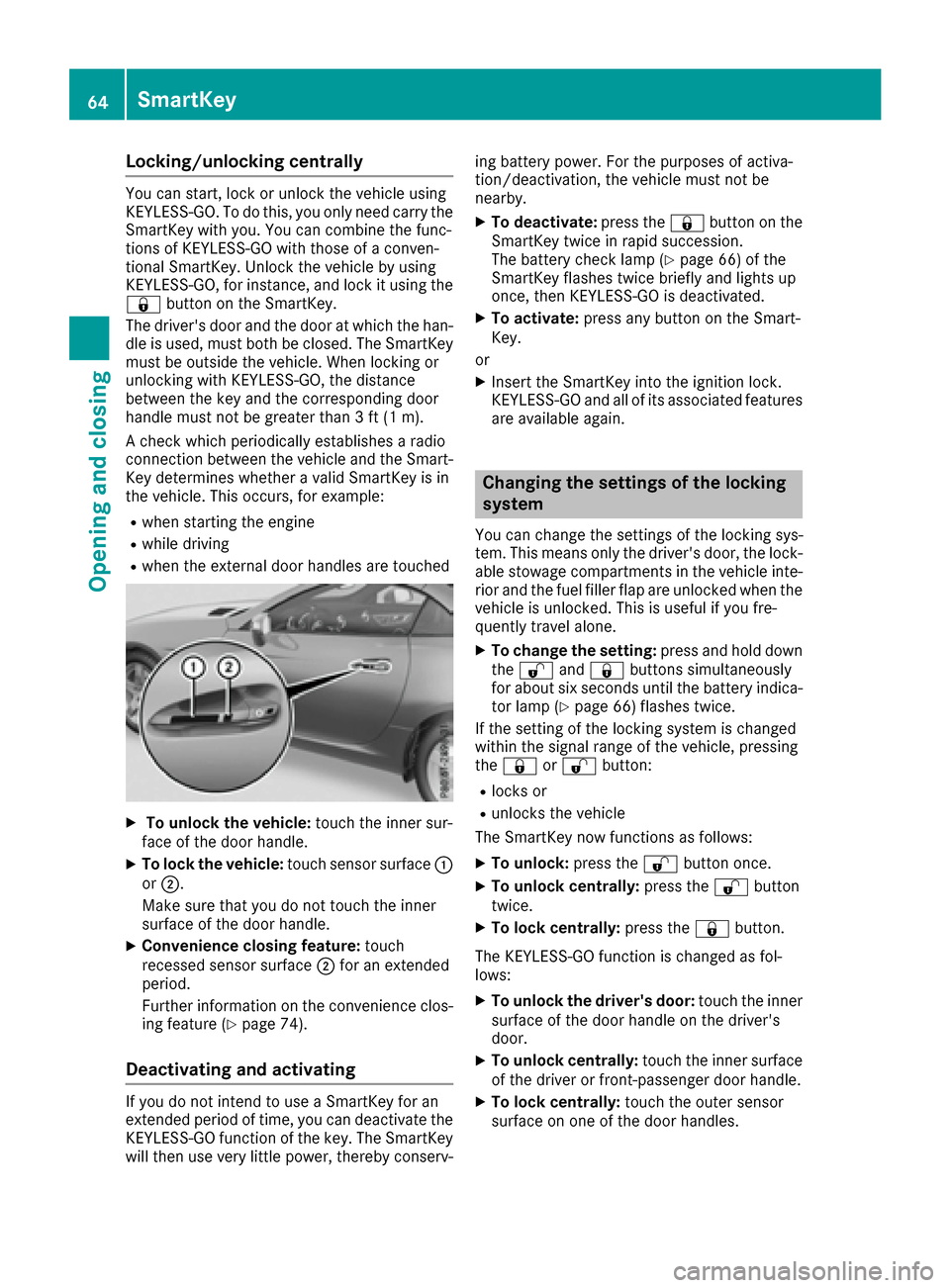
XTo unlock th evehicle: touch th einner sur-
fac eoft hedoor handle.
XTo lock th evehicle: touch sensor surface :
or ;.
Makes ure that you do not touch th einner
surface of th edoor handle.
XConvenience closing feature: touch
recesseds ensor surface ;for an extended
period.
Further informatio nontheconvenience clos-
ing feature (
Ypage 74).
Deactivating and activating
If you do not intend to use aSmartKey for an
extended perio doftime, you can deactivate the
KEYLESS-GO function of th ekey. The SmartKey
will then use veryl ittle power,therebyc onserv- ing battery power.F
or thepurposes of activa-
tion/deactivation, th evehicle must not be
nearby.
XTo deactivate: pressthe& button on the
SmartKey twic einrapid succession.
The battery check lamp (
Ypage 66 )ofthe
SmartKey flashes twic ebriefly and lightsu p
once, then KEYLESS-GO is deactivated.
XTo activate: pressany button on th eSmart-
Key.
or
XInsertt heSmartKey int othe ignitio nlock.
KEYLESS-GO and all of its associate dfeatures
are available again.
Changing th esettings of th elocking
system
You can change th esettings of th elockin gsys-
tem .This meanso nlyt he driver' sdoor,t helock-
able stowage compartments in th evehicle inte-
rior and th efuel filler flap are unlocked when the
vehicle is unlocked. This is useful if you fre-
quently travel alone.
XTo change th esetting: pressand hold down
the % and& buttons simultaneously
for about six second suntil th ebattery indica-
to rlamp (
Ypage 66 )flashes twice.
If th esettin goft helockin gsystem is changed
within th esignal range of th evehicle ,pressing
the & or% button:
Rlocks or
Runlock sthe vehicle
The SmartKey now functionsasf ollows:
XTo unlock:pressthe % button once.
XTo unlock centrally: pressthe % button
twice.
XTo lock centrally: pressthe& button.
The KEYLESS-GO function is changed as fol-
lows:
XTo unlock th edriver's door: touch theinner
surface of th edoor handle on th edriver's
door.
XTo unlock centrally: touch theinner surface
of th edriver or front-passenger door handle.
XTo lock centrally: touch theouter sensor
surface on one of th edoor handles.
64SmartKey
Opening and closing
Page 70 of 294
ProblemPossible causes/consequences andMSolutions
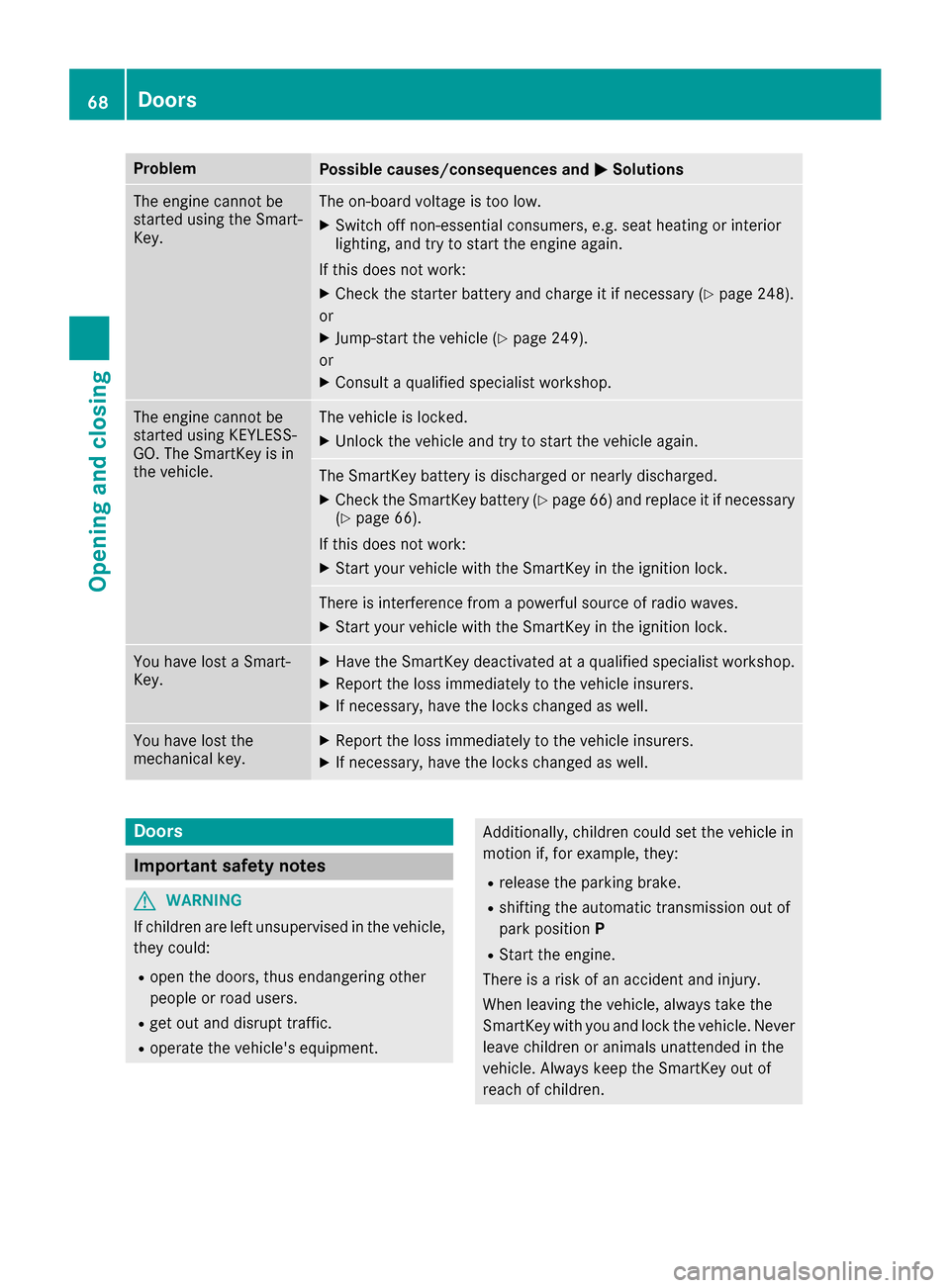
The engine cannot be
started using the Smart-
Key.The on-board voltage is too low.
XSwitch off non-essential consumers, e.g. seat heating or interior
lighting, and try to start the engine again.
If this does not work:
XCheck the starter battery and charge it if necessary (Ypage 248).
or
XJump-start the vehicle (Ypage 249).
or
XConsult aqualified specialist workshop.
The engine cannot be
started using KEYLESS-
GO. The SmartKey is in
the vehicle.The vehicle is locked.
XUnlock the vehicle and try to start the vehicle again.
The SmartKey battery is discharged or nearly discharged.
XCheck the SmartKey battery (Ypage 66) and replace it if necessary
(Ypage 66).
If this does not work:
XStart your vehicle with the SmartKey in the ignition lock.
There is interference from apowerful source of radio waves.
XStart your vehicle with the SmartKey in the ignition lock.
You have lost aSmart-
Key.XHave the SmartKey deactivated at aqualified specialist workshop.
XReport the loss immediately to the vehicle insurers.
XIf necessary, have the locks changed as well.
You have lost the
mechanical key.XReport the loss immediately to the vehicle insurers.
XIf necessary, have the locks changed as well.
Doors
Important safety notes
GWARNING
If children are left unsupervised in the vehicle,
they could:
Ropen the doors, thus endangering other
people or road users.
Rget out and disrupt traffic.
Roperate the vehicle's equipment.
Additionally, children could set the vehicle in
motion if, for example, they:
Rrelease the parking brake.
Rshifting the automatic transmission out of
park position P
RStart the engine.
There is arisk of an accident and injury.
When leaving the vehicle, always take the
SmartKey with you and lock the vehicle. Never
leave children or animals unattended in the
vehicle. Always keep the SmartKey out of
reach of children.
68Doors
Opening and closing
Page 75 of 294
Make sure that no body parts are in close
proximity during the closing procedure. If
someone becomes trapped, press the switch
to open the side window again.
Opening and closing the side win-
dows in the front
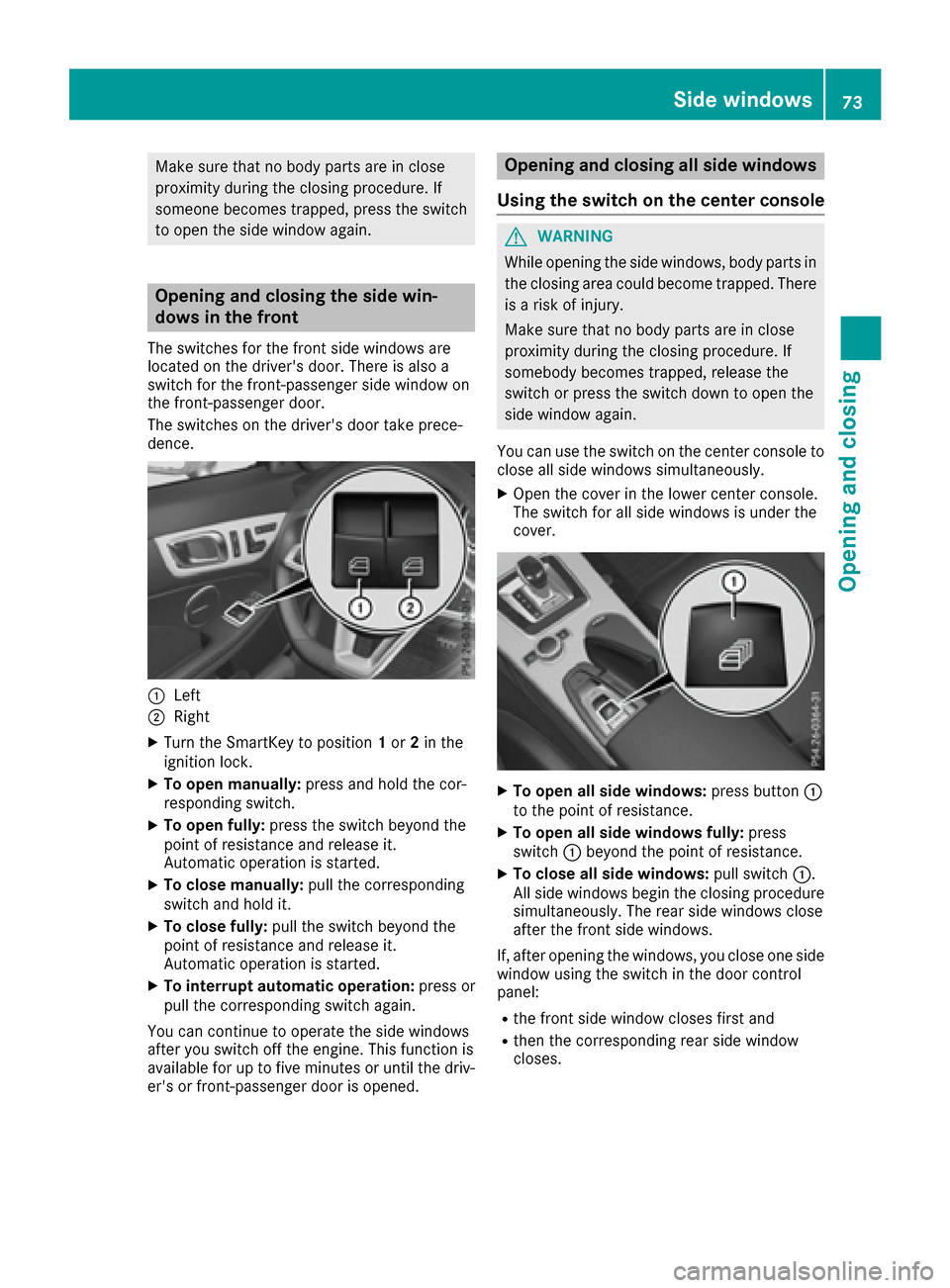
The switches for the front side windows are
located on the driver's door. There is also a
switch for the front-passenger side window on
the front-passenger door.
The switches on the driver's door take prece-
dence.
:Left
;Right
XTurn the SmartKey to position1or 2in the
ignition lock.
XTo open manually: press and hold the cor-
responding switch.
XTo open fully: press the switch beyond the
point of resistance and release it.
Automatic operation is started.
XTo close manually: pull the corresponding
switch and hold it.
XTo close fully: pull the switch beyond the
point of resistance and release it.
Automatic operation is started.
XTo interrupt automatic operation: press or
pull the corresponding switch again.
You can continue to operate the side windows
after you switch off the engine. This function is
available for up to five minutes or until the driv-
er's or front-passenger door is opened.
Opening and closing all side windows
Using the switch on the center console
GWARNING
While opening the side windows, body parts in
the closing area could become trapped. There is ar isk of injury.
Make sure that no body parts are in close
proximity during the closing procedure. If
somebody becomes trapped, release the
switch or press the switch down to open the
side window again.
You can use the switch on the center console to
close all side windows simultaneously.
XOpen the cover in the lower center console.
The switch for all side windows is under the
cover.
XTo open all side windows: press button:
to the point of resistance.
XTo open all side windows fully: press
switch :beyond the point of resistance.
XTo close all side windows: pull switch:.
All side windows begin the closing procedure
simultaneously.T he rear side windows close
after the front side windows.
If, after opening the windows, you close one side
window using the switch in the door control
panel:
Rthe front side window closes first and
Rthen the corresponding rear side window
closes.
Side windows73
Opening and closing
Z
Page 83 of 294
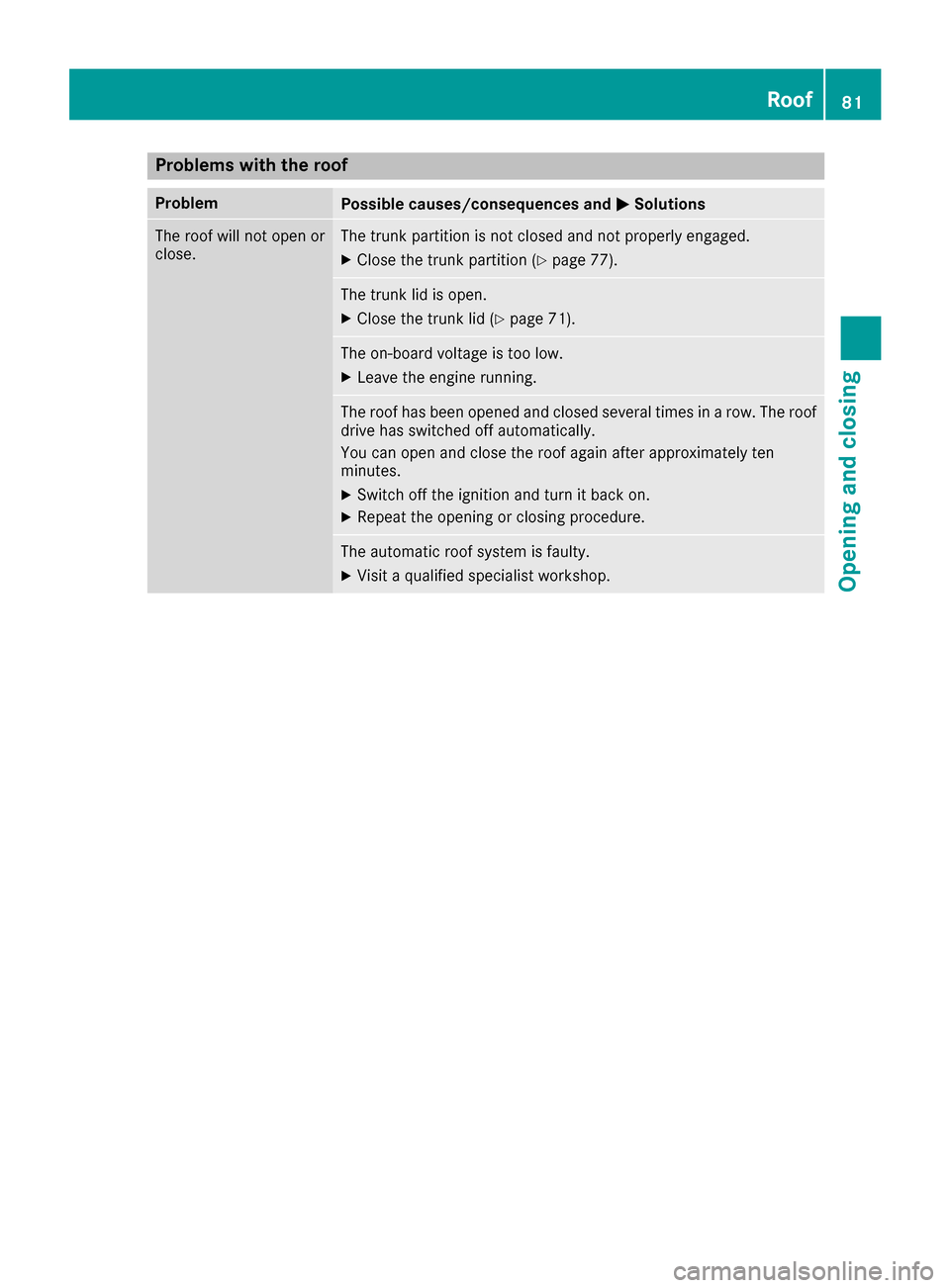
Problems with the roof
ProblemPossible causes/consequences andMSolutions
The roof will not open or
close.The trunk partition is not closed and not properly engaged.
XClose the trunk partition (Ypage 77).
The trunk lid is open.
XClose the trunk lid (Ypage 71).
The on-board voltage is too low.
XLeave the engine running.
The roof has been opened and closed several times in arow. The roof
drive has switched off automatically.
You can open and close the roof again after approximately ten
minutes.
XSwitch off the ignition and turn it back on.
XRepeat the opening or closing procedure.
The automatic roof system is faulty.
XVisit aqualified specialist workshop.
Roof81
Opening and closing
Z