engine MERCEDES-BENZ SLC-Class 2017 R172 User Guide
[x] Cancel search | Manufacturer: MERCEDES-BENZ, Model Year: 2017, Model line: SLC-Class, Model: MERCEDES-BENZ SLC-Class 2017 R172Pages: 294, PDF Size: 7.28 MB
Page 20 of 294
Sidewall(de finition) ....................... 273
Speed rating (definition) ................ 273
Storing ........................................... 275
Structure and characteristics
(definition) ..................................... 272
Summer tire s................................. 257
Temperature .................................. 268
TIN (Tire Identification Number)
(definition) ..................................... 274
Tire bead (definition) ...................... 273
Tire pressure (definition) ................ 273
Tire pressures (recommended )...... 272
Tire size (data )............................... 278
Tire size designation, load-bearing
capacity, speed rating .................... 269
Tire trea d....................................... 256
Tire trea d(definition) ..................... 273
Tota lloa dlim it (definition) ............. 274
Tractio n......................................... 268
Tractio n(definition) ....................... 274
Tread wear ..................................... 268
Uniform Tire Quality Grading
Standard s...................................... 267
Uniform Tire Quality Grading
Standard s(de finition) .................... 272
Wea rindicator (definition) ............. 274
Wheel and tire combination ........... 278
Wheel rim (definition) .................... 272
see Fla ttire
Tow-starting
Emergency engine starting ............ 253
Important safety notes .................. 251
Towin gaway
Important safety guideline s........... 251
Installing the towing eye. ............... 252
Removing the towing eye. .............. 252
Transporting the vehicl e................ 253
With both axles on the ground ....... 252
With the rea raxler aised ................ 252
Trafficr eports
see also Digital Operator's Man-
ua l.................................................. 211
Transmission
Selector lever ................................ 122
see Automati ctransmission
Transmission position display ......... 122
Transporting the vehicle .................. 253Trip computer (on-board com-
puter)
.................................................. 166
Trip odometer
Calling up ....................................... 166
R
esetting (on-board computer) ...... 167
Trunk
Emergency release .......................... 71
Important safety notes .................... 70
Locking separately. .......................... 71
Opening/closing (manuall yfrom
outside) ............................................ 71
Overview .......................................... 70
Trunk lid
Displa ymessage ............................ 199
Opening dimensions ...................... 289
Trunk load (maximum) ...................... 289
Trunk partition
Displa ymessage ............................ 200
Genera lnotes .................................. 77
Opening/closing .............................. 78
Turn signals
Displa ymessage ............................ 189
Switching on/of f.............................. 94
Two-wa yradio
Frequencie s................................... 282
Installation ..................................... 282
Transmission output( maximum) .... 282
Type identificatio nplate
see Vehicl eide ntification plate
U
Unlocking
Emergency unlocking ....................... 70
From inside the vehicl e(central
unlocking button) ............................. 69
Upshif tind icator
(on-board computer, SLC 43
AMG). ............................................ 175
USB devices
Connecting to the Media Inter-
face ............................................... 216
V
VehicleCorrect us e...................................... 26
Data acquisition ............................... 27
Displa ymessage ............................ 198
18Index
Page 21 of 294
Electronics .....................................282
Equipment ....................................... 23
Individua lsettings .......................... 172
Limited Warranty .............................2 7
Loading .......................................... 265
Locking (in an emergency) ............... 70
Locking (SmartKey) .......................... 63
Lowering ........................................ 278
Maintenance .................................... 24
Parking for along period. ............... 133
Pulling awa y................................... 117
Raising ........................................... 275
Reporting problems ......................... 26
Securing from rolling away ............ 275
Tow-starting ................................... 251
Towing away .................................. 251
Transporting .................................. 253
Unlocking (i nanemergency) ........... 70
Unlocking (SmartKey )...................... 63
Vehicl edata. .................................. 289
Vehicl ebattery
see Battery (vehicle)
Vehicl edata ....................................... 289
Vehicl edimensions ........................... 289
Vehicl eemergencyl ocking ................ 70
Vehicl eidentificatio nnumber
see VIN
Vehicl eidentificatio nplate .............. 283
Vehicl etoolkit.................................. 241
Video
Operating the DVD ......................... 169
see also Digital Operator's Man-
ual.................................................. 211
VIN
Seat. .............................................. 284
Type plate ...................................... 283
Voice ControlS ystem
see Separate operating instructions
W
Warning and indicator lamps ABS ................................................ 204
Active Brake Assist ........................ 209
Brake Assist ................................... 209
Brakes ........................................... 204
Check Engine ................................. 207
Coolant .......................................... 207 Distance Pilo
tDISTRONIC ............. 209
Distance warning ........................... 209
ESP
®.............................................. 205
ESP®OFF ....................................... 206
Fue ltank ........................................ 207
Genera lnotes ................................ 202
Parking brake ................................ 206
PASSENGER AIR BAG ...................... 38
Reserve fue l................................... 207
Restraint system ............................ 206
Seatb elt. ....................................... 203
SPOR Thandling mod e................... 206
Tire pressure monitor .................... 210
Warranty .............................................. 23
Washer fluid
Displa ymessage ............................ 201
Wheel and tire combinations
Tires ............................................... 278
Wheel bolt tightenin gtorque ........... 278
Wheel chock ...................................... 275
Wheels
Changing awheel .......................... 274
Checking ........................................ 255
Cleaning ......................................... 238
Emergency spare wheel. ................ 279
Important safety notes .................. 255
Information on driving .................... 255
Interchanging/changing ................ 274
Mounting anew wheel. .................. 277
Mounting awheel .......................... 275
Overview ........................................ 255
Removing awheel .......................... 277
Storing ........................................... 275
Tightening torque ........................... 278
Wheel size/tire size ....................... 278
Win dscreen
Inserting and removing .................... 78
Preparing for installation .................. 78
see AIRGUIDE
Windows
see Sid ewindows
Windshield
Defrosting ...................................... 109
Windshiel dwasher fluid
see Windshield washers ystem
Windshiel dwasher system
Adding washerf luid ....................... 234
Index19
Page 24 of 294
Protection of the environment
General notes
HEnvironmental note
Daimler's declared policy is one of compre-
hensive environmental protection.
The objectives are for the natural resources
that form the basis of our existence on this
planet to be used sparingly and in amanner
that takes the requirements of both nature
and humanity into account.
You too can help to protect the environment
by operating your vehicle in an environmen-
tally responsible manner.
Fuel consumption and the rate of engine,
transmission, brake and tire wear are affected by these factors:
Roperating conditionsofy our vehicle
Ryour personal driving style
You can influence both factors. You should
bear the following in mind:
Operating conditions:
Ravoid short trips as these increase fuel con-
sumption.
Ralways make sure that the tire pressures
are correct.
Rdo not carry any unnecessary weight.
Rremove roof racks once you no longer need
them.
Rar egularly serviced vehicle will contribute
to environmental protection. You should
therefore adhere to the service intervals.
Ralways have service work carried out at a
qualified specialist workshop.
Personal driving style:
Rdo not depress the accelerator pedal when
startin gthe engine.
Rdo not warm up the engine when the vehicle
is stationary.
Rdrive carefully and maintain asafe distance
from the vehicle in front.
Ravoid frequent, sudden acceleration and
braking.
Rchange gear in good time and use each gear
only up to Ôof its maximum engine speed.
Rswitch off the engine in stationary traffic.
Rkeep an eye on the vehicle's fuel consump-
tion.
Environmental concerns and recom-
mendations
Wherever the operating instructions require you
to dispose of materials, first try to regenerate or
re-use them. Observe the relevant environmen-
tal rules and regulations when disposing of
materials. In this way you will help to protect the
environment.
Genuine Mercedes-Benz parts
HEnvironmental note
Daimler AG also suppliesr econditioned major
assemblies and parts which are of the same
quality as new parts. They are covered by the
same Limited Warranty entitlements as new
parts.
!Air bags and Emergency Tensioning Devi-
ces, as well as control units and sensors for
these restraint systems, may be installed in
the following areas of your vehicle:
Rdoors
Rdoor pillars
Rdoor sills
Rseats
Rcockpit
Rinstrumentc luster
Rcenter console
Do not install accessories such as audio sys-
tems in these areas. Do not carry out repairs or welding. You could impair the operating
efficiency of the restraint systems.
Have aftermarket accessories installed at a
qualified specialist workshop.
You could jeopardize the operating safety of
your vehicle if you use parts, tires and wheels as
well as accessories relevant to safety which
have not been approved by Mercedes-Benz. This
could lead to malfunction sinsafety-relevant
22Genuine Mercedes-Benz parts
Introduction
Page 26 of 294
have directly notified Mercedes-BenzUSA,
LLC in writing of the need for its repair.
(2) the same substantial defect or malfunction ofaless serious nature than category (1)
has been subject to repair four or more
times and you have directly notified
Mercedes-Benzinw riting of the need for its
repair.
(3) the vehicle is out of service by reason of repair of the same or different substantial
defects or malfunctions for acumulative
total of more than 30 calendar days.
Please send your written notice to:
Mercedes-BenzU SA, LLC
Customer Assistanc eCenter
3M ercedes Drive
Montvale, NJ 07645-0350
Maintenance
The Service and Warranty Booklet describes all
the necessary maintenanc ework which should
be done at regular intervals.
Always have the Service and Warranty Booklet
with you when you bring the vehicle to an
authorized Mercedes-BenzC enter. The service
advisor will record every service for you in the
Service and Warranty Booklet.
Breakdown assistance
The Mercedes-BenzR oadside AssistancePro-
gram offers technical help in the event of a
breakdown. Callstot he toll-free Roadside Assis-
tance Hotline are answered by our agents 24
hours aday, 365 days ayear.
1-800-FOR-MERCedes(1-800-367-6372)
(USA)
1-800-387-0100 (Canada)
For additional information, refer to the
Mercedes-BenzR oadside Assistanc eProgram
brochure (USA) or the "Roadside Assistance"
section in the Service and Warranty booklet
(Canada). You will find both in your vehicle lit-
erature portfolio.
Change of address or change of own-
ership
In the event of achange of address, please send
us the "Notification of Address Change" in the
Service and Guarantee booklet or simply call the
Mercedes-BenzC ustomer AssistanceC enter
(USA) at the hotline number
1-800-FOR-MERCedes(1-800-367-6372) or
Customer Service Center (Canada)a t
1-800-387-0100 .This will assist us in contact-
ing you in atimely manner should the need arise.
If you sell your Mercedes, please leave the entire
literature in the vehicle so that it is available to
the next owner.
If you have purchased aused car, please send us
the "Notification of Used Car Purchase" in the
Service and Guarantee booklet or simply call the
Mercedes-BenzC ustomer Assistanc eCenter
(USA) at the hotline number
1-800-FOR-MERCedes(1-800-367-6372) or
Customer Service (Canada)a t1-800-387-0100.
Vehicle operation outside the USA
and Canada
If you plan to operate your vehicle in foreign
countries, please be aware that:
Rservice facilities or replacement parts may
not be readily available.
Runleaded fuel for vehicles with acatalytic
converter may not be available. Leaded fuel
may cause damage to the catalytic converter.
Rthe fuel may have aconsiderably lower octane
rating. Unsuitable fuel can cause engine dam-
age.
Some Mercedes-Benzm odels are available for
delivery in Europe through our European Deliv-
ery Program. For details, consult an authorized
Mercedes-BenzC enter or write to one of the
following addresses.
In the USA
Mercedes-BenzU SA, LLC
European Delivery Department
One Mercedes Drive
Montvale, NJ 07645-0350
In Canada
Mercedes-BenzC anada,Inc.
European Delivery Department
98 Vanderhoof Avenue
Toronto, Ontario M4G 4C9
24Service and vehicleo peration
Introduction
Page 28 of 294
Diagnostics connection
The diagnosticsconnectio nisonlyi ntende dfor
th ec onnectio nofdiagnostic equipmen tata
qualified specialis tworkshop .
GWARNING
If you connec tequipmen ttoadiagnostic s
connection in th evehicle, it may affec tthe
operation of vehicle systems .Asaresult,the
operatin gsafet yofthe vehicle could be affec -
ted. There is ariskofana ccident.
Only connec tequipmen ttoadiagnostic scon-
nection in th evehicle, whic hisapproved fo r
your vehicle by Mercedes-Benz.
GWARNING
Objects in th edriver's footwell can restric tthe
peda ltra ve loro bstruct adepressed pedal.
The operatin gand road safet yofthe vehicle is
jeopardized. There is ariskofana ccident.
Mak esuret hata ll objects in th evehicle are
stowed correctly, and that they canno tenter
th ed river's footwell. Install th efloormat s
securely and as specifie dinorder to ensur e
sufficien tclearanc efor thep edals. Do no tuse
loose floormat sand do no tplac efloormat son
to pofo neanother.
!If th eengineiss witched of fand equipmen t
on th ediagnostic sconnectio nisused,the
starter battery may discharge.
Connectin gequipmen ttothediagnostic scon-
nection can lead to emission smonitor ingi nfor -
mation bein greset ,for example. Thi smay lead
to th evehicle failin gtomeetthe requirements of
th en exte mission stestd urin gthe main inspec-
tion .
Qualified specialist workshop
An authorized Mercedes-Ben zCente risaq uali-
fie ds pecialis tworkshop .Ithas th eneces sary
specialis tkno wledge ,too ls and qualification sto
correctl ycarry out th eworkr equire donyour
vehicle. Thi sisespecially th ecasef or wor krel-
evant to safety.
Observ ethe note sint heMaintenance Booklet .Always hav
ethe followin gworkc arrie dout at an
authorized Mercedes-Ben zCenter:
Rwor krelevant to safet y
Rserviceand maintenance wor k
Rrepair work
Ralterations, installation wor kand modifica-
tion s
Rworkone lectronic component s
Correct use
If you remov eany warnin gstickers, you or oth-
ers could fail to recogniz ecertai ndangers.
Leave warnin gsticker sinposition .
Observ ethe followin ginformati on when drivin g
your vehicle:
Rth es afet ynotes in this manual
Rthev ehicle technical dat a
Rtraffic rulesand regulation s
Rlaws and safet ystandard spertainin gtomotor
vehicles
Problem swithy ourv ehicle
If you should experience aproblem wit hyour
vehicle, particularly on ethaty ou believe may
affec tits saf eoperation ,weurgey ou to contact
an authorized Mercedes-Ben zCente rimmedi-
ately to hav ethe problem diagnosed and recti -
fied. If th eproblem is no tresolved to your sat -
isfaction ,please discus sthe problem again wit h
an authorized Mercedes-Ben zCente ror,if nec-
essary, contact us at on eofthefollowin g
addresses.
In th eUSA
Customer Assistanc eCente r
Mercedes-Ben zUSA,LLC
3M ercedes Drive
Montvale, NJ 07645-0350
In Canad a
Customer Relation sDepartmen t
Mercedes-Ben zCanada, Inc.
98 Vanderhoo fAvenu e
Toronto ,Ontar io M4 G4C9
Reporting safet ydefect s
USAo nly:
26Operating safety
Introduction
Page 33 of 294
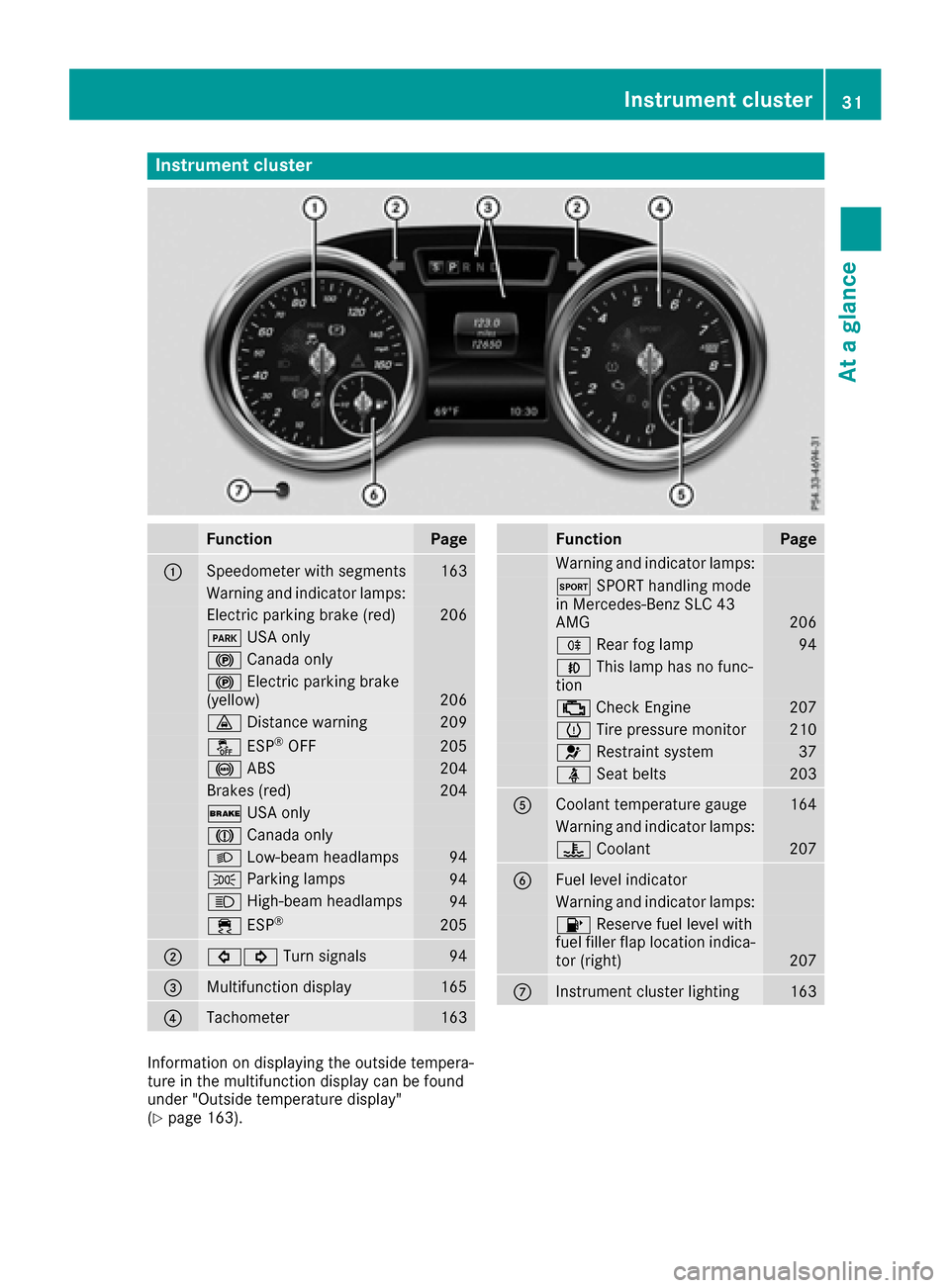
Instrumentcluster
FunctionPag e
:Speedometer wit hsegments163
Warning and indicator lamps:
Electric parking brak e(red)20 6
F USAo nly
! Canad aonly
! Electric parking brak e
(yellow)20 6
· Distanc ewarning209
å ESP®OF F205
! ABS204
Brake s(red)20 4
$ USAo nly
J Canad aonly
L Low-beam headlamps94
TParking lamp s94
KHigh-beam headlamps94
÷ESP®20 5
;#! Turn signals94
=Multifunction display165
?Tachometer163
FunctionPag e
Warning and indicator lamps:
M SPORT handlin gmode
in Mercedes-Ben zSLC 43
AM G
206
R Rear fog lamp94
NThis lamp has no func-
tion
; CheckEngine20 7
h Tirep ressur emonitor210
6 Restrain tsystem37
ü Seat belt s203
ACoolan ttem perature gauge164
Warning and indicator lamps:
? Coolan t207
BFue llevel indicator
Warning and indicator lamps:
8 Reserve fuel level wit h
fuel filler flap location indica-
to r( right )
207
CInstrumen tcluste rlighting16 3
Information on displayin gthe outside tempera-
tur eint hemultifunction display can be foun d
under "Outside temperature display"
(
Ypage 163).
Instrument cluster31
At ag lance
Page 39 of 294
Panic alarm
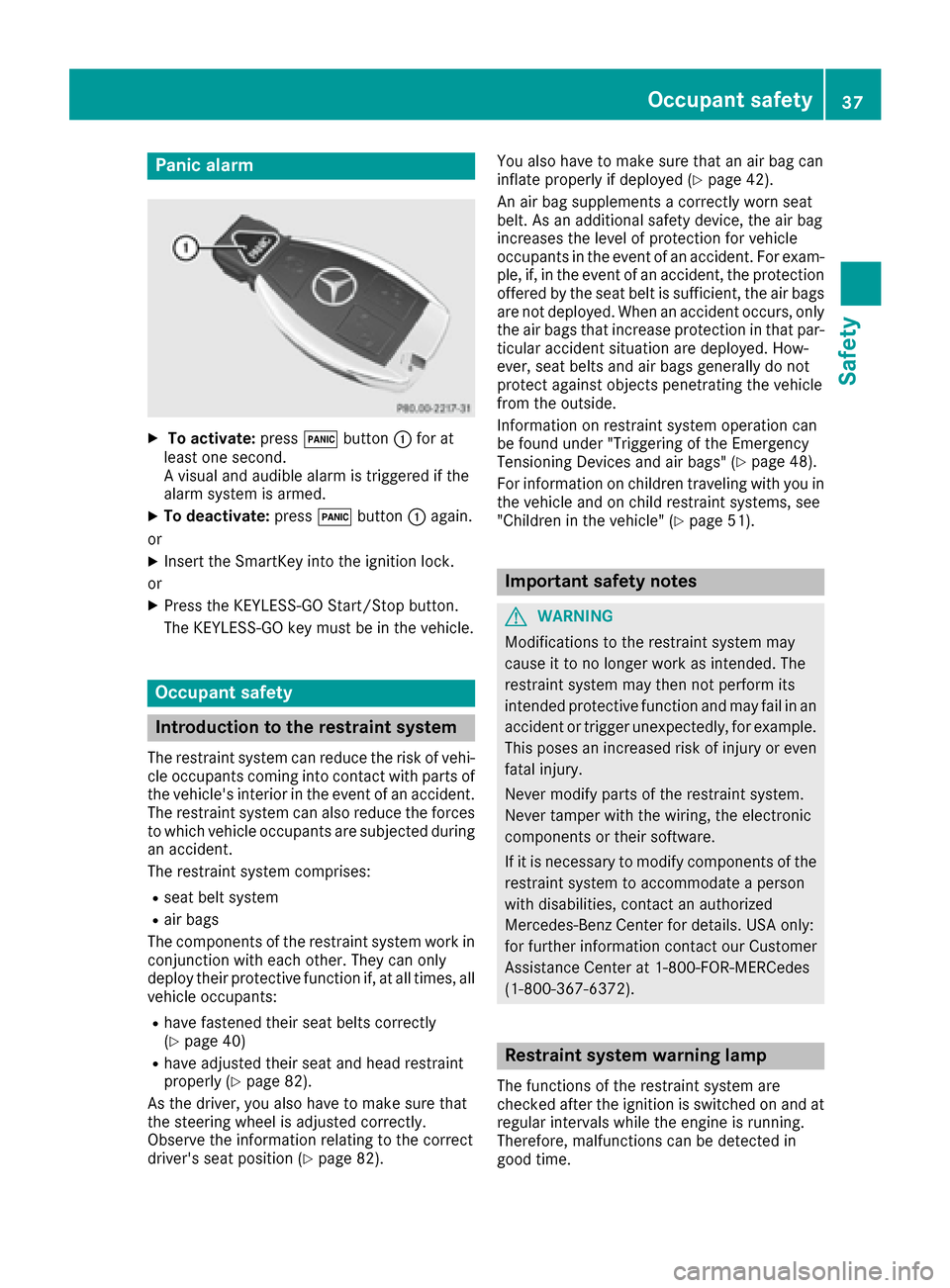
XTo activate:press!button :for at
least one second.
Av isual and audible alarm is triggered if the
alarm system is armed.
XTo deactivate: press!button :again.
or
XInsert the SmartKey into the ignition lock.
or
XPress the KEYLESS-GO Start/Stop button.
The KEYLESS-GO key must be in the vehicle.
Occupant safety
Introduction to the restraint system
The restraint system can reduce the risk of vehi- cle occupants coming into contact with parts of
the vehicle's interior in the event of an accident.
The restraint system can also reduce the forces to which vehicle occupants are subjected during
an accident.
The restraint system comprises:
Rseat belt system
Rair bags
The components of the restraint system work in
conjunction with each other. They can only
deploy their protective function if, at all times, all vehicle occupants:
Rhave fastened their seat belts correctly
(Ypage 40)
Rhave adjusted their seat and head restraint
properly (Ypage 82).
As the driver, you also have to make sure that
the steering wheel is adjusted correctly.
Observe the information relating to the correct
driver's seat position (
Ypage 82). You also have to make sure that an air bag can
inflate properly if deploye
d(
Ypage 42).
An air bag supplements acorrectly worn seat
belt. As an additional safety device, the air bag
increases the level of protection for vehicle
occupants in the event of an accident. For exam-
ple, if, in the event of an accident, the protection
offered by the seat belt is sufficient, the air bags
are not deployed. When an accident occurs, only
the air bags that increase protection in that par- ticular accident situation are deployed. How-
ever, seat belts and air bags generally do not
protect against object spenetrating the vehicle
from the outside.
Information on restraint system operation can
be found under "Triggering of the Emergency
Tensioning Devices and air bags" (
Ypage 48).
For information on children traveling with you in
the vehicle and on child restraint systems, see
"Children in the vehicle" (
Ypage 51).
Important safety notes
GWARNING
Modifications to the restraint system may
cause it to no longer work as intended. The
restraint system may then not perform its
intended protective function and may fail in an
accident or trigger unexpectedly, for example.
This poses an increased risk of injury or even fatal injury.
Never modify parts of the restraint system.
Never tamper with the wiring, the electronic
components or their software.
If it is necessary to modify components of the
restraint system to accommodate aperson
with disabilities, contact an authorized
Mercedes-Benz Center for details. USA only:
for further information contact our Customer
AssistanceC enter at 1-800-FOR-MERCedes
(1‑800‑36 7‑6372).
Restraint system warning lamp
The functions of the restraint system are
checked after the ignition is switched on and at
regular intervals while the engine is running.
Therefore, malfunction scan be detected in
good time.
Occupant safety37
Safety
Z
Page 40 of 294
The6 restraint system warning lamp in the
instrument cluster lights up when the ignition is
switched on. It goes out no later than afew sec-
onds after the vehicle is started. The compo-
nentsoft he restraint system are in operational
readiness.
Am alfunction has occurred if the 6restraint
system warning lamp:
Rdoes not light up after the ignition is switched
on
Rdoes not go out after afew seconds with the
engine running
Rlights up again while the engine is running
GWARNING
If the restraint system is malfunctioning,
restraint system components may be trig-
gered unintentionally or may not deploy as
intended during an accident .This can affect
for example the Emergency Tensioning
Device or the air bag. This poses an increased
risk of injury or even fatal injury.
Have the restraint system checked and
repaired in aqualified specialist workshop as
soon as possible.
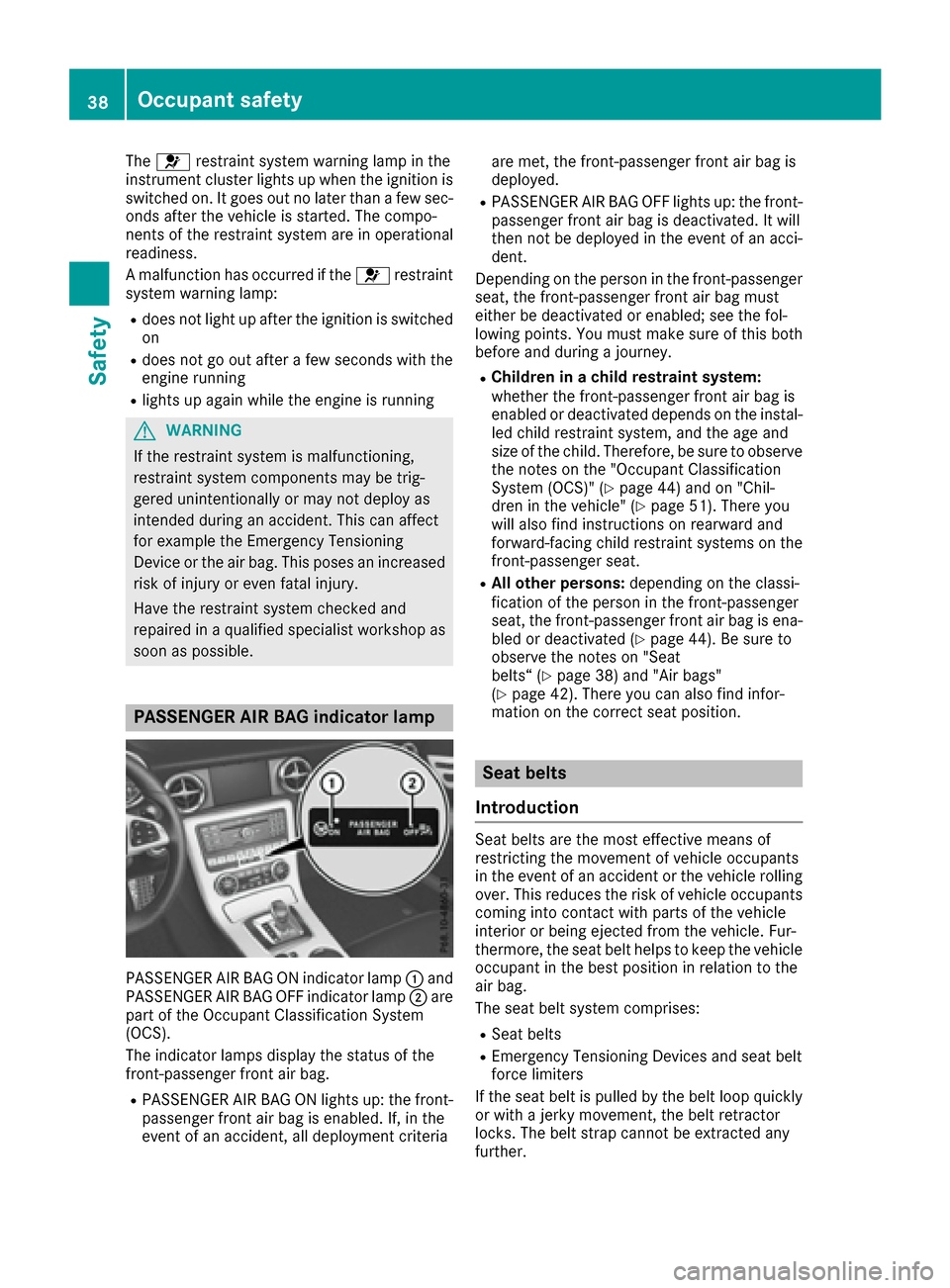
PASSENGER AIR BAG indicator lamp
PASSENGER AIR BAG ON indicator lamp :and
PASSENGER AIR BAG OFF indicator lamp ;are
part of the Occupant Classification System
(OCS).
The indicator lamps display the status of the
front-passenger front air bag.
RPASSENGER AIR BAG ON lights up: the front-
passenger front air bag is enabled. If, in the
event of an accident ,all deployment criteria are met, the front-passenger front air bag is
deployed.
RPASSENGER AIR BAG OFF lights up: the front-
passenger front air bag is deactivated. It will
then not be deployed in the event of an acci-
dent.
Dependin gonthe person in the front-passenger
seat, the front-passenger front air bag must
either be deactivated or enabled; see the fol-
lowing points. You must make sure of this both
before and during ajourney.
RChildren in achild restraint system:
whether the front-passenger front air bag is
enabled or deactivated depends on the instal-
led child restraint system, and the age and
size of the child. Therefore, be sure to observe
the notes on the "Occupant Classification
System (OCS)" (
Ypage 44) and on "Chil-
dren in the vehicle" (Ypage 51). There you
will also find instructions on rearward and
forward-facing child restraint systems on the
front-passenger seat.
RAll other persons: depending on the classi-
fication of the person in the front-passenger
seat, the front-passenger front air bag is ena-
bled or deactivated (
Ypage 44). Be sure to
observe the notes on "Seat
belts“ (
Ypage 38) and "Air bags"
(Ypage 42). There you can also find infor-
mation on the corrects eat position.
Seat belts
Introduction
Seat belts are the most effective means of
restrictingt he movementofv ehicle occupants
in the event of an accident or the vehicle rolling
over. This reduces the risk of vehicle occupants
coming into contact with parts of the vehicle
interior or being ejected from the vehicle. Fur-
thermore, the seat belt helps to keep the vehicle
occupant in the best position in relation to the
air bag.
The seat belt system comprises:
RSeat belts
REmergency Tensionin gDevices and seat belt
force limiters
If the seat belt is pulled by the belt loop quickly
or with ajerk ym ovement, the belt retractor
locks. The belt strap cannot be extracted any
further.
38Occupant safety
Safety
Page 43 of 294
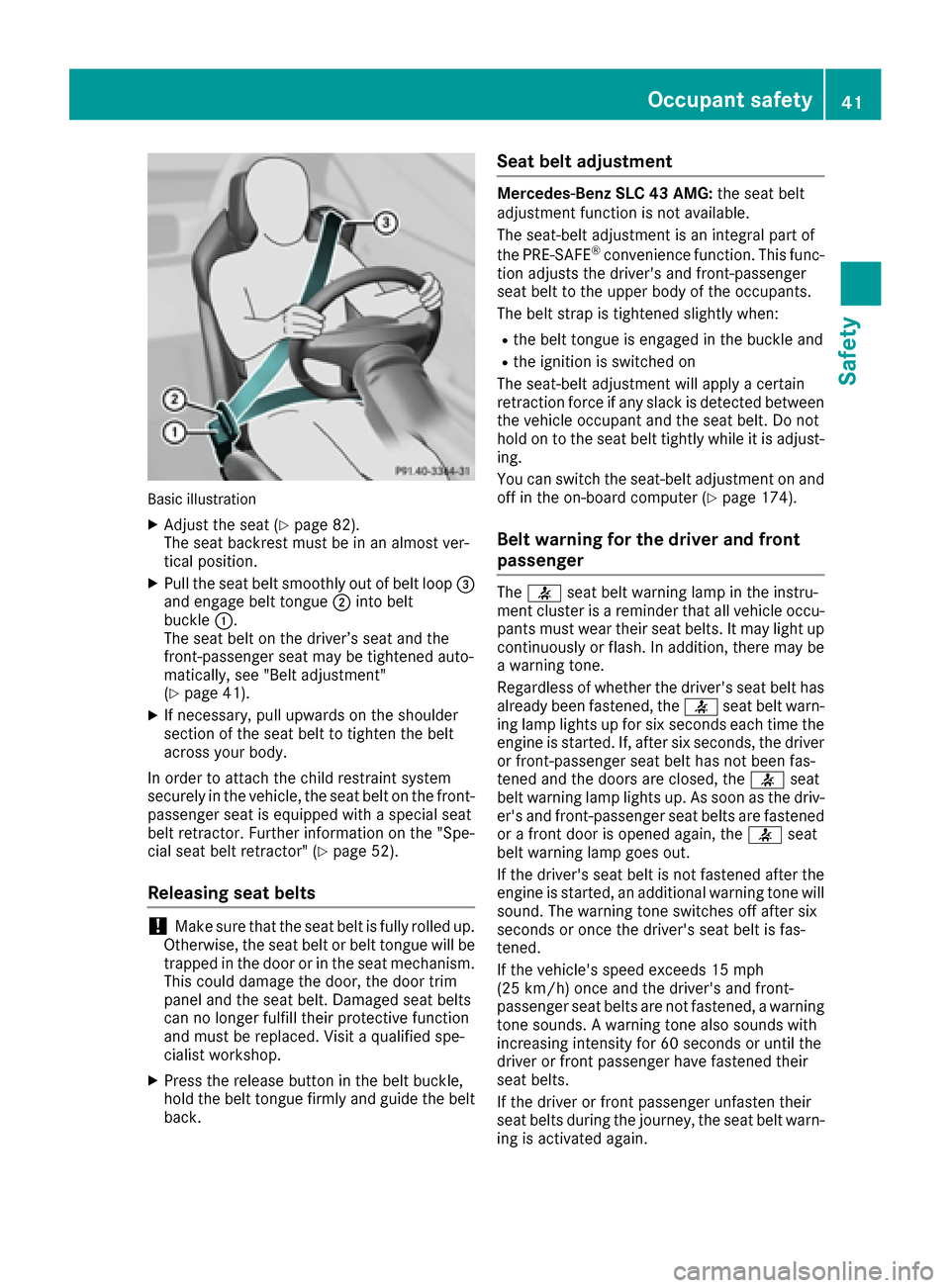
Basicillust ration
XAdjus tthe sea t(Ypage 82).
The sea tbackrest mus tbeinana lmost ver-
tical position.
XPull the sea tbelts moothly outofb eltl oop =
and engage bel ttongue ;into belt
buckle :.
The sea tbeltont he driver’ sseata nd the
front-passenger sea tmay be tightened auto-
matically ,see "Belt adjustment"
(
Ypage 41).
XIf necessary ,pullu pward sonthe shoulder
section of the sea tbelttot ighten the belt
across your body.
In orde rtoattach the chil drestraint system
securelyint he vehicle, the sea tbeltont he front-
passenger sea tisequipped with aspecia lseat
bel tretractor. Furthe rinformation on the "Spe-
cia lsea tb eltr etractor" (
Ypage 52).
Releasing seat belts
!Make sur ethat the sea tbeltisf ully rolled up.
Otherwise ,the sea tbeltorb eltt onguew illb e
trapped in the doo rorinthe seatmechanism.
Thisc ouldd amaget he door, the doo rtrim
panel and the sea tbelt. Damaged sea tbelts
can no longer fulfil lthei rprotective function
and mus tbereplaced. Visit aquali fied spe-
cialist workshop.
XPres sthe release button in the bel tbuckle,
hol dthe bel ttonguef irmlyand guide the belt
back.
Sea tbelta djustment
Mercedes-Ben zSLC 43 AMG: the seatbelt
adjustment function is not available.
The seat-bel tadjustment is an integral part of
the PRE-SAFE
®convenience function. Thisf unc-
tion adjusts the driver's and front-passenger
sea tbelttot he upper bod yofthe occupants.
The bel tstrap is tightened slightlyw hen:
Rthe belttongueise ngaged in the buckle and
Rthe ignition is switched on
The seat-bel tadjustment will apply acertain
retraction force if any slack is detected between
the vehicle occupant and the sea tbelt. Do not
hol dontot he seatbeltt ightly while it is adjust-
ing.
You can switch the seat-bel tadjustment on and
off in the on-board computer (
Ypage 174).
Beltw arning for the drive rand front
passenger
The 7 seatbeltw arning lamp in the instru-
ment cluster is areminder that al lvehicle occu-
pants mus twearthei rseatb elts. It may light up
continuously or flash. In addition, there may be
aw arning tone.
Regardless of whether the driver's sea tbelth as
already bee nfastened, the 7seatbeltw arn-
ing lamp lights up for six seconds each time the engine is started. If, afte rsix seconds ,the driver
or front-passenger sea tbelth as not bee nfas-
tened and the doors are closed, the 7seat
bel twarning lamp lights up .Assoon as the driv-
er's and front-passenger sea tbelts are fastened
or afront doo risopened again, the 7seat
bel tw arning lamp goeso ut.
If the driver's sea tbeltisn ot fastened afte rthe
engine is started, an additional warning tone will
sound. The warning tone switches off after six
seconds or once the driver's sea tbeltisf as-
tened.
If the vehicle' sspeed exceeds 15 mph
(25 km/h )once and the driver's and front-
passenger sea tbelts are not fastened, awarning
tone sounds. Awarning tone also sounds with
increasing intensity for 60 seconds or until the
driver or front passenger hav efastened their
sea tbelts.
If the driver or front passenger unfasten their
sea tbelts during the journey,t he seatbeltw arn-
ing is activated again.
Occupan tsafety41
Safety
Z
Page 53 of 294
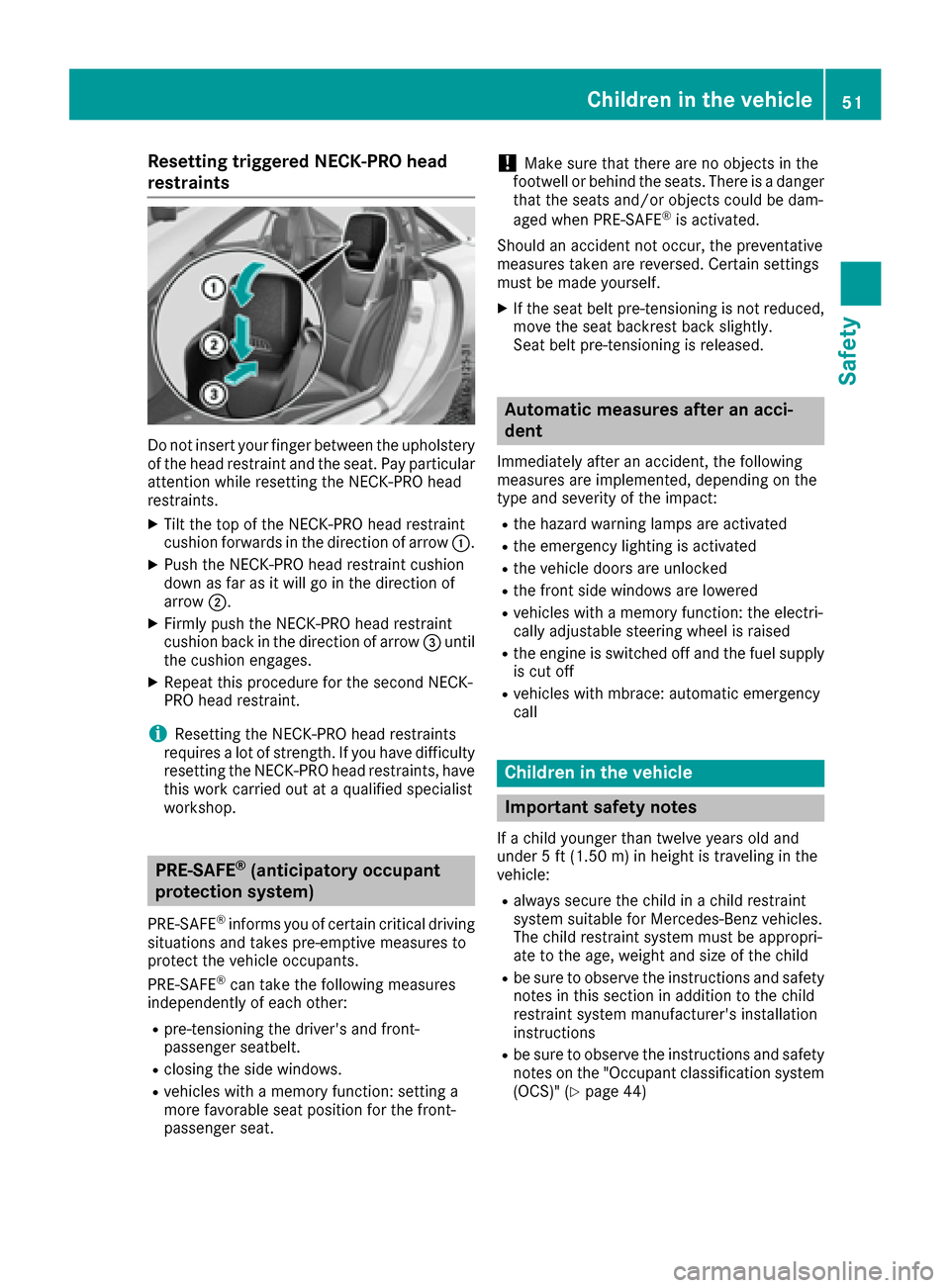
Resetting triggeredNECK-PRO head
restraints
Do not insert your finger between the upholstery of the hea drestraint and the seat. Payp articular
attention whil eresetting the NECK-PROh ead
restraints.
XTilt the top of the NECK-PROh eadr estraint
cushio nforward sinthe direction of arrow :.
XPush the NECK-PROh eadr estraint cushion
dow nasfar as it will go in the direction of
arrow ;.
XFirmly push the NECK-PROh eadr estraint
cushio nbackint he direction of arrow =until
the cushio nengages.
XRepea tthis procedure for the second NECK-
PROh eadr estraint.
iResetting the NECK-PROh eadr estraints
requires alot of strength. If yo uhaved ifficulty
resetting the NECK-PROh eadr estraints, have
this work carrie doutataq uali fied specialist
workshop.
PRE-SAFE®(anticipatory occupant
protection system)
PRE-SAFE®informs yo uofcertain critical driving
situations and take spre-emptive measures to
protect the vehicl eoccupants.
PRE-SAFE
®can take the following measures
independentl yofeacho ther:
Rpre-tensioning the driver' sand front-
passenger seatbelt.
Rclosing the sid ewindows.
Rvehicles with amemory function: setting a
more favorabl eseatp osition for the front-
passenger seat.
!Make sure that there are no objects in the
footwell or behind the seats. There is adanger
that the seats and/or objects could be dam-
aged when PRE-SAFE
®is activated.
Should an accident not occur, the preventative
measures take nare reversed. Certai nsettings
mus tbem adey ourself.
XIf the sea tbeltp re-tensioning is not reduced,
move the sea tbackrest back slightly.
Seatb eltp re-tensioning is released.
Automatic measures after an acci-
dent
Immediately afte ranaccident, the following
measures are implemented, depending on the
typ eand severity of the impact:
Rthe hazard warning lamps are activated
Rthe emergency lighting is activated
Rthe vehicl edoors are unlocked
Rthe front sid ewindow sare lowered
Rvehicles with amemory function: the electri-
cally adjustabl esteering wheel is raised
Rthe engine is switched off and the fue lsuppl y
is cut off
Rvehicles with mbrace: automatic emergency
call
Childrenint he vehicle
Important safety notes
Ifac hild younger than twelve years olda nd
under 5ft(1.50 m) in height is traveling in the
vehicle:
Ralways secur ethe child in achild restraint
systems uitabl efor Mercedes-Benz vehicles.
The child restraint systemm ustbea ppropri-
ate to the age, weight and size of the child
Rbe sure to observe the instructions and safety
note sint hissectio nina dditiontot he child
restraint systemm anufacturer's installation
instructions
Rbe sure to observe the instructions and safety
note sont he "Occupant classification system
(OCS) "(
Ypage 44)
Children in the vehicle51
Safety
Z