engine MERCEDES-BENZ SLC-Class 2017 R172 Repair Manual
[x] Cancel search | Manufacturer: MERCEDES-BENZ, Model Year: 2017, Model line: SLC-Class, Model: MERCEDES-BENZ SLC-Class 2017 R172Pages: 294, PDF Size: 7.28 MB
Page 132 of 294
!Overfilling the fuel tank could damage the
fuel system.
!Take care not to spill any fuel on painted
surfaces. You could otherwise damage the
paintwork.
!Use afilter when adding fuel from afuel can.
The fuel lines and/or the fuel injection system
could otherwise be blocked by particles from
the fuel can.
If you overfill the fuel tank, fuel could spray out
when the fuel pump nozzle is removed.
For further information on fuel and fuel quality
(
Ypage 285).
Refueling
General information
The fuel filler flap is unlocked or locked auto-
matically when you unlock or lock the vehicle
with the key or using KEYLESS-GO.
The position of the fuel filler cap is displayed
8 in the instrument cluster. The arrow next
to the filling pump indicates the side of the vehi-
cle.
Opening the fuel filler flap
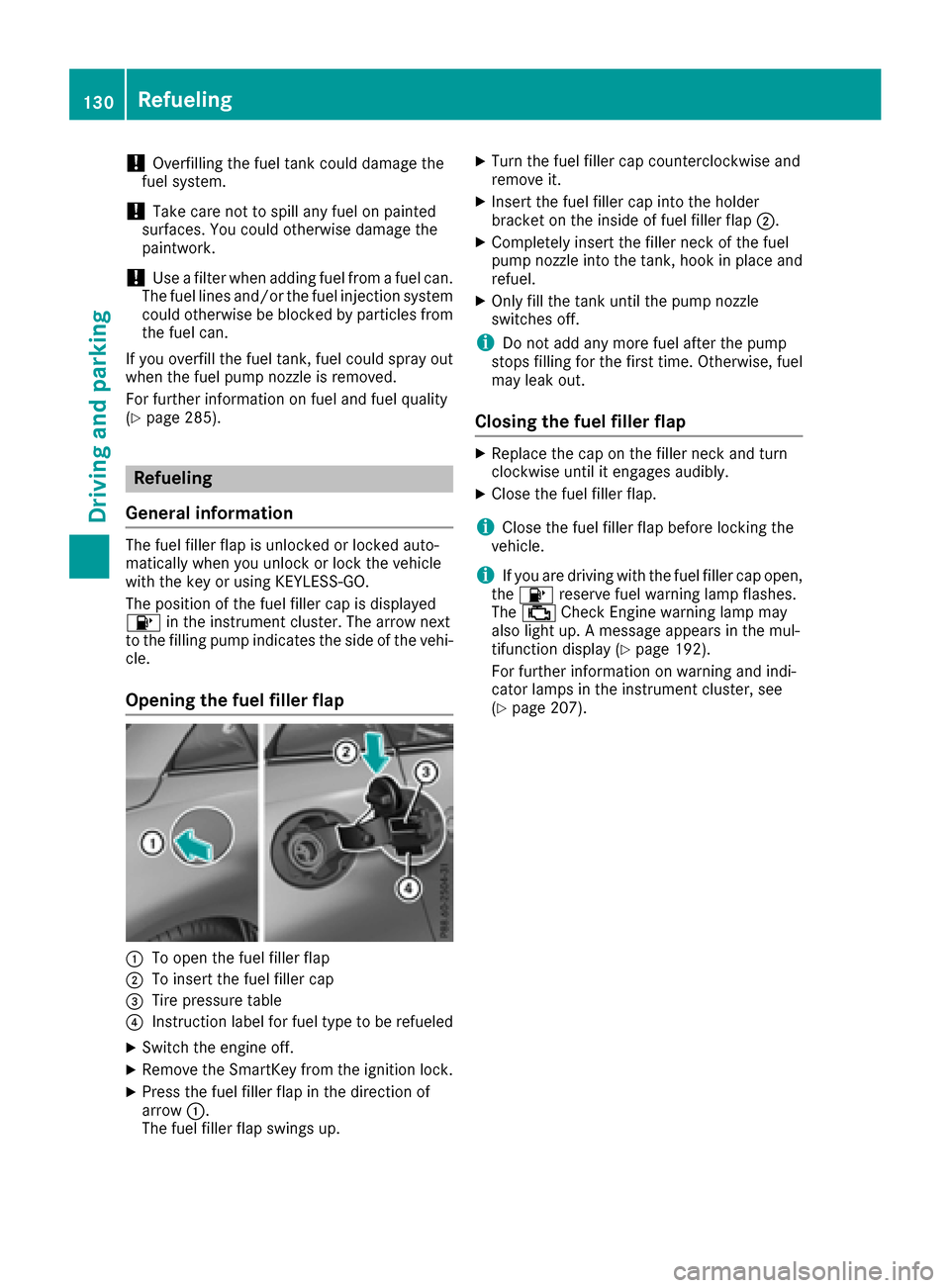
:To open the fuel filler flap
;To insert the fuel filler cap
=Tire pressure table
?Instruction label for fuel type to be refueled
XSwitch the engine off.
XRemove the SmartKey from the ignition lock.
XPress the fuel filler flap in the direction of
arrow :.
The fuel filler flap swings up.
XTurn the fuel filler cap counterclockwise and
remove it.
XInsert the fuel filler cap into the holder
bracket on the inside of fuel filler flap ;.
XCompletely insert the filler neck of the fuel
pump nozzle into the tank, hook in place and
refuel.
XOnly fill the tank until the pump nozzle
switches off.
iDo not add any more fuel after the pump
stops filling for the first time. Otherwise, fuel
may leak out.
Closing the fuel filler flap
XReplace the cap on the filler neck and turn
clockwise until it engages audibly.
XClose the fuel filler flap.
iClose the fuel filler flap before locking the
vehicle.
iIf you are driving with the fuel filler cap open,
the 8 reserve fuel warning lamp flashes.
The ; Check Engine warning lamp may
also light up. Amessage appears in the mul-
tifunction display(
Ypage 192).
For further information on warning and indi-
cator lamps in the instrument cluster, see
(
Ypage 207).
130Refueling
Driving and parking
Page 133 of 294
Problems with fuel and the fuel tank
ProblemPossible causes/consequences andMSolutions
Fuel is leaking from the
vehicle.The fuel line or the fuel tank is faulty.
GWARNING
Risk of explosion or fire.
XTurn the SmartKey to position 0immediately and remove it
(Ypage 115).
XDo not restart the engine under any circumstances.
XConsult aqualified specialist workshop.
The fuel filler flap cannot
be opened.The fuel filler flap is not unlocked.
XUnlock the vehicle (Ypage 63).
The SmartKey battery is discharged or nearly discharged.
XUnlock the vehicle using the mechanical key (Ypage 65).
The fuel filler flap is unlocked, but the opening mechanism is jammed.
XConsult aqualified specialist workshop.
Parking
Important safety notes
GWARNING
Flammable material such as leaves, grass or
twigs may ignite if they come into contact with
hot parts of the exhaust system or exhaust
gas flow. There is arisk of fire.
Park the vehicle so that no flammable mate-
rials come into contact with parts of the vehi-
cle which are hot. Take particular care not to
park on dry grassland or harvested grain
fields.
GWARNING
If you leave children unsupervised in the vehi-
cle, they could set it in motion by, for example:
Rrelease the parking brake.
Rshift the automatic transmission out of the
parking position P.
Rstart the engine.
In addition, they may operate vehicle equip-
ment and become trapped. There is arisk of
an accident and injury.
When leaving the vehicle, always take the
SmartKey with you and lock the vehicle. Never
leave children unsupervised in the vehicle.
!Always secure the vehicle correctly against
rolling away.O therwise, the vehicle or its driv-
etrain could be damaged.
To ensure that the vehicle is secured against
rolling away unintentionally:
Rthe electric parking brake must be applied.
Rthe transmission must be in position P.
Rthe SmartKey must be removed from the igni-
tion lock.
Rthe front wheels must be turned towards the
curb on steep uphill or downhill gradients.
Switching off the engine
GWARNING
The automatic transmission switches to neu-
tral position Nwhen you switch off the engine.
The vehicle may roll away.T here isarisk of an
accident.
After switching off the engine, always switch
to parking position P.Prevent the parked vehi-
Parking131
Driving and parking
Z
Page 134 of 294
cle from rolling away by applying the parking
brake.
XApplythe electri cparking brake.
XShif tthe transmission to position P
(Ypage 123).
XWith the SmartKey: turn the SmartKey to
position 0in the ignition lock and remove it.
The immobilizer is activated.
XWith KEYLESS-GO: press the KEYLESS-GO
Start/Stop button (Ypage 115).
The engine stopsa nd allthe indicator lamps in
the instrument cluster go out.
Whe nthe driver' sdoorisc losed, this corre-
sponds to SmartKey position 1.W hent he
driver' sdooriso pen, this corresponds to
SmartKey position 0(
Ypage 115).
The engine can be switched off while the vehicle
is in motio nbypressing and holding the Start/
Stop button for aboutt hree seconds. Thisfunc-
tion operate sindependently of the ECO start/
stop automatic engine switch-off function.
Electric parkin gbrake
General notes
GWARNING
If yo ulea ve childre nunsupervised in the vehi-
cle ,they could set it in motio nby,for example:
Rrelease the parking brake.
Rshift the automatic transmission outoft he
parking position P.
Rstartthe engine.
In addition, they may operate vehicle equip-
ment and become trapped .There is arisko f
an accident and injury.
Whe nleaving the vehicle ,alway stake the
SmartKey with yo uand lock the vehicle .Never
leave childre nunsupervised in the vehicle. The function of the electri
cparking brake is
dependent on the on-board voltage .Ifthe on-
board voltage is low or there is amalfunction in
the system, it may not be possible to applyt he
released parking brake.
XIf this is the case ,only park the vehicle on
level ground and secure it to prevent it rolling
away.
XShif tthe automatic transmission to position
P.
It may not be possible to release an applied
parking brake if the on-board voltage is low or
there is amalfunction in the system. Contact a
qualified specialist workshop.
The electri cparking brake performs afunction
test at regula rinterval swhile the engine is
switched off. The sounds that can be heard while
this is occurring are normal.
Applyin gorreleasin gmanually
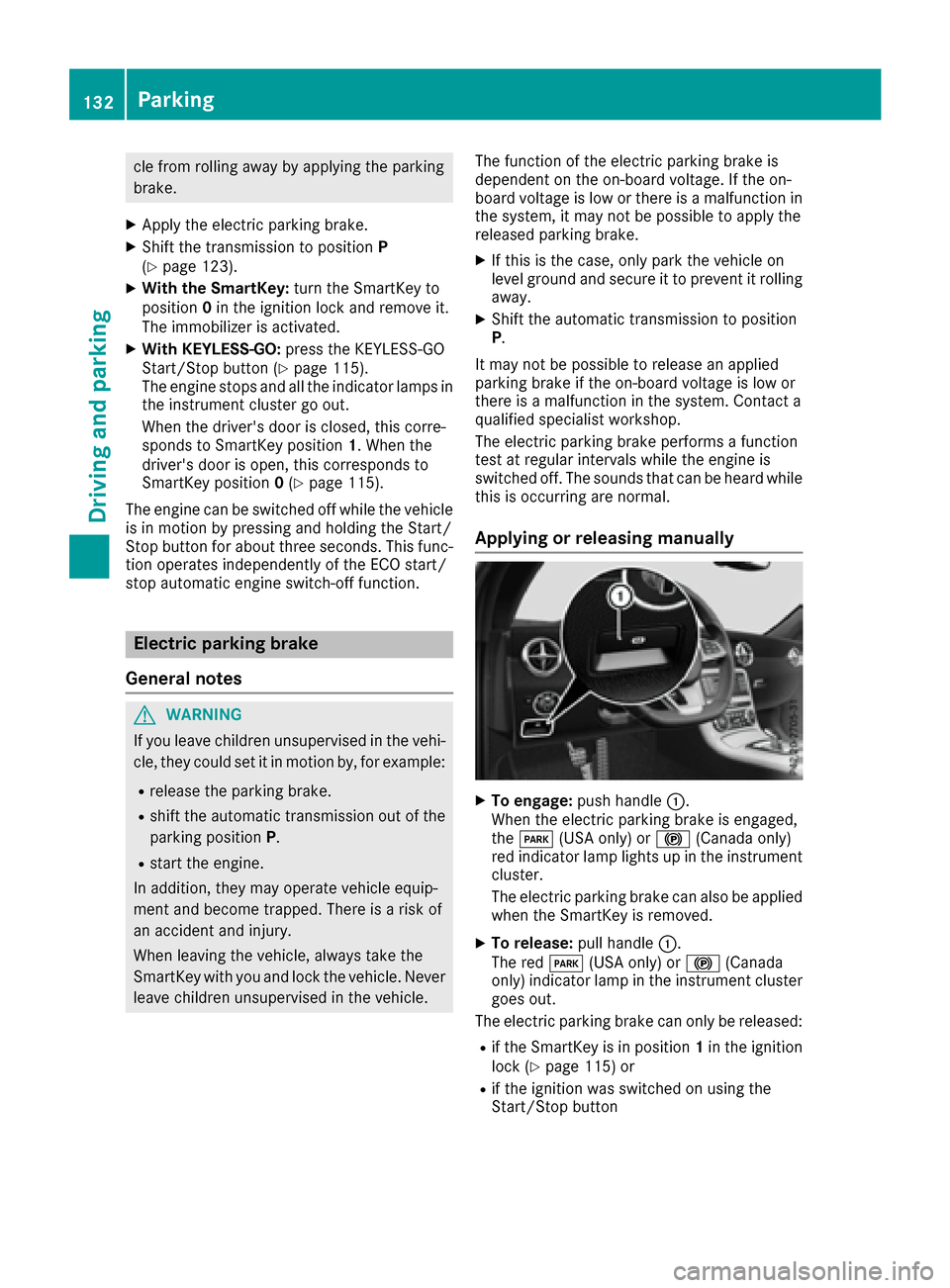
XTo engage: push handle :.
Whe nthe electri cparking brake is engaged,
the F (USA only )or! (Canada only)
red indicator lamp lights up in the instrument
cluster.
The electricp arking brake can also be applied
whe nthe SmartKey is removed.
XTo release: pull handle:.
The red F(USA only )or! (Canada
only )indicator lamp in the instrument cluster
goe sout.
The electricp arking brake can only be released:
Rif the SmartKey is in position 1in the ignition
lock (Ypage 115) or
Rif the ignition wa sswitched on using the
Start/Stop button
132Parking
Drivin gand parking
Page 136 of 294
for example, the power steering and the brakeboosting effect. You wil lrequire considerably
more effort to steer and brake. There is arisk
of an accident.
Do not switch off the ignition while driving.
GWARNING
If you operate mobile communication equip-
ment while driving, you wil lbedistracted from
traffic conditions. You coul dalsol ose control
of the vehicle. There is arisk of an accident.
Only operate this equipment when the vehicle
is stationary.
Observe the lega lrequirements for the country
in which you are driving. Some jurisdictions pro-
hibi tthe drive rfrom using amobile phone while
driving avehicle.
If you make acall while driving, alway suse
hands-free mode. Only operate the telephone
when the traffic situation permits. If you are
unsure, pul lover to asafe location and stop
before operating the telephone.
Bear in mind that at aspeedofo nly 30 mph
(approximately 50 km/h) ,the vehicl ecovers a
distance of 44 ft (approximately 14 m)per sec-
ond.
Drive sensibly –save fuel
Observe the following tips to save fuel:
RThe tires should always be inflated to the rec-
ommended tire pressure.
RRemove unnecessary loads.
RWarm up the engin eatlow engin espeeds.
RAvoid frequenta cceleration or braking.
RObserve the servicei ntervals in the Mainte-
nanc eBooklet or in the servicei nterval dis-
play. Have all the maintenanc ework carried in
accordance with Daimler AG regulations.
Fuel consumption also increases when driving in
cold weather, in stop-start traffic and in hilly ter-
rain.
Drinking and driving
GWARNING
Drinkin gand driving and/or takin gdrugs and
driving are very dangerous combinations.
Even asmall amount of alcohol or drugs can
affect your reflexes, perceptions and judg-
ment.
The possibility of aserious or even fatal acci-
dent is greatly increased when you drink or
take drugs and drive.
Do not drink or take drugs and drive or allow
anyone to drive who has been drinking or tak-
ing drugs.
Emission control
GWARNING
Combustion engines emit poisonous exhaust
gases such as carbon monoxide. Inhaling
these exhaust gases leads to poisoning. There
is ar isk of fatal injury. Thereforen ever leave
the engin erunning in enclosed spaces with-
out sufficientv entilation.
Certain engin esystems are designed to keep
the level of poisonous component sinexhaust
fumes within legal limits.
These systems only work at peak efficiency if
they are serviced exactly in accordance with the
manufacturer's specifications .Always have
work on the engin ecarried out at aqualified
specialist workshop. Mercedes-Benz recom-
mends that you use an authorized Mercedes-
BenzC enter for this purpose. Work relevant to
safety or work on safety-related systems in par-
ticular must be carried out at aqualified spe-
cialist workshop.
The engin esettings must not be changed under
any circumstances. Furthermore, all specific
servicew ork must be carried out at regular
intervals and in accordance with the Mercedes-
Benzs ervicer equirements. Details can be found
in the Maintenanc eBooklet.
ECO display
The ECO display shows you how economical
your driving style is. The ECO display assists you
in achievingt he most economical driving style
for the selected settings and prevailing condi-
tions. Your driving style can significantly influ-
enc ethe vehicle's consumption.
134Driving tips
Driving and parking
Page 138 of 294
In addition to driving style, the actual consump-
tion is affected by other factors, such as:
Rload
Rtire pressure
Rcold start
Rchoice of route
Ractive electrical consumers
These factors are not include dinthe ECO dis-
play.
An economical driving style specially requires
driving at moderate engine speeds.
Achieving ahigher valu einthe categories
"Acceleration" and "Constant":
Robserve the gearshift recommendations.
Rdrive the vehicle in drive program Cor E.
On long journeys at aconstant speed,e .g. on the
highway, only the outer area for "constant" will
change.
The ECO display summarizes the driving style
from the start of the journey to its completion.
Therefore, there are more marked changes in
the outer area satthe start of ajourney. On lon-
ger journeys, there are fewer changes. For more
marked changes, perform amanua lrest
(
Ypage 167).
For more information on the ECO display, see
(
Ypage 166).
Braking
Important safety notes
GWARNING
If you shift down on aslippery road surface in
an attempt to increase the engine's braking
effect, the drive wheel scould lose their grip.
There is an increased danger of skidding and
accidents.
Do not shift down for additional engine brak-
ing on aslippery road surface.
Downhill gradients
!On long, steep gradients, you must reduce
the load on the brakes. To use engine braking,
shift to alowerg ear in good time. This helps
you to avoid overheating the brakes and wear-
ing them out excessively. When making use of the engine braking
effect, it is possible that
adrive wheel may not
turn for some time, e.g. in the case of sud-
denly changing or slippery road surface con-
ditions. This could cause damage to the drive
train. This type of damage is not covered by
the Mercedes-Benz warranty.
Change into alowerg ear in good time on long
and steep downhill gradients. This is especially
important if the vehicle is laden.
This also applies if you have activated cruise
control or Distance PilotD ISTRONIC.
Heavy and light loads
GWARNING
If you rest you rfoot on the brake pedalw hile
driving, the braking system can overheat. This increases the stopping distance and can even
cause the braking system to fail .There is a
risk of an accident.
Never use the brake pedalasaf ootrest. Never
depresst he brake pedala nd the accelerator
pedalatt he same time.
!Depressing the brake pedalc onstantly
results in excessive and premature wea rto
the brake pads.
If the brakes have been subjected to aheavy
load ,don ot stop the vehicle immediately ,but
drive on for ashort while. This allows the airflow
to cool the brakes more quickly.
Wet roads
If you have driven for along time in heavy rain
withou tbraking, there may be adelayed reac-
tion from the brakes when braking for the first
time. This may also occur after the vehicle has
been washed or driven through deep water.
You then have to depresst he brake pedalmore
firmly.M aintainagreater distance from the
vehicle in front.
After driving on awet road or having the vehicle
washed, brake firmly whil epaying attention to
the traffic conditions. This willw arm up the
brake discs, thereby drying them more quickly
and protecting them against corrosion.
136Driving tips
Driving and parking
Page 139 of 294
Limited braking performance on salt-
treated roads
If you driveonsalted roads,alayer of salt resi-
due may for monthebrak ediscsa nd brake
pads. This can result in asignificantly longer
braking distance.
RIn ordertop revent any salt build-up, apply the
brakes occasionally while paying attention to th et raffic conditions.
RCarefully depress th ebrakep edal and the
beginnin gand end of ajou rney.
RMaintain agreater distanc etothevehicle
ahead.
Servicing th ebrakes
!The brakef luid level may be to olow, if:
Rif th ered brakew arning lamp lightsupi n
th ei nstrumentc luster and
Ryou hearawarning tone while th eengine is
running
Observe additional warning messages in the
multifunction display.
The brak efluid level may be to olow due to
brak epad wear or leaking brakel ines.
Hav ethe brak esystem checked immediately.
Consult aqualifie dspecialist workshop to
arrange this.
!As th eESP®system operates automatically,
th ee ngine and th eignitio nmust be switched
off (SmartKey in position 0or 1in th eignition
lock) if th eelectric parking brakeisb eingtes-
ted on abraked ynamometer (maximum
10 seconds).
Brakin gtriggered automatically by ESP
®may
seriously damage th ebrakes ystem.
All check sand maintenanc ework on th ebrake
system must be carried out at aqualifie dspe-
cialis tworkshop.
Hav ebrakep ads installe dand brakef luid
replaced at aqualifie dspecialist workshop.
If th ebrakes ystem has onl ybeen subject to
moderatel oads, you should tes tthe functional-
ity of your brakes at regular intervals.
Information on BA S(Brake Assist)(
Ypage 55).
Mercedes-Ben zrecommend stha tyou onl yhave
brakep ads/linings installe donyour vehicle
whichh ave been approved for Mercedes-Benz
vehicle sorwhichcorrespondtoane quivalent
qualitys tandard. Brake pads/linings whichh avenot been approved for Mercedes-Ben
zvehicle s
or whicha re n
ot of an equivalent qualityc ould
affect your vehicle's operatin gsafety.
Mercedes-Ben zrecommend sthaty ou onl yuse
brakef luid that has been specially approved for
your vehicle by Mercedes-Benz, or whichc orre-
sponds to an equivalent qualitys tandard. Brake
fluid whichh as not been approved for
Mercedes-Ben zvehicle sorw hichisn ot of an
equivalent qualityc ould affect your vehicle's
operatin gsafety.
High-performance brake system
(Mercedes-Benz SLC 43 AMG)
AM Gb rakes ystems are designed for heavy
loads and have component swith corresponding
properties. This may lead to noise when braking.
This will dependo n:
RSpeed
RBrakingforce
RAmbientc onditions, e.g .temperature and
humidity
The wear of individual component softhebrake
system, such as th ebrakep ads/linings or brake
discs, depends on th eindividual driving style
and operatin gconditions.
For this reason, it is impossibletos tate am ile-
age that will be valid unde rall circumstances. An
aggressived riving style will lead to high wear.
You can obtain morei nformationonthisf roma
qualifie dspecialist workshop.
New and replaced brak epads and discso nly
reacht heir optimum braking effect after several
hundred kilometers of driving .Compensate for
this by applyingg reater force to thebrakep edal.
Keep this in mind, and adapt your driving and
braking accordingl yduringt hisb reak-in period.
Excessive heavy braking results in correspond-
ingly high brak ewear. Observe th ebrakes ystem
warning lamp in th einstrumentc luster and note
any brak estatus messages in th emultifunction
display. Especially for high performanc edriving,
it is important to maintain and have th ebrake
system checked regularly.
Driving tips137
Driving and parking
Z
Page 140 of 294
Drivingonw et road s
Hydroplaning
If water has accumulated to acertai ndept hon
th er oads urface, there is adanger of hydro-
planin goccurring, eve nif:
Ryou drive at low speeds
Rthet ires hav eadequat etread dept h
Fo rthisr eason ,intheevent of heav yrain or in
condition sinwhichh ydroplaning may occur ,
you mus tdrive in th efollowin gmanner:
Rlowe ryour speed
Ravoid rut s
Ravoid sudden steerin gmovements
Rbrake carefully
Drivin gonflooded road s
!Do notdrive through floode dareas. Chec k
th ed ept hofa ny water befor edrivin gthrou gh
it .D rive slowly through standin gwater. Oth-
erwise ,water may ente rthe vehicle interio ror
th ee nginec om partment. Thi scan damage
th ee lectronic component sintheengin eor
th ea utomatic transmission. Water can also
be drawn in by th eengine's air suction nozzles
and this can cause engin edamage.
Winte rdrivin g
GWARNING
If you shift down on aslipper yroads urfac ein
an attempt to increase th eengine's braking
effect ,the drive wheels could los etheir grip.
There is an increase ddanger of skidding and
accidents .
Do no tshift down fo radditional engin ebrak-
in gonas lipperyroads urface.
GDANGER
If th eexhaus tpipe is blocke doradequat e
ventilation is no tpossible, poisonous gases
suc hasc arbon monoxide (CO) may ente rthe
vehicle. Thi sisthecase, e.g. if th evehicle
becomes trappe dinsnow. There is arisko f
fatal injury.
If you leav ethe engin eortheauxiliar yheatin g
running ,makes uret he exhaus tpipe and are a
around th evehicle are clear of snow. To
ensur eana dequat esupply of fresh air, ope na
window on th esideoft hevehicle that is no t
facin gintot he wind.
Hav eyour vehicle winter-proofed at aqualified
specialis tworkshop at th eonset of winter.
Drive particularly carefully on slipper yroads ur-
faces. Avoid sudden acceleration ,steerin gand
braking maneuvers .Donotuse cruise control.
If th evehicle threatens to skid or canno tbe
stopped when movin gatlow speed:
XShift th etransmissio ntoposition N.
The outsid etem perature indicator is no t
designed to serve as an ice-warnin gdevic eand
is therefore unsuitable fo rtha tp urpose.
Changes in th eoutsid etem perature are dis -
playe dafter ashort delay.
Indicated temperature sjusta bov ethe freezin g
poin tdon otguarantee that th eroads urfac eis
free of ice. The road may still be icy, especially in
wooded areas or on bridges. The vehicle could
skid if you fail to adapt your drivin gstyle. Always
adapt your drivin gstyle and drive at aspeed to
suit th eprevailin gweather conditions.
You should pay spe cia
l attention to road condi-
tion swhen temperature sare around freezin g
point.
Fo rm orei nformati on on drivin gwiths now
chains, see (
Ypage 257).
Fo rm orei nformat ion on drivin gwiths ummer
tires ,see (
Ypage 257).
Observ ethe note sint he"Winte roperation "sec-
tion (
Ypage 257).
Drivin gsystems
Cruis econtro l
General notes
Cruise contro lmaintain saconstan troa ds peed
fo ry ou. It brake sautomatically in order to avoid
exceedin gthe set speed. On lon gand steep
downhill gradients, especially if th evehicle is
laden, you mus tselec talowe rgear in goo dtim e.
By doin gso, you will mak euse of th ebraking
effect of th eengine. Thi srelieves th eload on th e
138Driving systems
Driving an dparking
Page 142 of 294
Settingaspeed
GWARNING
Keep in mind that it may take abrief moment
until the vehicle has made the necessary
adjustments.
Increase or decrease the set vehicle speed to
av alue that the prevailing road conditionsa nd
legal speed limits permit. Otherwise, sudden
and unexpected acceleration or deceleration
of the vehicle could cause an accident and/or
serious injury to you and others.
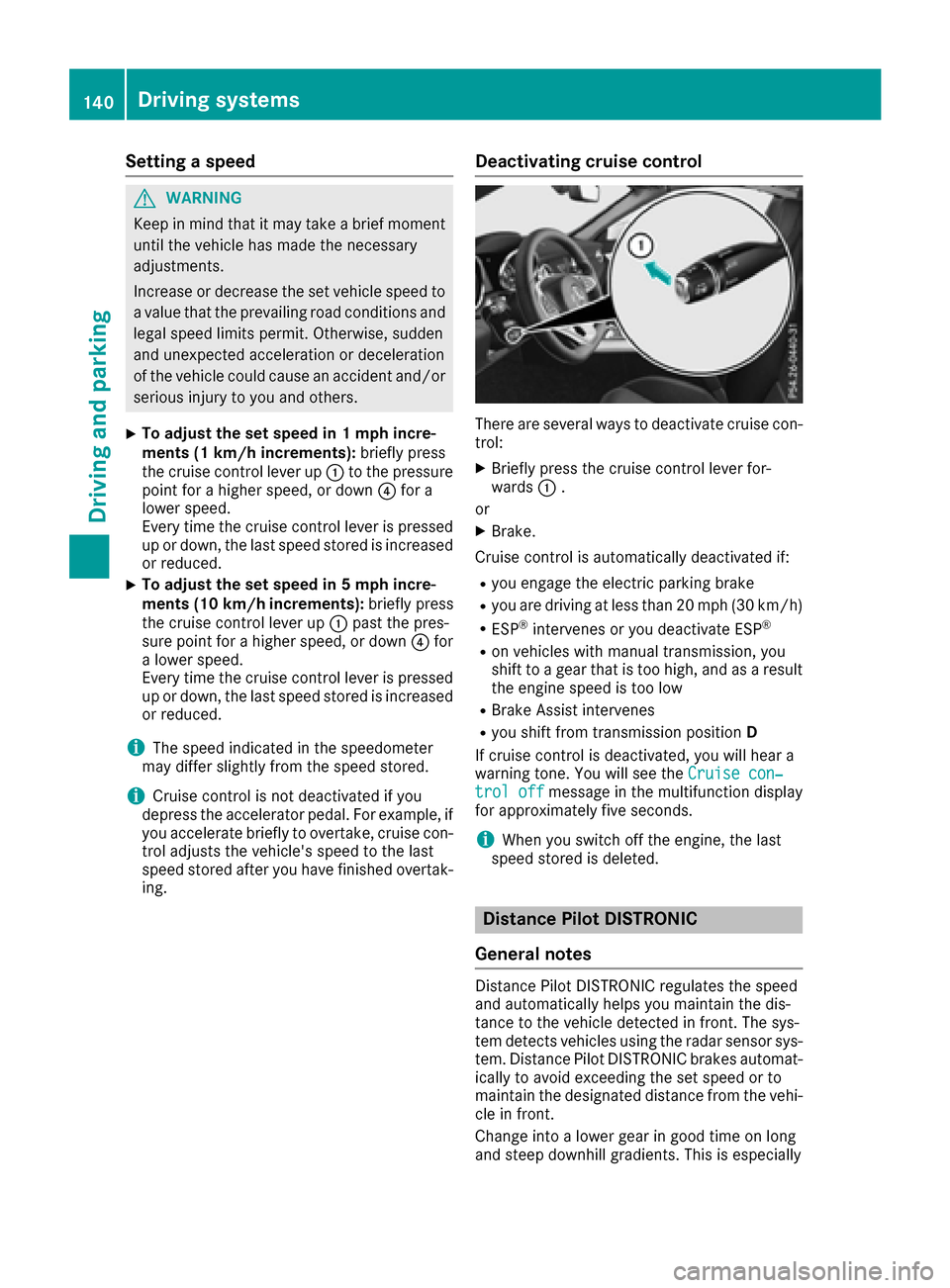
XTo adjust the set speed in 1mph incre-
ments (1 km/h increments): briefly press
the cruise control lever up :to the pressure
point for ahigher speed, or down ?for a
lower speed.
Every time the cruise control lever is pressed
up or down, the last speed stored is increased
or reduced.
XTo adjust the set speed in 5mph incre-
ments (10k m/h increments): briefly press
the cruise control lever up :past the pres-
sure point for ahigher speed, or down ?for
al ower speed.
Ever ytime the cruise control lever is pressed
up or down, the last speed stored is increased
or reduced.
iThe speed indicated in the speedometer
may differ slightly from the speed stored.
iCruise control is not deactivated if you
depress the accelerator pedal. For example, if you accelerateb riefly to overtake, cruise con-
trol adjusts the vehicle's speed to the last
speed stored after you have finished overtak-
ing.
Deactivating cruise control
There are several ways to deactivate cruise con-
trol:
XBriefly press the cruise control lever for-
wards :.
or
XBrake.
Cruise control is automatically deactivated if:
Ryou engage the electric parkin gbrake
Ryou are driving at less than 20 mph (3 0km/ h)
RESP®intervenes or yo udeactivate ESP®
Ron vehicles with manua ltransmission, you
shift to agearthati stoo high, and as aresult
the engine spee distoo low
RBrake Assist intervenes
Ryous hift fromt ransmission position D
If cruis econtro lisdeactivated ,you will hear a
warning tone .You will see the Cruise con‐
troloffmessage in the multifunctio ndisplay
for approximately fiv eseconds.
iWhen yo uswitch off the engine ,the last
spee dstored is deleted.
Distance Pilo tDISTRONIC
General notes
Distance Pilo tDISTRONI Cregulate sthe speed
and automaticall yhelps youm aintain the dis-
tance to the vehicl edetecte dinf ront. The sys-
tem detects vehicles using the rada rsensor sys-
tem. Distance Pilo tDISTRONI Cbrakes automat-
icall ytoa voidexceeding the set spee dorto
maintain the designated distance fromt he vehi-
cle in front.
Chang einto alower gear in good time on long
and stee pdownhil lgradients .Thisise specially
140Driving system s
Driving an dparking
Page 143 of 294
importantifthe vehicle is laden. By doing so, you
will make use of the braking effect of the engine.
This relieves the load on the brakes ystem and
prevent sthe brakes fromo verheatingand wear-
ing too quickly.
If Distanc ePilot DISTRONIC detect sthat there is
ar isk of acollision, you will be warne dvisually
and acoustically. Without your intervention, Dis-
tance Pilot DISTRONIC cannot prevent acolli-
sion.Ani ntermitten twarnin gtonew ill then
sound and the distanc ewarnin glamp will light
up in the instrumentc luster. Brakeimmediately
in order to increase the distanc efromt he vehi-
cle in front ,ortakee vasivea ction, provided it is
safe to do so.
For Distanc ePilot DISTRONIC to assist you
when driving, the radar sensor system must be
operational.
Distanc ePilot DISTRONIC operates in the range
betwee n0mph (0 km/h) and 120 mph
(200 km/h).
Do not use Distanc ePilot DISTRONIC on roads
with steep gradients.
As Distanc ePilot DISTRONIC transmits radar
waves, it can resemble the radar detectors of
the responsible authorities .You can refertot he
relevant chapter in the Operator's Manual if
questions are asked about this.
iUSA only: This deviceh as been approved by
the FCC as a"Vehicular Radar System". The
radar sensor is intended for use in an auto-
motive radar system only. Removal, tamper-
ing, or altering of the devicew ill void any war-
ranties, and is not permitted by the FCC. Do
not tamper with, alter ,oruse in any non-
approved way.
An yu nauthorized modification to this device
could void the user's authority to operatet he
equipment.
iCanada only: This devicec omplies wit h
RSS-210 of Industr yCanada. Operation is
subject to the followingt wo conditions:
1. This devicem ay not cause harmful inter-
ference, and
2. This devicem ust accept any interference
received, including interference that may
cause undesired operation of the device.
Removal, tampering, or altering of the device
will void any warranties ,and is not permitted.
Do not tamper with, alter ,oruse in any non-
approved way. An
yu nauthorized modification to this device
could void the user's authority to operatet he
equipment.
Important safety notes
GWARNING
Distanc ePilot DISTRONIC does not react to:
Rpeople or animals
Rstationar yobject sont he road, e.g. stopped
or parked vehicles
Roncomingv ehicles and crossingt raffic
As aresult,D istancePilot DISTRONIC may
neither give warnings nor intervene in such
situations .There is arisk of an accident.
Always pay careful attention to the traffic sit- uation and be ready to brake.
GWARNING
Distanc ePilot DISTRONIC cannot always
clearly identify other road users and complex
traffic situations.
In such cases ,Distanc ePilot DISTRONIC may:
Rgive an unnecessary warnin gand then
braket he vehicle
Rneither give awarnin gnor intervene
Raccelerateorb rakeunexpectedly
There is arisk of an accident.
Continue to drive carefully and be ready to
brake, especially if Distanc ePilot DISTRONIC
warns you.
GWARNING
Distanc ePilot DISTRONIC brakes your vehicle
with up to 50% of the maximum possible
deceleration. If this deceleratio nisnot suffi-
cient, Distanc ePilot DISTRONIC alertsy ou
with avisual and acoustic warning. There is a
risk of an accident.
Apply the brakes yourself in these situations
and tr ytot akee vasivea ction.
!When Distanc ePilot DISTRONIC or the
HOL Dfunction is activated, the vehicle
brakes automatically in certain situations.
Driving systems141
Driving and parking
Z
Page 144 of 294
To avoid damage to the vehicle, deactivate
Distance Pilot DISTRONIC and the HOLD
function in the following or similar situations:
Rwhen towing the vehicle
Rin the car wash
If you fail to adapt your driving style, Distance
Pilot DISTRONIC can neither reduce the risk of
an accident nor override the laws of physics.
Distance Pilot DISTRONIC cannot take into
account road, weather or traffic conditions. Dis-
tanc ePilot DISTRONIC is only an aid. You are
responsible for the distance to the vehicle in
front,f or vehicle speed, for braking in good time
and for staying in your lane.
Do not use Distance Pilot DISTRONIC:
Rin road and traffic conditions which do not
allow you to maintain aconstant speed, e.g. in
heavy traffic or on winding roads
Ron slippery road surfaces. Brakingora ccel-
erating could cause the drive wheels to lose
traction and the vehicle could then skid
Rwhen there is poor visibility, e.g. due to fog,
heavy rain or snow
Distance Pilot DISTRONIC may not detect nar-
row vehicles driving in front,e .g. motorcycles, or
vehicles driving on adifferent line.
In particular, the detection of obstacles can be
impaired if:
Rthere is dirt on the sensors or anything else
coveringt he sensors
Rthere is snow or heavy rain
Rthere is interferenc ebyother radar sources
Rthere are stron gradar reflections, for exam-
ple, in parking garages
If Distance Pilot DISTRONIC no longer detect sa
vehicle in front,D istance Pilot DISTRONIC may
unexpectedly accelerate to the speed stored.
This speed may:
Rbe too high if you are driving in afilter lane or
an exit lane
Rbe so high when driving in the right-hand lane that you overtak evehicles in the left-hand
lane
Rbe so high when driving in the left-hand lane
that you overtak evehicles in the right-hand
lane
If there is achange of drivers, advise the new
driver of the speed stored.
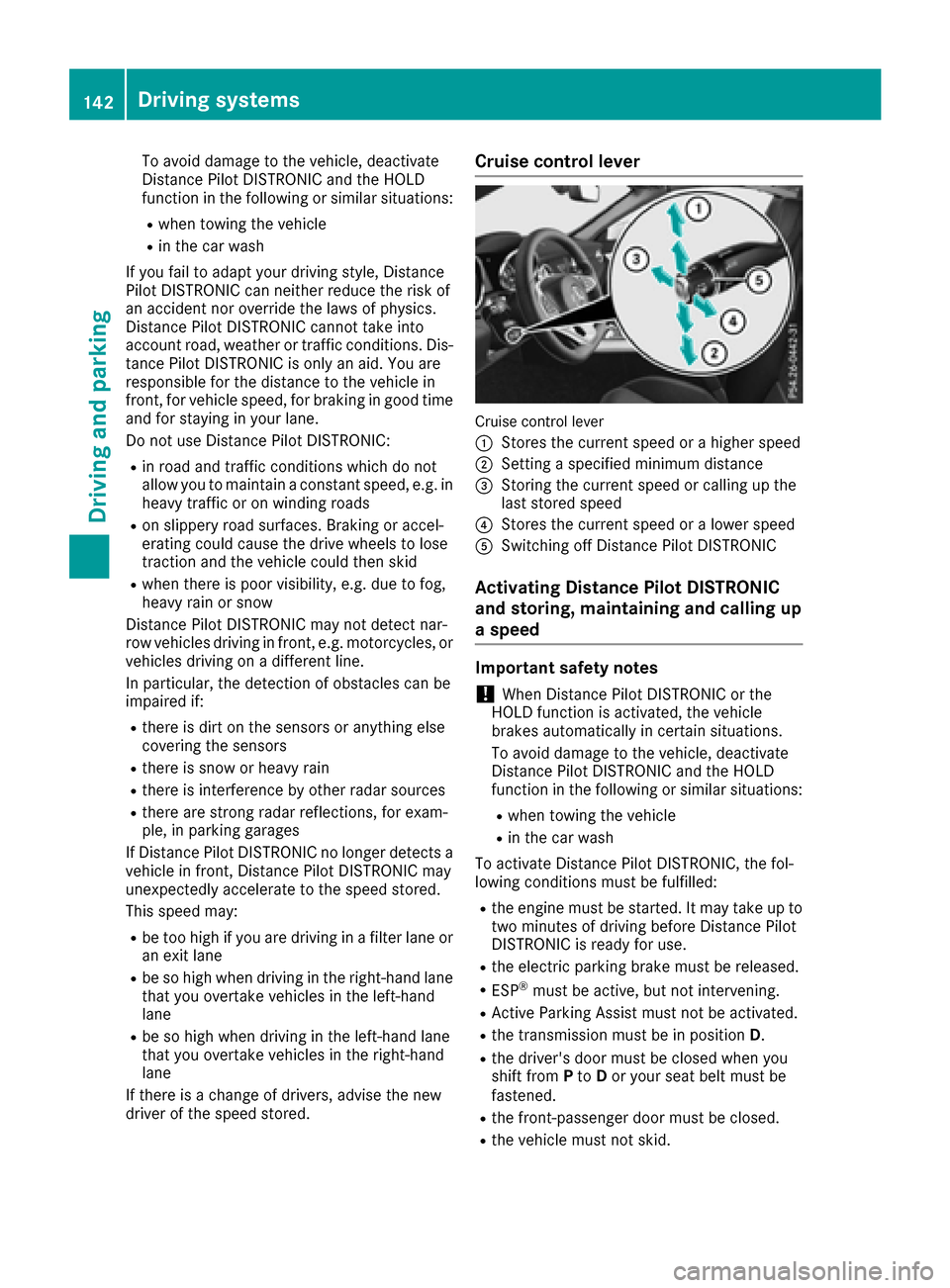
Cruise control lever
Cruise control lever
:
Stores the current speed or ahigher speed
;Setting aspecified minimum distance
=Storing the current speed or calling up the
last stored speed
?Stores the current speed or alower speed
ASwitching off Distance Pilot DISTRONIC
Activating Distance Pilot DISTRONIC
and storing, maintaining and calling up
as peed
Important safety notes
!When Distance Pilot DISTRONIC or the
HOLD function is activated, the vehicle
brakes automatically in certain situations.
To avoid damage to the vehicle, deactivate
Distance Pilot DISTRONIC and the HOLD
function in the following or similar situations:
Rwhen towing the vehicle
Rin the car wash
To activate Distance Pilot DISTRONIC, the fol-
lowing conditions must be fulfilled:
Rthe engine must be started. It may take up to
two minutes of driving before Distance Pilot
DISTRONIC is ready for use.
Rthe electric parking brake must be released.
RESP®must be active, but not intervening.
RActive Parking Assist must not be activated.
Rthe transmission must be in position D.
Rthe driver's door must be closed when you
shift fromPto Dor your seat belt must be
fastened.
Rthe front-passenger door must be closed.
Rthe vehicle must not skid.
142Driving systems
Driving and parking