ESP MERCEDES-BENZ SLK CLASS 2002 Workshop Manual
[x] Cancel search | Manufacturer: MERCEDES-BENZ, Model Year: 2002, Model line: SLK CLASS, Model: MERCEDES-BENZ SLK CLASS 2002Pages: 290, PDF Size: 18.21 MB
Page 231 of 290
228 Towing the vehicle
Te ch n i c a l
data Instruments
and controlsOperation DrivingInstrument
cluster displayPractical hintsCar care Index
Note:
To signal turns while being towed with hazard warning
flasher in use, turn key in steering lock to position 2 and
activate combination switch for left or right turn signal
in usual manner – only the selected turn signal will
operate. Upon canceling the turn signal, the hazard
warning flasher will operate again.Caution!
If the vehicle is towed with the front axle raised, the
engine must be shut off (key in steering lock position 0
or 1). Otherwise, the ESP will immediately be engaged
and will apply the rear wheel brakes. Switch off the
tow-away alarm as well as the automatic central locking,
see page 37 and page 31.
Page 263 of 290
260 Technical data
Te ch n i c a l
data Instruments
and controlsOperation DrivingInstrument
cluster displayPractical hints Car care Index
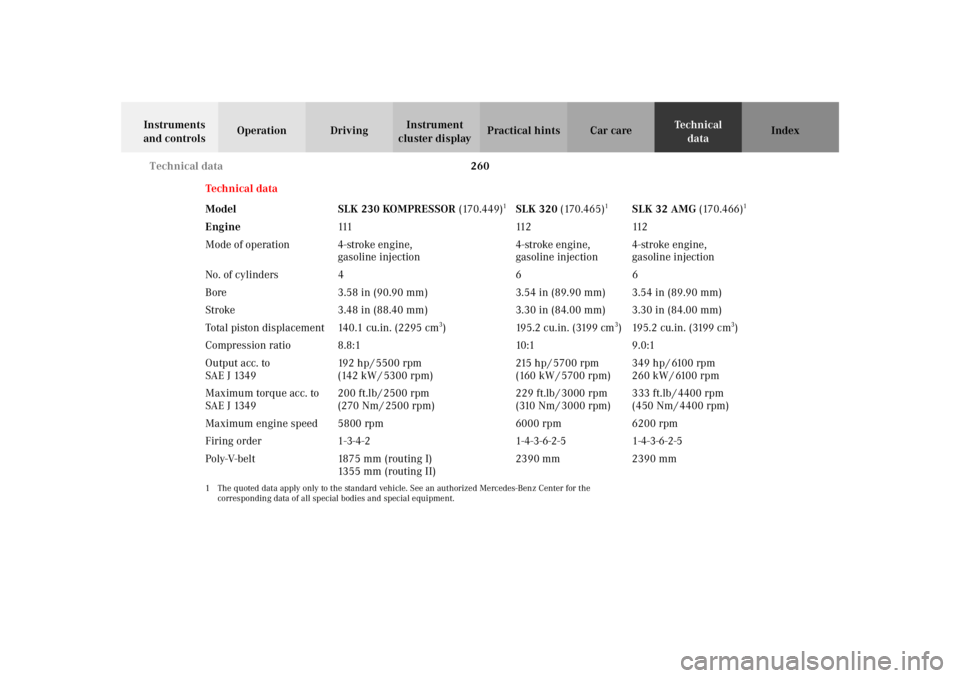
Te ch n i c a l d a t a
Model SLK 230 KOMPRESSOR (170.449)
1
SLK 320 (170.465)
1
SLK 32 AMG (170.466)
1
Engine111 11 2 11 2
Mode of operation 4-stroke engine,
gasoline injection4-stroke engine,
gasoline injection4-stroke engine,
gasoline injection
No. of cylinders 4 6 6
Bore 3.58 in (90.90 mm) 3.54 in (89.90 mm) 3.54 in (89.90 mm)
Stroke 3.48 in (88.40 mm) 3.30 in (84.00 mm) 3.30 in (84.00 mm)
Total piston displacement 140.1 cu.in. (2295 cm
3) 195.2 cu.in. (3199 cm
3) 195.2 cu.in. (3199 cm
3)
Compression ratio 8.8:1 10:1 9.0:1
Output acc. to
SAE J 1349192 hp / 5500 rpm
(142 kW / 5300 rpm)215 hp / 5700 rpm
(160 kW / 5700 rpm)349 hp / 6100 rpm
260 kW / 6100 rpm
Maximum torque acc. to
SAE J 1349200 ft.lb / 2500 rpm
(270 Nm / 2500 rpm)229 ft.lb / 3000 rpm
(310 Nm / 3000 rpm)333 ft.lb / 4400 rpm
(450 Nm / 4400 rpm)
Maximum engine speed 5800 rpm 6000 rpm 6200 rpm
Firing order 1-3-4-2 1-4-3-6-2-5 1-4-3-6-2-5
Poly-V-belt 1875 mm (routing I)
1355 mm (routing II)2390 mm 2390 mm
1 The quoted data apply only to the standard vehicle. See an authorized Mercedes-Benz Center for the
corresponding data of all special bodies and special equipment.
Page 269 of 290
266 Fuels, coolants, lubricants etc. - capacities
Te ch n i c a l
data Instruments
and controlsOperation DrivingInstrument
cluster displayPractical hints Car care Index
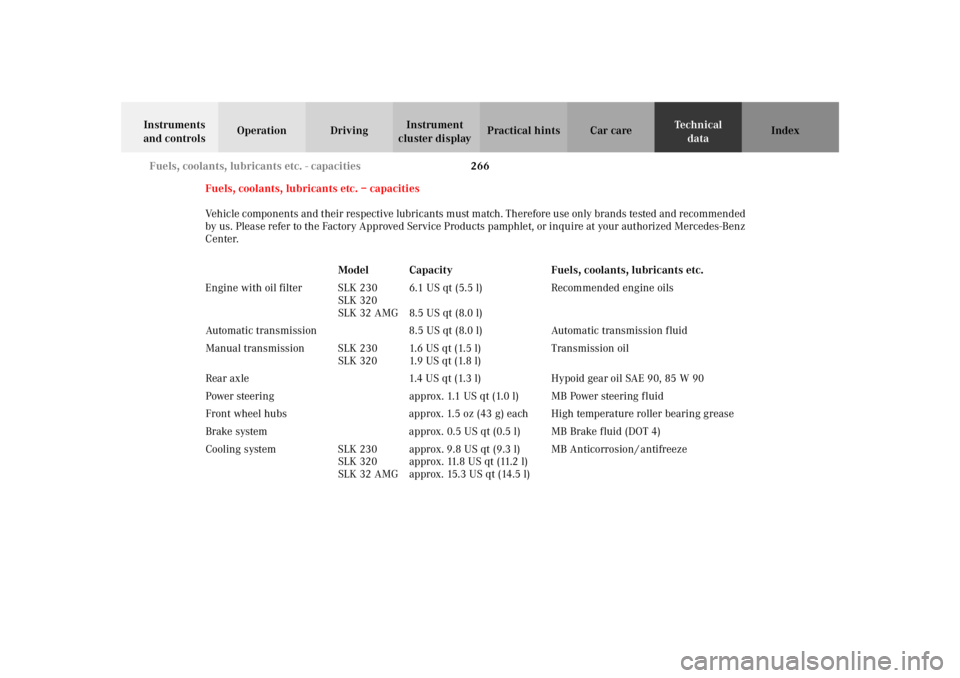
Fuels, coolants, lubricants etc. – capacities
Vehicle components and their respective lubricants must match. Therefore use only brands tested and recommended
by us. Please refer to the Factory Approved Service Products pamphlet, or inquire at your authorized Mercedes-Benz
Center.
Model Capacity Fuels, coolants, lubricants etc.
Engine with oil filter SLK 230
SLK 320
SLK 32 AMG6.1 US qt (5.5 l)
8.5 US qt (8.0 l)Recommended engine oils
Automatic transmission 8.5 US qt (8.0 l) Automatic transmission fluid
Manual transmission SLK 230
SLK 3201. 6 U S q t ( 1. 5 l )
1. 9 U S q t ( 1. 8 l )Transmission oil
Rear axle 1.4 US qt (1.3 l) Hypoid gear oil SAE 90, 85 W 90
Power steering approx. 1.1 US qt (1.0 l) MB Power steering fluid
Front wheel hubs approx. 1.5 oz (43 g) each High temperature roller bearing grease
Brake system approx. 0.5 US qt (0.5 l) MB Brake fluid (DOT 4)
Cooling system SLK 230
SLK 320
SLK 32 AMGapprox. 9.8 US qt (9.3 l)
approx. 11.8 US qt (11.2 l)
approx. 15.3 US qt (14.5 l)MB Anticorrosion / antifreeze
Page 273 of 290
270 Fuels, coolants, lubricants etc. - capacities
Te ch n i c a l
data Instruments
and controlsOperation DrivingInstrument
cluster displayPractical hints Car care Index
Gasoline additives
A major concern among engine manufacturers is carbon
build up caused by gasoline. Mercedes-Benz
recommends the use of only quality gasoline containing
additives that prevent the build up of carbon deposits.
After an extended period of using fuels without such
additives, carbon deposits can build up especially on the
intake valves and in the combustion area, leading to
engine performance problems such as:
•warm-up hesitation,
•unstable idle,
•knocking / pinging,
•misfire,
•power loss.
Do not blend other specific fuel additives with fuel.
They only result in unnecessary cost, and may be
harmful to the engine operation.
Damage or malfunctions resulting from poor fuel
quality or from blending specific fuel additives are not
covered by the Mercedes-Benz Limited Warranty.Coolants
The engine coolant is a mixture of water and
anticorrosion / antifreeze, which provides:
•corrosion protection,
•freeze protection,
•boiling protection (by increasing the boiling point).
The cooling system was filled at the factory with a
coolant providing freeze protection to approximately
-22°F (-30°C) and corrosion protection.
If the antifreeze mixture is effective to -22°F (-30°C), the
boiling point of the coolant in the pressurized cooling
system is reached at approximately 266°F (130°C).
The coolant solution must be used year round to provide
the necessary corrosion protection and increase in the
boil-over protection. You should have it replaced every
3years.
To provide the important corrosion protection, the
solution must be at least 45% anticorrosion / antifreeze
(equals a freeze protection to approx. - 22 °F [- 30 °C]). If
you use a solution that is more than 55% anticorrosion /
antifreeze (freeze protection to approx. - 49 °F [- 45°C]),
Page 276 of 290
273 Consumer information
Te ch n i c a l
data Instruments
and controlsOperation DrivingInstrument
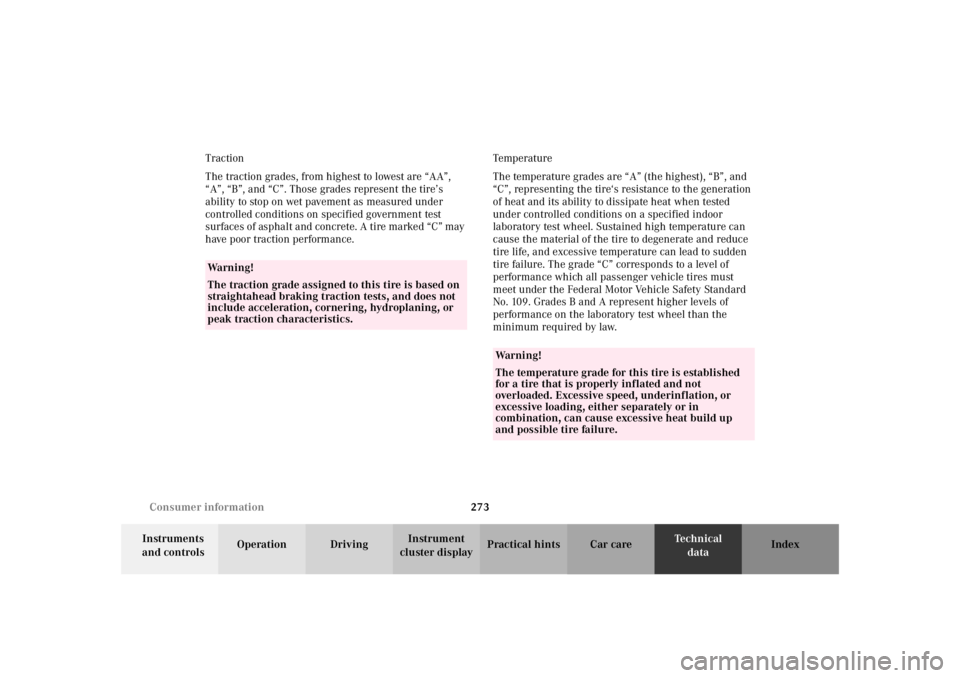
cluster displayPractical hints Car care Index Traction
The traction grades, from highest to lowest are “AA”,
“A”, “B”, and “C”. Those grades represent the tire’s
ability to stop on wet pavement as measured under
controlled conditions on specified government test
surfaces of asphalt and concrete. A tire marked “C” may
have poor traction performance.Te mp e r a t u r e
The temperature grades are “A” (the highest), “B”, and
“C”, representing the tire‘s resistance to the generation
of heat and its ability to dissipate heat when tested
under controlled conditions on a specified indoor
laboratory test wheel. Sustained high temperature can
cause the material of the tire to degenerate and reduce
tire life, and excessive temperature can lead to sudden
tire failure. The grade “C” corresponds to a level of
performance which all passenger vehicle tires must
meet under the Federal Motor Vehicle Safety Standard
No. 109. Grades B and A represent higher levels of
performance on the laboratory test wheel than the
minimum required by law.
Wa r n i n g !
The traction grade assigned to this tire is based on
straightahead braking traction tests, and does not
include acceleration, cornering, hydroplaning, or
peak traction characteristics.
Wa r n i n g !
The temperature grade for this tire is established
for a tire that is properly inflated and not
overloaded. Excessive speed, underinflation, or
excessive loading, either separately or in
combination, can cause excessive heat build up
and possible tire failure.
Page 279 of 290
276 Index
Te ch n i c a l
data Instruments
and controlsOperation DrivingInstrument
cluster displayPractical hints Car careIndex
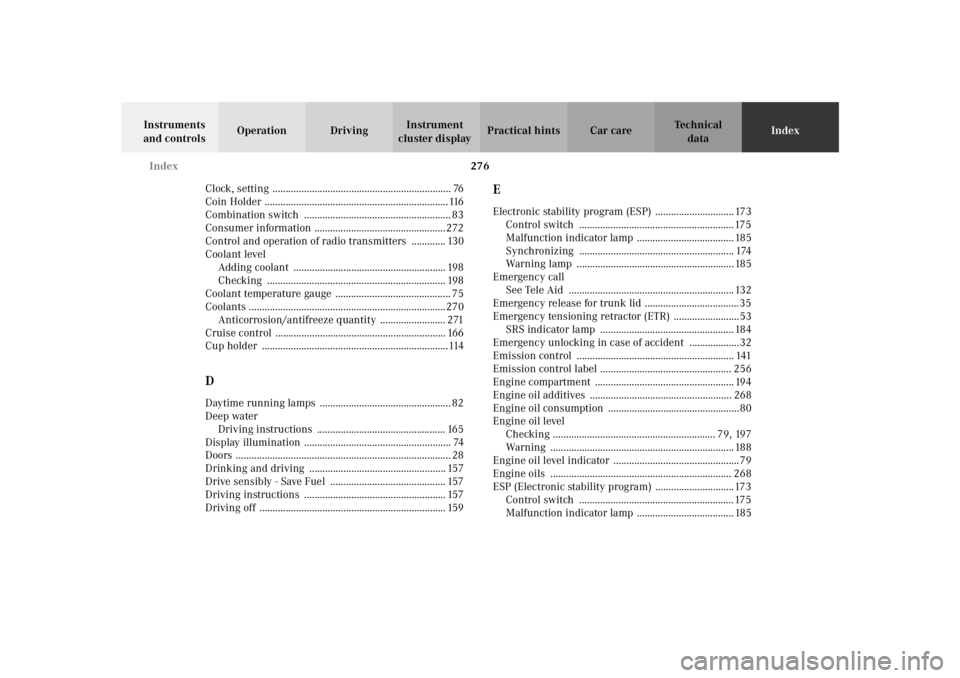
Clock, setting .................................................................... 76
Coin Holder ......................................................................116
Combination switch ........................................................ 83
Consumer information .................................................. 272
Control and operation of radio transmitters ............. 130
Coolant level
Adding coolant .......................................................... 198
Checking .................................................................... 198
Coolant temperature gauge ............................................ 75
Coolants ........................................................................... 270
Anticorrosion/antifreeze quantity ......................... 271
Cruise control ................................................................. 166
Cup holder .......................................................................114
DDaytime running lamps .................................................. 82
Deep water
Driving instructions ................................................. 165
Display illumination ........................................................ 74
Doors .................................................................................. 28
Drinking and driving .................................................... 157
Drive sensibly - Save Fuel ............................................ 157
Driving instructions ...................................................... 157
Driving off ....................................................................... 159
EElectronic stability program (ESP) .............................. 173
Control switch ........................................................... 175
Malfunction indicator lamp ..................................... 185
Synchronizing ........................................................... 174
Warning lamp ............................................................ 185
Emergency call
See Tele Aid ............................................................... 132
Emergency release for trunk lid .................................... 35
Emergency tensioning retractor (ETR) .........................53
SRS indicator lamp ................................................... 184
Emergency unlocking in case of accident ...................32
Emission control ............................................................ 141
Emission control label .................................................. 256
Engine compartment ..................................................... 194
Engine oil additives ...................................................... 268
Engine oil consumption ..................................................80
Engine oil level
Checking .............................................................. 79, 197
Warning ...................................................................... 188
Engine oil level indicator ................................................ 79
Engine oils ..................................................................... 268
ESP (Electronic stability program) .............................. 173
Control switch ........................................................... 175
Malfunction indicator lamp ..................................... 185