engine MERCEDES-BENZ SLK ROADSTER 2008 User Guide
[x] Cancel search | Manufacturer: MERCEDES-BENZ, Model Year: 2008, Model line: SLK ROADSTER, Model: MERCEDES-BENZ SLK ROADSTER 2008Pages: 273, PDF Size: 4.42 MB
Page 43 of 273
Occupant safet
y40
ess is pre-emptive in nature as the airbag
must be deployed during – and not at the end
of – the collision
.
i Airbags are not deployed in all types of
accidents. They are controlled by comple x
sensor technology and evaluation logic.
This process is pre-emptive in nature as
airbag deployment must take place during
the impact and must be adapted to provide
calculated, additional protection for the
vehicle occupants. Not all airbags are
deployed in an accident.
The different airbag systems work inde-
pendently of each other. However, each
individual system depends on the type of
accident determined by the control system
in the first stages of the collision (head-on
collision, side impact, rear-end collision
and overturn) and the extent of the acci-
dent (in particular, the vehicle's rate of
deceleration or acceleration).
The rate of vehicle deceleration or accelera-
tion and the direction of the force are basi-
cally determined by:
R the distribution of forces during the colli -
sion
R the collision angle R
the deformation characteristics of the vehi-
cle
R the characteristics of the object with which
the vehicle has collided, e.g. the other vehi-
cle
Factors which can only be seen and measured
after the collision has taken place do not play
a decisive role in the deployment of an airbag,
nor do they provide an indication of it.
The vehicle may be deformed significantly ,
e. g. on the bonnet or the wing, without an
airbag being deployed. This happens if only
parts which are relatively easily deformed are
affected and the necessary deceleration does
not occur. Conversely, airbags may be
deployed even though the vehicle suffers only
minor deformations. This is the case if, for
example, very rigid vehicle parts such as lon-
gitudinal body members are affected and suf-
ficient deceleration occurs as a result.
Belt tensioners, belt force limiter s The seat belts are fitted with belt tensioners.
!
Do not engage the seat belt tongue in the
buckle on the front-passenger seat if the
seat is not occupied. Otherwise the belt
tensioner could be activated in an emer-
gency. If the seat belt is also equipped with a belt
force limiter, the force exerted by the seat
belt on the seat occupant is reduced.
Belt tensioners tighten the seat belts in an
accident, pulling them close against the body.
i
Belt tensioners do not correct incorrect
seat positions or incorrectly fastened sea t
belts.
Belt tensioners do not pull occupants back
towards the backrest.
The belt force limiters are synchronised with
the front airbags, which spread the forces
exerted by the belt force limiters on the occu-
pant over a greater area.
When the ignition is switched on, the belt ten -
sioner is triggered:
R only if the restraint systems are operational
(the 1 warning lamp lights up after th e
ignition is switched on and goes out onc e
the engine is running)( Ypage 39)
R for each three-point seat belt in the front of
the vehicle when the belt tongue is
engaged in the buckle
R In the event of a head-on or rear-end colli-
sion if the vehicle decelerates or acceler-
ates rapidly in a longitudinal direction
during the initial stages of the collision Safety
171_AKB; 3; 4, en-GB
vpfaff7,
2007-11-13T10:50:25+01:00 - Seite 40
Page 54 of 273
Driving safety sys
tems 51G
Risk of accident
If BAS has malfunctioned, the braking sys-
tem remains available with full brake boost-
ing effect. However, braking force is not
automatically increased in emergency
braking situations and the stopping dis-
tance may increase. ES
P®
(Electronic Stability Program)
ES P®
monitors driving stability and traction,
i.e. power transmission between the tyres
and the road surface.
If ESP ®
detects that the vehicle is deviatin g
from the direction desired by the driver, one
or more wheels are braked to stabilise the
vehicle. The engine output is also modified, if
necessary, to keep the vehicle on the desired
course within the scope of the laws of phys-
ics. ESP ®
assists the driver when pulling away
on wet or slippery roads. ES P®
can also sta-
bilise the vehicle during braking.
When ESP ®
intervenes, the vwarning
lamp flashes in the instrument cluster. G
Risk of accident
If the v warning lamp in the instrumen t
cluster flashes, proceed as follows: R
Do not deactivate ESP ®
under any cir -
cumstances .
R Only depress the accelerator pedal as far
as necessary when pulling away.
R Adapt your driving style to suit the pre -
vailing road and weather conditions.
The vehicle could otherwise go into a skid.
ESP ®
cannot reduce the risk of an accident
if you drive too fast. ESP ®
cannot overrid e
the laws of physics .
! The ignition must be switched off (key in
position 0or Iin the ignition lock) if:
R the vehicle is being towed with the front
or rear axle raised
R you are having the handbrake checke d
on the brake dynamometer
Application of the brakes by ESP ®
could
otherwise destroy the brake system on the
front or rear axle.
i Only use wheels with the recommended
tyre sizes. Only then will ESP ®
function
properly . To deactivate/activate ES
P® ESP
®
is activated automatically when the
engine is running.
It may be best to deactivate ES P®
in the fol-
lowing situations:
R when using snow chain s
R in deep sno w
R on sand or gravel G
Risk of accident
Activate ESP ®
as soon as the situations
described above no longer apply. ES P®
will
otherwise not be able to stabilise the vehi -
cle if the vehicle starts to skid or a wheel
starts to spin.
If you deactivate ESP ®
:
R ESP ®
no longer improves driving stability
R Engine torque is not limited and the drive
wheels are able to spin. The spinning
wheels produce a cutting effect for better
traction.
R traction control is still activated .
R ESP ®
still provides support when you
brake. Safety
171_AKB; 3; 4, en-GB
vpfaff7,
2007-11-13T10:50:25+01:00 - Seite 51
Page 55 of 273
Anti-theft syste
ms52
i
If ESP ®
is deactivated and one or mor e
wheels start to spin, the vwarning lamp
in the instrument cluster flashes. ES P®
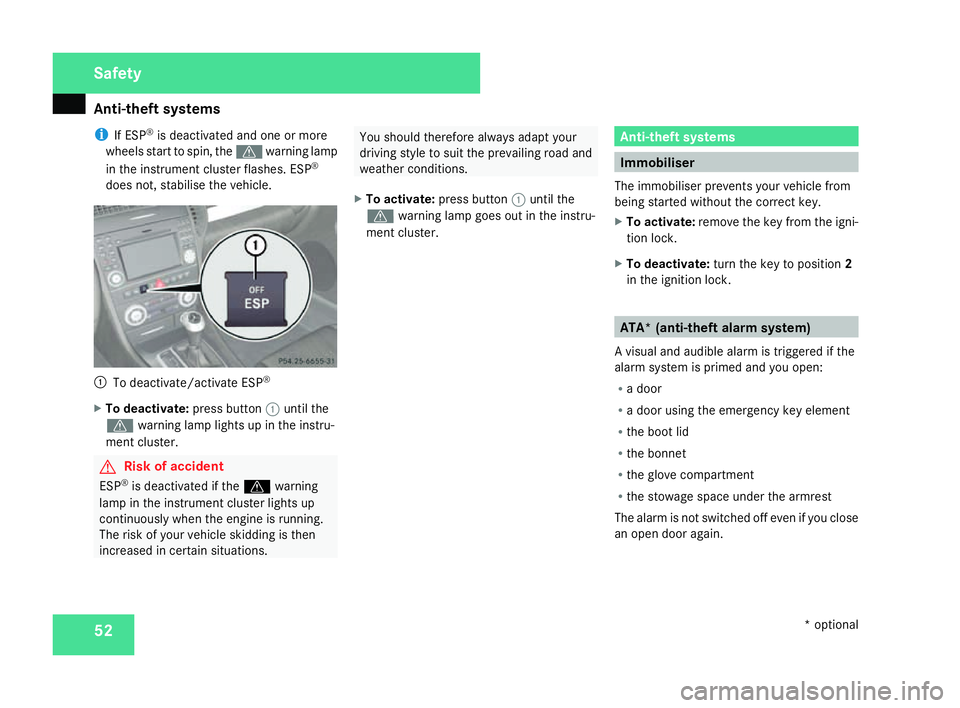
does not, stabilise the vehicle. 1
To deactivate/activate ESP ®
X To deactivate :press button 1until th e
v warning lamp lights up in the instru-
ment cluster. G
Risk of acciden
t
ESP ®
is deactivated if the vwarnin g
lamp in the instrument cluster lights up
continuously when the engine is running.
The risk of your vehicle skidding is then
increased in certain situations. You should therefore always adapt your
driving style to suit the prevailing road and
weather conditions.
X To activate :press button 1until th e
v warning lamp goes out in the instru-
ment cluster. Anti-theft systems
Immobiliser
The immobiliser prevents your vehicle from
being started without the correct key.
X To activate :remove the key from the igni -
tion lock.
X To deactivate :turn the key to position 2
in the ignition lock . ATA* (anti-theft alarm system)
A visual and audible alarm is triggered if th e
alarm system is primed and you open :
R a door
R a door using the emergency key elemen t
R the boot li d
R the bonne t
R the glove compartment
R the stowage space under the armrest
The alarm is not switched off even if you clos e
an open door again. Safety
* optional
171_AKB; 3; 4, en-GB
vpfaff7
, 2007-11-13T10:50:25+01:00 - Seite 52
Page 61 of 273
Opening and closing
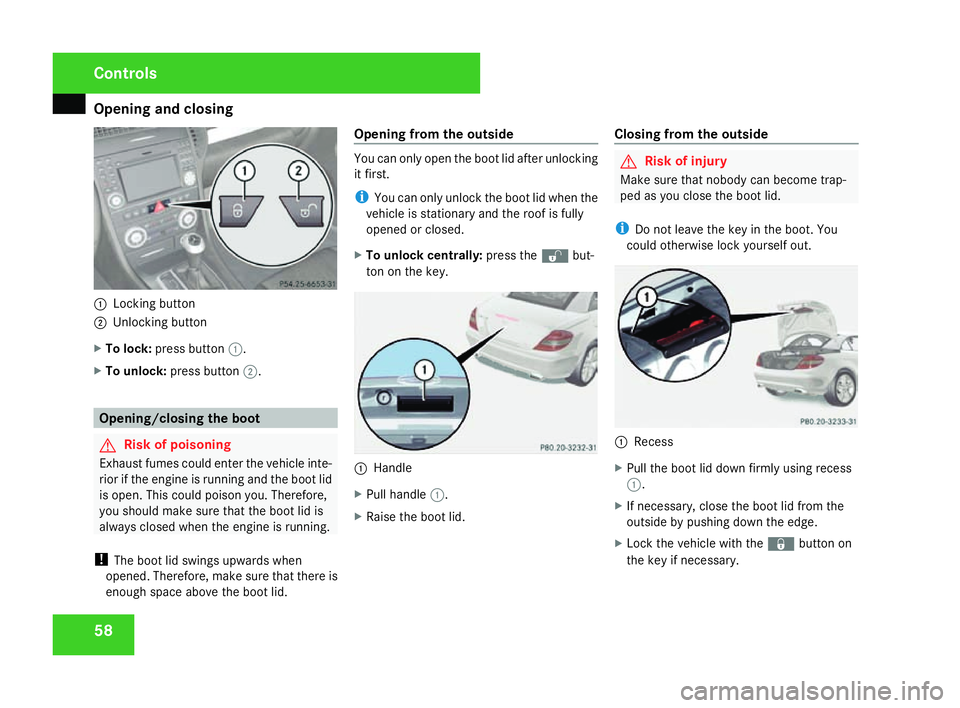
581
Locking button
2 Unlocking button
X To lock :press button 1.
X To unlock :press button 2. Opening/closing the boot
G
Risk of poisoning
Exhaust fumes could enter the vehicle inte -
rior if the engine is running and the boot lid
is open. This could poison you. Therefore,
you should make sure that the boot lid is
always closed when the engine is running.
! The boot lid swings upwards whe n
opened. Therefore, make sure that there is
enough space above the boot lid. Opening from the outside You can only open the boot lid after unlocking
it first.
i
You can only unlock the boot lid when the
vehicle is stationary and the roof is fully
opened or closed.
X To unlock centrally: press thekbut-
ton on the key. 1
Handle
X Pull handle 1.
X Raise the boot lid. Closing from the outside G
Risk of injury
Make sure that nobody can become trap-
ped as you close the boot lid.
i Do not leave the key in the boot. Yo u
could otherwise lock yourself out. 1
Reces s
X Pull the boot lid down firmly using recess
1 .
X If necessary, close the boot lid from the
outside by pushing down the edge.
X Lock the vehicle with the ‹button on
the key if necessary. Controls
171_AKB; 3; 4, en-GB
vpfaff7,
2007-11-13T10:50:25+01:00 - Seite 58
Page 62 of 273
Seats
59
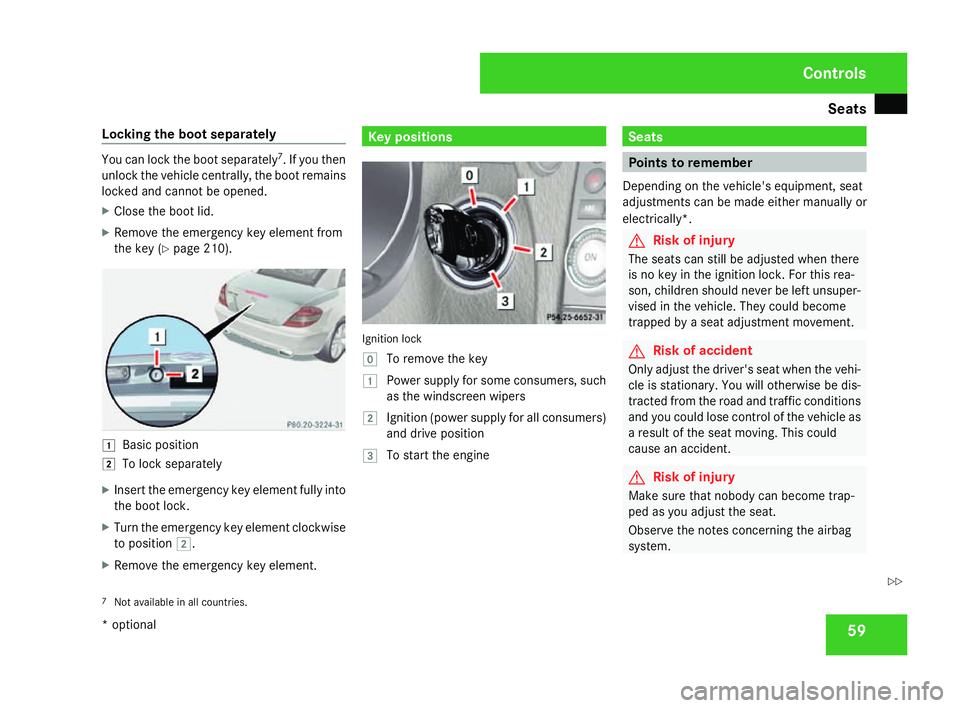
Locking the boot separately You can lock the boot separately
7
. If you then
unlock the vehicle centrally, the boot remains
locked and cannot be opened.
X Close the boot lid.
X Remove the emergency key element from
the key (Y page 210). $
Basic position
% To lock separately
X Insert the emergency key element fully into
the boot lock.
X Turn the emergency key element clockwise
to position %.
X Remove the emergency key element. Key positions
Ignition loc
k
} To remove the key
$ Power supply for some consumers, such
as the windscreen wipers
% Ignition (power supply for all consumers)
and drive positio n
& To start the engine Seats
Points to remember
Depending on the vehicle's equipment, seat
adjustments can be made either manually or
electrically*. G
Risk of injury
The seats can still be adjusted when there
is no key in the ignition lock. For this rea -
son, children should never be left unsuper-
vised in the vehicle. They could become
trapped by a seat adjustment movement. G
Risk of accident
Only adjust the driver's seat when the vehi-
cle is stationary. You will otherwise be dis-
tracted from the road and traffic conditions
and you could lose control of the vehicle as
a result of the seat moving. This could
cause an accident. G
Risk of injury
Make sure that nobody can become trap -
ped as you adjust the seat.
Observe the notes concerning the airbag
system.
7 Not available in all countries. Controls
* optional
171_AKB; 3; 4, en-GB
vpfaff7,
2007-11-13T10:50:25+01:00 - Seite 59 Z
Page 74 of 273
Seat belts
711
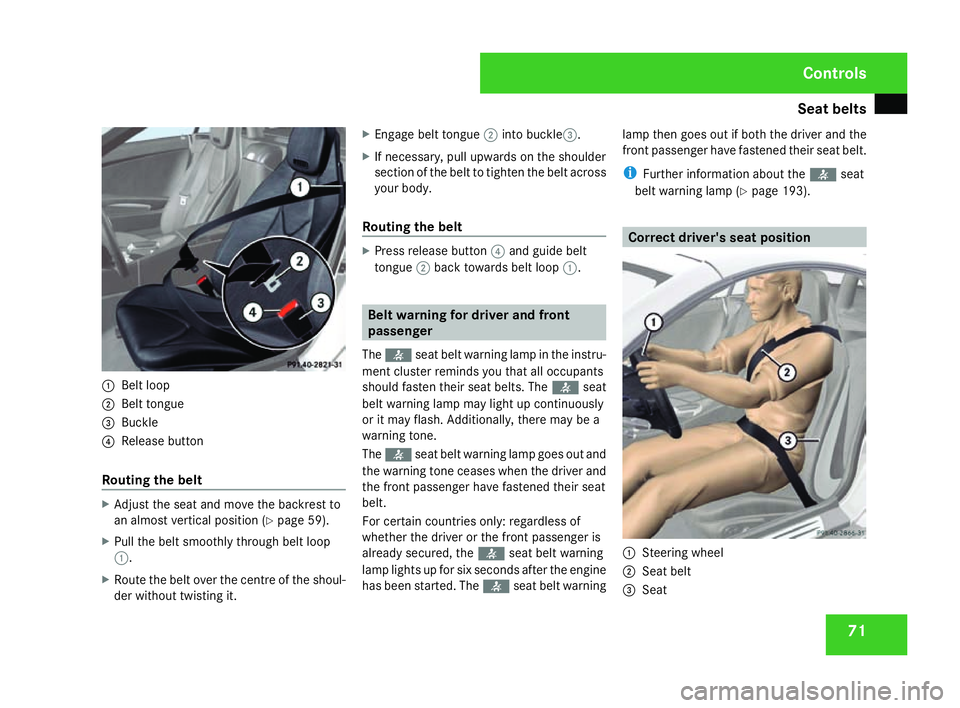
Belt loo p
2 Belt tongu e
3 Buckl e
4 Release butto n
Routing the belt X
Adjust the seat and move the backrest to
an almost vertical position (Y page 59).
X Pull the belt smoothly through belt loop
1 .
X Route the belt over the centre of the shoul-
der without twisting it . X
Engage belt tongue 2into buckle3 .
X If necessary, pull upwards on the shoulder
section of the belt to tighten the belt across
your body.
Routing the belt X
Press release button 4and guide belt
tongue 2back towards belt loop 1. Belt warning for driver and fron
t
passenge r
The < seat belt warning lamp in the instru-
ment cluster reminds you that all occupants
should fasten their seat belts. The
or it may flash. Additionally, there may be a
warning tone.
The < seat belt warning lamp goes out and
the warning tone ceases when the driver and
the front passenger have fastened their seat
belt.
For certain countries only: regardless of
whether the driver or the front passenger is
already secured, the
has been started. The
i
Further information about the
1
Steering wheel
2 Seat belt
3 Sea t Cont
rols
171_AKB; 3; 4, en-GB
vpfaff7,
2007-11-13T10:50:25+01:00 - Seite 71
Page 76 of 273
Light
s 73Lights
Light switch
For reasons of safety, Mercedes-Benz recom-
mends that you drive with the lights switched
on even during the daytime. In some coun -
tries, daytime use of headlamps varies due to
legal requirements and self-imposed obliga -
tions. In these countries, dipped-beam head -
lamps are switched on when the ignition is
switched on.
i If you drive in countries in which traffic
drives on the opposite side of the road to
the country where the vehicle is registered ,
oncoming traffic may be dazzled by the
asymmetrical dipped-beam headlamps.
Have the headlamps changed to symmet-
rical dipped beam when driving in these
countries. You can obtain information
about this from any Mercedes-Benz Servic e
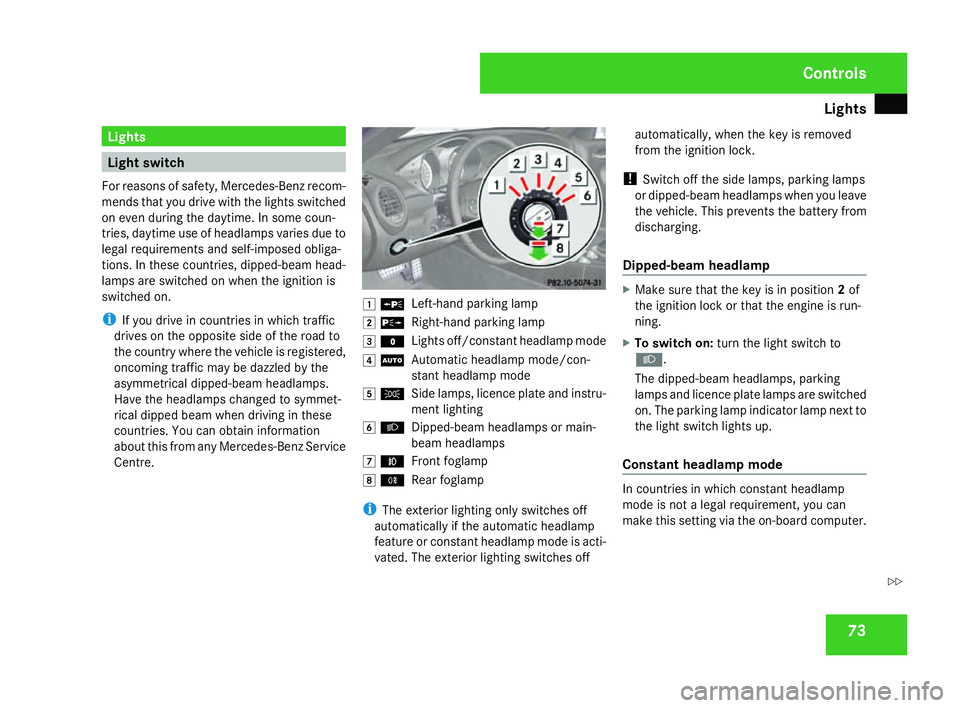
Centre. $
a
Left-hand parking lamp
% g
Right-hand parking lamp
& M
Lights off/constant headlamp mode
( U
Automatic headlamp mode/con-
stant headlamp mod e
) C
Side lamps, licence plate and instru-
ment lighting
* B
Dipped-beam headlamps or main-
beam headlamps
, ¥
Front foglamp
. †
Rear foglamp
i The exterior lighting only switches off
automatically if the automatic headlamp
feature or constant headlamp mode is acti-
vated. The exterior lighting switches off automatically, when the key is removed
from the ignition lock.
! Switch off the side lamps, parking lamps
or dipped-beam headlamps when you leave
the vehicle. This prevents the battery from
discharging.
Dipped-beam headlam p X
Make sure that the key is in position 2of
the ignition lock or that the engine is run-
ning.
X To switch on :turn the light switch to
B .
The dipped-beam headlamps, parking
lamps and licence plate lamps are switched
on. The parking lamp indicator lamp next to
the light switch lights up.
Constant headlamp mode In countries in which constant headlamp
mode is not a legal requirement, you can
make this setting via the on-board computer
. Cont
rols
171_AKB; 3; 4, en-GB
vpfaff7,
2007-11-13T10:50:25+01:00 - Seite 73 Z
Page 77 of 273
Light
s 74
X
Make sure that constant headlamp mode
has been set with the on-board computer
(Y page 101). 8
X To switch on :turn the light switch to
M orU .
The dipped-beam headlamps, side lamps
and licence plate lighting are switched on
when the engine is running.
i When you turn the light switch to any
position other than MorU , the cor -
responding light goes on.
Automatic headlamp mode The side lamps, dipped-beam headlamps and
licence plate lighting are switched on or off
automatically, depending on the brightness of
the ambient light. G
Risk of accident
If the light switch is set to U, the head-
lamps may temporarily switch off due to
exposure to light, or the lights may not
come on automatically if it is foggy. This
could endanger you and others. Therefore,
turn the light switch to Bin the dark or
in fog. The automatic headlamp feature is only an
aid. The driver is responsible for the vehicle
lighting at all times.
G
Risk of accident
When it is dark or foggy, turn the light
switch quickly from UtoB . You
could otherwise cause an accident if the
headlamps were to switch off temporarily.
X To switch on :turn the light switch to
U .
The side lamps are switched on and off
automatically when the key is in position
1 in the ignition lock .
The dipped-beam headlamps, side lamps
and licence plate lighting are switched on
automatically when the engine is running.
When the parking lamp or dipped-beam
headlamps are switched on, the indicator
lamp next to the light switch lights up.
Front foglamps/rear foglamp G
Risk of accident
If you suspect that driving conditions will be
foggy, turn the light switch to Bbefore you start your journey. Otherwise, your
vehicle may not be visible and you could
therefore endanger yourself and others.
G
Risk of accident
When it is dark or foggy, turn the light
switch quickly from UtoB . You
could otherwise cause an accident if the
headlamps were to switch off temporarily.
i When the light switch is set to Uyou
cannot switch on the front or rear fog-
lamps.
X Make sure that the key is in position 2in
the ignition lock .
X To switch on the front foglamps: turn the
light switch to the BorC position .
X Pull the light switch out to the first stop.
The ¥ green indicator lamp next to the
light switch lights up.
X To switch on the rear foglamp: turn the
light switch to the Bposition .
X Pull the light switch out to the second stop.
The † yellow indicator lamp next to th e
light switch lights up.
8 This is not possible in countries where constant headlamp mode is required by law. Controls
171_AKB; 3; 4, en-GB
vpfaff7,
2007-11-13T10:50:25+01:00 - Seite 74
Page 79 of 273
Light
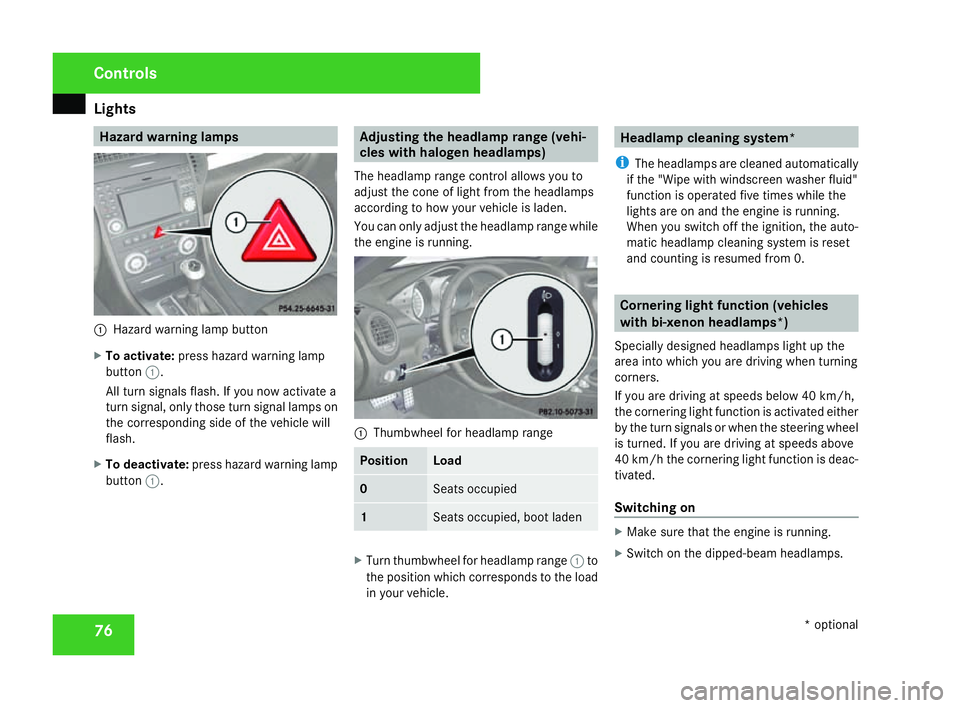
s 76 Hazard warning lamps
1
Hazard warning lamp button
X To activate :press hazard warning lamp
button 1.
All turn signals flash. If you now activate a
turn signal, only those turn signal lamps on
the corresponding side of the vehicle will
flash.
X To deactivate :press hazard warning lamp
button 1. Adjusting the headlamp range (vehi-
cles with halogen headlamps)
The headlamp range control allows you to
adjust the cone of light from the headlamps
according to how your vehicle is laden.
You can only adjust the headlamp range while
the engine is running. 1
Thumbwheel for headlamp range Position Load
0 Seats occupied
1 Seats occupied, boot lade
n X
Turn thumbwheel for headlamp range 1to
the position which corresponds to the load
in your vehicle. Headlamp cleaning system*
i The headlamps are cleaned automatically
if the "Wipe with windscreen washer fluid"
function is operated five times while the
lights are on and the engine is running.
When you switch off the ignition, the auto-
matic headlamp cleaning system is reset
and counting is resumed from 0. Cornering light function (vehicles
with bi-xenon headlamps*)
Specially designed headlamps light up the
area into which you are driving when turning
corners.
If you are driving at speeds below 40 km/h,
the cornering light function is activated either
by the turn signals or when the steering wheel
is turned. If you are driving at speeds above
40 km/h the cornering light function is deac-
tivated.
Switching on X
Make sure that the engine is running.
X Switch on the dipped-beam headlamps. Control
s
* optional
171_AKB; 3; 4, en-GB
vpfaff7,
2007-11-13T10:50:25+01:00 - Seite 76
Page 84 of 273
Driving and pa
rking 81
X
To open side windows :Pull back the roof
switch twice in rapid succession in the
direction of the arrow 1.
All side windows open.
i If you then close a side window using the
power window switch on the door, the tri-
angular rear window remains open. To
close the triangular rear window, you must
close the side window using the roof
switch.
X To close side windows :Push the roof
switch forward twice in rapid succession in
the direction of arrow 2and hold it.
The front side windows close first. Afte r
about a second, the rear triangular win-
dows close.
i If the roof is open, only the two front side
windows close.
i If the window is obstructed during clos-
ing, the closing procedure is interrupted
and it opens again slightly. Resetting the side windows
Each side window must be reset if the battery
was disconnected or discharged.
X Make sure that the key is in position 2in
the ignition lock .
X Pull the switch upwards until the window is
closed, and hold it in this position for
another second. Driving and parking
Starting the engine
G
Risk of accident
Do not keep any objects in the driver's foot-
well. If you use a floormat or carpet in the
driver's footwell, make sure that they are
correctly secured and that there is suffi-
cient clearance for the pedals.
Objects could otherwise get between the
pedals in the event of sudden braking or
acceleration. You may then no longer be
able to brake, change gear or accelerate as
intended. This may result in an accident and
injury . G
Risk of poisoning
Never leave the engine running in enclose d
spaces. The exhaust gases contain carbon
monoxide. Inhaling exhaust fumes consti-
tutes a health hazard and could lead to loss
of consciousness or even death.
! Do not depress the accelerator pedal
when starting the engine.
i If you depress the brake when starting the
engine, pedal travel will be unusually long
and there will be less pedal resistance. Controls
171_AKB; 3; 4, en-GB
vpfaff7,
2007-11-13T10:50:25+01:00 - Seite 81