clock MERCEDES-BENZ SLS AMG 2013 User Guide
[x] Cancel search | Manufacturer: MERCEDES-BENZ, Model Year: 2013, Model line: SLS AMG, Model: MERCEDES-BENZ SLS AMG 2013Pages: 286, PDF Size: 3.26 MB
Page 232 of 286
X
Do not remove any foreign objects which
have penetrated the tire, e.g. screws or
nails.
X Take the TIREFIT kit out of the trunk
(Y page 228). X
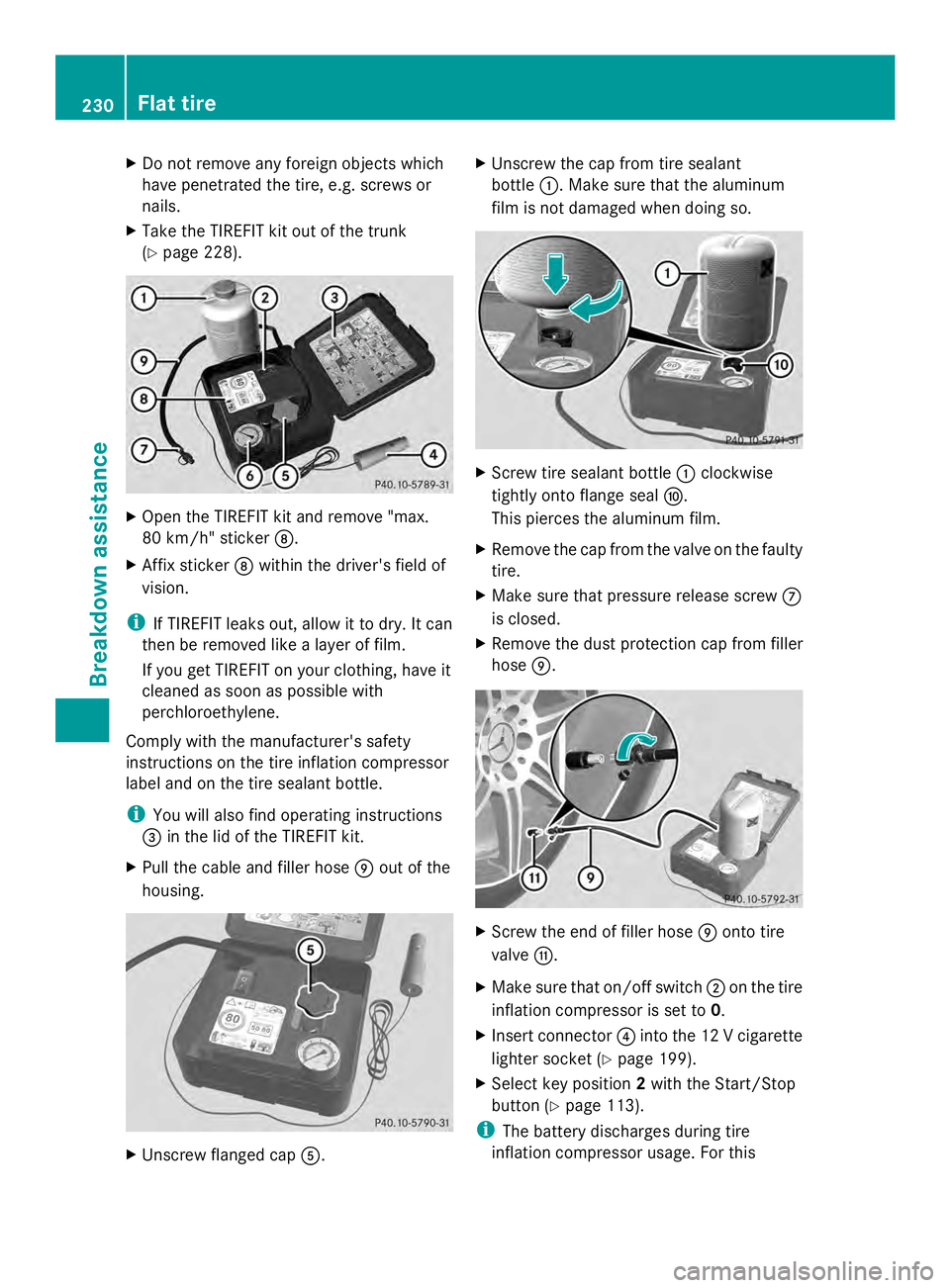
Open the TIREFIT kit and remove "max.
80 km/h" sticker 006C.
X Affix sticker 006Cwithin the driver's field of
vision.
i If TIREFIT leaks out, allow it to dry. It can
then be removed like a layer of film.
If you get TIREFIT on your clothing, have it
cleaned as soon as possible with
perchloroethylene.
Comply with the manufacturer's safety
instructions on the tire inflation compressor
label and on the tire sealant bottle.
i You will also find operating instructions
0087 in the lid of the TIREFIT kit.
X Pull the cable and filler hose 006Dout of the
housing. X
Unscrew flanged cap 0083. X
Unscrew the cap from tire sealant
bottle 0043. Make sure that the aluminum
film is not damaged when doing so. X
Screw tire sealant bottle 0043clockwise
tightly onto flange seal 006E.
This pierces the aluminum film.
X Remove the cap from the valve on the faulty
tire.
X Make sure that pressure release screw 006B
is closed.
X Remove the dust protection cap from filler
hose 006D. X
Screw the end of filler hose 006Donto tire
valve 006F.
X Make sure that on/off switch 0044on the tire
inflation compressor is set to 0.
X Insert connector 0085into the 12 V cigarette
lighter socket ( Ypage 199).
X Select key position 2with the Start/Stop
button ( Ypage 113).
i The battery discharges during tire
inflation compressor usage. For this 230
Flat tireBreakdown assistance
Page 236 of 286
Make sure that the ground on which the
vehicle is standing and where you place the
jack is solid, level and not slippery. If
necessary, use a large underlay. On slippery
surfaces, such as tiled floors, you should use
a non-slip underlay, for example a rubber mat.
Do not use wooden blocks or similar objects
as a jack underlay. Otherwise, the jack may
not be able to achieve its load-bearing
capacity if it is not at its full height.
Never start the engine when the vehicle is
raised.
Also observe the notes on the jack. X
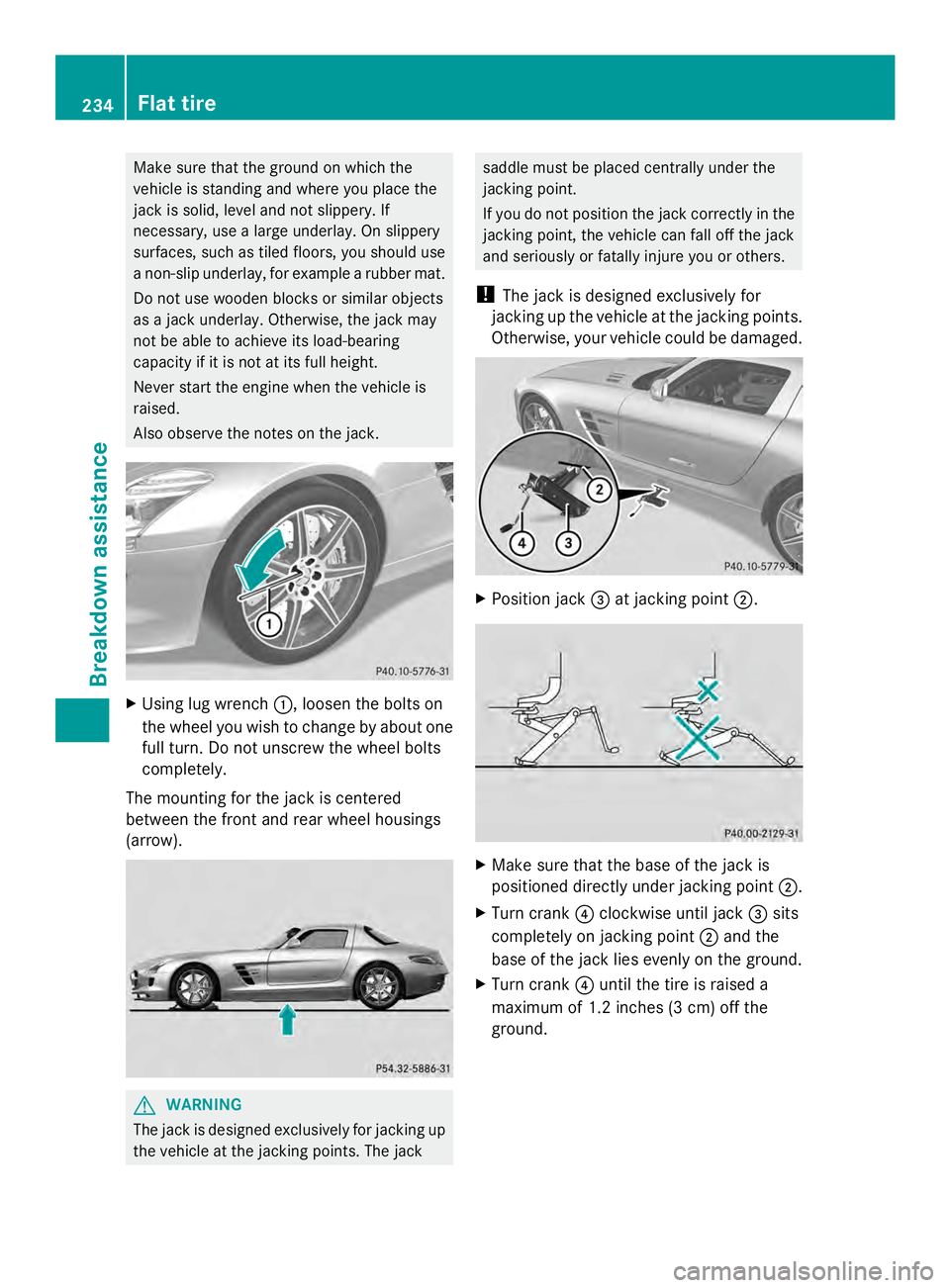
Using lug wrench 0043, loosen the bolts on
the wheel you wish to change by about one
full turn. Do not unscrew the wheel bolts
completely.
The mounting for the jack is centered
between the front and rear wheel housings
(arrow). G
WARNING
The jack is designed exclusively for jacking up
the vehicle at the jacking points. The jack saddle must be placed centrally under the
jacking point.
If you do not position the jack correctly in the
jacking point, the vehicle can fall off the jack
and seriously or fatally injure you or others.
! The jack is designed exclusively for
jacking up the vehicle at the jacking points.
Otherwise, your vehicle could be damaged. X
Position jack 0087at jacking point 0044. X
Make sure that the base of the jack is
positioned directly under jacking point 0044.
X Turn crank 0085clockwise until jack 0087sits
completely on jacking point 0044and the
base of the jack lies evenly on the ground.
X Turn crank 0085until the tire is raised a
maximum of 1.2 inches (3 cm) off the
ground. 234
Flat tireBreakdown assistance
Page 238 of 286
X
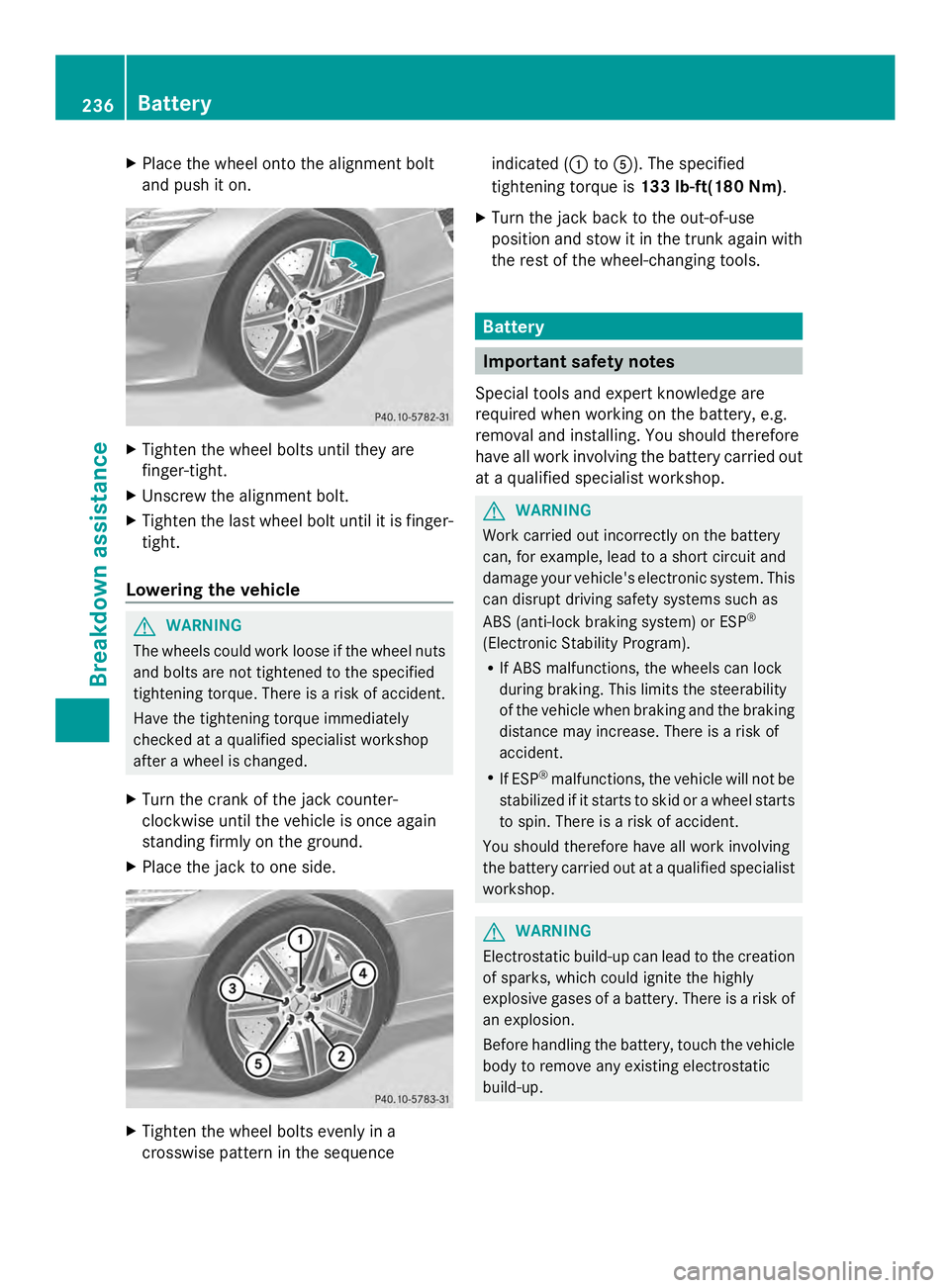
Place the wheel onto the alignment bolt
and push it on. X
Tighten the wheel bolts until they are
finger-tight.
X Unscrew the alignment bolt.
X Tighten the last wheel bolt until it is finger-
tight.
Lowering the vehicle G
WARNING
The wheels could work loose if the wheel nuts
and bolts are not tightened to the specified
tightening torque. There is a risk of accident.
Have the tightening torque immediately
checked at a qualified specialist workshop
after a wheel is changed.
X Turn the crank of the jack counter-
clockwise until the vehicle is once again
standing firmly on the ground.
X Place the jack to one side. X
Tighten the wheel bolts evenly in a
crosswise pattern in the sequence indicated (0043
to0083). The specified
tightening torque is 133 lb-ft(180 Nm).
X Turn the jack back to the out-of-use
position and stow it in the trunk again with
the rest of the wheel-changing tools. Battery
Important safety notes
Special tools and expert knowledge are
required when working on the battery, e.g.
removal and installing. You should therefore
have all work involving the battery carried out
at a qualified specialist workshop. G
WARNING
Work carried out incorrectly on the battery
can, for example, lead to a short circuit and
damage your vehicle's electronic system. This
can disrupt driving safety systems such as
ABS (anti-lock braking system) or ESP ®
(Electronic Stability Program).
R If ABS malfunctions, the wheels can lock
during braking. This limits the steerability
of the vehicle when braking and the braking
distance may increase. There is a risk of
accident.
R If ESP ®
malfunctions, the vehicle will not be
stabilized if it starts to skid or a wheel starts
to spin. There is a risk of accident.
You should therefore have all work involving
the battery carried out at a qualified specialist
workshop. G
WARNING
Electrostatic build-up can lead to the creation
of sparks, which could ignite the highly
explosive gases of a battery. There is a risk of
an explosion.
Before handling the battery, touch the vehicle
body to remove any existing electrostatic
build-up. 236
BatteryBreakdown assistance
Page 245 of 286
!
Do not use the towing eye for recovery,
as this could damage the vehicle. If in
doubt, recover the vehicle with a crane.
! You may only tow the vehicle a maximum
distance of 30 miles (50 km). A towing
speed of 30 mph (50 km/h) must not be
exceeded.
For towing distances over 30 miles
(50 km), the vehicle must loaded onto a
transporter.
! Do not tow with sling-type equipment.
This could damage the vehicle.
! Tow-starting the vehicle is not permitted.
The transmission may otherwise be
damaged.
Also observe the following notes:
R If the engine does not start, try jump-
starting it (Y page 240). Tow-starting the
vehicle is not permitted.
R If it is not possible to jump-start the vehicle,
have it transported to the nearest qualified
specialist workshop, e.g. an authorized
Mercedes-Benz Center.
R If the vehicle has transmission damage,
have it transported to a qualified specialist
workshop. Observe the display messages
in the instrument cluster. Installing/removing the towing eye
Installing the towing eye X
Take the towing eye and the wheel
wrench 12
out of the wheel-change tool kit
(Y page 228).
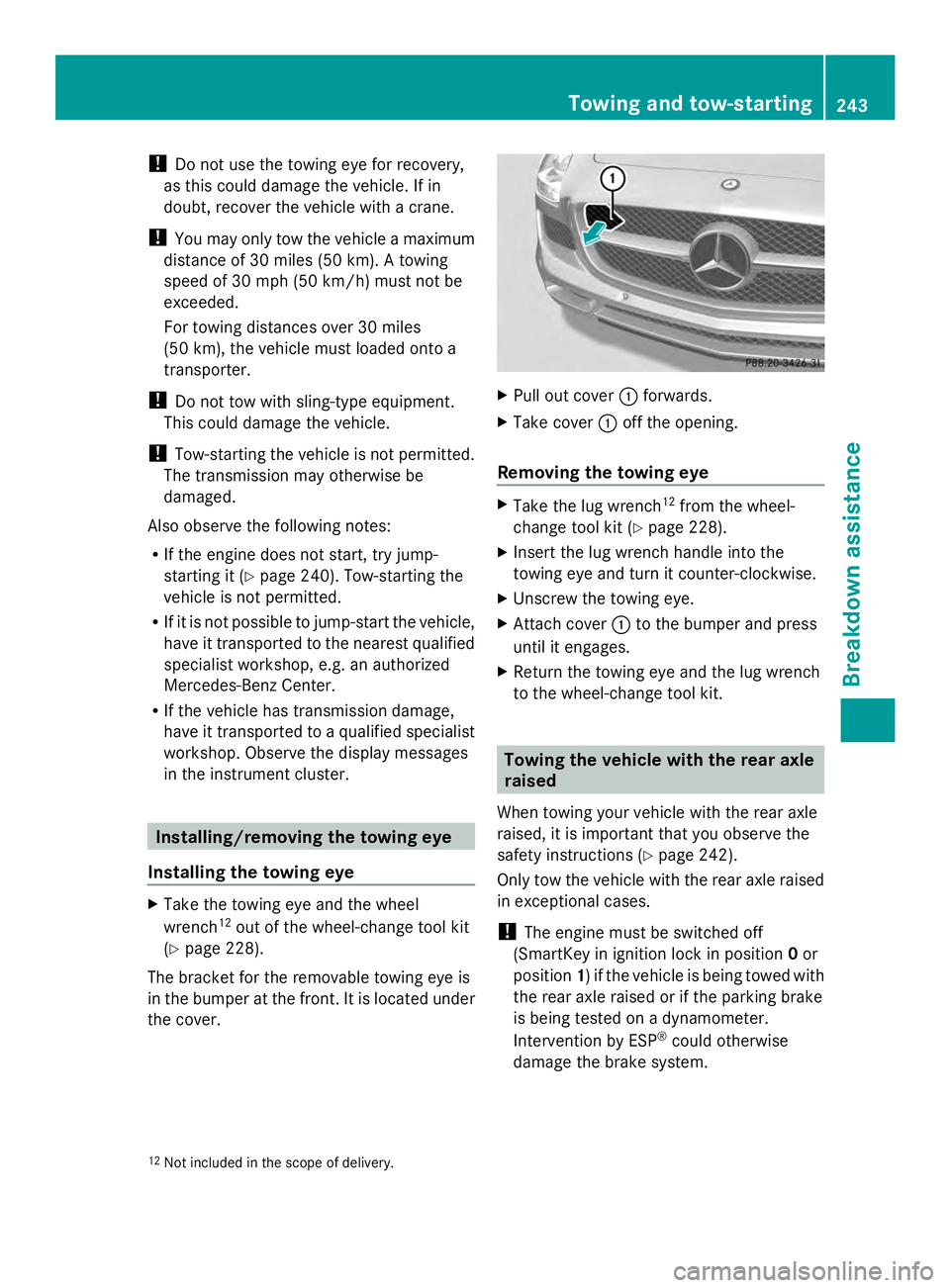
The bracket for the removable towing eye is
in the bumper at the front. It is located under
the cover. X
Pull out cover 0043forwards.
X Take cover 0043off the opening.
Removing the towing eye X
Take the lug wrench 12
from the wheel-
change tool kit (Y page 228).
X Insert the lug wrench handle into the
towing eye and turn it counter-clockwise.
X Unscrew the towing eye.
X Attach cover 0043to the bumper and press
until it engages.
X Return the towing eye and the lug wrench
to the wheel-change tool kit. Towing the vehicle with the rear axle
raised
When towing your vehicle with the rear axle
raised, it is important that you observe the
safety instructions (Y page 242).
Only tow the vehicle with the rear axle raised
in exceptional cases.
! The engine must be switched off
(SmartKey in ignition lock in position 0or
position 1) if the vehicle is being towed with
the rear axle raised or if the parking brake
is being tested on a dynamometer.
Intervention by ESP ®
could otherwise
damage the brake system.
12 Not included in the scope of delivery. Towing and tow-starting
243Breakdown assistance Z