change time MERCEDES-BENZ SPRINTER 2006 Service Manual
[x] Cancel search | Manufacturer: MERCEDES-BENZ, Model Year: 2006, Model line: SPRINTER, Model: MERCEDES-BENZ SPRINTER 2006Pages: 2305, PDF Size: 48.12 MB
Page 1168 of 2305
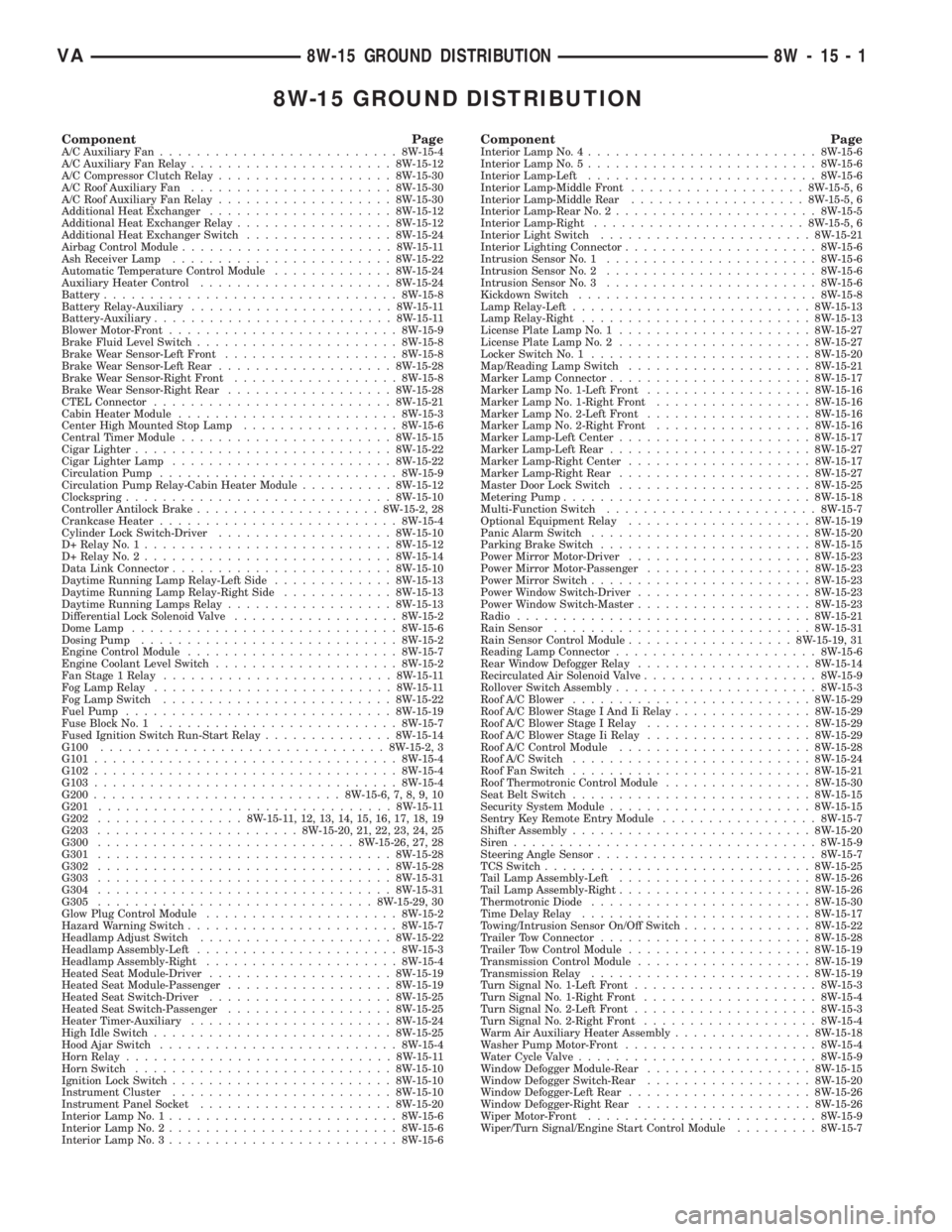
8W-15 GROUND DISTRIBUTION
Component PageA/C Auxiliary Fan..........................8W-15-4
A/C Auxiliary Fan Relay......................8W-15-12
A/C Compressor Clutch Relay...................8W-15-30
A/C Roof Auxiliary Fan......................8W-15-30
A/C Roof Auxiliary Fan Relay...................8W-15-30
Additional Heat Exchanger....................8W-15-12
Additional Heat Exchanger Relay.................8W-15-12
Additional Heat Exchanger Switch................8W-15-24
Airbag Control Module.......................8W-15-11
Ash Receiver Lamp........................8W-15-22
Automatic Temperature Control Module.............8W-15-24
Auxiliary Heater Control.....................8W-15-24
Battery................................8W-15-8
Battery Relay-Auxiliary......................8W-15-11
Battery-Auxiliary..........................8W-15-11
Blower Motor-Front.........................8W-15-9
Brake Fluid Level Switch......................8W-15-8
Brake Wear Sensor-Left Front...................8W-15-8
Brake Wear Sensor-Left Rear...................8W-15-28
Brake Wear Sensor-Right Front..................8W-15-8
Brake Wear Sensor-Right Rear..................8W-15-28
CTEL Connector..........................8W-15-21
Cabin Heater Module........................8W-15-3
Center High Mounted Stop Lamp.................8W-15-6
Central Timer Module.......................8W-15-15
Cigar Lighter............................8W-15-22
Cigar Lighter Lamp........................8W-15-22
Circulation Pump..........................8W-15-9
Circulation Pump Relay-Cabin Heater Module..........8W-15-12
Clockspring.............................8W-15-10
Controller Antilock Brake....................8W-15-2, 28
Crankcase Heater..........................8W-15-4
Cylinder Lock Switch-Driver...................8W-15-10
D+ Relay No. 1...........................8W-15-12
D+ Relay No. 2...........................8W-15-14
Data Link Connector........................8W-15-10
Daytime Running Lamp Relay-Left Side.............8W-15-13
Daytime Running Lamp Relay-Right Side............8W-15-13
Daytime Running Lamps Relay..................8W-15-13
Differential Lock Solenoid Valve..................8W-15-2
Dome Lamp.............................8W-15-6
Dosing Pump............................8W-15-2
Engine Control Module.......................8W-15-7
Engine Coolant Level Switch....................8W-15-2
Fan Stage 1 Relay.........................8W-15-11
Fog Lamp Relay..........................8W-15-11
Fog Lamp Switch.........................8W-15-22
Fuel Pump.............................8W-15-19
Fuse Block No. 1..........................8W-15-7
Fused Ignition Switch Run-Start Relay..............8W-15-14
G100...............................8W-15-2, 3
G101.................................8W-15-4
G102.................................8W-15-4
G103.................................8W-15-4
G200...........................8W-15-6, 7, 8, 9, 10
G201................................8W-15-11
G202................8W-15-11, 12, 13, 14, 15, 16, 17, 18, 19
G203......................8W-15-20, 21, 22, 23, 24, 25
G300............................8W-15-26, 27, 28
G301................................8W-15-28
G302................................8W-15-28
G303................................8W-15-31
G304................................8W-15-31
G305..............................8W-15-29, 30
Glow Plug Control Module.....................8W-15-2
Hazard Warning Switch.......................8W-15-7
Headlamp Adjust Switch.....................8W-15-22
Headlamp Assembly-Left......................8W-15-3
Headlamp Assembly-Right.....................8W-15-4
Heated Seat Module-Driver....................8W-15-19
Heated Seat Module-Passenger..................8W-15-19
Heated Seat Switch-Driver....................8W-15-25
Heated Seat Switch-Passenger..................8W-15-25
Heater Timer-Auxiliary......................8W-15-24
High Idle Switch..........................8W-15-25
Hood Ajar Switch..........................8W-15-4
Horn Relay.............................8W-15-11
Horn Switch............................8W-15-10
Ignition Lock Switch........................8W-15-10
Instrument Cluster........................8W-15-10
Instrument Panel Socket.....................8W-15-20
Interior Lamp No. 1.........................8W-15-6
Interior Lamp No. 2.........................8W-15-6
Interior Lamp No. 3.........................8W-15-6Component PageInterior Lamp No. 4.........................8W-15-6
Interior Lamp No. 5.........................8W-15-6
Interior Lamp-Left.........................8W-15-6
Interior Lamp-Middle Front...................8W-15-5, 6
Interior Lamp-Middle Rear...................8W-15-5, 6
Interior Lamp-Rear No. 2......................8W-15-5
Interior Lamp-Right.......................8W-15-5, 6
Interior Light Switch.......................8W-15-21
Interior Lighting Connector.....................8W-15-6
Intrusion Sensor No. 1.......................8W-15-6
Intrusion Sensor No. 2.......................8W-15-6
Intrusion Sensor No. 3.......................8W-15-6
Kickdown Switch..........................8W-15-8
Lamp Relay-Left..........................8W-15-13
Lamp Relay-Right.........................8W-15-13
License Plate Lamp No. 1.....................8W-15-27
License Plate Lamp No. 2.....................8W-15-27
Locker Switch No. 1........................8W-15-20
Map/Reading Lamp Switch....................8W-15-21
Marker Lamp Connector......................8W-15-17
Marker Lamp No. 1-Left Front..................8W-15-16
Marker Lamp No. 1-Right Front.................8W-15-16
Marker Lamp No. 2-Left Front..................8W-15-16
Marker Lamp No. 2-Right Front.................8W-15-16
Marker Lamp-Left Center.....................8W-15-17
Marker Lamp-Left Rear......................8W-15-27
Marker Lamp-Right Center....................8W-15-17
Marker Lamp-Right Rear.....................8W-15-27
Master Door Lock Switch.....................8W-15-25
Metering Pump...........................8W-15-18
Multi-Function Switch.......................8W-15-7
Optional Equipment Relay....................8W-15-19
Panic Alarm Switch........................8W-15-20
Parking Brake Switch.......................8W-15-15
Power Mirror Motor-Driver....................8W-15-23
Power Mirror Motor-Passenger..................8W-15-23
Power Mirror Switch........................8W-15-23
Power Window Switch-Driver...................8W-15-23
Power Window Switch-Master...................8W-15-23
Radio................................8W-15-21
Rain Sensor............................8W-15-31
Rain Sensor Control Module..................8W-15-19, 31
Reading Lamp Connector......................8W-15-6
Rear Window Defogger Relay...................8W-15-14
Recirculated Air Solenoid Valve...................8W-15-9
Rollover Switch Assembly......................8W-15-3
Roof A/C Blower..........................8W-15-29
Roof A/C Blower Stage I And Ii Relay...............8W-15-29
Roof A/C Blower Stage I Relay..................8W-15-29
Roof A/C Blower Stage Ii Relay..................8W-15-29
Roof A/C Control Module.....................8W-15-28
Roof A/C Switch..........................8W-15-24
Roof Fan Switch..........................8W-15-21
Roof Thermotronic Control Module................8W-15-30
Seat Belt Switch..........................8W-15-15
Security System Module......................8W-15-15
Sentry Key Remote Entry Module.................8W-15-7
Shifter Assembly..........................8W-15-20
Siren.................................8W-15-9
Steering Angle Sensor........................8W-15-7
TCS Switch.............................8W-15-25
Tail Lamp Assembly-Left.....................8W-15-26
Tail Lamp Assembly-Right.....................8W-15-26
Thermotronic Diode........................8W-15-30
Time Delay Relay.........................8W-15-17
Towing/Intrusion Sensor On/Off Switch..............8W-15-22
Trailer Tow Connector.......................8W-15-28
Trailer Tow Control Module....................8W-15-19
Transmission Control Module...................8W-15-19
Transmission Relay........................8W-15-19
Turn Signal No. 1-Left Front....................8W-15-3
Turn Signal No. 1-Right Front...................8W-15-4
Turn Signal No. 2-Left Front....................8W-15-3
Turn Signal No. 2-Right Front...................8W-15-4
Warm Air Auxiliary Heater Assembly...............8W-15-18
Washer Pump Motor-Front.....................8W-15-4
Water Cycle Valve..........................8W-15-9
Window Defogger Module-Rear..................8W-15-15
Window Defogger Switch-Rear..................8W-15-20
Window Defogger-Left Rear....................8W-15-26
Window Defogger-Right Rear...................8W-15-26
Wiper Motor-Front.........................8W-15-9
Wiper/Turn Signal/Engine Start Control Module.........8W-15-7
VA8W-15 GROUND DISTRIBUTION 8W - 15 - 1
Page 1290 of 2305
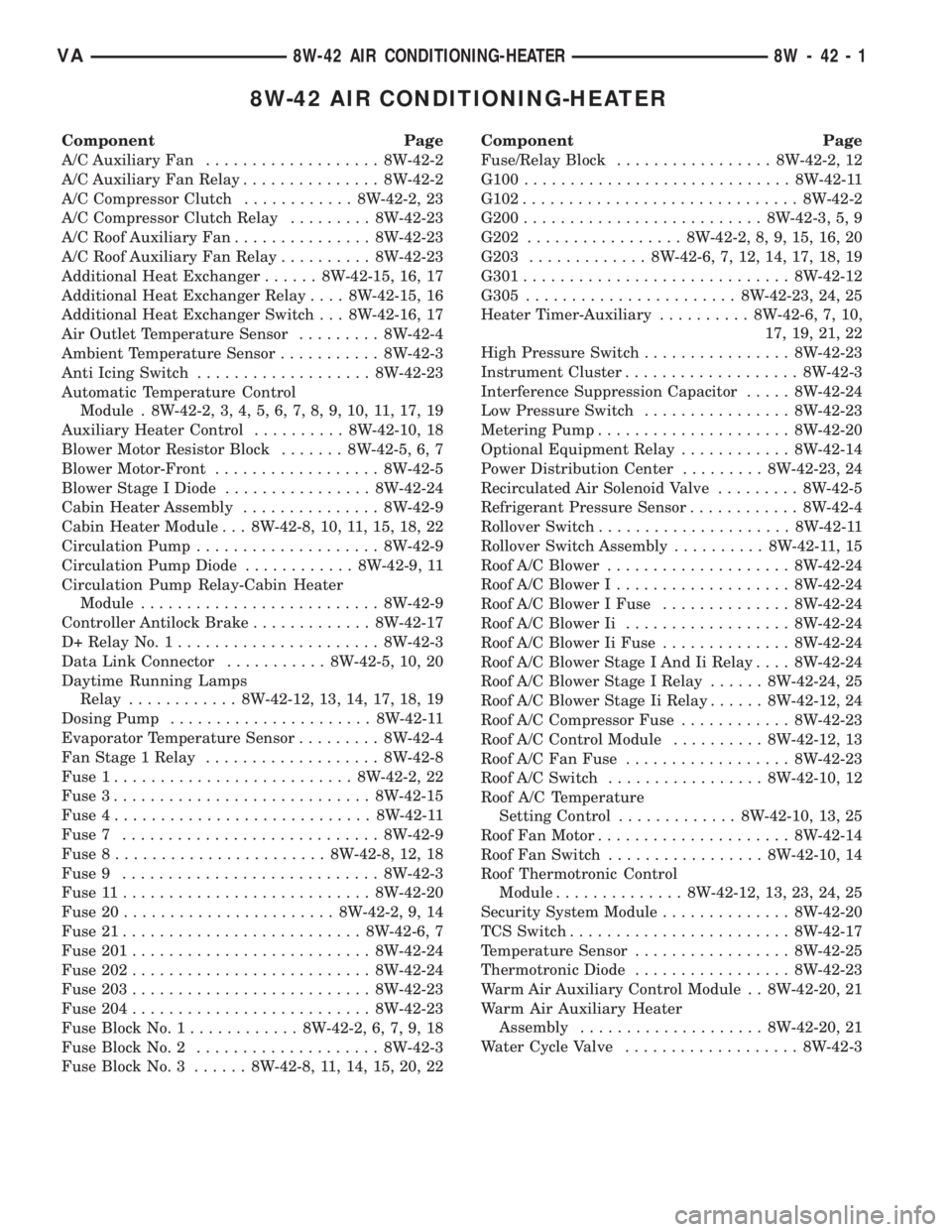
8W-42 AIR CONDITIONING-HEATER
Component Page
A/C Auxiliary Fan................... 8W-42-2
A/C Auxiliary Fan Relay............... 8W-42-2
A/C Compressor Clutch............ 8W-42-2, 23
A/C Compressor Clutch Relay......... 8W-42-23
A/C Roof Auxiliary Fan............... 8W-42-23
A/C Roof Auxiliary Fan Relay.......... 8W-42-23
Additional Heat Exchanger...... 8W-42-15, 16, 17
Additional Heat Exchanger Relay.... 8W-42-15, 16
Additional Heat Exchanger Switch . . . 8W-42-16, 17
Air Outlet Temperature Sensor......... 8W-42-4
Ambient Temperature Sensor........... 8W-42-3
Anti Icing Switch................... 8W-42-23
Automatic Temperature Control
Module . 8W-42-2, 3, 4, 5, 6, 7, 8, 9, 10, 11, 17, 19
Auxiliary Heater Control.......... 8W-42-10, 18
Blower Motor Resistor Block....... 8W-42-5, 6, 7
Blower Motor-Front.................. 8W-42-5
Blower Stage I Diode................ 8W-42-24
Cabin Heater Assembly............... 8W-42-9
Cabin Heater Module . . . 8W-42-8, 10, 11, 15, 18, 22
Circulation Pump.................... 8W-42-9
Circulation Pump Diode............ 8W-42-9, 11
Circulation Pump Relay-Cabin Heater
Module.......................... 8W-42-9
Controller Antilock Brake............. 8W-42-17
D+ Relay No. 1...................... 8W-42-3
Data Link Connector........... 8W-42-5, 10, 20
Daytime Running Lamps
Relay............ 8W-42-12, 13, 14, 17, 18, 19
Dosing Pump...................... 8W-42-11
Evaporator Temperature Sensor......... 8W-42-4
Fan Stage 1 Relay................... 8W-42-8
Fuse 1.......................... 8W-42-2, 22
Fuse 3............................ 8W-42-15
Fuse 4............................ 8W-42-11
Fuse 7............................ 8W-42-9
Fuse 8....................... 8W-42-8, 12, 18
Fuse 9............................ 8W-42-3
Fuse 11........................... 8W-42-20
Fuse 20....................... 8W-42-2, 9, 14
Fuse 21.......................... 8W-42-6, 7
Fuse 201.......................... 8W-42-24
Fuse 202.......................... 8W-42-24
Fuse 203.......................... 8W-42-23
Fuse 204.......................... 8W-42-23
Fuse Block No. 1............ 8W-42-2, 6, 7, 9, 18
Fuse Block No. 2.................... 8W-42-3
Fuse Block No. 3...... 8W-42-8, 11, 14, 15, 20, 22Component Page
Fuse/Relay Block................. 8W-42-2, 12
G100............................. 8W-42-11
G102.............................. 8W-42-2
G200.......................... 8W-42-3, 5, 9
G202................. 8W-42-2, 8, 9, 15, 16, 20
G203............. 8W-42-6, 7, 12, 14, 17, 18, 19
G301............................. 8W-42-12
G305....................... 8W-42-23, 24, 25
Heater Timer-Auxiliary.......... 8W-42-6, 7, 10,
17, 19, 21, 22
High Pressure Switch................ 8W-42-23
Instrument Cluster................... 8W-42-3
Interference Suppression Capacitor..... 8W-42-24
Low Pressure Switch................ 8W-42-23
Metering Pump..................... 8W-42-20
Optional Equipment Relay............ 8W-42-14
Power Distribution Center......... 8W-42-23, 24
Recirculated Air Solenoid Valve......... 8W-42-5
Refrigerant Pressure Sensor............ 8W-42-4
Rollover Switch..................... 8W-42-11
Rollover Switch Assembly.......... 8W-42-11, 15
Roof A/C Blower.................... 8W-42-24
Roof A/C Blower I................... 8W-42-24
Roof A/C Blower I Fuse.............. 8W-42-24
Roof A/C Blower Ii.................. 8W-42-24
Roof A/C Blower Ii Fuse.............. 8W-42-24
Roof A/C Blower Stage I And Ii Relay.... 8W-42-24
Roof A/C Blower Stage I Relay...... 8W-42-24, 25
Roof A/C Blower Stage Ii Relay...... 8W-42-12, 24
Roof A/C Compressor Fuse............ 8W-42-23
Roof A/C Control Module.......... 8W-42-12, 13
Roof A/C Fan Fuse.................. 8W-42-23
Roof A/C Switch................. 8W-42-10, 12
Roof A/C Temperature
Setting Control............. 8W-42-10, 13, 25
Roof Fan Motor..................... 8W-42-14
Roof Fan Switch................. 8W-42-10, 14
Roof Thermotronic Control
Module.............. 8W-42-12, 13, 23, 24, 25
Security System Module.............. 8W-42-20
TCS Switch........................ 8W-42-17
Temperature Sensor................. 8W-42-25
Thermotronic Diode................. 8W-42-23
Warm Air Auxiliary Control Module . . 8W-42-20, 21
Warm Air Auxiliary Heater
Assembly.................... 8W-42-20, 21
Water Cycle Valve................... 8W-42-3
VA8W-42 AIR CONDITIONING-HEATER 8W - 42 - 1
Page 1418 of 2305
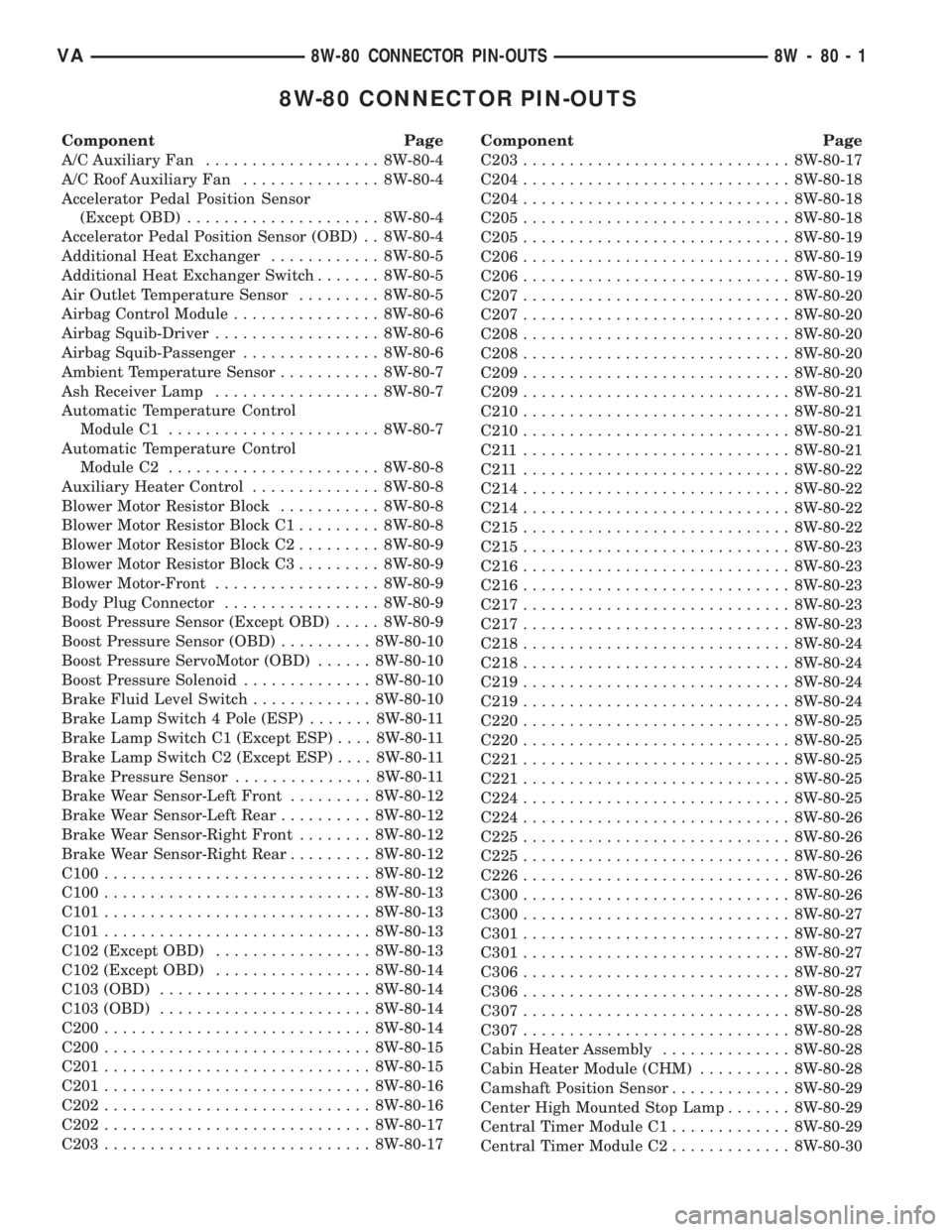
8W-80 CONNECTOR PIN-OUTS
Component Page
A/C Auxiliary Fan................... 8W-80-4
A/C Roof Auxiliary Fan............... 8W-80-4
Accelerator Pedal Position Sensor
(Except OBD)..................... 8W-80-4
Accelerator Pedal Position Sensor (OBD) . . 8W-80-4
Additional Heat Exchanger............ 8W-80-5
Additional Heat Exchanger Switch....... 8W-80-5
Air Outlet Temperature Sensor......... 8W-80-5
Airbag Control Module................ 8W-80-6
Airbag Squib-Driver.................. 8W-80-6
Airbag Squib-Passenger............... 8W-80-6
Ambient Temperature Sensor........... 8W-80-7
Ash Receiver Lamp.................. 8W-80-7
Automatic Temperature Control
Module C1....................... 8W-80-7
Automatic Temperature Control
Module C2....................... 8W-80-8
Auxiliary Heater Control.............. 8W-80-8
Blower Motor Resistor Block........... 8W-80-8
Blower Motor Resistor Block C1......... 8W-80-8
Blower Motor Resistor Block C2......... 8W-80-9
Blower Motor Resistor Block C3......... 8W-80-9
Blower Motor-Front.................. 8W-80-9
Body Plug Connector................. 8W-80-9
Boost Pressure Sensor (Except OBD)..... 8W-80-9
Boost Pressure Sensor (OBD).......... 8W-80-10
Boost Pressure ServoMotor (OBD)...... 8W-80-10
Boost Pressure Solenoid.............. 8W-80-10
Brake Fluid Level Switch............. 8W-80-10
Brake Lamp Switch 4 Pole (ESP)....... 8W-80-11
Brake Lamp Switch C1 (Except ESP).... 8W-80-11
Brake Lamp Switch C2 (Except ESP).... 8W-80-11
Brake Pressure Sensor............... 8W-80-11
Brake Wear Sensor-Left Front......... 8W-80-12
Brake Wear Sensor-Left Rear.......... 8W-80-12
Brake Wear Sensor-Right Front........ 8W-80-12
Brake Wear Sensor-Right Rear......... 8W-80-12
C100............................. 8W-80-12
C100............................. 8W-80-13
C101............................. 8W-80-13
C101............................. 8W-80-13
C102 (Except OBD)................. 8W-80-13
C102 (Except OBD)................. 8W-80-14
C103 (OBD)....................... 8W-80-14
C103 (OBD)....................... 8W-80-14
C200............................. 8W-80-14
C200............................. 8W-80-15
C201............................. 8W-80-15
C201............................. 8W-80-16
C202............................. 8W-80-16
C202............................. 8W-80-17
C203............................. 8W-80-17Component Page
C203............................. 8W-80-17
C204............................. 8W-80-18
C204............................. 8W-80-18
C205............................. 8W-80-18
C205............................. 8W-80-19
C206............................. 8W-80-19
C206............................. 8W-80-19
C207............................. 8W-80-20
C207............................. 8W-80-20
C208............................. 8W-80-20
C208............................. 8W-80-20
C209............................. 8W-80-20
C209............................. 8W-80-21
C210............................. 8W-80-21
C210............................. 8W-80-21
C211 ............................. 8W-80-21
C211 ............................. 8W-80-22
C214............................. 8W-80-22
C214............................. 8W-80-22
C215............................. 8W-80-22
C215............................. 8W-80-23
C216............................. 8W-80-23
C216............................. 8W-80-23
C217............................. 8W-80-23
C217............................. 8W-80-23
C218............................. 8W-80-24
C218............................. 8W-80-24
C219............................. 8W-80-24
C219............................. 8W-80-24
C220............................. 8W-80-25
C220............................. 8W-80-25
C221............................. 8W-80-25
C221............................. 8W-80-25
C224............................. 8W-80-25
C224............................. 8W-80-26
C225............................. 8W-80-26
C225............................. 8W-80-26
C226............................. 8W-80-26
C300............................. 8W-80-26
C300............................. 8W-80-27
C301............................. 8W-80-27
C301............................. 8W-80-27
C306............................. 8W-80-27
C306............................. 8W-80-28
C307............................. 8W-80-28
C307............................. 8W-80-28
Cabin Heater Assembly.............. 8W-80-28
Cabin Heater Module (CHM).......... 8W-80-28
Camshaft Position Sensor............. 8W-80-29
Center High Mounted Stop Lamp....... 8W-80-29
Central Timer Module C1............. 8W-80-29
Central Timer Module C2............. 8W-80-30
VA8W-80 CONNECTOR PIN-OUTS 8W - 80 - 1
Page 1639 of 2305
(14) Remove riveting tool.
(15) Turn over tool moving assembly insert to the
riveting profile.
NOTE: Rivet pins of the riveted link individually.
(16) Position riveting tool exactly over middle of
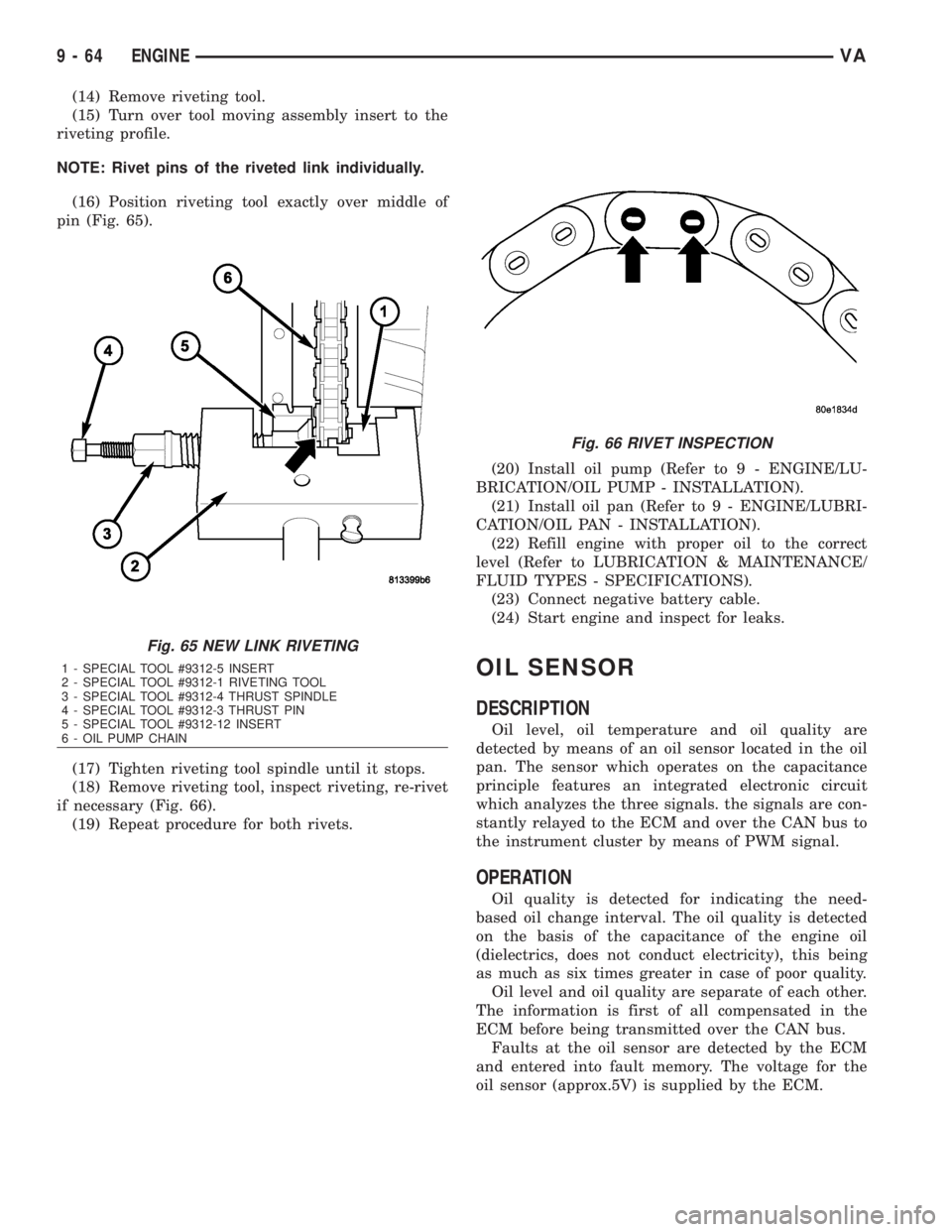
pin (Fig. 65).
(17) Tighten riveting tool spindle until it stops.
(18) Remove riveting tool, inspect riveting, re-rivet
if necessary (Fig. 66).
(19) Repeat procedure for both rivets.(20) Install oil pump (Refer to 9 - ENGINE/LU-
BRICATION/OIL PUMP - INSTALLATION).
(21) Install oil pan (Refer to 9 - ENGINE/LUBRI-
CATION/OIL PAN - INSTALLATION).
(22) Refill engine with proper oil to the correct
level (Refer to LUBRICATION & MAINTENANCE/
FLUID TYPES - SPECIFICATIONS).
(23) Connect negative battery cable.
(24) Start engine and inspect for leaks.
OIL SENSOR
DESCRIPTION
Oil level, oil temperature and oil quality are
detected by means of an oil sensor located in the oil
pan. The sensor which operates on the capacitance
principle features an integrated electronic circuit
which analyzes the three signals. the signals are con-
stantly relayed to the ECM and over the CAN bus to
the instrument cluster by means of PWM signal.
OPERATION
Oil quality is detected for indicating the need-
based oil change interval. The oil quality is detected
on the basis of the capacitance of the engine oil
(dielectrics, does not conduct electricity), this being
as much as six times greater in case of poor quality.
Oil level and oil quality are separate of each other.
The information is first of all compensated in the
ECM before being transmitted over the CAN bus.
Faults at the oil sensor are detected by the ECM
and entered into fault memory. The voltage for the
oil sensor (approx.5V) is supplied by the ECM.
Fig. 65 NEW LINK RIVETING
1 - SPECIAL TOOL #9312-5 INSERT
2 - SPECIAL TOOL #9312-1 RIVETING TOOL
3 - SPECIAL TOOL #9312-4 THRUST SPINDLE
4 - SPECIAL TOOL #9312-3 THRUST PIN
5 - SPECIAL TOOL #9312-12 INSERT
6 - OIL PUMP CHAIN
Fig. 66 RIVET INSPECTION
9 - 64 ENGINEVA
Page 1646 of 2305
INSTALLATION
CAUTION: Care must be taken to closley inspect
the gasket area around the time case cover to cyl-
inder head gasket coolant port. If damage is found,
replace the cylinder head gasket. Failure to do so
may result in engine damage.
NOTE: Thoroughly clean all mating surfaces with
the appropriate solvents to assure that no grease or
oil is present during assembly.
(1) Inspect cylinder head gasket and oil pan gas-
ket. If damaged, replace.
(2) Replace the front crankshaft seal (Refer to 9 -
ENGINE/ENGINE BLOCK/CRANKSHAFT OIL
SEAL - FRONT - INSTALLATION).
(3) Install ancillary components to timing case
cover.
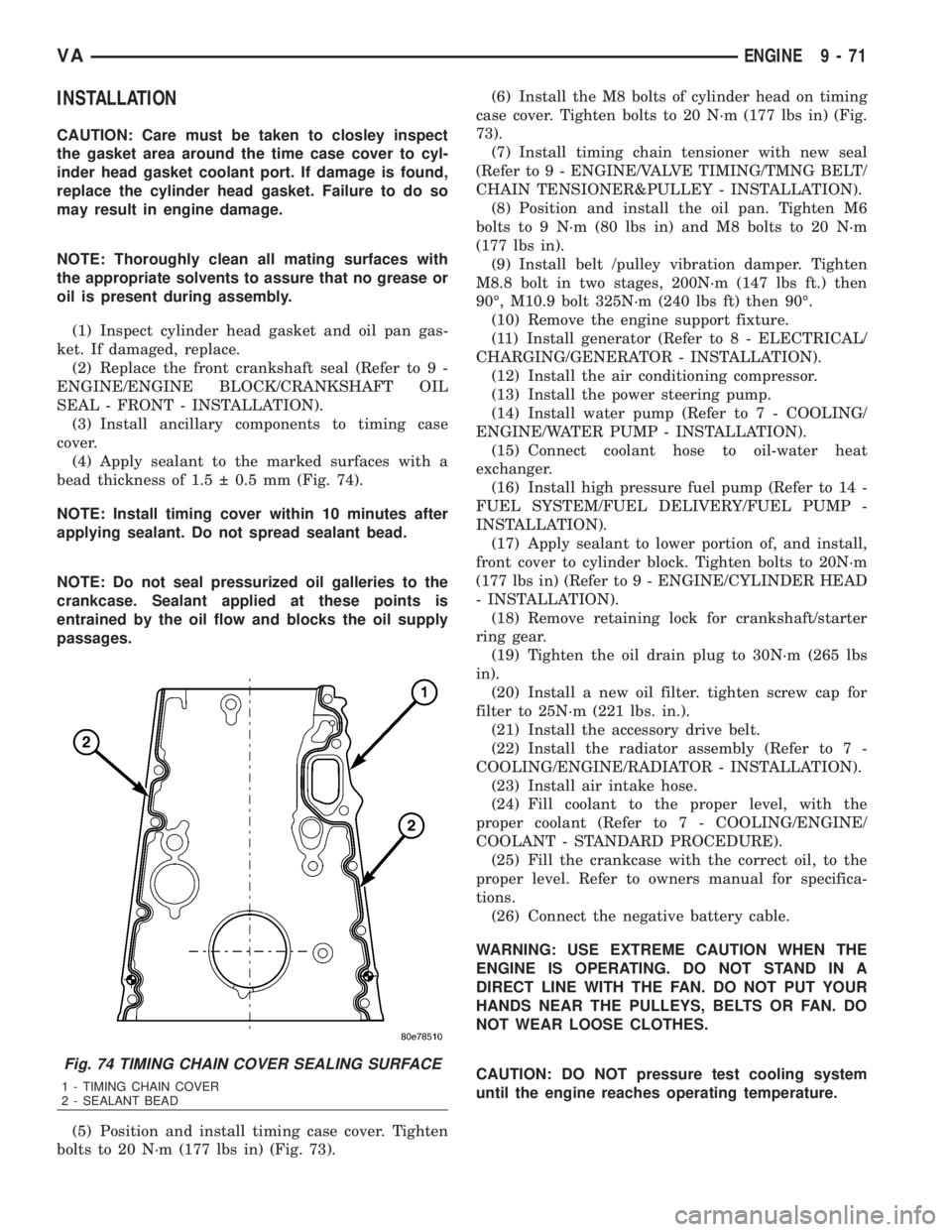
(4) Apply sealant to the marked surfaces with a
bead thickness of 1.5 0.5 mm (Fig. 74).
NOTE: Install timing cover within 10 minutes after
applying sealant. Do not spread sealant bead.
NOTE: Do not seal pressurized oil galleries to the
crankcase. Sealant applied at these points is
entrained by the oil flow and blocks the oil supply
passages.
(5) Position and install timing case cover. Tighten
bolts to 20 N´m (177 lbs in) (Fig. 73).(6) Install the M8 bolts of cylinder head on timing
case cover. Tighten bolts to 20 N´m (177 lbs in) (Fig.
73).
(7) Install timing chain tensioner with new seal
(Refer to 9 - ENGINE/VALVE TIMING/TMNG BELT/
CHAIN TENSIONER&PULLEY - INSTALLATION).
(8) Position and install the oil pan. Tighten M6
bolts to 9 N´m (80 lbs in) and M8 bolts to 20 N´m
(177 lbs in).
(9) Install belt /pulley vibration damper. Tighten
M8.8 bolt in two stages, 200N´m (147 lbs ft.) then
90É, M10.9 bolt 325N´m (240 lbs ft) then 90É.
(10) Remove the engine support fixture.
(11) Install generator (Refer to 8 - ELECTRICAL/
CHARGING/GENERATOR - INSTALLATION).
(12) Install the air conditioning compressor.
(13) Install the power steering pump.
(14) Install water pump (Refer to 7 - COOLING/
ENGINE/WATER PUMP - INSTALLATION).
(15) Connect coolant hose to oil-water heat
exchanger.
(16) Install high pressure fuel pump (Refer to 14 -
FUEL SYSTEM/FUEL DELIVERY/FUEL PUMP -
INSTALLATION).
(17) Apply sealant to lower portion of, and install,
front cover to cylinder block. Tighten bolts to 20N´m
(177 lbs in) (Refer to 9 - ENGINE/CYLINDER HEAD
- INSTALLATION).
(18) Remove retaining lock for crankshaft/starter
ring gear.
(19) Tighten the oil drain plug to 30N´m (265 lbs
in).
(20) Install a new oil filter. tighten screw cap for
filter to 25N´m (221 lbs. in.).
(21) Install the accessory drive belt.
(22) Install the radiator assembly (Refer to 7 -
COOLING/ENGINE/RADIATOR - INSTALLATION).
(23) Install air intake hose.
(24) Fill coolant to the proper level, with the
proper coolant (Refer to 7 - COOLING/ENGINE/
COOLANT - STANDARD PROCEDURE).
(25) Fill the crankcase with the correct oil, to the
proper level. Refer to owners manual for specifica-
tions.
(26) Connect the negative battery cable.
WARNING: USE EXTREME CAUTION WHEN THE
ENGINE IS OPERATING. DO NOT STAND IN A
DIRECT LINE WITH THE FAN. DO NOT PUT YOUR
HANDS NEAR THE PULLEYS, BELTS OR FAN. DO
NOT WEAR LOOSE CLOTHES.
CAUTION: DO NOT pressure test cooling system
until the engine reaches operating temperature.
Fig. 74 TIMING CHAIN COVER SEALING SURFACE
1 - TIMING CHAIN COVER
2 - SEALANT BEAD
VAENGINE 9 - 71
Page 1690 of 2305
(4) Fill fuel tank with fresh diesel fuel.
(5) Drain and remove the fuel filter. (Refer to 14 -
FUEL SYSTEM/FUEL DELIVERY/FUEL FILTER /
WATER SEPARATOR - REMOVAL)
(6) Install a new fuel filter. (Refer to 14 - FUEL
SYSTEM/FUEL DELIVERY/FUEL FILTER / WATER
SEPARATOR - INSTALLATION)
(7) Check the engine control module for any diag-
nostic trouble codes (DTCs). Record and clear any
DTCs that are present.
(8) Start and run the engine. Run the engine for
up to 15 minutes to allow time for any DTCs to reset
and shut off the engine.
(9) Check the engine control module for any diag-
nostic trouble codes (DTCs). Record any DTCs that
are present. Refer to the appropriate engine electrical
diagnostics to diagnose any DTCs that were set.
CAUTION: With the high pressure fuel system in
this vehicle, any residual contaminated fuel will be
removed very quickly. Shut off the engine immedi-
ately if signs of engine damage are noted.The engine should then be evaluated to determine
if the contaminated fuel has caused any damage to
the fuel system and/or engine. Indicators that the
fuel system has been damaged include the following:
²Unstable fuel rail pressure. This can manifest
itself as instability of idle speeds, excessive under-
shoot/overshoot at engine start-up, or excessive
undershoot/overshoot when the engine operating con-
ditions change. A typical engine response to a large
rail pressure undershoot would be a decrease in
engine speed or engine stall.
²Excessive noise from the engine. This could indi-
cate poor rail pressure control or the inability of the
injection system to inject the proper amount of fuel.
²Excessive smoke (black or white). This could
indicate the inability of the fuel system to inject the
proper amount of fuel.
NOTE: If any of these conditions are exhibited after
cleaning the fuel system, proceed to the appropri-
ate engine electrical diagnostic information. Repair
the fuel system and/or engine as necessary.
SPECIFICATIONS
TORQUE
DESCRIPTION N´m Ft. Lbs. In. Lbs.
FUEL TANK MOUNTING NUTS 15 - 17 11 - 13 -
FUEL TANK MODULE LOCKRING (LOCK-
NUT)60 44 -
PRESSURE CONTROL VALVE NUT TO
FUEL RAIL (2 STAGES)60, loosen 90É, re-
tighten to 8044, loosen 90É, re-
tighten to 59-
SPECIAL TOOLS
FUEL SYSTEM
SPECIAL TOOL CROSS REFERENCE CHART
MB
TOOL #MILLER
TOOL #DESCRIPTION
N/A 5069-2 FUEL GAUGE
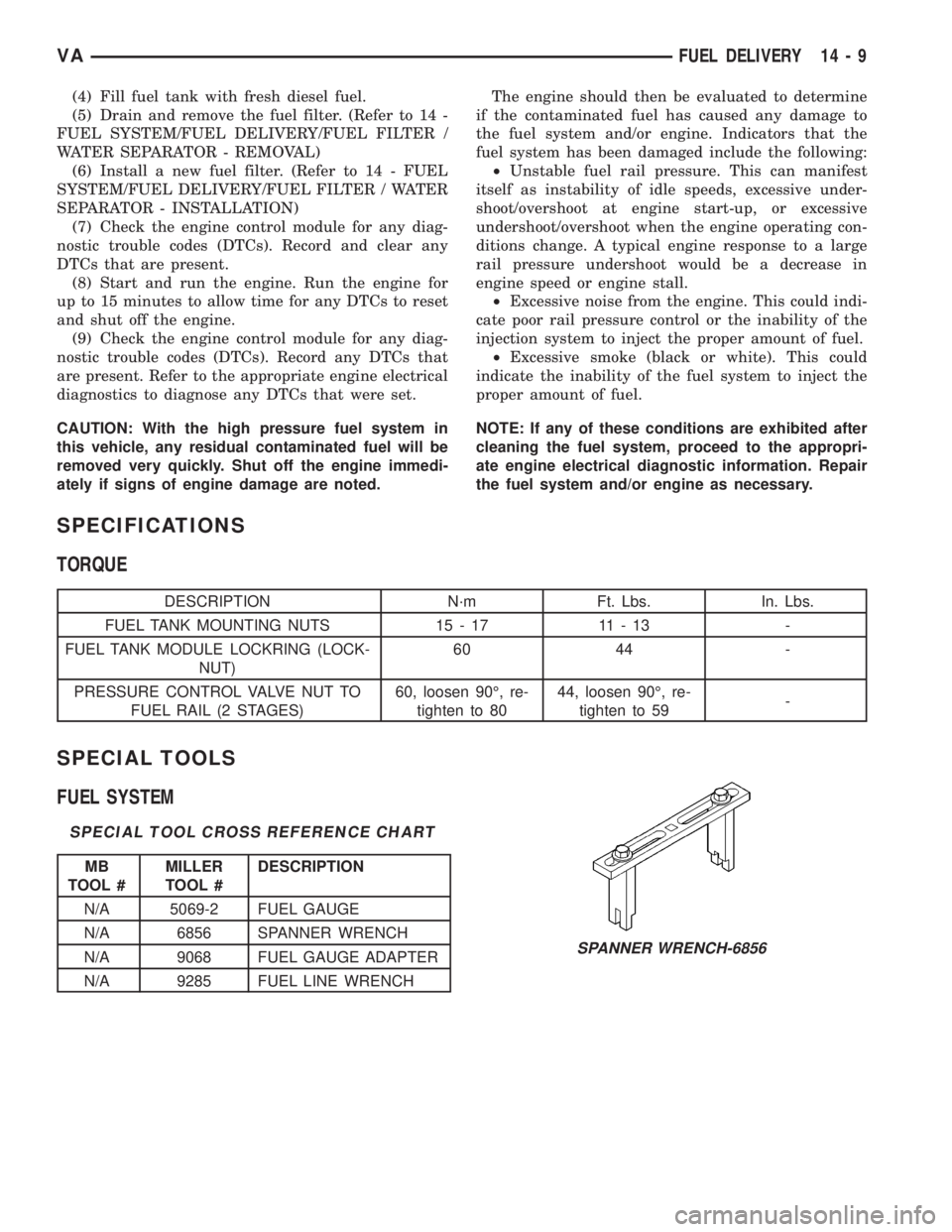
N/A 6856 SPANNER WRENCH
N/A 9068 FUEL GAUGE ADAPTER
N/A 9285 FUEL LINE WRENCH
SPANNER WRENCH-6856
VAFUEL DELIVERY 14 - 9
Page 1725 of 2305
INSTALLATION
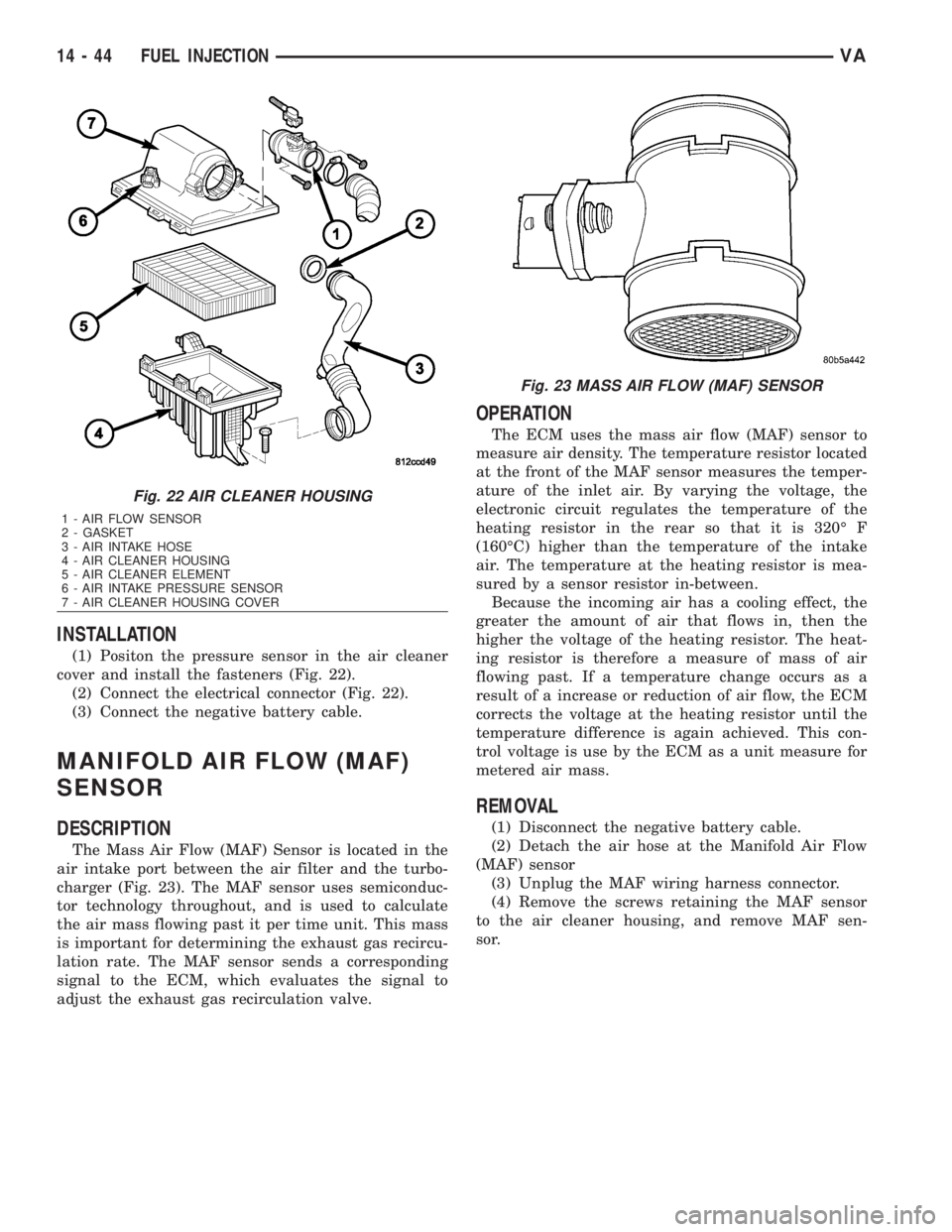
(1) Positon the pressure sensor in the air cleaner
cover and install the fasteners (Fig. 22).
(2) Connect the electrical connector (Fig. 22).
(3) Connect the negative battery cable.
MANIFOLD AIR FLOW (MAF)
SENSOR
DESCRIPTION
The Mass Air Flow (MAF) Sensor is located in the
air intake port between the air filter and the turbo-
charger (Fig. 23). The MAF sensor uses semiconduc-
tor technology throughout, and is used to calculate
the air mass flowing past it per time unit. This mass
is important for determining the exhaust gas recircu-
lation rate. The MAF sensor sends a corresponding
signal to the ECM, which evaluates the signal to
adjust the exhaust gas recirculation valve.
OPERATION
The ECM uses the mass air flow (MAF) sensor to
measure air density. The temperature resistor located
at the front of the MAF sensor measures the temper-
ature of the inlet air. By varying the voltage, the
electronic circuit regulates the temperature of the
heating resistor in the rear so that it is 320É F
(160ÉC) higher than the temperature of the intake
air. The temperature at the heating resistor is mea-
sured by a sensor resistor in-between.
Because the incoming air has a cooling effect, the
greater the amount of air that flows in, then the
higher the voltage of the heating resistor. The heat-
ing resistor is therefore a measure of mass of air
flowing past. If a temperature change occurs as a
result of a increase or reduction of air flow, the ECM
corrects the voltage at the heating resistor until the
temperature difference is again achieved. This con-
trol voltage is use by the ECM as a unit measure for
metered air mass.
REMOVAL
(1) Disconnect the negative battery cable.
(2) Detach the air hose at the Manifold Air Flow
(MAF) sensor
(3) Unplug the MAF wiring harness connector.
(4) Remove the screws retaining the MAF sensor
to the air cleaner housing, and remove MAF sen-
sor.
Fig. 22 AIR CLEANER HOUSING
1 - AIR FLOW SENSOR
2 - GASKET
3 - AIR INTAKE HOSE
4 - AIR CLEANER HOUSING
5 - AIR CLEANER ELEMENT
6 - AIR INTAKE PRESSURE SENSOR
7 - AIR CLEANER HOUSING COVER
Fig. 23 MASS AIR FLOW (MAF) SENSOR
14 - 44 FUEL INJECTIONVA
Page 1912 of 2305
²Tipping the selector lever toward ª-º one
time after another:The shift range is reduced in
descending sequence by one gear each time, i.e., from
D-4-3-2-1.Iftheselected limitation of the shift
range would result in a downshift causing excessive
engine speed, the shifting is not executed and the
engaged gear as well as the shift range remain
unchanged. This is to prevent the engine from over-
speeding. Engine retardation is low with the selector
lever in position ªDº. To make use of the full braking
power of the engine, ªmanualº downshifting by tip-
ping the lever towards the left-hand side is recom-
mended. If this has been done, subsequent upshifting
must be carried out manually as well.
²Tipping the selector lever toward ª-º and
holding it in this position:The currently engaged
gear in range ªDº is indicated in the instrument clus-
ter display and the shift range is limited to this gear.
²Tipping the selector lever toward ª+º one
time after another:The shift range is increased by
one gear each time and the increased shift range is
displayed in the instrument cluster; possibly, the
transmission upshifts to a faster gear.
²Tipping the selector lever toward ª+º sev-
eral times:The shift range is increased by one gear
each time the lever is tipped until the shift range
ends up in ªDº.
²Tipping the selector lever toward ª+º and
holding it in this position:The shift range is
extended immediately to ªDº, shift ranges are indi-
cated in ascending sequence; possibly, the transmis-
sion upshifts to a faster gear due to the extension of
the shift range.
REMOVAL
(1) Move selector lever to position ªDº.
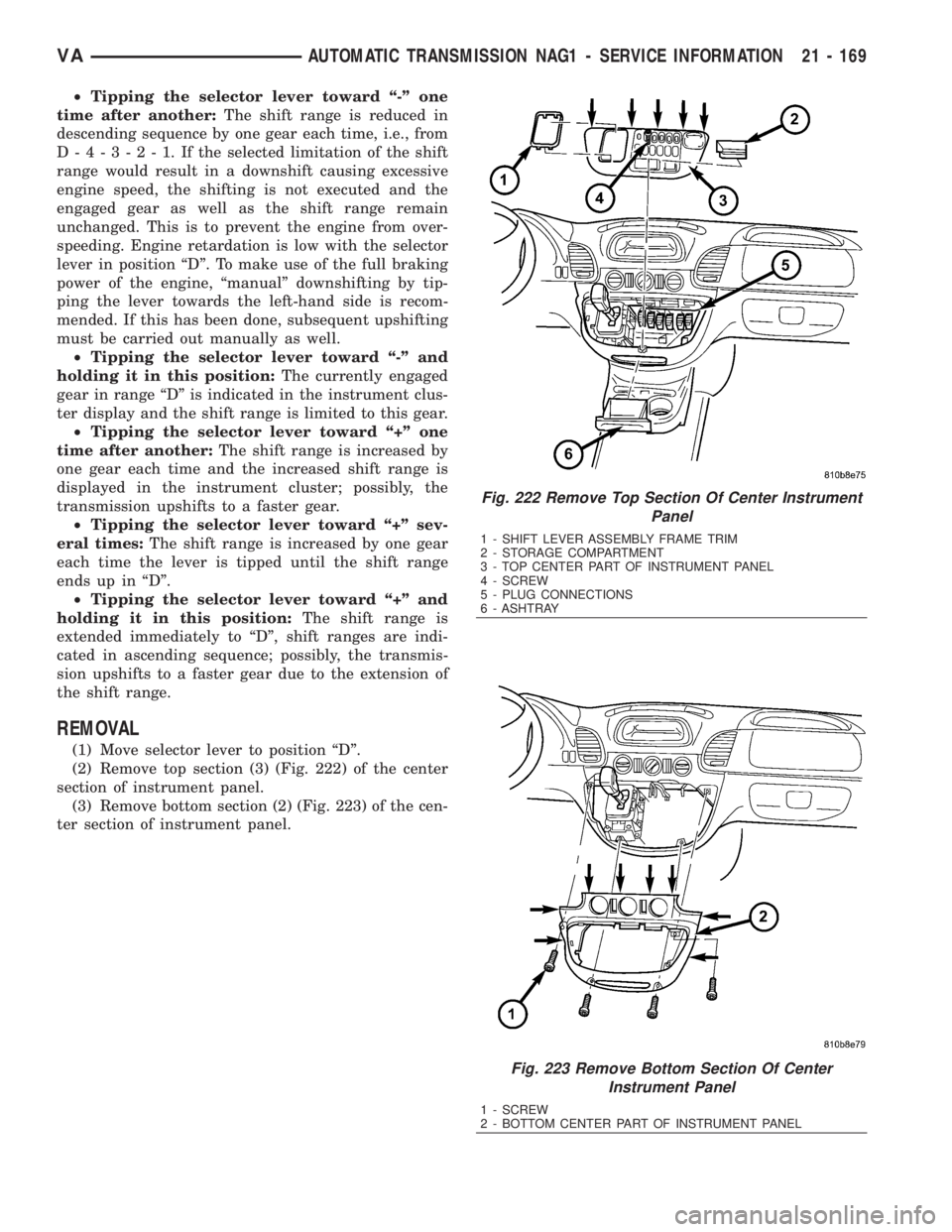
(2) Remove top section (3) (Fig. 222) of the center
section of instrument panel.
(3) Remove bottom section (2) (Fig. 223) of the cen-
ter section of instrument panel.
Fig. 222 Remove Top Section Of Center Instrument
Panel
1 - SHIFT LEVER ASSEMBLY FRAME TRIM
2 - STORAGE COMPARTMENT
3 - TOP CENTER PART OF INSTRUMENT PANEL
4 - SCREW
5 - PLUG CONNECTIONS
6 - ASHTRAY
Fig. 223 Remove Bottom Section Of Center
Instrument Panel
1 - SCREW
2 - BOTTOM CENTER PART OF INSTRUMENT PANEL
VAAUTOMATIC TRANSMISSION NAG1 - SERVICE INFORMATION 21 - 169
Page 2166 of 2305
1.0 INTRODUCTION
The procedures contained in this manual include
all of the specifications, instructions, and graphics
needed to diagnose NAG1 Electronic Automatic
Transmission and Shift Lever Assembly problems.
The diagnostics in this manual are based on the
failure condition or symptom being present at the
time of diagnosis.
When repairs are required, refer to the appropri-
ate volume of the service information for the proper
removal and repair procedure.
READ THIS MANUAL BEFORE TRYING TO
DIAGNOSE A VEHICLE TROUBLE CODE.
Diagnostic procedures change every year. New
diagnostic systems may be added and/or carryover
systems may be enhanced. It is recommended that
you review the entire manual to become familiar
with all new and changed diagnostic procedures.
1.1 SYSTEM COVERAGE
This diagnostic procedures manual covers all
Sprinter (VA) equipped with a NAG1 Automatic
Transmission.
1.2 SIX -STEP TROUBLESHOOTING
PROCEDURE
Diagnosis of the NAG1 electronic transmission is
done in six basic steps:
Verification of complaint
Verification of any related symptoms
Symptom analysis
Problem isolation
Repair of isolated problem
Verification of proper operation
2.0 IDENTIFICATION OF
SYSTEM
The NAG1 Transmission family can be identified
by the presence of a 13 pin electrical connector, with
a bayonet lock on the right hand side of the trans-
mission. The connector is oriented horizontally.
3.0 SYSTEM DESCRIPTION AND
FUNCTIONAL OPERATION
3.1 GENERAL DESCRIPTION
The NAG1 electronic transmission is an electron-
ically controlled five speed transmission with a
controlled slip torque converter. The NAG1 elec-tronic transmission is a conventional transmission
in that it uses hydraulically applied clutches to shift
a planetary gear train. However, the electronic
control system replaces many of the mechanical and
hydraulic components used in conventional trans-
mission valve bodies.
The ratios for the gear stages are obtained by 3
planetary gear sets. Fifth Gear is designed as an
Overdrive with a high speed ratio. The gears are
actuated electronically/hydraulically. The electronic
control system enables precise adaptation of pres-
sures to the respective operating conditions and to
the engine output during a shift phase, which
results in a significant improvement in shift qual-
ity.
3.2 FUNCTIONAL OPERATION
The NAG1 electronic transmission has a fully
adaptive control system. The system performs its
functions based on continuous real-time sensor and
switch feedback information. In addition the TCM
receives information from the Shift Lever Assembly,
ECM (engine management) and ABS (chassis sys-
tems) controllers over the CAN bus. The CAN bus is
a high speed communication bus that allows real
time control capability between various controllers.
Most messages are sent every 20 milliseconds, this
means critical information can be shared between
the Transmission, Shifter, Engine and ABS control-
lers. The CAN bus is a two wire bus with aCAN C
Bus (+) circuitand aCAN C Bus (-) circuit. The
CAN bus uses a twisted pair of wires in the harness
to reduce the potential of radio and noise interfer-
ence. The CAN bus also uses a 120 ohm terminating
resistor in both the ECM and Sentry Key Remote
Entry Module (SKREEM) modules. The module
terminating resistance is measured across both
CAN bus circuits at the ECM or SKREEM module.
The control system automatically adapts to
changes in engine performance, vehicle speed, and
transmission temperature variations to provide
consistent shift quality. The control system ensures
that clutch operation during upshifting and down-
shifting is more responsive without increased
harshness. The TCM controls the actuation of sole-
noid valves for modulating shift pressure and gear
change. The required pressure level is calculated
from the load condition, engine speed. Power for the
transmission system is supplied through the Trans-
mission Relay. The TCM is located in the under the
drivers seat of the vehicle.
The Transmission Control Module (TCM) contin-
uously checks for electrical problems, mechanical
problems, and some hydraulic problems. When a
problem is sensed, the TCM stores a diagnostic
trouble code (DTC). Some of these codes cause the
transmission to go into9limp-in9or9default9mode.
1
GENERAL INFORMATION
Page 2169 of 2305
3.2.5 TRANSMISSION OPERATION AND
SHIFT SCHEDULING
The transmission covered in this manual has
unique shift schedules depending on the tempera-
ture of the transmission oil. The transmission oil
temperature has a decisive effect on the shift qual-
ity of the transmission. The shift schedule is modi-
fied to extend the life of the transmission while
operating under extreme conditions and to improve
driver comfort by modifying shift schedules.
The transmission oil temperature is measured
with a Temperature Sensor on the NAG1 transmis-
sion. The Temperature Sensor is an integral com-
ponent of the Transmission Solenoid assembly. If
the Temperature Sensor is causing a problem, a
DTC will be set in the TCM.
The Transmission Temperature Sensor is wired in
series with the Park /Neutral (P/N) switch. The P/N
switch is also located in the transmission. The trans-
mission temperature is only read by the TCM when
the P/N switch closes while in the R, D position.
When the shifter lever is in the park or neutral
position, the P/N switch opens and the temperature
being displayed is Engine temperature.
AutoStick Feature (If equipped)
This feature allows the driver to manually shift the
transaxle when the shift lever is moved sideways to
the (+ / -) in position D to adjust the shift range.
3.2.6 TRANSMISSION ADAPTIVES -
INITIALIZE AND STORE
Initialize Adaptive -This TCM function should be
used when a new transmission has been placed in
the vehicle. This command will reset the TCM
adaptive to the factory setting.
Store Adaptive -This command should be used
after the vehicle has been test driven by the tech-
nician to store any learned adaptive changes that
occurred during the test drive. During normal op-
eration adaptive are updated every 10 minutes.
Using this command the latest adaptive will be
written to the TCM immediately.
3.3 DIAGNOSTIC TROUBLE CODES
Diagnostic trouble codes (DTC's) are codes stored
by the Transmission Control Module (TCM) and the
Shift Lever Assembly Module (SLA) to help diag-
nose Transmission and Shifter problems. They are
viewed using the DRBIIItscan tool.
Always begin by performing a visual inspection of
the wiring, connectors, cooler lines and the trans-
mission. Any obvious wiring problems or leaks
should be repaired prior to performing any diagnos-
tic test procedures. Some engine driveability prob-lems can be misinterpreted as a transmission prob-
lem. Ensure that the engine is running properly
and that no ECM DTC's are present that could
cause a transmission complaint.
If there is a communication K-ABS,Shifter or
K-TCM circuit problem, trouble codes will not be
accessible until the problem is fixed. The DRBIIIt
will display an appropriate message. The following
is a possible list of causes for a bus problem:
± open or short to ground/battery in K line
circuit.
± internal failure of any module or component
connected to the K line circuit
Each diagnostic trouble code is diagnosed by
following a specific testing sequence. The diagnostic
test procedures contain step-by-step instructions
for determining the cause of a transmission diag-
nostic trouble code. Possible sources of the code are
checked and eliminated one by one. It is not neces-
sary to perform all of the tests in this book to
diagnose an individual code. These tests are based
on the problem being present at the time that the
test is run.
If the TCM records a DTC that will adversely
affect the vehicles transmission, it will request (via
the communication bus) that the ECM illuminate
the Malfunction Indicator Lamp (MIL). All trans-
mission DTC's will be stored in the TCM.
3.3.1 ACTIVE (HARD) CODE
Any Diagnostic Trouble Code (DTC) that is set
whenever the system or component is monitored is
an Active code. This means that the problem is
there every time the TCM checks that system or
component. Some codes will set immediately at
start up and others will require a road test under
specific conditions to set the DTC. It must be
determined if a code is Active (repeatable) or Stored
(Intermittent) before attempting diagnosis.
3.3.2 STORED (INTERMITTENT) CODE
A diagnostic trouble code that is not there every
time the TCM checks the circuit or function is a
Stored (Intermittent) code. Problems that come and
go like this are the most difficult to diagnose, they
must be looked for under the specific conditions
that cause them. If the DTC is reset (after an
ignition cycle) the DTC will be set to Stored (Inter-
mittent) status. A DTC status can be9Active9or
9Stored9(Intermittent). Active is when the DTC is
present in the controller and the transmission is in
the particular mode of operation for that DTC.
Stored means that the DTC occurred at some point,
but is not currently present, or the conditions have
not been right to check for the presence of the
problem, when a DTC is classified as Stored (Inter-
mittent), no TCM reaction is required.
4
GENERAL INFORMATION