instrument panel MERCEDES-BENZ SPRINTER 2006 Service Manual
[x] Cancel search | Manufacturer: MERCEDES-BENZ, Model Year: 2006, Model line: SPRINTER, Model: MERCEDES-BENZ SPRINTER 2006Pages: 2305, PDF Size: 48.12 MB
Page 1513 of 2305
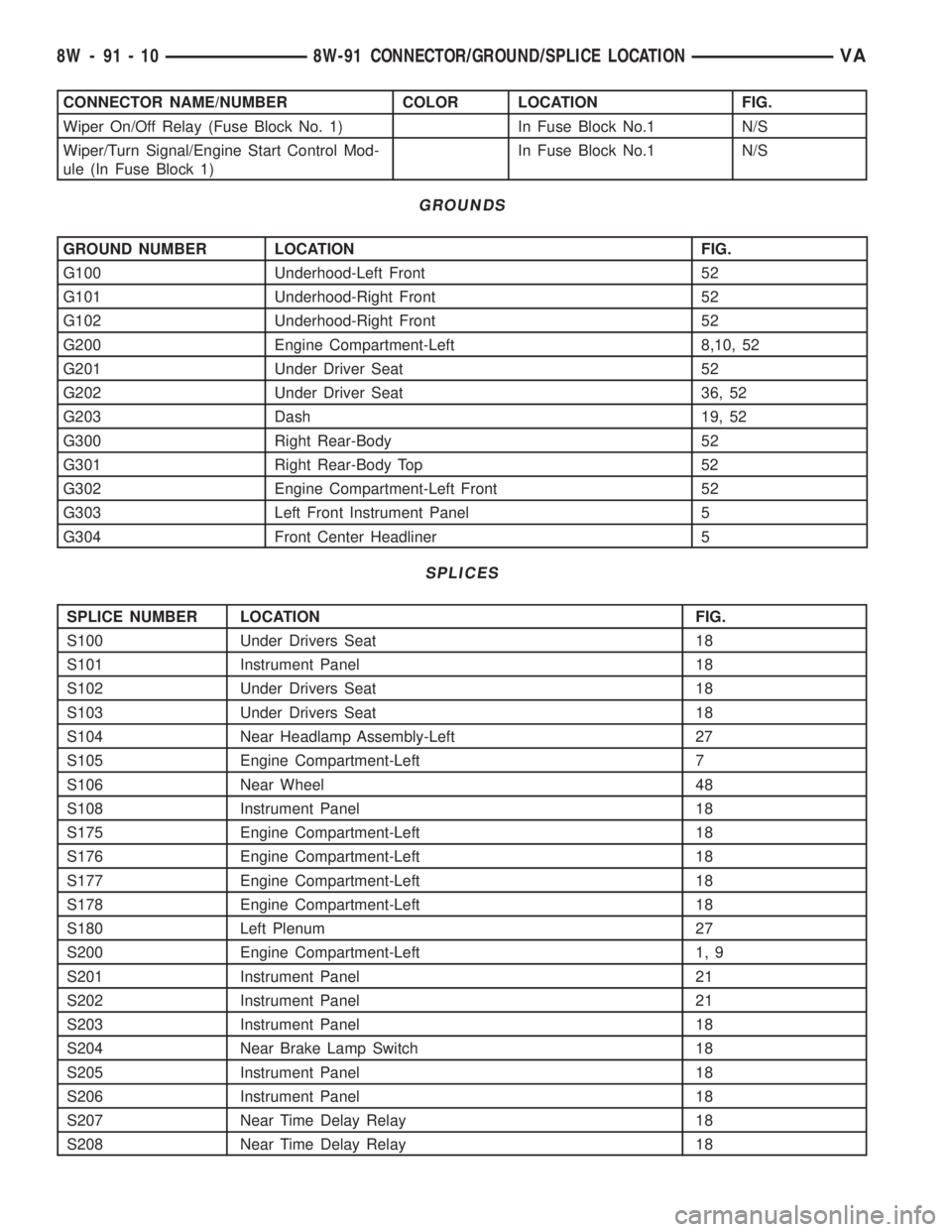
CONNECTOR NAME/NUMBER COLOR LOCATION FIG.
Wiper On/Off Relay (Fuse Block No. 1) In Fuse Block No.1 N/S
Wiper/Turn Signal/Engine Start Control Mod-
ule (In Fuse Block 1)In Fuse Block No.1 N/S
GROUNDS
GROUND NUMBER LOCATION FIG.
G100 Underhood-Left Front 52
G101 Underhood-Right Front 52
G102 Underhood-Right Front 52
G200 Engine Compartment-Left 8,10, 52
G201 Under Driver Seat 52
G202 Under Driver Seat 36, 52
G203 Dash 19, 52
G300 Right Rear-Body 52
G301 Right Rear-Body Top 52
G302 Engine Compartment-Left Front 52
G303 Left Front Instrument Panel 5
G304 Front Center Headliner 5
SPLICES
SPLICE NUMBER LOCATION FIG.
S100 Under Drivers Seat 18
S101 Instrument Panel 18
S102 Under Drivers Seat 18
S103 Under Drivers Seat 18
S104 Near Headlamp Assembly-Left 27
S105 Engine Compartment-Left 7
S106 Near Wheel 48
S108 Instrument Panel 18
S175 Engine Compartment-Left 18
S176 Engine Compartment-Left 18
S177 Engine Compartment-Left 18
S178 Engine Compartment-Left 18
S180 Left Plenum 27
S200 Engine Compartment-Left 1, 9
S201 Instrument Panel 21
S202 Instrument Panel 21
S203 Instrument Panel 18
S204 Near Brake Lamp Switch 18
S205 Instrument Panel 18
S206 Instrument Panel 18
S207 Near Time Delay Relay 18
S208 Near Time Delay Relay 18
8W - 91 - 10 8W-91 CONNECTOR/GROUND/SPLICE LOCATIONVA
Page 1514 of 2305
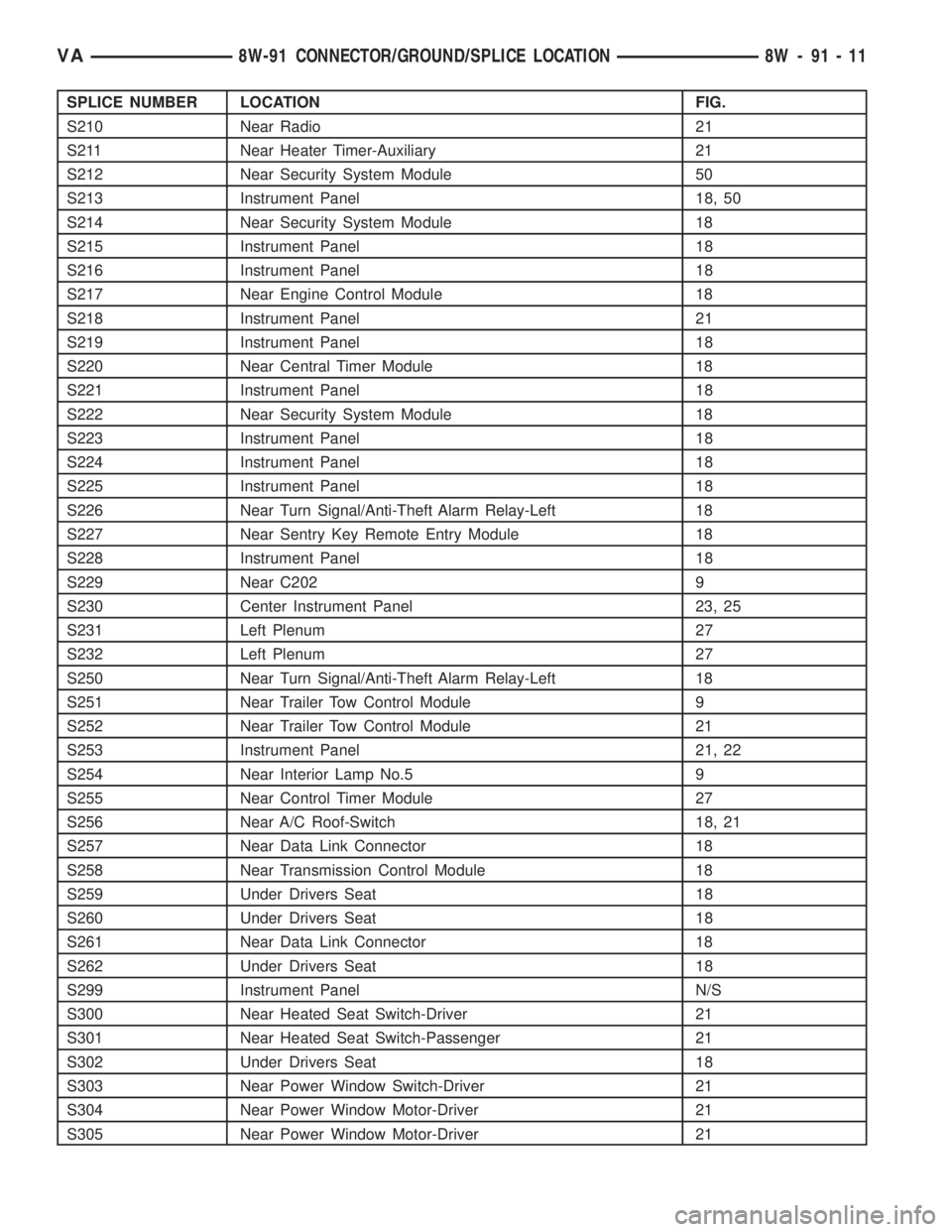
SPLICE NUMBER LOCATION FIG.
S210 Near Radio 21
S211 Near Heater Timer-Auxiliary 21
S212 Near Security System Module 50
S213 Instrument Panel 18, 50
S214 Near Security System Module 18
S215 Instrument Panel 18
S216 Instrument Panel 18
S217 Near Engine Control Module 18
S218 Instrument Panel 21
S219 Instrument Panel 18
S220 Near Central Timer Module 18
S221 Instrument Panel 18
S222 Near Security System Module 18
S223 Instrument Panel 18
S224 Instrument Panel 18
S225 Instrument Panel 18
S226 Near Turn Signal/Anti-Theft Alarm Relay-Left 18
S227 Near Sentry Key Remote Entry Module 18
S228 Instrument Panel 18
S229 Near C202 9
S230 Center Instrument Panel 23, 25
S231 Left Plenum 27
S232 Left Plenum 27
S250 Near Turn Signal/Anti-Theft Alarm Relay-Left 18
S251 Near Trailer Tow Control Module 9
S252 Near Trailer Tow Control Module 21
S253 Instrument Panel 21, 22
S254 Near Interior Lamp No.5 9
S255 Near Control Timer Module 27
S256 Near A/C Roof-Switch 18, 21
S257 Near Data Link Connector 18
S258 Near Transmission Control Module 18
S259 Under Drivers Seat 18
S260 Under Drivers Seat 18
S261 Near Data Link Connector 18
S262 Under Drivers Seat 18
S299 Instrument Panel N/S
S300 Near Heated Seat Switch-Driver 21
S301 Near Heated Seat Switch-Passenger 21
S302 Under Drivers Seat 18
S303 Near Power Window Switch-Driver 21
S304 Near Power Window Motor-Driver 21
S305 Near Power Window Motor-Driver 21
VA8W-91 CONNECTOR/GROUND/SPLICE LOCATION 8W - 91 - 11
Page 1515 of 2305
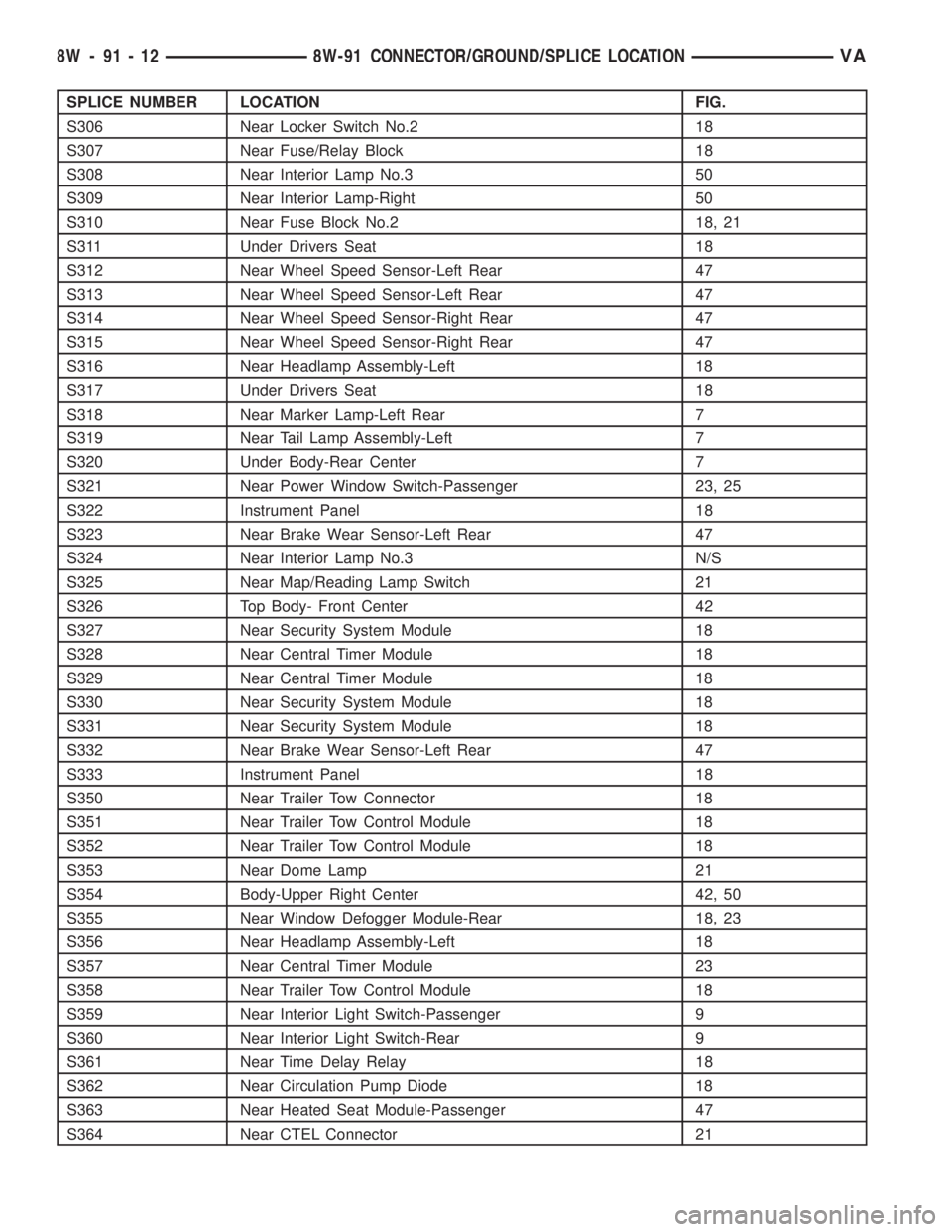
SPLICE NUMBER LOCATION FIG.
S306 Near Locker Switch No.2 18
S307 Near Fuse/Relay Block 18
S308 Near Interior Lamp No.3 50
S309 Near Interior Lamp-Right 50
S310 Near Fuse Block No.2 18, 21
S311 Under Drivers Seat 18
S312 Near Wheel Speed Sensor-Left Rear 47
S313 Near Wheel Speed Sensor-Left Rear 47
S314 Near Wheel Speed Sensor-Right Rear 47
S315 Near Wheel Speed Sensor-Right Rear 47
S316 Near Headlamp Assembly-Left 18
S317 Under Drivers Seat 18
S318 Near Marker Lamp-Left Rear 7
S319 Near Tail Lamp Assembly-Left 7
S320 Under Body-Rear Center 7
S321 Near Power Window Switch-Passenger 23, 25
S322 Instrument Panel 18
S323 Near Brake Wear Sensor-Left Rear 47
S324 Near Interior Lamp No.3 N/S
S325 Near Map/Reading Lamp Switch 21
S326 Top Body- Front Center 42
S327 Near Security System Module 18
S328 Near Central Timer Module 18
S329 Near Central Timer Module 18
S330 Near Security System Module 18
S331 Near Security System Module 18
S332 Near Brake Wear Sensor-Left Rear 47
S333 Instrument Panel 18
S350 Near Trailer Tow Connector 18
S351 Near Trailer Tow Control Module 18
S352 Near Trailer Tow Control Module 18
S353 Near Dome Lamp 21
S354 Body-Upper Right Center 42, 50
S355 Near Window Defogger Module-Rear 18, 23
S356 Near Headlamp Assembly-Left 18
S357 Near Central Timer Module 23
S358 Near Trailer Tow Control Module 18
S359 Near Interior Light Switch-Passenger 9
S360 Near Interior Light Switch-Rear 9
S361 Near Time Delay Relay 18
S362 Near Circulation Pump Diode 18
S363 Near Heated Seat Module-Passenger 47
S364 Near CTEL Connector 21
8W - 91 - 12 8W-91 CONNECTOR/GROUND/SPLICE LOCATIONVA
Page 1535 of 2305

Fig. 19 INSTRUMENT PANEL
8W - 91 - 32 8W-91 CONNECTOR/GROUND/SPLICE LOCATIONVA
Page 1537 of 2305

Fig. 21 INSTRUMENT PANEL SPLICES
8W - 91 - 34 8W-91 CONNECTOR/GROUND/SPLICE LOCATIONVA
Page 1538 of 2305

Fig. 22 INSTRUMENT PANEL AND SHIFTER
VA8W-91 CONNECTOR/GROUND/SPLICE LOCATION 8W - 91 - 35
Page 1570 of 2305
8W-97 POWER DISTRIBUTION
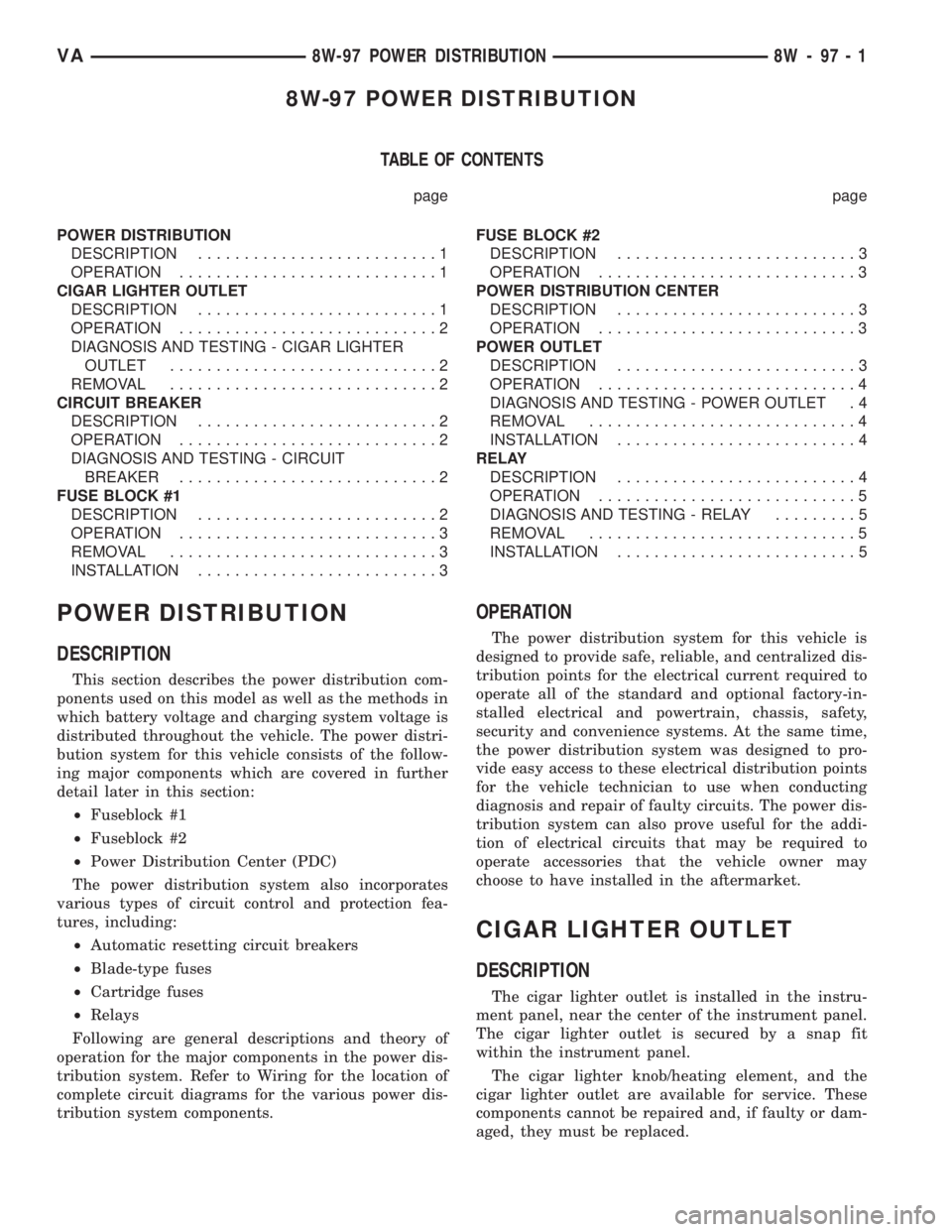
TABLE OF CONTENTS
page page
POWER DISTRIBUTION
DESCRIPTION..........................1
OPERATION............................1
CIGAR LIGHTER OUTLET
DESCRIPTION..........................1
OPERATION............................2
DIAGNOSIS AND TESTING - CIGAR LIGHTER
OUTLET.............................2
REMOVAL.............................2
CIRCUIT BREAKER
DESCRIPTION..........................2
OPERATION............................2
DIAGNOSIS AND TESTING - CIRCUIT
BREAKER............................2
FUSE BLOCK #1
DESCRIPTION..........................2
OPERATION............................3
REMOVAL.............................3
INSTALLATION..........................3FUSE BLOCK #2
DESCRIPTION..........................3
OPERATION............................3
POWER DISTRIBUTION CENTER
DESCRIPTION..........................3
OPERATION............................3
POWER OUTLET
DESCRIPTION..........................3
OPERATION............................4
DIAGNOSIS AND TESTING - POWER OUTLET . 4
REMOVAL.............................4
INSTALLATION..........................4
RELAY
DESCRIPTION..........................4
OPERATION............................5
DIAGNOSIS AND TESTING - RELAY.........5
REMOVAL.............................5
INSTALLATION..........................5
POWER DISTRIBUTION
DESCRIPTION
This section describes the power distribution com-
ponents used on this model as well as the methods in
which battery voltage and charging system voltage is
distributed throughout the vehicle. The power distri-
bution system for this vehicle consists of the follow-
ing major components which are covered in further
detail later in this section:
²Fuseblock #1
²Fuseblock #2
²Power Distribution Center (PDC)
The power distribution system also incorporates
various types of circuit control and protection fea-
tures, including:
²Automatic resetting circuit breakers
²Blade-type fuses
²Cartridge fuses
²Relays
Following are general descriptions and theory of
operation for the major components in the power dis-
tribution system. Refer to Wiring for the location of
complete circuit diagrams for the various power dis-
tribution system components.
OPERATION
The power distribution system for this vehicle is
designed to provide safe, reliable, and centralized dis-
tribution points for the electrical current required to
operate all of the standard and optional factory-in-
stalled electrical and powertrain, chassis, safety,
security and convenience systems. At the same time,
the power distribution system was designed to pro-
vide easy access to these electrical distribution points
for the vehicle technician to use when conducting
diagnosis and repair of faulty circuits. The power dis-
tribution system can also prove useful for the addi-
tion of electrical circuits that may be required to
operate accessories that the vehicle owner may
choose to have installed in the aftermarket.
CIGAR LIGHTER OUTLET
DESCRIPTION
The cigar lighter outlet is installed in the instru-
ment panel, near the center of the instrument panel.
The cigar lighter outlet is secured by a snap fit
within the instrument panel.
The cigar lighter knob/heating element, and the
cigar lighter outlet are available for service. These
components cannot be repaired and, if faulty or dam-
aged, they must be replaced.
VA8W-97 POWER DISTRIBUTION 8W - 97 - 1
Page 1572 of 2305
OPERATION
All of the circuits entering and leaving the fuse
block do so through the instrument panel wire har-
ness. Internal connection of all of the fuse block cir-
cuits is accomplished by an intricate combination of
hard wiring and bus bars. Internal relays and micro
processors allow the vehicle electronics to control
some of the power distribution circuits throughout
the vehicle. Refer to the Wiring section for complete
circuit diagrams.
REMOVAL
(1) Disconnect and isolate the negative battery
cable.
(2) Remove fuse block cover by rotating locking
screw 90É.
(3) Remove the steering column cover. Refer to the
Body section for the procedure.
(4) Unscrew fuse block connections and disconnect
all electrical connectors from the fuse block.
(5) Remove the fuse block from the steering col-
umn.
INSTALLATION
(1) Position the fuse block in the steering column.
(2) Install fuse block connections and connect all
electrical connectors on the fuse block.
(3) Install the steering column cover. Refer to the
Body section for the procedure.
(4) Install fuse block cover by rotating locking
screw 90É.
(5) Connect the negative battery cable.
(6) Set time and radio stations.
FUSE BLOCK #2
DESCRIPTION
An electrical fuse block is concealed under the
driver side front seat. The fuse block serves to dis-
tribute electrical current to many of the electrical
systems in the vehicle. The fuse block houses blade-
type mini fuses, blade-type automatic resetting cir-
cuit breakers and International Standards
Organization relays. Additional provisions are avail-
able in the fuse block for additional fuses and ISO
relays.
The molded plastic fuse block housing has an inte-
gral mounting bracket that is secured with screws to
the seat base. The driver side seat base also has a
snap-fit fuse access panel that can be removed for
service of the fuses and the relays. A finger recess is
molded into one end for easy removal. A fuse layout
map is molded onto the back side of the panel to
ensure proper fuse identification.
The fuse block is integral to the body wire harness.
If any internal circuit or the fuse block housing isfaulty or damaged, the entire fuse block and body
wire harness unit must be replaced.
OPERATION
All of the circuits entering and leaving the fuse
block do so through the body wire harness. Internal
connection of all of the fuse block circuits is accom-
plished by an intricate combination of hard wiring
and bus bars.
POWER DISTRIBUTION CEN-
TER
DESCRIPTION
All of the electrical current distributed throughout
this vehicle is directed through the Power Distribu-
tion Center (PDC). The molded plastic PDC housing
is located in the left front corner of the engine com-
partment, on the battery positive cable. The PDC
housing has a molded plastic cover that slides over
the PDC housing. The PDC cover is easily opened or
removed for service access.
The PDC unit cannot be repaired and is only ser-
viced as a unit with the headlamp and dash wire
harness. If the internal circuits or the PDC housing
are faulty or damaged, the headlamp and dash wire
harness unit must be replaced.
OPERATION
All of the current from the battery and the gener-
ator output enters the PDC through the positive bat-
tery cable. The PDC cover is removed to access the
battery and generator output connection B(+) termi-
nal studs. Internal connection of all of the PDC cir-
cuits is accomplished by an intricate combination of
hard wiring and bus bars. Refer to Wiring Diagrams
for the location of complete PDC circuit diagrams.
POWER OUTLET
DESCRIPTION
The power outlet is installed in the instrument
panel accessory switch plate, which is located near
the center of the instrument panel. The power outlet
base is secured by a snap fit within the instrument
panel. A plastic protective cap snaps over the power
outlet base when the power outlet is not being used.
While the power outlet is very similar to a cigar
lighter base unit, it does not include the two small
spring-clip retainers inside the bottom of the recepta-
cle shell that are used to secure the cigar lighter
heating element to the insulated contact.
The power outlet receptacle unit are available for
service. The power outlet receptacle cannot be
VA8W-97 POWER DISTRIBUTION 8W - 97 - 3
Page 1573 of 2305
repaired and, if faulty or damaged, it must be
replaced.
OPERATION
The power outlet base or receptacle shell is con-
nected to ground, and an insulated contact in the
bottom of the shell is connected to battery current.
The power outlet receives battery voltage from a fuse
in the fuse block at all times.
DIAGNOSIS AND TESTING - POWER OUTLET
(1) Check for battery voltage at the fused B(+) fuse
in the fuse block. If OK, go to Step 2. If not OK,
repair the open fused B(+) circuit to the battery as
required.
(2) Check for continuity between the inside cir-
cumference of the power outlet receptacle and a good
ground. There should be continuity. If OK, go to Step
3. If not OK, go to Step 4.
(3) Check for battery voltage at the insulated con-
tact located at the back of the power outlet recepta-
cle. If not OK, go to Step 4.
(4) Disconnect and isolate the battery negative
cable. Check for continuity between the ground cir-
cuit cavity of the power outlet wire harness connector
and a good ground. There should be continuity. If
OK, go to Step 5. If not OK, repair the open ground
circuit to ground as required.
(5) Connect the battery negative cable. Check for
battery voltage at the fused B(+) circuit cavity of the
power outlet wire harness connector. If OK, replace
the faulty power outlet receptacle. If not OK, repair
the open fused B(+) circuit to the fuse in the fuse
block as required.
REMOVAL
(1) Disconnect and isolate the battery negative
cable.
(2) Pull the cigar lighter knob and element out of
the cigar lighter receptacle base, or unsnap the pro-
tective cap from the power outlet receptacle base.
(3) Look inside the cigar lighter or power outlet
receptacle base and note the position of the rectangu-
lar retaining bosses of the mount that secures the
receptacle base to the instrument panel.
(4) Insert a pair of external snap ring pliers into
the cigar lighter or power outlet receptacle base and
engage the tips of the pliers with the retaining
bosses of the mount.
(5) Squeeze the pliers to disengage the mount
retaining bosses from the receptacle base and, using
a gentle rocking motion, pull the pliers and the
receptacle base out of the mount.
(6) Disconnect the instrument panel wire harness
connector from the connector receptacle of the cigar
lighter or the power outlet receptacle base.(7) Remove the cigar lighter or power outlet mount
from the instrument panel.
INSTALLATION
(1) Install the cigar lighter or power outlet mount
into the instrument panel.
(2) Reconnect the instrument panel wire harness
connector to the connector receptacle of the cigar
lighter or the power outlet receptacle base.
(3) Align the splines on the outside of the cigar
lighter or power outlet receptacle base connector
receptacle with the grooves on the inside of the
mount.
(4) Press firmly on the cigar lighter or power out-
let receptacle base until the retaining bosses of the
mount are fully engaged in their receptacles.
(5) Install the cigar lighter knob and element into
the cigar lighter receptacle base.
(6) Reconnect the battery negative cable.
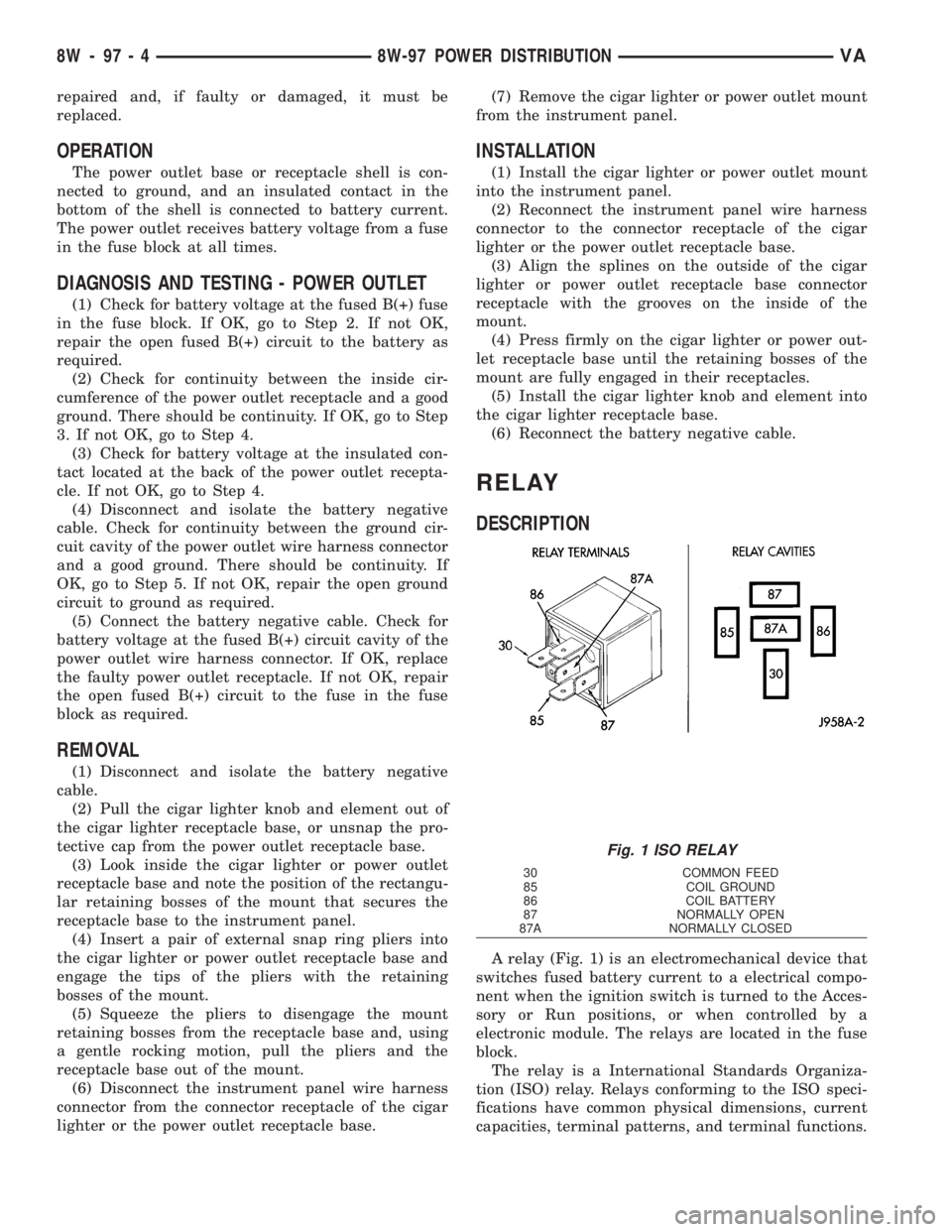
RELAY
DESCRIPTION
A relay (Fig. 1) is an electromechanical device that
switches fused battery current to a electrical compo-
nent when the ignition switch is turned to the Acces-
sory or Run positions, or when controlled by a
electronic module. The relays are located in the fuse
block.
The relay is a International Standards Organiza-
tion (ISO) relay. Relays conforming to the ISO speci-
fications have common physical dimensions, current
capacities, terminal patterns, and terminal functions.
Fig. 1 ISO RELAY
30 COMMON FEED
85 COIL GROUND
86 COIL BATTERY
87 NORMALLY OPEN
87A NORMALLY CLOSED
8W - 97 - 4 8W-97 POWER DISTRIBUTIONVA
Page 1882 of 2305
Engine starts must not be possible in any other gear
position.
(3) With floor shift lever handle push-button not
depressed and lever in:
(a) PARK position - Apply forward force on cen-
ter of handle and remove pressure. Engine starts
must be possible.
(b) PARK position - Apply rearward force on cen-
ter of handle and remove pressure. Engine starts
must be possible.
(c) NEUTRAL position - Normal position. Engine
starts must be possible.
(d) NEUTRAL position - Engine running and
brakes applied, apply forward force on center of
shift handle. Transmission shall not be able to shift
from NEUTRAL to REVERSE.
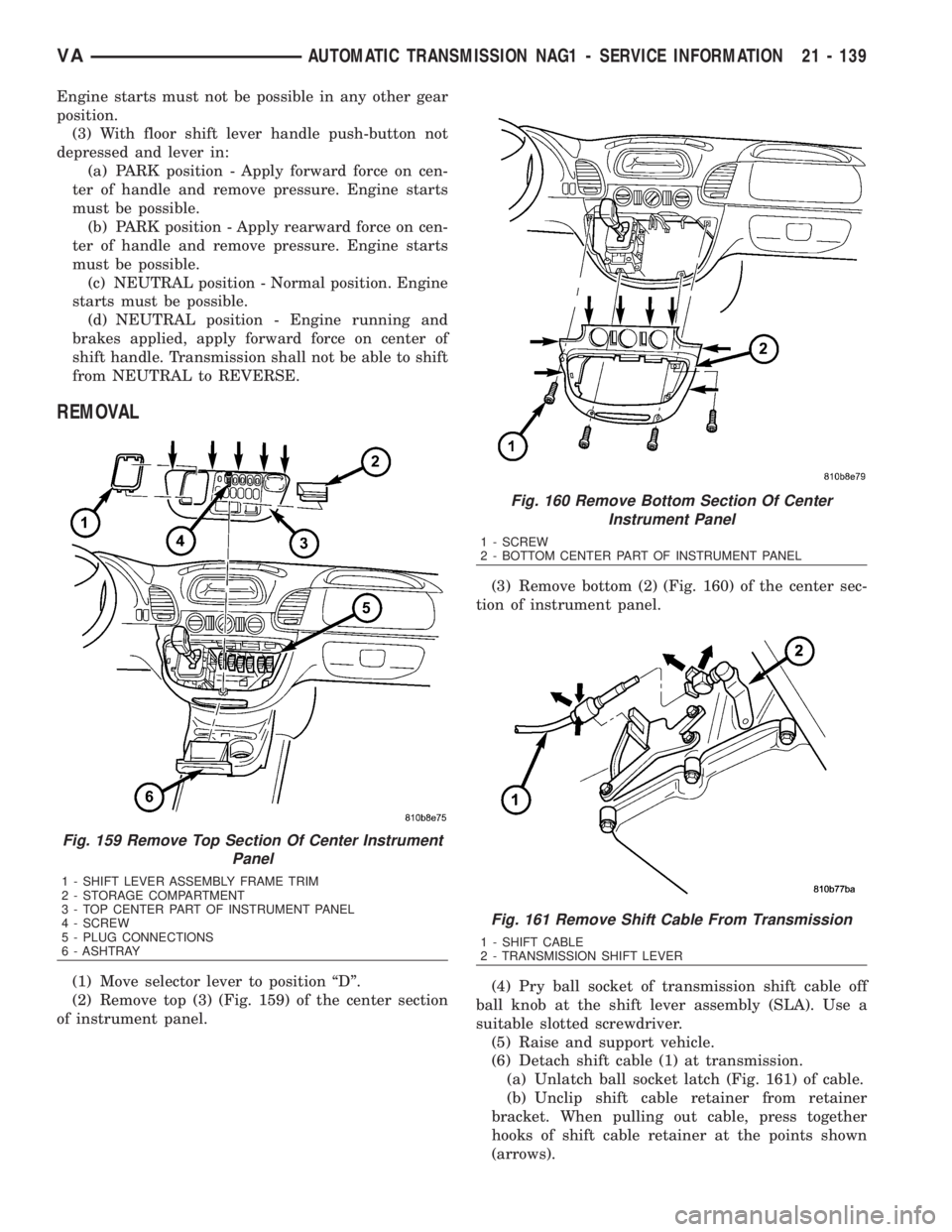
REMOVAL
(1) Move selector lever to position ªDº.
(2) Remove top (3) (Fig. 159) of the center section
of instrument panel.(3) Remove bottom (2) (Fig. 160) of the center sec-
tion of instrument panel.
(4) Pry ball socket of transmission shift cable off
ball knob at the shift lever assembly (SLA). Use a
suitable slotted screwdriver.
(5) Raise and support vehicle.
(6) Detach shift cable (1) at transmission.
(a) Unlatch ball socket latch (Fig. 161) of cable.
(b) Unclip shift cable retainer from retainer
bracket. When pulling out cable, press together
hooks of shift cable retainer at the points shown
(arrows).
Fig. 159 Remove Top Section Of Center Instrument
Panel
1 - SHIFT LEVER ASSEMBLY FRAME TRIM
2 - STORAGE COMPARTMENT
3 - TOP CENTER PART OF INSTRUMENT PANEL
4 - SCREW
5 - PLUG CONNECTIONS
6 - ASHTRAY
Fig. 160 Remove Bottom Section Of Center
Instrument Panel
1 - SCREW
2 - BOTTOM CENTER PART OF INSTRUMENT PANEL
Fig. 161 Remove Shift Cable From Transmission
1 - SHIFT CABLE
2 - TRANSMISSION SHIFT LEVER
VAAUTOMATIC TRANSMISSION NAG1 - SERVICE INFORMATION 21 - 139