radio MERCEDES-BENZ SPRINTER 2006 User Guide
[x] Cancel search | Manufacturer: MERCEDES-BENZ, Model Year: 2006, Model line: SPRINTER, Model: MERCEDES-BENZ SPRINTER 2006Pages: 2305, PDF Size: 48.12 MB
Page 350 of 2305
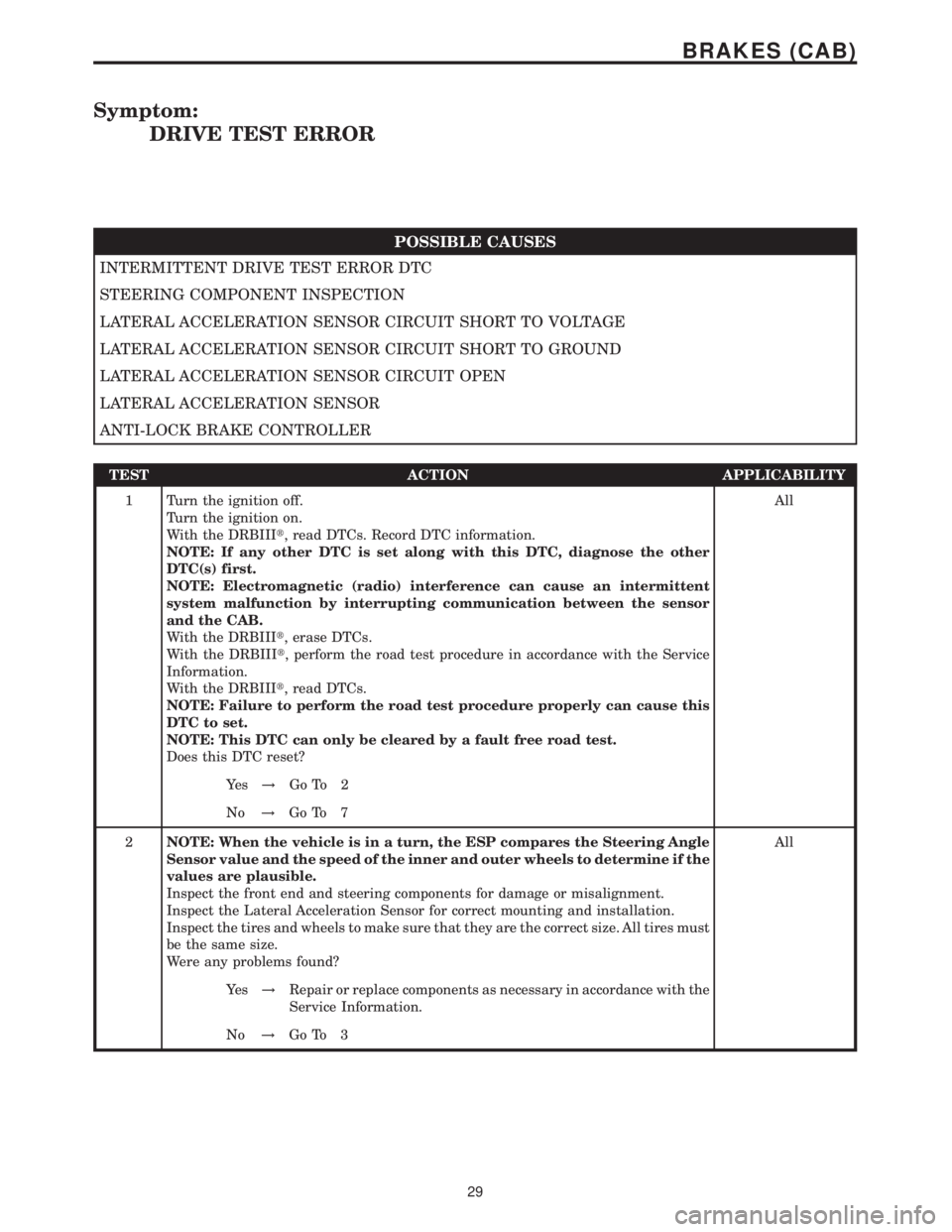
Symptom:
DRIVE TEST ERROR
POSSIBLE CAUSES
INTERMITTENT DRIVE TEST ERROR DTC
STEERING COMPONENT INSPECTION
LATERAL ACCELERATION SENSOR CIRCUIT SHORT TO VOLTAGE
LATERAL ACCELERATION SENSOR CIRCUIT SHORT TO GROUND
LATERAL ACCELERATION SENSOR CIRCUIT OPEN
LATERAL ACCELERATION SENSOR
ANTI-LOCK BRAKE CONTROLLER
TEST ACTION APPLICABILITY
1 Turn the ignition off.
Turn the ignition on.
With the DRBIIIt, read DTCs. Record DTC information.
NOTE: If any other DTC is set along with this DTC, diagnose the other
DTC(s) first.
NOTE: Electromagnetic (radio) interference can cause an intermittent
system malfunction by interrupting communication between the sensor
and the CAB.
With the DRBIIIt, erase DTCs.
With the DRBIIIt, perform the road test procedure in accordance with the Service
Information.
With the DRBIIIt, read DTCs.
NOTE: Failure to perform the road test procedure properly can cause this
DTC to set.
NOTE: This DTC can only be cleared by a fault free road test.
Does this DTC reset?All
Ye s!Go To 2
No!Go To 7
2NOTE: When the vehicle is in a turn, the ESP compares the Steering Angle
Sensor value and the speed of the inner and outer wheels to determine if the
values are plausible.
Inspect the front end and steering components for damage or misalignment.
Inspect the Lateral Acceleration Sensor for correct mounting and installation.
Inspect the tires and wheels to make sure that they are the correct size. All tires must
be the same size.
Were any problems found?All
Ye s!Repair or replace components as necessary in accordance with the
Service Information.
No!Go To 3
29
BRAKES (CAB)
Page 357 of 2305
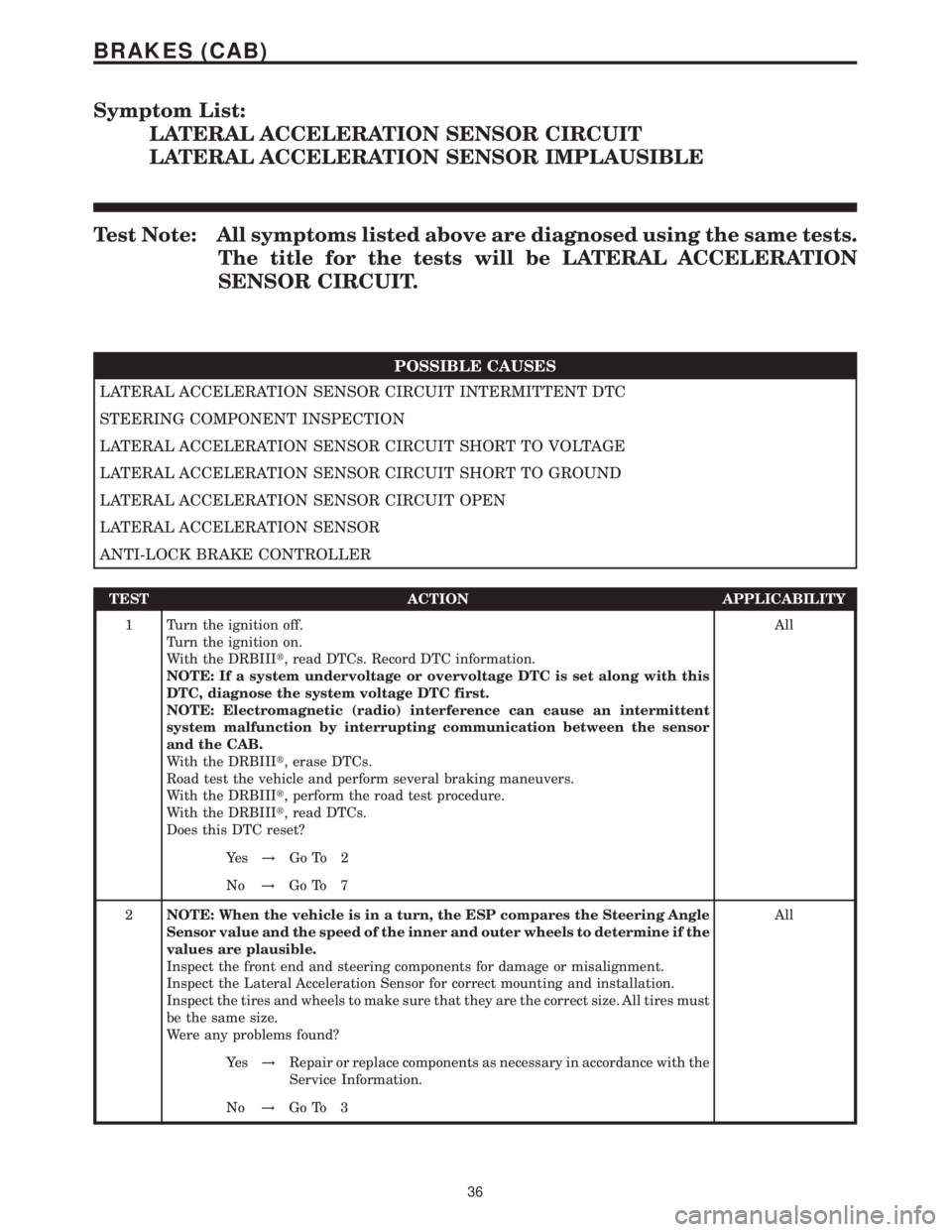
Symptom List:
LATERAL ACCELERATION SENSOR CIRCUIT
LATERAL ACCELERATION SENSOR IMPLAUSIBLE
Test Note: All symptoms listed above are diagnosed using the same tests.
The title for the tests will be LATERAL ACCELERATION
SENSOR CIRCUIT.
POSSIBLE CAUSES
LATERAL ACCELERATION SENSOR CIRCUIT INTERMITTENT DTC
STEERING COMPONENT INSPECTION
LATERAL ACCELERATION SENSOR CIRCUIT SHORT TO VOLTAGE
LATERAL ACCELERATION SENSOR CIRCUIT SHORT TO GROUND
LATERAL ACCELERATION SENSOR CIRCUIT OPEN
LATERAL ACCELERATION SENSOR
ANTI-LOCK BRAKE CONTROLLER
TEST ACTION APPLICABILITY
1 Turn the ignition off.
Turn the ignition on.
With the DRBIIIt, read DTCs. Record DTC information.
NOTE: If a system undervoltage or overvoltage DTC is set along with this
DTC, diagnose the system voltage DTC first.
NOTE: Electromagnetic (radio) interference can cause an intermittent
system malfunction by interrupting communication between the sensor
and the CAB.
With the DRBIIIt, erase DTCs.
Road test the vehicle and perform several braking maneuvers.
With the DRBIIIt, perform the road test procedure.
With the DRBIIIt, read DTCs.
Does this DTC reset?All
Ye s!Go To 2
No!Go To 7
2NOTE: When the vehicle is in a turn, the ESP compares the Steering Angle
Sensor value and the speed of the inner and outer wheels to determine if the
values are plausible.
Inspect the front end and steering components for damage or misalignment.
Inspect the Lateral Acceleration Sensor for correct mounting and installation.
Inspect the tires and wheels to make sure that they are the correct size. All tires must
be the same size.
Were any problems found?All
Ye s!Repair or replace components as necessary in accordance with the
Service Information.
No!Go To 3
36
BRAKES (CAB)
Page 360 of 2305
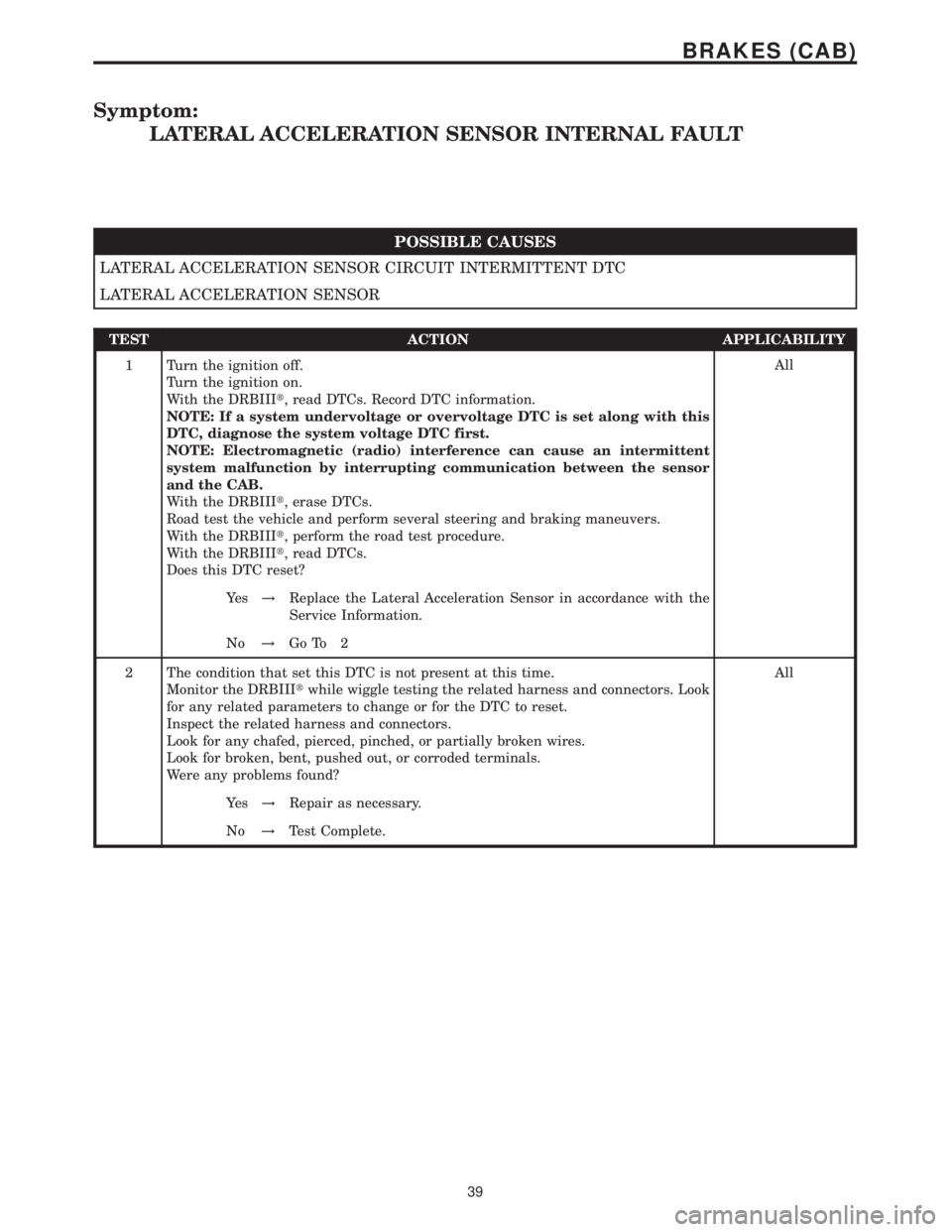
Symptom:
LATERAL ACCELERATION SENSOR INTERNAL FAULT
POSSIBLE CAUSES
LATERAL ACCELERATION SENSOR CIRCUIT INTERMITTENT DTC
LATERAL ACCELERATION SENSOR
TEST ACTION APPLICABILITY
1 Turn the ignition off.
Turn the ignition on.
With the DRBIIIt, read DTCs. Record DTC information.
NOTE: If a system undervoltage or overvoltage DTC is set along with this
DTC, diagnose the system voltage DTC first.
NOTE: Electromagnetic (radio) interference can cause an intermittent
system malfunction by interrupting communication between the sensor
and the CAB.
With the DRBIIIt, erase DTCs.
Road test the vehicle and perform several steering and braking maneuvers.
With the DRBIIIt, perform the road test procedure.
With the DRBIIIt, read DTCs.
Does this DTC reset?All
Ye s!Replace the Lateral Acceleration Sensor in accordance with the
Service Information.
No!Go To 2
2 The condition that set this DTC is not present at this time.
Monitor the DRBIIItwhile wiggle testing the related harness and connectors. Look
for any related parameters to change or for the DTC to reset.
Inspect the related harness and connectors.
Look for any chafed, pierced, pinched, or partially broken wires.
Look for broken, bent, pushed out, or corroded terminals.
Were any problems found?All
Ye s!Repair as necessary.
No!Test Complete.
39
BRAKES (CAB)
Page 387 of 2305
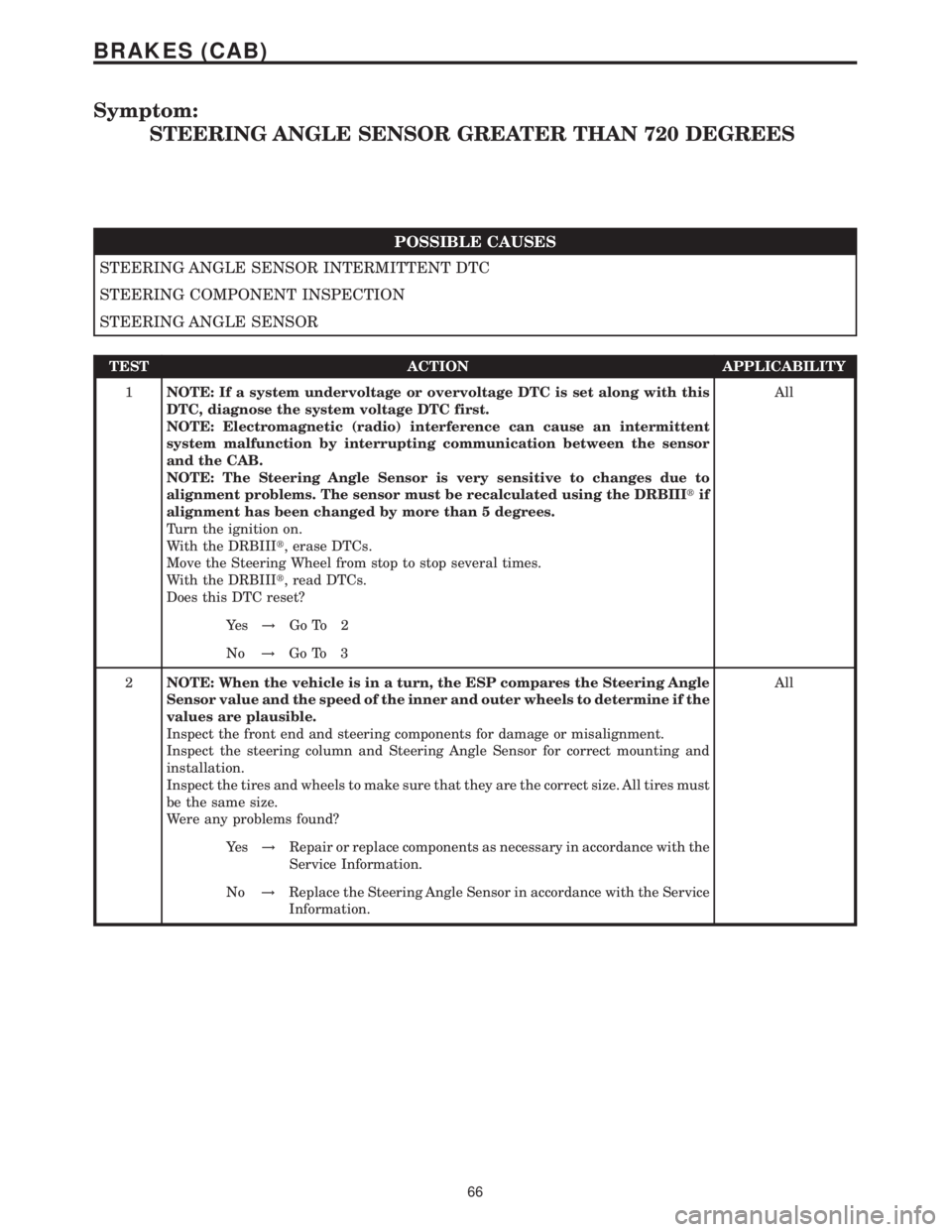
Symptom:
STEERING ANGLE SENSOR GREATER THAN 720 DEGREES
POSSIBLE CAUSES
STEERING ANGLE SENSOR INTERMITTENT DTC
STEERING COMPONENT INSPECTION
STEERING ANGLE SENSOR
TEST ACTION APPLICABILITY
1NOTE: If a system undervoltage or overvoltage DTC is set along with this
DTC, diagnose the system voltage DTC first.
NOTE: Electromagnetic (radio) interference can cause an intermittent
system malfunction by interrupting communication between the sensor
and the CAB.
NOTE: The Steering Angle Sensor is very sensitive to changes due to
alignment problems. The sensor must be recalculated using the DRBIIItif
alignment has been changed by more than 5 degrees.
Turn the ignition on.
With the DRBIIIt, erase DTCs.
Move the Steering Wheel from stop to stop several times.
With the DRBIIIt, read DTCs.
Does this DTC reset?All
Ye s!Go To 2
No!Go To 3
2NOTE: When the vehicle is in a turn, the ESP compares the Steering Angle
Sensor value and the speed of the inner and outer wheels to determine if the
values are plausible.
Inspect the front end and steering components for damage or misalignment.
Inspect the steering column and Steering Angle Sensor for correct mounting and
installation.
Inspect the tires and wheels to make sure that they are the correct size. All tires must
be the same size.
Were any problems found?All
Ye s!Repair or replace components as necessary in accordance with the
Service Information.
No!Replace the Steering Angle Sensor in accordance with the Service
Information.
66
BRAKES (CAB)
Page 389 of 2305
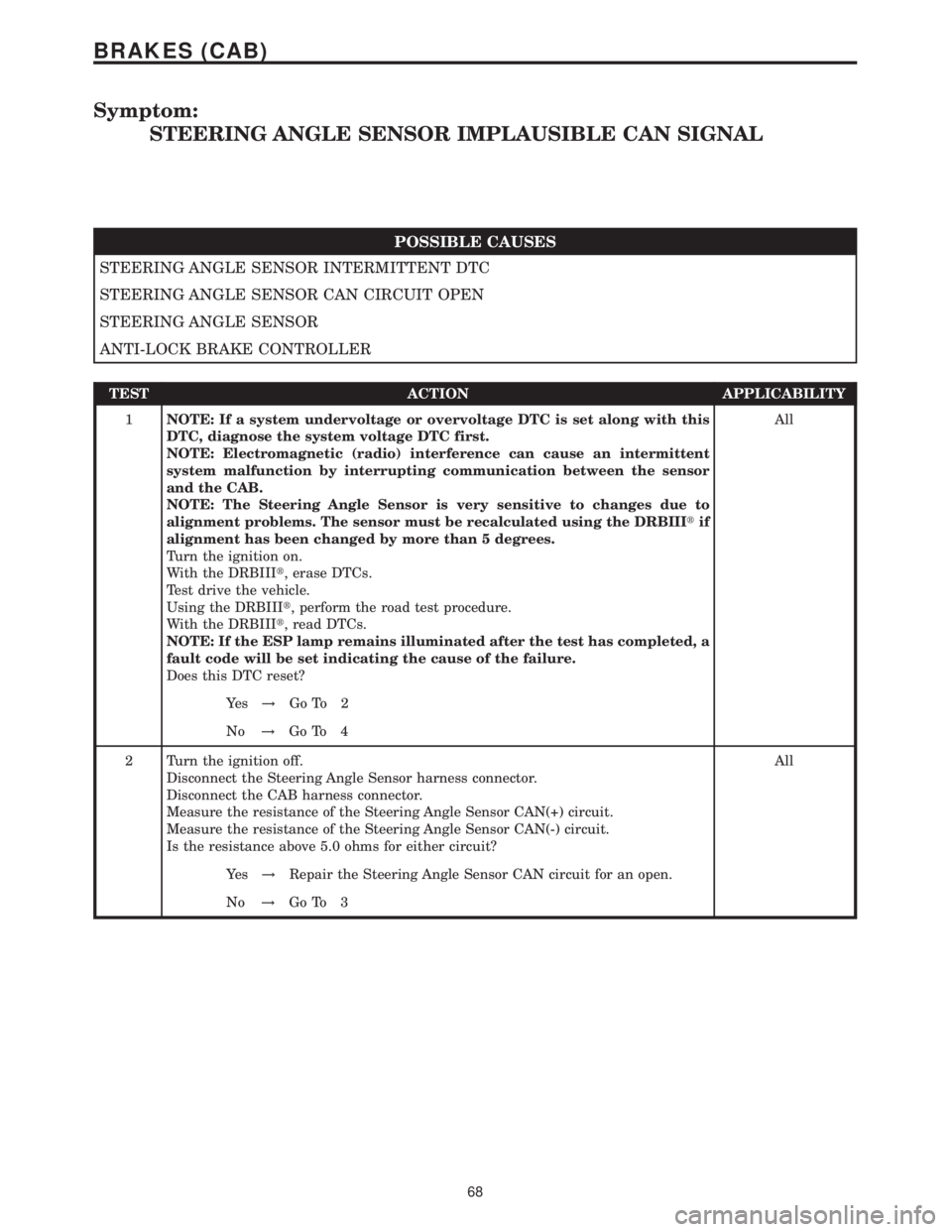
Symptom:
STEERING ANGLE SENSOR IMPLAUSIBLE CAN SIGNAL
POSSIBLE CAUSES
STEERING ANGLE SENSOR INTERMITTENT DTC
STEERING ANGLE SENSOR CAN CIRCUIT OPEN
STEERING ANGLE SENSOR
ANTI-LOCK BRAKE CONTROLLER
TEST ACTION APPLICABILITY
1NOTE: If a system undervoltage or overvoltage DTC is set along with this
DTC, diagnose the system voltage DTC first.
NOTE: Electromagnetic (radio) interference can cause an intermittent
system malfunction by interrupting communication between the sensor
and the CAB.
NOTE: The Steering Angle Sensor is very sensitive to changes due to
alignment problems. The sensor must be recalculated using the DRBIIItif
alignment has been changed by more than 5 degrees.
Turn the ignition on.
With the DRBIIIt, erase DTCs.
Test drive the vehicle.
Using the DRBIIIt, perform the road test procedure.
With the DRBIIIt, read DTCs.
NOTE: If the ESP lamp remains illuminated after the test has completed, a
fault code will be set indicating the cause of the failure.
Does this DTC reset?All
Ye s!Go To 2
No!Go To 4
2 Turn the ignition off.
Disconnect the Steering Angle Sensor harness connector.
Disconnect the CAB harness connector.
Measure the resistance of the Steering Angle Sensor CAN(+) circuit.
Measure the resistance of the Steering Angle Sensor CAN(-) circuit.
Is the resistance above 5.0 ohms for either circuit?All
Ye s!Repair the Steering Angle Sensor CAN circuit for an open.
No!Go To 3
68
BRAKES (CAB)
Page 391 of 2305
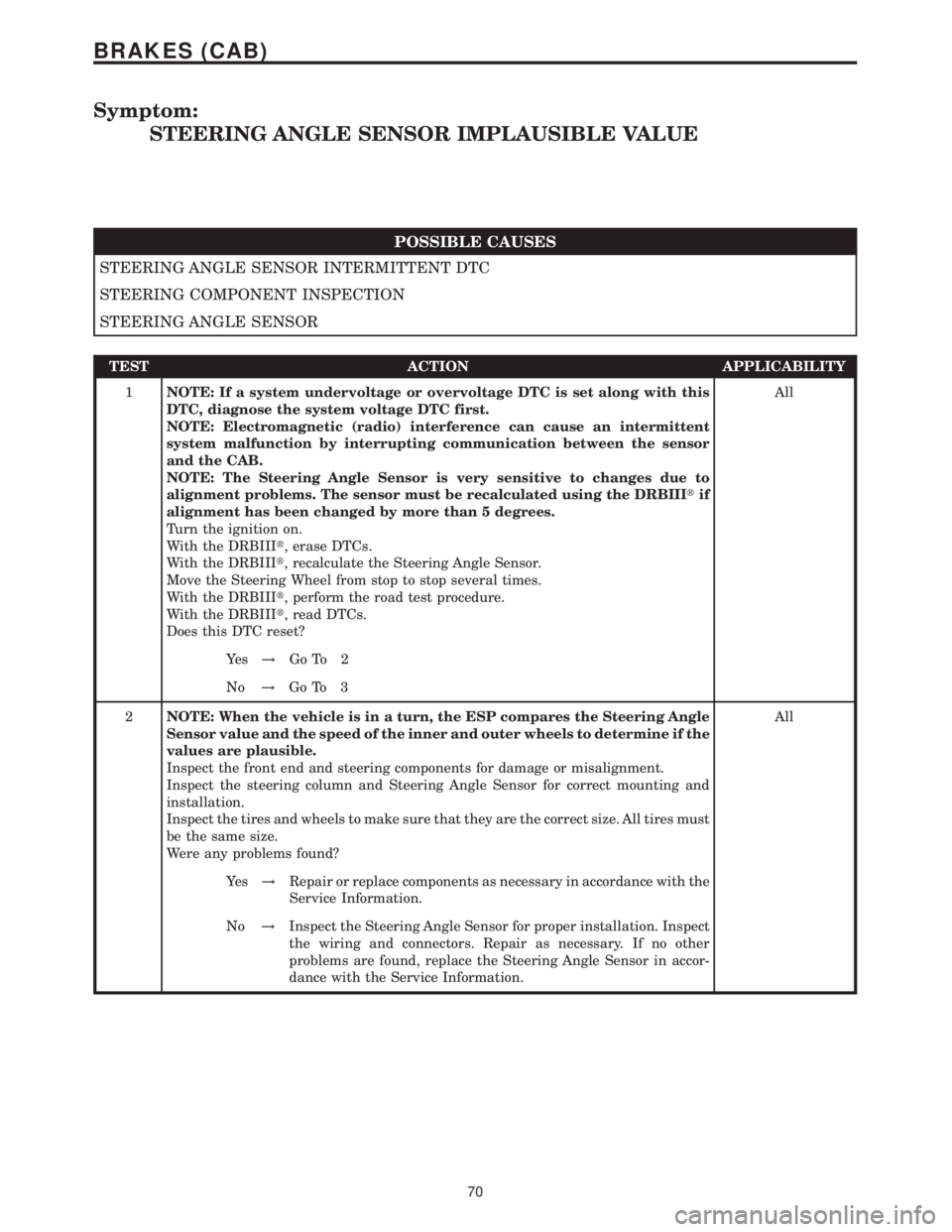
Symptom:
STEERING ANGLE SENSOR IMPLAUSIBLE VALUE
POSSIBLE CAUSES
STEERING ANGLE SENSOR INTERMITTENT DTC
STEERING COMPONENT INSPECTION
STEERING ANGLE SENSOR
TEST ACTION APPLICABILITY
1NOTE: If a system undervoltage or overvoltage DTC is set along with this
DTC, diagnose the system voltage DTC first.
NOTE: Electromagnetic (radio) interference can cause an intermittent
system malfunction by interrupting communication between the sensor
and the CAB.
NOTE: The Steering Angle Sensor is very sensitive to changes due to
alignment problems. The sensor must be recalculated using the DRBIIItif
alignment has been changed by more than 5 degrees.
Turn the ignition on.
With the DRBIIIt, erase DTCs.
With the DRBIIIt, recalculate the Steering Angle Sensor.
Move the Steering Wheel from stop to stop several times.
With the DRBIIIt, perform the road test procedure.
With the DRBIIIt, read DTCs.
Does this DTC reset?All
Ye s!Go To 2
No!Go To 3
2NOTE: When the vehicle is in a turn, the ESP compares the Steering Angle
Sensor value and the speed of the inner and outer wheels to determine if the
values are plausible.
Inspect the front end and steering components for damage or misalignment.
Inspect the steering column and Steering Angle Sensor for correct mounting and
installation.
Inspect the tires and wheels to make sure that they are the correct size. All tires must
be the same size.
Were any problems found?All
Ye s!Repair or replace components as necessary in accordance with the
Service Information.
No!Inspect the Steering Angle Sensor for proper installation. Inspect
the wiring and connectors. Repair as necessary. If no other
problems are found, replace the Steering Angle Sensor in accor-
dance with the Service Information.
70
BRAKES (CAB)
Page 393 of 2305
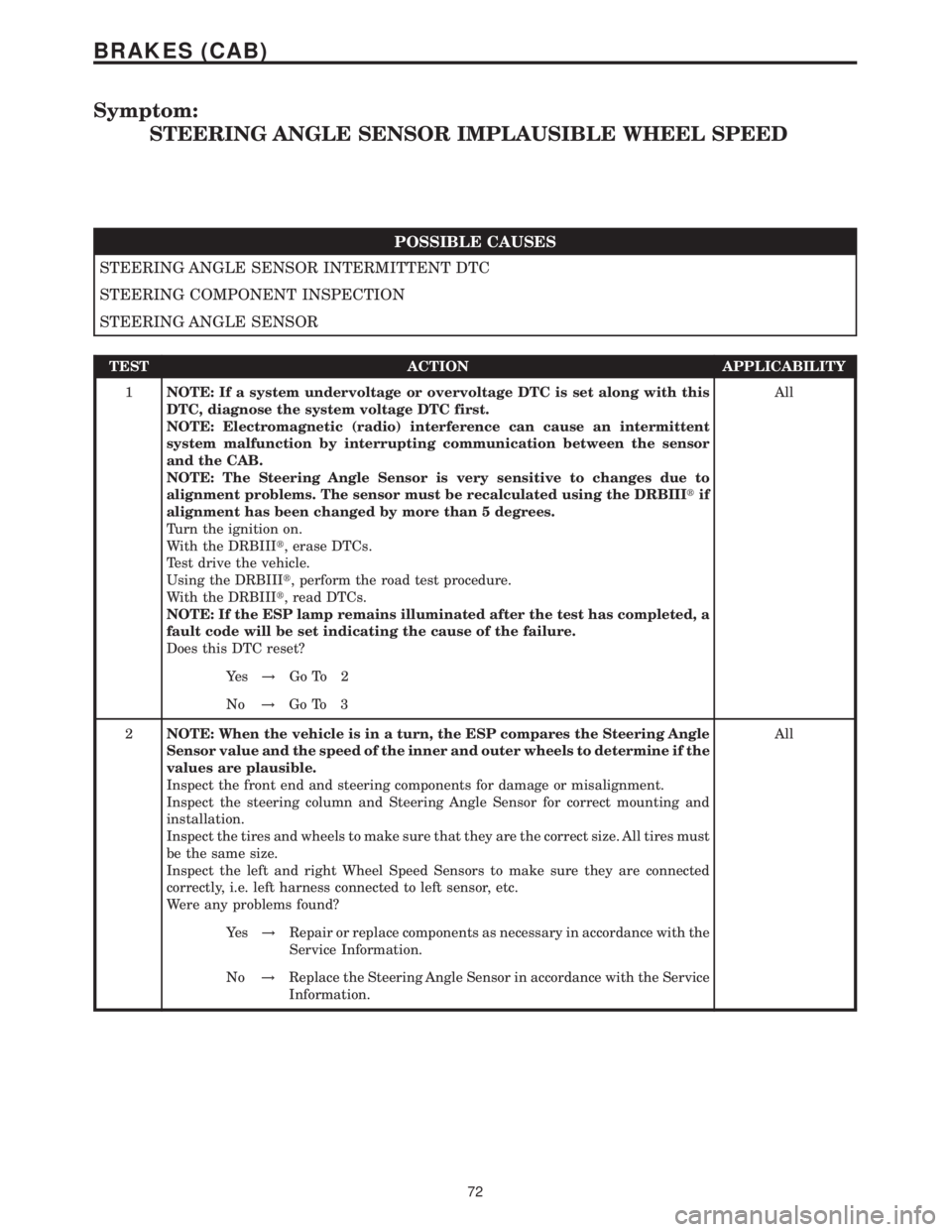
Symptom:
STEERING ANGLE SENSOR IMPLAUSIBLE WHEEL SPEED
POSSIBLE CAUSES
STEERING ANGLE SENSOR INTERMITTENT DTC
STEERING COMPONENT INSPECTION
STEERING ANGLE SENSOR
TEST ACTION APPLICABILITY
1NOTE: If a system undervoltage or overvoltage DTC is set along with this
DTC, diagnose the system voltage DTC first.
NOTE: Electromagnetic (radio) interference can cause an intermittent
system malfunction by interrupting communication between the sensor
and the CAB.
NOTE: The Steering Angle Sensor is very sensitive to changes due to
alignment problems. The sensor must be recalculated using the DRBIIItif
alignment has been changed by more than 5 degrees.
Turn the ignition on.
With the DRBIIIt, erase DTCs.
Test drive the vehicle.
Using the DRBIIIt, perform the road test procedure.
With the DRBIIIt, read DTCs.
NOTE: If the ESP lamp remains illuminated after the test has completed, a
fault code will be set indicating the cause of the failure.
Does this DTC reset?All
Ye s!Go To 2
No!Go To 3
2NOTE: When the vehicle is in a turn, the ESP compares the Steering Angle
Sensor value and the speed of the inner and outer wheels to determine if the
values are plausible.
Inspect the front end and steering components for damage or misalignment.
Inspect the steering column and Steering Angle Sensor for correct mounting and
installation.
Inspect the tires and wheels to make sure that they are the correct size. All tires must
be the same size.
Inspect the left and right Wheel Speed Sensors to make sure they are connected
correctly, i.e. left harness connected to left sensor, etc.
Were any problems found?All
Ye s!Repair or replace components as necessary in accordance with the
Service Information.
No!Replace the Steering Angle Sensor in accordance with the Service
Information.
72
BRAKES (CAB)
Page 395 of 2305
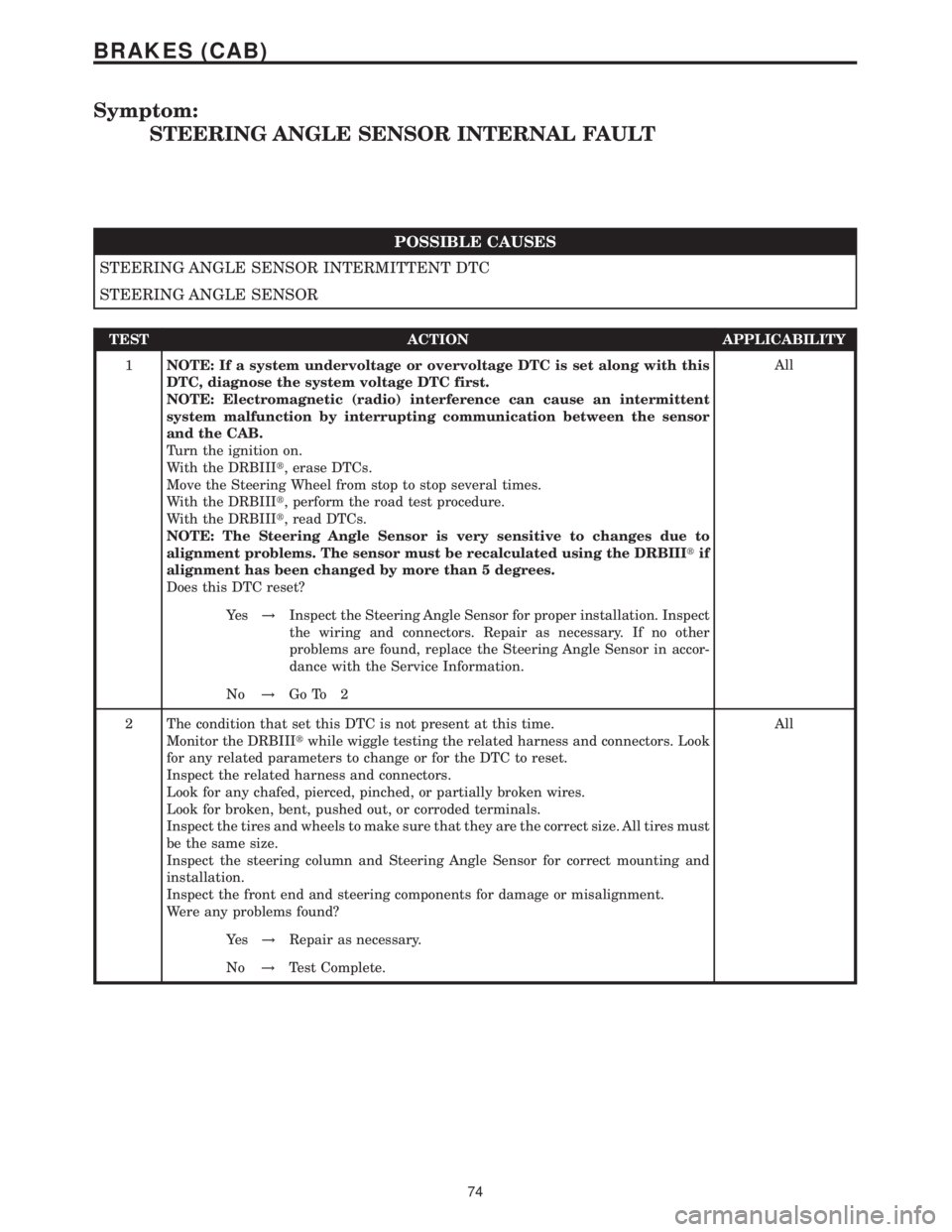
Symptom:
STEERING ANGLE SENSOR INTERNAL FAULT
POSSIBLE CAUSES
STEERING ANGLE SENSOR INTERMITTENT DTC
STEERING ANGLE SENSOR
TEST ACTION APPLICABILITY
1NOTE: If a system undervoltage or overvoltage DTC is set along with this
DTC, diagnose the system voltage DTC first.
NOTE: Electromagnetic (radio) interference can cause an intermittent
system malfunction by interrupting communication between the sensor
and the CAB.
Turn the ignition on.
With the DRBIIIt, erase DTCs.
Move the Steering Wheel from stop to stop several times.
With the DRBIIIt, perform the road test procedure.
With the DRBIIIt, read DTCs.
NOTE: The Steering Angle Sensor is very sensitive to changes due to
alignment problems. The sensor must be recalculated using the DRBIIItif
alignment has been changed by more than 5 degrees.
Does this DTC reset?All
Ye s!Inspect the Steering Angle Sensor for proper installation. Inspect
the wiring and connectors. Repair as necessary. If no other
problems are found, replace the Steering Angle Sensor in accor-
dance with the Service Information.
No!Go To 2
2 The condition that set this DTC is not present at this time.
Monitor the DRBIIItwhile wiggle testing the related harness and connectors. Look
for any related parameters to change or for the DTC to reset.
Inspect the related harness and connectors.
Look for any chafed, pierced, pinched, or partially broken wires.
Look for broken, bent, pushed out, or corroded terminals.
Inspect the tires and wheels to make sure that they are the correct size. All tires must
be the same size.
Inspect the steering column and Steering Angle Sensor for correct mounting and
installation.
Inspect the front end and steering components for damage or misalignment.
Were any problems found?All
Ye s!Repair as necessary.
No!Test Complete.
74
BRAKES (CAB)
Page 426 of 2305
3.2.6 SKREEM OPERATION
When ignition power is supplied to the SKREEM,
the SKREEM performs an internal self-test. After
the self-test is complete, the SKREEM energizes
the antenna (this activates the transponder chip)
and sends a challenge to the transponder chip. The
transponder chip responds to the challenge by gen-
erating an encrypted response message.
After responding to the coded message, the tran-
sponder sends a transponder ID message to the
SKREEM. The SKREEM compares the transpon-
der ID message to the available valid key codes in
SKREEM memory (8 key maximum at any one
time). After validating the ignition key the
SKREEM sends a CAN Bus message request to the
ECM, then waits for the ECM response. If the ECM
does not respond, the SKREEM will send the re-
quest again. If the ECM does not respond again, the
SKREEM will stop sending the request and store a
trouble code in memory. If the ECM sends a correct
response to the SKREEM, the SKREEM sends a
valid/invalid key message to the ECM. The ECM
will allow or disallow engine operation based on this
message.
Secret Key - an electronically stored value (iden-
tification number) that is unique to each SKREEM.
The secret key is stored in the SKREEM, ECM and
all ignition key transponders.
Challenge - a random number that is generated by
the SKREEM at each ignition key cycle.
The secret key and challenge are the two vari-
ables used in the algorithm that produces the
encrypted response message. The transponder uses
the crypto algorithm to receive, decode and respond
to the message sent by the SKREEM. After re-
sponding to the coded message, the transponder
sends a transponder ID message to the SKREEM.
3.3 DIAGNOSTIC TROUBLE CODES
Each diagnostic trouble code (DTC) is diagnosed
by following a specific procedure. The diagnostic
test procedure contains step-by-step instruction for
determining the cause of the DTC as well as no
trouble code problems. It is not necessary to per-
form all of the tests in this book to diagnose an
individual code.
Always begin diagnosis by reading the DTCs
using the DRBIIIt. This will direct you to the
specific test(s) that must be performed.
3.3.1 HARD CODE
A DTC that comes back within one cycle of the
ignition key is a hard code. This means that the
problem is current every time the ECM/SKREEM
checks that circuit or function. Procedures in this
manual verify if the DTC is a hard code at thebeginning of each test. When the fault is not a hard
code, an intermittent test must be performed.
NOTE: If the DRBIIITdisplays faults for
multiple components (i.e. ECT, MAF, IAT
sensors) identify and check the shared
circuits for possible problems before
continuing (i.e. sensor grounds or 5-volt
supply circuits). Refer to the appropriate
schematic to identify shared circuits.
3.3.2 INTERMITTENT CODE
A DTC that is not current every time the ECM/
SKREEM checks the circuit or function is an inter-
mittent code. Most intermittent DTCs are caused
by wiring or connector problems. Problems that
come and go like this are the most difficult to
diagnose; they must be looked for under specific
conditions that cause them. The following checks
may assist you in identifying a possible intermit-
tent problem.
± Visually inspect the related wire harness con-
nectors. Look for broken, bent, pushed out or
corroded terminals.
± Visually inspect the related wire harness.
Look for chafed, pierced or partially broken
wire.
± Refer to hotlines or technical service bulletins
that may apply.
NOTE: Electromagnetic (radio) interference
can cause an intermittent system
malfunction. This interference can interrupt
communication between the ignition key
transponder and the SKREEM.
3.3.3 ECM DIAGNOSTIC TROUBLE CODES
IMPORTANT NOTE: Before replacing the
ECM for a failed driver, control circuit or
ground circuit, be sure to check the related
component/circuit integrity for failures not
detected due to a double fault in the circuit.
Most ECM driver/control circuit failures are
caused by internal failures to components
(i.e. relays and solenoids) and shorted
circuits (i.e. sensor pull-ups, drivers and
ground circuits). These faults are difficult to
detect when a double fault has occurred and
only one DTC has set.
If the DRBIIItdisplays faults for multiple com-
ponents (i.e. MAF, ECT, ENG OIL, etc.), identify
and check the shared circuits for possible problems
before continuing (i.e. sensor grounds or 5-volt
3
GENERAL INFORMATION
Page 681 of 2305
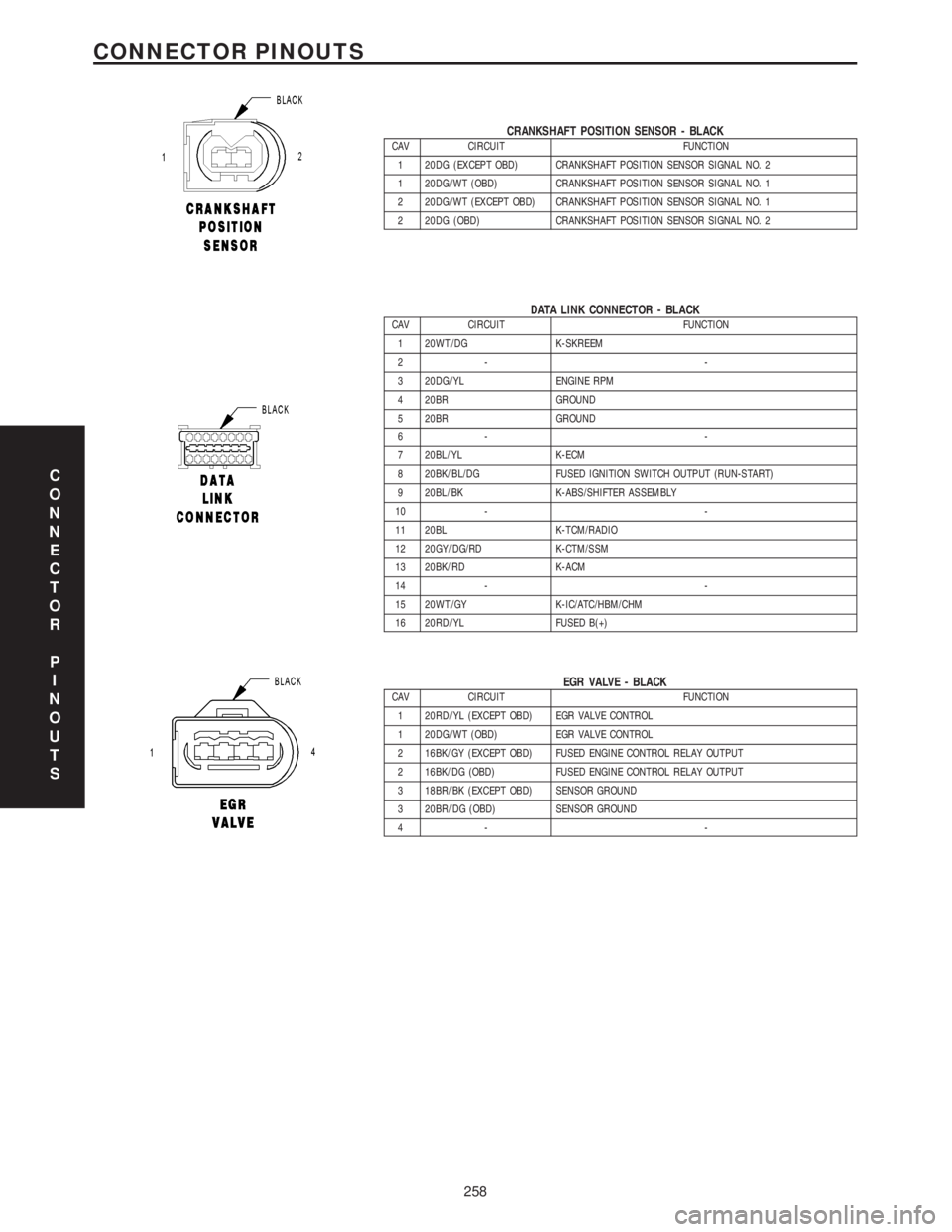
CRANKSHAFT POSITION SENSOR - BLACKCAV CIRCUIT FUNCTION
1 20DG (EXCEPT OBD) CRANKSHAFT POSITION SENSOR SIGNAL NO. 2
1 20DG/WT (OBD) CRANKSHAFT POSITION SENSOR SIGNAL NO. 1
2 20DG/WT (EXCEPT OBD) CRANKSHAFT POSITION SENSOR SIGNAL NO. 1
2 20DG (OBD) CRANKSHAFT POSITION SENSOR SIGNAL NO. 2
DATA LINK CONNECTOR - BLACKCAV CIRCUIT FUNCTION
1 20WT/DG K-SKREEM
2- -
3 20DG/YL ENGINE RPM
4 20BR GROUND
5 20BR GROUND
6- -
7 20BL/YL K-ECM
8 20BK/BL/DG FUSED IGNITION SWITCH OUTPUT (RUN-START)
9 20BL/BK K-ABS/SHIFTER ASSEMBLY
10 - -
11 20BL K-TCM/RADIO
12 20GY/DG/RD K-CTM/SSM
13 20BK/RD K-ACM
14 - -
15 20WT/GY K-IC/ATC/HBM/CHM
16 20RD/YL FUSED B(+)
EGR VALVE - BLACKCAV CIRCUIT FUNCTION
1 20RD/YL (EXCEPT OBD) EGR VALVE CONTROL
1 20DG/WT (OBD) EGR VALVE CONTROL
2 16BK/GY (EXCEPT OBD) FUSED ENGINE CONTROL RELAY OUTPUT
2 16BK/DG (OBD) FUSED ENGINE CONTROL RELAY OUTPUT
3 18BR/BK (EXCEPT OBD) SENSOR GROUND
3 20BR/DG (OBD) SENSOR GROUND
4- -
C
O
N
N
E
C
T
O
R
P
I
N
O
U
T
S
258
CONNECTOR PINOUTS