starter MERCEDES-BENZ SPRINTER 2006 User Guide
[x] Cancel search | Manufacturer: MERCEDES-BENZ, Model Year: 2006, Model line: SPRINTER, Model: MERCEDES-BENZ SPRINTER 2006Pages: 2305, PDF Size: 48.12 MB
Page 637 of 2305
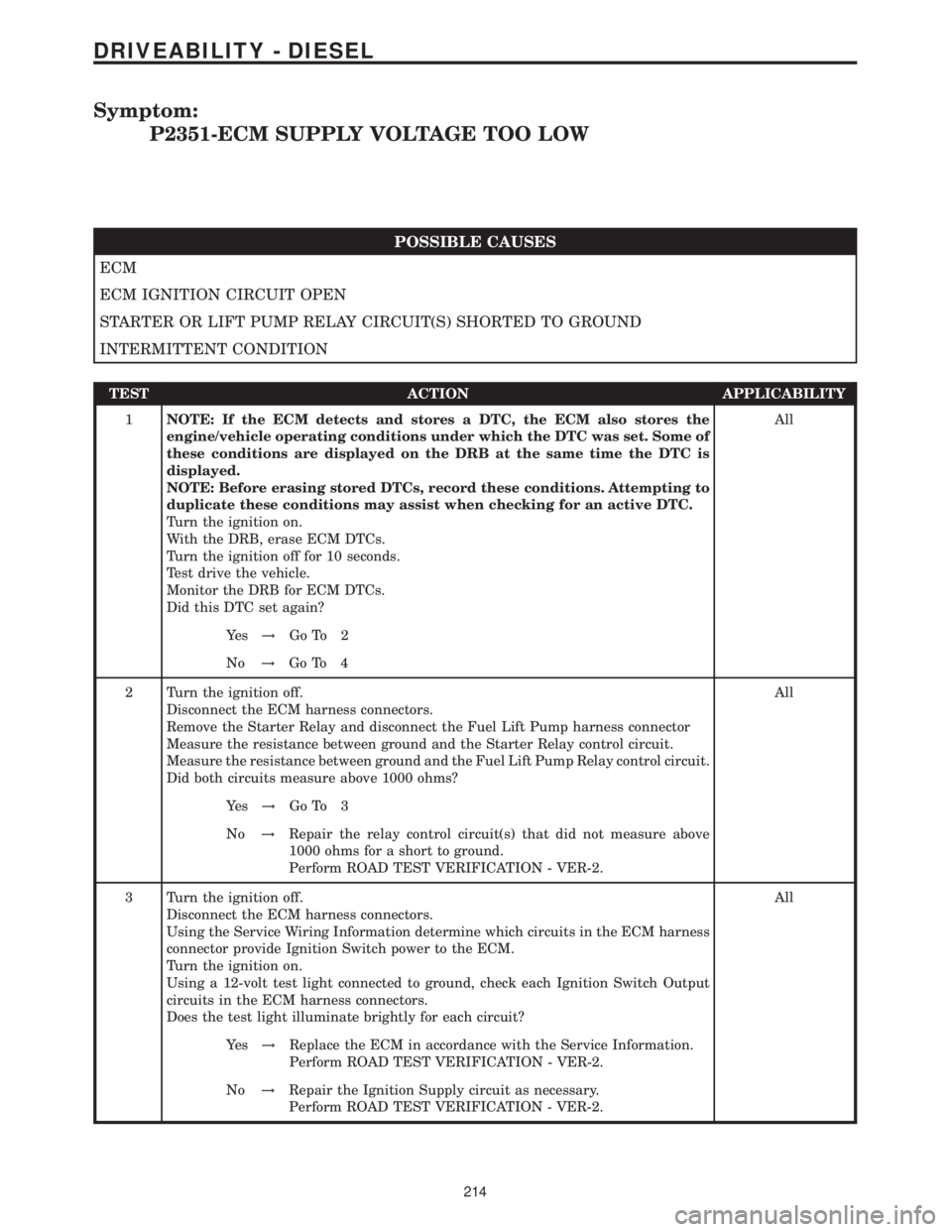
Symptom:
P2351-ECM SUPPLY VOLTAGE TOO LOW
POSSIBLE CAUSES
ECM
ECM IGNITION CIRCUIT OPEN
STARTER OR LIFT PUMP RELAY CIRCUIT(S) SHORTED TO GROUND
INTERMITTENT CONDITION
TEST ACTION APPLICABILITY
1NOTE: If the ECM detects and stores a DTC, the ECM also stores the
engine/vehicle operating conditions under which the DTC was set. Some of
these conditions are displayed on the DRB at the same time the DTC is
displayed.
NOTE: Before erasing stored DTCs, record these conditions. Attempting to
duplicate these conditions may assist when checking for an active DTC.
Turn the ignition on.
With the DRB, erase ECM DTCs.
Turn the ignition off for 10 seconds.
Test drive the vehicle.
Monitor the DRB for ECM DTCs.
Did this DTC set again?All
Ye s!Go To 2
No!Go To 4
2 Turn the ignition off.
Disconnect the ECM harness connectors.
Remove the Starter Relay and disconnect the Fuel Lift Pump harness connector
Measure the resistance between ground and the Starter Relay control circuit.
Measure the resistance between ground and the Fuel Lift Pump Relay control circuit.
Did both circuits measure above 1000 ohms?All
Ye s!Go To 3
No!Repair the relay control circuit(s) that did not measure above
1000 ohms for a short to ground.
Perform ROAD TEST VERIFICATION - VER-2.
3 Turn the ignition off.
Disconnect the ECM harness connectors.
Using the Service Wiring Information determine which circuits in the ECM harness
connector provide Ignition Switch power to the ECM.
Turn the ignition on.
Using a 12-volt test light connected to ground, check each Ignition Switch Output
circuits in the ECM harness connectors.
Does the test light illuminate brightly for each circuit?All
Ye s!Replace the ECM in accordance with the Service Information.
Perform ROAD TEST VERIFICATION - VER-2.
No!Repair the Ignition Supply circuit as necessary.
Perform ROAD TEST VERIFICATION - VER-2.
214
DRIVEABILITY - DIESEL
Page 659 of 2305
TEST ACTION APPLICABILITY
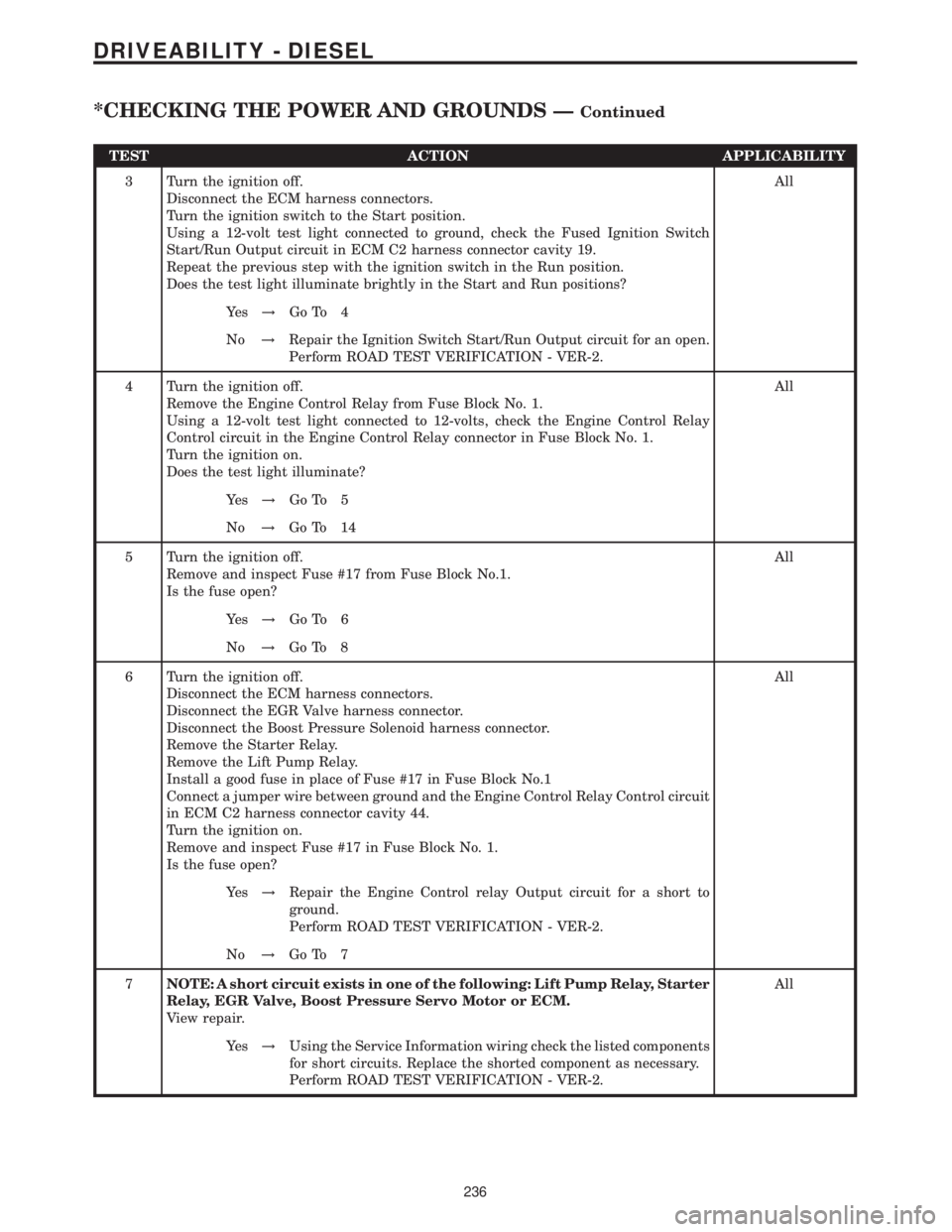
3 Turn the ignition off.
Disconnect the ECM harness connectors.
Turn the ignition switch to the Start position.
Using a 12-volt test light connected to ground, check the Fused Ignition Switch
Start/Run Output circuit in ECM C2 harness connector cavity 19.
Repeat the previous step with the ignition switch in the Run position.
Does the test light illuminate brightly in the Start and Run positions?All
Ye s!Go To 4
No!Repair the Ignition Switch Start/Run Output circuit for an open.
Perform ROAD TEST VERIFICATION - VER-2.
4 Turn the ignition off.
Remove the Engine Control Relay from Fuse Block No. 1.
Using a 12-volt test light connected to 12-volts, check the Engine Control Relay
Control circuit in the Engine Control Relay connector in Fuse Block No. 1.
Turn the ignition on.
Does the test light illuminate?All
Ye s!Go To 5
No!Go To 14
5 Turn the ignition off.
Remove and inspect Fuse #17 from Fuse Block No.1.
Is the fuse open?All
Ye s!Go To 6
No!Go To 8
6 Turn the ignition off.
Disconnect the ECM harness connectors.
Disconnect the EGR Valve harness connector.
Disconnect the Boost Pressure Solenoid harness connector.
Remove the Starter Relay.
Remove the Lift Pump Relay.
Install a good fuse in place of Fuse #17 in Fuse Block No.1
Connect a jumper wire between ground and the Engine Control Relay Control circuit
in ECM C2 harness connector cavity 44.
Turn the ignition on.
Remove and inspect Fuse #17 in Fuse Block No. 1.
Is the fuse open?All
Ye s!Repair the Engine Control relay Output circuit for a short to
ground.
Perform ROAD TEST VERIFICATION - VER-2.
No!Go To 7
7NOTE: A short circuit exists in one of the following: Lift Pump Relay, Starter
Relay, EGR Valve, Boost Pressure Servo Motor or ECM.
View repair.All
Ye s!Using the Service Information wiring check the listed components
for short circuits. Replace the shorted component as necessary.
Perform ROAD TEST VERIFICATION - VER-2.
236
DRIVEABILITY - DIESEL
*CHECKING THE POWER AND GROUNDS ÐContinued
Page 665 of 2305
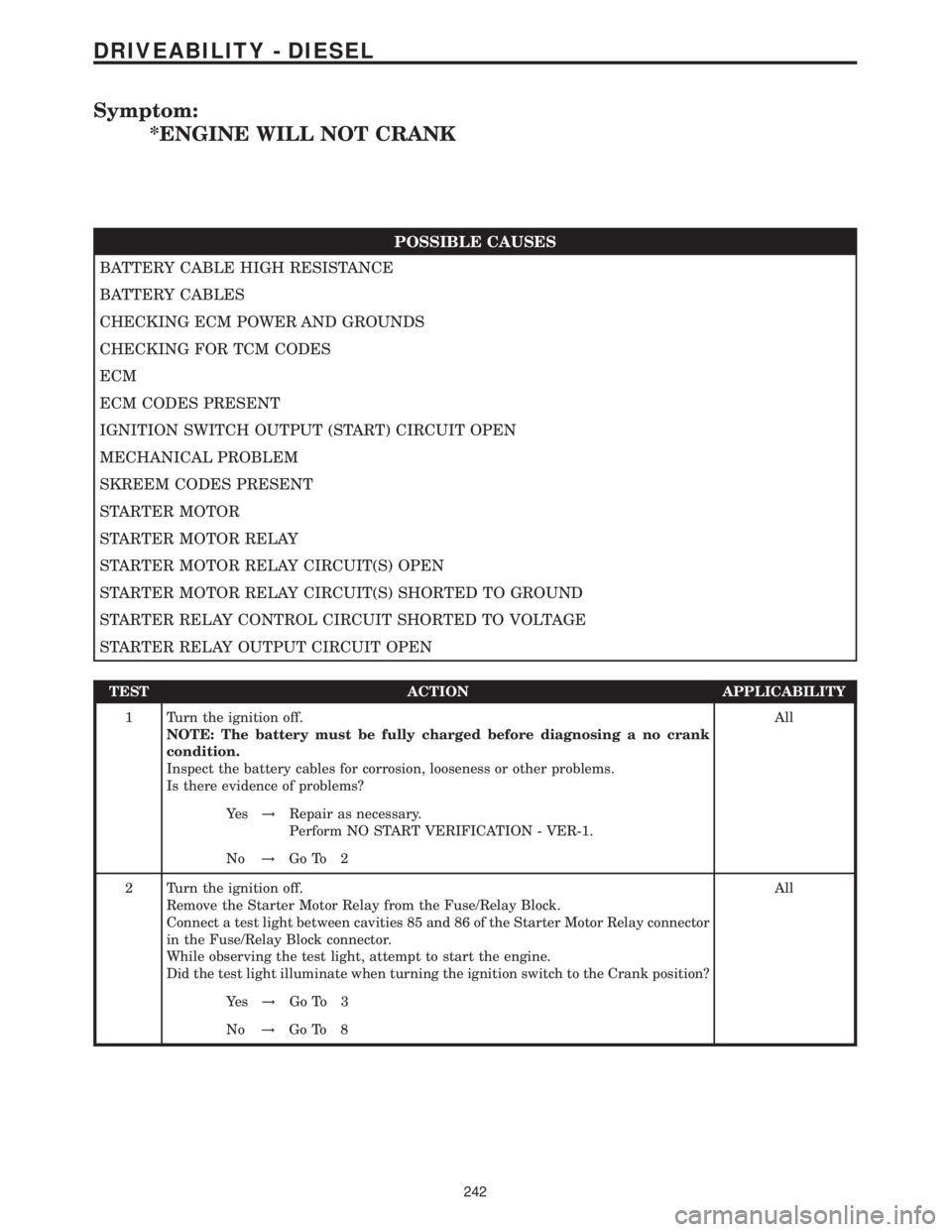
Symptom:
*ENGINE WILL NOT CRANK
POSSIBLE CAUSES
BATTERY CABLE HIGH RESISTANCE
BATTERY CABLES
CHECKING ECM POWER AND GROUNDS
CHECKING FOR TCM CODES
ECM
ECM CODES PRESENT
IGNITION SWITCH OUTPUT (START) CIRCUIT OPEN
MECHANICAL PROBLEM
SKREEM CODES PRESENT
STARTER MOTOR
STARTER MOTOR RELAY
STARTER MOTOR RELAY CIRCUIT(S) OPEN
STARTER MOTOR RELAY CIRCUIT(S) SHORTED TO GROUND
STARTER RELAY CONTROL CIRCUIT SHORTED TO VOLTAGE
STARTER RELAY OUTPUT CIRCUIT OPEN
TEST ACTION APPLICABILITY
1 Turn the ignition off.
NOTE: The battery must be fully charged before diagnosing a no crank
condition.
Inspect the battery cables for corrosion, looseness or other problems.
Is there evidence of problems?All
Ye s!Repair as necessary.
Perform NO START VERIFICATION - VER-1.
No!Go To 2
2 Turn the ignition off.
Remove the Starter Motor Relay from the Fuse/Relay Block.
Connect a test light between cavities 85 and 86 of the Starter Motor Relay connector
in the Fuse/Relay Block connector.
While observing the test light, attempt to start the engine.
Did the test light illuminate when turning the ignition switch to the Crank position?All
Ye s!Go To 3
No!Go To 8
242
DRIVEABILITY - DIESEL
Page 666 of 2305
TEST ACTION APPLICABILITY
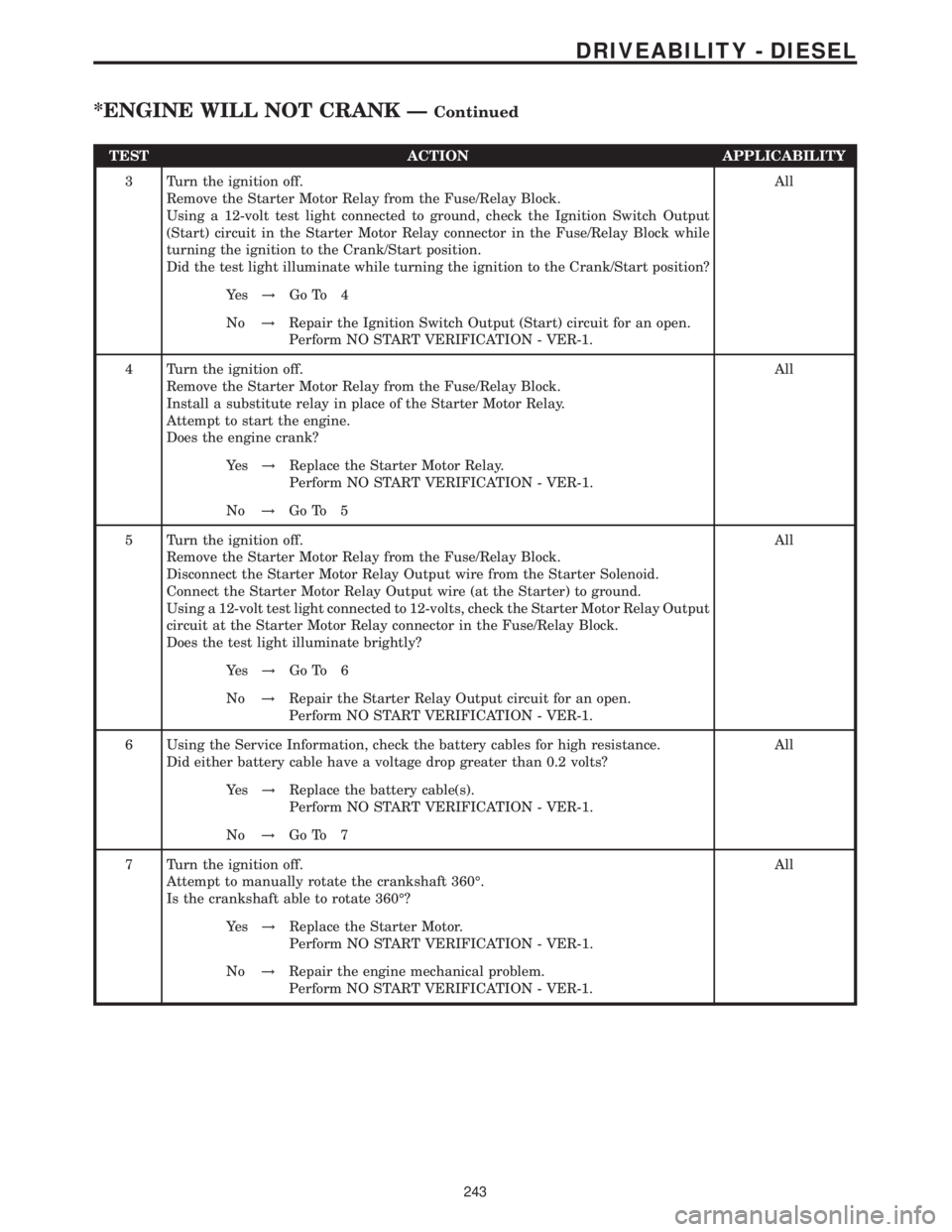
3 Turn the ignition off.
Remove the Starter Motor Relay from the Fuse/Relay Block.
Using a 12-volt test light connected to ground, check the Ignition Switch Output
(Start) circuit in the Starter Motor Relay connector in the Fuse/Relay Block while
turning the ignition to the Crank/Start position.
Did the test light illuminate while turning the ignition to the Crank/Start position?All
Ye s!Go To 4
No!Repair the Ignition Switch Output (Start) circuit for an open.
Perform NO START VERIFICATION - VER-1.
4 Turn the ignition off.
Remove the Starter Motor Relay from the Fuse/Relay Block.
Install a substitute relay in place of the Starter Motor Relay.
Attempt to start the engine.
Does the engine crank?All
Ye s!Replace the Starter Motor Relay.
Perform NO START VERIFICATION - VER-1.
No!Go To 5
5 Turn the ignition off.
Remove the Starter Motor Relay from the Fuse/Relay Block.
Disconnect the Starter Motor Relay Output wire from the Starter Solenoid.
Connect the Starter Motor Relay Output wire (at the Starter) to ground.
Using a 12-volt test light connected to 12-volts, check the Starter Motor Relay Output
circuit at the Starter Motor Relay connector in the Fuse/Relay Block.
Does the test light illuminate brightly?All
Ye s!Go To 6
No!Repair the Starter Relay Output circuit for an open.
Perform NO START VERIFICATION - VER-1.
6 Using the Service Information, check the battery cables for high resistance.
Did either battery cable have a voltage drop greater than 0.2 volts?All
Ye s!Replace the battery cable(s).
Perform NO START VERIFICATION - VER-1.
No!Go To 7
7 Turn the ignition off.
Attempt to manually rotate the crankshaft 360É.
Is the crankshaft able to rotate 360É?All
Ye s!Replace the Starter Motor.
Perform NO START VERIFICATION - VER-1.
No!Repair the engine mechanical problem.
Perform NO START VERIFICATION - VER-1.
243
DRIVEABILITY - DIESEL
*ENGINE WILL NOT CRANK ÐContinued
Page 667 of 2305
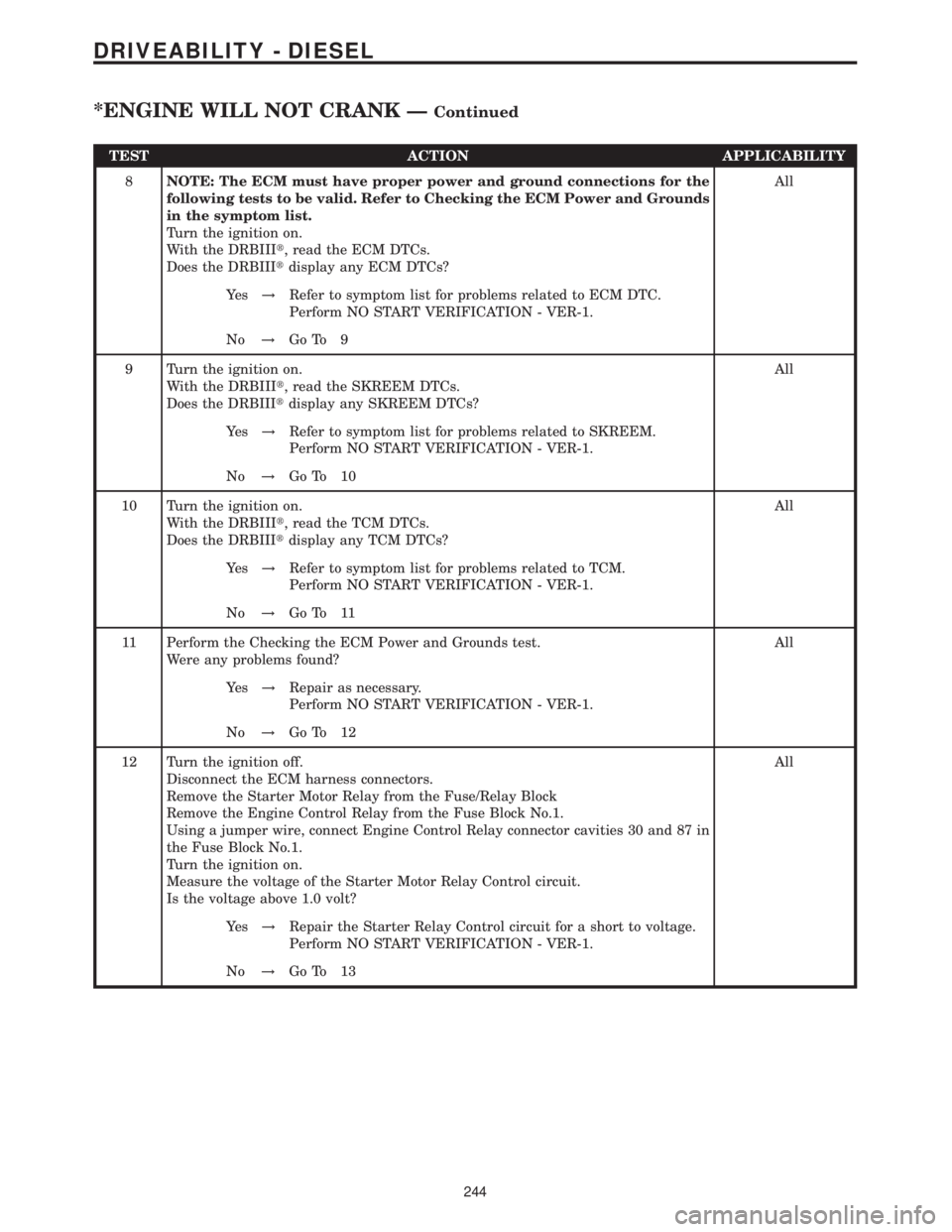
TEST ACTION APPLICABILITY
8NOTE: The ECM must have proper power and ground connections for the
following tests to be valid. Refer to Checking the ECM Power and Grounds
in the symptom list.
Turn the ignition on.
With the DRBIIIt, read the ECM DTCs.
Does the DRBIIItdisplay any ECM DTCs?All
Ye s!Refer to symptom list for problems related to ECM DTC.
Perform NO START VERIFICATION - VER-1.
No!Go To 9
9 Turn the ignition on.
With the DRBIIIt, read the SKREEM DTCs.
Does the DRBIIItdisplay any SKREEM DTCs?All
Ye s!Refer to symptom list for problems related to SKREEM.
Perform NO START VERIFICATION - VER-1.
No!Go To 10
10 Turn the ignition on.
With the DRBIIIt, read the TCM DTCs.
Does the DRBIIItdisplay any TCM DTCs?All
Ye s!Refer to symptom list for problems related to TCM.
Perform NO START VERIFICATION - VER-1.
No!Go To 11
11 Perform the Checking the ECM Power and Grounds test.
Were any problems found?All
Ye s!Repair as necessary.
Perform NO START VERIFICATION - VER-1.
No!Go To 12
12 Turn the ignition off.
Disconnect the ECM harness connectors.
Remove the Starter Motor Relay from the Fuse/Relay Block
Remove the Engine Control Relay from the Fuse Block No.1.
Using a jumper wire, connect Engine Control Relay connector cavities 30 and 87 in
the Fuse Block No.1.
Turn the ignition on.
Measure the voltage of the Starter Motor Relay Control circuit.
Is the voltage above 1.0 volt?All
Ye s!Repair the Starter Relay Control circuit for a short to voltage.
Perform NO START VERIFICATION - VER-1.
No!Go To 13
244
DRIVEABILITY - DIESEL
*ENGINE WILL NOT CRANK ÐContinued
Page 668 of 2305
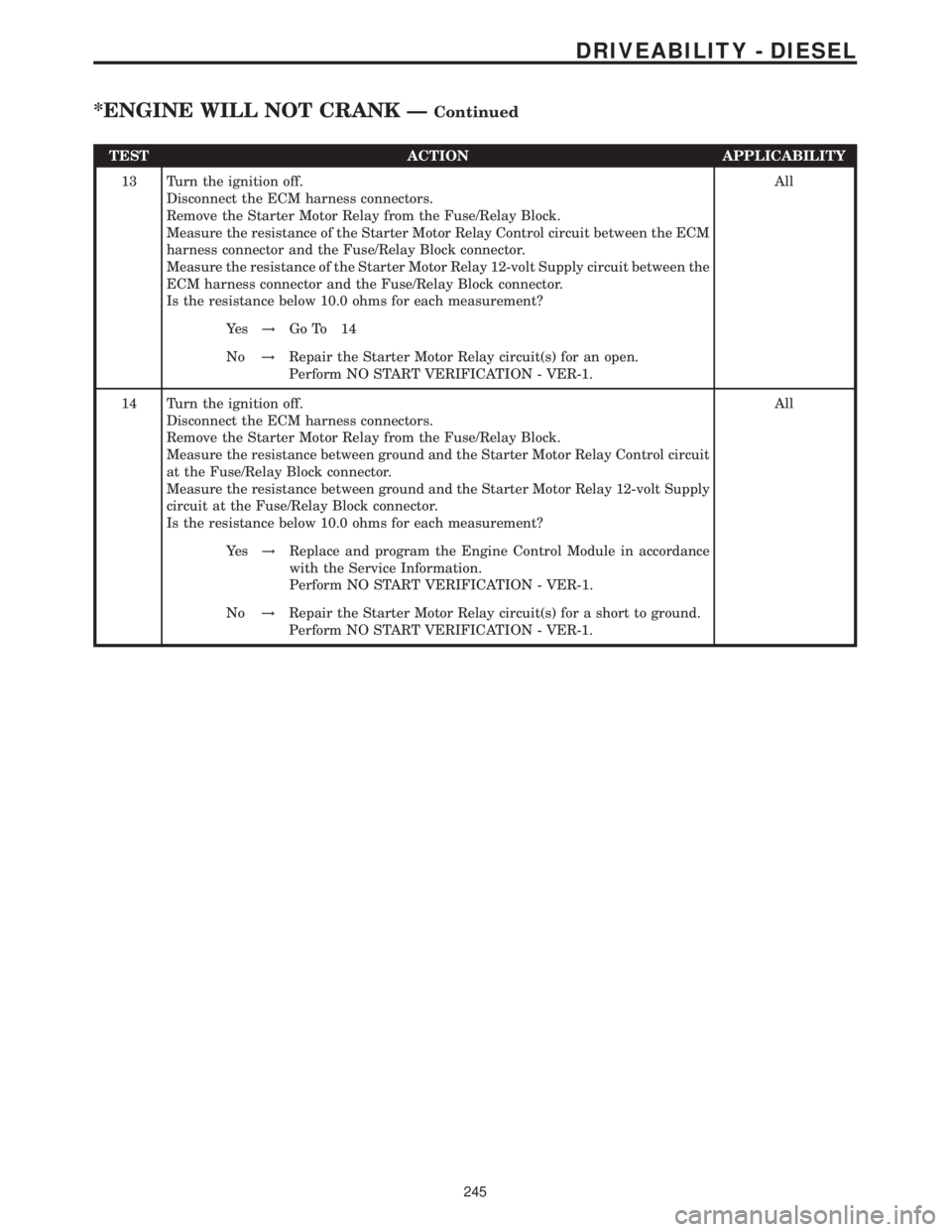
TEST ACTION APPLICABILITY
13 Turn the ignition off.
Disconnect the ECM harness connectors.
Remove the Starter Motor Relay from the Fuse/Relay Block.
Measure the resistance of the Starter Motor Relay Control circuit between the ECM
harness connector and the Fuse/Relay Block connector.
Measure the resistance of the Starter Motor Relay 12-volt Supply circuit between the
ECM harness connector and the Fuse/Relay Block connector.
Is the resistance below 10.0 ohms for each measurement?All
Ye s!Go To 14
No!Repair the Starter Motor Relay circuit(s) for an open.
Perform NO START VERIFICATION - VER-1.
14 Turn the ignition off.
Disconnect the ECM harness connectors.
Remove the Starter Motor Relay from the Fuse/Relay Block.
Measure the resistance between ground and the Starter Motor Relay Control circuit
at the Fuse/Relay Block connector.
Measure the resistance between ground and the Starter Motor Relay 12-volt Supply
circuit at the Fuse/Relay Block connector.
Is the resistance below 10.0 ohms for each measurement?All
Ye s!Replace and program the Engine Control Module in accordance
with the Service Information.
Perform NO START VERIFICATION - VER-1.
No!Repair the Starter Motor Relay circuit(s) for a short to ground.
Perform NO START VERIFICATION - VER-1.
245
DRIVEABILITY - DIESEL
*ENGINE WILL NOT CRANK ÐContinued
Page 683 of 2305
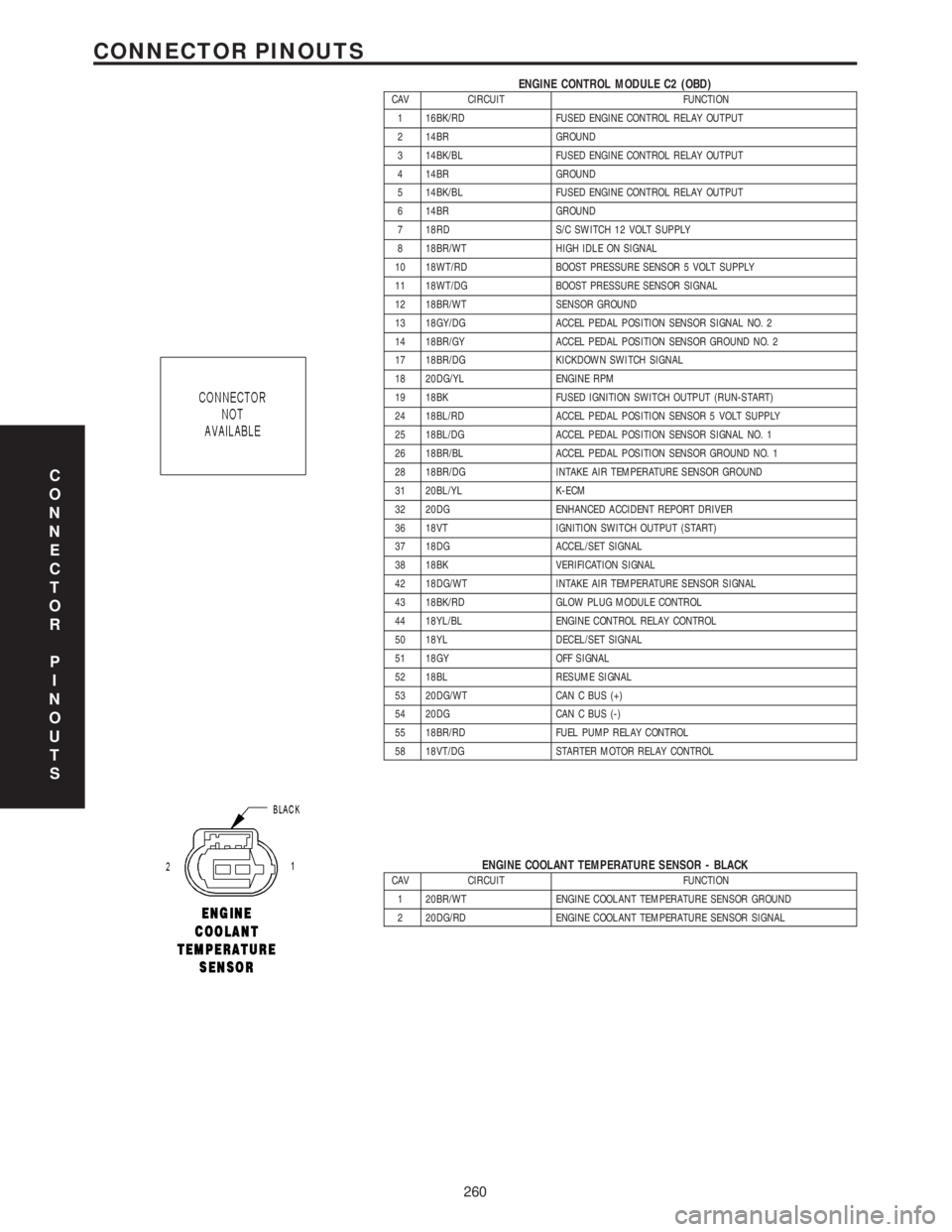
ENGINE CONTROL MODULE C2 (OBD)CAV CIRCUIT FUNCTION
1 16BK/RD FUSED ENGINE CONTROL RELAY OUTPUT
2 14BR GROUND
3 14BK/BL FUSED ENGINE CONTROL RELAY OUTPUT
4 14BR GROUND
5 14BK/BL FUSED ENGINE CONTROL RELAY OUTPUT
6 14BR GROUND
7 18RD S/C SWITCH 12 VOLT SUPPLY
8 18BR/WT HIGH IDLE ON SIGNAL
10 18WT/RD BOOST PRESSURE SENSOR 5 VOLT SUPPLY
11 18WT/DG BOOST PRESSURE SENSOR SIGNAL
12 18BR/WT SENSOR GROUND
13 18GY/DG ACCEL PEDAL POSITION SENSOR SIGNAL NO. 2
14 18BR/GY ACCEL PEDAL POSITION SENSOR GROUND NO. 2
17 18BR/DG KICKDOWN SWITCH SIGNAL
18 20DG/YL ENGINE RPM
19 18BK FUSED IGNITION SWITCH OUTPUT (RUN-START)
24 18BL/RD ACCEL PEDAL POSITION SENSOR 5 VOLT SUPPLY
25 18BL/DG ACCEL PEDAL POSITION SENSOR SIGNAL NO. 1
26 18BR/BL ACCEL PEDAL POSITION SENSOR GROUND NO. 1
28 18BR/DG INTAKE AIR TEMPERATURE SENSOR GROUND
31 20BL/YL K-ECM
32 20DG ENHANCED ACCIDENT REPORT DRIVER
36 18VT IGNITION SWITCH OUTPUT (START)
37 18DG ACCEL/SET SIGNAL
38 18BK VERIFICATION SIGNAL
42 18DG/WT INTAKE AIR TEMPERATURE SENSOR SIGNAL
43 18BK/RD GLOW PLUG MODULE CONTROL
44 18YL/BL ENGINE CONTROL RELAY CONTROL
50 18YL DECEL/SET SIGNAL
51 18GY OFF SIGNAL
52 18BL RESUME SIGNAL
53 20DG/WT CAN C BUS (+)
54 20DG CAN C BUS (-)
55 18BR/RD FUEL PUMP RELAY CONTROL
58 18VT/DG STARTER MOTOR RELAY CONTROL
ENGINE COOLANT TEMPERATURE SENSOR - BLACKCAV CIRCUIT FUNCTION
1 20BR/WT ENGINE COOLANT TEMPERATURE SENSOR GROUND
2 20DG/RD ENGINE COOLANT TEMPERATURE SENSOR SIGNAL
C
O
N
N
E
C
T
O
R
P
I
N
O
U
T
S
260
CONNECTOR PINOUTS
Page 692 of 2305
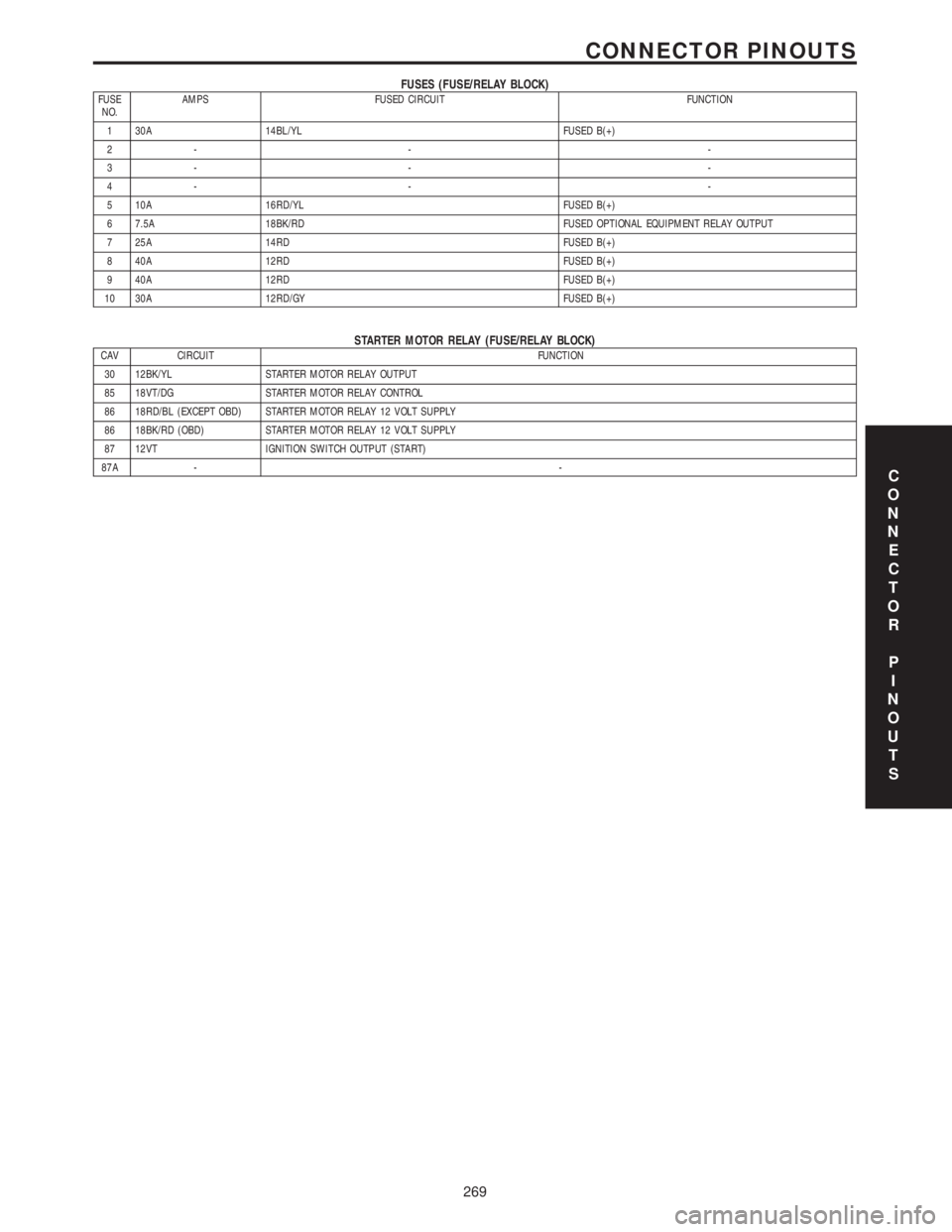
FUSES (FUSE/RELAY BLOCK)FUSE
NO.AMPS FUSED CIRCUIT FUNCTION
1 30A 14BL/YL FUSED B(+)
2- - -
3- - -
4- - -
5 10A 16RD/YL FUSED B(+)
6 7.5A 18BK/RD FUSED OPTIONAL EQUIPMENT RELAY OUTPUT
7 25A 14RD FUSED B(+)
8 40A 12RD FUSED B(+)
9 40A 12RD FUSED B(+)
10 30A 12RD/GY FUSED B(+)
STARTER MOTOR RELAY (FUSE/RELAY BLOCK)CAV CIRCUIT FUNCTION
30 12BK/YL STARTER MOTOR RELAY OUTPUT
85 18VT/DG STARTER MOTOR RELAY CONTROL
86 18RD/BL (EXCEPT OBD) STARTER MOTOR RELAY 12 VOLT SUPPLY
86 18BK/RD (OBD) STARTER MOTOR RELAY 12 VOLT SUPPLY
87 12VT IGNITION SWITCH OUTPUT (START)
87A --
C
O
N
N
E
C
T
O
R
P
I
N
O
U
T
S
269
CONNECTOR PINOUTS
Page 722 of 2305
(6) Start the engine in the vehicle which has the
booster battery, let the engine idle a few minutes,
then start the engine in the vehicle with the dis-
charged battery.
CAUTION: Do not crank starter motor on disabled
vehicle for more than 15 seconds, starter will over-
heat and could fail.
(7) Allow battery in disabled vehicle to charge to
at least 12.4 volts (75% charge) before attempting to
start engine. If engine does not start within 15 sec-
onds, stop cranking engine and allow starter to cool
(15 min.), before cranking again.
DISCONNECT CABLE CLAMPS AS FOLLOWS:
²Disconnect BLACK cable clamp from engine
ground on disabled vehicle.
²When using a Booster vehicle, disconnect
BLACK cable clamp from battery negative terminal.
Disconnect RED cable clamp from battery positive
terminal.
²Disconnect RED cable clamp from battery posi-
tive terminal on disabled vehicle.
TOWING
STANDARD PROCEDURE - TOWING
WARNING: Do not tow the vehicle if the key cannot
be turned in the ignition lock. If the key cannot be
turned, the ignition lock remains locked and the
vehicle cannot be steered. With the engine not run-
ning there is no power assistance for the braking
and steering systems. In this case, it is important to
keep in mind that a considerably higher degree of
effort is necessary to brake and steer the vehicle.
The vehicle must not be towed with the front axle
raised and the key in position 2 in the ignition lock
as the drive wheels could then lock due to the
acceleration skid control (ASR)
If the Engine is Damaged
For towing distances up to 30 miles (about 50
km)
²Shift selector lever in ªNº position.
²Do not exceed a towing speed of 30 m.p.h. (50
km/h).
For towing distances greater than 30 mile
(about 50 km)
²Remove the propeller shafts leading to the drive
axles. The vehicle can be towed without restriction.
If the Transmission is Damaged
²Remove the propeller shafts leading to the drive
axles. The vehicle can be towed without restriction.
If the Front Axle is Damaged
²Raise the front axle.
²Observe the same towing restrictions as for
engine damage.
If the Rear Axle is Damaged
²Raise the rear axle.
NOTE: Comply with local legal regulations regard-
ing towing vehicles.
SAFETY PRECAUTIONS
NOTE: The following safety precautions must be
observed when towing a vehicle.
²Secure loose and protruding parts.
²Always use a safety chain system that is inde-
pendent of the lifting and towing equipment.
²Do not allow towing equipment to contact the
disabled vehicle's fuel tank.
²Do not allow anyone under the disabled vehicle
while it is lifted by the towing device.
²Do not allow passengers to ride in a vehicle
being towed.
²Always observe state and local laws regarding
towing regulations.
²Do not tow a vehicle in a manner that could
jeopardize the safety of the operator, pedestrians or
other motorists.
²Do not attach tow chains, T-hooks, J-hooks, or a
tow sling to a bumper, steering linkage, drive shafts
or a non-reinforced frame hole.
²Remove exhaust pipe tips that interfere with the
tow sling and crossbar
²Padding should be placed between the tow sling/
crossbar and any painted surfaces
²When placing tow hooks on the rear axle, posi-
tion them so they do not damage the brake tubing or
hoses
²Do not tow the vehicle by connecting to the front
or rear shock absorbers
²Do not tow a heavily loaded vehicle. Damage to
the vehicle may result. Use a flatbed device to trans-
port a loaded vehicle.
GROUND CLEARANCE
CAUTION: If vehicle is towed with wheels removed,
install lug nuts to retain brake drums.
A towed vehicle should be raised until lifted wheels
are a minimum 100 mm (4 in) from the ground. Be
sure there is adequate ground clearance at the oppo-
site end of the vehicle, especially when towing over
rough terrain, steep rises in the road or if the vehicle
is equipped with air dams, spoilers, and/or ground
VALUBRICATION & MAINTENANCE 0 - 7
Page 859 of 2305
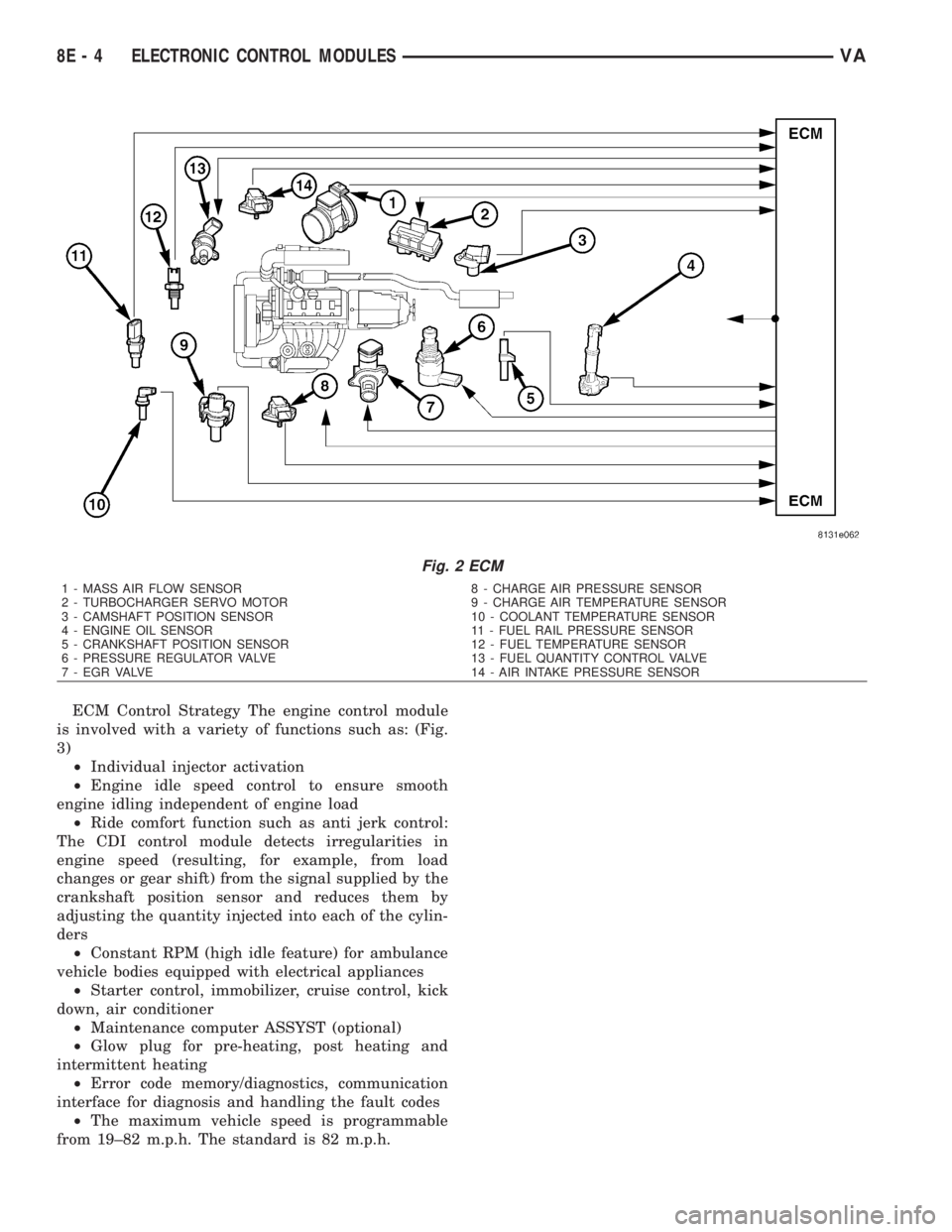
ECM Control Strategy The engine control module
is involved with a variety of functions such as: (Fig.
3)
²Individual injector activation
²Engine idle speed control to ensure smooth
engine idling independent of engine load
²Ride comfort function such as anti jerk control:
The CDI control module detects irregularities in
engine speed (resulting, for example, from load
changes or gear shift) from the signal supplied by the
crankshaft position sensor and reduces them by
adjusting the quantity injected into each of the cylin-
ders
²Constant RPM (high idle feature) for ambulance
vehicle bodies equipped with electrical appliances
²Starter control, immobilizer, cruise control, kick
down, air conditioner
²Maintenance computer ASSYST (optional)
²Glow plug for pre-heating, post heating and
intermittent heating
²Error code memory/diagnostics, communication
interface for diagnosis and handling the fault codes
²The maximum vehicle speed is programmable
from 19±82 m.p.h. The standard is 82 m.p.h.
Fig. 2 ECM
1 - MASS AIR FLOW SENSOR 8 - CHARGE AIR PRESSURE SENSOR
2 - TURBOCHARGER SERVO MOTOR 9 - CHARGE AIR TEMPERATURE SENSOR
3 - CAMSHAFT POSITION SENSOR 10 - COOLANT TEMPERATURE SENSOR
4 - ENGINE OIL SENSOR 11 - FUEL RAIL PRESSURE SENSOR
5 - CRANKSHAFT POSITION SENSOR 12 - FUEL TEMPERATURE SENSOR
6 - PRESSURE REGULATOR VALVE 13 - FUEL QUANTITY CONTROL VALVE
7 - EGR VALVE 14 - AIR INTAKE PRESSURE SENSOR
8E - 4 ELECTRONIC CONTROL MODULESVA